Circles, arcs and sectors
Introduced| English | Meaning |
|---|---|
| circumference/sɜːˈkʌmfrəns/ | circumference |
| area/ˈeərɪə/ | The measure of a two-dimensional region, expressed in square units. |
| sector/ˈsektə/ | A region of a circle bounded by two radii and the arc between them. |
| arc length/ɑːk leŋθ/ | The distance along a curved part of a circle or another curve. |
The number that never ends
- $\pi \approx 3.14159\dots$ is the ratio of every circle's circumference 圆周 to its diameter.
- It's irrational — the digits never repeat and never end. The ancient Egyptians approximated it as $\dfrac{256}{81} \approx 3.16$.
Circumference and area 面积
- For a circle with radius $r$ (diameter $d = 2r$):
Radius $7\text{ cm}$: circumference $= 2\pi(7) = 14\pi\text{ cm}$, area $= \pi(7^2) = 49\pi\text{ cm}^2$.
Don't confuse $r$ and $d$. If you're given the diameter, halve it first. A circle with diameter $10$ has radius $5$, so area $= \pi(5)^2 = 25\pi$, NOT $\pi(10)^2 = 100\pi$.

A sector 扇形 is the fraction $\tfrac{\theta}{360}$ of the whole circle, so its arc and area are that fraction of $2\pi r$ and $\pi r^2$
Arcs & sectors
s = rθ · A = ½r²θ
A bigger angle or radius means a longer arc and larger sector area.
A circle has radius 7 cm. Its area is kπ cm². What is k?
Difficulty 2/5 · 140 coins + a small bonus on first completion today
Area = πr² = π(7²) = 49π, so k = 49.
A circle has radius 7 cm. Its circumference is kπ cm. What is k?
Difficulty 2/5 · 140 coins + a small bonus on first completion today
Circumference = 2πr = 2π(7) = 14π, so k = 14.
A circle with diameter 10 cm has area 100π cm².
Difficulty 1/5 · 100 coins + a small bonus on first completion today
Radius = 5 cm, so area = π(5²) = 25π, not 100π. You must halve the diameter first.
Arcs and sectors
- A sector is a slice of the circle between two radii, with angle $\theta$.
- It is the fraction $\dfrac{\theta}{360}$ of the whole circle:

A sector with angle $\theta$ is $\dfrac{\theta}{360}$ of the whole circle — the same fraction applies to arc length 弧长 and area.
Worked example
- $\theta = 90^{\circ}$, $r = 8$: fraction $= \dfrac{90}{360} = \dfrac{1}{4}$.
- Arc $= \dfrac{1}{4} \times 2\pi(8) = 4\pi\text{ cm}$.
- Area $= \dfrac{1}{4} \times \pi(8^2) = 16\pi\text{ cm}^2$.

A circle: circumference = pi d and area = pi r squared
A sector has angle 90° and radius 8 cm. Its area is kπ cm². What is k?
Difficulty 2/5 · 140 coins + a small bonus on first completion today
Fraction 90/360 = ¼; area = ¼ × π × 8² = 16π, so k = 16.
A sector has angle 60° and radius 12 cm. The arc length is kπ cm. What is k?
Difficulty 2/5 · 140 coins + a small bonus on first completion today
Fraction = 60/360 = 1/6. Arc = (1/6) × 2π(12) = 4π, so k = 4.
A sector is the fraction θ/______ of the whole circle.
Difficulty 1/5 · 100 coins + a small bonus on first completion today
The fraction is θ/360, where θ is the sector angle in degrees.
Arc length is not sector perimeter
- A sector of radius 6 cm and angle $120^{\circ}$ has fraction $1/3$. Arc length $L=(1/3)2\pi(6)=4\pi$ cm; area $S=(1/3)\pi(6)^2=12\pi\text{ cm}^2$.
- Its perimeter also includes two radii: $P=L+2r=4\pi+12\approx24.6$ cm. Core sector angles are factors of $360^{\circ}$; Extended can use other angles.
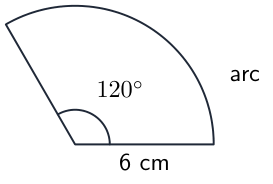
A sector has radius 6 cm and arc length 4π cm. Find its perimeter to 1 dp in cm.
Difficulty 2/5 · 140 coins + a small bonus on first completion today
Perimeter = arc + two radii = 4π + 12 ≈ 24.6 cm.
You've got it
- circumference $= 2\pi r$; area $= \pi r^2$
- a sector of angle $\theta$ is the fraction $\dfrac{\theta}{360}$ of the circle
- $90^{\circ}$ sector of radius $8$: arc $4\pi$, area $16\pi$