Units of measure
Introduced| English | Meaning |
|---|---|
| metric/ˈmetrɪk/ | The measurement system based on metres, grams and litres with powers of ten. |
| length/leŋθ/ | The distance between two points. |
| mass/mæs/ | A measure of an object’s inertia, measured in kilograms. |
| capacity/kəˈpæsɪti/ | The volume a container can hold, measured in litres or millilitres. |
The Mars orbiter that cost 125 million dollars
- In 1999, NASA lost the Mars Climate Orbiter because one team used metres and another used feet.
- Unit mistakes aren't just embarrassing — they can be catastrophic. Getting units right is a core mathematical skill.
Unit choice lab
Choose the unit that matches the measurement scale.
Metric 公制 length 长度, mass 质量 and capacity 容量
- Length: $10\text{ mm}=1\text{ cm}$, $100\text{ cm}=1\text{ m}$, $1000\text{ m}=1\text{ km}$. Moving to a larger unit divides the number.
- Mass: $1000\text{ g}=1\text{ kg}$. Divide by 1000 from g to kg; multiply from kg to g.
- Capacity: $1000\text{ ml}=1\text{ litre}$; $\;1\text{ litre} = 1000\text{ cm}^3$.
- $1\text{ m} = 100\text{ cm} = 1000\text{ mm}$.
$2.5\text{ kg} = 2500\text{ g}$. $350\text{ ml} = 0.35\text{ litres}$. Always multiply when going to a smaller unit, divide for a larger one.

Changing length units: multiply going down, divide going up
How many cm are there in 1 m?
Difficulty 2/5 · 140 coins + a small bonus on first completion today
1 m = 100 cm.
How many cm³ are there in 1 litre?
Difficulty 2/5 · 140 coins + a small bonus on first completion today
1 litre = 1000 cm³.
Area and volume conversions need care
- Area conversions are squared: $1\text{ m}^2 = 100^2 = 10\,000\text{ cm}^2$.
- Volume conversions are cubed: $1\text{ m}^3 = 100^3 = 1\,000\,000\text{ cm}^3$.
Don't just multiply by 100. $3\text{ m}^2 = 30\,000\text{ cm}^2$, NOT $300\text{ cm}^2$. You must square the conversion factor: $3 \times 100^2 = 3 \times 10\,000$.
Convert 3 m² to cm². (1 m² = 10 000 cm²)
Difficulty 2/5 · 140 coins + a small bonus on first completion today
3 × 10 000 = 30 000 cm².
Convert 0.5 m³ to cm³.
Difficulty 2/5 · 140 coins + a small bonus on first completion today
0.5 × 1 000 000 = 500 000 cm³.
1 m² = 100 cm².
Difficulty 1/5 · 100 coins + a small bonus on first completion today
1 m² = 100² = 10 000 cm², not 100 cm². The conversion factor must be squared for area.
To convert m³ to cm³, multiply by ______.
Difficulty 1/5 · 100 coins + a small bonus on first completion today
1 m³ = 100³ cm³ = 1 000 000 cm³.
Worked examples
- $3\text{ m}^2 = 3 \times 10\,000 = 30\,000\text{ cm}^2$.
- $0.5\text{ m}^3 = 0.5 \times 1\,000\,000 = 500\,000\text{ cm}^3$.
- $2\,500\text{ cm}^3 = 2.5\text{ litres}$ (divide by $1000$).
Fun fact
- The metre was originally defined as $\dfrac{1}{10\,000\,000}$ of the distance from the equator to the North Pole. It's now defined using the speed of light: $1\text{ m} =$ the distance light travels in $\dfrac{1}{299\,792\,458}$ seconds.
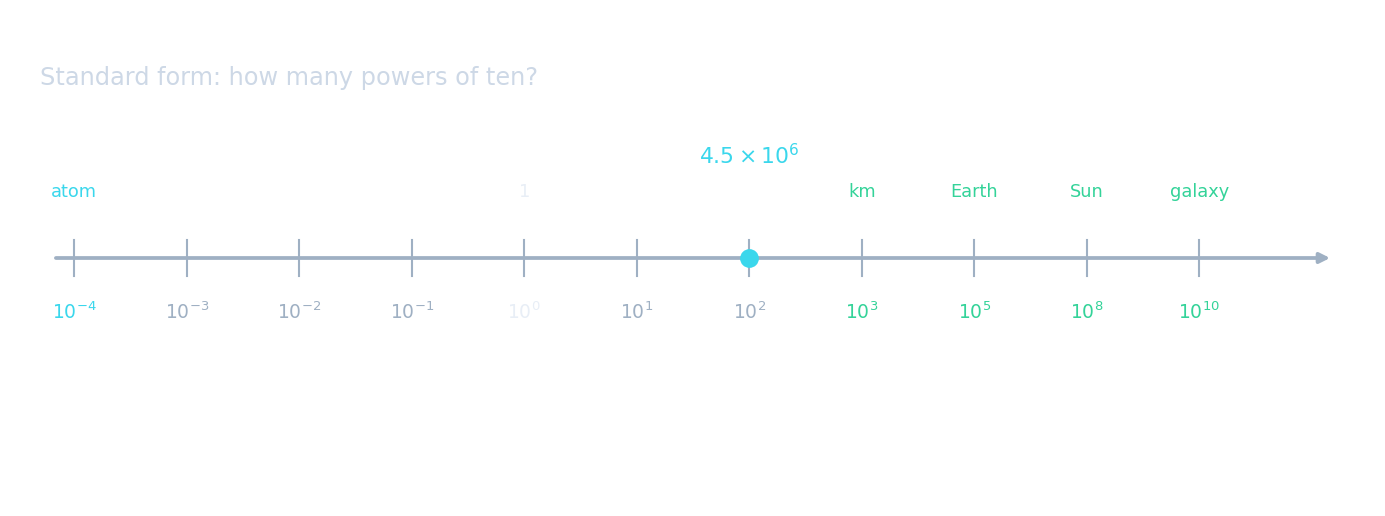
Converting units is about moving between scales on this number line — from millimetres to kilometres and beyond.
You've got it
- $1\text{ m} = 100\text{ cm}$, so $1\text{ m}^2 = 10\,000\text{ cm}^2$ and $1\text{ m}^3 = 1\,000\,000\text{ cm}^3$
- square the conversion for area, cube it for volume
- $1\text{ litre} = 1000\text{ cm}^3$; $\;1\text{ m}^3 = 1000\text{ litres}$