跳到主要内容

生殖

IGCSE 生物 · 第 16 主题

训练
讲义 词汇表
16.1 16.2

无性生殖

大纲
Core Supplement
1 Describe asexual reproduction as a process resulting in the production of genetically identical offspring from one parent
2 Identify examples of asexual reproduction in diagrams, images and information provided 3 Discuss the advantages and disadvantages of asexual reproduction: (a) to a population of a species in the wild (b) to crop production
Core Supplement
1 Describe sexual reproduction as a process involving the fusion of the nuclei of two gametes to form a zygote and the production of offspring that are genetically different from each other 3 State that nuclei of gametes are haploid and that the nucleus of a zygote is diploid
2 Describe fertilisation as the fusion of the nuclei of gametes
4 Discuss the advantages and disadvantages of sexual reproduction: (a) to a population of a species in the wild (b) to crop production

来源:剑桥国际大纲

生殖(reproduction)制造同种的新生物。有两种类型。

无性生殖有一个亲本产生相同的克隆;有性生殖有两个亲本,它们的配子结合以给出多样的后代
无性生殖需要一个亲本并给出相同的克隆;有性生殖需要两个并给出多样的后代

Asexual reproduction

无性生殖(asexual reproduction)只需要一个****亲本(parent)。后代(offspring)有与亲本完全相同的基因(genes)——它们遗传上相同(克隆)。

  • 优点:它快而且只需要一个亲本——当条件好而稳定时有用。
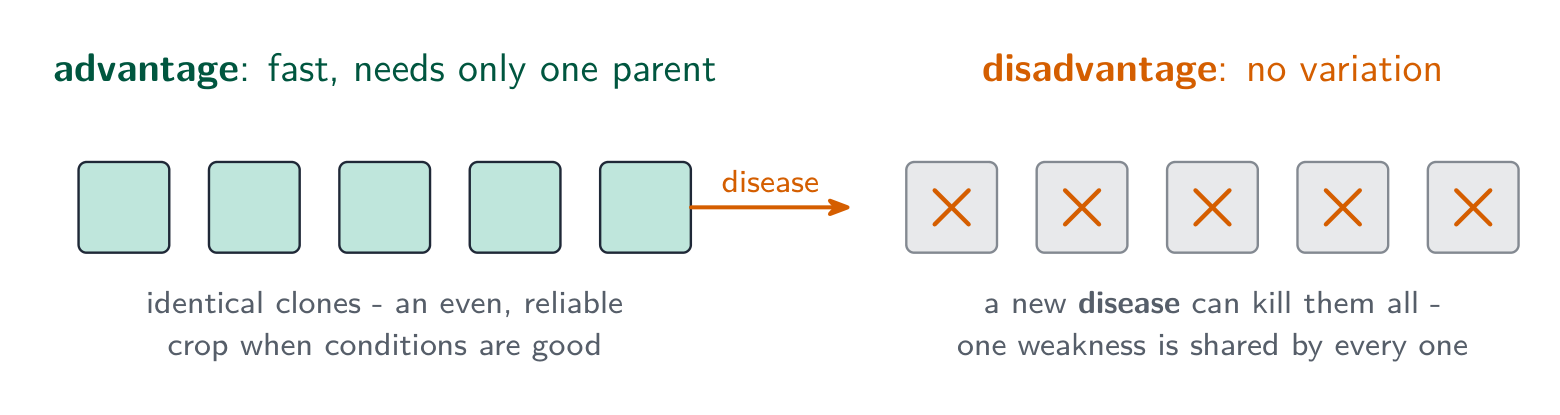
  • 缺点:所有后代都相同,所以若环境(environment)改变(例如一种新疾病)它们可能全部死亡。(在作物中,相同的植物给一个均匀的收成,但一种疾病能消灭整个作物。)
无性生殖快而且给出一个均匀、可靠的相同克隆作物,但因为它们共享每个弱点,一种新疾病能杀死它们全部
无性生殖快但不给变异,所以一种疾病能杀死每个相同的后代

Sexual reproduction

有性生殖(sexual reproduction)需要两个亲本。它涉及两个配子(gametes,性细胞)的细胞核(nuclei)的融合(fusion,结合)以制造一个合子(zygote)。这种结合叫受精(fertilisation)。后代从两个亲本得到基因的一个混合,所以它们显示变异(variation,它们遗传上不同)。

  • 优点:变异意味着若环境改变,一些后代可能存活。
  • 缺点:它更慢而且需要两个亲本。

(补充) 配子的细胞核是单倍体(haploid,一套染色体(chromosomes));合子的细胞核是二倍体(diploid,两套)。

探索

Asexual reproduction

One parent makes genetically identical offspring (clones) by mitosis — no gametes needed.

词汇表 训练
英文 中文 拼音
reproduction 生殖 shēng zhí
asexual reproduction 无性生殖 wú xìng shēng zhí
parent 亲本 qīn běn
offspring 后代 hòu dài
genes 基因 jī yīn
environment 环境 huán jìng
sexual reproduction 有性生殖 yǒu xìng shēng zhí
fusion 融合 róng hé
nuclei 细胞核 xì bāo hé
gametes 配子 pèi zi
zygote 合子 hé zǐ
variation 变异 biàn yì
haploid 单倍体 dān bèi tǐ
chromosomes 染色体 rǎn sè tǐ
diploid 二倍体 èr bèi tǐ
16.3

植物的有性生殖

大纲
Core Supplement
1 Identify in diagrams and images and draw the following parts of an insect-pollinated flower: sepals, petals, stamens, filaments, anthers, carpels, style, stigma, ovary and ovules
2 State the functions of the structures listed in 16.3.1
3 Identify in diagrams and images and describe the anthers and stigmas of a wind-pollinated flower
4 Distinguish between the pollen grains of insect-pollinated and wind-pollinated flowers
5 Describe pollination as the transfer of pollen grains from an anther to a stigma
9 Describe self-pollination as the transfer of pollen grains from the anther of a flower to the stigma of the same flower or a different flower on the same plant
10 Describe cross-pollination as the transfer of pollen grains from the anther of a flower to the stigma of a flower on a different plant of the same species
11 Discuss the potential effects of self-pollination and cross-pollination on a population, in terms of variation, capacity to respond to changes in the environment and reliance on pollinators
6 State that fertilisation occurs when a pollen nucleus fuses with a nucleus in an ovule 12 Describe the growth of the pollen tube and its entry into the ovule followed by fertilisation (details of production of endosperm and development are not required)
7 Describe the structural adaptations of insect-pollinated and wind-pollinated flowers
8 Investigate and describe the environmental conditions that affect germination of seeds, limited to the requirement for: water, oxygen and a suitable temperature

来源:剑桥国际大纲

Parts of an insect-pollinated flower

部分 功能
萼片(sepals) 在花蕾打开之前保护它
花瓣(petals) 大而色彩鲜艳,以吸引昆虫(insects)
雄蕊(stamens) 雄性部分;每个是一根托起一个花药(anther)的花丝(filament)
花药 制造花粉粒(pollen grains)
雌蕊(carpel) 雌性部分;由一个柱头(stigma)、一个花柱(style)和一个子房(ovary)构成
柱头 接住花粉粒
子房 容纳胚珠(ovules),它们变成种子
穿过一朵虫媒花的切面:外面萼片和花瓣、中间雄性雄蕊(花丝和花药)和雌性雌蕊(柱头、花柱和带胚珠的子房)
一朵虫媒花:雄性雄蕊和雌性雌蕊
一朵真实百合花的特写:六个雄蕊,每个是一根长花丝托起一个覆盖花粉的深红色花药,围绕一根顶着一个黏性柱头的中央花柱
一朵真实的百合:长雄蕊制造花粉而中央柱头接收它

Pollination

传粉(pollination)是花粉粒从一个花药到一个柱头的转移。

  • 虫媒花有鲜艳的花瓣、香味和花蜜,以及黏性或带刺的花粉,以吸引昆虫并粘到它们身上。
  • 风媒花有小的暗淡花瓣、悬在外面的花药和柱头,以及轻的、光滑的、在风中吹的花粉。
两朵花比较:一朵虫媒花,带被一只蜜蜂拜访的大而鲜艳的花瓣;一朵风媒花,带小的暗淡花瓣和悬在风中的花药和一个羽状柱头
虫媒花艳丽;风媒花小,部件悬在外面
三种不同植物的花粉粒的一张扫描电子显微照片,加了假彩色;每种有它自己的脊和刺的表面图案
电子显微镜下看到的花粉粒(加了颜色);每种植物有它自己的图案

(补充) 自花传粉(self-pollination)是花粉落在同一朵花(或同一植物上另一朵花)的柱头上。异花传粉(cross-pollination)是花粉被运到同种不同植物上的一朵花。异花传粉给出更多的变异,帮助种群应对变化,但它依赖传粉者(pollinators)或风。自花传粉更可靠但给较少的变异。

Fertilisation and germination

受精在一个花粉核与一个胚珠中的核融合时发生。(补充) 首先一根花粉管(pollen tube)往下长过花柱进入子房,把花粉核运到胚珠。

一颗种子(seed)只在它有水、氧气(oxygen)和一个合适的温度(temperature)时才会萌发(germinate,开始生长)。

探索

Sexual reproduction

Two parents each contribute a gamete; fertilisation combines them, creating variation.

词汇表 训练
英文 中文 拼音
sepals 萼片 è piàn
petals 花瓣 huā bàn
insects 昆虫 kūn chóng
stamens 雄蕊 xióng ruǐ
filament 花丝 huā sī
anther 花药 huā yào
pollen grains 花粉粒 huā fěn lì
carpel 雌蕊 cí ruǐ
stigma 柱头 zhù tóu
style 花柱 huā zhù
ovary 子房 zi fáng
ovules 胚珠 pēi zhū
pollination 传粉 chuán fěn
self-pollination 自花传粉 zì huā chuán fěn
cross-pollination 异花传粉 yì huā chuán fěn
pollinators 传粉者 chuán fěn zhě
pollen tube 花粉管 huā fěn guǎn
seed 种子 zhǒng zi
germinate 萌发 méng fā
oxygen 氧气 yǎng qì
temperature 温度 wēn dù
16.4

人类的有性生殖

大纲
Core Supplement
1 Identify on diagrams and state the functions of the following parts of the male reproductive system: testes, scrotum, sperm ducts, prostate gland, urethra and penis
2 Identify on diagrams and state the functions of the following parts of the female reproductive system: ovaries, oviducts, uterus, cervix and vagina
3 Describe fertilisation as the fusion of the nuclei from a male gamete (sperm) and a female gamete (egg cell)
4 Explain the adaptive features of sperm, limited to: flagellum, mitochondria and enzymes in the acrosome
5 Explain the adaptive features of egg cells, limited to: energy stores and the jelly coat that changes at fertilisation
6 Compare male and female gametes in terms of: size, structure, motility and numbers
7 State that in early development, the zygote forms an embryo which is a ball of cells that implants into the lining of the uterus
8 Identify on diagrams and state the functions of the following in the development of the fetus: umbilical cord, placenta, amniotic sac and amniotic fluid 9 Describe the function of the placenta and umbilical cord in relation to the exchange of dissolved nutrients, gases and excretory products between the blood of the mother and the blood of the fetus
10 State that some pathogens and toxins can pass across the placenta and affect the fetus

来源:剑桥国际大纲

The male reproductive system

部分 功能
睾丸(testes) 制造精子(sperm)和睾酮(testosterone)
阴囊(scrotum) 把睾丸容纳在身体外面,保持略凉
输精管(sperm ducts) 把精子从睾丸运走
前列腺(prostate gland) 加入液体以制造精液
尿道(urethra) 把精液(和尿液)通过阴茎运出
阴茎(penis) 把精子传入雌性

The female reproductive system

部分 功能
卵巢(ovaries) 制造卵细胞(egg cells)和雌激素(oestrogen)
输卵管(oviducts) 把卵运向子宫;受精在这里发生
子宫(uterus) 婴儿在那里发育
子宫颈(cervix) 子宫底部的肌肉环
阴道(vagina) 接收阴茎;也是产道

Gametes and fertilisation

受精是一个雄配子(精子)和一个雌配子(卵细胞)的细胞核的融合。这两个配子适应它们的工作:

精子 卵细胞
大小 非常小
数目 数百万 少(约一个月一个)
它能移动吗? 能——用一根鞭毛(flagellum)游泳 不能——它被带着走
特殊特征 许多线粒体(mitochondria)供能;顶体(acrosome)中的(enzymes)以钻进卵 一个食物储存;一个胶质层(jelly coat),它在受精后改变以把其他精子挡在外面
一个小的精子细胞,带一个头、顶体和一条长尾,挨着一个大得多的圆形卵细胞,带一个食物储存、细胞核和一个胶质层
精子小而游泳;卵细胞大而储存食物

Pregnancy and the fetus

受精之后合子分裂以构成一个胚胎(embryo)——一个植入(implants)子宫内膜的细胞球。随着它生长,它变成一个胎儿(fetus)。这些结构支持它:

  • 胎盘(placenta)——溶解的营养物质、气体和废物在母亲的血液和胎儿的血液之间交换的地方(两者从不混合)。
  • 脐带(umbilical cord)——把胎儿连到胎盘。
  • 羊膜囊(amniotic sac)——胎儿周围的一个囊,充满缓冲它的羊水(amniotic fluid)。
一个胎儿蜷缩在子宫里:子宫壁上的胎盘由脐带连到胎儿,而胎儿在羊膜囊里面的羊水中漂浮,下面是子宫颈
胎儿在子宫中发育,由胎盘、脐带和羊膜囊支持

(补充) 一些病原体(pathogens)和毒素(toxins)能穿过胎盘并伤害胎儿。

探索

Reproductive organ lab

Match each organ to its role in human reproduction.

探索

Fertilisation to pregnancy

Follow the route from gametes to implantation.

词汇表 训练
英文 中文 拼音
fertilisation 受精 shòu jīng
testes 睾丸 gāo wán
sperm 精子 jīng zi
testosterone 睾酮 gāo tóng
scrotum 阴囊 yīn náng
sperm ducts 输精管 shū jīng guǎn
prostate gland 前列腺 qián liè xiàn
urethra 尿道 niào dào
penis 阴茎 yīn jīng
ovaries 卵巢 luǎn cháo
egg cells 卵细胞 luǎn xì bāo
oestrogen 雌激素 cí jī sù
oviducts 输卵管 shū luǎn guǎn
uterus 子宫 zi gōng
cervix 子宫颈 zi gōng jǐng
vagina 阴道 yīn dào
flagellum 鞭毛 biān máo
mitochondria 线粒体 xiàn lì tǐ
enzymes méi
acrosome 顶体 dǐng tǐ
jelly coat 胶质层 jiāo zhì céng
embryo 胚胎 pēi tāi
implants 植入 zhí rù
fetus 胎儿 tāi ér
placenta 胎盘 tāi pán
umbilical cord 脐带 qí dài
amniotic sac 羊膜囊 yáng mó náng
amniotic fluid 羊水 yáng shuǐ
pathogens 病原体 bìng yuán tǐ
toxins 毒素 dú sù
pregnancy 怀孕 huái yùn
16.5

人类的性激素

大纲
Core Supplement
1 Describe the roles of testosterone and oestrogen in the development and regulation of secondary sexual characteristics during puberty
2 Describe the menstrual cycle in terms of changes in the ovaries and in the lining of the uterus 3 Describe the sites of production of oestrogen and progesterone in the menstrual cycle and in pregnancy
4 Explain the role of hormones in controlling the menstrual cycle and pregnancy, limited to FSH, LH, progesterone and oestrogen

来源:剑桥国际大纲

Puberty

青春期(puberty),性激素(hormones)使身体发育第二性征(secondary sexual characteristics)——如体毛、男孩更深的声音,和女孩的乳房。睾酮在男孩中做这个;雌激素在女孩中做它。

The menstrual cycle

月经周期(menstrual cycle,约 28 天)为一个可能的怀孕准备子宫:

  • 子宫内膜增厚。
  • 约第 14 天一个卵巢释放一个卵(排卵(ovulation))。
  • 若卵没有受精,内膜分解并离开身体(一次月经),而周期再次开始。
一个 28 天周期上的图:子宫内膜在第 1–5 天的月经期间脱落,然后增厚,一个卵在第 14 天排卵时被释放,而内膜保持厚直到它再次分解
内膜增厚,一个卵在第 14 天被释放,若没有怀孕则一次月经随之而来

(补充) 四种激素控制周期:FSH(使一个卵成熟并使卵巢释放雌激素)、LH(触发排卵)、雌激素(修复并增厚内膜),和孕酮(progesterone,保持内膜厚)。雌激素和孕酮在卵巢中制造;怀孕(pregnancy)期间,孕酮把内膜保持在原位。

例题。 一位女性的月经周期规律,为 28 天,她的月经在本月 1 日开始。她最可能受孕的大约是哪一天?排卵大约发生在第 14 天,所以从月经开始那天往后数 14 天,指向本月大约 14 日,它前后几天受孕机会最大。第 1 天是月经开始的那天,不是月经结束的那天 - 从错误的那天开始数,正是大多数周期题目出错的原因。

探索

The menstrual cycle

Hormones control a roughly monthly cycle that prepares the uterus for a possible pregnancy.

词汇表 训练
英文 中文 拼音
puberty 青春期 qīng chūn qī
hormones 激素 jī sù
secondary sexual characteristics 第二性征 dì èr xìng zhēng
menstrual cycle 月经周期 yuè jīng zhōu qī
ovulation 排卵 pái luǎn
progesterone 孕酮 yùn tóng
16.6

性传播感染

大纲
Core Supplement
1 Describe a sexually transmitted infection (STI) as an infection that is transmitted through sexual contact
2 State that human immunodeficiency virus (HIV) is a pathogen that causes an STI
3 State that HIV infection may lead to AIDS
4 Describe the methods of transmission of HIV
5 Explain how the spread of STIs is controlled

来源:剑桥国际大纲

一种性传播感染(sexually transmitted infection,STI)是一种通过性接触传播的感染(infection)。

HIV 是一种引起一种 STI 的病毒(virus),而它能导致 AIDS,在其中免疫系统停止正常工作。HIV 在受感染的体液中传递——例如通过共用针头、在性行为期间,或从母亲到婴儿(跨胎盘或在母乳中)。

STI 的传播通过使用避孕套、有更少的伴侣、检测和治疗受感染的人,以及不共用针头来控制。

探索

STI prevention chain

See where prevention breaks transmission.

词汇表 训练
英文 中文 拼音
sexually transmitted infection 性传播感染 xìng chuán bō gǎn rǎn
infection 感染 gǎn rǎn
virus 病毒 bìng dú
16.6

考试技巧

  • 无性:一个亲本,相同的后代(没有变异)。有性:两个亲本,配子融合,后代显示变异。
  • 受精 = 两个配子核的融合 → 合子。(补充:配子单倍体,合子二倍体。)
  • 学习花的部分以及哪些是雄性(雄蕊)和雌性(雌蕊)。比较虫媒和风媒花。
  • 精子:小、多、移动(鞭毛)。卵:大、少,带一个食物储存。
  • 月经周期:内膜增厚 → 排卵(第 14 天)→ 若没有受精则月经。(补充:FSH、LH、雌激素、孕酮。)
  • HIV 是一种引起一种 STI 并能导致 AIDS 的病毒;它通过体液传播。

本主题的互动课程

逐步学习,并即时检测练习。

IGCSE 生物历年真题

IGCSE 生物的更多主题

登录或创建账号

IGCSE, A-Level & AP