| Core | Supplement |
|---|---|
| 1 State that chromosomes are made of DNA, which contains genetic information in the form of genes | |
| 2 Define a gene as a length of DNA that codes for a protein | |
| 3 Define an allele as an alternative form of a gene | |
| 4 Describe the inheritance of sex in humans with reference to X and Y chromosomes | |
| 5 State that the sequence of bases in a gene determines the sequence of amino acids used to make a specific protein (knowledge of the details of nucleotide structure is not required) | |
| 6 Explain that different sequences of amino acids give different shapes to protein molecules | |
| 7 Explain that DNA controls cell function by controlling the production of proteins, including enzymes, membrane carriers and receptors for neurotransmitters | |
| 8 Explain how a protein is made, limited to: • the gene coding for the protein remains in the nucleus • messenger RNA (mRNA) is a copy of a gene • mRNA molecules are made in the nucleus and move to the cytoplasm • the mRNA passes through ribosomes • the ribosome assembles amino acids into protein molecules • the specific sequence of amino acids is determined by the sequence of bases in the mRNA (knowledge of the details of transcription or translation is not required) | |
| 9 Explain that most body cells in an organism contain the same genes, but many genes in a particular cell are not expressed because the cell only makes the specific proteins it needs | |
| 10 Describe a haploid nucleus as a nucleus containing a single set of chromosomes | |
| 11 Describe a diploid nucleus as a nucleus containing two sets of chromosomes | |
| 12 State that in a diploid cell, there is a pair of each type of chromosome and in a human diploid cell there are 23 pairs |
遗传
IGCSE 生物 · 第 17 主题
 8:11
8:11
Inheritance
Two brown-eyed parents can have a blue-eyed child. That is not a mistake, and it is not a surprise once you can read genotypes. By the end of this lesson you…
英文讲解 · 内嵌中英文字幕
17.1
染色体、基因与蛋白质

大纲
来源:剑桥国际大纲
染色体(chromosomes)由 DNA 构成,它在叫基因(genes)的单元中携带遗传信息。
- 一个基因是一段为一个蛋白质(protein)编码(codes)的 DNA。
- 一个等位基因(allele)是一个基因的一个替代形式。例如,一个眼睛颜色的基因可能有一个棕色等位基因和一个蓝色等位基因。

Sex chromosomes
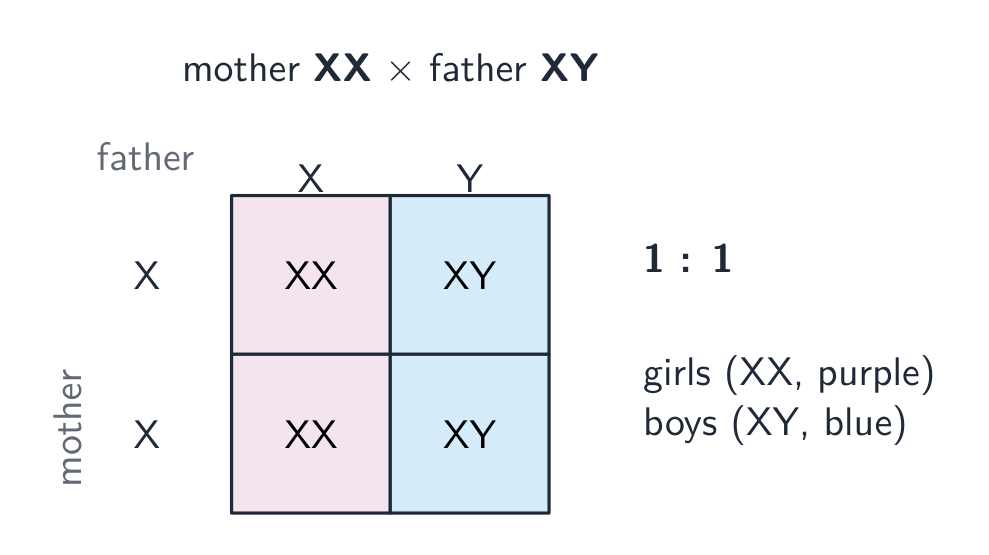
性别通过性染色体(sex chromosomes)遗传。女性是 XX 而男性是 XY。一个卵总是携带一个 X;一个精子携带一个 X 或一个 Y,所以精子决定婴儿的性别。这给出女孩对男孩 1:1 的比例(ratio)。
词汇表
训练
| 英文 | 中文 | 拼音 |
|---|---|---|
| chromosomes/ˈkrəʊməsəʊmz/ | 染色体 | rǎn sè tǐ |
| genes/dʒiːnz/ | 基因 | jī yīn |
| codes/kəʊdz/ | 编码 | biān mǎ |
| allele/əˈliːl/ | 等位基因 | děng wèi jī yīn |
| sex chromosomes/seks ˈkrəʊməsəʊmz/ | 性染色体 | xìng rǎn sè tǐ |
| ratio/ˈreɪʃɪəʊ/ | 比例 | bǐ lì |
17.1
DNA 如何调控细胞(拓展)
一个基因的碱基序列(base sequence)设定一个蛋白质中氨基酸(amino acids)的顺序。一个不同的氨基酸顺序把蛋白质折叠成一个不同的形状,而形状决定它的工作。所以 DNA 通过控制哪些蛋白质被制造来控制细胞——包括酶(enzymes)、膜载体和神经递质(neurotransmitters)的受体蛋白(receptor proteins)。
大多数体细胞容纳相同的基因,但每个细胞只表达(expresses,开启)它需要的基因,所以它只制造用于它自己工作的蛋白质。
词汇表
训练
| 英文 | 中文 | 拼音 |
|---|---|---|
| proteins/ˈprəʊtiːnz/ | 蛋白质 | dàn bái zhì |
| base sequence/beɪs ˈsiːkwəns/ | 碱基序列 | jiǎn jī xù liè |
| amino acids/əˈmiːnəʊ ˈæsɪdz/ | 氨基酸 | ān jī suān |
| enzymes/ˈenzaɪmz/ | 酶 | méi |
| receptor proteins/rɪˈseptə ˈprəʊtiːnz/ | 受体蛋白 | shòu tǐ dàn bái |
| neurotransmitters/ˈnjuːrətrænsmɪtəz/ | 神经递质 | shén jīng dì zhì |
| expresses/ekˈspresɪz/ | 表达 | biǎo dá |
17.1
合成蛋白质(拓展)

一个基因待在细胞核(nucleus)中,但蛋白质在细胞质(cytoplasm)中制造。它们之间的联系是信使(messenger)RNA(mRNA):
- mRNA 在细胞核中作为基因的一个副本被制造。
- mRNA 移出到细胞质并通过一个核糖体(ribosome)。
- 核糖体读 mRNA 的碱基(bases)并按匹配的顺序连接氨基酸以构建蛋白质。
探索
From gene to protein
Step along the DNA template: each base pairs to an mRNA base, and every three bases (a codon) codes for one amino acid in the protein.
词汇表
训练
| 英文 | 中文 | 拼音 |
|---|---|---|
| nucleus/ˈnjuːklɪəs/ | 细胞核 | xì bāo hé |
| cytoplasm/ˈsaɪtəplæzəm/ | 细胞质 | xì bāo zhì |
| messenger/ˈmesɪndʒə/ | 信使 | xìn shǐ |
| ribosome/ˈriːbəʊsəʊm/ | 核糖体 | hé táng tǐ |
| bases/ˈbeɪsɪz/ | 碱基 | jiǎn jī |
17.2 17.3
有丝分裂

大纲
| Core | Supplement |
|---|---|
| 1 Describe mitosis as nuclear division giving rise to genetically identical cells (details of the stages of mitosis are not required) | |
| 2 State the role of mitosis in growth, repair of damaged tissues, replacement of cells and asexual reproduction | |
| 3 State that the exact replication of chromosomes occurs before mitosis | |
| 4 State that during mitosis, the copies of chromosomes separate, maintaining the chromosome number in each daughter cell | |
| 5 Describe stem cells as unspecialised cells that divide by mitosis to produce daughter cells that can become specialised for specific functions |
| Core | Supplement |
|---|---|
| 1 State that meiosis is involved in the production of gametes | |
| 2 Describe meiosis as a reduction division in which the chromosome number is halved from diploid to haploid resulting in genetically different cells (details of the stages of meiosis are not required) |
来源:剑桥国际大纲
体细胞是二倍体(diploid,两套染色体;人类有 23 对)。配子是单倍体(haploid,一套)。细胞通过细胞核分裂(division)制造新细胞,有两种。
有丝分裂(mitosis):
- 制造两个与亲代细胞遗传上相同的细胞。
- 染色体在分裂之前被精确地复制(复制(replication)),所以每个子细胞(daughter cell)保留完整的染色体数目。
- 它被用于生长、组织修复、替换旧细胞和无性生殖(asexual reproduction)。
- 干细胞(stem cells)是通过有丝分裂分裂的未特化细胞;它们的子细胞随即能变得特化。
减数分裂(meiosis):
- 制造配子(gametes)。
- 它是一个减数分裂:染色体数目被减半,从二倍体到单倍体。
- 它制造的细胞彼此遗传上不同。

探索
Mitosis
Mitosis makes two genetically identical cells — for growth, repair and asexual reproduction.
词汇表
训练
| 英文 | 中文 | 拼音 |
|---|---|---|
| division/dɪˈvɪʒn/ | 分裂 | fēn liè |
| diploid/ˈdɪplɔɪd/ | 二倍体 | èr bèi tǐ |
| haploid/ˈhæplɔɪd/ | 单倍体 | dān bèi tǐ |
| mitosis/maɪˈtəʊsɪs/ | 有丝分裂 | yǒu sī fēn liè |
| replication/ˌreplɪˈkeɪʃn/ | 复制 | fù zhì |
| daughter cell/ˈdɔːtə sel/ | 子细胞 | zi xì bāo |
| asexual reproduction/eɪˈsekʃuːəl rɪprəˈdʌkʃn/ | 无性生殖 | wú xìng shēng zhí |
| stem cells/stem selz/ | 干细胞 | gàn xì bāo |
| meiosis/meɪˈəʊsɪs/ | 减数分裂 | jiǎn shù fēn liè |
| gametes/ˈɡæmiːts/ | 配子 | pèi zi |
17.4
单基因遗传

大纲
| Core | Supplement |
|---|---|
| 1 Describe inheritance as the transmission of genetic information from generation to generation | |
| 2 Describe genotype as the genetic make-up of an organism and in terms of the alleles present | |
| 3 Describe phenotype as the observable features of an organism | |
| 4 Describe homozygous as having two identical alleles of a particular gene | |
| 5 State that two identical homozygous individuals that breed together will be pure-breeding | |
| 6 Describe heterozygous as having two different alleles of a particular gene | |
| 7 State that a heterozygous individual will not be pure-breeding | |
| 8 Describe a dominant allele as an allele that is expressed if it is present in the genotype | |
| 9 Describe a recessive allele as an allele that is only expressed when there is no dominant allele of the gene present in the genotype | |
| 10 Interpret pedigree diagrams for the inheritance of a given characteristic | |
| 11 Use genetic diagrams to predict the results of monohybrid crosses and calculate phenotypic ratios, limited to 1:1 and 3:1 ratios | 13 Explain how to use a test cross to identify an unknown genotype |
| 12 Use Punnett squares in crosses which result in more than one genotype to work out and show the possible different genotypes | |
| 14 Describe codominance as a situation in which both alleles in heterozygous organisms contribute to the phenotype | |
| 15 Explain the inheritance of ABO blood groups: phenotypes are A, B, AB and O blood groups and alleles are $I^A$, $I^B$ and $I^o$ | |
| 16 Describe a sex-linked characteristic as a feature in which the gene responsible is located on a sex chromosome and that this makes the characteristic more common in one sex than in the other | |
| 17 Describe red-green colour blindness as an example of sex linkage | |
| 18 Use genetic diagrams to predict the results of monohybrid crosses involving codominance or sex linkage and calculate phenotypic ratios |
来源:剑桥国际大纲
遗传(inheritance)是遗传信息从一代到下一代的传递。学习这些词:
| 词 | 意义 |
|---|---|
| 基因型(genotype) | 一个生物体拥有的等位基因(它的遗传构成) |
| 表现型(phenotype) | 你能观察到的特征 |
| 显性(dominant)等位基因 | 即使只有一个副本存在也在表现型中显示(写成一个大写字母,例如 B) |
| 隐性(recessive)等位基因 | 只在没有显性等位基因存在时才显示(小写字母,例如 b) |
| 纯合子(homozygous) | 两个相同的等位基因(BB 或 bb);这些真实繁殖,或纯种(pure-breeding) |
| 杂合子(heterozygous) | 两个不同的等位基因(Bb);不是纯种繁殖 |
词汇表
训练
| 英文 | 中文 | 拼音 |
|---|---|---|
| inheritance/ɪnˈherɪtəns/ | 遗传 | yí chuán |
| genotype/ˈdʒenətaɪp/ | 基因型 | jī yīn xíng |
| phenotype/ˈfenətaɪp/ | 表现型 | biǎo xiàn xíng |
| dominant/ˈdɒmɪnənt/ | 显性 | xiǎn xìng |
| recessive/rɪˈsesɪv/ | 隐性 | yǐn xìng |
| homozygous/ˌhɒməˈzɪɡəs/ | 纯合子 | chún hé zǐ |
| pure-breeding/pjʊə ˈbriːdɪŋ/ | 纯种 | chún zhǒng |
| heterozygous/ˌhetrəˈzɪɡəs/ | 杂合子 | zá hé zǐ |
17.4
单基因杂交

要预测一个涉及一个基因的杂交(cross)的后代,用一个遗传图或一个庞纳特方格(Punnett square):
- 写每个亲代的基因型,然后配子(每个配子携带一个等位基因)。
- 在一个网格中组合它们以找到可能的后代基因型和表现型。
两个杂合子亲代(Bb × Bb)给出显性对隐性 3:1 的比例。一个杂合子与一个纯合隐性杂交(Bb × bb)给出 1:1 的比例。你也可以读一个系谱图(pedigree diagram,一个家谱)以跟踪一个特征并算出基因型。
(补充) 一个测交(test cross)找到一个未知的基因型:把未知的与一个纯合隐性杂交。若任何后代显示隐性特征,未知的一定曾是杂合子。
例题。 棕色眼睛(B)对蓝色眼睛(b)是显性。一对棕眼父母生了一个蓝眼孩子。写出父母的基因型,以及他们下一个孩子是蓝眼的概率。从孩子入手:蓝色是隐性,所以孩子必定是 bb,他从父母各得到一个 b。所以父母各自都带有一个 b。但父母都表现为棕眼,所以各自还必定带有一个 B:父母都是 Bb。Bb × Bb 的庞纳特方格给出 BB、Bb、Bb 和 bb,所以孩子是蓝眼的概率是 1/4(25%)。永远从隐性个体倒推 - 隐性表现型能精确锁定基因型,其余的都能顺着推出来。25% 对每一个孩子单独成立:前三个是棕眼,并不会让第四个变成蓝眼。
探索
Predicting a genetic cross
A Punnett square shows the possible combinations of alleles offspring can inherit from two parents.
探索
A monohybrid cross
Set each parent's genotype and read the offspring. Two heterozygotes (Aa × Aa) give a 3 : 1 ratio.
词汇表
训练
| 英文 | 中文 | 拼音 |
|---|---|---|
| cross/krɒs/ | 杂交 | zá jiāo |
| Punnett square/ˈpʌnɪt skweə/ | 庞纳特方格 | páng nà tè fāng gé |
| pedigree diagram/ˈpedɪɡriː ˈdaɪəɡræm/ | 系谱图 | xì pǔ tú |
| test cross/test krɒs/ | 测交 | cè jiāo |
17.4
共显性与血型(拓展)
在共显性(codominance)中,一个杂合子生物体中的两个等位基因都在表现型中显示。
ABO 血型(blood groups)是一个例子。等位基因是 $I^A$、$I^B$ 和 $I^o$。等位基因 $I^A$ 和 $I^B$ 是共显性的,而 $I^o$ 是隐性的:
- $I^A I^A$ 或 $I^A I^o$ → A 型
- $I^B I^B$ 或 $I^B I^o$ → B 型
- $I^A I^B$ → AB 型(两个等位基因都显示)
- $I^o I^o$ → O 型
探索
Codominance cross
When both alleles show in the phenotype (codominance), the heterozygote shows BOTH features — work it out with a Punnett square.
词汇表
训练
| 英文 | 中文 | 拼音 |
|---|---|---|
| codominance/ˈkəʊdəmɪnəns/ | 共显性 | gòng xiǎn xìng |
| blood groups/blʌd ɡruːps/ | 血型 | xuè xíng |
17.4
伴性遗传(拓展)
一个伴性遗传(sex-linked)特征由一个性染色体(通常是 X)上的一个基因控制。因为男性只有一个 X 染色体,它上面的一个隐性等位基因总是在男性中显示,所以这个特征在男性中比在女性中更常见。
红绿色盲(red-green colour blindness)是一个例子:隐性等位基因在 X 染色体上,所以它在男孩中比在女孩中常见得多。
词汇表
训练
| 英文 | 中文 | 拼音 |
|---|---|---|
| sex-linked/seks lɪŋkt/ | 伴性遗传 | bàn xìng yí chuán |
| colour blindness/ˈkʌlə ˈblaɪndnəs/ | 色盲 | sè máng |
17.4
考试技巧
- 基因 = 一段为一个蛋白质编码的 DNA。等位基因 = 一个基因的一个形式。
- 基因型 = 存在的等位基因;表现型 = 你看到的。纯合子 = 两个相同;杂合子 = 两个不同。
- 显性用一个副本就显示;隐性需要两个副本。
- 学习画一个庞纳特方格。Bb × Bb → 3:1;Bb × bb → 1:1。
- (补充)共显性:两个等位基因都显示(血型 AB)。伴性遗传:X 上的一个基因,在男孩中更常见(色盲)。
本主题的互动课程
逐步学习,并即时检测练习。