| 核心 | 补充 |
|---|---|
| 1 将药物描述为任何摄入体内并能改变或影响体内化学反应的物质 | |
| 2 描述抗生素用于治疗细菌感染的用途 | |
| 3 指出某些细菌对抗生素具有耐药性,从而降低了抗生素的有效性 | 5 解释仅在必要时使用抗生素如何限制耐抗生素细菌(如MRSA)的滋生 |
| 4 指出抗生素能杀死细菌,但对病毒无效 |
药物
IGCSE 生物 · 知识点 15
 4:37
药物与抗生素
感冒时找医生要抗生素,他们会拒绝你。并不是因为他们故意刁难——而是因为这确实不起作用,而且因为……
英语旁白 · 英中内嵌字幕
15.1
药物

教学大纲
来源:Cambridge International 教学大纲
English
A drug 药物 is any substance taken into the body that changes or affects the chemical reactions 化学反应 in the body. Many drugs are medicines that help to treat illness.
词汇
训练
| English | 中文 | 拼音 |
|---|---|---|
| drug/drʌɡ/ | 药物 | yào wù |
| chemical reactions/ˈkemɪkl rɪˈækʃnz/ | 化学反应 | huà xué fǎn yìng |
15.1
抗生素
English
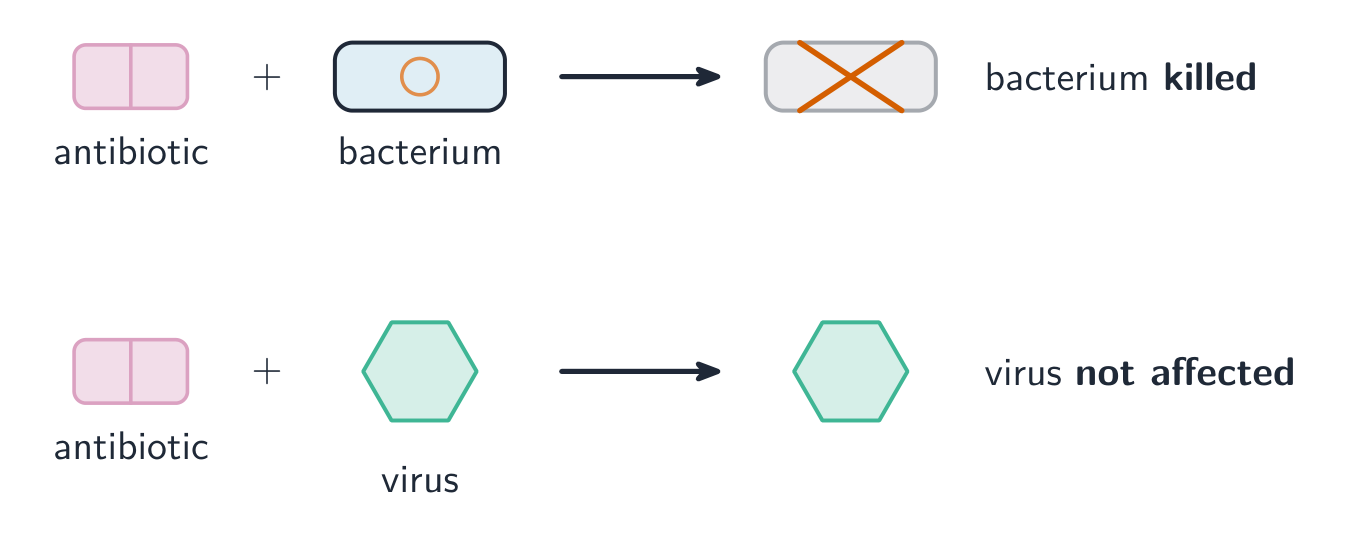
Antibiotics 抗生素 are drugs used to treat bacterial infections 感染. They kill bacteria 细菌, or stop them growing, but they do not affect viruses 病毒. This is why antibiotics cannot cure a cold or the flu, which are caused by viruses.
Why antibiotics do not affect viruses. An antibiotic works by damaging a part of the bacterial cell, for example its cell wall 细胞壁, or by stopping the bacterium's own reactions. A virus is not a cell. It has no cell wall and no reactions of its own; it can only reproduce inside our cells. So there is nothing in a virus for the antibiotic to attack.
To test which antibiotic works best, small paper discs soaked in different antibiotics are placed on a plate covered with bacteria. Where an antibiotic kills the bacteria, a clear ring with no growth appears around the disc. A bigger ring means the antibiotic is more effective.

探索
药物与抗生素实验室
按药物的作用和局限性对医学示例进行分类。
词汇
训练
| English | 中文 | 拼音 |
|---|---|---|
| antibiotics/ˌæntɪbaɪˈɒtɪks/ | 抗生素 | kàng shēng sù |
| infections/ɪnˈfekʃnz/ | 感染 | gǎn rǎn |
| bacteria/bækˈtɪərɪə/ | 细菌 | xì jūn |
| viruses/ˈvaɪrəsɪz/ | 病毒 | bìng dú |
| cell wall/sel wɔːl/ | 细胞壁 | xì bāo bì |
15.1
抗生素耐药性

English
Some bacteria are resistant 耐药 to an antibiotic — the antibiotic no longer kills them. These bacteria survive and multiply, so the antibiotic slowly becomes less effective for everyone.
(Supplement) To slow this down, antibiotics should be used only when they are really needed, and the full course should always be finished. Using antibiotics too often lets resistant bacteria, such as MRSA, spread.
Worked example. A patient stops taking their antibiotic as soon as they feel better, and the infection comes back worse. Explain using resistance. In the starting population a few bacteria are already resistant, by chance. The antibiotic kills the non-resistant ones, so those few survive, multiply, and come to make up most of the population - and the antibiotic no longer works on it. Stopping early leaves behind exactly the bacteria that are hardest to kill. Say the resistant bacteria already existed and survived: writing that the antibiotic "made them resistant" is wrong and loses every mark.
词汇
训练
| English | 中文 | 拼音 |
|---|---|---|
| resistant/rɪˈzɪstənt/ | 耐药 | nài yào |
15.1
Common mistakes
English
- "The patient becomes resistant to the antibiotic." It is the bacteria that are resistant, not the person.
- "The antibiotic makes bacteria resistant." The resistant bacteria were already there, by chance; the antibiotic kills the others, so the resistant ones are left to multiply.
- "Antibiotics kill all microorganisms." They kill bacteria only, not viruses.
- "A drug is an illegal substance." Medicines such as antibiotics and painkillers are drugs too.
15.1
考试技巧
English
- A drug is any substance that changes the body's chemical reactions — not only illegal drugs.
- Antibiotics kill bacteria only; they do not work on viruses (so they are useless against colds and flu).
- Overusing antibiotics leads to resistant bacteria like MRSA. Use them only when needed, and finish the whole course.
该知识点的互动课程
逐步完成,配合即时检查练习。