| Core | Supplement |
|---|---|
| 1 State that electrical impulses travel along neurones | |
| 2 Describe the mammalian nervous system in terms of: (a) the central nervous system (CNS) consisting of the brain and the spinal cord (b) the peripheral nervous system (PNS) consisting of the nerves outside of the brain and spinal cord | |
| 3 Describe the role of the nervous system as coordination and regulation of body functions | |
| 4 Identify in diagrams and images sensory, relay and motor neurones | |
| 5 Describe a simple reflex arc in terms of: receptor, sensory neurone, relay neurone, motor neurone and effector | |
| 6 Describe a reflex action as a means of automatically and rapidly integrating and coordinating stimuli with the responses of effectors (muscles and glands) | |
| 7 Describe a synapse as a junction between two neurones | 8 Describe the structure of a synapse, including the presence of vesicles containing neurotransmitter molecules, the synaptic gap and receptor proteins |
| 9 Describe the events at a synapse as: (a) an impulse stimulates the release of neurotransmitter molecules from vesicles into the synaptic gap (b) the neurotransmitter molecules diffuse across the gap (c) neurotransmitter molecules bind with receptor proteins on the next neurone (d) an impulse is then stimulated in the next neurone | |
| 10 State that synapses ensure that impulses travel in one direction only |
协调与反应
IGCSE 生物 · 第 14 主题
 18:13
18:13
Coordination and Response
Touch something hot and your hand is already moving before you feel the pain. That is one of your two control systems — the fast one, made of nerves. The other…
英文讲解 · 内嵌中英文字幕
14.1
协调与反应

大纲
来源:剑桥国际大纲
你的身体必须协调(coordinate)它所有的部分并对变化作出反应。神经系统(nervous system)用沿神经元(neurones,神经细胞)行进的快速电脉冲(electrical impulses)做这个。它有两部分:
- 中枢神经系统(central nervous system,CNS)——大脑(brain)和脊髓(spinal cord)。
- 周围神经系统(peripheral nervous system,PNS)——大脑和脊髓之外的所有神经。
神经系统协调并调节(regulates)身体的功能。
词汇表
训练
| 英文 | 中文 | 拼音 |
|---|---|---|
| coordinate/kəʊˈɔːdɪnət/ | 协调 | xié tiáo |
| nervous system/ˈnɜːvəs ˈsɪstəm/ | 神经系统 | shén jīng xì tǒng |
| electrical impulses/ɪˈlektrɪkl ˈɪmpʌlsɪz/ | 电脉冲 | diàn mài chōng |
| neurones/ˈnjuːrəʊnz/ | 神经元 | shén jīng yuán |
| central nervous system/ˈsentrəl ˈnɜːvəs ˈsɪstəm/ | 中枢神经系统 | zhōng shū shén jīng xì tǒng |
| brain/breɪn/ | 大脑 | dà nǎo |
| spinal cord/ˈspaɪnl kɔːd/ | 脊髓 | jí suǐ |
| peripheral nervous system/pəˈrɪfərəl ˈnɜːvəs ˈsɪstəm/ | 周围神经系统 | zhōu wéi shén jīng xì tǒng |
| regulates/ˈreɡjʊleɪts/ | 调节 | tiáo jié |
| reflex arc/ˈriːfleks ɑːk/ | 反射弧 | fǎn shè hú |
14.1
神经元与反射弧

有三种神经元:
- 感觉神经元(sensory neurones)——把冲动从感受器运到 CNS。
- 中间神经元(relay neurones)——在 CNS 内部传递冲动。
- 运动神经元(motor neurones)——把冲动从 CNS 运到效应器。
一个反射(reflex)动作是对一个刺激(stimulus,一个变化)的一个快速、自动的反应(response)。它遵循一条固定的路径,反射弧(reflex arc):
感受器(receptor)→ 感觉神经元 → 中间神经元 → 运动神经元 → 效应器(effector,一块肌肉(muscle)或腺体(gland))

探索
The reflex arc
A reflex is a fast, automatic response — the signal takes a short cut through the spinal cord.
词汇表
训练
| 英文 | 中文 | 拼音 |
|---|---|---|
| sensory neurones/ˈsensəri ˈnjuːrəʊnz/ | 感觉神经元 | gǎn jué shén jīng yuán |
| relay neurones/ˈriːleɪ ˈnjuːrəʊnz/ | 中间神经元 | zhōng jiān shén jīng yuán |
| motor neurones/ˈməʊtə ˈnjuːrəʊnz/ | 运动神经元 | yùn dòng shén jīng yuán |
| response/rɪˈspɒns/ | 反应 | fǎn yìng |
| stimulus/ˈstɪmjʊləs/ | 刺激 | cì jī |
| receptor/rɪˈseptə/ | 感受器 | gǎn shòu qì |
| effector/ɪˈfektə/ | 效应器 | xiào yìng qì |
| muscle/ˈmʌsl/ | 肌肉 | jī ròu |
| gland/ɡlænd/ | 腺体 | xiàn tǐ |
14.1
突触(拓展)

一个突触(synapse)是两个神经元之间的一个接点(一个微小的间隙)。在一个神经元的末端是容纳神经递质(neurotransmitter)分子的囊泡(vesicles)。跨突触间隙(synaptic gap),下一个神经元有受体蛋白(receptor proteins)。
一个突触处的事件:
- 一个冲动到达并使囊泡把神经递质释放到突触间隙中。
- 神经递质分子跨间隙扩散(diffuse)。
- 它们结合到下一个神经元上的受体蛋白。
- 这在下一个神经元中启动一个新冲动。
突触使冲动只往一个方向行进。
探索
Across the synapse
Neurons don't touch — the impulse crosses the tiny gap using a chemical messenger.
词汇表
训练
| 英文 | 中文 | 拼音 |
|---|---|---|
| synapse/ˈsɪnæps/ | 突触 | tū chù |
| vesicles/ˈvesɪklz/ | 囊泡 | náng pào |
| neurotransmitter/ˈnjuːrətrænsmɪtə/ | 神经递质 | shén jīng dì zhì |
| synaptic gap/sɪˈnæptɪk ɡæp/ | 突触间隙 | tū chù jiàn xì |
| receptor proteins/rɪˈseptə ˈprəʊtiːnz/ | 受体蛋白 | shòu tǐ dàn bái |
| diffuse/dɪˈfjuːz/ | 扩散 | kuò sàn |
14.2
感觉器官

大纲
| Core | Supplement |
|---|---|
| 1 Describe sense organs as groups of receptor cells responding to specific stimuli: light, sound, touch, temperature and chemicals | |
| 2 Identify in diagrams and images the structures of the eye, limited to: cornea, iris, pupil, lens, retina, optic nerve and blind spot | |
| 3 Describe the function of each part of the eye, limited to: (a) cornea – refracts light (b) iris – controls how much light enters the pupil (c) lens – focuses light on to the retina (d) retina – contains light receptors, some sensitive to light of different colours (e) optic nerve – carries impulses to the brain | |
| 4 Explain the pupil reflex, limited to changes in light intensity and pupil diameter | 5 Explain the pupil reflex in terms of the antagonistic action of circular and radial muscles in the iris |
| 6 Explain accommodation to view near and distant objects in terms of the contraction and relaxation of the ciliary muscles, tension in the suspensory ligaments, shape of the lens and refraction of light | |
| 7 Describe the distribution of rods and cones in the retina of a human | |
| 8 Outline the function of rods and cones, limited to: (a) greater sensitivity of rods for night vision (b) three different kinds of cones, absorbing light of different colours, for colour vision | |
| 9 Identify in diagrams and images the position of the fovea and state its function |
来源:剑桥国际大纲
感觉器官(sense organs)是响应一种刺激——光、声音、触摸、温度或化学物——的感受器细胞群。眼睛响应光。
Parts of the eye
| 部分 | 功能 |
|---|---|
| 角膜(cornea) | 在光进入时折射(refracts,弯曲)光 |
| 虹膜(iris) | 控制多少光进入瞳孔(pupil) |
| 晶状体(lens) | 把光聚焦到视网膜上 |
| 视网膜(retina) | 含有光感受器,一些对不同颜色敏感 |
| 视神经(optic nerve) | 把冲动运到大脑 |
| 盲点(blind spot) | 视神经离开眼睛的地方;它没有感受器 |
The pupil reflex
在明亮的光中瞳孔变小,以保护视网膜。在昏暗的光中它变宽,以让更多的光进入。(补充) 这由虹膜中两组拮抗(antagonistic)肌肉完成:环肌(circular muscles)和辐射肌(radial muscles)。在明亮的光中环肌收缩而瞳孔变窄;在昏暗的光中辐射肌收缩而瞳孔变宽。
Accommodation (Supplement)
视觉调节(accommodation)是改变晶状体的形状以聚焦于近或远的物体,用睫状肌(ciliary muscles)和悬韧带(suspensory ligaments):
- 近物体:睫状肌收缩,韧带松弛,而晶状体变胖——更多的折射。
- 远物体:睫状肌放松,韧带拉紧,而晶状体变薄——较少的折射。
Rods and cones (Supplement)
视网膜有两种光感受器:
- 视杆细胞(rods)——非常敏感,适合昏暗光中的视觉(vision,夜视);它们不检测颜色。
- 视锥细胞(cones)——三种,每种吸收一种不同的颜色,给出彩色视觉;它们在明亮的光中工作得最好。
视锥细胞在中央凹(fovea)最密集地聚集,中央凹是视网膜给出最清晰图像的部分。
探索
Explore the eye
Tap each part to follow light through the eye — from the cornea and lens that focus it to the retina that detects it.
探索
Accommodation — focusing the eye
The eye changes the shape of its lens to focus on near or far objects.
词汇表
训练
| 英文 | 中文 | 拼音 |
|---|---|---|
| reflex/ˈriːfleks/ | 反射 | fǎn shè |
| sense organs/sens ˈɔːɡənz/ | 感觉器官 | gǎn jué qì guān |
| cornea/ˈkɔːnɪə/ | 角膜 | jiǎo mó |
| refracts/rɪˈfrækts/ | 折射 | zhé shè |
| iris/ˈaɪrɪs/ | 虹膜 | hóng mó |
| pupil/ˈpjuːpl/ | 瞳孔 | tóng kǒng |
| lens/lenz/ | 晶状体 | jīng zhuàng tǐ |
| retina/ˈretɪnə/ | 视网膜 | shì wǎng mó |
| optic nerve/ˈɒptɪk nɜːv/ | 视神经 | shì shén jīng |
| blind spot/blaɪnd spɒt/ | 盲点 | máng diǎn |
| antagonistic/ænˈtæɡənɪstɪk/ | 拮抗 | jié kàng |
| circular muscles/ˈsɜːkjʊlə ˈmʌslz/ | 环肌 | huán jī |
| radial muscles/ˈreɪdɪəl ˈmʌslz/ | 辐射肌 | fú shè jī |
| accommodation/əˌkɒməˈdeɪʃn/ | 视觉调节 | shì jué tiáo jié |
| ciliary muscles/ˈsɪlɪəri ˈmʌslz/ | 睫状肌 | jié zhuàng jī |
| suspensory ligaments/səˈspensəri ˈlɪɡəmənts/ | 悬韧带 | xuán rèn dài |
| rods/rɒdz/ | 视杆细胞 | shì gān xì bāo |
| vision/ˈvɪʒn/ | 视觉 | shì jué |
| cones/kəʊnz/ | 视锥细胞 | shì zhuī xì bāo |
| fovea/ˈfəʊvɪə/ | 中央凹 | zhōng yāng āo |
14.3
激素

大纲
| Core | Supplement |
|---|---|
| 1 Describe a hormone as a chemical substance, produced by a gland and carried by the blood, which alters the activity of one or more specific target organs | |
| 2 Identify in diagrams and images specific endocrine glands and state the hormones they secrete, limited to: (a) adrenal glands and adrenaline (b) pancreas and insulin (c) testes and testosterone (d) ovaries and oestrogen | 5 State that glucagon is secreted by the pancreas |
| 3 Describe adrenaline as the hormone secreted in ‘fight or flight’ situations and its effects, limited to: (a) increased breathing rate (b) increased heart rate (c) increased pupil diameter | 6 Describe the role of adrenaline in the control of metabolic activity, limited to: (a) increasing the blood glucose concentration (b) increasing heart rate |
| 4 Compare nervous and hormonal control, limited to speed of action and duration of effect |
来源:剑桥国际大纲
一个激素(hormone)是一种化学物,由一个腺体制造并在血液中携带,它改变一个或多个靶器官(target organs)的活动。激素由内分泌腺(endocrine glands)制造,它们把它们直接释放到血液中。
| 腺体 | 激素 | 主要效果 |
|---|---|---|
| 肾上腺(adrenal glands) | 肾上腺素(adrenaline) | 为行动准备身体 |
| 胰腺(pancreas) | 胰岛素(insulin,以及胰高血糖素(glucagon)) | 控制血葡萄糖(glucose) |
| 睾丸(testes) | 睾酮(testosterone) | 男性发育 |
| 卵巢(ovaries) | 雌激素(oestrogen) | 女性发育 |
肾上腺素在"战斗或逃跑"情况下被释放,如恐惧或危险。它增加呼吸速率、心率(heart rate)、血葡萄糖浓度(concentration)和瞳孔直径,使身体准备好行动。
探索
How hormones work
Hormones are chemical messengers carried in the blood — slower than nerves, but longer-lasting.
词汇表
训练
| 英文 | 中文 | 拼音 |
|---|---|---|
| hormone/ˈhɔːməʊn/ | 激素 | jī sù |
| target organs/ˈtɑːɡɪt ˈɔːɡənz/ | 靶器官 | bǎ qì guān |
| endocrine glands/ˈendəʊkraɪn ɡlændz/ | 内分泌腺 | nèi fēn mì xiàn |
| adrenal glands/əˈdriːnl ɡlændz/ | 肾上腺 | shèn shàng xiàn |
| adrenaline/əˈdrenəlɪn/ | 肾上腺素 | shèn shàng xiàn sù |
| pancreas/ˈpæŋkrɪəs/ | 胰腺 | yí xiàn |
| insulin/ˈɪnsjuːlɪn/ | 胰岛素 | yí dǎo sù |
| glucagon/ˈɡluːkæɡən/ | 胰高血糖素 | yí gāo xuè táng sù |
| glucose/ˈɡluːkəʊs/ | 葡萄糖 | pú táo táng |
| testes/ˈtestiːz/ | 睾丸 | gāo wán |
| testosterone/teˈstɒstərəʊn/ | 睾酮 | gāo tóng |
| ovaries/ˈəʊvəriz/ | 卵巢 | luǎn cháo |
| oestrogen/ˈiːstrədʒn/ | 雌激素 | cí jī sù |
| heart rate/hɑːt reɪt/ | 心率 | xīn lǜ |
| concentration/ˌkɒnsənˈtreɪʃn/ | 浓度 | nóng dù |
14.3
神经调节与激素调节

| 神经控制 | 激素控制 | |
|---|---|---|
| 速度 | 非常快 | 较慢 |
| 持续时间(duration) | 短暂 | 更持久 |
| 它如何行进 | 沿神经元的电脉冲 | 血液中的化学物 |
词汇表
训练
| 英文 | 中文 | 拼音 |
|---|---|---|
| duration/djʊəˈreɪʃn/ | 持续时间 | chí xù shí jiān |
14.4
稳态
大纲
| Core | Supplement |
|---|---|
| 1 Describe homeostasis as the maintenance of a constant internal environment | 3 Explain the concept of homeostatic control by negative feedback with reference to a set point |
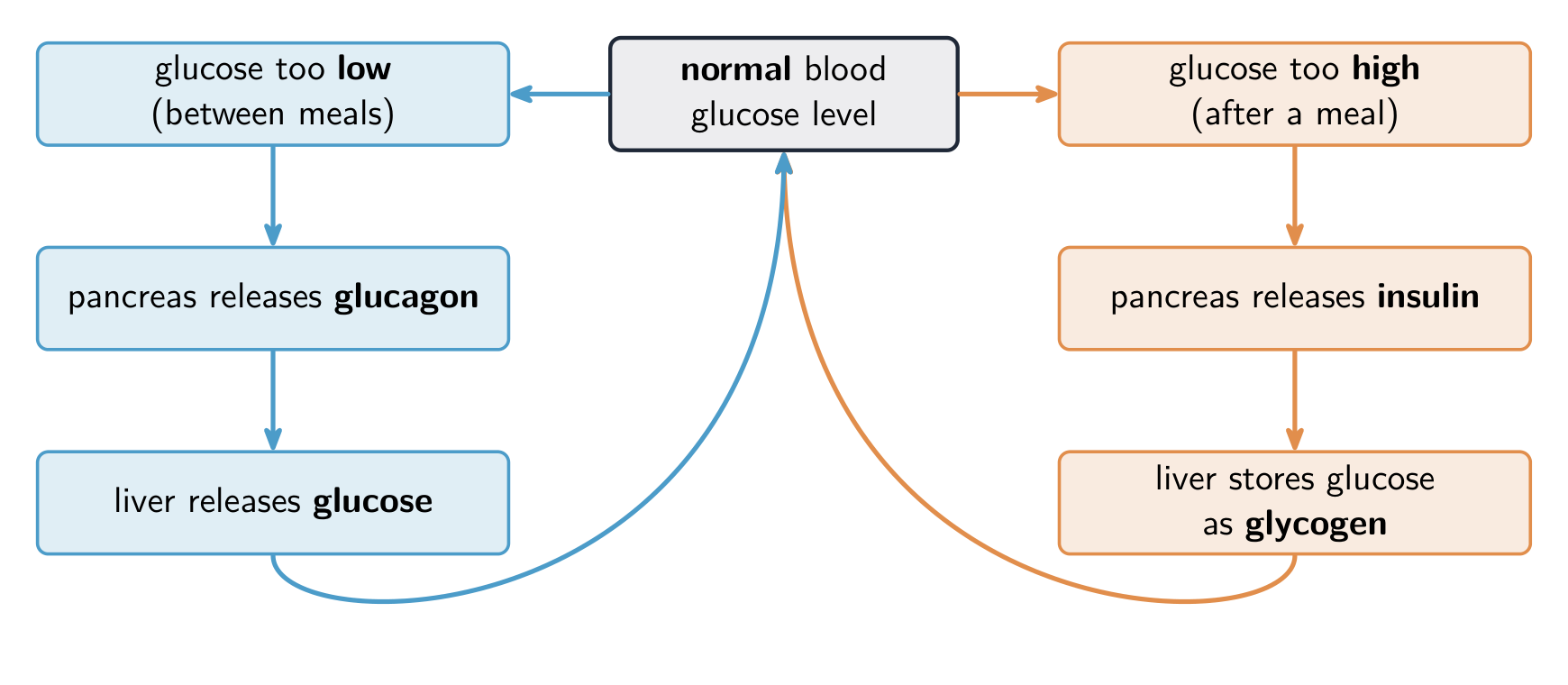
| 2 State that insulin decreases blood glucose concentration | 4 Describe the control of blood glucose concentration by the liver and the roles of insulin and glucagon |
| 5 Outline the treatment of Type 1 diabetes | |
| 6 Identify in diagrams and images of the skin: hairs, hair erector muscles, sweat glands, receptors, sensory neurones, blood vessels and fatty tissue | |
| 7 Describe the maintenance of a constant internal body temperature in mammals in terms of: insulation, sweating, shivering and the role of the brain | |
| 8 Describe the maintenance of a constant internal body temperature in mammals in terms of vasodilation and vasoconstriction of arterioles supplying skin surface capillaries |
来源:剑桥国际大纲
稳态(homeostasis)是保持身体内部一个恒定的内环境(environment)——例如一个稳定的温度和一个稳定的血糖水平。
(补充) 稳态通过负反馈(negative feedback)工作:当一个值偏离它的设定点(set point)时,身体行动以把它带回来。变化本身触发纠正。
Controlling blood glucose
肝脏(liver)和胰腺保持血糖稳定:
- 胰岛素在一餐后降低血糖——肝脏把葡萄糖储存为糖原(glycogen)。
- (补充)胰高血糖素在两餐之间提高血糖——肝脏释放葡萄糖。
在 1 型糖尿病(Type 1 diabetes)中,胰腺不能制造胰岛素,所以血糖升得太高。它用胰岛素注射和一份仔细规划的饮食治疗。
例题。 血糖在饭后急剧上升,然后在接下来两小时内回落到正常。说出涉及的器官和激素,以及它们各做什么。胰腺察觉到上升并释放胰岛素。胰岛素让肝脏把葡萄糖从血液中取走,以糖原的形式储存起来,所以血糖回落到正常。两餐之间运行的是相反的回路:胰腺释放胰高血糖素,肝脏重新释放葡萄糖。要把两个词分清 - 胰岛素是激素,糖原是储存物。把它们弄混是最经典的错误。
Controlling body temperature (Supplement)
大脑检测体温度(temperature)并保持它稳定。皮肤帮助:
| 结构 | 作用 |
|---|---|
| 汗腺(sweat glands) | 制造汗;当它蒸发时它使皮肤降温(出汗(sweating)) |
| 立毛肌(hair erector muscles) | 竖起毛以困住一层空气 |
| 血管(blood vessels) | 改变多少血液在皮肤表面附近流动 |
| 脂肪组织(fatty tissue) | 给隔热(insulation)以减少热量流失 |
当你太热时:你出汗,而小动脉(arterioles)变宽(血管舒张(vasodilation)),所以更多的血液流到皮肤毛细血管(capillaries)并失去热量。
当你太冷时:你颤抖(shiver,肌肉制造热),而小动脉变窄(血管收缩(vasoconstriction)),所以较少的血液到达表面,把热量留住。

探索
Negative feedback
Push body temperature away from its set point and watch negative feedback bring it back to normal.
词汇表
训练
| 英文 | 中文 | 拼音 |
|---|---|---|
| homeostasis/ˌhəʊmiːəˈstɑːsiz/ | 稳态 | wěn tài |
| environment/enˈvaɪrənmənt/ | 环境 | huán jìng |
| negative feedback/ˈneɡətɪv ˈfiːdbæk/ | 负反馈 | fù fǎn kuì |
| set point/set pɔɪnt/ | 设定点 | shè dìng diǎn |
| liver/ˈlɪvə/ | 肝脏 | gān zàng |
| glycogen/ˈɡlaɪkədʒn/ | 糖原 | táng yuán |
| diabetes/ˌdaɪəˈbiːtiːz/ | 糖尿病 | táng niào bìng |
| temperature/ˈtemprɪtʃə/ | 温度 | wēn dù |
| sweat glands/swet ɡlændz/ | 汗腺 | hàn xiàn |
| sweating/ˈswetɪŋ/ | 出汗 | chū hàn |
| hair erector muscles/heə ɪˈrektə ˈmʌslz/ | 立毛肌 | lì máo jī |
| blood vessels/blʌd ˈveslz/ | 血管 | xuè guǎn |
| fatty tissue/ˈfæti ˈtɪʃuː/ | 脂肪组织 | zhī fáng zǔ zhī |
| insulation/ˌɪnsjuːˈleɪʃn/ | 隔热 | gé rè |
| arterioles/ɑːˈtɪəriəʊlz/ | 小动脉 | xiǎo dòng mài |
| vasodilation/ˌvæsədɪˈleɪʃn/ | 血管舒张 | xuè guǎn shū zhāng |
| capillaries/ˈkæpɪləriz/ | 毛细血管 | máo xì xuè guǎn |
| shiver/ˈʃɪvə/ | 颤抖 | chàn dǒu |
| vasoconstriction/ˌvæsəkənˈstrɪkʃn/ | 血管收缩 | xuè guǎn shōu suō |
14.5
向性反应

大纲
| Core | Supplement |
|---|---|
| 1 Describe gravitropism as a response in which parts of a plant grow towards or away from gravity | 4 Explain phototropism and gravitropism of a shoot as examples of the chemical control of plant growth |
| 2 Describe phototropism as a response in which parts of a plant grow towards or away from the direction of the light source | 5 Explain the role of auxin in controlling shoot growth, limited to: (a) auxin is made in the shoot tip (b) auxin diffuses through the plant from the shoot tip (c) auxin is unequally distributed in response to light and gravity (d) auxin stimulates cell elongation |
| 3 Investigate and describe gravitropism and phototropism in shoots and roots |
来源:剑桥国际大纲
一个向性(tropism)是一株植物对一个方向的生长反应:
- 向地性(gravitropism)——响应重力(gravity)的生长(根往下长,芽往上长)。
- 向光性(phototropism)——响应光的方向的生长(芽朝光长)。
(补充) 这些反应由一种叫生长素(auxin)的化学物控制:
- 生长素在嫩枝(shoot)尖制造。
- 它往下扩散穿过植物。
- 光或重力使生长素不均匀地铺到一侧。
- 生长素使细胞伸长(elongate,长得更长)。生长素更多的一侧长得更快,所以芽弯曲。
探索
Phototropism — bending to light
A shoot grows towards light because a hormone makes one side grow faster than the other.
词汇表
训练
| 英文 | 中文 | 拼音 |
|---|---|---|
| tropism/ˈtrəʊpɪzəm/ | 向性 | xiàng xìng |
| gravitropism/ˈɡrævɪtrəʊpɪzəm/ | 向地性 | xiàng dì xìng |
| gravity/ˈɡrævɪti/ | 重力 | zhòng lì |
| phototropism/ˌfəʊtəʊˈtrəʊpɪzəm/ | 向光性 | xiàng guāng xìng |
| auxin/ˈɔːksɪn/ | 生长素 | shēng zhǎng sù |
| shoot/ʃuːt/ | 嫩枝 | nèn zhī |
| elongate/ˈiːlɒŋɡeɪt/ | 伸长 | shēn cháng |
14.5
考试技巧
- 神经系统:CNS(大脑 + 脊髓)和 PNS(神经)。冲动沿神经元行进。
- 按顺序学习反射弧:感受器 → 感觉 → 中间 → 运动 → 效应器。
- 在一个突触处,神经递质跨间隙扩散——这使冲动只往一个方向走。
- 眼睛:角膜和晶状体折射光;晶状体改变形状(视觉调节);视杆细胞用于昏暗光,视锥细胞用于颜色。
- 激素比神经更慢但更持久。胰岛素降低血糖;胰高血糖素提高它。
- 太热 → 出汗和血管舒张;太冷 → 颤抖和血管收缩。
- 来自嫩枝尖的生长素通过使细胞伸长来控制向光性和向地性。
本主题的互动课程
逐步学习,并即时检测练习。