| English | 释义 | 拼音 |
|---|---|---|
| cornea/ˈkɔːnɪə/ | 角膜 | jiǎo mó |
| pupil/ˈpjuːpl/ | 瞳孔 | tóng kǒng |
| iris/ˈaɪrɪs/ | 虹膜 | hóng mó |
| lens/lenz/ | 晶状体 | jīng zhuàng tǐ |
| retina/ˈretɪnə/ | 视网膜 | shì wǎng mó |
| optic nerve/ˈɒptɪk nɜːv/ | 视神经 | shì shén jīng |
A living camera
- The eye is a remarkable organ that focuses light to form a clear image.
- Each part has a specific job in capturing and focusing light.
The part that controls the size of the pupil is the:
难度 1/5 · 今日首次完成可获 100 金币及少量额外奖励
The iris adjusts the pupil size.
Light first enters the eye through the transparent ______.
难度 1/5 · 今日首次完成可获 100 金币及少量额外奖励
The cornea does most of the focusing.
Letting light in
- Light enters through the clear cornea 角膜, then the pupil 瞳孔 (the hole in the middle).
- The coloured iris 虹膜 controls how big the pupil is.
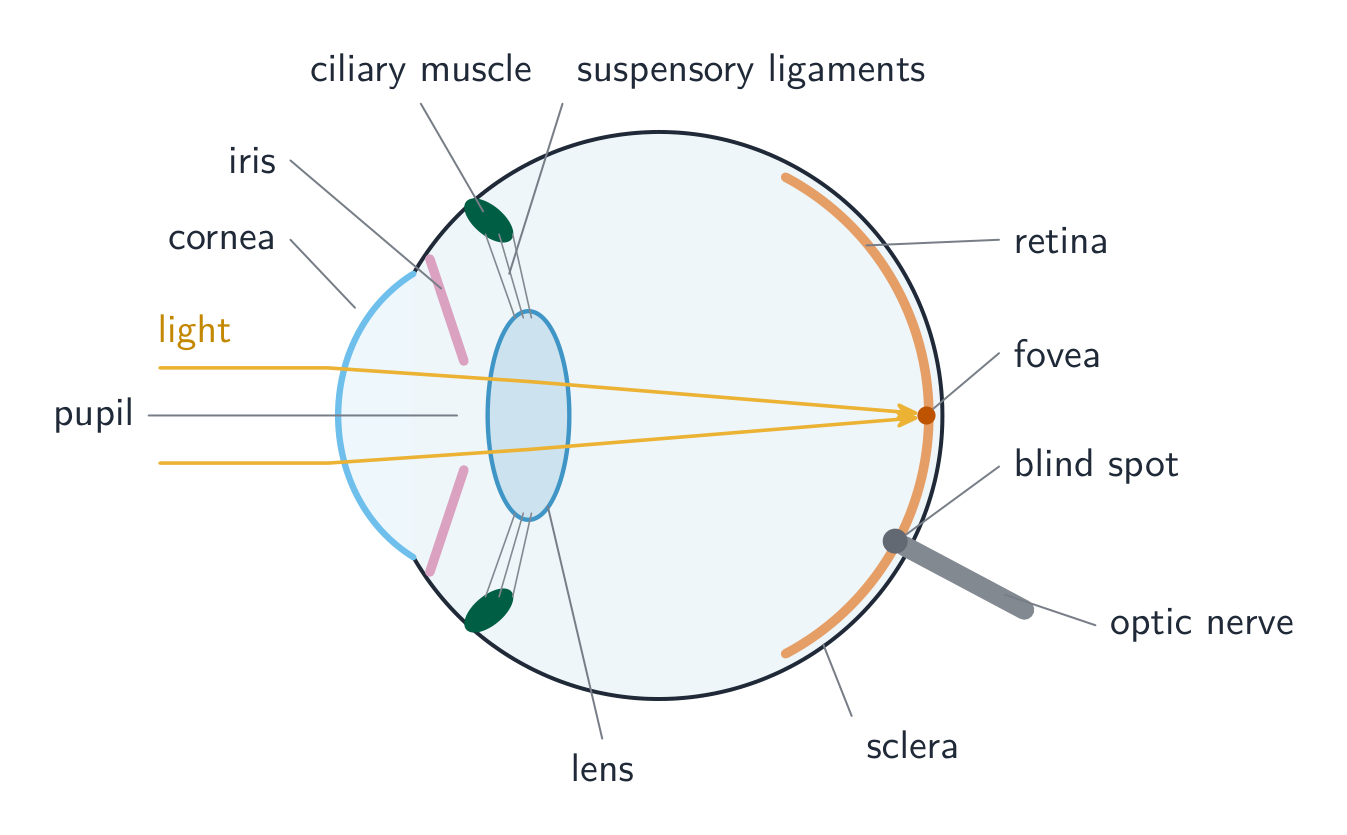
Light is focused by the cornea and lens 晶状体 onto the retina 视网膜; impulses leave by the optic nerve 视神经
Explore the eye
Tap each part to follow light through the eye — from the cornea and lens that focus it to the retina that detects it.
Light is focused onto the:
难度 1/5 · 今日首次完成可获 100 金币及少量额外奖励
The lens focuses light onto the retina.
Focusing the light
- The lens focuses light onto the retina at the back.
- The cornea does most of the focusing; the lens fine-tunes it.
Impulses travel from the retina to the brain along the:
难度 1/5 · 今日首次完成可获 100 金币及少量额外奖励
The optic nerve carries impulses to the brain.
The image formed on the retina is upside down.
难度 1/5 · 今日首次完成可获 100 金币及少量额外奖励
The brain interprets it the right way up.
Sending the signal
- The retina has light-sensitive cells that turn light into nerve impulses.
- The optic nerve carries these impulses to the brain.
The image on the retina is upside down. The lens flips the image, so it lands inverted on the retina. Your brain turns it the right way up — you never notice.
Worked example: walking out into sunshine
A student walks from a dark cinema into bright sunshine. Describe the pupil reflex and explain why it matters.
- Bright light is detected by the retina. In the iris, the circular muscles contract and the radial muscles relax, so the pupil gets smaller and less light enters.
- This is a reflex: fast and automatic. It protects the light-sensitive cells of the retina from damage. Back in the dark, the radial muscles contract and the pupil widens to let in more light.
In dim light, which iris muscles contract?
难度 1/5 · 今日首次完成可获 100 金币及少量额外奖励
Radial muscles pull the pupil wider so more light reaches the retina.
The blind spot has no light receptors, because the optic nerve leaves the eye there.
难度 1/5 · 今日首次完成可获 100 金币及少量额外奖励
No rods or cones sit where the optic nerve leaves, so an image falling there is not seen.
You've got it
- light enters through the cornea and pupil (size set by the iris)
- the lens focuses light onto the retina
- the retina makes nerve impulses; the optic nerve carries them to the brain
Write from this case
- Light has passed through the cornea and the pupil.
- A sharp image lands on the back of the eye.
What focuses the light, and which nerve carries the impulses?
Focus and dimming are different jobs.
Which part focuses light onto the retina?
难度 1/5 · 今日首次完成可获 100 金币及少量额外奖励
The lens is the focusing part named in the lesson.