跳到主要内容

社会心理学与人格

AP 心理学 · 第 4 主题

训练
讲义 词汇表
4.1

归因理论与人际知觉

大纲
Learning ObjectiveEssential Knowledge

4.1.A
Explain how attribution theory applies to behavior and mental processes.

  • 4.1.A.1 Attributions are how people explain behavior and mental processes of themselves and others. Dispositional attributions relate to internal qualities of others (such as intelligence or personality) while situational attributions relate to external circumstances that are experienced.
  • 4.1.A.2 People demonstrate a predictable pattern of attributions called explanatory style. Explanatory style is how people explain good and bad events in their lives and in the lives of others. Explanatory style can be optimistic or pessimistic.
  • 4.1.A.3 People are subject to biases in their attributions. Those biases include actor/ observer bias, fundamental attribution error, and self-serving bias, all of which can affect behavior and mental processes.

4.1.B
Explain how locus of control (internal and external) applies to behavior and mental processes.

4.1.C
Explain how person perception applies to behavior and mental processes.

  • 4.1.C.1 People’s perception of how much they like something can be influenced by the mere exposure effect. The mere exposure effect occurs when people are exposed to a stimulus repeatedly over time, which causes them to like the stimulus more.
  • 4.1.C.2 People can behave in ways that elicit behaviors from others that confirm their beliefs or perceptions about themselves or others (self-fulfilling prophecy).
  • 4.1.C.3 Social comparison is a type of person perception that occurs when people evaluate themselves based on comparisons to other members of society or social circles. Social comparison can be upward or downward. People often judge their own sense of deprivation relative to others (relative deprivation).

来源:美国大学理事会 AP 课程与考试说明

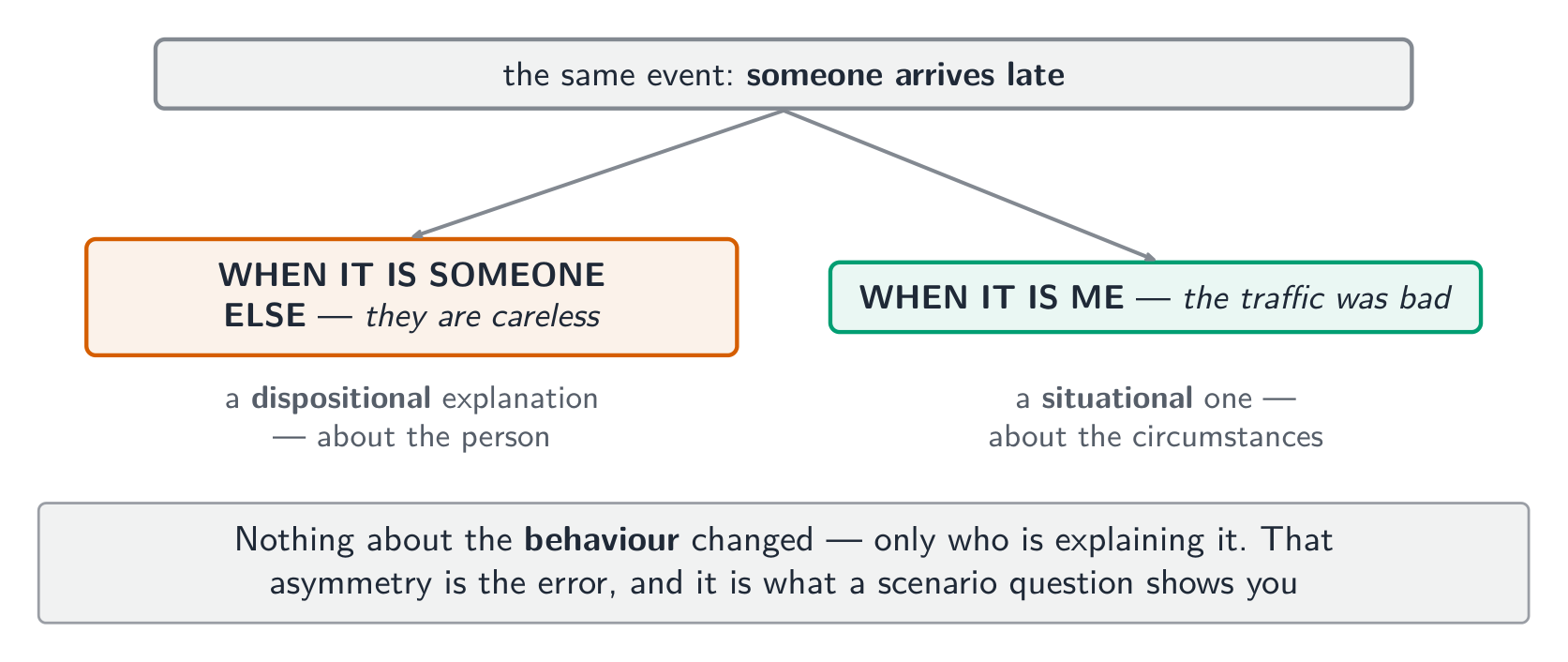
社会心理学(social psychology)研究人们如何思考他人、影响他人并与他人相处。它从归因(attribution)开始——我们如何解释行为。

一种解释要么是内归因(dispositional,归于个人的性格),要么是外归因(situational,归于情境)。人们在选择哪一种时并不公平:

  • 基本归因错误(fundamental attribution error)是在解释他人行为时过度使用内归因。
  • 行动者-观察者偏差(actor-observer bias)是用情境解释自己的行为,却用性格解释他人的行为。
  • 自利偏差(self-serving bias)把成功归于自己,把失败归于情境。
  • 公正世界现象(just-world phenomenon)是相信人们所得皆其所应得。

一个人的解释风格(explanatory style)可以是乐观的(optimistic)或悲观的(pessimistic),这会影响他如何面对挫折。

人际知觉本身也有若干效应。单纯曝光效应(mere exposure effect)指反复接触会增加喜欢程度。自我实现预言(self-fulfilling prophecy)指期待促成了证实该期待的行为。社会比较(social comparison)是拿自己与他人比较,可以是向上比较(upward)或向下比较(downward)。

词汇表 训练
英文 中文 拼音
Social psychology 社会心理学 shè huì xīn lǐ xué
attribution 归因 guī yīn
dispositional 内归因 nèi guī yīn
situational 外归因 wài guī yīn
fundamental attribution error 基本归因错误 jī běn guī yīn cuò wù
actor-observer bias 行动者-观察者偏差 xíng dòng zhě - guān chá zhě piān chā
self-serving bias 自利偏差 zì lì piān chā
just-world phenomenon 公正世界现象 gōng zhèng shì jiè xiàn xiàng
explanatory style 解释风格 jiě shì fēng gé
optimistic 乐观的 lè guān de
pessimistic 悲观的 bēi guān de
mere exposure effect 单纯曝光效应 dān chún bào guāng xiào yìng
self-fulfilling prophecy 自我实现预言 zì wǒ shí xiàn yù yán
Social comparison 社会比较 shè huì bǐ jiào
upward 向上比较 xiàng shàng bǐ jiào
downward 向下比较 xiàng xià bǐ jiào
4.2

态度的形成与改变

大纲
Learning ObjectiveEssential Knowledge

4.2.A
Explain how stereotypes and implicit attitudes contribute to the behaviors and mental processes of prejudice and discrimination.

  • 4.2.A.1 A stereotype is a generalized concept about a group. Stereotypes can help reduce cognitive load when making decisions or judgments. Stereotypes can be the cause and/or result of biased perceptions and experiences and are frequently the basis of prejudiced attitudes and discriminatory behaviors.
  • 4.2.A.2 Implicit attitudes are those that individuals hold but may be unaware of or may not acknowledge. Research has focused on how implicit attitudes reflect negative evaluations of others, as demonstrated by the just-world phenomenon, out-group homogeneity bias, in-group bias, or ethnocentrism.

4.2.B
Explain how belief perseverance and cognitive dissonance apply to attitude formation and change.

  • 4.2.B.1 Belief perseverance occurs when a belief persists even if evidence suggests it is not accurate. People experiencing belief perseverance may engage in confirmation bias, thereby clinging to an attitude or belief regardless of the evidence for or against it.
  • 4.2.B.2 Cognitive dissonance refers to the mental discomfort that occurs when actions or attitudes are in conflict. People are motivated to reduce the discomfort by changing either actions or attitudes to be more in line with each other.

来源:美国大学理事会 AP 课程与考试说明

刻板印象(stereotype)是关于某个群体的概括性看法;它减少了认知负担,但可能不准确且有害。偏见(prejudice)是一种态度,歧视(discrimination)则是行为。内隐态度(implicit attitudes)是本人未必意识到的态度。

态度不易改变。信念固着(belief perseverance)使某个信念在支持它的证据被推翻后仍然存在。确认偏差(confirmation bias)是只去寻找符合既有信念的证据。

认知失调(cognitive dissonance)是行为与态度冲突时产生的心理不适。由于行为已经发生,人们往往通过改变态度来化解——这也是"做了某事会改变一个人的想法"的原因。

词汇表 训练
英文 中文 拼音
stereotype 刻板印象 kè bǎn yìn xiàng
Prejudice 偏见 piān jiàn
discrimination 歧视 qí shì
Implicit attitudes 内隐态度 nèi yǐn tài dù
Belief perseverance 信念固着 xìn niàn gù zhuó
Confirmation bias 确认偏差 què rèn piān chā
Cognitive dissonance 认知失调 rèn zhī shī tiáo
4.3

社会情境心理学

大纲
Learning ObjectiveEssential Knowledge

4.3.A
Explain how the social situation affects behavior and mental processes.

  • 4.3.A.1 Social norms define expectations and roles a society may have for its members in individual and social situations.
  • 4.3.A.2 Social influence theory proposes that social pressure to behave or think in certain ways can be normative or informational.
  • 4.3.A.3 Persuasion refers to the techniques applied to convince the self or others of particular ideas, actions, or beliefs.
    • 4.3.A.3.i Persuasion can depend on the route to persuasion. The elaboration likelihood model outlines two main routes to persuasion: central and peripheral. The halo effect is an example of a peripheral route to persuasion.
    • 4.3.A.3.ii Persuasion can depend on how information is presented, as demonstrated by the foot-in-the-door and the door-in-the-face techniques.
  • 4.3.A.4 Research on conformity clarifies the conditions that strengthen the likelihood of people adhering to unspoken rules, norms, or expectations.
  • 4.3.A.5 Research on obedience clarifies the conditions that strengthen the likelihood of people complying with the directives of an authority figure.

4.3.B
Explain how being in a group can affect an individual’s behavior and mental processes.

  • 4.3.B.1 Cultural phenomena such as individualism, collectivism, and multiculturalism can influence how one perceives and behaves towards oneself and others.
  • 4.3.B.2 Being a member of a group can influence how one behaves or experiences mental processes via group polarization, groupthink, diffusion of responsibility, social loafing, and deindividuation.
  • 4.3.B.3 Performing a mental or physical behavior in front of a group can lead to social facilitation.
  • 4.3.B.4 People often overestimate the levels to which others agree with them, known as the false consensus effect.
  • 4.3.B.5 Superordinate goals serve to unite disparate groups under a common goal and help reduce negative affect and stereotyping among groups. Social traps occur when individuals do not unite and act in their own self-interest to the detriment of the group.
  • 4.3.B.6 Industrial-organizational (I/O) psychologists study how people perform in the workplace. I/O psychologists study best practices in management of work, relationships among people working together or for a common company or program, and how people feel about work (burnout).

4.3.C
Explain how prosocial behavior affects behavior and mental processes.

  • 4.3.C.1 Altruism refers to selfless behavior, but some researchers suggest that people act in prosocial ways due to incurring social debt. The social reciprocity norm and the social responsibility norm explain this type of behavior.
  • 4.3.C.2 The bystander effect demonstrates that situational and attentional variables predict whether someone is likely to help another person.

来源:美国大学理事会 AP 课程与考试说明

社会规范(social norms)规定了群体期待的行为。他人在场时行为会发生改变:

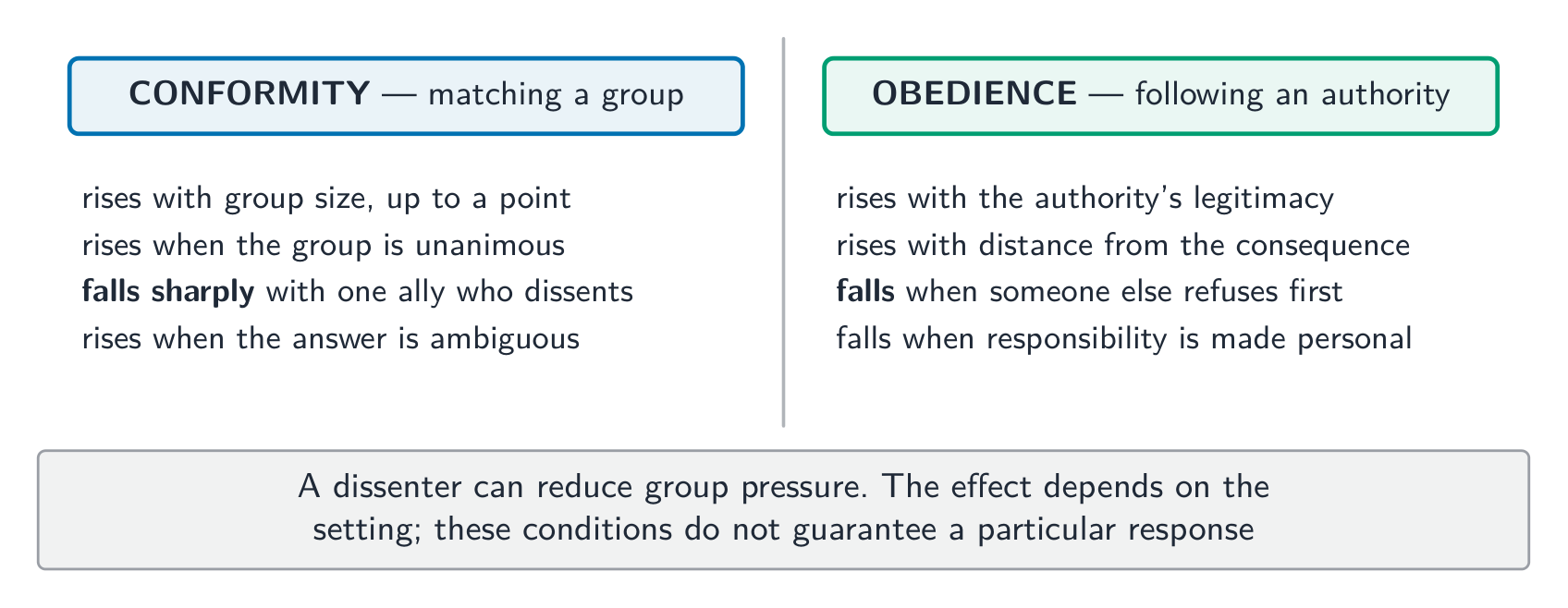
  • 从众(conformity)是调整行为以与群体一致。群体规模(在一定范围内)、意见一致性和情境模糊性都会提高从众,而哪怕只有一个人持异议也会显著降低它。
  • 服从(obedience)是听从权威的指令。权威的合法性与临近程度会提高服从,受害者靠近或权威远离则会降低服从。
  • 规范性社会影响(normative social influence)是为了被接纳而从众;信息性社会影响(informational social influence)是因为认为别人更懂而从众。

说服(persuasion)在精细加工可能性模型(elaboration likelihood model)中有两条路径:中心路径(central route)依靠论据本身的力量,边缘路径(peripheral route)依靠吸引力等外围线索。请求的先后顺序也很重要:登门槛效应(foot-in-the-door)先提小要求,留面子效应(door-in-the-face)先提一个不合理的大要求。

群体情境会进一步改变行为。社会助长(social facilitation)使人在他人注视下把简单或熟练的任务做得更好,却把困难任务做得更差。社会惰化(social loafing)是群体中个人努力程度下降。去个体化(deindividuation)是在人群中丧失自我意识。群体极化(group polarization)把群体的平均观点推向其原有方向的更极端处,群体思维(groupthink)则是为维持和谐而压制异议。

个人主义(individualism)与集体主义(collectivism)会塑造上述所有现象,多元文化主义(multiculturalism)描述多种传统并存的社会。虚假一致效应(false consensus effect)是高估赞同自己的人数。超级目标(superordinate goals)——需要合作才能达成的共同目标——能减少群体间的敌意。

利他行为(altruism)是无私的助人行为,不过亲社会行为(prosocial behavior)也可能给助人者带来好处。旁观者效应(bystander effect)表明,旁观人数越多,人们越不容易出手相助,原因是责任分散(diffusion of responsibility)。

Worked example(一道真实的 AP 考题)。2025 年的证据分析题要求学生「就他人在场是否会提升表现提出并论证一个观点」,随后要求「运用在 AP 心理学中学到的心理学视角、理论、概念或研究结果,解释 B(i)中的证据如何支持你的观点」。满分答案会给出课程概念,而不只是复述材料:「被试在被观察时,在简单任务上的表现更好(材料 1)。这支持我的观点,因为社会助长预测:观众会提升简单或熟练任务的表现,却会损害困难任务的表现。」*注意其结构:先引用材料,再点出概念*说明该概念的预测。只把研究重述一遍拿不到解释分。

词汇表 训练
英文 中文 拼音
Social norms 社会规范 shè huì guī fàn
Conformity 从众 cóng zhòng
Obedience 服从 fú cóng
Normative social influence 规范性社会影响 guī fàn xìng shè huì yǐng xiǎng
informational social influence 信息性社会影响 xìn xī xìng shè huì yǐng xiǎng
Persuasion 说服 shuō fú
elaboration likelihood model 精细加工可能性模型 jīng xì jiā gōng kě néng xìng mó xíng
central route 中心路径 zhōng xīn lù jìng
peripheral route 边缘路径 biān yuán lù jìng
foot-in-the-door 登门槛效应 dēng mén kǎn xiào yìng
door-in-the-face 留面子效应 liú miàn zi xiào yìng
Social facilitation 社会助长 shè huì zhù zhǎng
Social loafing 社会惰化 shè huì duò huà
Deindividuation 去个体化 qù gè tǐ huà
Group polarization 群体极化 qún tǐ jí huà
groupthink 群体思维 qún tǐ sī wéi
Individualism 个人主义 gè rén zhǔ yì
collectivism 集体主义 jí tǐ zhǔ yì
multiculturalism 多元文化主义 duō yuán wén huà zhǔ yì
false consensus effect 虚假一致效应 xū jiǎ yí zhì xiào yìng
Superordinate goals 超级目标 chāo jí mù biāo
Altruism 利他行为 lì tā xíng wéi
prosocial behavior 亲社会行为 qīn shè huì xíng wéi
bystander effect 旁观者效应 páng guān zhě xiào yìng
diffusion of responsibility 责任分散 zé rèn fēn sàn
4.4

精神动力学与人本主义人格理论

大纲
Learning ObjectiveEssential Knowledge

4.4.A
Explain how the psychodynamic theory of personality defines and assesses personality.

  • 4.4.A.1 According to the psychodynamic theory of personality, unconscious processes drive personality.
    • Exclusion Statement: The stage theory of psychosexual development is out of scope for the AP Psychology Exam.
  • 4.4.A.2 Ego defense mechanisms (denial, displacement, projection, rationalization, reaction formation, regression, repression, and sublimation) serve to protect the ego unconsciously from threats.
  • 4.4.A.3 Psychodynamic personality psychologists assess personality using projective tests that are designed to probe the preconscious and unconscious mind.

4.4.B
Explain how the humanistic theory of personality defines and assesses personality.

  • 4.4.B.1 According to humanistic psychology, personality focuses on unconditional regard and the self-actualizing tendency as primary motivating factors.
    • Exclusion Statement: Maslow’s hierarchy of needs is outside the scope of the AP Psychology Exam.

来源:美国大学理事会 AP 课程与考试说明

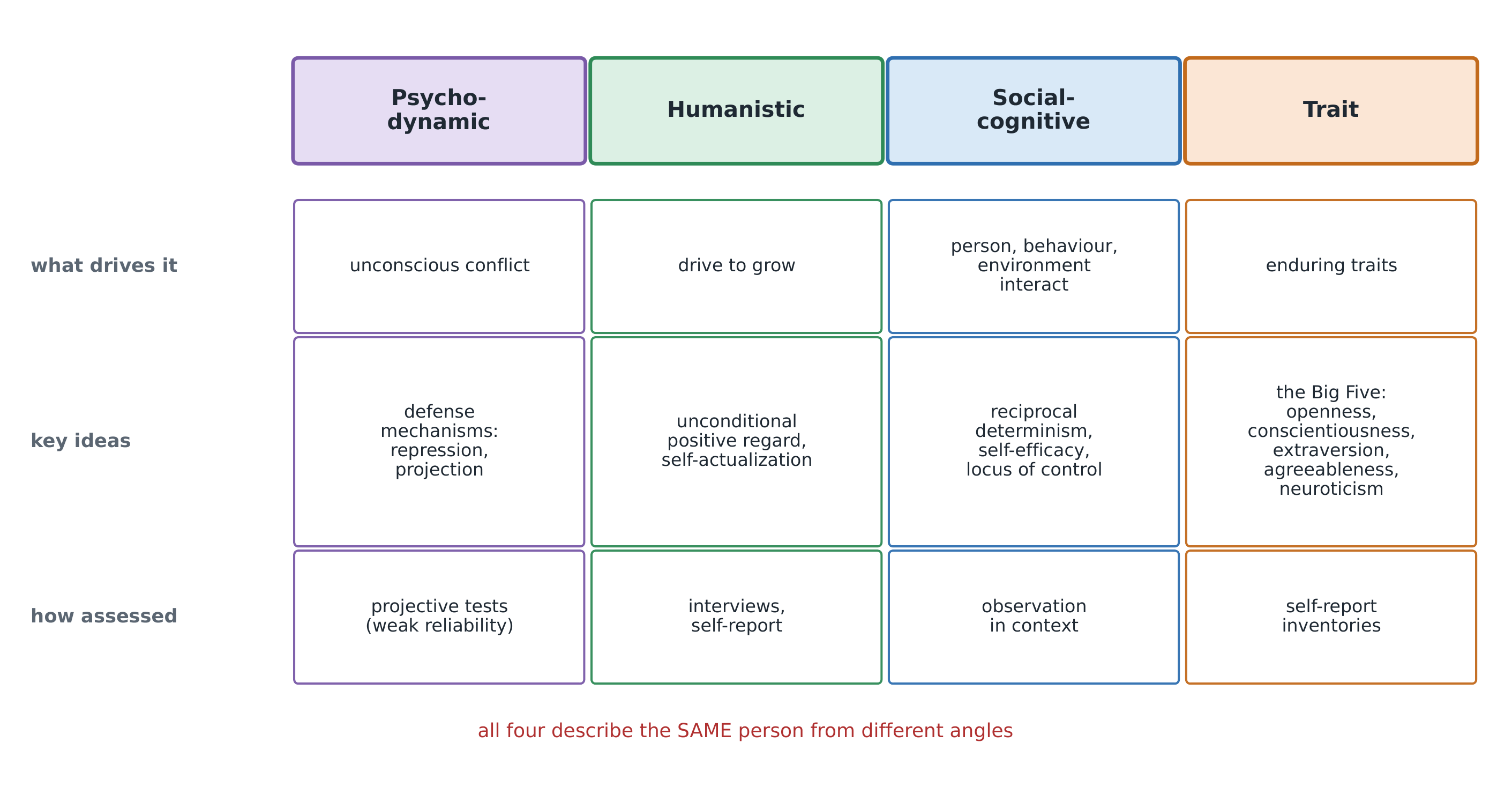
四种人格取向并列呈现,分别标出各自认为驱动人格的因素以及测评方式
四种人格取向,各有不同的驱动因素与不同的测量方式

人格(personality)是一个人在思维、情感与行为上的典型模式。有四种取向在考试范围内。

精神动力学(psychodynamic)取向认为无意识(unconscious)过程驱动人格。自我防御机制(ego defense mechanisms)保护个体免受焦虑困扰,考试范围内的一组是否认(denial)、转移(displacement)、投射(projection)、合理化(rationalization)、反向形成(reaction formation)、退行(regression)、压抑(repression)和升华(sublimation)。它使用呈现模糊刺激的投射测验(projective tests)来测评人格,而这类测验的信度效度都较弱。

人本主义(humanistic)取向关注成长,强调无条件积极关注(unconditional positive regard)与自我实现(self-actualization)——成为最充分的自己。

词汇表 训练
英文 中文 拼音
Personality 人格 rén gé
psychodynamic 精神动力学 jīng shén dòng lì xué
unconscious 无意识 wú yì shí
Ego defense mechanisms 自我防御机制 zì wǒ fáng yù jī zhì
denial 否认 fǒu rèn
displacement 转移 zhuǎn yí
projection 投射 tóu shè
rationalization 合理化 hé lǐ huà
reaction formation 反向形成 fǎn xiàng xíng chéng
regression 退行 tuì xíng
repression 压抑 yā yì
sublimation 升华 shēng huá
projective tests 投射测验 tóu shè cè yàn
humanistic 人本主义 rén běn zhǔ yì
unconditional positive regard 无条件积极关注 wú tiáo jiàn jī jí guān zhù
self-actualization 自我实现 zì wǒ shí xiàn
4.5

社会认知与特质人格理论

大纲
Learning ObjectiveEssential Knowledge

4.5.A
Explain how the social-cognitive theory of personality defines and assesses personality.

  • 4.5.A.1 According to social-cognitive theory, reciprocal determinism shapes personality. Reciprocal determinism explores self-concept (how one views themselves and in relation to others) and how self-efficacy and self-esteem both contribute to self-concept.

4.5.B
Explain how trait theories of personality define and assess personality.

  • 4.5.B.1 Trait theories of personality conclude that personality involves a set of enduring characteristics that lead to typical responses to stimuli.
  • 4.5.B.2 The Big Five theory of personality proposes that traits of agreeableness, openness to experience, extraversion, conscientiousness, and emotional stability make up one’s personality. These traits are measured by specialized personality inventories that use factor analysis to organize item responses.

来源:美国大学理事会 AP 课程与考试说明

社会认知(social-cognitive)取向用交互决定论(reciprocal determinism)解释人格:个人、行为与环境三者相互影响。核心概念是自我效能感(self-efficacy,相信自己能完成某项任务),以及分为内控(internal)与外控(external)的控制点(locus of control)。

特质理论(trait theories)把人格描述为持久的特征。大五人格(Big Five)包括开放性(openness to experience)、尽责性(conscientiousness)、外向性(extraversion)、宜人性(agreeableness)和神经质(neuroticism)。特质用自陈量表测量,其信度高于投射测验。

词汇表 训练
英文 中文 拼音
social-cognitive 社会认知 shè huì rèn zhī
reciprocal determinism 交互决定论 jiāo hù jué dìng lùn
Self-efficacy 自我效能感 zì wǒ xiào néng gǎn
locus of control 控制点 kòng zhì diǎn
internal 内控 nèi kòng
external 外控 wài kòng
Trait theories 特质理论 tè zhì lǐ lùn
Big Five 大五人格 dà wǔ rén gé
openness to experience 开放性 kāi fàng xìng
conscientiousness 尽责性 jìn zé xìng
extraversion 外向性 wài xiàng xìng
agreeableness 宜人性 yí rén xìng
neuroticism 神经质 shén jīng zhì
4.6

动机

大纲
Learning ObjectiveEssential Knowledge

4.6.A
Explain how theories about motivation apply to behavior and mental processes.

  • 4.6.A.1 Some theories about motivation focus on behavior and mental processes that seek to address physical needs and desires such as drive-reduction theory and arousal theory. Drive-reduction theory addresses how certain behaviors help maintain homeostasis while arousal theory addresses how people seek an optimal level of arousal when they behave (as demonstrated by the Yerkes-Dodson Law).
  • 4.6.A.2 Self-determination theory proposes that people are motivated by intrinsic (internal) or extrinsic (external) motivations. Incentive theory explores the role of rewards (an extrinsic motivation) in motivating behavior.
  • 4.6.A.3 Many non-human animals are motivated by instincts (innate, typically fixed patterns of behavior in animals in response to certain stimuli). Humans do not seem to demonstrate instinctual behavior or mental processes.
  • 4.6.A.4 Lewin’s motivational conflicts theory proposes that choices create conflicts one must resolve as the basis of motivation. The type of conflicts faced include approach-approach, approach-avoidance, and avoidance-avoidance.
  • 4.6.A.5 Sensation-seeking theory proposes that one’s level of need for varied or novel experiences is the basis of motivation. The types of sensation seeking are experience seeking, thrill or adventure seeking, disinhibition, and boredom susceptibility.

4.6.B
Explain how eating and belongingness motivate behavior and mental processes.

  • 4.6.B.1 Eating is a complex motivated behavior that demonstrates how physical and mental processes interact.
    • 4.6.B.1.i Hormones, such as ghrelin and leptin (regulated by the hypothalamus via the pituitary gland), regulate feelings of hunger and satiety.
    • 4.6.B.1.ii External factors like the presence of food, time of day, or social gatherings around meals also influence the behavior of eating.

来源:美国大学理事会 AP 课程与考试说明

有若干理论解释行为的驱动力:

  • 驱力减少理论(drive-reduction theory)认为行为是为了减少生理需要,以恢复内稳态(homeostasis)。
  • 唤醒理论(arousal theory)认为人追求最佳唤醒水平;耶克斯-多德森定律(Yerkes-Dodson law)指出中等唤醒水平在多数任务上带来最佳表现。
  • 自我决定理论(self-determination theory)区分内在动机(intrinsic motivation,源自内部)与外在动机(extrinsic motivation,源自奖励),诱因理论(incentive theory)则关注奖励的拉动作用。
  • 本能(instincts)是天生的固定行为模式,主要见于非人类动物,而非人类行为。
  • 勒温的动机冲突理论(Lewin's motivational conflicts)提出三种冲突:双趋冲突(approach-approach)、趋避冲突(approach-avoidance)和双避冲突(avoidance-avoidance)。
  • 感觉寻求理论(sensation-seeking theory)解释人们对新异刺激需求程度的差异。

进食体现了生理与心理过程的相互作用。由下丘脑调节的胃饥饿素瘦素控制饥饿与饱腹感,而外部因素——看到食物、到了饭点、与人共餐——会改变人的进食量。

词汇表 训练
英文 中文 拼音
Drive-reduction theory 驱力减少理论 qū lì jiǎn shǎo lǐ lùn
homeostasis 内稳态 nèi wěn tài
Arousal theory 唤醒理论 huàn xǐng lǐ lùn
Yerkes-Dodson law 耶克斯-多德森定律 yé kè sī - duō dé sēn dìng lǜ
Self-determination theory 自我决定理论 zì wǒ jué dìng lǐ lùn
intrinsic motivation 内在动机 nèi zài dòng jī
extrinsic motivation 外在动机 wài zài dòng jī
incentive theory 诱因理论 yòu yīn lǐ lùn
Instincts 本能 běn néng
Lewin's motivational conflicts 勒温的动机冲突理论 lēi wēn de dòng jī chōng tū lǐ lùn
approach-approach 双趋冲突 shuāng qū chōng tū
approach-avoidance 趋避冲突 qū bì chōng tū
avoidance-avoidance 双避冲突 shuāng bì chōng tū
Sensation-seeking theory 感觉寻求理论 gǎn jué xún qiú lǐ lùn
4.7

情绪

大纲
Learning ObjectiveEssential Knowledge

4.7.A
Explain how theories of emotion apply to behavior and mental processes.

  • 4.7.A.1 Emotion, or affect, is a complex psychological process that is distinguished from reasoning or knowledge. Emotions reflect internal and external factors affecting an individual. Early 20th century psychological theories of emotion parsed the distinction between the physiological and cognitive experiences of emotion. Some theories proposed that the physiological and cognitive experiences occurred in succession while others proposed that they occurred simultaneously. Other theories emphasize that the cognitive label is required to experience an emotion. The facial-feedback hypothesis suggests that the experience of emotion is influenced by facial expressions, which supports theories that propose the physiological experience of emotion precedes the cognitive appraisal, and research testing this hypothesis has produced mixed results.
    • Exclusion Statement: Specific names of theories of emotion are outside the scope of the AP Psychology Exam.
  • 4.7.A.2 The broaden-and-build theory of emotion proposes that positive emotional experiences tend to broaden awareness and encourage new actions and thoughts. Negative emotions tend to reduce awareness and narrow thinking and action.

4.7.B
Explain how social norms and experiences influence the expression of emotions.

  • 4.7.B.1 Research has explored whether the expression of emotions is universally common. Some emotions that may be commonly experienced across cultures include anger, disgust, sadness, happiness, surprise, and fear. Research on the universality of emotions shows mixed results.
  • 4.7.B.2 Display rules and elicitors for emotional expression can differ among cultures. Display rules and elicitors may regulate how people from different genders, ages, or socioeconomic classes within a culture can display and interpret emotions.

来源:美国大学理事会 AP 课程与考试说明

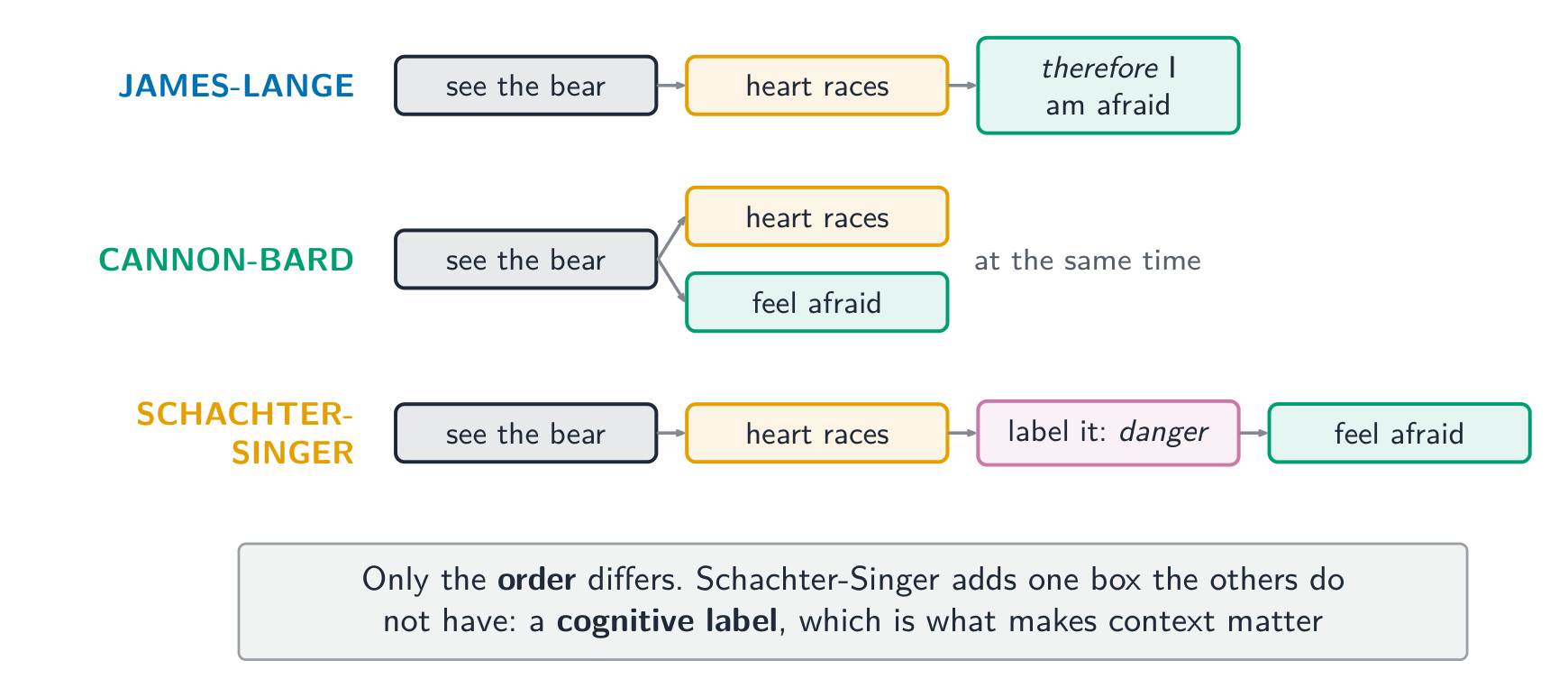
情绪(emotion),也称情感(affect),由生理唤醒、表情行为与主观体验共同构成。考试范围内的理论有詹姆斯-兰格理论(James-Lange theory,身体先反应,情绪是对该反应的解读)、坎农-巴德理论(Cannon-Bard theory,唤醒与情绪同时发生)和沙赫特-辛格两因素理论(Schachter-Singer two-factor theory,唤醒加上认知标签(cognitive label))。拓展-建构理论(broaden-and-build theory)认为积极情绪会拓宽思维并建构持久的资源。

有些面部表情能被跨文化识别,但表达规则(display rules,某一文化关于何时表露情绪的规范)以及引发情绪的事件都因文化而异。

词汇表 训练
英文 中文 拼音
Emotion 情绪 qíng xù
affect 情感 qíng gǎn
James-Lange theory 詹姆斯-兰格理论 zhān mǔ sī - lán gé lǐ lùn
Cannon-Bard theory 坎农-巴德理论 kǎn nóng - bā dé lǐ lùn
Schachter-Singer two-factor theory 沙赫特-辛格两因素理论 shā hè tè - xīn gé liǎng yīn sù lǐ lùn
cognitive label 认知标签 rèn zhī biāo qiān
Broaden-and-build theory 拓展-建构理论 tuò zhǎn - jiàn gòu lǐ lùn
display rules 表达规则 biǎo dá guī zé
4.7

考试技巧

  • 基本归因错误用于解释他人。如果题目问的是解释自己,答案通常是自利偏差
  • 社会助长提升简单任务、损害困难任务的表现。要说清情境描述的是哪一类任务。
  • 从众(与群体一致)和服从(听从权威)区分开。
  • 回答认知失调题时,要点明冲突所在,并说明哪一方发生了改变——通常是态度,因为行为已经发生。
  • 大五人格当作一组来记;题目常要求你把描述中的人放到某一具体特质上。
  • 情绪理论的区别在于顺序:身体先(詹姆斯-兰格)、同时(坎农-巴德),还是唤醒加标签(两因素)。

本主题的互动课程

逐步学习,并即时检测练习。

AP 心理学的更多主题

登录或创建账号

IGCSE, A-Level & AP