跳到主要内容

认知

AP 心理学 · 第 2 主题

训练
讲义 词汇表
2.1

知觉

大纲
Learning ObjectiveEssential Knowledge

2.1.A
Explain how internal and external factors influence perception.

  • 2.1.A.1 Perception is influenced by whether one primarily relies on external sensory information (bottom-up processing) or internal prior expectations (top-down processing).
  • 2.1.A.2 Schemas and perceptual sets are internal factors that filter perceptions of the world.
  • 2.1.A.3 Contexts, experiences, and cultural experiences and expectations are external factors that filter perceptions of the world.
  • 2.1.A.4 Perceptual principles proposed by Gestalt psychology (closure, figure and ground, proximity, and similarity) help explain how humans organize their perceptual world.
  • 2.1.A.5 Attention is an interaction of sensation and perception that is affected by internal and external processes.
    • 2.1.A.5.i Some experiences of attention can be selective, such as with the cocktail party effect, where people attend to mentions of their names or specific topics in loud or distracting environments.
    • 2.1.A.5.ii Inattention can lead to a type of “blindness” to aspects of the environment. Change blindness occurs when changes to the environment are not perceived due to inattention.

2.1.B
Explain how visual perceptual processes produce correct or incorrect interpretations of stimuli.

  • 2.1.B.1 Binocular depth cues of retinal disparity (the difference between the images projecting onto the retina) and convergence (the merging of the retinal images by the brain) utilize images from each eye to provide perception of depth.
  • 2.1.B.2 Monocular depth cues (relative clarity, relative size, texture gradient, linear perspective, and interposition) give the illusion of depth on flat or two-dimensional surfaces.
    • Exclusion Statement: The AP Psychology Exam will only address the listed monocular depth cues in EK 2.1.B.2.
  • 2.1.B.3 Visual perceptual constancies maintain the perception of an object even when the images of the object in the visual field change.
  • 2.1.B.4 Apparent movement can be visually perceived even when objects are not actually moving.

来源:美国大学理事会 AP 课程与考试说明

第一单元讲到感觉(sensation),即对刺激的探测。知觉(perception)是大脑接下来做的事:组织并解释这些信息。同样的信号可以被知觉成不止一种样子。

两个加工方向共同起作用:

  • 自下而上加工(bottom-up processing)从原始的感觉信息出发,逐层向上构建。
  • 自上而下加工(top-down processing)从你已有的期待与知识出发。

内部因素会过滤知觉。图式(schema)是由过往经验形成的心理框架,知觉定势(perceptual set)是以某种特定方式去看事物的准备状态。外部因素同样重要:情境(context)和文化期待会改变人们报告看到的内容。

格式塔心理学(Gestalt psychology)描述了大脑如何把部分组合成整体:闭合(closure,补全缺口)、图形与背景(figure and ground,把物体从背景中分离)、邻近性(proximity,把靠近的东西归为一组)和相似性(similarity,把看起来像的东西归为一组)。

注意(attention)位于感觉与知觉之间。它是有限的,因此一部分信息会丢失:

  • 选择性注意(selective attention)聚焦于某一输入。鸡尾酒会效应(cocktail party effect)是指在嘈杂房间里听到有人叫自己的名字。
  • 无意视盲(inattentional blindness)是因为注意力在别处而没看见眼前的东西;变化盲视(change blindness)是没有察觉到某处发生了变化。
词汇表 训练
英文 中文 拼音
Perception 知觉 zhī jué
Bottom-up processing 自下而上加工 zì xià ér shàng jiā gōng
Top-down processing 自上而下加工 zì shàng ér xià jiā gōng
schema 图式 tú shì
perceptual set 知觉定势 zhī jué dìng shì
context 情境 qíng jìng
Gestalt psychology 格式塔心理学 gé shì tǎ xīn lǐ xué
closure 闭合 bì hé
figure and ground 图形与背景 tú xíng yǔ bèi jǐng
proximity 邻近性 lín jìn xìng
similarity 相似性 xiāng sì xìng
Attention 注意 zhù yì
Selective attention 选择性注意 xuǎn zé xìng zhù yì
cocktail party effect 鸡尾酒会效应 jī wěi jiǔ huì xiào yìng
Inattentional blindness 无意视盲 wú yì shì máng
change blindness 变化盲视 biàn huà máng shì
2.1

知觉

大纲
Learning ObjectiveEssential Knowledge

2.1.A
Explain how internal and external factors influence perception.

  • 2.1.A.1 Perception is influenced by whether one primarily relies on external sensory information (bottom-up processing) or internal prior expectations (top-down processing).
  • 2.1.A.2 Schemas and perceptual sets are internal factors that filter perceptions of the world.
  • 2.1.A.3 Contexts, experiences, and cultural experiences and expectations are external factors that filter perceptions of the world.
  • 2.1.A.4 Perceptual principles proposed by Gestalt psychology (closure, figure and ground, proximity, and similarity) help explain how humans organize their perceptual world.
  • 2.1.A.5 Attention is an interaction of sensation and perception that is affected by internal and external processes.
    • 2.1.A.5.i Some experiences of attention can be selective, such as with the cocktail party effect, where people attend to mentions of their names or specific topics in loud or distracting environments.
    • 2.1.A.5.ii Inattention can lead to a type of “blindness” to aspects of the environment. Change blindness occurs when changes to the environment are not perceived due to inattention.

2.1.B
Explain how visual perceptual processes produce correct or incorrect interpretations of stimuli.

  • 2.1.B.1 Binocular depth cues of retinal disparity (the difference between the images projecting onto the retina) and convergence (the merging of the retinal images by the brain) utilize images from each eye to provide perception of depth.
  • 2.1.B.2 Monocular depth cues (relative clarity, relative size, texture gradient, linear perspective, and interposition) give the illusion of depth on flat or two-dimensional surfaces.
    • Exclusion Statement: The AP Psychology Exam will only address the listed monocular depth cues in EK 2.1.B.2.
  • 2.1.B.3 Visual perceptual constancies maintain the perception of an object even when the images of the object in the visual field change.
  • 2.1.B.4 Apparent movement can be visually perceived even when objects are not actually moving.

来源:美国大学理事会 AP 课程与考试说明

要从平面的视网膜像知觉出三维世界,大脑会使用深度线索(depth cues)。

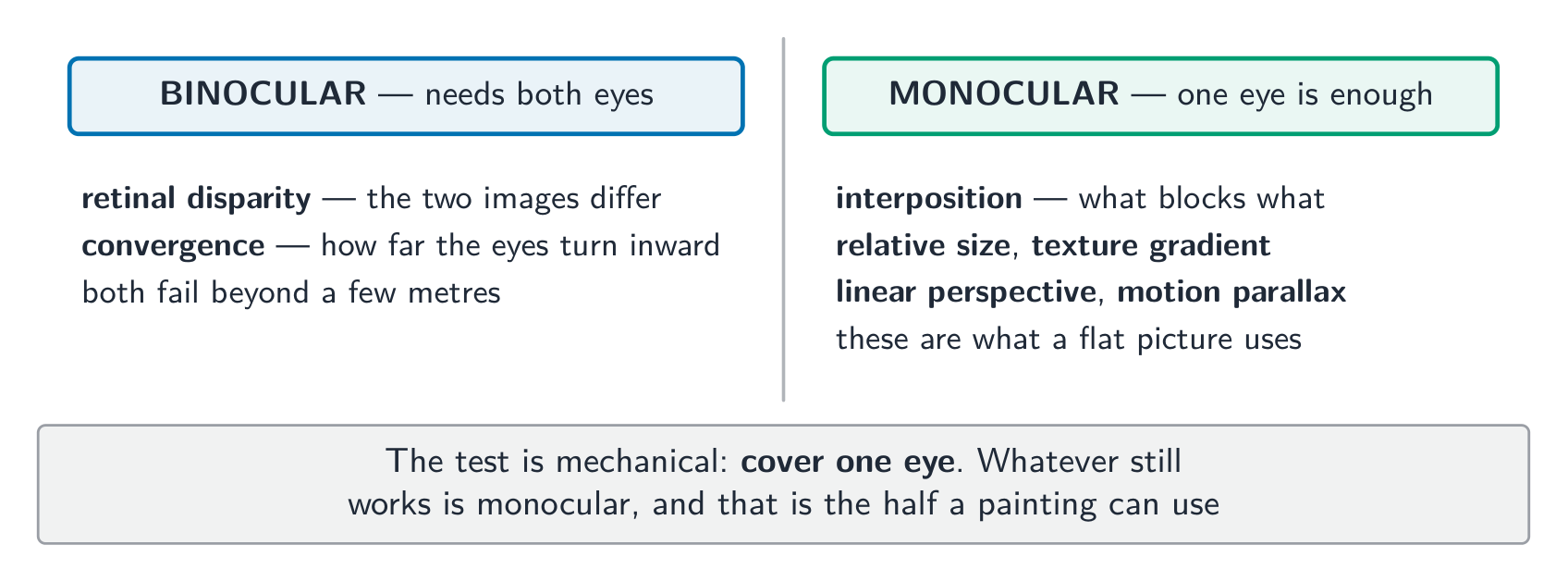
双眼线索(binocular cues)需要两只眼睛。视网膜像差(retinal disparity)是两幅图像之间的细小差别,差别越大,物体越近。辐辏(convergence)是看近物时双眼向内转动。

单眼线索(monocular cues)只用一只眼即可:相对清晰度(relative clarity)、相对大小(relative size)、纹理梯度(texture gradient)、线条透视(linear perspective)和遮挡(interposition,近处物体挡住远处物体)。

知觉恒常性(perceptual constancy)让物体在视网膜像改变时看起来仍然一样——门打开时仍被看成长方形。大脑还能在没有真实运动时知觉到似动(apparent movement),这正是一连串静止画面看起来像影片的原因。

词汇表 训练
英文 中文 拼音
depth cues 深度线索 shēn dù xiàn suǒ
Binocular cues 双眼线索 shuāng yǎn xiàn suǒ
Retinal disparity 视网膜像差 shì wǎng mó xiàng chà
Convergence 辐辏 fú còu
Monocular cues 单眼线索 dān yǎn xiàn suǒ
relative clarity 相对清晰度 xiāng duì qīng xī dù
relative size 相对大小 xiāng duì dà xiǎo
texture gradient 纹理梯度 wén lǐ tī dù
linear perspective 线条透视 xiàn tiáo tòu shì
interposition 遮挡 zhē dǎng
Perceptual constancy 知觉恒常性 zhī jué héng cháng xìng
apparent movement 似动 shì dòng
2.2

思维、问题解决、判断与决策

大纲
Learning ObjectiveEssential Knowledge

2.2.A
Explain how psychological concepts and theories account for thinking, problem-solving, judgment, and decision-making.

  • 2.2.A.1 Concepts form the basis of thought. Prototypes are the ideal example for any given concept.
  • 2.2.A.2 People form and modify schemas, or frameworks for thinking, through assimilation (taking in new information but not changing the schema in light of it) and accommodation (taking in new information and changing the schema to incorporate the new information).
  • 2.2.A.3 Algorithms address problems by attempting all possible solutions until the correct one is found.
  • 2.2.A.4 Heuristics address problems by using mental shortcuts to make judgments. Using heuristics can lead to errors in judgment when decisions are made according to prior expectations or stereotypes (representativeness heuristic) or recalling the first or most vivid example that comes to mind (availability heuristic).
  • 2.2.A.5 Decision making can be influenced by prior experiences that were successful (mental set) or circumstances surrounding a decision (priming and framing).
  • 2.2.A.6 Cognitive processes such as gambler’s fallacy and sunk-cost fallacy can hinder people from making good decisions.
  • 2.2.A.7 Executive functions are cognitive processes that allow individuals to generate, organize, plan, and carry out goal-directed behaviors and experience critical thinking.
  • 2.2.A.8 Creativity is a way of thinking that includes generating novel ideas and engaging in divergent (versus convergent) thinking. Creative thinking is hindered by functional fixedness.

来源:美国大学理事会 AP 课程与考试说明

概念(concepts)是思维的基础,原型(prototype)是某个概念最典型的例子。人们通过同化(assimilation,把新信息纳入已有图式)和顺应(accommodation,改变图式以适应新信息)来建立和修改图式。

解决问题有两种方式:

  • 算法(algorithm)逐一尝试所有可能的解法,一定能得到答案,但很慢。
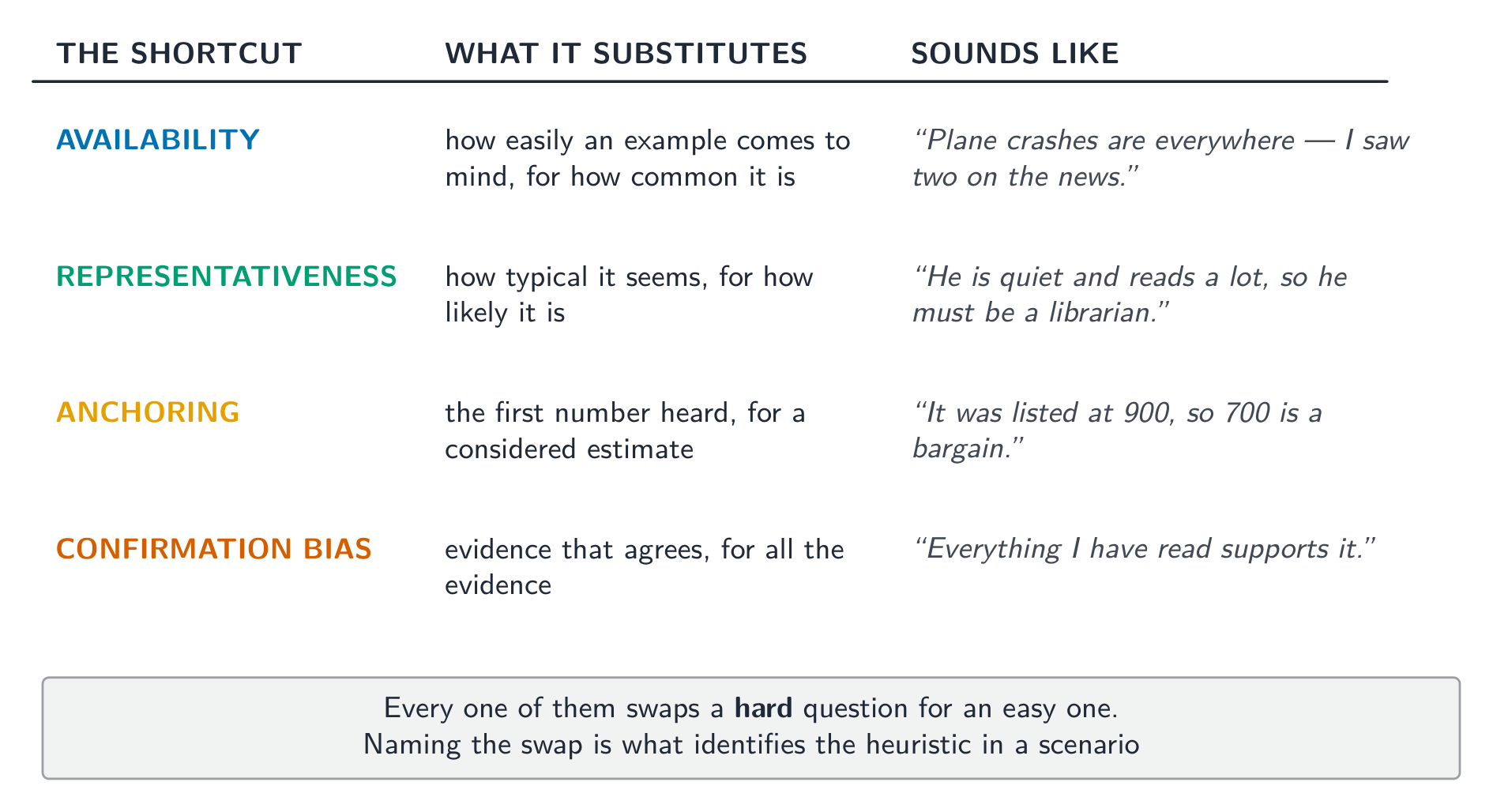
  • 启发式(heuristic)是心理捷径,速度快但可能出错——代表性启发式(representativeness heuristic)按与原型的相似程度作判断,可得性启发式(availability heuristic)按例子在脑中出现的容易程度作判断。

思维也可能卡住。心向(mental set)是倾向于重复以前奏效的解法,功能固着(functional fixedness)是只看到物体的常规用途。赌徒谬误(gambler's fallacy,认为连续的走势必然会中断)和沉没成本谬误(sunk-cost fallacy,因为已经投入而继续)都会妨碍好的决策。

执行功能(executive functions)使人能够产生、组织、计划并执行目标。创造力(creativity)依赖发散思维(divergent thinking,产生大量想法),而不是聚合思维(convergent thinking,收敛到唯一答案)。

词汇表 训练
英文 中文 拼音
Concepts 概念 gài niàn
prototype 原型 yuán xíng
assimilation 同化 tóng huà
accommodation 顺应 shùn yìng
algorithm 算法 suàn fǎ
heuristic 启发式 qǐ fā shì
representativeness heuristic 代表性启发式 dài biǎo xìng qǐ fā shì
availability heuristic 可得性启发式 kě dé xìng qǐ fā shì
mental set 心向 xīn xiàng
Functional fixedness 功能固着 gōng néng gù zhuó
gambler's fallacy 赌徒谬误 dǔ tú miù wù
sunk-cost fallacy 沉没成本谬误 chén mò chéng běn miù wù
Executive functions 执行功能 zhí xíng gōng néng
Creativity 创造力 chuàng zào lì
divergent thinking 发散思维 fā sàn sī wéi
convergent thinking 聚合思维 jù hé sī wéi
2.3

记忆导论

大纲
Learning ObjectiveEssential Knowledge

2.3.A
Explain how the types, structures, and processes of memory work.

  • 2.3.A.1 Memories for learned knowledge, events, and experiences are differentiated by how they are processed by, stored in, and retrieved by the brain.
    • 2.3.A.1.i Explicit memory is a type of memory that is more easily described or explained to others. Types of explicit memory include episodic and semantic.
    • 2.3.A.1.ii Implicit memory is more challenging to describe or explain to others. Procedural memory is a type of implicit memory for procedures and processes.
    • 2.3.A.1.iii Prospective memory is a type of memory related to future actions.
  • 2.3.A.2 Long-term potentiation, a process by which synaptic connections between neurons become stronger with frequent activation, is a biological process for memory.
  • 2.3.A.3 The working memory model examines how our primary memory system—working memory— engages in a dynamic interaction with several components, namely the central executive, phonological loop, and visuospatial sketchpad, to process information into long-term memory.
  • 2.3.A.4 The multi-store model proposes three interacting systems (sensory memory [including iconic and echoic memory], short-term memory, and long-term memory) that information must pass through to be remembered. This model focuses on the impact of automatic and effortful processing on memory encoding, storage, and retrieval.
  • 2.3.A.5 The levels of processing model proposes that memory is encoded on three levels from shallowest to deepest: structural, phonemic, and semantic.

来源:美国大学理事会 AP 课程与考试说明

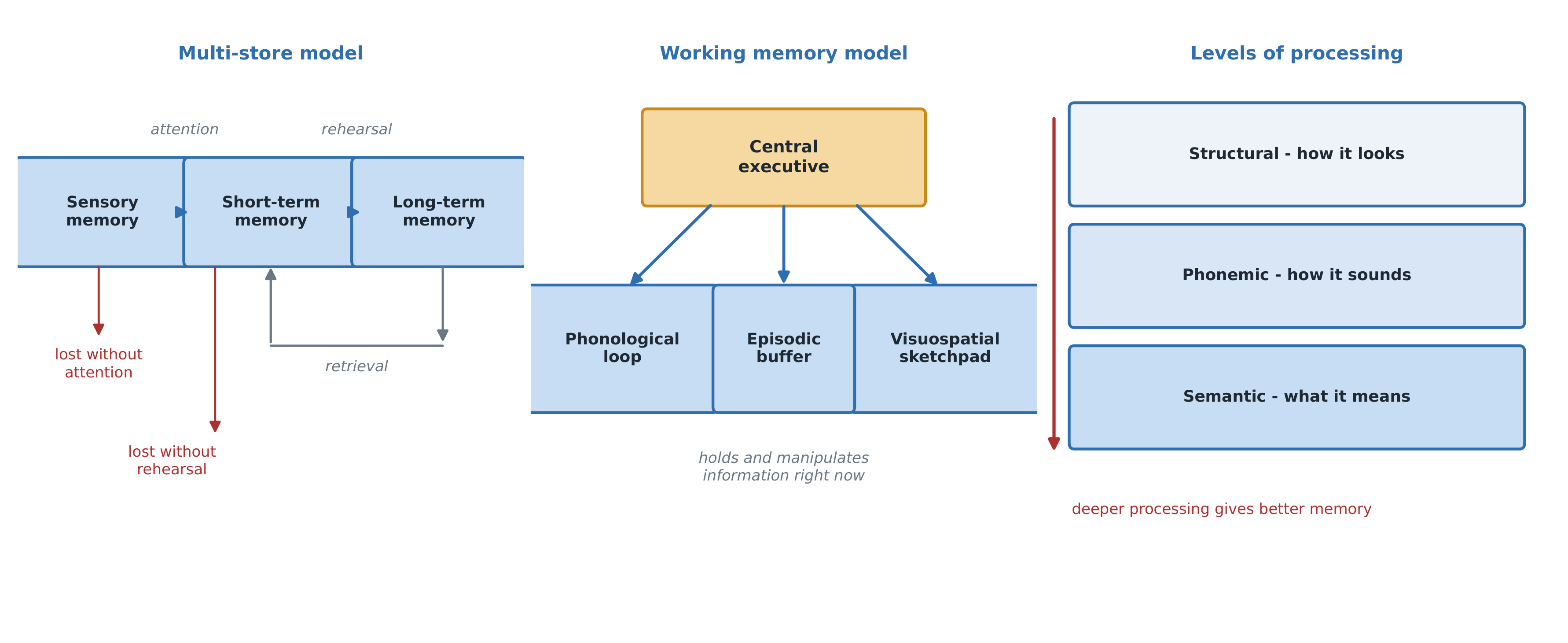
并排呈现的三种记忆模型:多重存储的信息流、工作记忆的各个成分,以及加工水平的深度标尺
三种在考试范围内的记忆模型:信息在各存储之间流动,在工作记忆中被主动保持,而加工越深记忆越好

记忆按信息的加工方式来划分。

外显记忆(explicit memory)可以向别人描述,又分为情景记忆(episodic memory,个人经历)和语义记忆(semantic memory,事实知识)。内隐记忆(implicit memory)较难描述,其中包括程序性记忆(procedural memory,如骑车这类技能)。前瞻记忆(prospective memory)是记得以后要做某件事。

长时程增强(long-term potentiation)是其生物学基础:突触连接会因反复使用而增强。

有三种模型在考试范围内:

  • 多重存储模型(multi-store model)提出感觉记忆(sensory memory,包括图像记忆(iconic)和声像记忆(echoic))、短时记忆(short-term memory)和长时记忆(long-term memory)。
  • 工作记忆模型(working memory model)把中间阶段看作主动加工,而非等候室。它包含语音回路(phonological loop)、视空间模板(visuospatial sketchpad)和中央执行系统(central executive)。
  • 加工水平模型(levels of processing model)认为加工越深记忆越好:从最浅的外形加工,到语音加工,再到最深的意义加工。
词汇表 训练
英文 中文 拼音
Explicit memory 外显记忆 wài xiǎn jì yì
episodic memory 情景记忆 qíng jǐng jì yì
semantic memory 语义记忆 yǔ yì jì yì
Implicit memory 内隐记忆 nèi yǐn jì yì
procedural memory 程序性记忆 chéng xù xìng jì yì
Prospective memory 前瞻记忆 qián zhān jì yì
Long-term potentiation 长时程增强 zhǎng shí chéng zēng qiáng
multi-store model 多重存储模型 duō zhòng cún chǔ mó xíng
sensory memory 感觉记忆 gǎn jué jì yì
iconic 图像记忆 tú xiàng jì yì
echoic 声像记忆 shēng xiàng jì yì
short-term memory 短时记忆 duǎn shí jì yì
long-term memory 长时记忆 zhǎng shí jì yì
working memory model 工作记忆模型 gōng zuò jì yì mó xíng
phonological loop 语音回路 yǔ yīn huí lù
visuospatial sketchpad 视空间模板 shì kōng jiān mú bǎn
central executive 中央执行系统 zhōng yāng zhí xíng xì tǒng
levels of processing model 加工水平模型 jiā gōng shuǐ píng mó xíng
2.4 2.5

记忆的编码

大纲
Learning ObjectiveEssential Knowledge

2.4.A
Explain how different encoding processes work to get information into memory.

  • 2.4.A.1 Encoding involves processes and strategies to get information into memory. How information is encoded can determine how effectively information is stored and retrieved.
  • 2.4.A.2 Mnemonic devices, such as method of loci, are processes that aid in encoding information into working and long-term memory.
  • 2.4.A.3 Encoding can be improved by the process of grouping information together into meaningful chunks (“chunking”), categories, or hierarchies.
  • 2.4.A.4 The spacing effect is a process that can cause significant differences in encoding and memory consolidation depending on whether the information is encoded all at once (massed practice) or distributed over time (distributed practice).
  • 2.4.A.5 Encoding processes can be affected by the order of how the information is presented, called the serial position effect. The serial position effect predicts that information presented at the beginning of a list (primacy effect) or the end of a list (recency effect) will be more memorable than information presented in the middle of a list.
Learning ObjectiveEssential Knowledge

2.5.A
Explain how memory storage processes retain information in memory.

  • 2.5.A.1 Sensory memory, short-term memory, working memory, and long-term memory are processes that differ in storage duration, capacity, and content.
  • 2.5.A.2 Storage may be prolonged by rehearsing information over time (maintenance rehearsal). Rehearsing information over time in ways that promote meaning (elaborative rehearsal) helps with memory retention.
  • 2.5.A.3 Some people demonstrate highly superior autobiographical memory which may indicate that there are biological processes for superior memory storage. Autobiographical memory may also explain why memories connected to our own lives or selves are more memorable.
  • 2.5.A.4 Storage processes may be negatively affected by physical impairment and developmental limitations, such as amnesia (retrograde and anterograde), Alzheimer’s disease, and infantile amnesia.

来源:美国大学理事会 AP 课程与考试说明

编码(encoding)是把信息送入记忆的过程,编码方式会改变记忆效果。

  • 记忆术(mnemonic devices),如位置法(method of loci),有助于编码。
  • 组块(chunking)把项目合并成有意义的单元,从而提高短时记忆的容量。
  • 间隔效应(spacing effect)表明分散学习优于集中练习(massed practice,临时抱佛脚)。
  • 系列位置效应(serial position effect)指列表开头(首因效应(primacy))和结尾(近因效应(recency))的项目记得最牢。

不同系统的存储方式不同。保持性复述(maintenance rehearsal)靠重复来保持信息;精细复述(elaborative rehearsal)把信息与已有知识联系起来,效果更好。

少数人表现出超常自传体记忆(highly superior autobiographical memory),这提示存在生物学差异。存储也可能受损:阿尔茨海默病(Alzheimer's disease)和婴儿期遗忘(infantile amnesia)都会限制能够存储或恢复的内容。

词汇表 训练
英文 中文 拼音
Encoding 编码 biān mǎ
Mnemonic devices 记忆术 jì yì shù
method of loci 位置法 wèi zhì fǎ
Chunking 组块 zǔ kuài
spacing effect 间隔效应 jiàn gé xiào yìng
massed practice 集中练习 jí zhōng liàn xí
serial position effect 系列位置效应 xì liè wèi zhì xiào yìng
primacy 首因效应 shǒu yīn xiào yìng
recency 近因效应 jìn yīn xiào yìng
Maintenance rehearsal 保持性复述 bǎo chí xìng fù shù
elaborative rehearsal 精细复述 jīng xì fù shù
highly superior autobiographical memory 超常自传体记忆 chāo cháng zì zhuàn tǐ jì yì
Alzheimer's disease 阿尔茨海默病 ā ěr cí hǎi mò bìng
infantile amnesia 婴儿期遗忘 yīng ér qī yí wàng
2.6 2.7

记忆的提取

大纲
Learning ObjectiveEssential Knowledge

2.6.A
Explain how memory retrieval processes get information out of memory.

  • 2.6.A.1 The process of memory retrieval occurs through recall (remembering without cues) or recognition (which relies on retrieval cues).
  • 2.6.A.2 The process of memory retrieval can be enhanced when people are in the same environmental space (context-dependent memory), mood (mood-congruent memory), or physical state (state-dependent memory) as they were when they encoded the information to be retrieved.
  • 2.6.A.3 Successful retrieval is more likely when using retrieval practice processes, including testing effect and metacognition.
Learning ObjectiveEssential Knowledge

2.7.A
Explain possible reasons why memory failure or errors may occur.

  • 2.7.A.1 The forgetting curve shows that time is a significant factor in forgetting. Forgetting occurs rapidly after initial learning and levels off over time.
  • 2.7.A.2 Many memories are difficult to retrieve due to encoding failure, interference (proactive or retroactive), or inadequate retrieval (i.e., tip-of-the-tongue phenomenon).
  • 2.7.A.3 Psychodynamic theorists believe that information or memories can be forgotten to defend the ego from distress (repression).
  • 2.7.A.4 The accuracy of memories may be affected by the misinformation effect, source amnesia, or constructive memory (via memory consolidation and imagination inflation).

来源:美国大学理事会 AP 课程与考试说明

提取有两种形式:回忆(recall,没有线索地把信息提取出来)和再认(recognition,在若干选项中把它认出来)。再认更容易,这也是选择题比论述题感觉更轻松的原因。

条件匹配会提升提取效果。情境依存记忆(context-dependent memory)在同一地点效果更好;状态依存记忆(state-dependent memory)在同样的生理状态下更好;心境一致性记忆(mood-congruent memory)更容易回忆起与当前心境一致的材料。练习提取同样有效——测试效应(testing effect)表明自我测验优于反复阅读。

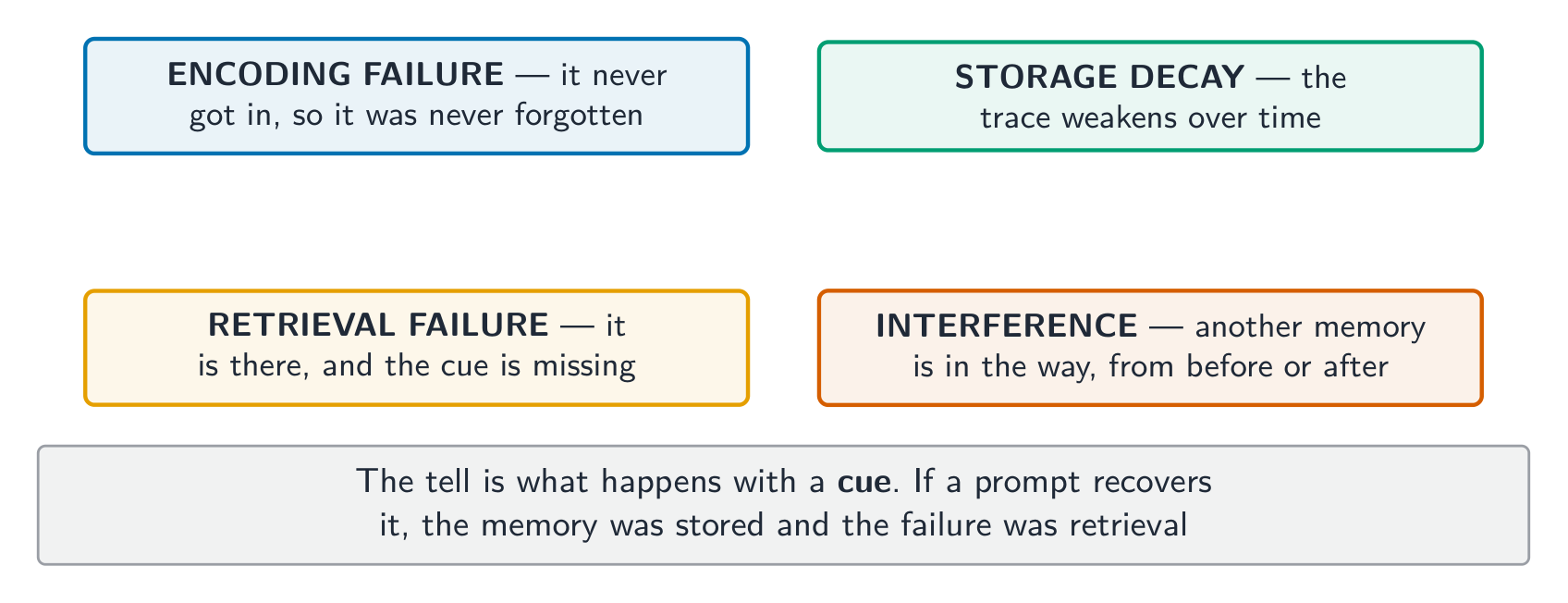
遗忘有多种原因。遗忘曲线(forgetting curve)显示学习之后遗忘最快。编码失败(encoding failure)意味着信息从未进入记忆。干扰(interference)可分为前摄干扰(proactive,旧学习妨碍新学习)和倒摄干扰(retroactive,新学习妨碍旧学习)。提取失败(retrieval failure)包括舌尖现象(tip-of-the-tongue phenomenon)。

记忆还是重构的(reconstructive),而不是录像。错误信息效应(misinformation effect)指事后获得的信息改变了一个人的记忆。来源遗忘(source amnesia)则是记得内容却想不起它出自哪里。

Worked example(一道真实的 AP 考题)。2025 年的文章分析题呈现了一项研究:被试阅读一段含 20%、50% 或 80% 误导性句子的摘要,然后回答关于一段视频的问题。正确率从 74%(低误导信息组)降到 63%(高误导信息组)。其中一问要求学生"解释至少一项研究结果如何支持或反驳错误信息效应"*。满分答案会同时给出结果*把它与概念相连:*"高误导信息组的正确率为 63%,而低误导信息组为 74%。接触更多误导性细节降低了准确率,因此该结果支持错误信息效应,即事件发生后获得的信息会改变对该事件的记忆。"*注意其结构:先引用数据,再点明数据支持的概念。只把定义重述一遍、不给出数字,并没有回答 Explain

词汇表 训练
英文 中文 拼音
recall 回忆 huí yì
recognition 再认 zài rèn
Context-dependent memory 情境依存记忆 qíng jìng yī cún jì yì
state-dependent memory 状态依存记忆 zhuàng tài yī cún jì yì
mood-congruent memory 心境一致性记忆 xīn jìng yí zhì xìng jì yì
testing effect 测试效应 cè shì xiào yìng
forgetting curve 遗忘曲线 yí wàng qū xiàn
Encoding failure 编码失败 biān mǎ shī bài
Interference 干扰 gān rǎo
proactive 前摄干扰 qián shè gān rǎo
retroactive 倒摄干扰 dào shè gān rǎo
Retrieval failure 提取失败 tí qǔ shī bài
tip-of-the-tongue phenomenon 舌尖现象 shé jiān xiàn xiàng
reconstructive 重构的 zhòng gòu de
misinformation effect 错误信息效应 cuò wù xìn xī xiào yìng
Source amnesia 来源遗忘 lái yuán yí wàng
2.8

智力与成就

大纲
Learning ObjectiveEssential Knowledge

2.8.A
Explain how modern and historical theories describe intelligence.

  • 2.8.A.1 Throughout history, consensus about how to define and measure intelligence continues to be elusive and can be subject to bias. Researchers debate whether intelligence is a general ability (called g) or is comprised of multiple abilities.

2.8.B
Explain how intelligence is measured.

  • 2.8.B.1 Early formal intelligence tests yielded an intelligence quotient (IQ), which divided mental age by chronological age. In modern times, IQ scores are often used to identify students for educational services.
    • Exclusion Statement: Labeling or describing cognitive abilities and disabilities are outside the scope of the AP Psychology Exam.
  • 2.8.B.2 All psychological assessments, including intelligence tests, should adhere to sound psychometric principles to be considered useful.
    • 2.8.B.2.i A test is said to be standardized when it is administered using consistent procedures and environments.
    • 2.8.B.2.ii A test is considered valid if it measures what it is designed to measure. Types of validity include construct and predictive.
    • 2.8.B.2.iii A test is considered reliable if it yields similar results each time it is administered. Types of reliability include test-retest and split-half.
  • 2.8.B.3 Researchers strive to develop assessments of intelligence that are socio-culturally responsive to reduce stereotype threat and potential inequity that may occur due to stereotype lift.

2.8.C
Explain how systemic issues relate to the quantitative and qualitative uses of intelligence assessments.

  • 2.8.C.1 IQ scores across much of the world have generally increased over time (Flynn Effect) due to societal factors, such as higher socioeconomic status and access to better health care and better nutrition.
  • 2.8.C.2 IQ scores tend to vary more within a group than between groups. Personal and sociocultural biases can impact the interpretation of individual IQ scores and the score’s relationship with other outcomes. Poverty, discrimination, and educational inequities can negatively influence intelligence scores of individuals and societal groups around the world.
  • 2.8.C.3 Scores from intelligence tests have been used to limit access to jobs, military ranks, educational institutions, and immigration to the US.

2.8.D
Explain how academic achievement is measured and experienced as compared to intelligence.

  • 2.8.D.1 Some academic tests attempt to measure what someone knows (achievement tests) or predict how someone will perform in the future (aptitude tests).
  • 2.8.D.2 People’s beliefs about whether intelligence is fixed from birth (fixed mindset) or malleable due to experience (growth mindset) can affect academic achievement.

来源:美国大学理事会 AP 课程与考试说明

心理学家至今仍未就如何定义智力(intelligence)达成一致。一般智力因素(Spearman's g)主张存在一种普遍能力;另一些理论主张存在多种能力,包括流体智力(fluid intelligence,用于解决新异问题的推理能力,随年龄下降)和晶体智力(crystallised intelligence,积累的知识,不随年龄下降)。

早期测验用心理年龄除以实际年龄得到智商(intelligence quotient, IQ)。现代分数则与总体的正态曲线(normal curve)作比较。

任何心理测评都必须符合心理测量学原则(psychometric principles):

  • 标准化(standardization)——按一致的程序施测,并与常模团体比较记分。
  • 效度(validity)——测的确实是它声称要测的东西。构念效度(construct validity)和预测效度(predictive validity)都在考试范围内。
  • 信度(reliability)——每次施测结果相近,可用重测信度(test-retest reliability)和分半信度(split-half reliability)检验。

全世界的 IQ 分数在代际间普遍上升(弗林效应(Flynn effect)),这指向社会因素而非生物因素。分数在群体内部的差异大于群体之间的差异,而刻板印象威胁(stereotype threat)会在一个人担心印证关于自身群体的负面刻板印象时拉低其表现。

词汇表 训练
英文 中文 拼音
intelligence 智力 zhì lì
Spearman's g 一般智力因素 yì bān zhì lì yīn sù
fluid intelligence 流体智力 liú tǐ zhì lì
crystallised intelligence 晶体智力 jīng tǐ zhì lì
intelligence quotient (IQ) 智商 zhì shāng
normal curve 正态曲线 zhèng tài qū xiàn
psychometric principles 心理测量学原则 xīn lǐ cè liáng xué yuán zé
Standardization 标准化 biāo zhǔn huà
Validity 效度 xiào dù
Construct validity 构念效度 gòu niàn xiào dù
predictive validity 预测效度 yù cè xiào dù
Reliability 信度 xìn dù
test-retest reliability 重测信度 zhòng cè xìn dù
split-half reliability 分半信度 fēn bàn xìn dù
Flynn effect 弗林效应 fú lín xiào yìng
stereotype threat 刻板印象威胁 kè bǎn yìn xiàng wēi xié
2.8

考试技巧

  • 感觉知觉分开:探测是感觉,解释是知觉。
  • 自下而上从刺激开始,自上而下从期待开始。要说清题目情境属于哪一种。
  • 按方向记干扰:前摄指旧材料向前影响新材料。
  • 回答编码类题目时,要点出具体策略——组块、间隔学习、精细复述——而不是笼统地说"更努力地学"。
  • 回答测评题时,把信度效度分开。一个测验可以很可靠,却测的是错的东西。
  • 题目给出数据时,先引用一个数字,再点明概念。以结果为依据的小问,分数就落在数字与术语之间的联系上。

本主题的互动课程

逐步学习,并即时检测练习。

AP 心理学的更多主题

登录或创建账号

IGCSE, A-Level & AP