跳到主要内容
学科

AP 心理学

学习建议

AP 心理学包含五个单元:行为的生物学基础、认知、发展与学习、社会心理学与人格,以及心理健康与身体健康。它们从神经元出发,层层向外延伸到个人、群体与临床。

这门课的定义非常精确,而这种精确本身就是考点。感觉不等于知觉,负强化不等于惩罚,相关不等于因果。大多数失分来自术语使用含糊,而不是来自没学过的内容。

每个单元同时也是研究方法单元。你需要判断一项研究采用了什么设计、读懂数据与图表,并说明某个结果能支持什么、不能支持什么——科学实践与内容知识一同被考查。

要把概念应用到情境中。题目通常先描述一个情境,再问哪个概念能解释它,这与背诵定义是两种不同的任务。

课程框架会标明自身的边界。"排除条款"明确指出哪些内容不在考试范围之内;下面的笔记保留了这些条款,方便你知道学到哪里为止。

笔记按 College Board 的课程框架逐个专题展开,并列出每条学习目标背后的必备知识。

训练全部词汇
  • 1

    行为的生物学基础

    讲义 词汇表
    1.1

    遗传与环境的相互作用

    大纲
    Learning ObjectiveEssential Knowledge

    1.1.A
    Explain the relationship between heredity and environment in shaping behavior and mental processes.

    • 1.1.A.1 Heredity and environmental factors interact to shape behavior and mental processes.
      • 1.1.A.1.i Heredity, or “nature,” refers to genetic or predisposed characteristics that influence physical, behavioral, and mental traits and processes.
      • 1.1.A.1.ii Environmental factors, or “nurture,” refers to the external factors that one experiences, such as family interactions or education.
        • Exclusion Statement: Specific information about genetics (genotype, phenotype, DNA, chromosomes, and recessive and dominant gene expression) is beyond the scope of the AP Psychology Exam.
    • 1.1.A.2 The evolutionary perspective explores how natural selection affects the expression of behavior and mental processes to increase survival and reproductive success. Some theorists have sought to apply principles of the evolutionary perspective in ways that discriminate against others (eugenics).
    • 1.1.A.3 Research on the effects of genes on individual behavior and mental processes is often conducted using twin studies, family studies, and adoption studies.

    来源:美国大学理事会 AP 课程与考试说明

    心理学研究行为(behavior,一个人做了什么)和心理过程(mental processes,一个人怎么想、怎么感受)。第一单元要问的是:这些东西在身体里从哪里来。

    每一种特征都由两个来源共同塑造。遗传(heredity)是一个人从父母那里继承来的东西,环境(environment)是发生在他周围的一切。两者都不会单独起作用。

    • 先天与后天(nature and nurture)始终相互作用。身高由遗传决定,但营养不良会让它变矮。
    • 进化论视角(evolutionary perspective)解释那些曾帮助祖先生存和繁衍的行为。人容易学会怕蛇,是因为这在过去能保命。
    • 双生子与收养研究(twin and adoption studies)可以把两个来源分开。如果分开抚养的同卵双胞胎仍然相似,说明遗传对该特征有影响。

    *注意:*考试不考基因、DNA 或染色体,而是考遗传与环境如何共同塑造行为。

    词汇表 训练
    英文 中文 拼音
    behavior 行为 xíng wéi
    mental processes 心理过程 xīn lǐ guò chéng
    Heredity 遗传 yí chuán
    Environment 环境 huán jìng
    Nature and nurture 先天与后天 xiān tiān yǔ hòu tiān
    evolutionary perspective 进化论视角 jìn huà lùn shì jiǎo
    Twin and adoption studies 双生子与收养研究 shuāng shēng zi yǔ shōu yǎng yán jiū
    1.2

    神经系统概览

    大纲
    Learning ObjectiveEssential Knowledge

    1.2.A
    Differentiate among the subsystems of the human nervous system and their functions.

    • 1.2.A.1 The central nervous system includes the brain and the spinal cord and interacts with all processes in the body.
    • 1.2.A.2 The peripheral nervous system relays messages from the central nervous system to the rest of the body and includes the autonomic and somatic nervous systems.
      • 1.2.A.2.i The autonomic nervous system governs processes that are involuntary and includes the parasympathetic and sympathetic nervous systems.
      • 1.2.A.2.ii The somatic nervous system governs processes that are voluntary.

    来源:美国大学理事会 AP 课程与考试说明

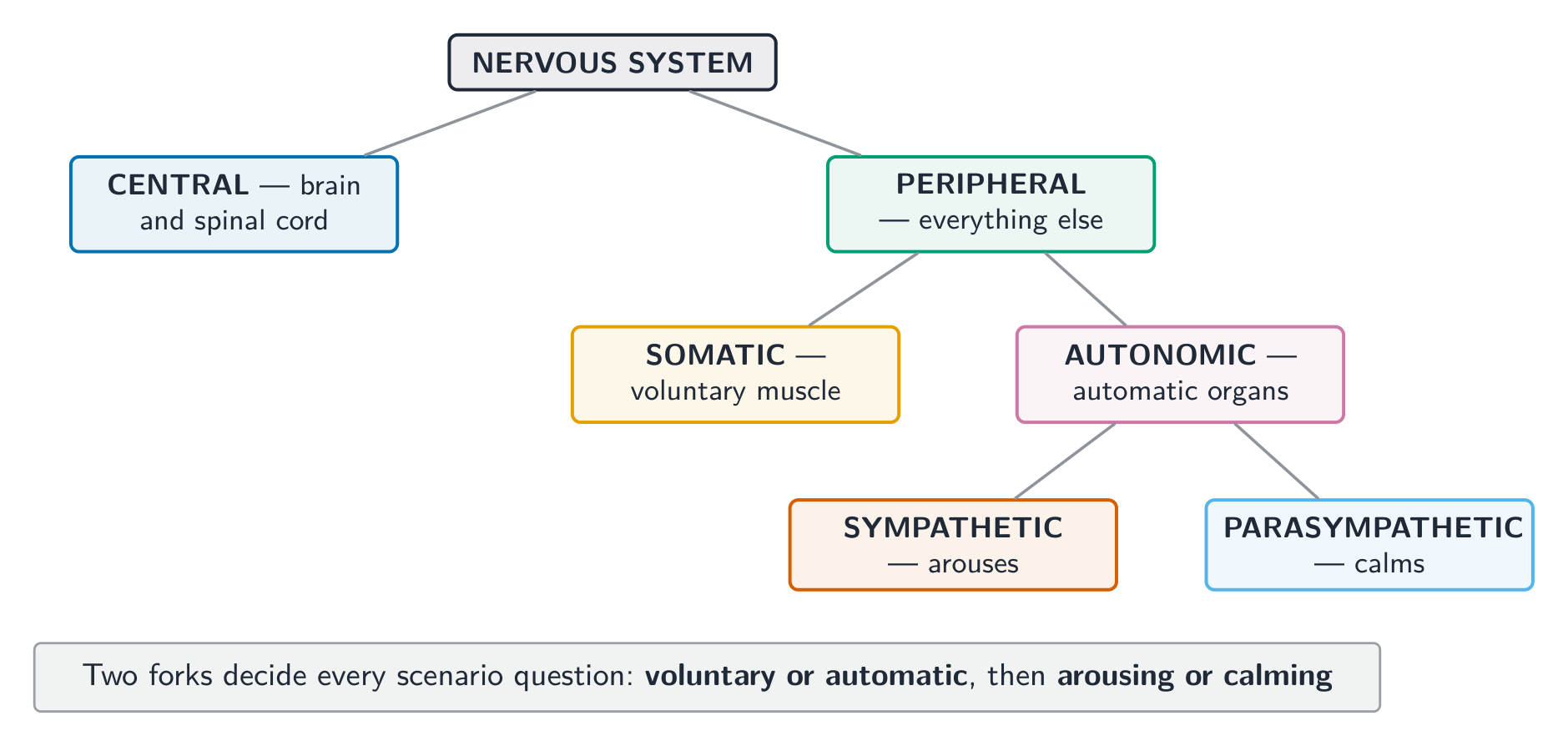
    神经系统(nervous system)在身体里传递信息,分为两大部分。

    中枢神经系统(central nervous system, CNS)由大脑和脊髓(spinal cord)组成,与身体的一切过程相互作用。

    周围神经系统(peripheral nervous system, PNS)在中枢神经系统与身体其余部分之间传递信息,它又分为:

    • 躯体神经系统(somatic nervous system)控制随意的(voluntary)动作,比如举手。
    • 自主神经系统(autonomic nervous system)控制不随意的(involuntary)过程,比如心跳和消化。它有两个作用相反的分支:交感神经系统(sympathetic nervous system)让身体准备行动(即"战或逃"反应),副交感神经系统(parasympathetic nervous system)随后让身体平静下来。
    词汇表 训练
    英文 中文 拼音
    nervous system 神经系统 shén jīng xì tǒng
    central nervous system (CNS) 中枢神经系统 zhōng shū shén jīng xì tǒng
    spinal cord 脊髓 jí suǐ
    peripheral nervous system (PNS) 周围神经系统 zhōu wéi shén jīng xì tǒng
    somatic nervous system 躯体神经系统 qū tǐ shén jīng xì tǒng
    voluntary 随意的 suí yì de
    autonomic nervous system 自主神经系统 zì zhǔ shén jīng xì tǒng
    involuntary 不随意的 bù suí yì de
    sympathetic nervous system 交感神经系统 jiāo gǎn shén jīng xì tǒng
    parasympathetic nervous system 副交感神经系统 fù jiāo gǎn shén jīng xì tǒng
    1.3

    神经元与神经冲动

    大纲
    Learning ObjectiveEssential Knowledge

    1.3.A
    Explain how the structures and functions of typical neurons in the central nervous system affect behavior and mental processes.

    • 1.3.A.1 Two common types of neural cells in the brain are neurons (neural cells that transmit information) and glial cells (cells that provide structure, insulation, communication, and waste transport). These types of cells form the basis of the nervous system and are the building blocks of all behavior and mental processes.
    • 1.3.A.2 In the spinal cord, the reflex arc demonstrates how neurons within the central and peripheral nervous systems work together to respond to stimuli. Three types of neurons work together in the spinal cord to create a reflex arc: sensory neurons, motor neurons, and interneurons.

    1.3.B
    Explain how the basic process of neural transmission is related to behavior and mental processes.

    • 1.3.B.1 The process of neural transmission most commonly occurs in an orderly, systematic way and involves the all-or-none principle, depolarization, refractory period, resting potential, reuptake, and threshold. Disruptions to this process could lead to disorders such as multiple sclerosis or myasthenia gravis.
      • Exclusion Statement: The sodium-potassium pump is outside the scope of the AP Psychology Exam.
    • 1.3.B.2 Each neurotransmitter has specific function(s) related to behavior and mental processes, which may depend on the neurotransmitter’s location in the nervous system. Neurotransmitters generally communicate either excitatory (making an action potential more likely) or inhibitory (making an action potential less likely) messages. Neurotransmitters related to behavior and mental processes for study in AP Psychology are limited to dopamine, serotonin, norepinephrine, glutamate, GABA, endorphins, substance p, and acetylcholine.
      • Exclusion Statement: The AP Psychology Exam will only address the listed neurotransmitters in EK 1.3.B.2.
    • 1.3.B.3 Outside of the nervous system, hormones perform actions similar to neurotransmitters. Hormones related to behavior and mental processes for study in AP Psychology are limited to adrenaline, leptin, ghrelin, melatonin, and oxytocin.
      • Exclusion Statement: The AP Psychology Exam will only address the listed hormones in EK 1.3.B.3.
      • Exclusion Statement: Specific information about the glands of the endocrine system (with the exception of the pituitary gland as referenced in EK 1.4.A.4) is outside the scope of the AP Psychology Exam.

    1.3.C
    Explain how psychoactive drugs affect behavior and mental processes.

    • 1.3.C.1 Psychoactive drugs can influence neurotransmitter function in various ways throughout the neural communication process. Some act as agonists which encourage neural firing. Some act as antagonists which discourage neural firing. Some act as reuptake inhibitors which block the reabsorption of neurotransmitters back into the cell.
    • 1.3.C.2 Psychoactive drugs have psychological and physiological effects.
      • 1.3.C.2.i Stimulants, such as caffeine and cocaine, typically cause increased neural activity.
      • 1.3.C.2.ii Depressants, such as alcohol, typically cause decreased neural activity.
      • 1.3.C.2.iii Hallucinogens, such as marijuana, typically cause distortions in perception and/or cognition.
      • 1.3.C.2.iv Opioids, such as heroin, typically act as pain relievers.
    • 1.3.C.3 Psychoactive drug use can lead to tolerance and/or addiction. Addiction can create significant withdrawal symptoms if the psychoactive drugs are no longer consumed.

    来源:美国大学理事会 AP 课程与考试说明

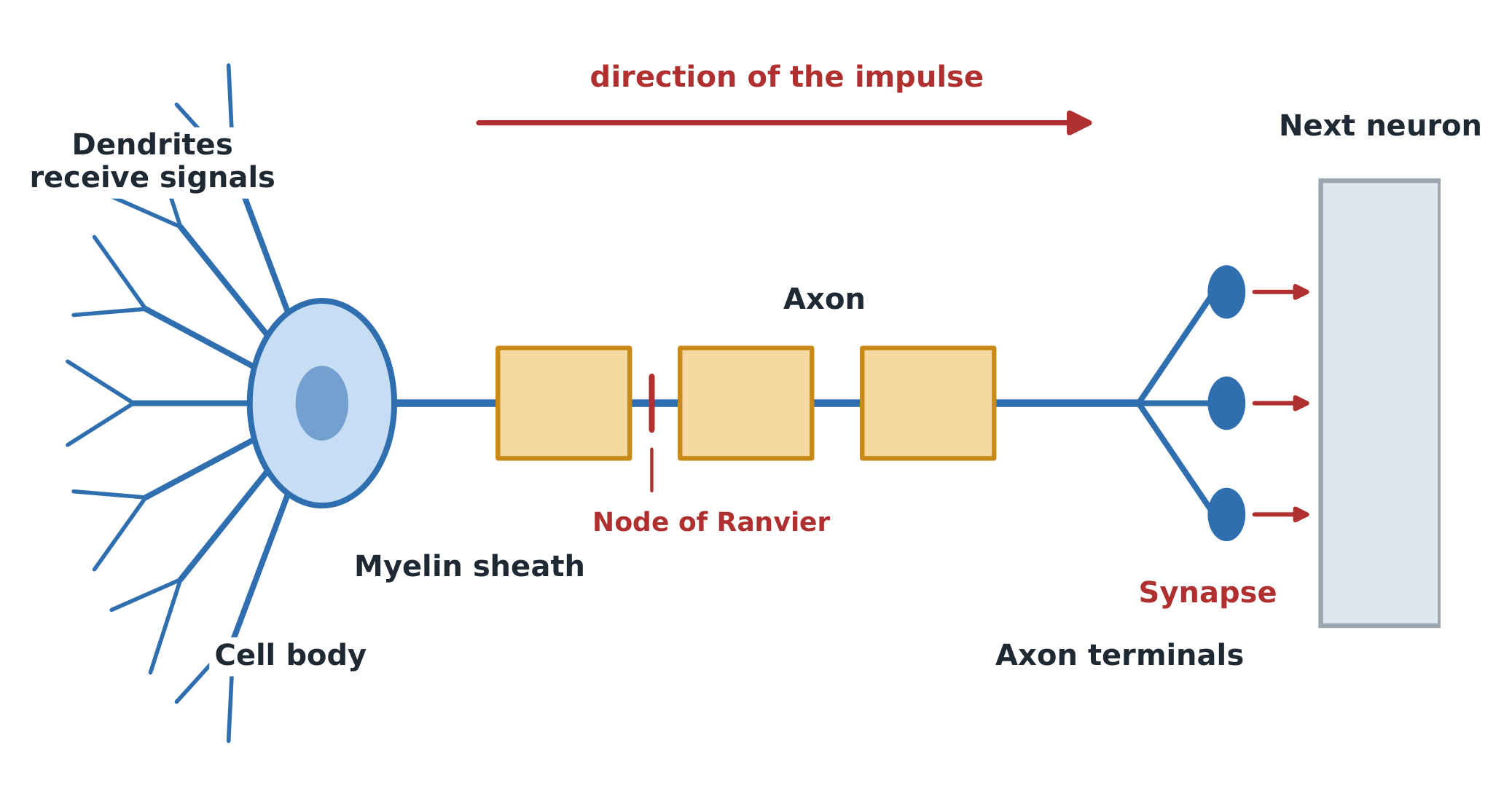
    标注了神经元结构的示意图:树突接收信号,细胞体整合信号,轴突把冲动传到末梢
    神经元在树突处接收信号,沿轴突放电,再通过突触把信息传给下一个细胞

    有两类细胞在工作。神经元(neurons)负责传递信息,神经胶质细胞(glial cells)提供结构、绝缘、通讯和废物运输。二者共同构成一切行为与心理过程的基础。

    一个神经元有接收信号的树突(dendrites)、细胞体(cell body),以及把信号传出去的轴突(axon)。许多轴突外面裹着髓鞘(myelin sheath),它能加快信号传导。

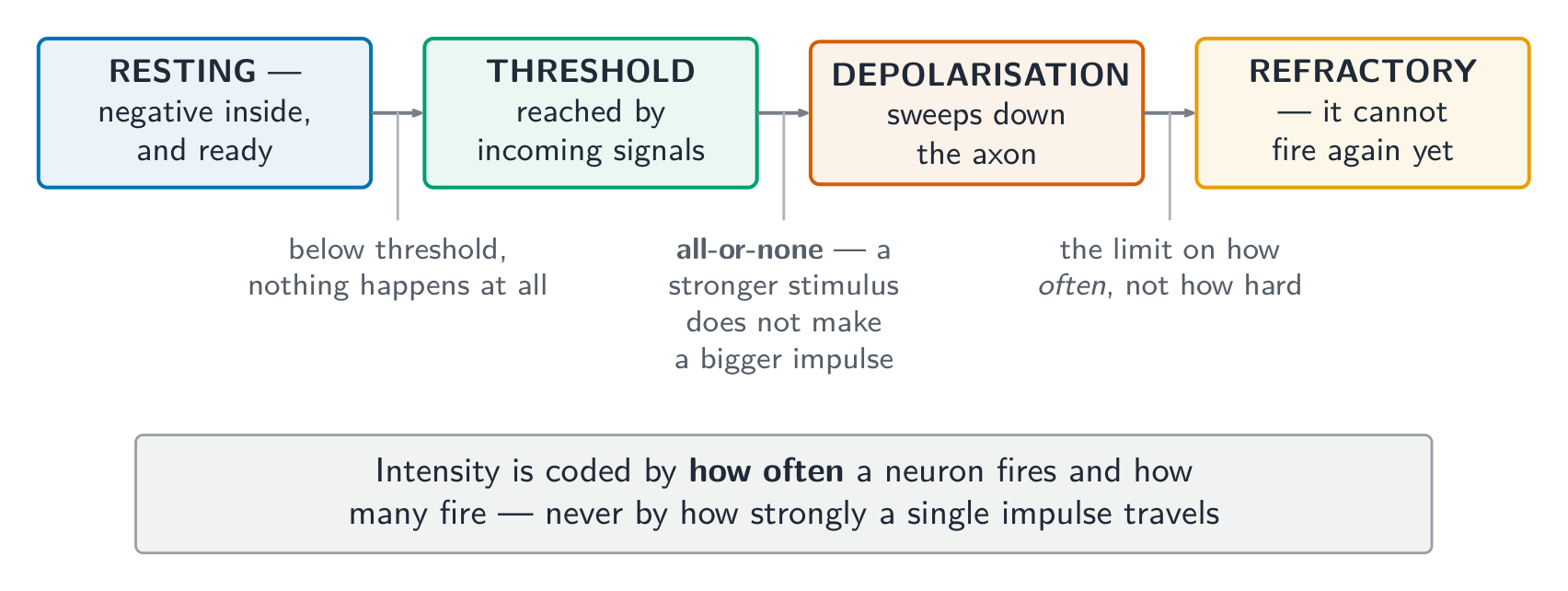
    神经传导按固定顺序进行:

    • 静息时神经元保持静息电位(resting potential),准备就绪但不放电。
    • 当传入信号超过阈限(threshold),神经元就去极化(depolarizes)并放电。
    • 放电遵循全或无原则(all-or-none principle):要么全力放电,要么完全不放。刺激更强只会让它放电更频繁,而不是更用力。
    • 放电之后紧接着是不应期(refractory period),此时神经元无法再次放电。
    • 在神经元之间的间隙突触(synapse)处,化学物质跨过间隙到达下一个细胞。多余的化学物质会通过再摄取(reuptake)被收回。

    这一过程受损可能导致多发性硬化(multiple sclerosis)或重症肌无力(myasthenia gravis)等疾病。

    在脊髓中,反射弧(reflex arc)展示了整个系统如何作为一个整体运作:感觉神经元(sensory neurons)把信息传入,中间神经元(interneurons)在脊髓内连接,运动神经元(motor neurons)把指令传出——这一切都发生在大脑参与之前。

    词汇表 训练
    英文 中文 拼音
    Neurons 神经元 shén jīng yuán
    Glial cells 神经胶质细胞 shén jīng jiāo zhì xì bāo
    dendrites 树突 shù tū
    cell body 细胞体 xì bāo tǐ
    axon 轴突 zhóu tū
    myelin sheath 髓鞘 suǐ qiào
    resting potential 静息电位 jìng xī diàn wèi
    threshold 阈限 yù xiàn
    depolarizes 去极化 qù jí huà
    all-or-none principle 全或无原则 quán huò wú yuán zé
    refractory period 不应期 bù yīng qī
    synapse 突触 tū chù
    reuptake 再摄取 zài shè qǔ
    multiple sclerosis 多发性硬化 duō fā xìng yìng huà
    myasthenia gravis 重症肌无力 zhòng zhèng jī wú lì
    reflex arc 反射弧 fǎn shè hú
    Sensory neurons 感觉神经元 gǎn jué shén jīng yuán
    interneurons 中间神经元 zhōng jiān shén jīng yuán
    motor neurons 运动神经元 yùn dòng shén jīng yuán
    1.3

    神经元与神经冲动

    大纲
    Learning ObjectiveEssential Knowledge

    1.3.A
    Explain how the structures and functions of typical neurons in the central nervous system affect behavior and mental processes.

    • 1.3.A.1 Two common types of neural cells in the brain are neurons (neural cells that transmit information) and glial cells (cells that provide structure, insulation, communication, and waste transport). These types of cells form the basis of the nervous system and are the building blocks of all behavior and mental processes.
    • 1.3.A.2 In the spinal cord, the reflex arc demonstrates how neurons within the central and peripheral nervous systems work together to respond to stimuli. Three types of neurons work together in the spinal cord to create a reflex arc: sensory neurons, motor neurons, and interneurons.

    1.3.B
    Explain how the basic process of neural transmission is related to behavior and mental processes.

    • 1.3.B.1 The process of neural transmission most commonly occurs in an orderly, systematic way and involves the all-or-none principle, depolarization, refractory period, resting potential, reuptake, and threshold. Disruptions to this process could lead to disorders such as multiple sclerosis or myasthenia gravis.
      • Exclusion Statement: The sodium-potassium pump is outside the scope of the AP Psychology Exam.
    • 1.3.B.2 Each neurotransmitter has specific function(s) related to behavior and mental processes, which may depend on the neurotransmitter’s location in the nervous system. Neurotransmitters generally communicate either excitatory (making an action potential more likely) or inhibitory (making an action potential less likely) messages. Neurotransmitters related to behavior and mental processes for study in AP Psychology are limited to dopamine, serotonin, norepinephrine, glutamate, GABA, endorphins, substance p, and acetylcholine.
      • Exclusion Statement: The AP Psychology Exam will only address the listed neurotransmitters in EK 1.3.B.2.
    • 1.3.B.3 Outside of the nervous system, hormones perform actions similar to neurotransmitters. Hormones related to behavior and mental processes for study in AP Psychology are limited to adrenaline, leptin, ghrelin, melatonin, and oxytocin.
      • Exclusion Statement: The AP Psychology Exam will only address the listed hormones in EK 1.3.B.3.
      • Exclusion Statement: Specific information about the glands of the endocrine system (with the exception of the pituitary gland as referenced in EK 1.4.A.4) is outside the scope of the AP Psychology Exam.

    1.3.C
    Explain how psychoactive drugs affect behavior and mental processes.

    • 1.3.C.1 Psychoactive drugs can influence neurotransmitter function in various ways throughout the neural communication process. Some act as agonists which encourage neural firing. Some act as antagonists which discourage neural firing. Some act as reuptake inhibitors which block the reabsorption of neurotransmitters back into the cell.
    • 1.3.C.2 Psychoactive drugs have psychological and physiological effects.
      • 1.3.C.2.i Stimulants, such as caffeine and cocaine, typically cause increased neural activity.
      • 1.3.C.2.ii Depressants, such as alcohol, typically cause decreased neural activity.
      • 1.3.C.2.iii Hallucinogens, such as marijuana, typically cause distortions in perception and/or cognition.
      • 1.3.C.2.iv Opioids, such as heroin, typically act as pain relievers.
    • 1.3.C.3 Psychoactive drug use can lead to tolerance and/or addiction. Addiction can create significant withdrawal symptoms if the psychoactive drugs are no longer consumed.

    来源:美国大学理事会 AP 课程与考试说明

    神经递质(neurotransmitters)是跨过突触的化学物质。每一种都有自己的功能,而其效果可能取决于它在神经系统中的作用部位。传递的信息要么是兴奋性的(excitatory,使放电更可能发生),要么是抑制性的(inhibitory,使放电更不可能发生)。

    只有以下这些属于考试范围:多巴胺(dopamine,奖赏与运动)、血清素(serotonin,情绪与睡眠)、去甲肾上腺素(norepinephrine,警觉)、谷氨酸(glutamate,主要的兴奋性递质)、γ-氨基丁酸(GABA,主要的抑制性递质)、内啡肽(endorphins,镇痛)、P物质(substance P,痛觉信号)和乙酰胆碱(acetylcholine,肌肉运动与记忆)。

    激素(hormones)在神经系统之外发挥类似作用,通过血液传播,速度更慢。同样只有五种在考试范围内:肾上腺素(adrenaline)、瘦素(leptin,降低饥饿感)、胃饥饿素(ghrelin,增加饥饿感)、褪黑素(melatonin,睡眠)和催产素(oxytocin,情感联结)。

    精神药物(psychoactive drugs)通过三种方式作用于神经传导来改变行为:

    • 激动剂(agonist)促进神经放电。
    • 拮抗剂(antagonist)抑制神经放电。
    • 再摄取抑制剂(reuptake inhibitor)阻断回收,使突触中留下更多递质。

    药物类别:兴奋剂(stimulants,咖啡因、可卡因)提高神经活动;抑制剂(depressants,酒精)降低神经活动;致幻剂(hallucinogens,大麻)扭曲知觉;阿片类药物(opioids,海洛因)缓解疼痛。反复使用会导致耐受性(tolerance,需要更大剂量才能达到同样效果)和成瘾(addiction),停用时会出现戒断反应(withdrawal)。
    词汇表 训练
    英文 中文 拼音
    Neurotransmitters 神经递质 shén jīng dì zhì
    excitatory 兴奋性的 xīng fèn xìng de
    inhibitory 抑制性的 yì zhì xìng de
    dopamine 多巴胺 duō bā àn
    serotonin 血清素 xuè qīng sù
    norepinephrine 去甲肾上腺素 qù jiǎ shèn shàng xiàn sù
    glutamate 谷氨酸 gǔ ān suān
    GABA γ-氨基丁酸 γ- ān jī dīng suān
    endorphins 内啡肽 nèi fēi tài
    substance P P物质 P wù zhì
    acetylcholine 乙酰胆碱 yǐ xiān dǎn jiǎn
    Hormones 激素 jī sù
    adrenaline 肾上腺素 shèn shàng xiàn sù
    leptin 瘦素 shòu sù
    ghrelin 胃饥饿素 wèi jī è sù
    melatonin 褪黑素 tuì hēi sù
    oxytocin 催产素 cuī chǎn sù
    Psychoactive drugs 精神药物 jīng shén yào wù
    agonist 激动剂 jī dòng jì
    antagonist 拮抗剂 jié kàng jì
    reuptake inhibitor 再摄取抑制剂 zài shè qǔ yì zhì jì
    stimulants 兴奋剂 xīng fèn jì
    depressants 抑制剂 yì zhì jì
    hallucinogens 致幻剂 zhì huàn jì
    opioids 阿片类药物 ā piàn lèi yào wù
    tolerance 耐受性 nài shòu xìng
    addiction 成瘾 chéng yǐn
    withdrawal 戒断反应 jiè duàn fǎn yìng
    1.4

    大脑

    大纲
    Learning ObjectiveEssential Knowledge

    1.4.A
    Explain how the structures and functions of the brain apply to behavior and mental processes.

    • 1.4.A.1 The brain stem (including the medulla) generally controls basic functioning such as breathing and heart rate.
    • 1.4.A.2 The reticular activating system and the brain’s reward center generally control alertness, some voluntary movement, eye movement, and some types of learning, cognition, and emotion.
    • 1.4.A.3 The cerebellum generally controls coordination of muscle movement, balance, and some forms of procedural learning.
    • 1.4.A.4 The cerebral cortex is divided into two hemispheres and includes the limbic system (thalamus, hypothalamus, pituitary gland, hippocampus, amygdala), corpus callosum, and the lobes of the cortex.
      • 1.4.A.4.i The occipital lobes generally control visual information processing and are located in the rear of the brain.
      • 1.4.A.4.ii The temporal lobes generally control auditory and linguistic processing and are located on the sides of the brain.
      • 1.4.A.4.iii The parietal lobes generally control association areas, which process and organize information, and the somatosensory cortex, which processes touch sensitivity. These lobes are located near the back crown of the brain.
      • 1.4.A.4.iv The frontal lobes, located just behind the forehead, generally control linguistic processing, higher-order thinking, and executive functioning, especially in the prefrontal cortex. The motor cortex is located at the rear of the frontal lobes and controls most types of skeletal movement.
    • 1.4.A.5 Split brain research, achieved by severing the corpus callosum (often a treatment for severe epilepsy), reveals that the right and left hemispheres of the brain may specialize in different activities and functions.
      • 1.4.A.5.i Areas of the brain that affect language are typically located in the left hemisphere and include Broca’s area (responsible for speech production) and Wernicke’s area (responsible for speech comprehension). Damage to these parts of the brain can lead to aphasia.
      • 1.4.A.5.ii Researchers test for cortex specialization with split-brain patients by showing information in each visual field, taking advantage of the brain’s contralateral hemispheric organization.
    • 1.4.A.6 Brain plasticity is the ability of the brain to rewire itself or modify or create new connections throughout development and generally allows for the function of a damaged part of the brain to be assumed by a different part of the brain.
    • 1.4.A.7 Research on the brain is done using scans (including EEG and fMRI), case studies, and surgical procedures (such as lesioning) to promote understanding of how the different structures of the brain work and how the brain functions together as a whole.

    来源:美国大学理事会 AP 课程与考试说明

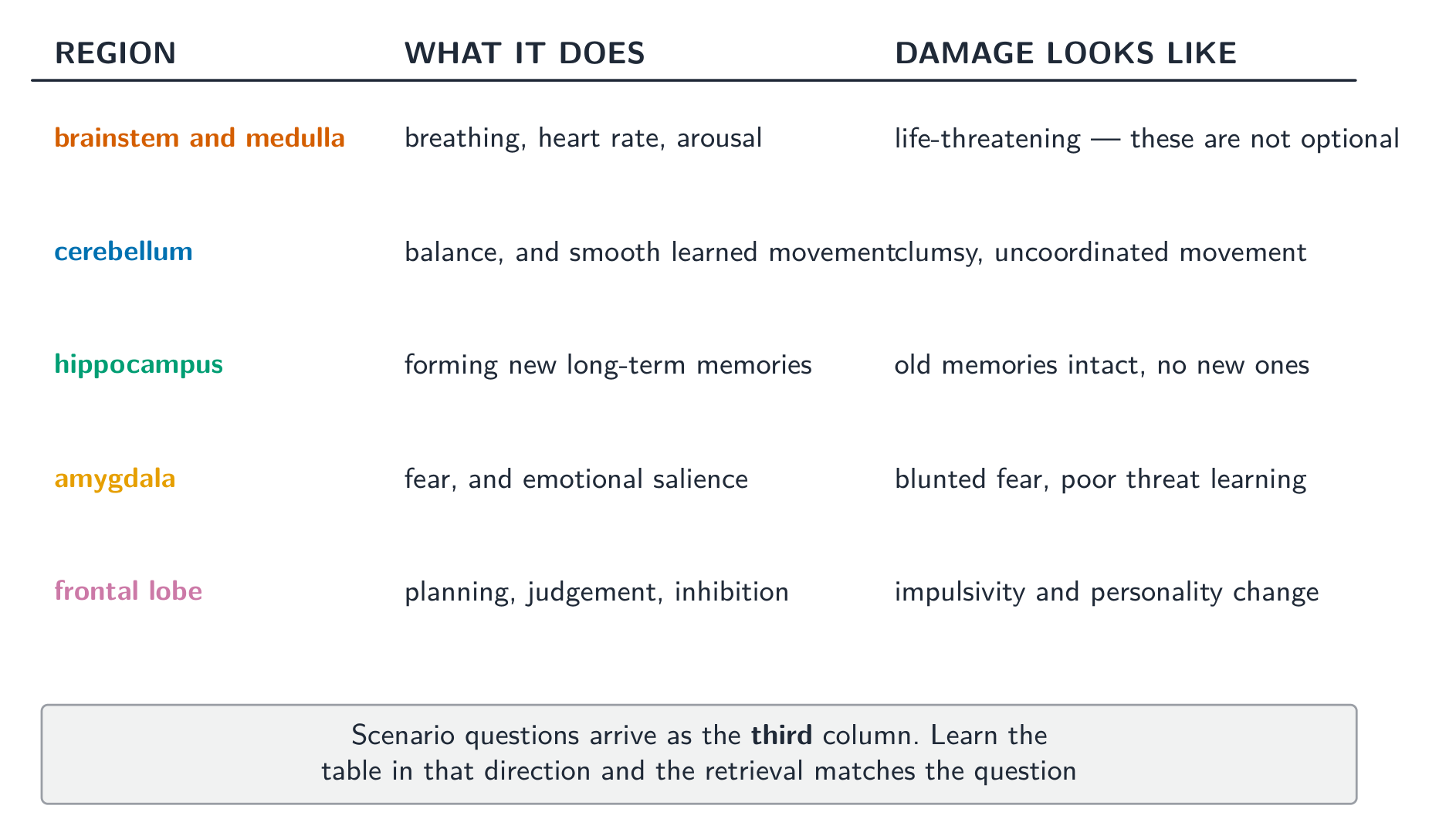
    研究大脑通常自下而上,因为越低的结构负责越基本的功能。

    • 脑干(brain stem)包括延髓(medulla),控制呼吸和心率。
    • 网状激活系统(reticular activating system)控制警觉与唤醒水平。
    • 小脑(cerebellum)控制动作协调、平衡,以及部分程序性学习(procedural learning)。
    • 边缘系统(limbic system)位于大脑皮层内部,包括丘脑(thalamus,感觉信息的中转站)、下丘脑(hypothalamus,饥饿、口渴、体温)、脑垂体(pituitary gland)、海马体(hippocampus,形成新记忆)和杏仁核(amygdala,恐惧与情绪)。

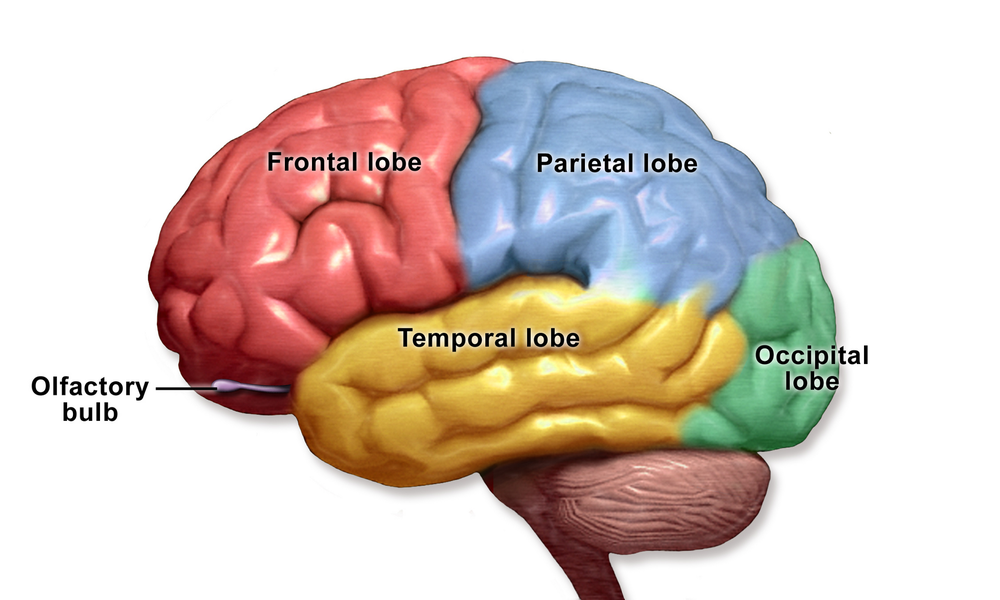
    大脑皮层(cerebral cortex)分为两个半球(hemispheres)和四个脑叶:枕叶(occipital lobes)在后部处理视觉;颞叶(temporal lobes)在两侧处理听觉与语言;顶叶(parietal lobes)包含处理触觉的体感皮层(somatosensory cortex);额叶(frontal lobes)负责高级思维与执行功能(executive function)。

    语言功能主要位于左半球:布罗卡区(Broca's area)负责言语产生,韦尼克区(Wernicke's area)负责言语理解。

    裂脑研究(split-brain research)以切断胼胝体(corpus callosum)治疗严重癫痫的病人为对象,表明两个半球可以独立工作。研究者每次只向一侧视野(visual field)呈现信息,因为每侧视野由对侧半球处理。

    大脑可塑性(brain plasticity)指大脑重新连线、形成新连接的能力,这有助于损伤后的恢复。研究方法包括脑电图(EEG)和功能性磁共振成像(fMRI)扫描、个案研究以及损毁法(lesioning)。

    词汇表 训练
    英文 中文 拼音
    brain stem 脑干 nǎo gàn
    medulla 延髓 yán suǐ
    reticular activating system 网状激活系统 wǎng zhuàng jī huó xì tǒng
    cerebellum 小脑 xiǎo nǎo
    procedural learning 程序性学习 chéng xù xìng xué xí
    limbic system 边缘系统 biān yuán xì tǒng
    thalamus 丘脑 qiū nǎo
    hypothalamus 下丘脑 xià qiū nǎo
    pituitary gland 脑垂体 nǎo chuí tǐ
    hippocampus 海马体 hǎi mǎ tǐ
    amygdala 杏仁核 xìng rén hé
    cerebral cortex 大脑皮层 dà nǎo pí céng
    hemispheres 半球 bàn qiú
    occipital lobes 枕叶 zhěn yè
    temporal lobes 颞叶 niè yè
    parietal lobes 顶叶 dǐng yè
    somatosensory cortex 体感皮层 tǐ gǎn pí céng
    frontal lobes 额叶 é yè
    executive function 执行功能 zhí xíng gōng néng
    Broca's area 布罗卡区 bù luó kǎ qū
    Wernicke's area 韦尼克区 wéi ní kè qū
    Split-brain research 裂脑研究 liè nǎo yán jiū
    corpus callosum 胼胝体 pián zhī tǐ
    visual field 视野 shì yě
    Brain plasticity 大脑可塑性 dà nǎo kě sù xìng
    lesioning 损毁法 sǔn huǐ fǎ
    1.5

    睡眠

    大纲
    Learning ObjectiveEssential Knowledge

    1.5.A
    Explain how the sleep/wake cycle affects behavior and mental processes throughout the day and night.

    • 1.5.A.1 Consciousness has varying levels of awareness of thoughts, feelings, behavior, and events in individuals’ internal and external worlds. Sleep and wakefulness are two types of consciousness.
    • 1.5.A.2 The sleep/wake cycle is a circadian rhythm, which in humans is about a 24-hour cycle. Jet lag and shift work are disruptions of the circadian rhythm.
    • 1.5.A.3 The stages of sleep are identified by their specific EEG patterns.
      • 1.5.A.3 .i NREM sleep occurs in Stages 1 through 3 and decreases in duration throughout the cycle. Hypnagogic sensations occur as one enters Initial Stage 1 sleep.
      • 1.5.A.3 .ii REM sleep is considered paradoxical because it produces waves similar to wakefulness, but the body is at its most relaxed. Dreaming typically occurs in REM sleep. The frequency of REM sleep typically increases as the cycle progresses. When deprived of REM sleep, REM rebound can occur.
    • 1.5.A.4 Theories regarding the structure and function of dreams include activation-synthesis and consolidation theory.
      • Exclusion Statement: The psychoanalytic theory of dreams is outside of the scope of the AP Psychology Exam.
    • 1.5.A.5 Memory consolidation and restoration are current theories about why sleep occurs. These theories suggest that sleep is useful for organizing and consolidating memories or restoring depleted resources used throughout a given day.
    • 1.5.A.6 Many disorders interrupt healthy sleep, and their effects on waking behavior and health vary. Sleep disruptions can affect physical and cognitive performance during wakefulness. Treating sleep disorders and following regular schedules for sleeping can improve waking performance and overall well-being. Disorders commonly studied in introductory psychology include insomnia, narcolepsy, REM sleep behavior disorder, sleep apnea, and somnambulism.
      • Exclusion Statement: The AP Psychology Exam will only address the listed disorders in EK 1.5.A.6.

    来源:美国大学理事会 AP 课程与考试说明

    意识(consciousness)是对内部与外部事件的觉察,其水平会变化。

    睡眠/觉醒周期是一种约 24 小时的昼夜节律(circadian rhythm)。时差反应(jet lag)和轮班工作会打乱它。

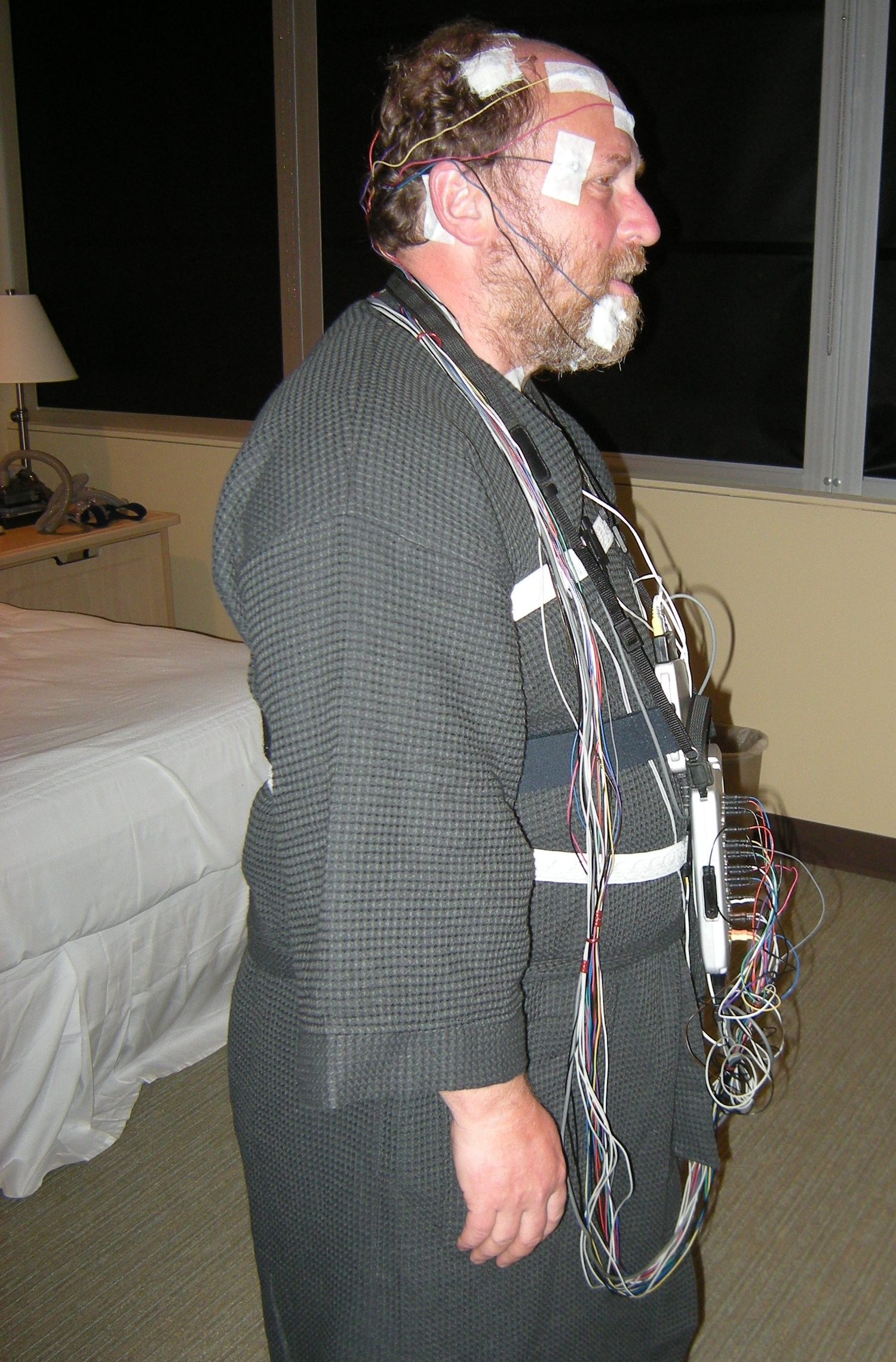
    睡眠阶段由脑电图模式来判定。非快速眼动睡眠(NREM sleep)包括第 1 至第 3 阶段;入睡时会出现入睡幻觉(hypnagogic sensations)。快速眼动睡眠(REM sleep)被称为异相睡眠(paradoxical sleep),因为此时脑电波接近清醒而身体最放松,大多数梦发生在这一阶段。

    关于梦有两种在考试范围内的理论:激活-综合理论(activation-synthesis theory,大脑对随机活动作出解释)和巩固理论(consolidation theory,梦反映记忆加工)。关于人为什么需要睡眠,则有记忆巩固(memory consolidation)与恢复(restoration)两种理论。

    *注意:*精神分析的梦理论不在考试范围内。

    睡眠障碍会影响清醒时的行为与健康:失眠(insomnia)、发作性睡病(narcolepsy)、睡眠呼吸暂停(sleep apnea)、梦游(somnambulism)和快速眼动睡眠行为障碍(REM sleep behavior disorder)。

    词汇表 训练
    英文 中文 拼音
    Consciousness 意识 yì shí
    circadian rhythm 昼夜节律 zhòu yè jié lǜ
    Jet lag 时差反应 shí chà fǎn yìng
    NREM sleep 非快速眼动睡眠 fēi kuài sù yǎn dòng shuì mián
    hypnagogic sensations 入睡幻觉 rù shuì huàn jué
    REM sleep 快速眼动睡眠 kuài sù yǎn dòng shuì mián
    paradoxical sleep 异相睡眠 yì xiāng shuì mián
    activation-synthesis theory 激活-综合理论 jī huó - zōng hé lǐ lùn
    consolidation theory 巩固理论 gǒng gù lǐ lùn
    memory consolidation 记忆巩固 jì yì gǒng gù
    restoration 恢复 huī fù
    insomnia 失眠 shī mián
    narcolepsy 发作性睡病 fā zuò xìng shuì bìng
    sleep apnea 睡眠呼吸暂停 shuì mián hū xī zàn tíng
    somnambulism 梦游 mèng yóu
    REM sleep behavior disorder 快速眼动睡眠行为障碍 kuài sù yǎn dòng shuì mián xíng wéi zhàng ài
    Sensation 感觉 gǎn jué
    1.6

    感觉

    大纲
    Learning ObjectiveEssential Knowledge

    1.6.A
    Explain how the process of sensation is related to behavior and mental processes.

    • 1.6.A.1 Sensation is the process of detecting information from the environment that meets a certain threshold and transducing stimuli into neurochemical messages for processing (perception) in the brain. The absolute threshold occurs when a stimulus can be detected at least 50% of the time.
    • 1.6.A.2 Detection of change in stimuli or diminished sensitivity to stimuli can be explained by the just-noticeable difference and sensory adaptation. Weber’s law describes the degree to which stimuli need to be different for the difference to be detected.
    • 1.6.A.3 The sensory systems constantly work together in a process called sensory interaction. Synesthesia is an experience of sensation in which one system of sensation is experienced through another.

    1.6.B
    Explain how the structures and functions of the visual sensory system relate to behavior and mental processes.

    • 1.6.B.1 The retina is the photosensitive surface at the back of the eye. Cells in the retina capture visual information that is transduced to the brain for processing. Evidence of incomplete images captured by the retina is demonstrated by the presence of the blind spot, where the visual nerve exits the eye. The brain fills in the gaps in the incomplete retinal images to perceive a relatively complete picture of the world.
    • 1.6.B.2 Visual stimuli are focused onto the retina by the lens via a process called accommodation. When this process is altered, nearsightedness or farsightedness can result.
    • 1.6.B.3 Cells that lie in the periphery of the eye and detect shapes and movement, but not color, are called rods. These cells are mainly activated in low-light environments. These cells play a role in light and dark adaptation.
    • 1.6.B.4 Color vision is explained by both the trichromatic theory and the opponent-process theory.
      • 1.6.B.4.i Photoreceptor cells located in the fovea of the eye that process color and detail are called cones. Researchers have identified blue (detecting short wavelengths), green (detecting medium wavelengths) and red (detecting long wavelengths) cones in the retina.
      • 1.6.B.4.ii Afterimages result when certain ganglion cells in the retina are activated while others are not. The ganglion cells involved in this opponent process are red/green, blue/ yellow/ and black/white.
      • 1.6.B.4.iii Color vision deficiency involves damage or irregularities to one or more cones or ganglion cells (red/green, blue/ yellow). Color vision deficiency includes dichromatism or monochromatism.
    • 1.6.B.5 Damage to parts of the brain responsible for vision (mainly the occipital lobes) can result in disorders such as prosopagnosia (face blindness) and blindsight.

    1.6.C
    Explain how the structures and functions of the auditory sensory system relate to behavior and mental processes.

    • 1.6.C.1 Sound occurs through the movement of air molecules at different wavelengths (called pitch) and amplitudes (called loudness).
    • 1.6.C.2 Theories that help explain pitch perception include place theory, volley theory, and frequency theory.
    • 1.6.C.3 Sound localization describes how we identify where sounds in our environment are coming from.
    • 1.6.C.4 Hearing difficulties can result from aging and various kinds of damage to auditory structures. Types of hearing loss include conduction deafness and sensorineural deafness.

    1.6.D
    Explain how the structures and functions of the chemical sensory systems relate to behavior and mental processes.

    • 1.6.D.1 Structures in the nose and brain process and/ or transduce olfactory stimuli. Smell is the only sense not processed first in the thalamus of the brain. Pheromones produce chemical messages for the olfactory system.
    • 1.6.D.2 Gustation is the sense of taste, and types of tastes include sweet, sour, salty, bitter, umami, and oleogustus.
    • 1.6.D.3 Structures in the tongue, mouth, and brain process and/or transduce basic tastes. The number of taste receptors on the tongue is related to how sensitive people are to tastes, classifying them as supertasters, medium tasters, or nontasters.
    • 1.6.D.4 The chemical senses interact to create the sensation of taste. Without the sense of smell, taste sensations are either muted or not experienced.

    1.6.E
    Explain how the structures and functions of the touch sensory system relate to behavior and mental processes.

    • 1.6.E.1 Structures within the skin and brain process and/or transduce touch stimuli. The sensation of “hot” is produced by the activation of warm and cold receptors in the skin.

    1.6.F
    Explain how the structures and functions of the pain sensory system relate to behavior and mental processes.

    • 1.6.F.1 Pain is processed both in the body and in the brain. Gate control theory is one attempt to describe the complexities of pain. Phantom limb sensation occurs when people who have lost limbs report sensation or pain where the limb used to be.

    1.6.G
    Explain how the structures and functions that maintain balance (vestibular) and body movement (kinesthetic) relate to behavior and mental processes.

    • 1.6.G.1 The vestibular sense controls balance and is primarily detected by the semicircular canals and structures in the brain.
    • 1.6.G.2 Kinesthesis the sense of one’s body movement. Kinesthesis allows the body to move in coordinated ways without having to look at the various parts of the body as it moves.

    来源:美国大学理事会 AP 课程与考试说明

    感觉(sensation)是探测环境中的信息,并把它转导(transducing)为大脑可用的神经信号。探测需要达到一定的绝对阈限(absolute threshold)。

    • 最小可觉差(just-noticeable difference)是一个人能察觉到的最小变化。
    • 感觉适应(sensory adaptation)指对不变刺激的敏感度下降——你会闻不到一直存在的气味。
    • 感觉相互作用(sensory interaction)指各种感觉协同工作。联觉(synesthesia)是一种感觉引发另一种感觉的体验。

    视觉。光线通过晶状体(lens)改变形状被聚焦到视网膜(retina)上,这一过程称为视觉调节(visual accommodation);这一过程出问题就会造成近视(nearsightedness)或远视(farsightedness)。视杆细胞(rods)分布在视网膜周边,在弱光下探测形状与运动。视锥细胞(cones)位于中央凹(fovea),负责颜色与细节。色觉需要两种理论共同解释:三色理论(trichromatic theory,蓝、绿、红三种视锥细胞)和解释后像(afterimages)的对立过程理论(opponent-process theory)。枕叶受损可能导致面孔失认症(prosopagnosia)。

    听觉。声音是空气的运动;波长决定音高(pitch),振幅决定响度(loudness)。音高知觉由位置理论(place theory)、齐射理论(volley theory)和频率理论(frequency theory)共同解释。声源定位(sound localization)让我们判断声音来自哪里。听力损失可分为传导性耳聋(conduction deafness)和感音神经性耳聋(sensorineural deafness)。

    化学感觉。嗅觉(olfaction)是唯一不先经丘脑中转的感觉。味觉(gustation)包括甜、酸、咸、苦、鲜味(umami)和脂味(oleogustus)。二者相互作用:失去嗅觉后,味觉会变得很弱。

    触觉、痛觉与身体位置。皮肤中的感受器转导触觉;"热"的感觉来自温觉与冷觉感受器同时放电。疼痛在身体和大脑中共同加工,闸门控制理论(gate control theory)解释了为什么注意力会改变疼痛程度;幻肢(phantom limb)现象则显示了大脑的作用。前庭觉(vestibular sense)通过半规管(semicircular canals)控制平衡,动觉(kinesthesis)是对自身身体运动的感觉。

    Worked example(一道真实的 AP 考题)。2025 年的文章分析题(AAQ)要求学生"指出该研究使用的研究方法",并进一步"结合研究中具体、相关的证据,解释该研究结果在多大程度上可以或不可以推广"*。第二问的满分答案会同时点明局限*扣住证据:*"该结果可能难以广泛推广,因为被试是同一所大学的本科生,样本不能代表总体人群。"*注意其结构:Explain 需要一个论断加上支撑它的证据。只写出研究方法,回答的是 A 问,而不是 E 问。

    词汇表 训练
    英文 中文 拼音
    transducing 转导 zhuǎn dǎo
    absolute threshold 绝对阈限 jué duì yù xiàn
    just-noticeable difference 最小可觉差 zuì xiǎo kě jué chà
    Sensory adaptation 感觉适应 gǎn jué shì yìng
    Sensory interaction 感觉相互作用 gǎn jué xiāng hù zuò yòng
    Synesthesia 联觉 lián jué
    retina 视网膜 shì wǎng mó
    lens 晶状体 jīng zhuàng tǐ
    visual accommodation 视觉调节 shì jué tiáo jié
    nearsightedness 近视 jìn shì
    farsightedness 远视 yuǎn shì
    Rods 视杆细胞 shì gān xì bāo
    Cones 视锥细胞 shì zhuī xì bāo
    fovea 中央凹 zhōng yāng āo
    trichromatic theory 三色理论 sān sè lǐ lùn
    opponent-process theory 对立过程理论 duì lì guò chéng lǐ lùn
    afterimages 后像 hòu xiàng
    prosopagnosia 面孔失认症 miàn kǒng shī rèn zhèng
    pitch 音高 yīn gāo
    loudness 响度 xiǎng dù
    place theory 位置理论 wèi zhì lǐ lùn
    volley theory 齐射理论 qí shè lǐ lùn
    frequency theory 频率理论 pín lǜ lǐ lùn
    Sound localization 声源定位 shēng yuán dìng wèi
    conduction deafness 传导性耳聋 chuán dǎo xìng ěr lóng
    sensorineural deafness 感音神经性耳聋 gǎn yīn shén jīng xìng ěr lóng
    Olfaction 嗅觉 xiù jué
    Gustation 味觉 wèi jué
    umami 鲜味 xiān wèi
    oleogustus 脂味 zhī wèi
    gate control theory 闸门控制理论 zhá mén kòng zhì lǐ lùn
    phantom limb 幻肢 huàn zhī
    vestibular sense 前庭觉 qián tíng jué
    semicircular canals 半规管 bàn guī guǎn
    kinesthesis 动觉 dòng jué
    1.6

    考试技巧

    • 只需记住列出的神经递质激素;考试不会考其他种类,而内分泌腺除脑垂体外都不在范围内。
    • 感觉(sensation)与知觉(perception)区分开:感觉是探测与转导,知觉是解释(第二单元)。
    • 全或无原则意味着刺激强度由神经元放电的频率编码,而不是由放电的强弱编码。
    • 动笔前先把结构与功能对应好:海马体形成记忆,杏仁核处理恐惧,小脑协调运动。
    • 交感神经系统唤醒身体,副交感神经系统使其平静。题目若描述心跳加速,就要点出交感分支。
    • 要说清一种扫描能显示什么、不能显示什么。fMRI 显示随时间变化的活动;EEG 显示电活动模式并用于判定睡眠阶段。
    词汇表 训练
    英文 中文 拼音
    EEG 脑电图 nǎo diàn tú
    fMRI 功能性磁共振成像 gōng néng xìng cí gòng zhèn chéng xiàng
  • 2

    认知

    讲义 词汇表
    2.1

    知觉

    大纲
    Learning ObjectiveEssential Knowledge

    2.1.A
    Explain how internal and external factors influence perception.

    • 2.1.A.1 Perception is influenced by whether one primarily relies on external sensory information (bottom-up processing) or internal prior expectations (top-down processing).
    • 2.1.A.2 Schemas and perceptual sets are internal factors that filter perceptions of the world.
    • 2.1.A.3 Contexts, experiences, and cultural experiences and expectations are external factors that filter perceptions of the world.
    • 2.1.A.4 Perceptual principles proposed by Gestalt psychology (closure, figure and ground, proximity, and similarity) help explain how humans organize their perceptual world.
    • 2.1.A.5 Attention is an interaction of sensation and perception that is affected by internal and external processes.
      • 2.1.A.5.i Some experiences of attention can be selective, such as with the cocktail party effect, where people attend to mentions of their names or specific topics in loud or distracting environments.
      • 2.1.A.5.ii Inattention can lead to a type of “blindness” to aspects of the environment. Change blindness occurs when changes to the environment are not perceived due to inattention.

    2.1.B
    Explain how visual perceptual processes produce correct or incorrect interpretations of stimuli.

    • 2.1.B.1 Binocular depth cues of retinal disparity (the difference between the images projecting onto the retina) and convergence (the merging of the retinal images by the brain) utilize images from each eye to provide perception of depth.
    • 2.1.B.2 Monocular depth cues (relative clarity, relative size, texture gradient, linear perspective, and interposition) give the illusion of depth on flat or two-dimensional surfaces.
      • Exclusion Statement: The AP Psychology Exam will only address the listed monocular depth cues in EK 2.1.B.2.
    • 2.1.B.3 Visual perceptual constancies maintain the perception of an object even when the images of the object in the visual field change.
    • 2.1.B.4 Apparent movement can be visually perceived even when objects are not actually moving.

    来源:美国大学理事会 AP 课程与考试说明

    第一单元讲到感觉(sensation),即对刺激的探测。知觉(perception)是大脑接下来做的事:组织并解释这些信息。同样的信号可以被知觉成不止一种样子。

    两个加工方向共同起作用:

    • 自下而上加工(bottom-up processing)从原始的感觉信息出发,逐层向上构建。
    • 自上而下加工(top-down processing)从你已有的期待与知识出发。

    内部因素会过滤知觉。图式(schema)是由过往经验形成的心理框架,知觉定势(perceptual set)是以某种特定方式去看事物的准备状态。外部因素同样重要:情境(context)和文化期待会改变人们报告看到的内容。

    格式塔心理学(Gestalt psychology)描述了大脑如何把部分组合成整体:闭合(closure,补全缺口)、图形与背景(figure and ground,把物体从背景中分离)、邻近性(proximity,把靠近的东西归为一组)和相似性(similarity,把看起来像的东西归为一组)。

    注意(attention)位于感觉与知觉之间。它是有限的,因此一部分信息会丢失:

    • 选择性注意(selective attention)聚焦于某一输入。鸡尾酒会效应(cocktail party effect)是指在嘈杂房间里听到有人叫自己的名字。
    • 无意视盲(inattentional blindness)是因为注意力在别处而没看见眼前的东西;变化盲视(change blindness)是没有察觉到某处发生了变化。
    词汇表 训练
    英文 中文 拼音
    Perception 知觉 zhī jué
    Bottom-up processing 自下而上加工 zì xià ér shàng jiā gōng
    Top-down processing 自上而下加工 zì shàng ér xià jiā gōng
    schema 图式 tú shì
    perceptual set 知觉定势 zhī jué dìng shì
    context 情境 qíng jìng
    Gestalt psychology 格式塔心理学 gé shì tǎ xīn lǐ xué
    closure 闭合 bì hé
    figure and ground 图形与背景 tú xíng yǔ bèi jǐng
    proximity 邻近性 lín jìn xìng
    similarity 相似性 xiāng sì xìng
    Attention 注意 zhù yì
    Selective attention 选择性注意 xuǎn zé xìng zhù yì
    cocktail party effect 鸡尾酒会效应 jī wěi jiǔ huì xiào yìng
    Inattentional blindness 无意视盲 wú yì shì máng
    change blindness 变化盲视 biàn huà máng shì
    2.1

    知觉

    大纲
    Learning ObjectiveEssential Knowledge

    2.1.A
    Explain how internal and external factors influence perception.

    • 2.1.A.1 Perception is influenced by whether one primarily relies on external sensory information (bottom-up processing) or internal prior expectations (top-down processing).
    • 2.1.A.2 Schemas and perceptual sets are internal factors that filter perceptions of the world.
    • 2.1.A.3 Contexts, experiences, and cultural experiences and expectations are external factors that filter perceptions of the world.
    • 2.1.A.4 Perceptual principles proposed by Gestalt psychology (closure, figure and ground, proximity, and similarity) help explain how humans organize their perceptual world.
    • 2.1.A.5 Attention is an interaction of sensation and perception that is affected by internal and external processes.
      • 2.1.A.5.i Some experiences of attention can be selective, such as with the cocktail party effect, where people attend to mentions of their names or specific topics in loud or distracting environments.
      • 2.1.A.5.ii Inattention can lead to a type of “blindness” to aspects of the environment. Change blindness occurs when changes to the environment are not perceived due to inattention.

    2.1.B
    Explain how visual perceptual processes produce correct or incorrect interpretations of stimuli.

    • 2.1.B.1 Binocular depth cues of retinal disparity (the difference between the images projecting onto the retina) and convergence (the merging of the retinal images by the brain) utilize images from each eye to provide perception of depth.
    • 2.1.B.2 Monocular depth cues (relative clarity, relative size, texture gradient, linear perspective, and interposition) give the illusion of depth on flat or two-dimensional surfaces.
      • Exclusion Statement: The AP Psychology Exam will only address the listed monocular depth cues in EK 2.1.B.2.
    • 2.1.B.3 Visual perceptual constancies maintain the perception of an object even when the images of the object in the visual field change.
    • 2.1.B.4 Apparent movement can be visually perceived even when objects are not actually moving.

    来源:美国大学理事会 AP 课程与考试说明

    要从平面的视网膜像知觉出三维世界,大脑会使用深度线索(depth cues)。

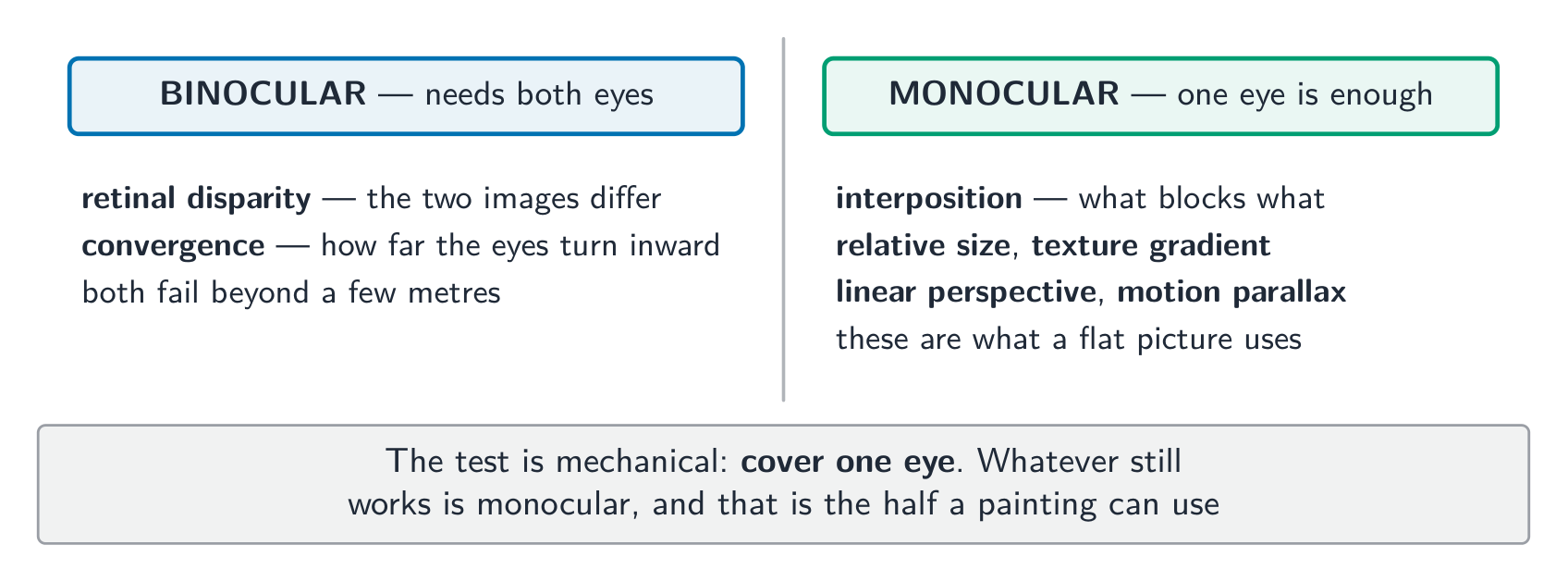
    双眼线索(binocular cues)需要两只眼睛。视网膜像差(retinal disparity)是两幅图像之间的细小差别,差别越大,物体越近。辐辏(convergence)是看近物时双眼向内转动。

    单眼线索(monocular cues)只用一只眼即可:相对清晰度(relative clarity)、相对大小(relative size)、纹理梯度(texture gradient)、线条透视(linear perspective)和遮挡(interposition,近处物体挡住远处物体)。

    知觉恒常性(perceptual constancy)让物体在视网膜像改变时看起来仍然一样——门打开时仍被看成长方形。大脑还能在没有真实运动时知觉到似动(apparent movement),这正是一连串静止画面看起来像影片的原因。

    词汇表 训练
    英文 中文 拼音
    depth cues 深度线索 shēn dù xiàn suǒ
    Binocular cues 双眼线索 shuāng yǎn xiàn suǒ
    Retinal disparity 视网膜像差 shì wǎng mó xiàng chà
    Convergence 辐辏 fú còu
    Monocular cues 单眼线索 dān yǎn xiàn suǒ
    relative clarity 相对清晰度 xiāng duì qīng xī dù
    relative size 相对大小 xiāng duì dà xiǎo
    texture gradient 纹理梯度 wén lǐ tī dù
    linear perspective 线条透视 xiàn tiáo tòu shì
    interposition 遮挡 zhē dǎng
    Perceptual constancy 知觉恒常性 zhī jué héng cháng xìng
    apparent movement 似动 shì dòng
    2.2

    思维、问题解决、判断与决策

    大纲
    Learning ObjectiveEssential Knowledge

    2.2.A
    Explain how psychological concepts and theories account for thinking, problem-solving, judgment, and decision-making.

    • 2.2.A.1 Concepts form the basis of thought. Prototypes are the ideal example for any given concept.
    • 2.2.A.2 People form and modify schemas, or frameworks for thinking, through assimilation (taking in new information but not changing the schema in light of it) and accommodation (taking in new information and changing the schema to incorporate the new information).
    • 2.2.A.3 Algorithms address problems by attempting all possible solutions until the correct one is found.
    • 2.2.A.4 Heuristics address problems by using mental shortcuts to make judgments. Using heuristics can lead to errors in judgment when decisions are made according to prior expectations or stereotypes (representativeness heuristic) or recalling the first or most vivid example that comes to mind (availability heuristic).
    • 2.2.A.5 Decision making can be influenced by prior experiences that were successful (mental set) or circumstances surrounding a decision (priming and framing).
    • 2.2.A.6 Cognitive processes such as gambler’s fallacy and sunk-cost fallacy can hinder people from making good decisions.
    • 2.2.A.7 Executive functions are cognitive processes that allow individuals to generate, organize, plan, and carry out goal-directed behaviors and experience critical thinking.
    • 2.2.A.8 Creativity is a way of thinking that includes generating novel ideas and engaging in divergent (versus convergent) thinking. Creative thinking is hindered by functional fixedness.

    来源:美国大学理事会 AP 课程与考试说明

    概念(concepts)是思维的基础,原型(prototype)是某个概念最典型的例子。人们通过同化(assimilation,把新信息纳入已有图式)和顺应(accommodation,改变图式以适应新信息)来建立和修改图式。

    解决问题有两种方式:

    • 算法(algorithm)逐一尝试所有可能的解法,一定能得到答案,但很慢。
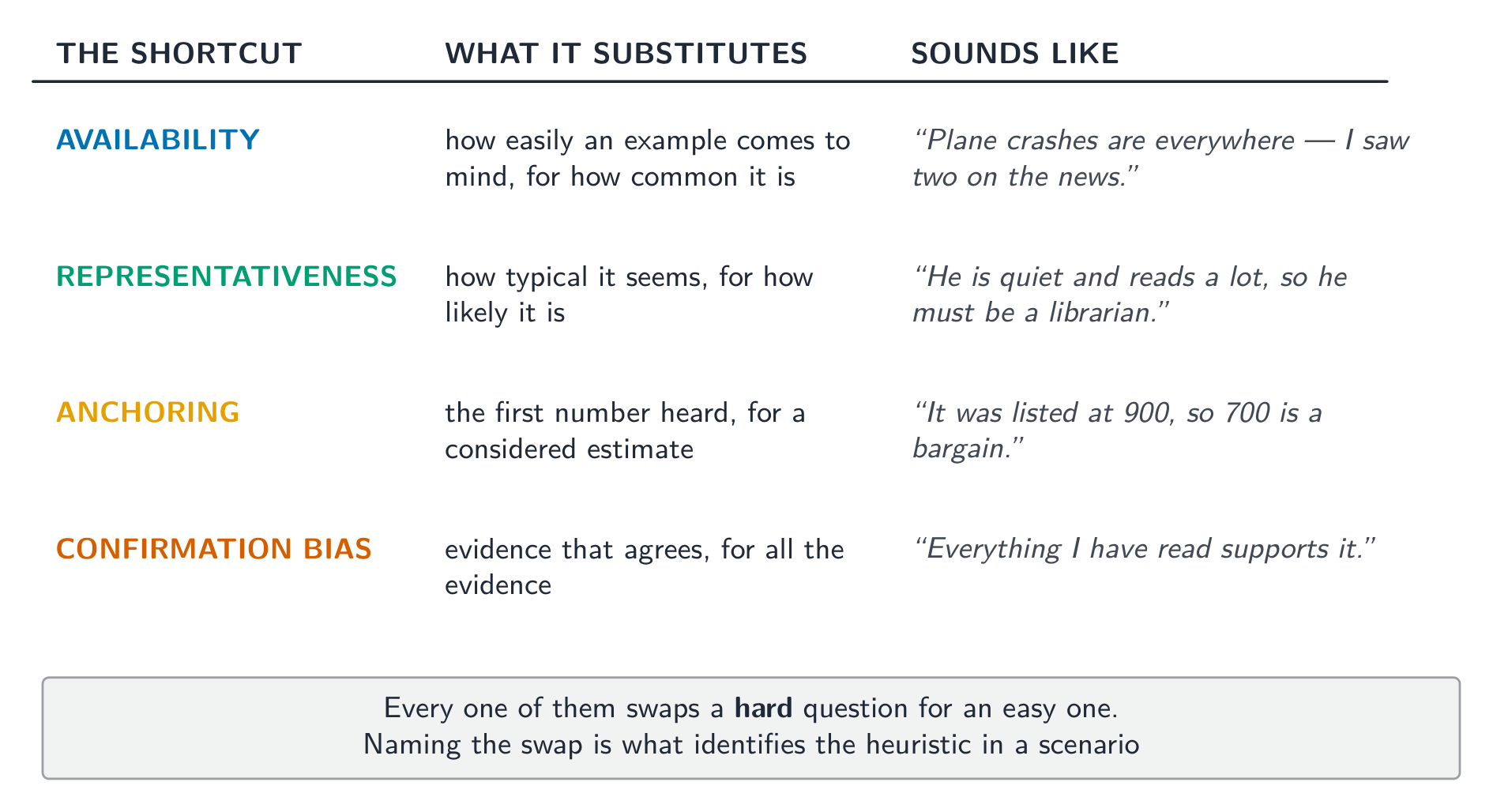
    • 启发式(heuristic)是心理捷径,速度快但可能出错——代表性启发式(representativeness heuristic)按与原型的相似程度作判断,可得性启发式(availability heuristic)按例子在脑中出现的容易程度作判断。

    思维也可能卡住。心向(mental set)是倾向于重复以前奏效的解法,功能固着(functional fixedness)是只看到物体的常规用途。赌徒谬误(gambler's fallacy,认为连续的走势必然会中断)和沉没成本谬误(sunk-cost fallacy,因为已经投入而继续)都会妨碍好的决策。

    执行功能(executive functions)使人能够产生、组织、计划并执行目标。创造力(creativity)依赖发散思维(divergent thinking,产生大量想法),而不是聚合思维(convergent thinking,收敛到唯一答案)。

    词汇表 训练
    英文 中文 拼音
    Concepts 概念 gài niàn
    prototype 原型 yuán xíng
    assimilation 同化 tóng huà
    accommodation 顺应 shùn yìng
    algorithm 算法 suàn fǎ
    heuristic 启发式 qǐ fā shì
    representativeness heuristic 代表性启发式 dài biǎo xìng qǐ fā shì
    availability heuristic 可得性启发式 kě dé xìng qǐ fā shì
    mental set 心向 xīn xiàng
    Functional fixedness 功能固着 gōng néng gù zhuó
    gambler's fallacy 赌徒谬误 dǔ tú miù wù
    sunk-cost fallacy 沉没成本谬误 chén mò chéng běn miù wù
    Executive functions 执行功能 zhí xíng gōng néng
    Creativity 创造力 chuàng zào lì
    divergent thinking 发散思维 fā sàn sī wéi
    convergent thinking 聚合思维 jù hé sī wéi
    2.3

    记忆导论

    大纲
    Learning ObjectiveEssential Knowledge

    2.3.A
    Explain how the types, structures, and processes of memory work.

    • 2.3.A.1 Memories for learned knowledge, events, and experiences are differentiated by how they are processed by, stored in, and retrieved by the brain.
      • 2.3.A.1.i Explicit memory is a type of memory that is more easily described or explained to others. Types of explicit memory include episodic and semantic.
      • 2.3.A.1.ii Implicit memory is more challenging to describe or explain to others. Procedural memory is a type of implicit memory for procedures and processes.
      • 2.3.A.1.iii Prospective memory is a type of memory related to future actions.
    • 2.3.A.2 Long-term potentiation, a process by which synaptic connections between neurons become stronger with frequent activation, is a biological process for memory.
    • 2.3.A.3 The working memory model examines how our primary memory system—working memory— engages in a dynamic interaction with several components, namely the central executive, phonological loop, and visuospatial sketchpad, to process information into long-term memory.
    • 2.3.A.4 The multi-store model proposes three interacting systems (sensory memory [including iconic and echoic memory], short-term memory, and long-term memory) that information must pass through to be remembered. This model focuses on the impact of automatic and effortful processing on memory encoding, storage, and retrieval.
    • 2.3.A.5 The levels of processing model proposes that memory is encoded on three levels from shallowest to deepest: structural, phonemic, and semantic.

    来源:美国大学理事会 AP 课程与考试说明

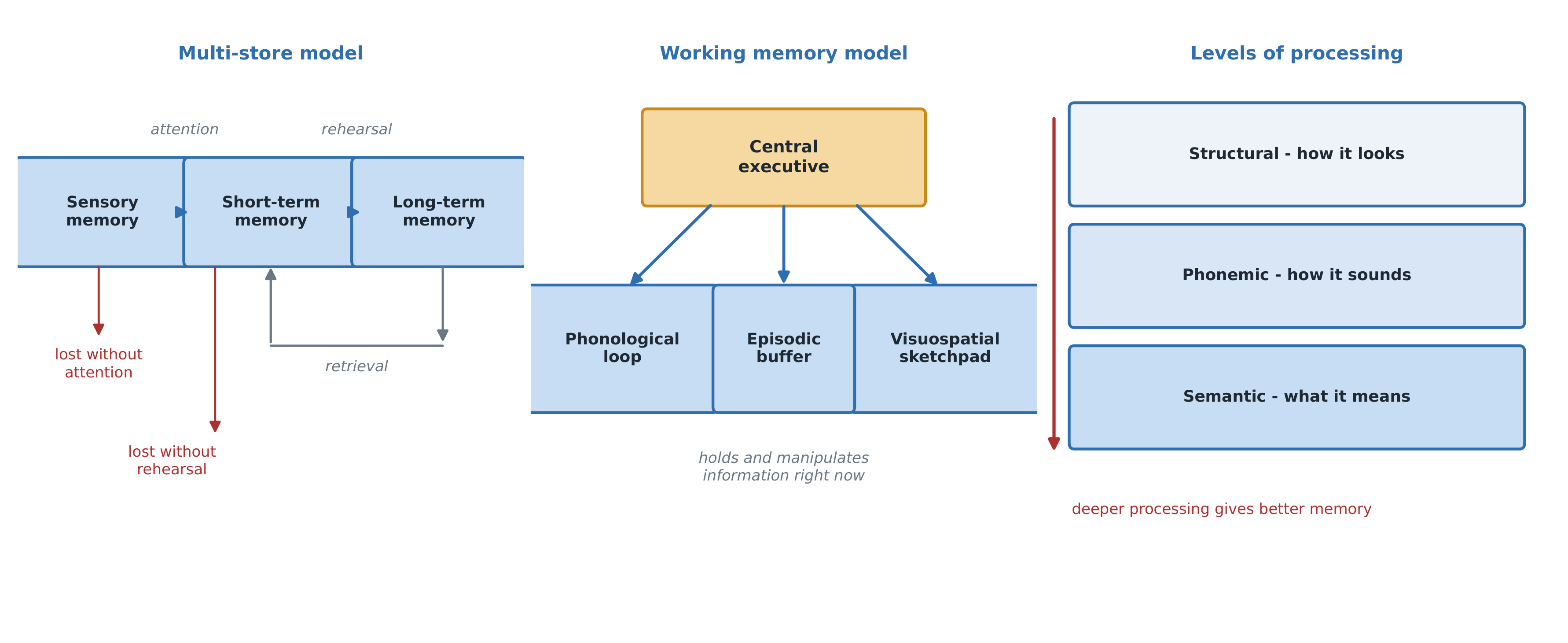
    并排呈现的三种记忆模型:多重存储的信息流、工作记忆的各个成分,以及加工水平的深度标尺
    三种在考试范围内的记忆模型:信息在各存储之间流动,在工作记忆中被主动保持,而加工越深记忆越好

    记忆按信息的加工方式来划分。

    外显记忆(explicit memory)可以向别人描述,又分为情景记忆(episodic memory,个人经历)和语义记忆(semantic memory,事实知识)。内隐记忆(implicit memory)较难描述,其中包括程序性记忆(procedural memory,如骑车这类技能)。前瞻记忆(prospective memory)是记得以后要做某件事。

    长时程增强(long-term potentiation)是其生物学基础:突触连接会因反复使用而增强。

    有三种模型在考试范围内:

    • 多重存储模型(multi-store model)提出感觉记忆(sensory memory,包括图像记忆(iconic)和声像记忆(echoic))、短时记忆(short-term memory)和长时记忆(long-term memory)。
    • 工作记忆模型(working memory model)把中间阶段看作主动加工,而非等候室。它包含语音回路(phonological loop)、视空间模板(visuospatial sketchpad)和中央执行系统(central executive)。
    • 加工水平模型(levels of processing model)认为加工越深记忆越好:从最浅的外形加工,到语音加工,再到最深的意义加工。
    词汇表 训练
    英文 中文 拼音
    Explicit memory 外显记忆 wài xiǎn jì yì
    episodic memory 情景记忆 qíng jǐng jì yì
    semantic memory 语义记忆 yǔ yì jì yì
    Implicit memory 内隐记忆 nèi yǐn jì yì
    procedural memory 程序性记忆 chéng xù xìng jì yì
    Prospective memory 前瞻记忆 qián zhān jì yì
    Long-term potentiation 长时程增强 zhǎng shí chéng zēng qiáng
    multi-store model 多重存储模型 duō zhòng cún chǔ mó xíng
    sensory memory 感觉记忆 gǎn jué jì yì
    iconic 图像记忆 tú xiàng jì yì
    echoic 声像记忆 shēng xiàng jì yì
    short-term memory 短时记忆 duǎn shí jì yì
    long-term memory 长时记忆 zhǎng shí jì yì
    working memory model 工作记忆模型 gōng zuò jì yì mó xíng
    phonological loop 语音回路 yǔ yīn huí lù
    visuospatial sketchpad 视空间模板 shì kōng jiān mú bǎn
    central executive 中央执行系统 zhōng yāng zhí xíng xì tǒng
    levels of processing model 加工水平模型 jiā gōng shuǐ píng mó xíng
    2.4 2.5

    记忆的编码

    大纲
    Learning ObjectiveEssential Knowledge

    2.4.A
    Explain how different encoding processes work to get information into memory.

    • 2.4.A.1 Encoding involves processes and strategies to get information into memory. How information is encoded can determine how effectively information is stored and retrieved.
    • 2.4.A.2 Mnemonic devices, such as method of loci, are processes that aid in encoding information into working and long-term memory.
    • 2.4.A.3 Encoding can be improved by the process of grouping information together into meaningful chunks (“chunking”), categories, or hierarchies.
    • 2.4.A.4 The spacing effect is a process that can cause significant differences in encoding and memory consolidation depending on whether the information is encoded all at once (massed practice) or distributed over time (distributed practice).
    • 2.4.A.5 Encoding processes can be affected by the order of how the information is presented, called the serial position effect. The serial position effect predicts that information presented at the beginning of a list (primacy effect) or the end of a list (recency effect) will be more memorable than information presented in the middle of a list.
    Learning ObjectiveEssential Knowledge

    2.5.A
    Explain how memory storage processes retain information in memory.

    • 2.5.A.1 Sensory memory, short-term memory, working memory, and long-term memory are processes that differ in storage duration, capacity, and content.
    • 2.5.A.2 Storage may be prolonged by rehearsing information over time (maintenance rehearsal). Rehearsing information over time in ways that promote meaning (elaborative rehearsal) helps with memory retention.
    • 2.5.A.3 Some people demonstrate highly superior autobiographical memory which may indicate that there are biological processes for superior memory storage. Autobiographical memory may also explain why memories connected to our own lives or selves are more memorable.
    • 2.5.A.4 Storage processes may be negatively affected by physical impairment and developmental limitations, such as amnesia (retrograde and anterograde), Alzheimer’s disease, and infantile amnesia.

    来源:美国大学理事会 AP 课程与考试说明

    编码(encoding)是把信息送入记忆的过程,编码方式会改变记忆效果。

    • 记忆术(mnemonic devices),如位置法(method of loci),有助于编码。
    • 组块(chunking)把项目合并成有意义的单元,从而提高短时记忆的容量。
    • 间隔效应(spacing effect)表明分散学习优于集中练习(massed practice,临时抱佛脚)。
    • 系列位置效应(serial position effect)指列表开头(首因效应(primacy))和结尾(近因效应(recency))的项目记得最牢。

    不同系统的存储方式不同。保持性复述(maintenance rehearsal)靠重复来保持信息;精细复述(elaborative rehearsal)把信息与已有知识联系起来,效果更好。

    少数人表现出超常自传体记忆(highly superior autobiographical memory),这提示存在生物学差异。存储也可能受损:阿尔茨海默病(Alzheimer's disease)和婴儿期遗忘(infantile amnesia)都会限制能够存储或恢复的内容。

    词汇表 训练
    英文 中文 拼音
    Encoding 编码 biān mǎ
    Mnemonic devices 记忆术 jì yì shù
    method of loci 位置法 wèi zhì fǎ
    Chunking 组块 zǔ kuài
    spacing effect 间隔效应 jiàn gé xiào yìng
    massed practice 集中练习 jí zhōng liàn xí
    serial position effect 系列位置效应 xì liè wèi zhì xiào yìng
    primacy 首因效应 shǒu yīn xiào yìng
    recency 近因效应 jìn yīn xiào yìng
    Maintenance rehearsal 保持性复述 bǎo chí xìng fù shù
    elaborative rehearsal 精细复述 jīng xì fù shù
    highly superior autobiographical memory 超常自传体记忆 chāo cháng zì zhuàn tǐ jì yì
    Alzheimer's disease 阿尔茨海默病 ā ěr cí hǎi mò bìng
    infantile amnesia 婴儿期遗忘 yīng ér qī yí wàng
    2.6 2.7

    记忆的提取

    大纲
    Learning ObjectiveEssential Knowledge

    2.6.A
    Explain how memory retrieval processes get information out of memory.

    • 2.6.A.1 The process of memory retrieval occurs through recall (remembering without cues) or recognition (which relies on retrieval cues).
    • 2.6.A.2 The process of memory retrieval can be enhanced when people are in the same environmental space (context-dependent memory), mood (mood-congruent memory), or physical state (state-dependent memory) as they were when they encoded the information to be retrieved.
    • 2.6.A.3 Successful retrieval is more likely when using retrieval practice processes, including testing effect and metacognition.
    Learning ObjectiveEssential Knowledge

    2.7.A
    Explain possible reasons why memory failure or errors may occur.

    • 2.7.A.1 The forgetting curve shows that time is a significant factor in forgetting. Forgetting occurs rapidly after initial learning and levels off over time.
    • 2.7.A.2 Many memories are difficult to retrieve due to encoding failure, interference (proactive or retroactive), or inadequate retrieval (i.e., tip-of-the-tongue phenomenon).
    • 2.7.A.3 Psychodynamic theorists believe that information or memories can be forgotten to defend the ego from distress (repression).
    • 2.7.A.4 The accuracy of memories may be affected by the misinformation effect, source amnesia, or constructive memory (via memory consolidation and imagination inflation).

    来源:美国大学理事会 AP 课程与考试说明

    提取有两种形式:回忆(recall,没有线索地把信息提取出来)和再认(recognition,在若干选项中把它认出来)。再认更容易,这也是选择题比论述题感觉更轻松的原因。

    条件匹配会提升提取效果。情境依存记忆(context-dependent memory)在同一地点效果更好;状态依存记忆(state-dependent memory)在同样的生理状态下更好;心境一致性记忆(mood-congruent memory)更容易回忆起与当前心境一致的材料。练习提取同样有效——测试效应(testing effect)表明自我测验优于反复阅读。

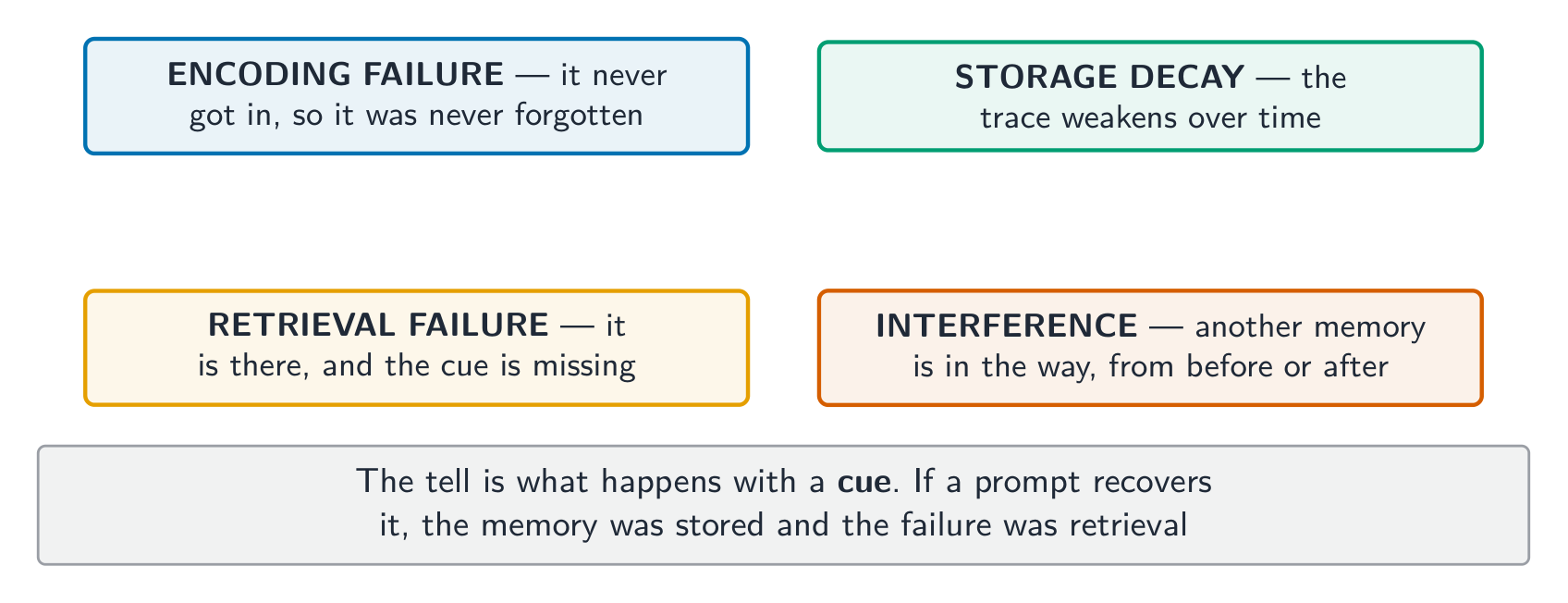
    遗忘有多种原因。遗忘曲线(forgetting curve)显示学习之后遗忘最快。编码失败(encoding failure)意味着信息从未进入记忆。干扰(interference)可分为前摄干扰(proactive,旧学习妨碍新学习)和倒摄干扰(retroactive,新学习妨碍旧学习)。提取失败(retrieval failure)包括舌尖现象(tip-of-the-tongue phenomenon)。

    记忆还是重构的(reconstructive),而不是录像。错误信息效应(misinformation effect)指事后获得的信息改变了一个人的记忆。来源遗忘(source amnesia)则是记得内容却想不起它出自哪里。

    Worked example(一道真实的 AP 考题)。2025 年的文章分析题呈现了一项研究:被试阅读一段含 20%、50% 或 80% 误导性句子的摘要,然后回答关于一段视频的问题。正确率从 74%(低误导信息组)降到 63%(高误导信息组)。其中一问要求学生"解释至少一项研究结果如何支持或反驳错误信息效应"*。满分答案会同时给出结果*把它与概念相连:*"高误导信息组的正确率为 63%,而低误导信息组为 74%。接触更多误导性细节降低了准确率,因此该结果支持错误信息效应,即事件发生后获得的信息会改变对该事件的记忆。"*注意其结构:先引用数据,再点明数据支持的概念。只把定义重述一遍、不给出数字,并没有回答 Explain

    词汇表 训练
    英文 中文 拼音
    recall 回忆 huí yì
    recognition 再认 zài rèn
    Context-dependent memory 情境依存记忆 qíng jìng yī cún jì yì
    state-dependent memory 状态依存记忆 zhuàng tài yī cún jì yì
    mood-congruent memory 心境一致性记忆 xīn jìng yí zhì xìng jì yì
    testing effect 测试效应 cè shì xiào yìng
    forgetting curve 遗忘曲线 yí wàng qū xiàn
    Encoding failure 编码失败 biān mǎ shī bài
    Interference 干扰 gān rǎo
    proactive 前摄干扰 qián shè gān rǎo
    retroactive 倒摄干扰 dào shè gān rǎo
    Retrieval failure 提取失败 tí qǔ shī bài
    tip-of-the-tongue phenomenon 舌尖现象 shé jiān xiàn xiàng
    reconstructive 重构的 zhòng gòu de
    misinformation effect 错误信息效应 cuò wù xìn xī xiào yìng
    Source amnesia 来源遗忘 lái yuán yí wàng
    2.8

    智力与成就

    大纲
    Learning ObjectiveEssential Knowledge

    2.8.A
    Explain how modern and historical theories describe intelligence.

    • 2.8.A.1 Throughout history, consensus about how to define and measure intelligence continues to be elusive and can be subject to bias. Researchers debate whether intelligence is a general ability (called g) or is comprised of multiple abilities.

    2.8.B
    Explain how intelligence is measured.

    • 2.8.B.1 Early formal intelligence tests yielded an intelligence quotient (IQ), which divided mental age by chronological age. In modern times, IQ scores are often used to identify students for educational services.
      • Exclusion Statement: Labeling or describing cognitive abilities and disabilities are outside the scope of the AP Psychology Exam.
    • 2.8.B.2 All psychological assessments, including intelligence tests, should adhere to sound psychometric principles to be considered useful.
      • 2.8.B.2.i A test is said to be standardized when it is administered using consistent procedures and environments.
      • 2.8.B.2.ii A test is considered valid if it measures what it is designed to measure. Types of validity include construct and predictive.
      • 2.8.B.2.iii A test is considered reliable if it yields similar results each time it is administered. Types of reliability include test-retest and split-half.
    • 2.8.B.3 Researchers strive to develop assessments of intelligence that are socio-culturally responsive to reduce stereotype threat and potential inequity that may occur due to stereotype lift.

    2.8.C
    Explain how systemic issues relate to the quantitative and qualitative uses of intelligence assessments.

    • 2.8.C.1 IQ scores across much of the world have generally increased over time (Flynn Effect) due to societal factors, such as higher socioeconomic status and access to better health care and better nutrition.
    • 2.8.C.2 IQ scores tend to vary more within a group than between groups. Personal and sociocultural biases can impact the interpretation of individual IQ scores and the score’s relationship with other outcomes. Poverty, discrimination, and educational inequities can negatively influence intelligence scores of individuals and societal groups around the world.
    • 2.8.C.3 Scores from intelligence tests have been used to limit access to jobs, military ranks, educational institutions, and immigration to the US.

    2.8.D
    Explain how academic achievement is measured and experienced as compared to intelligence.

    • 2.8.D.1 Some academic tests attempt to measure what someone knows (achievement tests) or predict how someone will perform in the future (aptitude tests).
    • 2.8.D.2 People’s beliefs about whether intelligence is fixed from birth (fixed mindset) or malleable due to experience (growth mindset) can affect academic achievement.

    来源:美国大学理事会 AP 课程与考试说明

    心理学家至今仍未就如何定义智力(intelligence)达成一致。一般智力因素(Spearman's g)主张存在一种普遍能力;另一些理论主张存在多种能力,包括流体智力(fluid intelligence,用于解决新异问题的推理能力,随年龄下降)和晶体智力(crystallised intelligence,积累的知识,不随年龄下降)。

    早期测验用心理年龄除以实际年龄得到智商(intelligence quotient, IQ)。现代分数则与总体的正态曲线(normal curve)作比较。

    任何心理测评都必须符合心理测量学原则(psychometric principles):

    • 标准化(standardization)——按一致的程序施测,并与常模团体比较记分。
    • 效度(validity)——测的确实是它声称要测的东西。构念效度(construct validity)和预测效度(predictive validity)都在考试范围内。
    • 信度(reliability)——每次施测结果相近,可用重测信度(test-retest reliability)和分半信度(split-half reliability)检验。

    全世界的 IQ 分数在代际间普遍上升(弗林效应(Flynn effect)),这指向社会因素而非生物因素。分数在群体内部的差异大于群体之间的差异,而刻板印象威胁(stereotype threat)会在一个人担心印证关于自身群体的负面刻板印象时拉低其表现。

    词汇表 训练
    英文 中文 拼音
    intelligence 智力 zhì lì
    Spearman's g 一般智力因素 yì bān zhì lì yīn sù
    fluid intelligence 流体智力 liú tǐ zhì lì
    crystallised intelligence 晶体智力 jīng tǐ zhì lì
    intelligence quotient (IQ) 智商 zhì shāng
    normal curve 正态曲线 zhèng tài qū xiàn
    psychometric principles 心理测量学原则 xīn lǐ cè liáng xué yuán zé
    Standardization 标准化 biāo zhǔn huà
    Validity 效度 xiào dù
    Construct validity 构念效度 gòu niàn xiào dù
    predictive validity 预测效度 yù cè xiào dù
    Reliability 信度 xìn dù
    test-retest reliability 重测信度 zhòng cè xìn dù
    split-half reliability 分半信度 fēn bàn xìn dù
    Flynn effect 弗林效应 fú lín xiào yìng
    stereotype threat 刻板印象威胁 kè bǎn yìn xiàng wēi xié
    2.8

    考试技巧

    • 感觉知觉分开:探测是感觉,解释是知觉。
    • 自下而上从刺激开始,自上而下从期待开始。要说清题目情境属于哪一种。
    • 按方向记干扰:前摄指旧材料向前影响新材料。
    • 回答编码类题目时,要点出具体策略——组块、间隔学习、精细复述——而不是笼统地说"更努力地学"。
    • 回答测评题时,把信度效度分开。一个测验可以很可靠,却测的是错的东西。
    • 题目给出数据时,先引用一个数字,再点明概念。以结果为依据的小问,分数就落在数字与术语之间的联系上。
  • 3

    发展与学习

    讲义 词汇表
    3.1

    发展心理学的主题与研究方法

    大纲
    Learning ObjectiveEssential Knowledge

    3.1.A
    Explain how enduring themes inform developmental psychology.

    • 3.1.A.1 Developmental psychology is concerned with both chronological order of development and/ or thematic issues in development across the lifespan. Thematic issues of interest to developmental psychologists include stability and change, nature and nurture, and continuous and discontinuous stages of development.

    3.1.B
    Describe ways cross-sectional and longitudinal research design methods used in developmental psychology inform understanding about behavior and mental processes.

    来源:美国大学理事会 AP 课程与考试说明

    发展心理学(developmental psychology)研究人在一生中如何变化。整个单元贯穿两个问题。

    • 变化是连续的(continuous,渐进而平滑)还是不连续的(discontinuous,分阶段进行)?
    • 某项特征在一生中是稳定的(stable),还是会发生改变?

    研究者用两种设计来回答。横断研究(cross-sectional study)在同一时间比较不同年龄组——快,但差异可能来自各组不同的成长年代。纵向研究(longitudinal study)追踪同一批人多年——慢,但能显示个体内部的真实变化。

    词汇表 训练
    英文 中文 拼音
    Developmental psychology 发展心理学 fā zhǎn xīn lǐ xué
    continuous 连续的 lián xù de
    discontinuous 不连续的 bù lián xù de
    stable 稳定的 wěn dìng de
    cross-sectional study 横断研究 héng duàn yán jiū
    longitudinal study 纵向研究 zòng xiàng yán jiū
    3.2

    毕生的生理发展

    大纲
    Learning ObjectiveEssential Knowledge

    3.2.A
    Explain how physical development before birth applies to behavior and mental processes.

    • 3.2.A.1 Teratogens, maternal illness, genetic mutations, hormonal, and environmental factors can influence the major physical and psychological milestones that occur during prenatal development.
      • Exclusion Statement: The stages of prenatal development (zygote, embryo, and fetus) are outside the scope of the AP Psychology Exam.

    3.2.B
    Explain how physical development in infancy and childhood apply to behavior and mental processes.

    • 3.2.B.1 Physical development in infancy and childhood happens in generally the same order, but the timing of the development can vary. The development of fine and gross motor coordination is among the major physical and psychological milestones that define infancy and childhood. These physical skills develop as children mature, allowing children to develop critical skills needed to become more independent.
    • 3.2.B.2 Infants possess reflexes, like the rooting reflex, that indicate on-track physical and psychological milestone development.
    • 3.2.B.3 Research using the visual cliff apparatus demonstrates an early ability in infants to perceive depth and an innovative way to assess infant responses.
    • 3.2.B.4 Research suggests that critical or sensitive periods in infancy and childhood have strong developmental effects, especially for skills such as language. Some non-human animals will imprint on the first object they encounter as a means of survival.

    3.2.C
    Explain how physical development in adolescence applies to behavior and mental processes.

    • 3.2.C.1 The main physical and psychological milestones that occur in adolescence are the adolescent growth spurt and puberty, in which reproductive ability develops. Adolescents develop primary and secondary sex characteristics during this time, such as menarche and spermarche.

    3.2.D
    Explain how physical development in adulthood applies to behavior and mental processes.

    • 3.2.D.1 Adulthood spans most of the lifespan and is characterized by a general leveling off and then a varying decline in reproductive ability (i.e., menopause), mobility, flexibility, reaction time, and visual and auditory sensory acuity.

    来源:美国大学理事会 AP 课程与考试说明

    出生前的发展可能被致畸物(teratogens,如酒精等有害因素)、母亲的疾病、基因突变,以及激素或环境因素所干扰。

    婴儿的生理发展在各地遵循大致相同的顺序,只是速度不同。新生儿具有表明发展正常的反射(reflexes),例如觅食反射(rooting reflex,面颊被触碰时转向该侧)。视崖(visual cliff)实验表明婴儿很早就能知觉深度。

    关键期(critical period)是某种经验产生异常强烈影响的时间窗口;敏感期(sensitive period)是同一想法较为宽松的版本。

    青春期(adolescence)带来青春期发育突增(adolescent growth spurt)和青春发育期(puberty),包括第一性征(primary sex characteristics)与第二性征(secondary sex characteristics)。成年期占据人生的大部分时间,其特点是先趋于平稳,随后逐渐衰退——女性会经历更年期(menopause)。

    词汇表 训练
    英文 中文 拼音
    teratogens 致畸物 zhì jī wù
    reflexes 反射 fǎn shè
    rooting reflex 觅食反射 mì shí fǎn shè
    visual cliff 视崖 shì yá
    critical period 关键期 guān jiàn qī
    sensitive period 敏感期 mǐn gǎn qī
    Adolescence 青春期 qīng chūn qī
    adolescent growth spurt 青春期发育突增 qīng chūn qī fā yù tū zēng
    puberty 青春发育期 qīng chūn fā yù qī
    primary sex characteristics 第一性征 dì yī xìng zhēng
    secondary sex characteristics 第二性征 dì èr xìng zhēng
    menopause 更年期 gēng nián qī
    Sex 生理性别 shēng lǐ xìng bié
    3.3

    性别与性取向

    大纲
    Learning ObjectiveEssential Knowledge

    3.3.A
    Describe how sex and gender influence socialization and other aspects of development.

    来源:美国大学理事会 AP 课程与考试说明

    生理性别(sex)指生物学特征,社会性别(gender)指社会赋予这些特征的角色与期待。性别角色(gender roles)通过社会化(socialization)习得:家庭、学校、同伴与媒体都在传递什么行为是被期待的。性取向(sexual orientation)描述一个人较为稳定的吸引模式。考试考查的是性别如何影响社会化与发展,而不是对个体作出任何评价。

    词汇表 训练
    英文 中文 拼音
    gender 社会性别 shè huì xìng bié
    Gender roles 性别角色 xìng bié jué sè
    socialization 社会化 shè huì huà
    Sexual orientation 性取向 xìng qǔ xiàng
    3.4

    毕生的认知发展

    大纲
    Learning ObjectiveEssential Knowledge

    3.4.A
    Explain how theories of cognitive development apply to behavior and mental processes.

    • 3.4.A.1 According to Piaget, children develop schemas via continuous and discontinuous processes such as assimilation and accommodation.
      • 3.4.A.1.i The sensorimotor stage occurs from infancy through toddlerhood. Object permanence develops during this stage.
      • 3.4.A.1.ii The preoperational stage occurs from toddlerhood through early childhood. Children become proficient in using mental symbols and engage in pretend play. The preoperational stage is identified more by cognitive tasks children cannot perform such as conservation and reversibility, or by those they exhibit, such as animism and egocentrism. Children begin to develop a theory of mind during this stage.
      • 3.4.A.1.iii The concrete operational stage occurs from early through late childhood. Children in this stage can generally correct the cognitive errors made in the preoperational stage and understand the world in logical, realistic, and straightforward ways, but struggle to think systematically.
      • 3.4.A.1.iv The formal operational stage occurs from late childhood through adulthood. People in this stage gain the ability to think abstractly and hypothetically. Piaget proposed that not all people achieve formal operational thinking.
    • 3.4.A.2 According to Vygotsky, children are social learners who learn through interacting with and scaffolding by other people within sociocultural contexts. Ideally, learning occurs while the person is in their zone of proximal development.
    • 3.4.A.3 Adults experience changes in cognitive capabilities as they progress through the lifespan. Crystallized intelligence remains relatively stable through adulthood while fluid intelligence tends to wane as people age. Cognitive disorders that affect adults include dementia.

    来源:美国大学理事会 AP 课程与考试说明

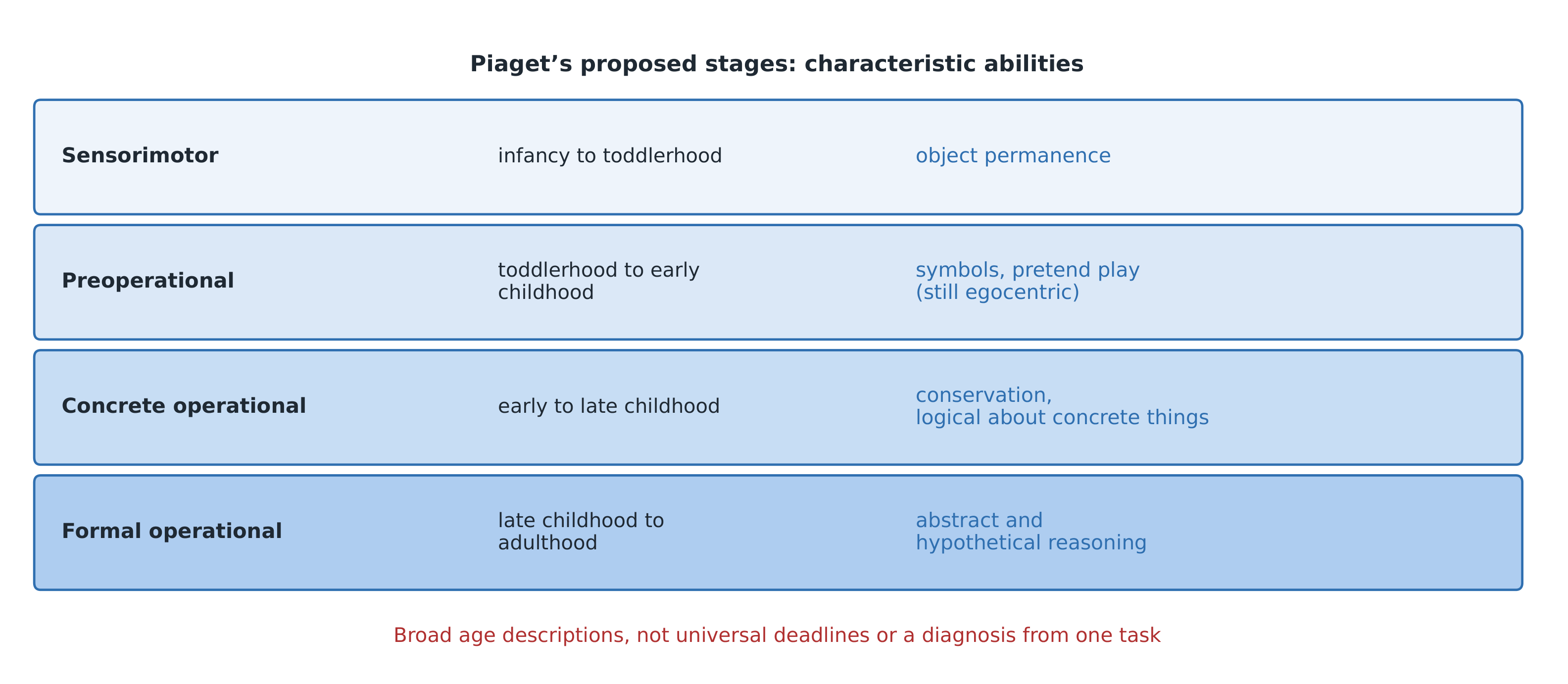
    皮亚杰的四个阶段呈阶梯上升,每一级标出年龄段以及定义该阶段的能力
    皮亚杰的四个阶段,每个阶段由儿童新获得的能力来定义

    皮亚杰(Piaget)提出儿童会建立图式,并经历四个阶段:

    • 感知运动阶段(sensorimotor stage,婴儿期至学步期):儿童通过感官与动作学习,并发展出客体永久性(object permanence)——知道被藏起来的物体依然存在。
    • 前运算阶段(preoperational stage,学步期至幼儿期):儿童会使用符号并进行假装游戏,但表现出自我中心(egocentrism,难以采纳他人视角),也尚未获得守恒(conservation,知道形状改变时数量不变)。
    • 具体运算阶段(concrete operational stage,幼儿期至童年后期):儿童能对具体事物进行逻辑推理,并获得守恒能力。
    • 形式运算阶段(formal operational stage,童年后期以后):抽象与假设性推理成为可能。

    维果茨基(Vygotsky)把儿童看作社会性学习者。最近发展区(zone of proximal development)是儿童独自能做到的与在帮助下能做到的之间的差距;支架(scaffolding)就是弥合这一差距的支持。

    成人的认知同样会变化,第二单元的流体/晶体之分在此再次出现:推理速度下降,而积累的知识不会。痴呆(dementia)则是超出正常衰老范围的衰退。

    词汇表 训练
    英文 中文 拼音
    Piaget 皮亚杰 pí yà jié
    Sensorimotor stage 感知运动阶段 gǎn zhī yùn dòng jiē duàn
    object permanence 客体永久性 kè tǐ yǒng jiǔ xìng
    Preoperational stage 前运算阶段 qián yùn suàn jiē duàn
    egocentrism 自我中心 zì wǒ zhōng xīn
    conservation 守恒 shǒu héng
    Concrete operational stage 具体运算阶段 jù tǐ yùn suàn jiē duàn
    Formal operational stage 形式运算阶段 xíng shì yùn suàn jiē duàn
    Vygotsky 维果茨基 wéi guǒ cí jī
    zone of proximal development 最近发展区 zuì jìn fā zhǎn qū
    scaffolding 支架 zhī jià
    Dementia 痴呆 chī dāi
    3.5

    沟通与语言发展

    大纲
    Learning ObjectiveEssential Knowledge

    3.5.A
    Explain how key components of language and communication apply to behavior and mental processes.

    • 3.5.A.1 Language is a shared (mutually agreed upon) system of arbitrary symbols (often expressed as and combined into phonemes, morphemes, and semantics) that are rule-governed (via grammar and syntax) and generative to produce an infinity of ideas.
      • Exclusion Statement: Pragmatics of language are outside the scope of the AP Psychology Exam.

    3.5.B
    Explain how language develops in humans.

    • 3.5.B.1 In language development across all cultures, people use nonverbal manual gestures (e.g., pointing) to communicate and develop formal language through specific stages (cooing, babbling, one-word stage, and telegraphic speech). People learning a language often make errors such as overgeneralization of language rules as they learn.

    来源:美国大学理事会 AP 课程与考试说明

    语言(language)是一套用于交流的、共同约定的任意符号系统。其发展遵循共同顺序:先是非言语的手势(gestures),然后是咕咕声(cooing)、咿呀语(babbling)、单词阶段(one-word stage),再到电报式语言(telegraphic speech,两词组合)。

    儿童先掌握规则,后掌握例外,于是出现过度规则化(overgeneralization)——把 went 说成 "goed"。这恰恰证明他们在学规则,而不只是模仿。

    词汇表 训练
    英文 中文 拼音
    Language 语言 yǔ yán
    gestures 手势 shǒu shì
    cooing 咕咕声 gū gū shēng
    babbling 咿呀语 yī yā yǔ
    one-word stage 单词阶段 dān cí jiē duàn
    telegraphic speech 电报式语言 diàn bào shì yǔ yán
    overgeneralization 过度规则化 guò dù guī zé huà
    Generalization 泛化 fàn huà
    3.6

    毕生的社会性与情绪发展

    大纲
    Learning ObjectiveEssential Knowledge

    3.6.A
    Explain how social development relates to behavior and mental processes.

    • 3.6.A.1 The ecological systems theory explores how the social environment influences development. The five systems in this theory are as follows: Bullet Microsystem (groups that have direct contact with the individual) Bullet Mesosystem (the relationships between groups in the microsystem) Bullet Exosystem (indirect factors in an individual’s life) Bullet Macrosystem (cultural events that affect the individuals and others around them) Bullet Chronosystem (the individual’s current stage of life).
    • 3.6.A.2 Research has identified different parenting styles of caregivers, including authoritarian, authoritative, and permissive. Cultural differences exist in the ways these parenting styles affect outcomes in caregivers and children.
    • 3.6.A.3 Research has identified different attachment styles demonstrated by infants and children, which vary by culture. The types of attachment infants and children display include secure and insecure (avoidant, anxious, and disorganized). Temperament is related to how children attach to caregivers.
      • 3.6.A.3.i Separation anxiety occurs when children express heightened anxiety or fear when away from a caregiver or in the presence of a stranger.
      • 3.6.A.3.ii Studies with monkeys demonstrate the importance of comfort over food in attachment.
    • 3.6.A.4 Developmental psychologists study how peer relationships develop over time.
      • 3.6.A.4.i Children engage with peers via play (parallel and pretend).
      • 3.6.A.4.ii Adolescents gradually rely more on peer relationships as they age. As adolescents interact with peers, they demonstrate a type of egocentrism that is often demonstrated via the imaginary audience and the personal fable.
    • 3.6.A.5 Developmental psychologists study how adults develop socially over time.
      • 3.6.A.5.i Culture plays a role in determining when adulthood begins and when major life events occur (social clock). Some cultures allow for a time of emerging adulthood as a transition from adolescence to adulthood.
      • 3.6.A.5.ii Relationships with other adults result in adults forming families or family-like relationships that should provide mutual support and care. Childhood attachment styles can affect how adults form attachments to other adults.
    • 3.6.A.6 The stage theory of psychosocial development, which was a reconceptualization of the psychosexual theory, proposes that people must resolve psychosocial conflicts at each stage of the lifespan. The stages are as follows: Bullet Trust and mistrust Bullet Autonomy and shame and doubt Bullet Initiative and guilt Bullet Industry and inferiority Bullet Identity and role confusion Bullet Intimacy and isolation Bullet Generativity and stagnation Bullet Integrity and despair
      • Exclusion Statement: The psychosexual stage theory of development is outside of the scope of the AP Psychology Exam.
    • 3.6.A.7 The experience of adverse childhood experiences (ACEs) has effects on relationships people form throughout the lifespan. Sociocultural differences exist in what is considered an ACE and how ACEs affect outcomes people may experience.
    • 3.6.A.8 Adolescents develop a sense of identity for who they will be as an adult through the processes of achievement, diffusion, foreclosure, and moratorium. Identity development also includes processes for developing identities such as racial/ethnic identity, gender identity, sexual orientation, religious identity, occupational identity, and familial identity, often through considering possible selves.

    来源:美国大学理事会 AP 课程与考试说明

    生态系统理论(ecological systems theory)把发展描述为层层嵌套的环境,从最贴近的家庭一直向外延伸到文化。

    研究区分出不同的教养方式(parenting styles):专制型(authoritarian,要求高、温情低)、权威型(authoritative,要求高、温情高)和放任型(permissive,要求低、温情高)。

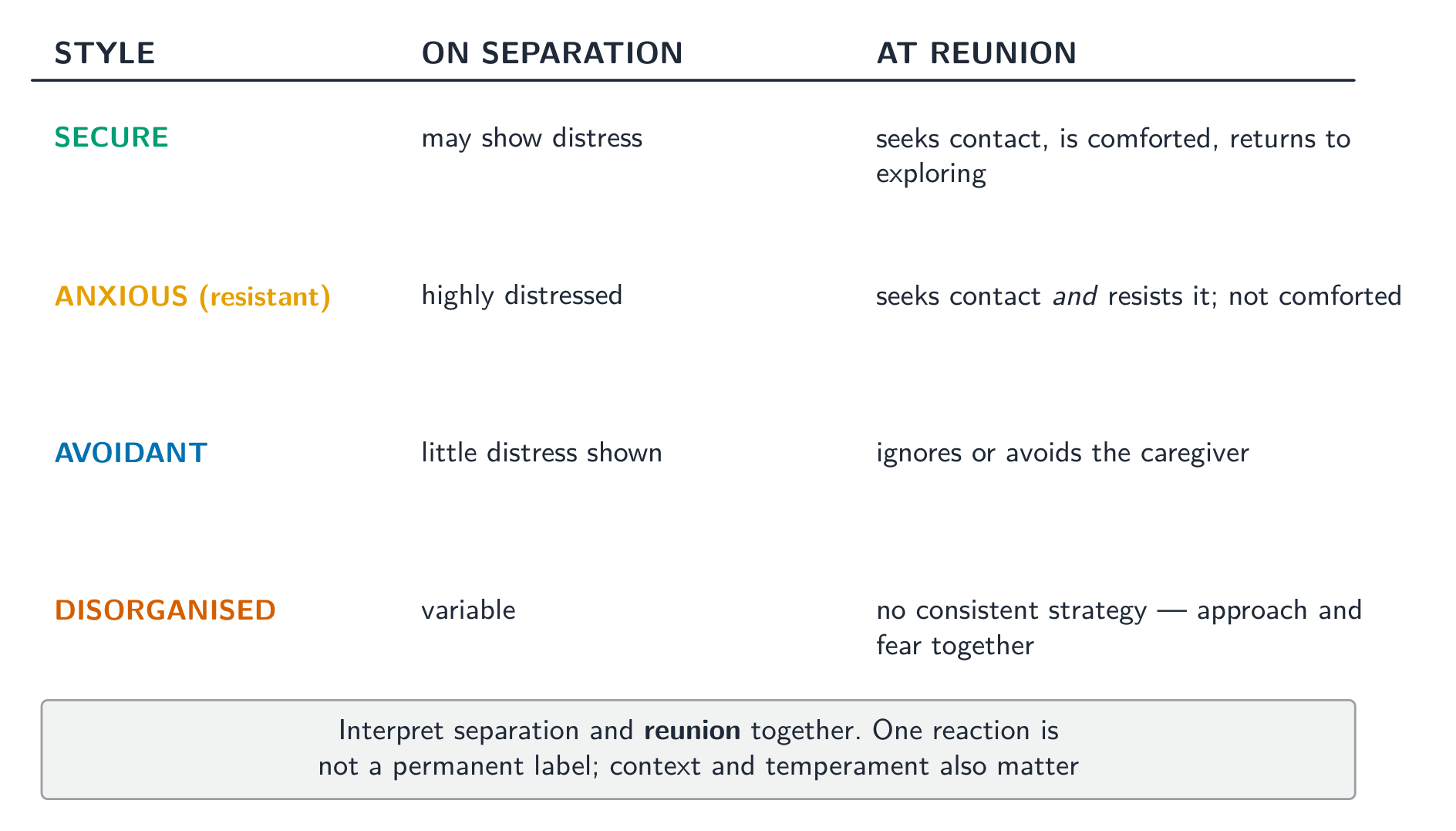
    依恋(attachment)是婴儿与照料者之间的情感联结,用陌生情境(strange situation)程序来研究。类型包括安全型依恋(secure attachment)以及不安全型(回避型(avoidant)、焦虑型(anxious)、混乱型(disorganized))。分离焦虑(separation anxiety)是离开照料者时的强烈不安。以猴子为对象的研究显示,幼崽更偏好接触安慰(contact comfort)而非食物,这改变了人们对依恋的理解。

    同伴关系在童年通过平行游戏(parallel play)和假装游戏(pretend play)发展,青少年则随年龄增长越来越依赖同伴。

    埃里克森(Erikson)提出了心理社会发展(psychosocial development)的阶段理论,每个阶段都提出一个需要解决的冲突——青少年阶段是同一性与角色混乱(identity versus role confusion)。童年不良经历(adverse childhood experiences, ACEs)会影响日后的人际关系与健康。

    词汇表 训练
    英文 中文 拼音
    Ecological systems theory 生态系统理论 shēng tài xì tǒng lǐ lùn
    parenting styles 教养方式 jiào yǎng fāng shì
    authoritarian 专制型 zhuān zhì xíng
    authoritative 权威型 quán wēi xíng
    permissive 放任型 fàng rèn xíng
    Attachment 依恋 yī liàn
    strange situation 陌生情境 mò shēng qíng jìng
    secure attachment 安全型依恋 ān quán xíng yī liàn
    avoidant 回避型 huí bì xíng
    anxious 焦虑型 jiāo lǜ xíng
    disorganized 混乱型 hùn luàn xíng
    Separation anxiety 分离焦虑 fēn lí jiāo lǜ
    contact comfort 接触安慰 jiē chù ān wèi
    parallel play 平行游戏 píng xíng yóu xì
    pretend play 假装游戏 jiǎ zhuāng yóu xì
    Erikson 埃里克森 āi lǐ kè sēn
    psychosocial development 心理社会发展 xīn lǐ shè huì fā zhǎn
    identity versus role confusion 同一性与角色混乱 tóng yī xìng yǔ jué sè hùn luàn
    Adverse childhood experiences (ACEs) 童年不良经历 tóng nián bù liáng jīng lì
    3.7

    经典条件作用

    大纲
    Learning ObjectiveEssential Knowledge

    3.7.A
    Explain how classical conditioning applies to behavior and mental processes.

    • 3.7.A.1 The behavioral perspective evolved from theories about learning via conditioning. Behaviorists have traditionally focused on observable behavior to the exclusion of mental processes.
    • 3.7.A.2 Classical conditioning focuses on the association of one stimulus with another stimulus to elicit a response. Learning the association (also known as acquisition) involves a series of steps that demonstrate principles of associative learning.
      • 3.7.A.2.i The unconditioned stimulus (UCS) elicits an unconditioned response (UCR). This response becomes the conditioned response (CR) when it is performed in response to the conditioned stimulus (CS).
      • 3.7.A.2.ii The order of presentation of the CS with the UCS is important to successful acquisition.
      • 3.7.A.2.iii A CR can become extinct when the CS is no longer paired with the UCS. A formerly extinct CR can be spontaneously recovered when the CS is again presented after extinction.
      • 3.7.A.2.iv Stimulus discrimination and generalization have been demonstrated in studies of classical conditioning.
      • 3.7.A.2.v A CS can be used as a UCS in higher-order conditioning.
        • Exclusion Statement: Delayed conditioning, trace conditioning, simultaneous conditioning, and backward conditioning are outside the scope of the AP Psychology Exam.
    • 3.7.A.3 Research has demonstrated that emotional responses can be classically conditioned. These findings form the basis of therapeutic interventions for many mental disorders, such as counterconditioning.
      • Exclusion Statement: The expectancy theory is outside the scope of the AP Psychology Exam.
    • 3.7.A.4 Research on taste aversions, which are acquired through classical conditioning, demonstrates one-trial conditioning and biological preparedness. One-trial learning occurs when the association is acquired through one pairing of the stimulus and response and is not strengthened by further pairings. Biological preparedness refers to how animals are biologically predisposed to learning certain stimulus-response pairings more quickly than others.
    • 3.7.A.5 Habituation occurs when organisms grow accustomed to and exhibit a diminished response to a repeated or enduring stimulus.

    来源:美国大学理事会 AP 课程与考试说明

    行为主义视角(behavioral perspective)用学习而非思维来解释行为。

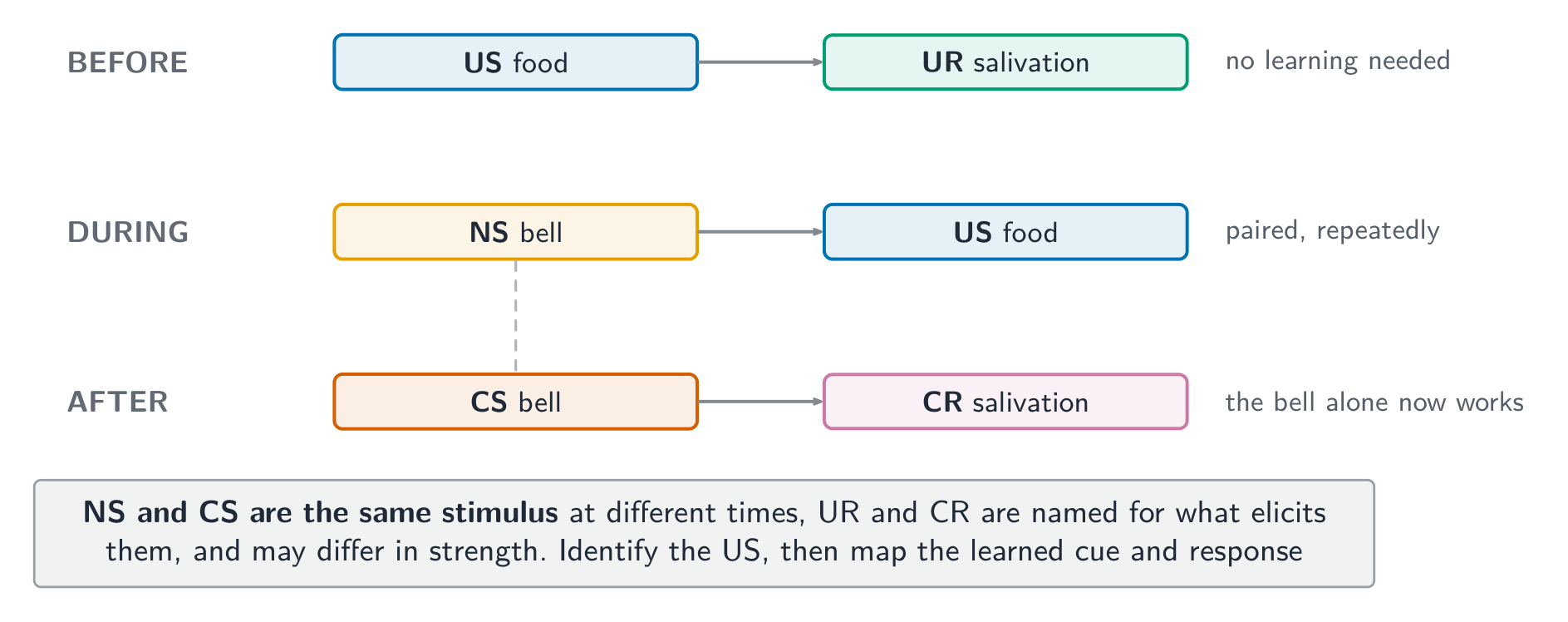
    经典条件作用(classical conditioning)把一个刺激与另一个刺激联系起来:

    • 无条件刺激(unconditioned stimulus, UCS)自然引发无条件反应(unconditioned response, UCR)——食物引起唾液分泌。
    • 与 UCS 配对的中性刺激(neutral stimulus)会变成条件刺激(conditioned stimulus, CS),引发条件反应(conditioned response, CR)。
    • 习得(acquisition)取决于配对的顺序与时间间隔。
    • 当 CS 不再与 UCS 配对时会发生消退(extinction);自发恢复(spontaneous recovery)是已消退的 CR 重新出现。
    • 泛化(generalization)是对相似刺激也作出反应;刺激辨别(stimulus discrimination)是只对特定 CS 作出反应。
    • 高级条件作用(higher-order conditioning)中,已建立的 CS 可充当新的 UCS。

    情绪反应可以被条件化,而味觉厌恶(taste aversion)表明某些联结一次即可形成,因为这有利于生存。习惯化(habituation)是对反复出现的刺激反应减弱。

    词汇表 训练
    英文 中文 拼音
    behavioral perspective 行为主义视角 xíng wéi zhǔ yì shì jiǎo
    Classical conditioning 经典条件作用 jīng diǎn tiáo jiàn zuò yòng
    unconditioned stimulus (UCS) 无条件刺激 wú tiáo jiàn cì jī
    unconditioned response (UCR) 无条件反应 wú tiáo jiàn fǎn yìng
    neutral stimulus 中性刺激 zhōng xìng cì jī
    conditioned stimulus (CS) 条件刺激 tiáo jiàn cì jī
    conditioned response (CR) 条件反应 tiáo jiàn fǎn yìng
    Acquisition 习得 xí dé
    Extinction 消退 xiāo tuì
    spontaneous recovery 自发恢复 zì fā huī fù
    stimulus discrimination 刺激辨别 cì jī biàn bié
    higher-order conditioning 高级条件作用 gāo jí tiáo jiàn zuò yòng
    taste aversion 味觉厌恶 wèi jué yàn wù
    Habituation 习惯化 xí guàn huà
    3.8

    操作性条件作用

    大纲
    Learning ObjectiveEssential Knowledge

    3.8.A
    Explain how operant conditioning applies to behavior and mental processes.

    • 3.8.A.1 Operant conditioning focuses on associating consequences (reinforcement and punishment) with behaviors. The Law of Effect states that behaviors with reinforcing consequences are more likely to be repeated while behaviors with punishing consequences are not as likely to be repeated.
    • 3.8.A.2 Reinforcement and punishment can be positive or negative. Reinforcers can be primary or secondary. Reinforcement discrimination and generalization have been demonstrated in studies of operant conditioning.
    • 3.8.A.3 Reinforcement can be used to shape behavior (“shaping”) gradually through rewarding successive approximations of the desired behavior. Research with animals shows that only certain behaviors can be shaped through reinforcement (known as instinctive drift).
    • 3.8.A.4 Superstitious behavior occurs when consequences reinforce unrelated behaviors. Learned helplessness occurs when organisms learn that they have no control over their experience of aversive consequences in a given situation.
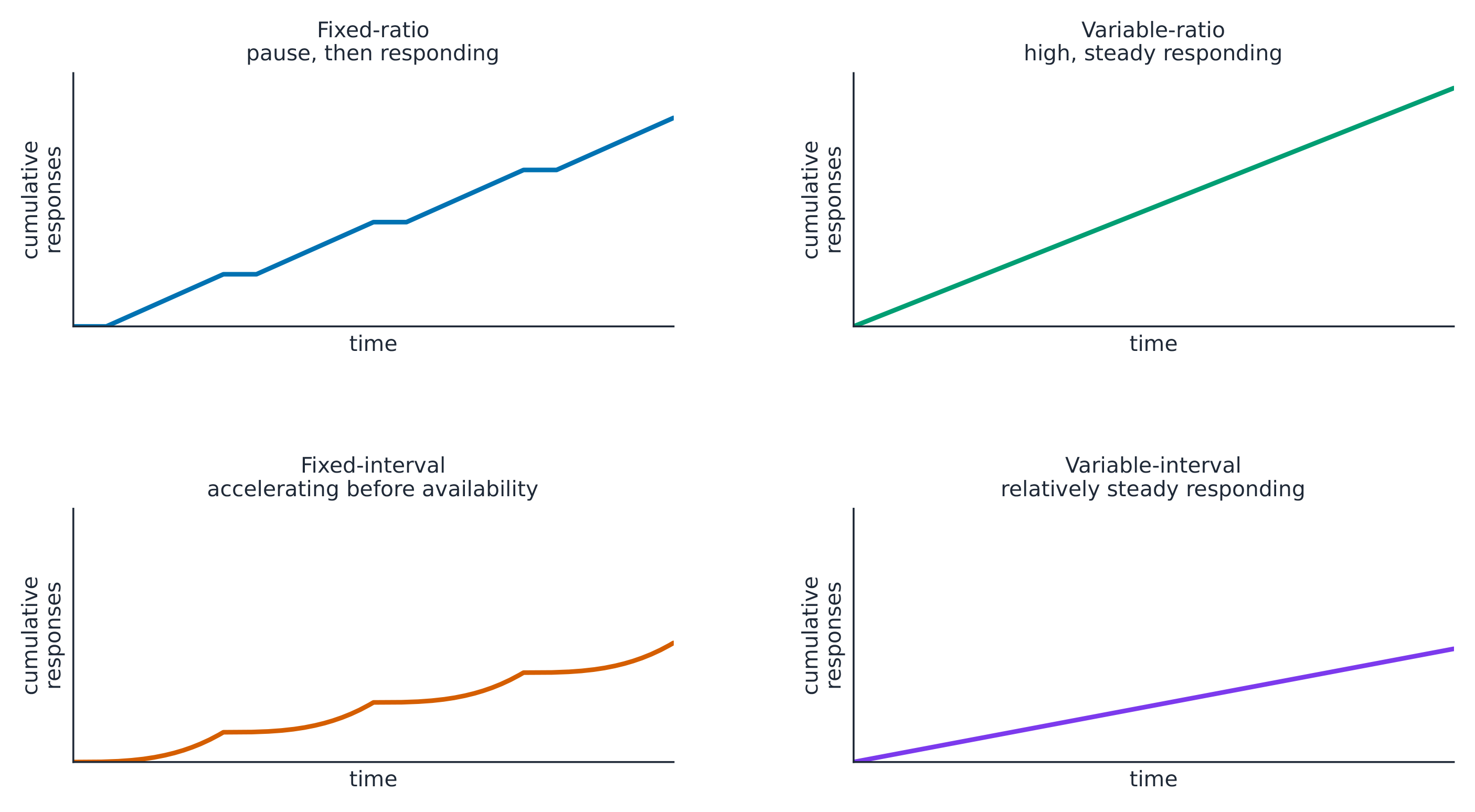
    • 3.8.A.5 The schedule with which reinforcement is delivered can determine the strength of the association between the consequence and the response. The two main types of reinforcement schedules are continuous and partial. Each type of reinforcement behavior can be graphed, resulting in a distinctive pattern on the graph (e.g., fixed-interval schedule produces a scalloped graph).
      • 3.8.A.5.i Continuous reinforcement schedules deliver reinforcement for each and every correct behavior.
      • 3.8.A.5.ii The partial reinforcement schedules focus on whether reinforcement is delivered on a time-based schedule (fixed- or variable-interval) or for the number of behaviors performed (fixed- or variable-ratio).

    来源:美国大学理事会 AP 课程与考试说明

    操作性条件作用(operant conditioning)把行为与其后果联系起来。

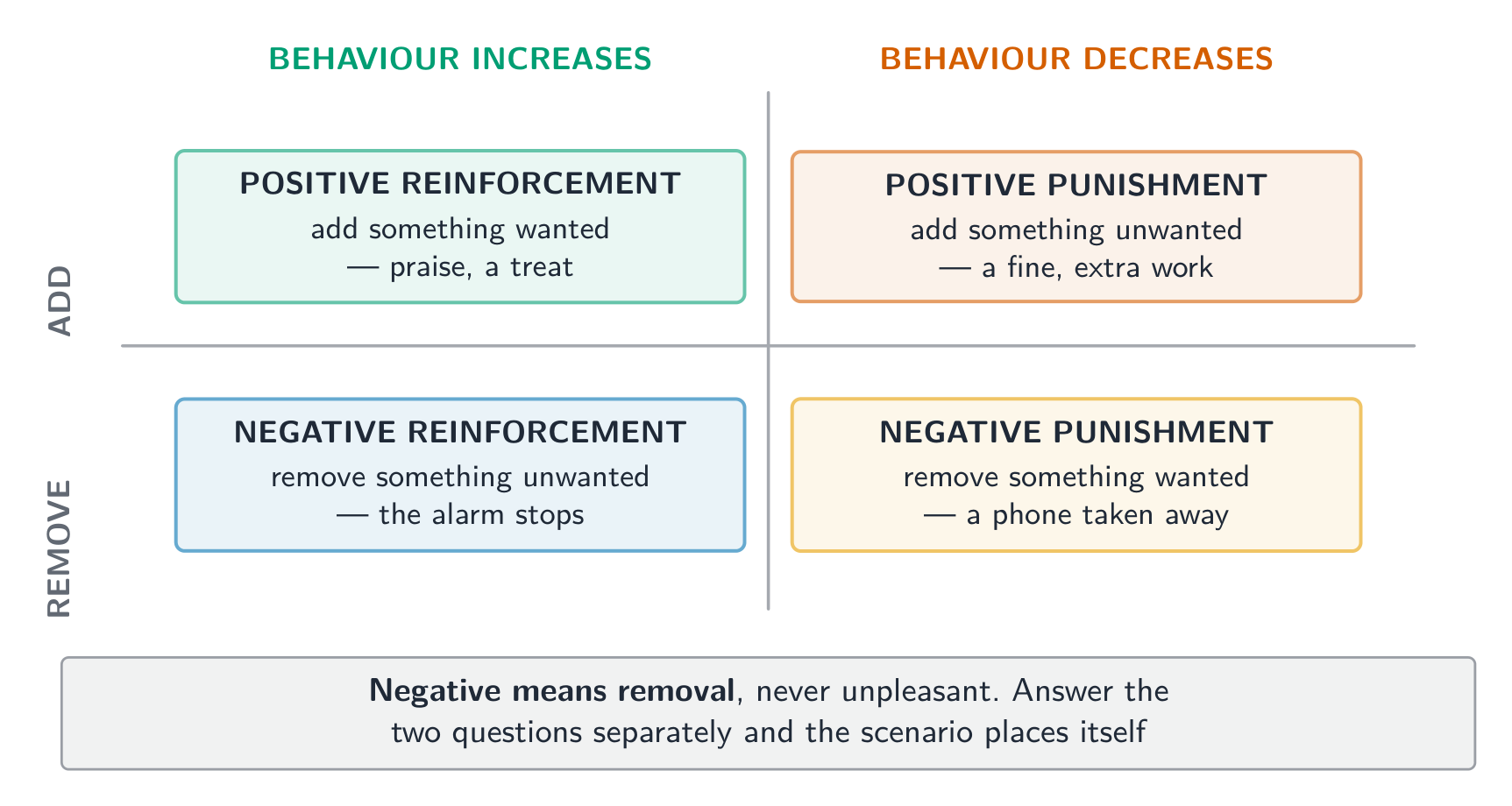
    • 强化(reinforcement)增加行为,惩罚(punishment)减少行为。
    • (positive)表示增加某物,(negative)表示移除某物。因此负强化(negative reinforcement)通过移除不愉快的东西来增加行为——它不是惩罚。
    • 原级强化物(primary reinforcer)满足生物需要,次级强化物(secondary reinforcer,如金钱)则是习得的。
    • 塑造(shaping)通过奖励逐步接近(successive approximations)目标的行为来达成目标。

    强化程式(reinforcement schedules)决定学习的牢固程度与持久性。连续强化(continuous reinforcement)对每次反应都给予强化,学得快但消退也快。部分强化(partial reinforcement)有四种——固定比率(fixed-ratio)、变动比率(variable-ratio)、固定时距(fixed-interval)和变动时距(variable-interval)——其中变动比率产生最高且最抗消退的反应率。

    迷信行为(superstitious behavior)源于后果强化了无关的动作。习得性无助(learned helplessness)则是个体反复无法逃离厌恶事件后不再尝试。

    词汇表 训练
    英文 中文 拼音
    Operant conditioning 操作性条件作用 cāo zuò xìng tiáo jiàn zuò yòng
    Reinforcement 强化 qiáng huà
    punishment 惩罚 chéng fá
    Positive zhèng
    negative
    negative reinforcement 负强化 fù qiáng huà
    primary reinforcer 原级强化物 yuán jí qiáng huà wù
    secondary reinforcer 次级强化物 cì jí qiáng huà wù
    Shaping 塑造 sù zào
    successive approximations 逐步接近 zhú bù jiē jìn
    Reinforcement schedules 强化程式 qiáng huà chéng shì
    Continuous reinforcement 连续强化 lián xù qiáng huà
    Partial reinforcement 部分强化 bù fèn qiáng huà
    fixed-ratio 固定比率 gù dìng bǐ lǜ
    variable-ratio 变动比率 biàn dòng bǐ lǜ
    fixed-interval 固定时距 gù dìng shí jù
    variable-interval 变动时距 biàn dòng shí jù
    Superstitious behavior 迷信行为 mí xìn xíng wéi
    Learned helplessness 习得性无助 xí dé xìng wú zhù
    3.9

    学习中的社会、认知与神经因素

    大纲
    Learning ObjectiveEssential Knowledge

    3.9.A
    Explain how social learning applies to behavior and mental processes.

    • 3.9.A.1 Social learning theory proposes that learning can occur by observation and does not have to involve personal experience with a consequence (vicarious conditioning). Learning can occur by copying the behavior of models. The more similar a model is, the more likely the behavior is to be learned.

    3.9.B
    Explain how cognitive factors in learning apply to behavior and mental processes.

    • 3.9.B.1 Insight learning occurs when the solution to a problem occurs without any association, consequence, or model being present.
    • 3.9.B.2 Latent learning occurs when information is learned without reinforcement but is not immediately evident. Latent learning is often demonstrated by cognitive maps.

    来源:美国大学理事会 AP 课程与考试说明

    并非所有学习都需要亲身经历。社会学习理论(social learning theory)表明,行为可以通过观察(observation)与榜样示范(modeling)习得——这正是波波玩偶实验中攻击行为被模仿的基础。

    顿悟学习(insight learning)是没有渐进条件化过程的突然领悟。潜伏学习(latent learning)是在没有强化的情况下发生、直到有理由表现时才显露的学习,老鼠在迷宫中形成认知地图(cognitive map)即是明证。

    Worked example(一道真实的 AP 考题)。2024 年的试题描述了学龄前儿童 Gavin 在科学博物馆的经历:他抓起一颗大玻璃弹珠,想把它拍到地上弹起来;中途他与父母短暂走散;第二天他向祖母讲述自己画的一幅画。题目要求学生「解释皮亚杰的同化概念如何与 Gavin 玩玻璃弹珠的经历相关」,以及「解释自我中心如何与 Gavin 在车里同祖母互动的方式相关」*。满分答案会给出定义*扣住具体细节:*「Gavin 已有关于球的图式,而球会弹起。他把弹珠同化进这一图式,于是把它当成球,试图让它弹起来。」*注意其结构:只给定义不得分,只复述情节同样不得分,得分点在于把两者连接起来。

    词汇表 训练
    英文 中文 拼音
    Social learning theory 社会学习理论 shè huì xué xí lǐ lùn
    observation 观察 guān chá
    modeling 榜样示范 bǎng yàng shì fàn
    Insight learning 顿悟学习 dùn wù xué xí
    Latent learning 潜伏学习 qián fú xué xí
    cognitive map 认知地图 rèn zhī dì tú
    3.9

    考试技巧

    • 负强化是增加行为。如果你能说出移除了什么,而行为上升了,那它就不是惩罚。
    • 把皮亚杰的阶段与其标志能力对应——客体永久性、守恒、抽象推理——而不是与年龄对应。
    • 经典条件作用连接两个刺激并产生不随意反应;操作性条件作用把行为与后果连接起来。
    • 变动比率程式最抗消退。题目描述类似赌博的持续行为时就用它。
    • 关键期用于狭窄的窗口,敏感期用于较宽松的情形。
    • 回答情境题时,先写出术语,再指出情境中证明它的细节。得分点正是那个细节。
  • 4

    社会心理学与人格

    讲义 词汇表
    4.1

    归因理论与人际知觉

    大纲
    Learning ObjectiveEssential Knowledge

    4.1.A
    Explain how attribution theory applies to behavior and mental processes.

    • 4.1.A.1 Attributions are how people explain behavior and mental processes of themselves and others. Dispositional attributions relate to internal qualities of others (such as intelligence or personality) while situational attributions relate to external circumstances that are experienced.
    • 4.1.A.2 People demonstrate a predictable pattern of attributions called explanatory style. Explanatory style is how people explain good and bad events in their lives and in the lives of others. Explanatory style can be optimistic or pessimistic.
    • 4.1.A.3 People are subject to biases in their attributions. Those biases include actor/ observer bias, fundamental attribution error, and self-serving bias, all of which can affect behavior and mental processes.

    4.1.B
    Explain how locus of control (internal and external) applies to behavior and mental processes.

    4.1.C
    Explain how person perception applies to behavior and mental processes.

    • 4.1.C.1 People’s perception of how much they like something can be influenced by the mere exposure effect. The mere exposure effect occurs when people are exposed to a stimulus repeatedly over time, which causes them to like the stimulus more.
    • 4.1.C.2 People can behave in ways that elicit behaviors from others that confirm their beliefs or perceptions about themselves or others (self-fulfilling prophecy).
    • 4.1.C.3 Social comparison is a type of person perception that occurs when people evaluate themselves based on comparisons to other members of society or social circles. Social comparison can be upward or downward. People often judge their own sense of deprivation relative to others (relative deprivation).

    来源:美国大学理事会 AP 课程与考试说明

    社会心理学(social psychology)研究人们如何思考他人、影响他人并与他人相处。它从归因(attribution)开始——我们如何解释行为。

    一种解释要么是内归因(dispositional,归于个人的性格),要么是外归因(situational,归于情境)。人们在选择哪一种时并不公平:

    • 基本归因错误(fundamental attribution error)是在解释他人行为时过度使用内归因。
    • 行动者-观察者偏差(actor-observer bias)是用情境解释自己的行为,却用性格解释他人的行为。
    • 自利偏差(self-serving bias)把成功归于自己,把失败归于情境。
    • 公正世界现象(just-world phenomenon)是相信人们所得皆其所应得。

    一个人的解释风格(explanatory style)可以是乐观的(optimistic)或悲观的(pessimistic),这会影响他如何面对挫折。

    人际知觉本身也有若干效应。单纯曝光效应(mere exposure effect)指反复接触会增加喜欢程度。自我实现预言(self-fulfilling prophecy)指期待促成了证实该期待的行为。社会比较(social comparison)是拿自己与他人比较,可以是向上比较(upward)或向下比较(downward)。

    词汇表 训练
    英文 中文 拼音
    Social psychology 社会心理学 shè huì xīn lǐ xué
    attribution 归因 guī yīn
    dispositional 内归因 nèi guī yīn
    situational 外归因 wài guī yīn
    fundamental attribution error 基本归因错误 jī běn guī yīn cuò wù
    actor-observer bias 行动者-观察者偏差 xíng dòng zhě - guān chá zhě piān chā
    self-serving bias 自利偏差 zì lì piān chā
    just-world phenomenon 公正世界现象 gōng zhèng shì jiè xiàn xiàng
    explanatory style 解释风格 jiě shì fēng gé
    optimistic 乐观的 lè guān de
    pessimistic 悲观的 bēi guān de
    mere exposure effect 单纯曝光效应 dān chún bào guāng xiào yìng
    self-fulfilling prophecy 自我实现预言 zì wǒ shí xiàn yù yán
    Social comparison 社会比较 shè huì bǐ jiào
    upward 向上比较 xiàng shàng bǐ jiào
    downward 向下比较 xiàng xià bǐ jiào
    4.2

    态度的形成与改变

    大纲
    Learning ObjectiveEssential Knowledge

    4.2.A
    Explain how stereotypes and implicit attitudes contribute to the behaviors and mental processes of prejudice and discrimination.

    • 4.2.A.1 A stereotype is a generalized concept about a group. Stereotypes can help reduce cognitive load when making decisions or judgments. Stereotypes can be the cause and/or result of biased perceptions and experiences and are frequently the basis of prejudiced attitudes and discriminatory behaviors.
    • 4.2.A.2 Implicit attitudes are those that individuals hold but may be unaware of or may not acknowledge. Research has focused on how implicit attitudes reflect negative evaluations of others, as demonstrated by the just-world phenomenon, out-group homogeneity bias, in-group bias, or ethnocentrism.

    4.2.B
    Explain how belief perseverance and cognitive dissonance apply to attitude formation and change.

    • 4.2.B.1 Belief perseverance occurs when a belief persists even if evidence suggests it is not accurate. People experiencing belief perseverance may engage in confirmation bias, thereby clinging to an attitude or belief regardless of the evidence for or against it.
    • 4.2.B.2 Cognitive dissonance refers to the mental discomfort that occurs when actions or attitudes are in conflict. People are motivated to reduce the discomfort by changing either actions or attitudes to be more in line with each other.

    来源:美国大学理事会 AP 课程与考试说明

    刻板印象(stereotype)是关于某个群体的概括性看法;它减少了认知负担,但可能不准确且有害。偏见(prejudice)是一种态度,歧视(discrimination)则是行为。内隐态度(implicit attitudes)是本人未必意识到的态度。

    态度不易改变。信念固着(belief perseverance)使某个信念在支持它的证据被推翻后仍然存在。确认偏差(confirmation bias)是只去寻找符合既有信念的证据。

    认知失调(cognitive dissonance)是行为与态度冲突时产生的心理不适。由于行为已经发生,人们往往通过改变态度来化解——这也是"做了某事会改变一个人的想法"的原因。

    词汇表 训练
    英文 中文 拼音
    stereotype 刻板印象 kè bǎn yìn xiàng
    Prejudice 偏见 piān jiàn
    discrimination 歧视 qí shì
    Implicit attitudes 内隐态度 nèi yǐn tài dù
    Belief perseverance 信念固着 xìn niàn gù zhuó
    Confirmation bias 确认偏差 què rèn piān chā
    Cognitive dissonance 认知失调 rèn zhī shī tiáo
    4.3

    社会情境心理学

    大纲
    Learning ObjectiveEssential Knowledge

    4.3.A
    Explain how the social situation affects behavior and mental processes.

    • 4.3.A.1 Social norms define expectations and roles a society may have for its members in individual and social situations.
    • 4.3.A.2 Social influence theory proposes that social pressure to behave or think in certain ways can be normative or informational.
    • 4.3.A.3 Persuasion refers to the techniques applied to convince the self or others of particular ideas, actions, or beliefs.
      • 4.3.A.3.i Persuasion can depend on the route to persuasion. The elaboration likelihood model outlines two main routes to persuasion: central and peripheral. The halo effect is an example of a peripheral route to persuasion.
      • 4.3.A.3.ii Persuasion can depend on how information is presented, as demonstrated by the foot-in-the-door and the door-in-the-face techniques.
    • 4.3.A.4 Research on conformity clarifies the conditions that strengthen the likelihood of people adhering to unspoken rules, norms, or expectations.
    • 4.3.A.5 Research on obedience clarifies the conditions that strengthen the likelihood of people complying with the directives of an authority figure.

    4.3.B
    Explain how being in a group can affect an individual’s behavior and mental processes.

    • 4.3.B.1 Cultural phenomena such as individualism, collectivism, and multiculturalism can influence how one perceives and behaves towards oneself and others.
    • 4.3.B.2 Being a member of a group can influence how one behaves or experiences mental processes via group polarization, groupthink, diffusion of responsibility, social loafing, and deindividuation.
    • 4.3.B.3 Performing a mental or physical behavior in front of a group can lead to social facilitation.
    • 4.3.B.4 People often overestimate the levels to which others agree with them, known as the false consensus effect.
    • 4.3.B.5 Superordinate goals serve to unite disparate groups under a common goal and help reduce negative affect and stereotyping among groups. Social traps occur when individuals do not unite and act in their own self-interest to the detriment of the group.
    • 4.3.B.6 Industrial-organizational (I/O) psychologists study how people perform in the workplace. I/O psychologists study best practices in management of work, relationships among people working together or for a common company or program, and how people feel about work (burnout).

    4.3.C
    Explain how prosocial behavior affects behavior and mental processes.

    • 4.3.C.1 Altruism refers to selfless behavior, but some researchers suggest that people act in prosocial ways due to incurring social debt. The social reciprocity norm and the social responsibility norm explain this type of behavior.
    • 4.3.C.2 The bystander effect demonstrates that situational and attentional variables predict whether someone is likely to help another person.

    来源:美国大学理事会 AP 课程与考试说明

    社会规范(social norms)规定了群体期待的行为。他人在场时行为会发生改变:

    • 从众(conformity)是调整行为以与群体一致。群体规模(在一定范围内)、意见一致性和情境模糊性都会提高从众,而哪怕只有一个人持异议也会显著降低它。
    • 服从(obedience)是听从权威的指令。权威的合法性与临近程度会提高服从,受害者靠近或权威远离则会降低服从。
    • 规范性社会影响(normative social influence)是为了被接纳而从众;信息性社会影响(informational social influence)是因为认为别人更懂而从众。

    说服(persuasion)在精细加工可能性模型(elaboration likelihood model)中有两条路径:中心路径(central route)依靠论据本身的力量,边缘路径(peripheral route)依靠吸引力等外围线索。请求的先后顺序也很重要:登门槛效应(foot-in-the-door)先提小要求,留面子效应(door-in-the-face)先提一个不合理的大要求。

    群体情境会进一步改变行为。社会助长(social facilitation)使人在他人注视下把简单或熟练的任务做得更好,却把困难任务做得更差。社会惰化(social loafing)是群体中个人努力程度下降。去个体化(deindividuation)是在人群中丧失自我意识。群体极化(group polarization)把群体的平均观点推向其原有方向的更极端处,群体思维(groupthink)则是为维持和谐而压制异议。

    个人主义(individualism)与集体主义(collectivism)会塑造上述所有现象,多元文化主义(multiculturalism)描述多种传统并存的社会。虚假一致效应(false consensus effect)是高估赞同自己的人数。超级目标(superordinate goals)——需要合作才能达成的共同目标——能减少群体间的敌意。

    利他行为(altruism)是无私的助人行为,不过亲社会行为(prosocial behavior)也可能给助人者带来好处。旁观者效应(bystander effect)表明,旁观人数越多,人们越不容易出手相助,原因是责任分散(diffusion of responsibility)。

    Worked example(一道真实的 AP 考题)。2025 年的证据分析题要求学生「就他人在场是否会提升表现提出并论证一个观点」,随后要求「运用在 AP 心理学中学到的心理学视角、理论、概念或研究结果,解释 B(i)中的证据如何支持你的观点」。满分答案会给出课程概念,而不只是复述材料:「被试在被观察时,在简单任务上的表现更好(材料 1)。这支持我的观点,因为社会助长预测:观众会提升简单或熟练任务的表现,却会损害困难任务的表现。」*注意其结构:先引用材料,再点出概念*说明该概念的预测。只把研究重述一遍拿不到解释分。

    词汇表 训练
    英文 中文 拼音
    Social norms 社会规范 shè huì guī fàn
    Conformity 从众 cóng zhòng
    Obedience 服从 fú cóng
    Normative social influence 规范性社会影响 guī fàn xìng shè huì yǐng xiǎng
    informational social influence 信息性社会影响 xìn xī xìng shè huì yǐng xiǎng
    Persuasion 说服 shuō fú
    elaboration likelihood model 精细加工可能性模型 jīng xì jiā gōng kě néng xìng mó xíng
    central route 中心路径 zhōng xīn lù jìng
    peripheral route 边缘路径 biān yuán lù jìng
    foot-in-the-door 登门槛效应 dēng mén kǎn xiào yìng
    door-in-the-face 留面子效应 liú miàn zi xiào yìng
    Social facilitation 社会助长 shè huì zhù zhǎng
    Social loafing 社会惰化 shè huì duò huà
    Deindividuation 去个体化 qù gè tǐ huà
    Group polarization 群体极化 qún tǐ jí huà
    groupthink 群体思维 qún tǐ sī wéi
    Individualism 个人主义 gè rén zhǔ yì
    collectivism 集体主义 jí tǐ zhǔ yì
    multiculturalism 多元文化主义 duō yuán wén huà zhǔ yì
    false consensus effect 虚假一致效应 xū jiǎ yí zhì xiào yìng
    Superordinate goals 超级目标 chāo jí mù biāo
    Altruism 利他行为 lì tā xíng wéi
    prosocial behavior 亲社会行为 qīn shè huì xíng wéi
    bystander effect 旁观者效应 páng guān zhě xiào yìng
    diffusion of responsibility 责任分散 zé rèn fēn sàn
    4.4

    精神动力学与人本主义人格理论

    大纲
    Learning ObjectiveEssential Knowledge

    4.4.A
    Explain how the psychodynamic theory of personality defines and assesses personality.

    • 4.4.A.1 According to the psychodynamic theory of personality, unconscious processes drive personality.
      • Exclusion Statement: The stage theory of psychosexual development is out of scope for the AP Psychology Exam.
    • 4.4.A.2 Ego defense mechanisms (denial, displacement, projection, rationalization, reaction formation, regression, repression, and sublimation) serve to protect the ego unconsciously from threats.
    • 4.4.A.3 Psychodynamic personality psychologists assess personality using projective tests that are designed to probe the preconscious and unconscious mind.

    4.4.B
    Explain how the humanistic theory of personality defines and assesses personality.

    • 4.4.B.1 According to humanistic psychology, personality focuses on unconditional regard and the self-actualizing tendency as primary motivating factors.
      • Exclusion Statement: Maslow’s hierarchy of needs is outside the scope of the AP Psychology Exam.

    来源:美国大学理事会 AP 课程与考试说明

    四种人格取向并列呈现,分别标出各自认为驱动人格的因素以及测评方式
    四种人格取向,各有不同的驱动因素与不同的测量方式

    人格(personality)是一个人在思维、情感与行为上的典型模式。有四种取向在考试范围内。

    精神动力学(psychodynamic)取向认为无意识(unconscious)过程驱动人格。自我防御机制(ego defense mechanisms)保护个体免受焦虑困扰,考试范围内的一组是否认(denial)、转移(displacement)、投射(projection)、合理化(rationalization)、反向形成(reaction formation)、退行(regression)、压抑(repression)和升华(sublimation)。它使用呈现模糊刺激的投射测验(projective tests)来测评人格,而这类测验的信度效度都较弱。

    人本主义(humanistic)取向关注成长,强调无条件积极关注(unconditional positive regard)与自我实现(self-actualization)——成为最充分的自己。

    词汇表 训练
    英文 中文 拼音
    Personality 人格 rén gé
    psychodynamic 精神动力学 jīng shén dòng lì xué
    unconscious 无意识 wú yì shí
    Ego defense mechanisms 自我防御机制 zì wǒ fáng yù jī zhì
    denial 否认 fǒu rèn
    displacement 转移 zhuǎn yí
    projection 投射 tóu shè
    rationalization 合理化 hé lǐ huà
    reaction formation 反向形成 fǎn xiàng xíng chéng
    regression 退行 tuì xíng
    repression 压抑 yā yì
    sublimation 升华 shēng huá
    projective tests 投射测验 tóu shè cè yàn
    humanistic 人本主义 rén běn zhǔ yì
    unconditional positive regard 无条件积极关注 wú tiáo jiàn jī jí guān zhù
    self-actualization 自我实现 zì wǒ shí xiàn
    4.5

    社会认知与特质人格理论

    大纲
    Learning ObjectiveEssential Knowledge

    4.5.A
    Explain how the social-cognitive theory of personality defines and assesses personality.

    • 4.5.A.1 According to social-cognitive theory, reciprocal determinism shapes personality. Reciprocal determinism explores self-concept (how one views themselves and in relation to others) and how self-efficacy and self-esteem both contribute to self-concept.

    4.5.B
    Explain how trait theories of personality define and assess personality.

    • 4.5.B.1 Trait theories of personality conclude that personality involves a set of enduring characteristics that lead to typical responses to stimuli.
    • 4.5.B.2 The Big Five theory of personality proposes that traits of agreeableness, openness to experience, extraversion, conscientiousness, and emotional stability make up one’s personality. These traits are measured by specialized personality inventories that use factor analysis to organize item responses.

    来源:美国大学理事会 AP 课程与考试说明

    社会认知(social-cognitive)取向用交互决定论(reciprocal determinism)解释人格:个人、行为与环境三者相互影响。核心概念是自我效能感(self-efficacy,相信自己能完成某项任务),以及分为内控(internal)与外控(external)的控制点(locus of control)。

    特质理论(trait theories)把人格描述为持久的特征。大五人格(Big Five)包括开放性(openness to experience)、尽责性(conscientiousness)、外向性(extraversion)、宜人性(agreeableness)和神经质(neuroticism)。特质用自陈量表测量,其信度高于投射测验。

    词汇表 训练
    英文 中文 拼音
    social-cognitive 社会认知 shè huì rèn zhī
    reciprocal determinism 交互决定论 jiāo hù jué dìng lùn
    Self-efficacy 自我效能感 zì wǒ xiào néng gǎn
    locus of control 控制点 kòng zhì diǎn
    internal 内控 nèi kòng
    external 外控 wài kòng
    Trait theories 特质理论 tè zhì lǐ lùn
    Big Five 大五人格 dà wǔ rén gé
    openness to experience 开放性 kāi fàng xìng
    conscientiousness 尽责性 jìn zé xìng
    extraversion 外向性 wài xiàng xìng
    agreeableness 宜人性 yí rén xìng
    neuroticism 神经质 shén jīng zhì
    4.6

    动机

    大纲
    Learning ObjectiveEssential Knowledge

    4.6.A
    Explain how theories about motivation apply to behavior and mental processes.

    • 4.6.A.1 Some theories about motivation focus on behavior and mental processes that seek to address physical needs and desires such as drive-reduction theory and arousal theory. Drive-reduction theory addresses how certain behaviors help maintain homeostasis while arousal theory addresses how people seek an optimal level of arousal when they behave (as demonstrated by the Yerkes-Dodson Law).
    • 4.6.A.2 Self-determination theory proposes that people are motivated by intrinsic (internal) or extrinsic (external) motivations. Incentive theory explores the role of rewards (an extrinsic motivation) in motivating behavior.
    • 4.6.A.3 Many non-human animals are motivated by instincts (innate, typically fixed patterns of behavior in animals in response to certain stimuli). Humans do not seem to demonstrate instinctual behavior or mental processes.
    • 4.6.A.4 Lewin’s motivational conflicts theory proposes that choices create conflicts one must resolve as the basis of motivation. The type of conflicts faced include approach-approach, approach-avoidance, and avoidance-avoidance.
    • 4.6.A.5 Sensation-seeking theory proposes that one’s level of need for varied or novel experiences is the basis of motivation. The types of sensation seeking are experience seeking, thrill or adventure seeking, disinhibition, and boredom susceptibility.

    4.6.B
    Explain how eating and belongingness motivate behavior and mental processes.

    • 4.6.B.1 Eating is a complex motivated behavior that demonstrates how physical and mental processes interact.
      • 4.6.B.1.i Hormones, such as ghrelin and leptin (regulated by the hypothalamus via the pituitary gland), regulate feelings of hunger and satiety.
      • 4.6.B.1.ii External factors like the presence of food, time of day, or social gatherings around meals also influence the behavior of eating.

    来源:美国大学理事会 AP 课程与考试说明

    有若干理论解释行为的驱动力:

    • 驱力减少理论(drive-reduction theory)认为行为是为了减少生理需要,以恢复内稳态(homeostasis)。
    • 唤醒理论(arousal theory)认为人追求最佳唤醒水平;耶克斯-多德森定律(Yerkes-Dodson law)指出中等唤醒水平在多数任务上带来最佳表现。
    • 自我决定理论(self-determination theory)区分内在动机(intrinsic motivation,源自内部)与外在动机(extrinsic motivation,源自奖励),诱因理论(incentive theory)则关注奖励的拉动作用。
    • 本能(instincts)是天生的固定行为模式,主要见于非人类动物,而非人类行为。
    • 勒温的动机冲突理论(Lewin's motivational conflicts)提出三种冲突:双趋冲突(approach-approach)、趋避冲突(approach-avoidance)和双避冲突(avoidance-avoidance)。
    • 感觉寻求理论(sensation-seeking theory)解释人们对新异刺激需求程度的差异。

    进食体现了生理与心理过程的相互作用。由下丘脑调节的胃饥饿素瘦素控制饥饿与饱腹感,而外部因素——看到食物、到了饭点、与人共餐——会改变人的进食量。

    词汇表 训练
    英文 中文 拼音
    Drive-reduction theory 驱力减少理论 qū lì jiǎn shǎo lǐ lùn
    homeostasis 内稳态 nèi wěn tài
    Arousal theory 唤醒理论 huàn xǐng lǐ lùn
    Yerkes-Dodson law 耶克斯-多德森定律 yé kè sī - duō dé sēn dìng lǜ
    Self-determination theory 自我决定理论 zì wǒ jué dìng lǐ lùn
    intrinsic motivation 内在动机 nèi zài dòng jī
    extrinsic motivation 外在动机 wài zài dòng jī
    incentive theory 诱因理论 yòu yīn lǐ lùn
    Instincts 本能 běn néng
    Lewin's motivational conflicts 勒温的动机冲突理论 lēi wēn de dòng jī chōng tū lǐ lùn
    approach-approach 双趋冲突 shuāng qū chōng tū
    approach-avoidance 趋避冲突 qū bì chōng tū
    avoidance-avoidance 双避冲突 shuāng bì chōng tū
    Sensation-seeking theory 感觉寻求理论 gǎn jué xún qiú lǐ lùn
    4.7

    情绪

    大纲
    Learning ObjectiveEssential Knowledge

    4.7.A
    Explain how theories of emotion apply to behavior and mental processes.

    • 4.7.A.1 Emotion, or affect, is a complex psychological process that is distinguished from reasoning or knowledge. Emotions reflect internal and external factors affecting an individual. Early 20th century psychological theories of emotion parsed the distinction between the physiological and cognitive experiences of emotion. Some theories proposed that the physiological and cognitive experiences occurred in succession while others proposed that they occurred simultaneously. Other theories emphasize that the cognitive label is required to experience an emotion. The facial-feedback hypothesis suggests that the experience of emotion is influenced by facial expressions, which supports theories that propose the physiological experience of emotion precedes the cognitive appraisal, and research testing this hypothesis has produced mixed results.
      • Exclusion Statement: Specific names of theories of emotion are outside the scope of the AP Psychology Exam.
    • 4.7.A.2 The broaden-and-build theory of emotion proposes that positive emotional experiences tend to broaden awareness and encourage new actions and thoughts. Negative emotions tend to reduce awareness and narrow thinking and action.

    4.7.B
    Explain how social norms and experiences influence the expression of emotions.

    • 4.7.B.1 Research has explored whether the expression of emotions is universally common. Some emotions that may be commonly experienced across cultures include anger, disgust, sadness, happiness, surprise, and fear. Research on the universality of emotions shows mixed results.
    • 4.7.B.2 Display rules and elicitors for emotional expression can differ among cultures. Display rules and elicitors may regulate how people from different genders, ages, or socioeconomic classes within a culture can display and interpret emotions.

    来源:美国大学理事会 AP 课程与考试说明

    情绪(emotion),也称情感(affect),由生理唤醒、表情行为与主观体验共同构成。考试范围内的理论有詹姆斯-兰格理论(James-Lange theory,身体先反应,情绪是对该反应的解读)、坎农-巴德理论(Cannon-Bard theory,唤醒与情绪同时发生)和沙赫特-辛格两因素理论(Schachter-Singer two-factor theory,唤醒加上认知标签(cognitive label))。拓展-建构理论(broaden-and-build theory)认为积极情绪会拓宽思维并建构持久的资源。

    有些面部表情能被跨文化识别,但表达规则(display rules,某一文化关于何时表露情绪的规范)以及引发情绪的事件都因文化而异。

    词汇表 训练
    英文 中文 拼音
    Emotion 情绪 qíng xù
    affect 情感 qíng gǎn
    James-Lange theory 詹姆斯-兰格理论 zhān mǔ sī - lán gé lǐ lùn
    Cannon-Bard theory 坎农-巴德理论 kǎn nóng - bā dé lǐ lùn
    Schachter-Singer two-factor theory 沙赫特-辛格两因素理论 shā hè tè - xīn gé liǎng yīn sù lǐ lùn
    cognitive label 认知标签 rèn zhī biāo qiān
    Broaden-and-build theory 拓展-建构理论 tuò zhǎn - jiàn gòu lǐ lùn
    display rules 表达规则 biǎo dá guī zé
    4.7

    考试技巧

    • 基本归因错误用于解释他人。如果题目问的是解释自己,答案通常是自利偏差
    • 社会助长提升简单任务、损害困难任务的表现。要说清情境描述的是哪一类任务。
    • 从众(与群体一致)和服从(听从权威)区分开。
    • 回答认知失调题时,要点明冲突所在,并说明哪一方发生了改变——通常是态度,因为行为已经发生。
    • 大五人格当作一组来记;题目常要求你把描述中的人放到某一具体特质上。
    • 情绪理论的区别在于顺序:身体先(詹姆斯-兰格)、同时(坎农-巴德),还是唤醒加标签(两因素)。
  • 5

    心理健康与身体健康

    讲义 词汇表
    5.1

    健康心理学导论

    大纲
    Learning ObjectiveEssential Knowledge

    5.1.A
    Explain how health psychology addresses issues of physical health and wellness as they apply to behavior and mental processes.

    5.1.B
    Explain how stress applies to behavior and mental processes.

    • 5.1.B.1 Stress is a factor in heightened susceptibility to disorders and disease. Stress has been linked to physiological issues such as hypertension, headaches, and immune suppression.
    • 5.1.B.2 Stressors can be viewed as motivating (eustress) or debilitating (distress). Stressors can be experienced as traumatic or as daily hassles that can build up over time. Adverse childhood experiences (ACEs) are sources of stress that can affect a person throughout the lifespan.

    5.1.C
    Explain how reactions to stress apply to behavior and mental processes.

    • 5.1.C.1 The general adaptation syndrome (GAS) describes the process of experiencing stress. Initially, alarm reaction occurs when the stress is encountered (via a fight-flight-freeze response). Then, a resistance phase occurs as the stress is confronted. Finally, an exhaustion phase occurs when the stress subsides, or resources are spent. The greatest susceptibility to illness occurs during the exhaustion phase.
    • 5.1.C.2 The tend-and-befriend theory proposes that some people react to stress by tending to their own needs and/or the needs of others and seeking connection with others. This phenomenon seems to occur mostly in women.

    5.1.D
    Explain how the ways that people cope with stress applies to behavior and mental processes.

    • 5.1.D.1 Problem-focused coping involves seeing stress as a problem to be solved and working solutions until a solution is found.
    • 5.1.D.2 Emotion-focused coping involves managing emotional reactions to stress as a means of coping. Strategies that are emotion-focused may include deep breathing, meditation, or taking medication aimed at reducing stressful emotional responses.

    来源:美国大学理事会 AP 课程与考试说明

    健康心理学(health psychology)研究心理因素如何影响身体健康。

    压力(stress)是人们评估并应对各种要求的过程,而应激源(stressor)是那个要求本身。压力会提高患病易感性,并与免疫功能下降和心脏病相关。

    应激源并不都一样:

    • 良性压力(eustress)具有激励作用,消极压力(distress)则令人衰弱。
    • 应激源的范围从日常烦扰(daily hassles)到重大生活变化(significant life changes)与灾难性事件(catastrophes)。

    一般适应综合征(general adaptation syndrome, GAS)把身体的反应分为三个阶段:警觉期(alarm,交感神经系统动员起来)、抵抗期(resistance,身体在较高但可维持的水平上应对)和衰竭期(exhaustion,资源耗竭,患病风险上升)。

    并非人人都以"战或逃"作出反应。照料-结盟理论(tend-and-befriend theory)提出,有些人应对压力的方式是照料他人并寻求社会支持。

    应对大致有两种方式。问题聚焦应对(problem-focused coping)把应激源当作有待解决的问题,直接处理原因,适合个体能够控制的情境。情绪聚焦应对(emotion-focused coping)则转而管理情绪反应,适合无法改变的情境。

    词汇表 训练
    英文 中文 拼音
    Health psychology 健康心理学 jiàn kāng xīn lǐ xué
    Stress 压力 yā lì
    stressor 应激源 yīng jī yuán
    Eustress 良性压力 liáng xìng yā lì
    distress 消极压力 xiāo jí yā lì
    daily hassles 日常烦扰 rì cháng fán rǎo
    significant life changes 重大生活变化 zhòng dà shēng huó biàn huà
    catastrophes 灾难性事件 zāi nàn xìng shì jiàn
    general adaptation syndrome (GAS) 一般适应综合征 yì bān shì yìng zōng hé zhēng
    alarm 警觉期 jǐng jué qī
    resistance 抵抗期 dǐ kàng qī
    exhaustion 衰竭期 shuāi jié qī
    Tend-and-befriend theory 照料-结盟理论 zhào liào - jié méng lǐ lùn
    Problem-focused coping 问题聚焦应对 wèn tí jù jiāo yìng duì
    Emotion-focused coping 情绪聚焦应对 qíng xù jù jiāo yìng duì
    5.2

    积极心理学

    大纲
    Learning ObjectiveEssential Knowledge

    5.2.A
    Explain how positive psychology approaches the study of behavior and mental processes.

    • 5.2.A.1 Positive psychology seeks to identify factors that lead to well-being, resilience, positive emotions, and psychological health.

    5.2.B
    Explain how positive subjective experiences apply to behavior and mental processes.

    • 5.2.B.1 Expressing gratitude, a positive subjective experience, increases subjective well-being.
    • 5.2.B.2 People who exercise their signature strengths or virtues report higher levels of positive objective experiences such as happiness and subjective well-being. A classification of character strengths has been developed around 6 categories of virtues: wisdom, courage, humanity, justice, temperance, and transcendence.
    • 5.2.B.3 Posttraumatic growth, a positive subjective experience, may result after the experience of trauma or stress.

    来源:美国大学理事会 AP 课程与考试说明

    积极心理学(positive psychology)研究是什么让生活变好,而不只是研究哪里出了问题。它寻找幸福感(well-being)与心理韧性(resilience)背后的因素。

    三项结论在考试范围内:

    • 表达感恩(gratitude)能提升主观幸福感(subjective well-being)。
    • 发挥自身标志性优势(signature strengths)的人,客观幸福水平更高。
    • 创伤后成长(posttraumatic growth)是在与创伤抗争之后可能出现的积极心理变化。
    词汇表 训练
    英文 中文 拼音
    Positive psychology 积极心理学 jī jí xīn lǐ xué
    well-being 幸福感 xìng fú gǎn
    resilience 心理韧性 xīn lǐ rèn xìng
    gratitude 感恩 gǎn ēn
    subjective well-being 主观幸福感 zhǔ guān xìng fú gǎn
    signature strengths 标志性优势 biāo zhì xìng yōu shì
    Posttraumatic growth 创伤后成长 chuāng shāng hòu chéng zhǎng
    5.3

    心理障碍的解释与分类

    大纲
    Learning ObjectiveEssential Knowledge

    5.3.A
    Describe the approaches used to define behaviors and mental processes as psychological disorders.

    • 5.3.A.1 Level of dysfunction, perception of distress, and deviation from the social norm are all factors used to identify psychological disorders.
    • 5.3.A.2 Diagnosing or classifying psychological disorders has positive and negative consequences depending on the nature of the disorder, the individual being diagnosed, and the presence of cultural/societal norms, stigma, racism, sexism, ageism, and discrimination.
    • 5.3.A.3 Diagnosing psychological disorders requires specialized training and the use of evidence-based diagnostic tools. The American Psychiatric Association developed the Diagnostic and Statistical Manual (DSM) of Mental Disorders to classify mental disorders. The World Health Organization developed the International Classification of Mental Disorders (ICD) to classify mental disorders. These classification systems are updated regularly to be responsive to new research and practice advances.

    5.3.B
    Explain how psychological perspectives define psychological disorders.

    • 5.3.B.1 Most psychologists employ an eclectic approach (using more than one psychological perspective) when diagnosing and treating clients.
    • 5.3.B.2 The behavioral perspective proposes that the causes of mental disorders focus on maladaptive learned associations between or among responses to stimuli.
    • 5.3.B.3 The psychodynamic perspective proposes that the causes of mental disorders focus on unconscious thoughts and experiences, often developed during childhood.
    • 5.3.B.4 The humanistic perspective proposes that the causes of mental disorders focus on a lack of social support and being unable to fulfill one’s potential.
    • 5.3.B.5 The cognitive perspective proposes that the causes of mental disorders focus on maladaptive thoughts, beliefs, attitudes, or emotions.
    • 5.3.B.6 The evolutionary perspective proposes that the causes of mental disorders focus on behaviors and mental processes that reduce the likelihood of survival.
    • 5.3.B.7 The sociocultural perspective proposes that the causes of mental disorders focus on maladaptive social and cultural relationships and dynamics.
    • 5.3.B.8 The biological perspective proposes that the causes of mental disorders focus on physiological or genetic issues.

    5.3.C
    Explain how interaction models define psychological disorders.

    • 5.3.C.1 The biopsychosocial model assumes that any psychological problem potentially involves a combination of biological, psychological, and sociocultural factors.
    • 5.3.C.2 The diathesis-stress model assumes that psychological disorders develop due to a genetic vulnerability (diathesis) in combination with stressful life experiences (stress).

    来源:美国大学理事会 AP 课程与考试说明

    判断某种行为是否属于障碍要考虑三点:功能失调(dysfunction)的程度、个体的个人痛苦(personal distress),以及偏离社会规范(deviation from social norms)的程度。由于规范因文化而异、也随时间改变,这一判断并非纯粹客观。

    对障碍进行分类既有益处也有代价。诊断能指导治疗、帮助获得支持,但标签也可能带来污名(stigma),改变他人对待此人的方式。诊断需要专门训练和有循证依据的标准。

    多数心理学家采取折衷取向(eclectic approach),同时借助多个视角:

    • 行为主义(behavioral):障碍源于习得的不良联结。
    • 精神动力学(psychodynamic):源于无意识冲突。
    • 人本主义(humanistic):源于缺乏接纳与支持。
    • 认知(cognitive):源于不良的思维模式。
    • 进化(evolutionary):源于曾经具有适应意义的行为。
    • 社会文化(sociocultural):源于个体所处的社会与文化环境。
    • 生物学(biological):源于生理与遗传因素。

    有两个整合模型在考试范围内。生物心理社会模型(biopsychosocial model)假定任何心理问题都可能同时涉及生物、心理与社会原因。素质-压力模型(diathesis-stress model)提出:当潜在的易感性遇上足够的压力时,障碍才会出现——这解释了为什么具有相同易感性的两个人结果可能不同。

    词汇表 训练
    英文 中文 拼音
    dysfunction 功能失调 gōng néng shī tiáo
    personal distress 个人痛苦 gè rén tòng kǔ
    deviation from social norms 偏离社会规范 piān lí shè huì guī fàn
    stigma 污名 wū míng
    eclectic approach 折衷取向 zhé zhōng qǔ xiàng
    Behavioral 行为主义 xíng wéi zhǔ yì
    Psychodynamic 精神动力学 jīng shén dòng lì xué
    Humanistic 人本主义 rén běn zhǔ yì
    Cognitive 认知 rèn zhī
    Evolutionary 进化 jìn huà
    Sociocultural 社会文化 shè huì wén huà
    Biological 生物学 shēng wù xué
    biopsychosocial model 生物心理社会模型 shēng wù xīn lǐ shè huì mó xíng
    diathesis-stress model 素质-压力模型 sù zhì - yā lì mó xíng
    5.4

    心理障碍主要类别选介

    大纲
    Learning ObjectiveEssential Knowledge

    5.4.A
    Describe the symptoms and possible causes of selected neurodevelopmental disorders.

    • 5.4.A.1 Neurodevelopmental disorders are a group of disorders with onset occurring during the developmental period. Symptoms of neurodevelopmental disorders focus on whether the person is exhibiting behaviors appropriate for their age or maturity range. Selected disorders in scope for AP Psychology in this category are attention-deficit/ hyperactivity disorder (ADHD) and autism spectrum disorder (ASD).
    • 5.4.A.2 Possible causes of neurodevelopmental disorders may be environmental, physiological, or genetic in nature.

    5.4.B
    Describe the symptoms and possible causes of selected schizophrenic spectrum disorders.

    • 5.4.B.1 Schizophrenic spectrum disorders are characterized by issues in one or more of these five areas: delusions, hallucinations, disorganized thinking or speech, disorganized motor behavior, and negative symptoms. Schizophrenia can be experienced as an acute or chronic condition.
      • 5.4.B.1.i Delusions (false beliefs) are positive symptoms and may manifest in ways such as delusions of persecution or grandeur.
      • 5.4.B.1.ii Hallucinations (false perceptions) are positive symptoms and may involve one or more of the senses.
      • 5.4.B.1.iii Disorganized thinking or speech is a positive symptom and may manifest as speaking in ways such as speaking in a word salad (stringing together words in nonsensical ways).
      • 5.4.B.1.iv Disorganized motor behavior may manifest as catatonia. Catatonia, or disordered movement, may be experienced as excitement (a positive symptom manifestation) or stupor (a negative symptom manifestation).
      • 5.4.B.1.v Negative symptoms present as the lack of a typical behavior, such as the lack of emotional expression (flat affect) or lack of movement (catatonic stupor).
    • 5.4.B.2 Possible causes of schizophrenia suggest a genetic or biological link, such as prenatal virus exposure or imbalances with certain neurotransmitters (dopamine hypothesis).

    5.4.C
    Describe the symptoms and possible causes of selected depressive disorders.

    • 5.4.C.1 Depressive disorders are characterized by the presence of sad, empty, or irritable mood along with physical and cognitive changes that affect a person’s ability to function. Selected disorders in scope for AP Psychology in this category are major depressive disorder and persistent depressive disorder.
    • 5.4.C.2 Possible causes of depressive disorders focus on biological, genetic, social, cultural, behavioral, or cognitive sources.

    5.4.D
    Describe the symptoms and possible causes of selected bipolar disorders.

    • 5.4.D.1 Bipolar disorders are characterized by periods of mania and periods of depression. Bipolar cycling involves experiencing periods of depression and mania in alternating periods that can last various amounts of time. Selected disorders in scope for AP Psychology in this category are Bipolar I disorder and Bipolar II disorder.
    • 5.4.D.2 Possible causes of bipolar disorders focus on biological, genetic, social, cultural, behavioral, or cognitive sources.

    5.4.E
    Describe the symptoms and possible causes of selected anxiety disorders.

    • 5.4.E.1 Anxiety disorders are characterized by excessive fear and/or anxiety with related disturbances to behavior. Selected disorders in scope for AP Psychology in this category are specific phobia, agoraphobia, panic disorder, social anxiety disorder, and generalized anxiety disorder.
      • 5.4.E.1.i Specific phobia involves fear or anxiety toward a specific object or situation, such as acrophobia (heights) or arachnophobia (spiders).
      • 5.4.E.1.ii Agoraphobia is intense fear of specific social situations, including using public transportation, being in open spaces, being in enclosed spaces (e.g., shops, theaters, etc.), standing in line or being in a crowd, or being outside of the home alone.
      • 5.4.E.1.iii Panic disorder involves the experience of panic attacks (unanticipated and overwhelming biological, cognitive, and emotional experiences of fear/anxiety). Panic disorder can manifest as a culture-bound anxiety disorder such as ataque de nervios (experienced mainly by people of e Caribbean or Iberian descent).
      • 5.4.E.1.iv Social anxiety disorder involves the intense fear of being judged or watched by others. Social anxiety disorder is distinct from but may include agoraphobia. Taijin kyofusho is a culture-bound anxiety disorder experienced mainly by Japanese people in which people fear others are judging their bodies as undesirable, offensive, or unpleasing.
      • 5.4.E.1.v Generalized anxiety disorder (GAD) involves prolonged experiences of nonspecific anxiety or fear.
    • 5.4.E.2 Possible causes of anxiety disorders focus on learned associations between and among stimuli, maladaptive thinking or emotional responses, and biological or genetic sources.

    5.4.F
    Describe the symptoms and possible causes of selected obsessive-compulsive disorders and related disorders.

    • 5.4.F.1 Obsessive-compulsive and related disorders are characterized by the presence of obsessions (intrusive thoughts) and compulsions (intrusive, often repetitive, behaviors intended to address obsessions). Selected disorders in scope for AP Psychology in this category are obsessive-compulsive disorder and hoarding disorder.
    • 5.4.F.2 Possible causes of obsessive-compulsive disorders involve learned associations between and among stimuli, maladaptive thinking or emotional responses, and biological or genetic sources.

    5.4.G
    Describe the symptoms and possible causes of selected dissociative disorders.

    • 5.4.G.1 Dissociative disorders are characterized by dissociations from consciousness, memory, identity, emotion, perception, body representation, motor control, and behavior. Selected disorders in scope for AP Psychology in this category are dissociative amnesia (with and without fugue) and dissociative identity disorder.
    • 5.4.G.2 Possible causes of dissociative disorders involve the experience of trauma or stress.

    5.4.H
    Describe the symptoms and possible causes of selected trauma and stressor-related disorders.

    • 5.4.H.1 Trauma and stressor-related disorders are characterized by exposure to a traumatic or stressful event with subsequent psychological distress. Symptoms of trauma and stressor-related disorders may involve hypervigilance, severe anxiety, flashbacks to traumatic or stressful experiences, insomnia, emotional detachment, and hostility. The selected disorder in scope for AP Psychology in this category is posttraumatic stress disorder.
    • 5.4.H.2 Possible causes of trauma and stressor-related disorders involve the experience of trauma or stress.

    5.4.I
    Describe the symptoms and possible causes of selected feeding and eating disorders.

    • 5.4.I.1 Feeding and eating disorders are characterized by altered consumption or absorption of food that impairs health or psychological functioning. Selected disorders in scope for AP Psychology in this category are anorexia nervosa and bulimia nervosa.
    • 5.4.I.2 Possible causes of feeding and eating disorders focus on biological, genetic, social, cultural, behavioral, or cognitive sources.

    5.4.J
    Describe the symptoms and possible causes of selected personality disorders.

    • 5.4.J.1 Personality disorders (which fall into three clusters) are characterized by enduring patterns of internal experience and behavior that is deviant from one’s culture; is pervasive and inflexible; begins in adolescence or early adulthood; is stable over time; and leads to personal distress or impairment.
      • 5.4.J.1.i Cluster A is the odd or eccentric cluster and includes paranoid, schizoid, and schizotypal personality disorders.
      • 5.4.J.1.ii Cluster B is the dramatic, emotional, or erratic cluster and includes antisocial, histrionic, narcissistic, and borderline personality disorders.
      • 5.4.J.1.iii Cluster C is the anxious or fearful cluster and includes avoidant, dependent, and obsessive-compulsive personality disorders.
    • 5.4.J.2 Possible causes of personality disorders focus on biological, genetic, social, cultural, behavioral, or cognitive sources.

    来源:美国大学理事会 AP 课程与考试说明

    素质-压力模型呈现为两个输入的组合:潜在易感性加上足够的压力才会导致障碍
    单有易感性或单有压力都可能不产生障碍;该模型预测两者同时出现时才会发病

    CED 列出了有限的一组类别,每一类都有其特征与可能成因。

    • 神经发育障碍(neurodevelopmental disorders)起病于发育阶段,成因可能是环境、生理或遗传因素。
    • 精神分裂症谱系障碍(schizophrenic spectrum disorders)包括阳性症状(positive symptoms)——妄想(delusions,错误信念)、幻觉(hallucinations,错误知觉)、思维紊乱(disorganized thinking)和紧张症(catatonia)——以及阴性症状(negative symptoms),即缺少本应有的行为,例如情感淡漠(flat affect)。
    • 抑郁障碍(depressive disorders)表现为悲伤、空虚或易激惹的心境,并伴有身体与思维方面的变化。
    • 双相障碍(bipolar disorders)表现为躁狂(mania)期与抑郁期交替出现。
    • 焦虑障碍(anxiety disorders)表现为过度的恐惧或焦虑:特定恐惧症(specific phobia)、广场恐惧症(agoraphobia)、伴有惊恐发作(panic attacks)的惊恐障碍(panic disorder)、社交焦虑障碍(social anxiety disorder)和广泛性焦虑障碍(generalized anxiety disorder, GAD)。
    • 强迫及相关障碍(obsessive-compulsive and related disorders)包含强迫思维(obsessions,侵入性想法)与强迫行为(compulsions,反复的动作)。
    • 分离障碍(dissociative disorders)表现为与意识、记忆或身份的分离,与创伤或应激有关。
    • 创伤及应激相关障碍(trauma and stressor-related disorders)发生在暴露于创伤事件之后,主要例子是创伤后应激障碍(posttraumatic stress disorder, PTSD)。
    • 进食障碍(feeding and eating disorders)表现为食物摄入或吸收方式的改变。
    • 人格障碍(personality disorders)是持久的行为模式,分为三个群组:A 群(Cluster A)古怪或反常,B 群(Cluster B)戏剧化或反复无常,C 群(Cluster C)焦虑或畏惧。

    对每一类别,考试都期待同样的两部分结构:界定性特征,以及可能成因——生物、遗传、社会、文化、行为与认知。

    词汇表 训练
    英文 中文 拼音
    Neurodevelopmental disorders 神经发育障碍 shén jīng fā yù zhàng ài
    Schizophrenic spectrum disorders 精神分裂症谱系障碍 jīng shén fēn liè zhèng pǔ xì zhàng ài
    positive symptoms 阳性症状 yáng xìng zhèng zhuàng
    delusions 妄想 wàng xiǎng
    hallucinations 幻觉 huàn jué
    disorganized thinking 思维紊乱 sī wéi wěn luàn
    catatonia 紧张症 jǐn zhāng zhèng
    negative symptoms 阴性症状 yīn xìng zhèng zhuàng
    flat affect 情感淡漠 qíng gǎn dàn mò
    Depressive disorders 抑郁障碍 yì yù zhàng ài
    Bipolar disorders 双相障碍 shuāng xiāng zhàng ài
    mania 躁狂 zào kuáng
    Anxiety disorders 焦虑障碍 jiāo lǜ zhàng ài
    specific phobia 特定恐惧症 tè dìng kǒng jù zhèng
    agoraphobia 广场恐惧症 guǎng chǎng kǒng jù zhèng
    panic disorder 惊恐障碍 jīng kǒng zhàng ài
    panic attacks 惊恐发作 jīng kǒng fā zuò
    social anxiety disorder 社交焦虑障碍 shè jiāo jiāo lǜ zhàng ài
    generalized anxiety disorder (GAD) 广泛性焦虑障碍 guǎng fàn xìng jiāo lǜ zhàng ài
    Obsessive-compulsive and related disorders 强迫及相关障碍 qiǎng pò jí xiāng guān zhàng ài
    obsessions 强迫思维 qiǎng pò sī wéi
    compulsions 强迫行为 qiǎng pò xíng wéi
    Dissociative disorders 分离障碍 fēn lí zhàng ài
    Trauma and stressor-related disorders 创伤及应激相关障碍 chuāng shāng jí yīng jī xiāng guān zhàng ài
    posttraumatic stress disorder (PTSD) 创伤后应激障碍 chuāng shāng hòu yīng jī zhàng ài
    Feeding and eating disorders 进食障碍 jìn shí zhàng ài
    Personality disorders 人格障碍 rén gé zhàng ài
    5.5

    心理障碍的治疗

    大纲
    Learning ObjectiveEssential Knowledge

    5.5.A
    Describe research and trends in the treatment of psychological disorders.

    • 5.5.A.1 Many researchers who have conducted meta-analytic studies of psychotherapy conclude that psychotherapies are generally effective. Many psychologists use evidence-based interventions to develop treatment plans. Therapists should exhibit cultural humility and establish a therapeutic alliance with the client to deliver therapy successfully.

    5.5.B
    Describe research and trends in the treatment of psychological disorders.

    • 5.5.B.1 Due to the increased use and effectiveness of psychotropic medication therapy, hospitals and asylums deinstitutionalized massive numbers of people in the late 20th century. Therapists now prefer to treat in decentralized ways, often with a combination of medication and psychological therapies.

    5.5.C
    Describe ethical principles in the treatment of psychological disorders.

    • 5.5.C.1 Psychologists in clinical or therapeutic situations must follow certain ethical principles as established by the APA, including nonmaleficence, fidelity, integrity, and respect for people’s rights and dignity.

    5.5.D
    Describe techniques used with psychological therapies.

    • 5.5.D.1 Psychodynamic therapies employ free association and dream interpretation to uncover the unconscious mind.
    • 5.5.D.2 Cognitive therapies may employ cognitive restructuring or fear hierarchies to combat maladaptive thinking. Cognitive therapy proposes that people should focus on the cognitive triad—negative thoughts about oneself, the world, and the future.
    • 5.5.D.3 Applied behavior analysis involves applying principles of conditioning to address mental disorders and developmental disabilities. Exposure therapies (such as systematic desensitization), aversion therapies, and token economies all employ principles of applied behavior analysis. Biofeedback uses principles of conditioning to help clients regulate body systems (such as the sympathetic and parasympathetic nervous systems) that contribute to feelings of anxiety or depression.
    • 5.5.D.4 Cognitive-behavioral therapies, such as dialectical behavior therapy and rational-emotive behavior therapy, combine techniques from the cognitive and behavioral perspectives to treat mental and behavioral disorders.
    • 5.5.D.5 Therapy from the humanistic perspective, commonly referred to as person-centered therapy, employs active listening and unconditional positive regard.

    5.5.E
    Explain how group therapy is different from individual therapy.

    5.5.F
    Describe effective uses of hypnosis.

    • 5.5.F.1 Hypnosis has shown effectiveness in treating pain and anxiety. Research does not support the use of hypnosis to retrieve accurate memories or regress in age.

    5.5.G
    Describe interventions derived from the biological perspective.

    • 5.5.G.1 Psychoactive medications, such as antidepressants, antianxiety drugs, lithium, or antipsychotic medications, interact with specific neurotransmitters in the central nervous system to address possible biochemical causes of mental disorders. Psychoactive medications can have side effects such as tardive dyskinesia (a movement disorder related to the regulation of dopamine in the nervous system).
    • 5.5.G.2 Surgical or invasive interventions include psychosurgery (which may involve lesioning), TMS (transcranial magnetic stimulation), or electroconvulsive therapy. The lobotomy is a form of psychosurgery that was popular in the mid-20th century but is rarely, if ever, performed today.

    来源:美国大学理事会 AP 课程与考试说明

    对心理治疗的元分析(meta-analyses)得出结论:心理治疗是有效的。有效的精神药物治疗(psychotropic medication)的普及也改变了照护方式,使长期住院让位于社区治疗。

    临床工作者必须遵守伦理原则,包括知情同意(informed consent)、保密(confidentiality),以及在自身胜任范围内工作。

    各种疗法对应上述视角:

    • 精神动力学治疗(psychodynamic therapies)使用自由联想(free association)与梦的解析来揭示无意识内容。
    • 认知疗法(cognitive therapies)使用认知重构(cognitive restructuring)与恐惧等级表(fear hierarchies)来改变不良思维。
    • 应用行为分析(applied behavior analysis)运用条件作用原理,包括系统脱敏(systematic desensitization)与代币制(token economies)。
    • 认知行为疗法(cognitive-behavioral therapies),如辩证行为疗法(dialectical behavior therapy)与理性情绪行为疗法(rational-emotive behavior therapy),把二者结合起来。
    • 来自人本主义视角的以人为中心疗法(person-centered therapy)使用积极倾听(active listening)与无条件积极关注。

    催眠(hypnosis)对疼痛与焦虑有效,但研究支持用它来恢复记忆。药物包括抗抑郁药(antidepressants)、抗焦虑药(antianxiety drugs)、锂盐(lithium)和抗精神病药(antipsychotics)。侵入性更强的手段包括精神外科手术(psychosurgery)、经颅磁刺激(transcranial magnetic stimulation, TMS)和电休克治疗(electroconvulsive therapy, ECT)。

    **Worked example(一道真实的 AP 考题)。*2025 年的文章分析题在六个小问之一中要求「指出研究者所遵循的至少一条伦理准则」。这是一个 Identify 小问,因此它要的是从研究中点出一条有名称的准则,而不是一篇论述:「研究者在研究开始前获得了被试的知情同意。」*注意其结构:Identify 小问用一句准确的话作答即可,额外的解释并不加分。把笔墨留给 Explain 小问,那里才需要用证据支撑论断。

    词汇表 训练
    英文 中文 拼音
    Meta-analyses 元分析 yuán fēn xī
    psychotropic medication 精神药物治疗 jīng shén yào wù zhì liáo
    informed consent 知情同意 zhī qíng tóng yì
    confidentiality 保密 bǎo mì
    Psychodynamic therapies 精神动力学治疗 jīng shén dòng lì xué zhì liáo
    free association 自由联想 zì yóu lián xiǎng
    Cognitive therapies 认知疗法 rèn zhī liáo fǎ
    cognitive restructuring 认知重构 rèn zhī zhòng gòu
    fear hierarchies 恐惧等级表 kǒng jù děng jí biǎo
    Applied behavior analysis 应用行为分析 yìng yòng xíng wéi fēn xī
    systematic desensitization 系统脱敏 xì tǒng tuō mǐn
    token economies 代币制 dài bì zhì
    Cognitive-behavioral therapies 认知行为疗法 rèn zhī xíng wéi liáo fǎ
    dialectical behavior therapy 辩证行为疗法 biàn zhèng xíng wéi liáo fǎ
    rational-emotive behavior therapy 理性情绪行为疗法 lǐ xìng qíng xù xíng wéi liáo fǎ
    Person-centered therapy 以人为中心疗法 yǐ rén wéi zhōng xīn liáo fǎ
    active listening 积极倾听 jī jí qīng tīng
    Hypnosis 催眠 cuī mián
    antidepressants 抗抑郁药 kàng yì yù yào
    antianxiety drugs 抗焦虑药 kàng jiāo lǜ yào
    lithium 锂盐 lǐ yán
    antipsychotics 抗精神病药 kàng jīng shén bìng yào
    psychosurgery 精神外科手术 jīng shén wài kē shǒu shù
    transcranial magnetic stimulation (TMS) 经颅磁刺激 jīng lú cí cì jī
    electroconvulsive therapy (ECT) 电休克治疗 diàn xiū kè zhì liáo
    5.5

    考试技巧

    • 题目问什么使行为构成障碍时,把三点合起来用:功能失调个人痛苦偏离规范
    • 回答素质-压力时,两半都要写出来。只有易感性而无应激源,或只有应激源而无易感性,正是该模型的要点。
    • 分清阳性阴性症状:阳性是多出了什么(幻觉),阴性是缺少了什么(情感淡漠)。
    • 把疗法与视角对应起来。自由联想属于精神动力学,认知重构属于认知,系统脱敏属于行为主义。
    • 强迫思维是想法,强迫行为是动作。
    • 看清任务动词。Identify 要名称,Describe 要细节,Explain 要有证据支撑的理由。

登录或创建账号

IGCSE, A-Level & AP