跳到主要内容

人口与迁移的格局与过程

AP 人文地理 · 第 2 主题

训练
讲义 词汇表
2.1 2.2

人口分布

大纲
Enduring UnderstandingLearning ObjectiveEssential Knowledge

PSO-2
Understanding where and how people live is essential to understanding global cultural, political, and economic patterns.

PSO-2.A
Identify the factors that influence the distribution of human populations at different scales.

  • PSO-2.A.1 Physical factors (e.g., climate, landforms, water bodies) and human factors (e.g., culture, economics, history, politics) influence the distribution of population.
  • PSO-2.A.2 Factors that illustrate patterns of population distribution vary according to the scale of analysis.

PSO-2.B
Define methods geographers use to calculate population density.

  • PSO-2.B.1 The three methods for calculating population density are arithmetic, physiological, and agricultural.

PSO-2.C
Explain the differences between and the impact of methods used to calculate population density.

  • PSO-2.C.1 The method used to calculate population density reveals different information about the pressure the population exerts on the land.
Enduring UnderstandingLearning ObjectiveEssential Knowledge

PSO-2
Understanding where and how people live is essential to understanding global cultural, political, and economic patterns.

PSO-2.D
Explain how population distribution and density affect society and the environment.

  • PSO-2.D.1 Population distribution and density affect political, economic, and social processes, including the provision of services such as medical care.
  • PSO-2.D.2 Population distribution and density affect the environment and natural resources; this is known as carrying capacity.

来源:美国大学理事会 AP 课程与考试说明

人在地球上分布得很不均匀。人口分布(population distribution)描述人们住在哪里;人口密度(population density)测量一个地方多拥挤。大多数人聚集在少数有利的地方:中纬度低洼的土地、海岸,和有水和肥沃土壤的河谷。

成百上千的人同时穿过一个宽阔的十字路口,填满了它的每一处
东京一个挤满人的人行横道:城市把人拉进一小块地方,形成极高的人口密度

地理学家用三种密度衡量:

  • 算术密度(arithmetic density)——总人数 ÷ 总土地面积。
  • 生理密度(physiological density)——人数 ÷ 可耕(arable)(可种植)土地的面积;对食物供应压力的一个更好的向导。
  • 农业密度(agricultural density)——农民 ÷ 可耕地;一个低值暗示更高效、机械化的农业。

不均匀的分布造成后果:拥挤的地区使住房、水和服务紧张,而空的地区可能难以提供道路和学校。

词汇表 训练
英文 中文 拼音
Population distribution 人口分布 rén kǒu fēn bù
population density 人口密度 rén kǒu mì dù
Arithmetic density 算术密度 suàn shù mì dù
Physiological density 生理密度 shēng lǐ mì dù
Agricultural density 农业密度 nóng yè mì dù
2.3

人口构成

大纲
Enduring UnderstandingLearning ObjectiveEssential Knowledge

PSO-2
Understanding where and how people live is essential to understanding global cultural, political, and economic patterns.

PSO-2.E
Describe elements of population composition used by geographers.

  • PSO-2.E.1 Patterns of age structure and sex ratio vary across different regions and may be mapped and analyzed at different scales.

PSO-2.F
Explain ways that geographers depict and analyze population composition.

  • PSO-2.F.1 Population pyramids are used to assess population growth and decline and to predict markets for goods and services.

来源:美国大学理事会 AP 课程与考试说明

解读人口金字塔

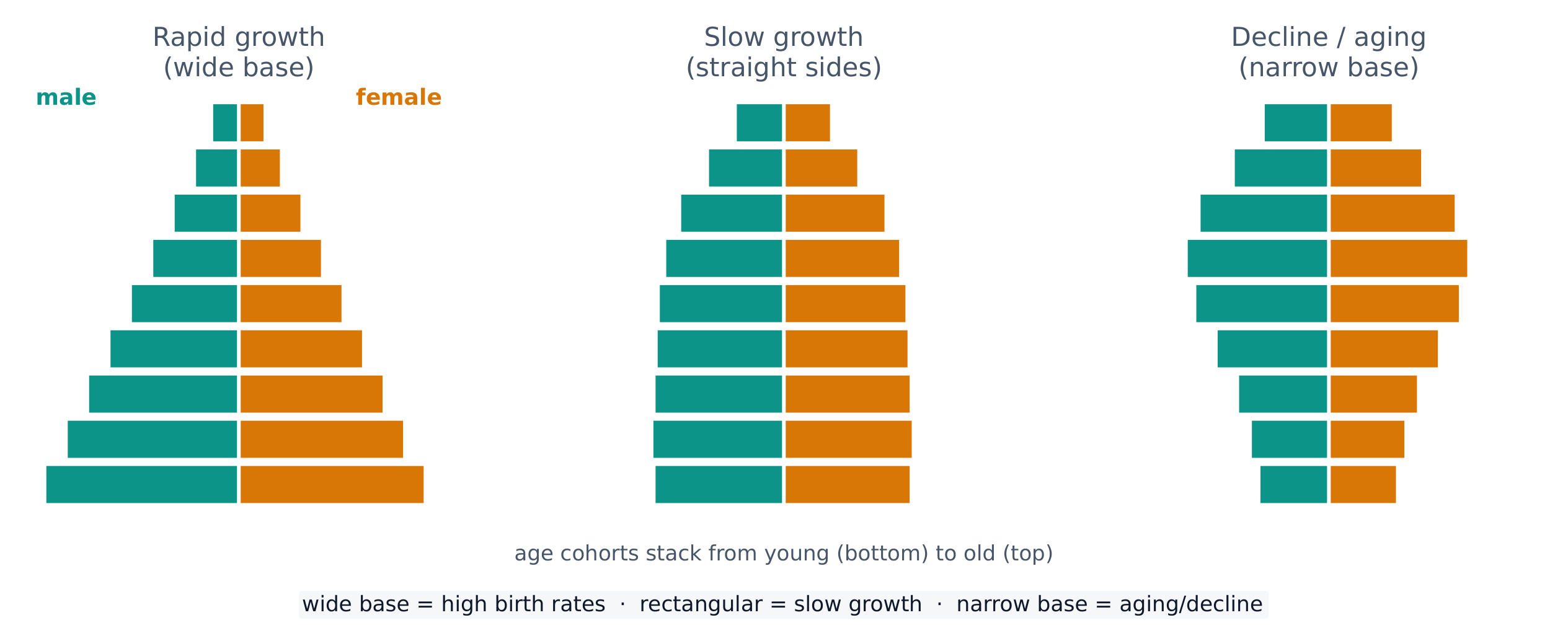
人口构成(population composition)是一个人口按年龄性别的组成。它显示在一个人口金字塔(population pyramid)上——男性和女性以五年年龄组(age cohorts)的背对背条形图。

三种人口金字塔形状:快速增长、缓慢增长和衰退
一个宽的基座意味着快速增长;直的侧面意味着缓慢增长;一个窄的基座意味着衰退
  • 一个宽的基座意味着高出生率和快速增长(许多年轻人)。
  • 直的侧面意味着缓慢、稳定的增长。
  • 一个窄的基座带一个宽的中间意味着一个老龄化、收缩的人口。

抚养比(dependency ratio)把受抚养者(15 岁以下和 64 岁以上)与工作年龄人口比较——一个高的比使支持他们的工人紧张。

词汇表 训练
英文 中文 拼音
Population composition 人口构成 rén kǒu gòu chéng
population pyramid 人口金字塔 rén kǒu jīn zì tǎ
age cohorts 年龄组 nián líng zǔ
dependency ratio 抚养比 fǔ yǎng bǐ
2.4

人口动态

大纲
Enduring UnderstandingLearning ObjectiveEssential Knowledge

IMP-2
Changes in population are due to mortality, fertility, and migration, which are influenced by the interplay of environmental, economic, cultural, and political factors.

IMP-2.A
Explain factors that account for contemporary and historical trends in population growth and decline.

  • IMP-2.A.1 Demographic factors that determine a population’s growth and decline are fertility, mortality, and migration.
  • IMP-2.A.2 Geographers use the rate of natural increase and population-doubling time to explain population growth and decline.
  • IMP-2.A.3 Social, cultural, political, and economic factors influence fertility, mortality, and migration rates.

来源:美国大学理事会 AP 课程与考试说明

人口通过出生、死亡和迁移变化。关键率(每年每 1,000 人):

  • 粗出生率(CBR)(crude birth rate)和粗死亡率(CDR)(crude death rate)。
  • 自然增长率(RNI)(rate of natural increase)= (CBR − CDR) ÷ 10,作为一个百分比——它忽略迁移。
  • 总和生育率(TFR)(total fertility rate)——每个妇女的平均孩子数;约 2.1更替水平(replacement level)。

倍增时间(doubling time)(一个人口翻倍的年数)≈ 70 ÷ RNI%。生育率的小变化有巨大的长期效应。

Worked example(一道真实的 AP 考题)。 "解释为什么同一个国家城市地区的自然增长率(RNI)可能与农村地区显著不同的一个原因。"(2023)满分答案:"在城市里,生活成本——住房、教育、托儿——更高,所以城市家庭往往生育更少的孩子。更少的出生降低了粗出生率,所以城市的 RNI 低于农村的 RNI,而农村的孩子仍帮助农活。" 注意答案的结构:命令词 Explain(解释)要求一条因果链,所以你必须说出原因并且把它一路追到 RNI。只给一个事实——"城市很贵"——得零分。

词汇表 训练
英文 中文 拼音
Crude birth rate (CBR) 粗出生率 cū chū shēng lǜ
crude death rate (CDR) 粗死亡率 cū sǐ wáng lǜ
Rate of natural increase (RNI) 自然增长率 zì rán zēng zhǎng lǜ
Total fertility rate (TFR) 总和生育率 zǒng hé shēng yù lǜ
replacement level 更替水平 gēng tì shuǐ píng
doubling time 倍增时间 bèi zēng shí jiān
2.5

人口转变模型

大纲
Enduring UnderstandingLearning ObjectiveEssential Knowledge

IMP-2
Changes in population are due to mortality, fertility, and migration, which are influenced by the interplay of environmental, economic, cultural, and political factors.

IMP-2.B
Explain theories of population growth and decline.

  • IMP-2.B.1 The demographic transition model can be used to explain population change over time.
  • IMP-2.B.2 The epidemiological transition explains causes of changing death rates.

来源:美国大学理事会 AP 课程与考试说明

人口转变模型

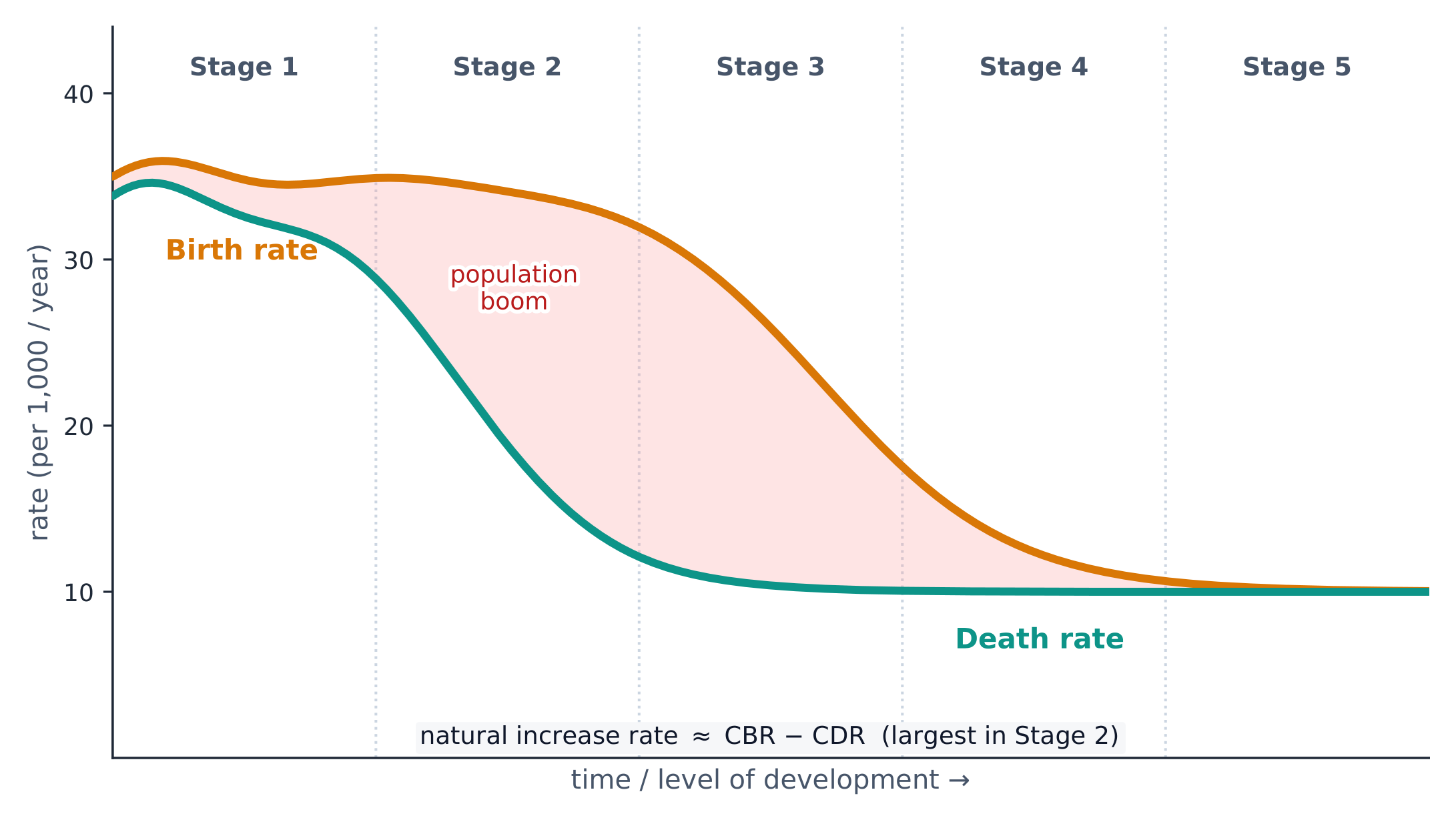
人口转变模型(DTM)(Demographic Transition Model)显示出生率和死亡率随着一个国家发展如何变化,通过五个阶段

人口转变模型:五个阶段的出生率和死亡率
死亡率先下降,然后出生率;它们之间的差距是人口爆炸
  1. 阶段 1 ——高的、波动的 CBR 和 CDR;缓慢增长(前工业)。
  2. 阶段 2 —— CDR 下降(更好的食物、医药、卫生设施)而 CBR 保持高;人口爆炸
  3. 阶段 3 —— CBR 下降(城市化、教育、女性工作);增长减慢。
  4. 阶段 4 ——低 CBR 和 CDR;人口稳定而大。
  5. 阶段 5 —— CBR 下降到 CDR 以下;人口衰退并老龄化。

相连的流行病学转变(epidemiological transition)描述随着一个国家经过 DTM,死亡的主要原因如何从传染病转向慢性、退行性疾病

词汇表 训练
英文 中文 拼音
Demographic Transition Model (DTM) 人口转变模型 rén kǒu zhuǎn biàn mó xíng
epidemiological transition 流行病学转变 liú xíng bìng xué zhuǎn biàn
2.6

马尔萨斯理论

大纲
Enduring UnderstandingLearning ObjectiveEssential Knowledge

IMP-2
Changes in population are due to mortality, fertility, and migration, which are influenced by the interplay of environmental, economic, cultural, and political factors.

IMP-2.B
Explain theories of population growth and decline.

  • IMP-2.B.3 Malthusian theory and its critiques are used to analyze population change and its consequences.

来源:美国大学理事会 AP 课程与考试说明

马尔萨斯理论及其批评

1798 年托马斯·马尔萨斯(Thomas Malthus)论证人口指数式(exponentially)增长而食物供应只线性(linearly)增长,所以人口会超过食物并被饥荒、疾病和战争抑制。

批评者说马尔萨斯低估了技术:绿色革命和现代农业巨大地提高了食物产出。新马尔萨斯主义者(neo-Malthusians)更新这个担忧以包括水、能源和其他有限资源。这个辩论是一个最爱的考试提示。

词汇表 训练
英文 中文 拼音
exponentially 指数式 zhǐ shù shì
linearly 线性 xiàn xìng
Neo-Malthusians 新马尔萨斯主义者 xīn mǎ ěr sà sī zhǔ yì zhě
2.7

人口政策

大纲
Enduring UnderstandingLearning ObjectiveEssential Knowledge

SPS-2
Changes in population have long- and short-term effects on a place’s economy, culture, and politics.

SPS-2.A
Explain the intent and effects of various population and immigration policies on population size and composition.

  • SPS-2.A.1 Types of population policies include those that promote or discourage population growth, such as pronatalist, antinatalist, and immigration policies.

来源:美国大学理事会 AP 课程与考试说明

政府试图用政策影响人口增长:

  • 鼓励生育(pro-natalist)政策在人口老龄化或收缩的地方鼓励生育(现金奖励、育儿假、托儿)——例如法国、日本。
  • 限制生育(anti-natalist)政策在增长被视为太快的地方阻止生育——例如印度的计划生育运动。

政策有意想不到的后果:强的限制生育政策能使性别比例失衡或加速老龄化,后来需要一个鼓励生育的回应。

词汇表 训练
英文 中文 拼音
Pro-natalist 鼓励生育 gǔ lì shēng yù
Anti-natalist 限制生育 xiàn zhì shēng yù
2.8 2.9

妇女与人口变化

大纲
Enduring UnderstandingLearning ObjectiveEssential Knowledge

SPS-2
Changes in population have long- and short-term effects on a place’s economy, culture, and politics.

SPS-2.B
Explain how the changing role of females has demographic consequences in different parts of the world.

  • SPS-2.B.1 Changing social values and access to education, employment, health care, and contraception have reduced fertility rates in most parts of the world.
  • SPS-2.B.2 Changing social, economic, and political roles for females have influenced patterns of fertility, mortality, and migration, as illustrated by Ravenstein’s laws of migration.
Enduring UnderstandingLearning ObjectiveEssential Knowledge

SPS-2
Changes in population have long- and short-term effects on a place’s economy, culture, and politics.

SPS-2.C
Explain the causes and consequences of an aging population.

  • SPS-2.C.1 Population aging is determined by birth and death rates and life expectancy.
  • SPS-2.C.2 An aging population has political, social, and economic consequences, including the dependency ratio.

来源:美国大学理事会 AP 课程与考试说明

女性的地位是生育率最强的驱动力之一。随着女性教育就业上升,女性结婚更晚并有更少的孩子,所以生育率下降——国家经过 DTM 的一个关键原因。

在另一端,人口老龄化(aging populations)(65 岁以上上升的份额)带来它们自己的挑战:更高的养老金和医疗成本、一个收缩的劳动力,和一个上升的抚养比。国家用更晚的退休、移民,或鼓励生育政策来回应。

词汇表 训练
英文 中文 拼音
aging populations 人口老龄化 rén kǒu lǎo líng huà
2.10 2.11

迁移的原因

大纲
Enduring UnderstandingLearning ObjectiveEssential Knowledge

IMP-2
Changes in population are due to mortality, fertility, and migration, which are influenced by the interplay of environmental, economic, cultural, and political factors.

IMP-2.C
Explain how different causal factors encourage migration.

  • IMP-2.C.1 Migration is commonly divided into push factors and pull factors.
  • IMP-2.C.2 Push/pull factors and intervening opportunities/obstacles can be cultural, demographic, economic, environmental, or political.
Enduring UnderstandingLearning ObjectiveEssential Knowledge

IMP-2
Changes in population are due to mortality, fertility, and migration, which are influenced by the interplay of environmental, economic, cultural, and political factors.

IMP-2.D
Describe types of forced and voluntary migration.

  • IMP-2.D.1 Forced migrations include slavery and events that produce refugees, internally displaced persons, and asylum seekers.
  • IMP-2.D.2 Types of voluntary migrations include transnational, transhumance, internal, chain, step, guest worker, and rural-to-urban.

来源:美国大学理事会 AP 课程与考试说明

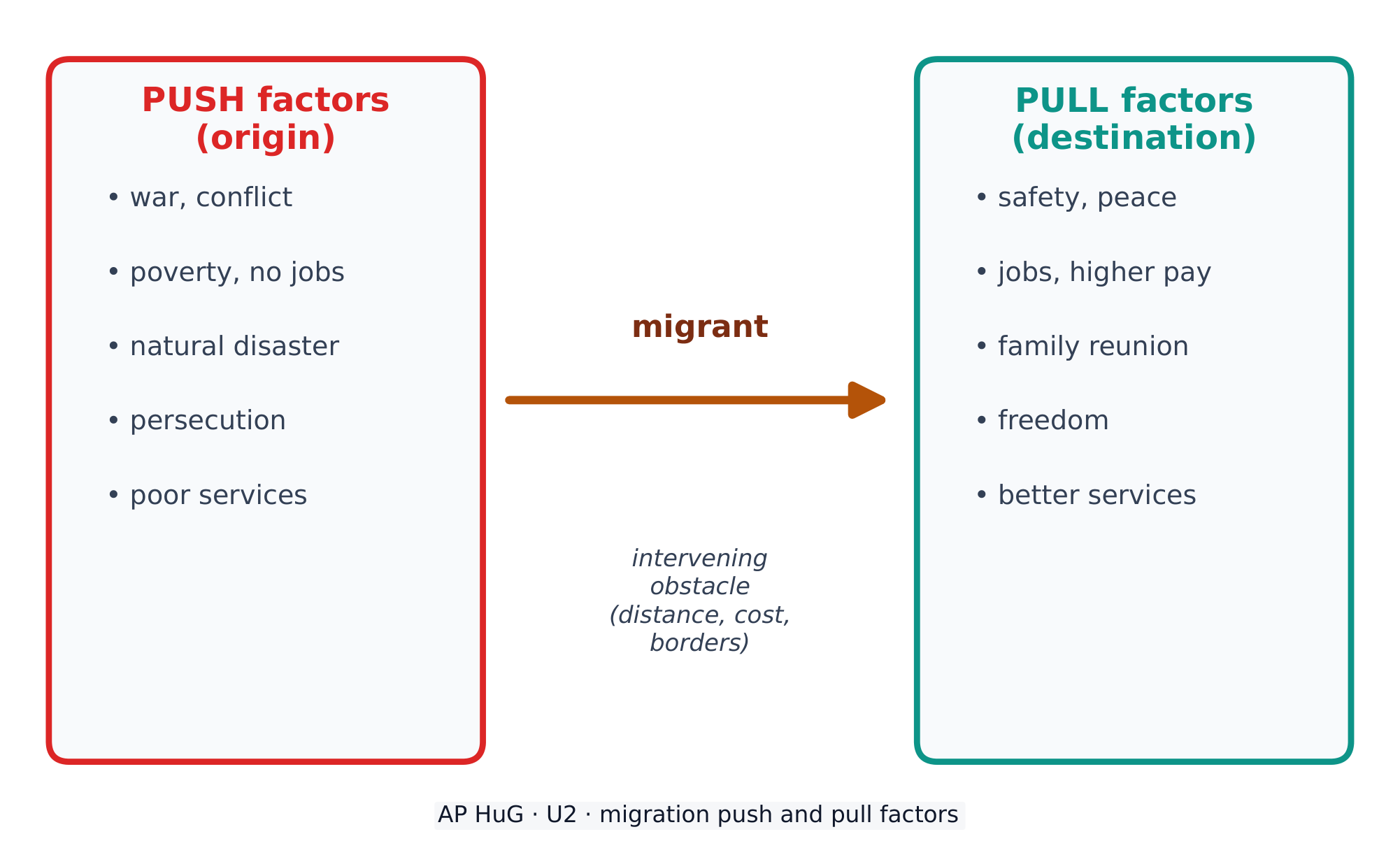
迁移(migration)是一个永久移动到一个新位置。它由推力(push factors)(离开的理由:战争、贫困、灾害)和拉力(pull factors)(到达的理由:工作、安全、家庭)驱动。

推力把人们赶出;拉力把他们吸引到一个新地方
迁移决定跨越一个中间障碍权衡推力与拉力
  • 自愿迁移(voluntary migration)是出于选择,通常出于经济原因。
  • 强迫迁移(forced migration)是违背一个人的意愿——逃离危险的难民(refugees),或被灾害流离失所的人。
  • 拉文斯坦定律(Ravenstein's laws)描述格局:大多数移民移动短距离、分步,而且主要被经济拉力吸引。

迁移能是国际(在国家之间)或国内(在一个国家内,例如从农村到城市)。

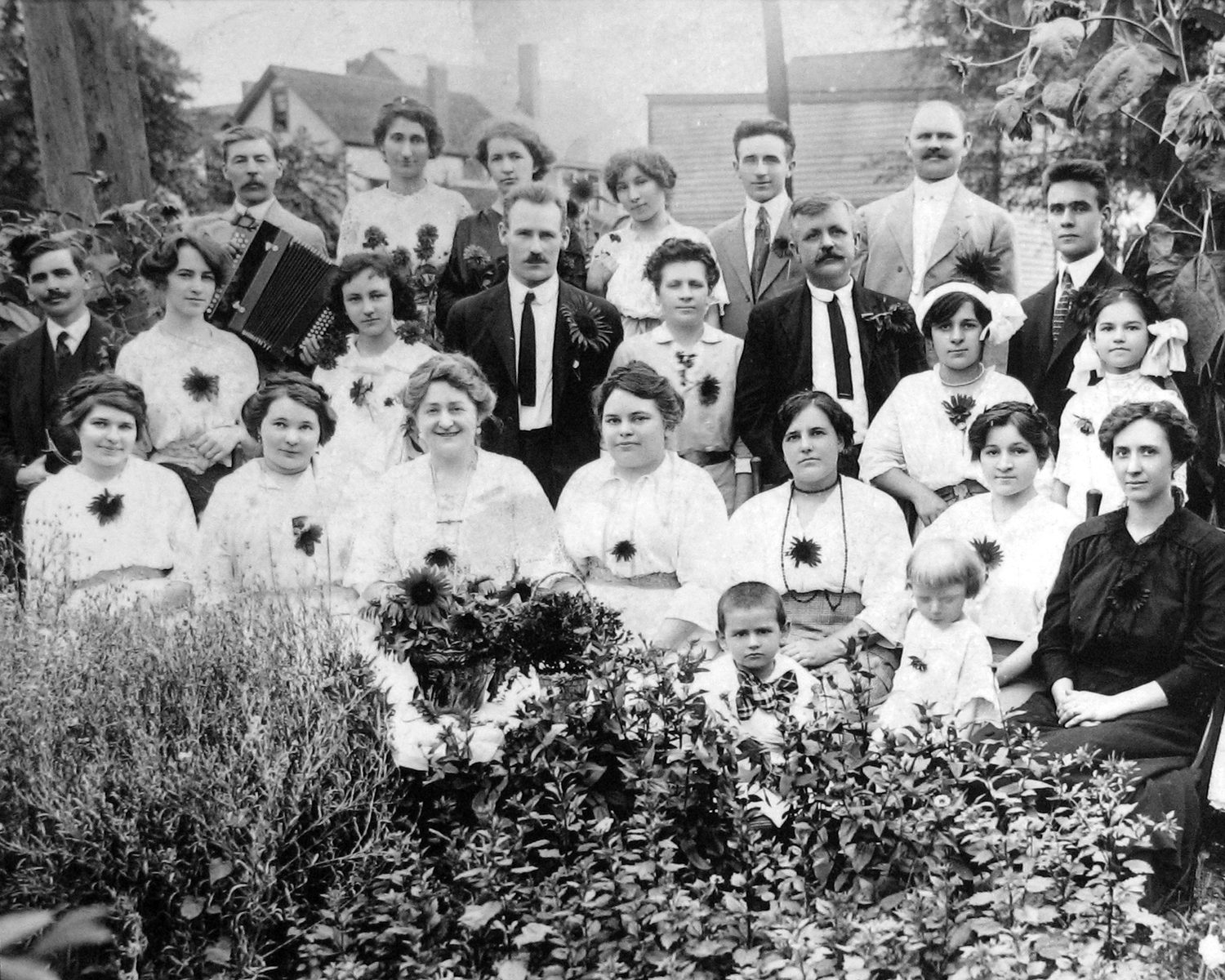
Immigrants arriving in a new city: migration redistributes population and reshapes places
探索

Push factor or pull factor?

A push factor drives people away from the origin; a pull factor draws them toward the destination.

词汇表 训练
英文 中文 拼音
Migration 迁移 qiān yí
push factors 推力 tuī lì
pull factors 拉力 lā lì
Voluntary migration 自愿迁移 zì yuàn qiān yí
Forced migration 强迫迁移 qiǎng pò qiān yí
refugees 难民 nàn mín
2.12

迁移的影响

大纲
Enduring UnderstandingLearning ObjectiveEssential Knowledge

IMP-2
Changes in population are due to mortality, fertility, and migration, which are influenced by the interplay of environmental, economic, cultural, and political factors.

IMP-2.E
Explain historical and contemporary geographic effects of migration.

  • IMP-2.E.1 Migration has political, economic, and cultural effects.

来源:美国大学理事会 AP 课程与考试说明

迁移重塑来源地目的地两者。

  • 目的地获得工人和文化多样性,但可能面对住房和服务的压力和社会紧张。
  • 来源地可能失去熟练工人(一次人才外流(brain drain))但获得侨汇(remittances)——移民寄回家的钱,对许多国家是一个主要的收入来源。
  • 迁移改变两个地方的年龄和性别结构,因为移民常常是年轻的工作年龄成人。
New arrivals reshape cities: migration changes labour markets, culture and demographics in destination places
词汇表 训练
英文 中文 拼音
brain drain 人才外流 rén cái wài liú
remittances 侨汇 qiáo huì
2.12

考试技巧

  • 计算 RNI = (CBR − CDR) ÷ 10 作为一个百分比,并把倍增时间读作约 70 ÷ RNI
  • 把一个人口金字塔的形状与生育率和 DTM 阶段联系起来——一个宽的基座意味着阶段 2。
  • 记住死亡率出生率之前下降;那就是为什么阶段 2 增长最快。
  • 推力拉力强迫自愿分开;一个难民跨越一个边界,一个 IDP(境内流离失所者)不跨越。
  • 权衡迁移效应:侨汇帮助来源地,但人才外流和老龄化伤害它。

本主题的互动课程

逐步学习,并即时检测练习。

AP 人文地理的更多主题

登录或创建账号

IGCSE, A-Level & AP