| English | 释义 | 拼音 |
|---|---|---|
| voluntary migration/ˈvɒləntəri maɪˈɡreɪʃn/ | 自愿迁移 | zì yuàn qiān yí |
| forced migration/fɔːst maɪˈɡreɪʃn/ | 强迫迁移 | qiǎng pò qiān yí |
| refugee/ˈrefjuːdʒiː/ | 难民 | nàn mín |
| internally displaced person/ɪnˈtɜːnəli dɪˈspleɪst ˈpɜːsn/ | 境内流离失所者 | jìng nèi liú lí shī suǒ zhě |
| transnational migration/trænˈsnæʃənl maɪˈɡreɪʃn/ | 跨国迁移 | kuà guó qiān yí |
Two families leave Syria
- From 2011, war in Syria forced about half of its 21 million people from their homes. Some crossed into Turkey, Lebanon or Jordan; others fled to safer towns inside Syria. At the same time, Syrian doctors with job offers moved to Germany by choice.
- Geographers divide migration into voluntary migration 自愿迁移 (by choice, usually for work or family) and forced migration 强迫迁移 (against a person's will, because of war, persecution, disaster or slavery).
Match each move to its kind.
难度 2/5 · 今日首次完成可获 140 金币及少量额外奖励
Choice or no real choice.
Who is who among forced migrants
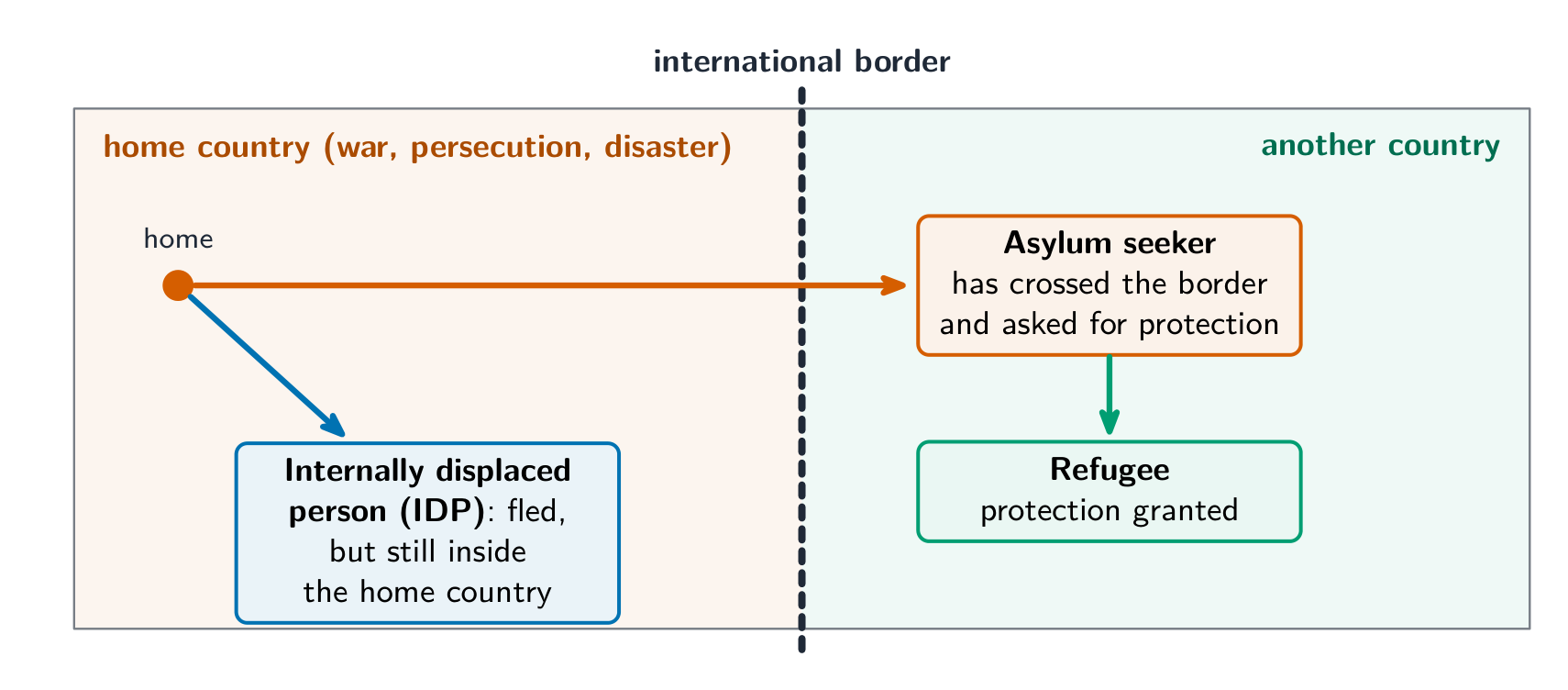
- A refugee 难民 has fled across an international border because of a well-founded fear of persecution or war, and has been recognised as needing protection. An asylum seeker has crossed and asked for that protection, but is still waiting for a decision.
- An internally displaced person 境内流离失所者 (IDP) has also been forced to flee, but has not crossed a border. In 2024 there were about 120 million forcibly displaced people worldwide, and more than half were IDPs.
自愿还是强制?
Sort each move as voluntary or forced migration.
Match each person to the correct term.
难度 2/5 · 今日首次完成可获 140 金币及少量额外奖励
The border, then the decision.
Types of voluntary migration
| Type | What it is | Example |
|---|---|---|
| Internal: interregional | between regions of one country | the Great Migration of African Americans from the US South to northern cities (1910s–1970s) |
| Internal: intraregional | within one region, often rural → urban or city → suburb | Chinese farmers moving to nearby cities |
| International | across a national border | Indians moving to the Gulf states for work |
| Guest workers | temporary workers invited to fill labour shortages | Turkish workers in West Germany (1961–1973) |
| Transnational migration 跨国迁移 | migrants keep strong ties to both countries, often sending money (remittances) home | Filipino nurses abroad |
| Transhumance | seasonal movement of herders with their animals | herders in the Alps or the Sahel |
Match each example to its type of migration.
难度 2/5 · 今日首次完成可获 140 金币及少量额外奖励
Each type describes a different pattern of movement.
The line is not always sharp
- Many moves mix choice and force: a farmer leaving land ruined by drought "chooses" to go, but has little real choice. Geographers often see migration as a range from fully voluntary to fully forced.
- Legal status matters: only people who cross a border can claim refugee protection under international law, so IDPs often receive less help.
Internally displaced people can claim refugee status under international law.
难度 1/5 · 今日首次完成可获 100 金币及少量额外奖励
Refugee status requires crossing an international border.
Worked FRQ answer
(A) Explain the difference between a refugee and an internally displaced person. Both were forced to flee, but a refugee has crossed an international border, while an IDP remains inside their own country.
(B) Explain ONE reason guest workers were invited to West Germany after 1961. The economy was growing quickly but there were not enough workers, so the government recruited workers from Turkey and southern Europe to fill factory and construction jobs.
(C) Explain ONE effect of transnational migration on the origin country. Migrants send remittances home, which help families pay for food, education and housing and can be a large share of the national income, as in the Philippines.
- Why it scores: (A) names the key difference (the border); (B) and (C) give a cause or effect with a mechanism and a real case.
"Refugee" is not a word for every migrant. A refugee is forced to flee across a border by war or persecution. People moving for work are voluntary migrants, however hard their situation.
Voluntary migration is by choice; forced migration is against a person's will. Refugees have crossed a border and received protection; asylum seekers are waiting for a decision; IDPs have fled but stayed inside their country. Voluntary types include interregional, intraregional, international, guest-worker, transnational and transhumance migration.
FRQ practice. A long drought ruins farmland, and many farmers move to the capital city of the same country. (A) Identify the type of migration. (B) Explain whether this move is voluntary or forced. (C) Explain ONE challenge the capital city may face.
Many real moves mix choice and force.