跳到主要内容

呈现:沟通与AP绘画作品集

AP 绘画 · 第 7 主题

训练
讲义 词汇表
7.1

AP绘画作品集

大纲

Focus: The AP exam is a portfolio, not a written test — two sections submitted digitally in early May. (CED Big Idea 3)

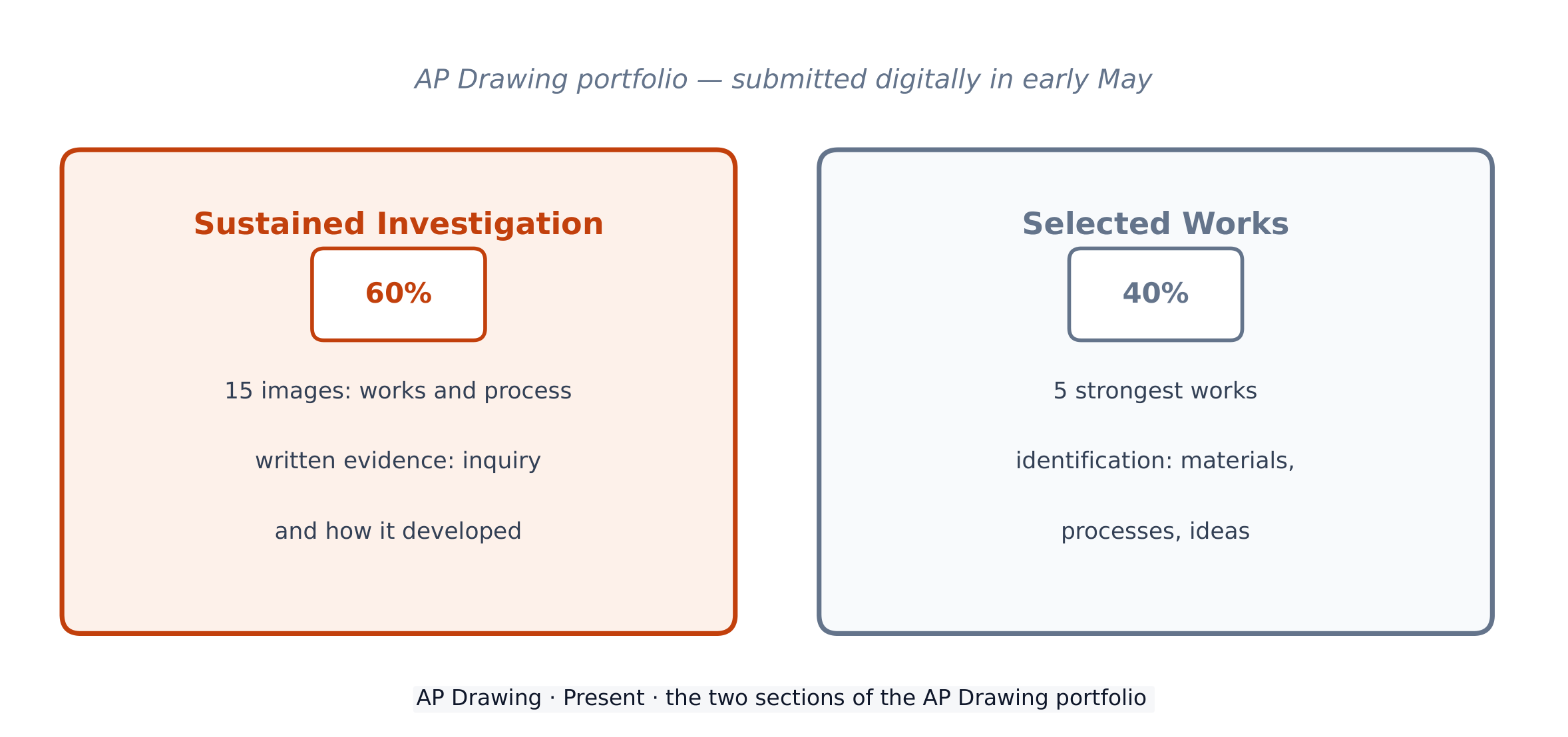
  • Sustained Investigation: 15 images of works and process, plus written evidence — 60% of the score.
  • Selected Works: 5 works demonstrating skillful synthesis of materials, processes, and ideas — 40%.
  • Selected Works may come from the investigation or outside it — choose your strongest five.
  • Everything uploads through the AP Digital Portfolio; teachers review before final submission.
  • Drawing, 2-D, and 3-D are separate portfolios; a student submits work made for the Drawing skill set.
  • Plan backwards from May: photography, writing, and selection all take real calendar time.

来源:美国大学理事会 AP 课程与考试说明

AP考试是一个作品集(portfolio),不是笔试——两个部分在五月初以数字方式提交。(CED大观念3)

AP绘画作品集:持续探究(15张图像+文字,60%)与精选作品(5件,40%)
两个部分:持续探究占分数的60%,精选作品占40%
  • 持续探究:15张作品与过程的图像,加上书面材料——占分数的60%。
  • 精选作品(Selected Works):5件展示材料、过程与想法熟练综合的作品——占40%。
  • 精选作品可以来自探究之内或之外。选你最强的五件,不论它们从哪来。
  • 一切通过数字作品集平台(AP Digital Portfolio)上传;提交前老师会审看。
  • 绘画、二维、三维艺术与设计是三个独立的作品集——提交为绘画技能而作的作品。
  • 从五月倒排计划:拍摄、写作和挑选都需要真实的日历时间。
探索

Where does it belong?

The Sustained Investigation holds 15 images with written evidence (60%); the Selected Works are your five strongest pieces (40%). Some things belong in neither.

词汇表 训练
英文 中文 拼音
portfolio 作品集 zuò pǐn jí
Selected Works 精选作品 jīng xuǎn zuò pǐn
AP Digital Portfolio 数字作品集平台 shù zì zuò pǐn jí píng tái
7.2

持续探究:图像与书面材料

大纲

Focus: The SI section pairs 15 images with short written evidence — images show, writing states. (CED 3.A/3.B)

  • Writing has two prompts: state the inquiry, and describe how the investigation developed — 1,200 characters total.
  • Every image carries its own caption fields: materials, processes, dimensions (and citations when needed).
  • Choose images that prove the writing: question stated → tests shown → development visible.
  • Process images (journal spreads, in-progress states, detail shots) count among the 15 — use several.
  • Order the images deliberately: scorers read them as a sequence, so build a narrative arc.
  • Write plainly and concretely; name materials, processes, ideas, and skills in CED vocabulary.

来源:美国大学理事会 AP 课程与考试说明

持续探究部分把15张图像与简短的书面证据(written evidence)配对——图像展示,文字陈述。(CED 3.A/3.B)

  • 写作回答两个提示:陈述探究问题,以及描述探究如何发展——总共约1200字符。
  • 每张图像都带说明字段:材料(materials)、过程(processes)、尺寸,以及必要时的引用。
  • 选那些能证明文字的图像:问题被陈述、测试被展示、发展看得见。
  • 过程图像——日志跨页、进行中的状态、细节照——算在15张之内。多用几张。
  • 有意安排图像的顺序:评卷人按序阅读,所以要构建一条叙事弧线。
  • 写得朴素而具体,用CED的词汇命名技能和要素。
持续探究奖励可见的探究过程:习作、过程照片与长期发展
词汇表 训练
英文 中文 拼音
written evidence 书面证据 shū miàn zhèng jù
materials 材料 cái liào
processes 过程 guò chéng
7.3

精选作品:展示技能

大纲

Focus: Selected Works are your five strongest statements — each judged on written evidence, drawing skills, and synthesis. (CED 3.C)

  • Pick for range and strength: together the five should cover the drawing skills list.
  • Each work carries identification: materials, processes, ideas — 100 characters per field, make every word count.
  • Quality beats concept here: flawless craft and full value range are what a 5 looks like.
  • Strong candidates: the observational tour de force, the chiaroscuro drama, the expressive figure, the synthesis piece.
  • Details matter at scoring size — view each candidate at thumbnail scale and at full zoom before choosing.
  • Ask three viewers to rank your top eight; overlap usually finds the true five.

来源:美国大学理事会 AP 课程与考试说明

精选作品是你最强的五个陈述——每件按书面证据、绘画技能和综合来评分。(CED 3.C)

  • 兼顾广度强度:五件放在一起应覆盖整张绘画技能清单。
  • 每件作品带一份作品信息(identification):材料、过程、想法——每个字段约100字符,字字都要有用。
  • 在这里质量胜过概念:无可挑剔的工艺和完整的明度范围就是5分的样子。
  • 有力的候选:写生的力作、明暗对照的戏剧之作、有表现力的人物、体现综合的作品。
  • 细节在评分尺寸下很重要。挑选前,把每件候选缩成小图看一遍、再放大到全图看一遍。
  • 请三个人给你的前八名排序;重叠的部分通常就是真正的前五。
A finished drawing for Selected Works: craft, composition and skill must read clearly in the image
词汇表 训练
英文 中文 拼音
identification 作品信息 zuò pǐn xìn xī
7.4

撰写作品说明

大纲

Focus: The written evidence is short, factual, and load-bearing — it directs the scorer's attention. (CED 3.D/3.E)

  • State the inquiry as a question or clear statement in the first sentence.
  • Use concrete nouns and verbs: 'compressed charcoal on gessoed cardboard, lifted with erasers' beats 'mixed media'.
  • Connect writing to visible things: if you claim experimentation, the images must show it.
  • Completely unrelated writing caps the Selected Works score — relevance is a rubric rule.
  • Draft early, cut hard: character limits reward the specific and punish the vague.
  • Have someone read writing while viewing the images — wherever they ask 'where?', revise.

来源:美国大学理事会 AP 课程与考试说明

书面证据简短、实事求是、承重——它引导评卷人的注意力。(CED 3.D/3.E)

  • 第一句就把探究写成一个问题或一句清楚的陈述。
  • 用具体的名词和动词:"石膏底纸板上的压缩木炭,用橡皮提亮"胜过"综合媒介"。
  • 把文字连到看得见的东西上:你声称实验,图像就必须显示实验。
  • 与作品完全无关的文字会封顶精选作品的分数——相关性是评分规则。
  • 早起草、狠删减:字符上限奖励具体、惩罚空泛。
  • 请人边看图边读你的文字。凡是对方问"在哪里?"的地方,就去修改。
Written evidence starts in the journal: notes next to studies become portfolio text
7.5

呈现与图像质量

大纲

Focus: Scorers see photographs, not originals — photography quality is portfolio quality. (CED 3.F)

  • Shoot in even, indirect daylight or two-lamp setups; avoid glare, shadows across the work, and keystone distortion.
  • Fill the frame, crop to the work's edges, and keep verticals vertical.
  • Check values on screen: a washed-out photo erases the light-and-shade skill you spent weeks building.
  • Detail shots are allowed and powerful — a close-up of mark-making proves what a full view only suggests.
  • Consistent, neutral backgrounds make a sequence read professionally.
  • Photograph work as it is finished, not all in April — fixative first, then shoot, then store flat.

来源:美国大学理事会 AP 课程与考试说明

评卷人看到的是照片(photographs),不是原作——摄影质量就是作品集质量。(CED 3.F)

  • 在均匀的散射日光或双灯设置下拍摄。避免眩光、横过画面的阴影和梯形畸变(keystone distortion)。
  • 让作品充满画幅、裁到作品边缘、保持竖线竖直。
  • 在屏幕上检查明度:一张发白的照片会抹掉你花几周建立的光影技能。
  • 允许并且有力的细节图(detail shot)——笔触的特写能证明全景只能暗示的东西。
  • 一致的中性背景让整组图像显得专业。
  • 每件作品完成时就拍,不要都拖到四月:先喷定画液,再拍摄,然后平放收存。
工作中的画室:认真记录过程照片与成品,用于作品集呈现
词汇表 训练
英文 中文 拼音
photographs 照片 zhào piān
keystone distortion 梯形畸变 tī xíng jī biàn
detail shot 细节图 xì jié tú
7.6

理解评分标准

大纲

Focus: Both sections are scored against published rubrics — knowing the rows lets you build to them.

  • Sustained Investigation rows: inquiry evident, evidence of practice/experimentation/revision, materials-processes-ideas, skills, and synthesis.
  • Selected Works criteria: written evidence identifies components; drawing skills; synthesis — scored 1-5 by preponderance of evidence.
  • Rubric language ladder: rudimentary → moderate → good → advanced — aim your evidence at the top descriptors.
  • Score your own mock portfolio against the rubric each term; the gaps write your to-do list.
  • Scores 1-5 arrive in July; college credit policies vary — but the rubric habits are the real prize.
  • Every rubric row asks for visual evidence — the recurring answer is: show it, then name it.

来源:美国大学理事会 AP 课程与考试说明

两个部分都按公开的评分标准(scoring guidelines)打分——了解每一行,就能朝它去构建。

评分语言的阶梯:初步、中等、良好、高级——把证据对准最高一级
评分标准的语言阶梯:把每一份证据都对准最高的描述词
  • 持续探究的评分行:探究可见;练习、实验与修改;材料、过程与想法;绘画技能;综合。
  • 精选作品的标准:书面证据点明要素;绘画技能;综合——按证据的总体倾向(preponderance of evidence)给1-5分。
  • 评分语言的阶梯是初步、中等、良好、高级——把证据对准最高的描述词。
  • 每学期用评分标准给自己的模拟作品集打分;缺口就是你的待办清单。
  • 1-5的分数七月公布,大学的学分政策各不相同——但评分标准养成的习惯才是真正的收获。
  • 每一行都要视觉证据。反复出现的答案是:先展示它,再命名它。
词汇表 训练
英文 中文 拼音
scoring guidelines 评分标准 píng fēn biāo zhǔn
preponderance of evidence 证据的总体倾向 zhèng jù de zǒng tǐ qīng xiàng
7.7

学术诚信与引用来源

大纲

Focus: The portfolio must be your own work; borrowed images and AI tools have strict rules.

  • Working from someone else's photograph or artwork requires citation in the image's materials/processes fields.
  • Substantially copying another artist's work — even cited — cannot demonstrate your idea development.
  • Draw from life and from your own reference photos wherever possible; it also simply teaches more.
  • Generative AI may not make your work: AP policy allows it only as a documented exploration tool, never as the artwork.
  • Plagiarism cancels scores — the College Board checks, and teachers must certify originality.
  • Integrity is also artistic self-interest: your own seeing is the only unique material you have.

来源:美国大学理事会 AP 课程与考试说明

作品集必须是你自己的作品。借用图像和AI工具有严格的规则。

  • 参考他人的照片或作品创作,必须在那张图像的材料/过程字段里写引用(citation)。
  • 大量照搬他人作品——即使写了引用——也无法展示你的想法发展。
  • 尽可能写生、用自己拍的参考照片;这也确实教得更多。
  • 生成式人工智能(generative AI)不能替你创作:AP政策只允许把它作为有记录的探索工具,绝不能作为作品本身。
  • 抄袭(plagiarism)会取消成绩。College Board会核查,教师必须证明原创性。
  • 诚信也是艺术上的自利:你自己的观看,是你唯一真正独有的材料。
词汇表 训练
英文 中文 拼音
citation 引用 yǐn yòng
generative AI 生成式人工智能 shēng chéng shì rén gōng zhì néng
plagiarism 抄袭 chāo xí
7.7

考试技巧

  • 把拍摄当回事,因为它就是回事——5分水平的画拍出眩光和梯形畸变,读起来就是3分。凡是让你犹豫的照片都重拍。
  • 用具体信息填满每个说明字段。"英格尔有色纸上的柳条木炭,减法擦亮"在替你挣分;空白或含糊的字段浪费白给的分数。
  • 检查相关性规则:如果你的书面证据原封不动放到别人的作品集下也说得通,那就太空泛了——把每句话拴到你的图像上。
  • 用新鲜的眼睛挑五件:缩略图打印摆上桌,请三位信得过的人排序,重叠者胜出。
  • 凡不是你拍的参考照片都要引用——漏一条引用就拿整个作品集冒险;三十秒的打字消除这个风险。

本主题的互动课程

逐步学习,并即时检测练习。

AP 绘画的更多主题

登录或创建账号

IGCSE, A-Level & AP