跳到主要内容
学科

AP 绘画

AP 素描以作品集评估,而非笔试。课程涵盖线条与笔触、明暗、光与形体、空间、深度与比例,以及 素描媒介与流程,同时包含作品集的三个部分:探究、创作、呈现。

素描与二维艺术设计的区别在于对"笔触"本身的强调——作品集评的是绘画决策,因此画面质感、线条 品质,以及笔触如何塑造形体,都具有分量。技术上工整却看不出任何决策的作品,得分往往低于敢于 冒险并展示修改过程的作品。

"持续探究"评的是长期的探究与发展,这意味着要边做边记录过程,而不是最后再补齐。本站笔记结合 实例逐项讲解素描基本功,再讲作品集要求,以及所附文字需要呈现什么。

训练全部词汇
  • 1

    线条与笔触

    讲义 词汇表
    1.1

    线条质感

    大纲

    Focus: Line quality is how a line looks and feels — the first drawing skill the AP rubric names is mark-making.

    • A line can be thick or thin, dark or light, smooth or rough, fast or slow.
    • Weighted line changes thickness along its length: press harder where a form turns away or carries weight.
    • Confident lines are drawn from the shoulder and elbow, not only the fingers.
    • Lost-and-found lines fade out and reappear — the viewer's eye completes the edge.
    • Line direction carries feeling: horizontal is calm, vertical is firm, diagonal is active.
    • Examiners read line quality instantly — scratchy, timid lines and one confident stroke tell different stories.

    来源:美国大学理事会 AP 课程与考试说明

    线条质感(line quality)指一条线看起来和给人的感觉。AP绘画评分标准把笔触(mark-making)列在绘画技能清单的第一位,而线条是最基本的笔触。

    • 线条可以粗或细、深或浅、光滑或粗糙、快或慢。
    • 轻重线条(weighted line)沿着长度改变粗细。在形体转向背光处或承受重量处下笔更重。
    • 虚实线条(lost-and-found lines)时隐时现。观者的眼睛会自动补全消失的边缘。
    • 自信的线条来自肩膀和手肘,而不只是手指。
    线条质感比较:均匀线、轻重线、虚实线与表现性线条
    同一条边缘的四种画法:均匀线、轻重线、虚实线和快速的表现性线条

    线条方向传递情绪:水平线平静,垂直线坚定,对角线充满动感。评卷人一眼就能读出线条质感,所以要练到线条果断、不犹豫。

    词汇表 训练
    英文 中文 拼音
    line quality 线条质感 xiàn tiáo zhì gǎn
    mark-making 笔触 bǐ chù
    weighted line 轻重线条 qīng zhòng xiàn tiáo
    lost-and-found lines 虚实线条 xū shí xiàn tiáo
    1.2

    轮廓素描

    大纲

    Focus: Contour drawing follows the edges of a form slowly and carefully — it trains eye-hand coordination.

    • A contour line traces the outer edge and the inner edges (folds, creases, overlaps) of a subject.
    • In blind contour you draw without looking at the paper — pure observation practice.
    • Cross-contour lines travel across the surface of a form, like latitude lines on a globe, and describe volume.
    • Draw slowly: match the speed of your eye moving along the edge with the speed of your pencil.
    • Overlapping contours (one edge passing in front of another) create instant depth.
    • Contour studies make strong Sustained Investigation process pages — they show observation skill.

    来源:美国大学理事会 AP 课程与考试说明

    轮廓线(contour line)沿着形体的边缘走——外边缘,以及褶皱、折痕和遮挡形成的内边缘。轮廓素描是缓慢、仔细的观察。

    • 让眼睛沿边缘移动的速度与铅笔移动的速度保持一致。
    • 盲画轮廓(blind contour)是指画的时候不看纸面。感觉很奇怪,但它训练纯粹的观察力。
    • 横截轮廓线(cross-contour lines)横穿形体表面,像地球仪上的纬线。它们描述体积,而不是边缘。
    • 轮廓的遮挡立刻产生纵深:一条边缘在另一条前面,就是在说"这个更近"。

    轮廓练习是持续探究里很好的过程页,因为它们展示真实的观察能力。

    Gesture and contour from a master study: line records form in one continuous look
    Gesture and contour from a master study: line records form in one continuous look
    词汇表 训练
    英文 中文 拼音
    contour line 轮廓线 lún kuò xiàn
    blind contour 盲画轮廓 máng huà lún kuò
    cross-contour lines 横截轮廓线 héng jié lún kuò xiàn
    1.3

    动态速写

    大纲

    Focus: Gesture drawing captures the energy, movement, and weight of a subject in seconds — before any detail.

    • A gesture drawing takes 30 seconds to 3 minutes; it looks for the action line running through the pose.
    • Draw the whole subject at once — big loose lines from the shoulder — never one polished corner.
    • Look for the line of action first: one curve that summarises the pose's movement.
    • Gesture is about what the subject is doing, not what it looks like.
    • Daily gesture pages build speed and confidence, and they photograph well as process evidence.
    • Long drawings usually start as a gesture: energy first, structure second, detail last.

    来源:美国大学理事会 AP 课程与考试说明

    动态速写(gesture drawing)在几秒钟内抓住对象的能量、动势和重量——先于任何细节。

    • 一张动态速写用30秒到3分钟。用大而放松的线条一次画出整个对象。
    • 先找动势线(line of action):一条概括姿势运动的曲线。
    • 动态速写问的是对象在做什么,而不是它长什么样。
    • 长时间的素描通常从动态速写开始:先有能量,再有结构,最后才是细节。

    每天画动态速写能提高速度和信心,拍下来也是很好的练习证据。

    Gesture captures action in a few lines before detail begins
    Gesture captures action in a few lines before detail begins
    词汇表 训练
    英文 中文 拼音
    gesture drawing 动态速写 dòng tài sù xiě
    line of action 动势线 dòng shì xiàn
    1.4

    排线与交叉排线

    大纲

    Focus: Hatching builds value with parallel lines; cross-hatching layers a second direction on top.

    • Closer, darker lines read as darker value; wider spacing reads as lighter value.
    • Cross-hatching adds layers at new angles — each layer deepens the tone step by step.
    • Curve the hatch lines around the form (cross-contour hatching) so the shading also describes volume.
    • Keep a consistent angle inside one plane; change angle when the plane changes — edges stay crisp.
    • Pen-and-ink drawing depends on hatching because ink has no grey — value comes only from line density.
    • Hatching shows control of mark-making and light and shade, two named AP drawing skills, in one technique.

    来源:美国大学理事会 AP 课程与考试说明

    用笔触塑造明暗

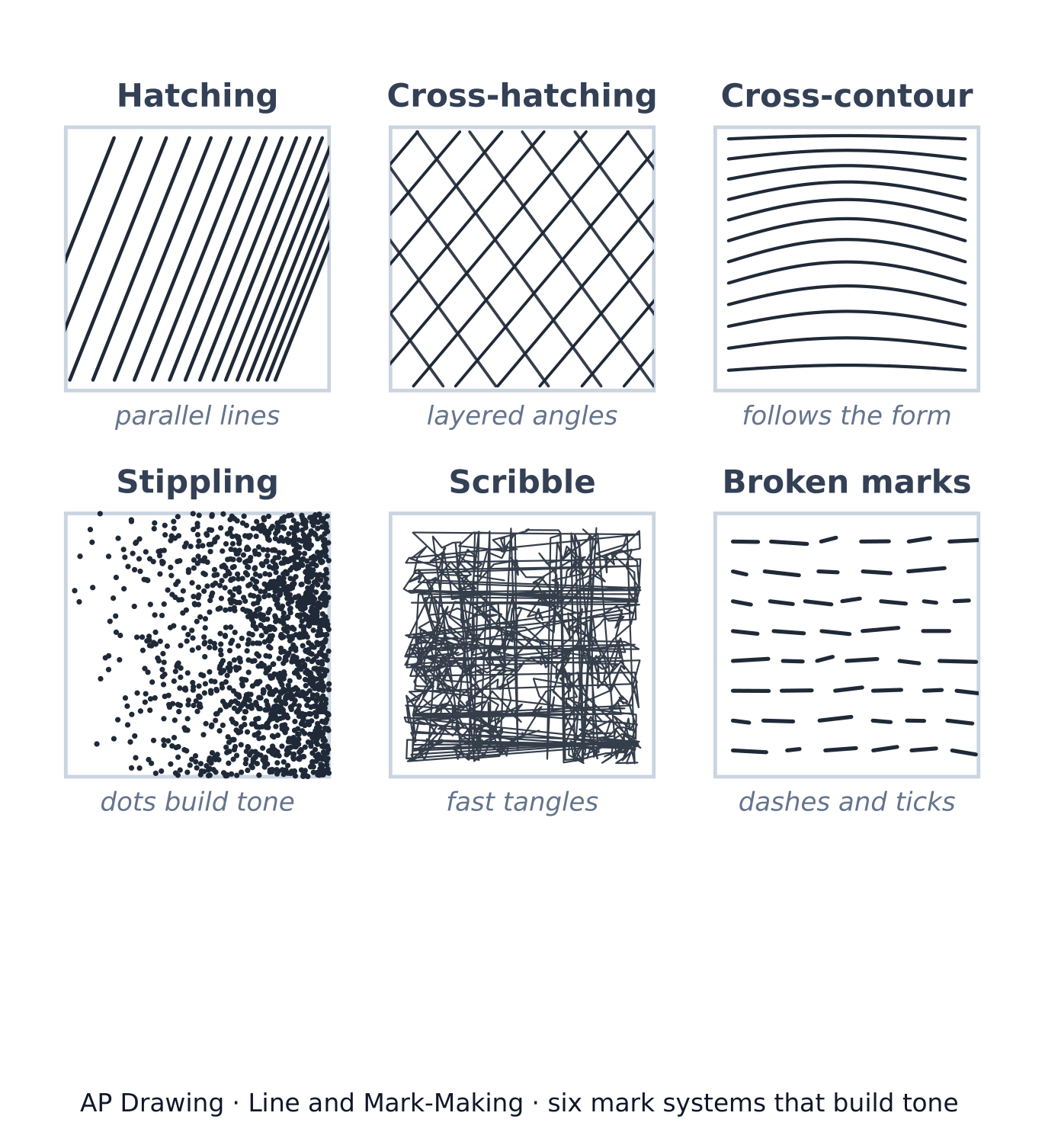
    排线(hatching)用平行线画出色调。交叉排线(cross-hatching)在上面以新的角度再叠一层线。

    一幅精细的古典大师素描,一双合拢的手,在蓝灰色纸上用密集的细墨线塑造
    丢勒用细密的平行排线和交叉排线画出这双手;线条越靠近、越交叉的地方色调越深,平面的笔迹就变成了立体的形体
    六种笔触系统:排线、交叉排线、横截排线、点画、乱线与断续笔触
    用笔触画出色调的六种方式;更密、更近的笔触读起来明度更深
    • 更近、更深的线条读作更深的明度(value);间距更宽读作更浅的明度。
    • 每叠一层交叉排线,色调就加深一步——逐渐建立暗部。
    • 让线条顺着形体弯曲(横截排线),这样明暗同时也在描述体积。
    • 同一个面里保持一个角度;面改变时才改变角度,边缘就会清晰。
    • 钢笔画完全依靠排线,因为墨水没有灰色:明度只来自线条的密度。
    探索

    Which mark system is it?

    Hatching uses parallel lines, cross-hatching layers a second angle, stippling builds tone from dots, and scribble uses fast tangles. Naming mark systems helps you choose and describe your own.

    词汇表 训练
    英文 中文 拼音
    hatching 排线 pái xiàn
    cross-hatching 交叉排线 jiāo chā pái xiàn
    value 明度 míng dù
    1.5

    点画、乱线与其他笔触

    大纲

    Focus: Beyond hatching there is a whole vocabulary of marks — dots, scribbles, dashes, smears — each with its own texture and speed.

    • Stippling builds tone from dots: dense dots read dark, sparse dots read light — slow but very controllable.
    • Scribble (or scumbled) marks are fast tangles of line — lively, good for fur, foliage, and energy.
    • Dashes, ticks, and broken marks suggest texture without outlining every detail.
    • Marks can be additive (adding material) or subtractive (lifting material out with an eraser).
    • Try one subject rendered in four different mark systems — a classic experimentation page.
    • A personal mark vocabulary is part of your artistic voice — examiners look for it across the portfolio.

    来源:美国大学理事会 AP 课程与考试说明

    除了排线,还有一整套笔触词汇——点、缠绕的线团、短划、涂抹——每种都有自己的质感和速度。

    • 点画(stippling)用点建立色调:密集的点读作深色,稀疏的点读作浅色。慢,但非常可控。
    • 乱线(scribble)是快速缠绕的线团——生动,适合皮毛、树叶和能量感。
    • 短划、勾线和断续的笔触暗示质感,而不必勾出每个细节。
    • 笔触可以是加法(additive)(往上加材料)或减法(subtractive)(用橡皮把材料提走)。
    • 经典的实验页:同一个对象用四种不同的笔触系统各画一遍。
    词汇表 训练
    英文 中文 拼音
    stippling 点画 diǎn huà
    scribble 乱线 luàn xiàn
    additive 加法 jiā fǎ
    subtractive 减法 jiǎn fǎ
    1.6

    肌理与画面质感

    大纲

    Focus: Surface is a named AP drawing skill: how the drawing's physical texture and the depicted texture work together.

    • Actual texture is the real surface of the work (rough paper, layered charcoal, collage); implied texture is drawn illusion.
    • Frottage (rubbing over a textured surface) transfers real texture into a drawing.
    • Paper tooth (roughness) changes every mark: the same pencil reads differently on smooth and rough paper.
    • Contrast of textures — smooth skin against rough cloth — makes both read more strongly.
    • Build texture with the logic of the material: short strokes for fur, long strokes for hair, broken marks for stone.
    • Describing texture convincingly is visual evidence of observation and material control.

    来源:美国大学理事会 AP 课程与考试说明

    画面质感(surface)是AP点名的绘画技能之一:作品实际的物理质感与画出来的质感幻觉共同起作用。

    • 实际肌理(actual texture)是作品真实的表面——粗糙的纸、层层的木炭、拼贴。视觉肌理(implied texture)是画出来的幻觉。
    • 拓印法(frottage)(在有纹理的表面上摩擦)把真实的肌理转移到画面里。
    • 纸纹(tooth)改变每一个笔触:同一支铅笔在光滑和粗糙的纸上效果完全不同。
    • 质感的对比——光滑的皮肤衬着粗糙的布料——让两者都更强烈。
    • 按材料的逻辑画质感:短笔触画皮毛,长笔触画头发,断续笔触画石头。
    词汇表 训练
    英文 中文 拼音
    surface 画面质感 huà miàn zhì gǎn
    actual texture 实际肌理 shí jì jī lǐ
    implied texture 视觉肌理 shì jué jī lǐ
    frottage 拓印法 tà yìn fǎ
    tooth 纸纹 zhǐ wén
    1.7

    表现性笔触

    大纲

    Focus: Marks carry emotion: the same subject drawn with angry, calm, or nervous marks tells three different stories.

    • Expressive lines exaggerate speed, pressure, and direction to communicate feeling, not just describe form.
    • Käthe Kollwitz's heavy charcoal and Egon Schiele's tense contours show how marks are the meaning.
    • Choose the mark to match the idea: soft graphite for quiet subjects, aggressive ink for conflict.
    • Distortion and exaggeration are legitimate drawing decisions when they serve intent — 'accurate' is not the only goal.
    • The AP rubric rewards ideas made visual: expressive marks link technique to meaning.
    • Test the same composition in two mark styles and write one sentence on which supports your inquiry better.

    来源:美国大学理事会 AP 课程与考试说明

    笔触承载情绪。同一个对象用愤怒的、平静的或紧张的笔触画出来,讲的是三个不同的故事。

    • 表现性线条(expressive lines)夸大速度、压力和方向,为了传达感受,而不只是描述形体。
    • 珂勒惠支(Käthe Kollwitz)厚重的木炭和席勒(Egon Schiele)紧绷的轮廓表明:笔触本身就是意义。
    • 让笔触配合想法:安静的主题用柔和的石墨,冲突的主题用激烈的墨线。
    • 变形(distortion)和夸张服务于你的意图时,它们是正当的绘画决定——"画得准"不是唯一的目标。
    • 个人的笔触词汇是你艺术个人风格(voice)的一部分。评卷人会在整个作品集里寻找它。
    词汇表 训练
    英文 中文 拼音
    expressive lines 表现性线条 biǎo xiàn xìng xiàn tiáo
    distortion 变形 biàn xíng
    voice 个人风格 gè rén fēng gé
    1.7

    考试技巧

    • 线条质感一眼定高下——一页自信、多变的笔触,比一小时胆怯的刻画更能说服评卷人。每次正式作画前先热身。
    • 展示系统,而不只是结果:一张包含排线、点画和横截排线练习的作品集图像,就是评分标准点名的笔触技能的直接视觉证据。
    • **近距离拍摄笔触。**你最好的一段笔触的特写,能证明全景图只能暗示的技能。
    • 盲画轮廓和动态速写页应放进过程图像——它们展示观察与练习,正是持续探究评分标准想看到的。
    • 在书面材料里把笔触和意义连起来:一句"毛糙的石墨线条呼应考试季的焦虑",把技法和想法连接起来,这正是评分所奖励的。
  • 2

    明度、光影与形体

    讲义 词汇表
    2.1

    明度阶

    大纲

    Focus: Value is lightness and darkness — the backbone of drawing, because we see form as light before we see colour.

    • A value scale runs from white through greys to black; a 9-step scale is the classic exercise.
    • Most beginners draw too light and too narrow — push the darks so the full range is used.
    • High-key drawings use mostly light values (airy, soft); low-key drawings use mostly dark values (heavy, dramatic).
    • Squint at the subject: squinting removes detail and shows the big value shapes.
    • Local value (how light the object's own surface is) is separate from lighting (how much light falls on it).
    • Control of the value scale is direct visual evidence of the AP skill light and shade.

    来源:美国大学理事会 AP 课程与考试说明

    明暗色阶

    明度(value)指明暗深浅——它是素描的脊柱,因为我们先看到光,再看到形。

    • 明度阶(value scale)从白经过灰到黑。画一条平滑的九级明度阶是经典的控制力练习。
    • 大多数初学者画得太浅、范围太窄。把暗部压下去,让画面用满整个明度范围。
    • 高调(high-key)作品以浅色为主,感觉轻盈;低调(low-key)作品以深色为主,感觉厚重或有戏剧性。
    • 固有明度(local value)指物体表面本身的深浅;光照指落在它上面的光有多少。这两个概念要分开。
    • 对着对象眯眼(squint):眯眼去掉细节,让大的明暗形状显现出来。
    词汇表 训练
    英文 中文 拼音
    value 明度 míng dù
    value scale 明度阶 míng dù jiē
    high-key 高调 gāo diào
    low-key 低调 dī diào
    local value 固有明度 gù yǒu míng dù
    squint 眯眼 mī yǎn
    2.2

    光影规律

    大纲

    Focus: One light source creates a predictable pattern of light and shadow — learn the pattern and any form becomes drawable.

    • The six zones: highlight, light, halftone, core shadow, reflected light, and cast shadow.
    • The core shadow is the darkest band on the form, where the surface turns fully away from the light.
    • Reflected light bounces back into the shadow side — it is always darker than any lit halftone.
    • The cast shadow is darkest and sharpest where it meets the object, softer and lighter further away.
    • Shadow edges tell the story: hard edges = sharp turn or cast shadow; soft edges = gradual turn.
    • Check the logic, not just the look: every value must be explainable by the light's direction.

    来源:美国大学理事会 AP 课程与考试说明

    光影逻辑:光如何塑造形体

    一个光源产生一套可预测的光影规律。学会这套规律,任何形体都能画。

    单一光源下的球体,标出六个光影区域
    一个光源,六个区域:高光、亮部、中间调、明暗交界线、反光和投影
    • 六个区域:高光(highlight)、亮部、中间调(halftone)、明暗交界线(core shadow)、反光(reflected light)和投影(cast shadow)。
    • 明暗交界线是形体上最深的一条带,出现在表面完全背离光源的地方。
    • 反光从环境弹回暗面——但它永远比任何受光的中间调更深。
    • 投影在紧贴物体处最深、边缘最锐,越远越浅、越软。
    • 阴影的边缘会讲故事:硬边缘表示急转或投影;软边缘表示缓转。
    探索

    Which zone of light?

    One light source makes six zones. The core shadow is the darkest band on the form; reflected light stays darker than any lit halftone; the cast shadow is sharpest where it meets the object.

    词汇表 训练
    英文 中文 拼音
    highlight 高光 gāo guāng
    halftone 中间调 zhōng jiān diào
    core shadow 明暗交界线 míng àn jiāo jiè xiàn
    reflected light 反光 fǎn guāng
    cast shadow 投影 tóu yǐng
    2.3

    塑造形体

    大纲

    Focus: Rendering means building smooth, believable volume — turning flat shapes into spheres, cylinders, and boxes.

    • Every complex subject simplifies into basic forms: sphere, cylinder, cube, cone — render those first.
    • Work dark to light or light to dark consistently; jumping around destroys the value structure.
    • Blend with intention: stumps and fingers smooth values, but preserved mark-making often reads stronger than over-blending.
    • Keep the lit side and shadow side clearly separated — form collapses when halftones creep into shadow.
    • A drawing of white objects (eggs, cups, cloth) is the classic rendering test: value comes only from light.
    • Rendered form demonstrates several AP drawing skills at once: light and shade, surface, and mark-making.

    来源:美国大学理事会 AP 课程与考试说明

    塑造(rendering)指画出平滑、可信的体积——把平面的形状变成球体、圆柱和方块。

    • 一切复杂对象都能简化为基本形体(basic forms):球、圆柱、立方、圆锥。先把它们画好。
    • 从深到浅或从浅到深,方向要一致;跳来跳去会破坏明度结构。
    • 有意识地揉擦:擦笔(blending stump)能把明度抹匀,但保留笔触往往比过度揉擦更有力量。
    • 让受光面和背光面清楚分开。中间调一旦渗进暗面,形体就垮了。
    • 画白色物体(鸡蛋、杯子、白布)是经典的塑造测试:所有明度只来自光。
    词汇表 训练
    英文 中文 拼音
    rendering 塑造 sù zào
    basic forms 基本形体 jī běn xíng tǐ
    blending stump 擦笔 cā bǐ
    2.4

    明暗对照法

    大纲

    Focus: Chiaroscuro ('light-dark') uses strong value contrast for drama — the language of Caravaggio and Rembrandt.

    • A single strong light against deep shadow pushes the subject forward and sets the mood.
    • Tenebrism is extreme chiaroscuro: most of the image sinks into darkness, one area blazes.
    • Reserve the strongest contrast for the focal point — contrast attracts the eye first.
    • Charcoal and ink wash suit chiaroscuro because they reach rich, deep darks quickly.
    • Working on toned paper with white and black media makes the light logic explicit.
    • High-contrast studies photograph impressively — strong candidates for Selected Works.

    来源:美国大学理事会 AP 课程与考试说明

    明暗对照法(chiaroscuro)("光—暗")用强烈的明度对比制造戏剧性——这是卡拉瓦乔和伦勃朗的语言。

    一幅柔和、朦胧的坐姿男子肖像素描,由平滑的灰调构成,没有硬轮廓线
    修拉的孔特蜡笔肖像仅由柔和的色调构成,几乎没有轮廓线;粗糙的纸面挂住蜡笔,产生天鹅绒般的灰色
    • 一束强光衬着深暗的背景,把主体推向前,也定下情绪。
    • 暗色调主义(tenebrism)是极端的明暗对照:画面大部分沉入黑暗,只有一处发亮。
    • 把最强的对比留给视觉焦点(focal point)——对比最先吸引眼睛。
    • 木炭和淡彩适合明暗对照法,因为它们能很快达到浓重的深色。
    • 有色纸(toned paper)上用黑白两种媒介作画,光影逻辑一目了然。
    词汇表 训练
    英文 中文 拼音
    chiaroscuro 明暗对照法 míng àn duì zhào fǎ
    tenebrism 暗色调主义 àn sè diào zhǔ yì
    focal point 视觉焦点 shì jué jiāo diǎn
    toned paper 有色纸 yǒu sè zhǐ
    2.5

    明暗构图

    大纲

    Focus: Notan is the design of light and dark shapes — a drawing works or fails at thumbnail size before any detail.

    • Reduce the scene to 2-3 flat values (a notan study): if the pattern reads clearly, the composition is strong.
    • Thumbnail sketches (5-8 cm) let you test several value plans in minutes.
    • Group values: many small lights scattered everywhere feel noisy; connected value shapes feel designed.
    • Place the darkest dark against the lightest light at the focal point.
    • A clear value hierarchy — one dominant value, one secondary, one accent — organises the whole page.
    • Keep the thumbnails in your process journal: they are ideal Sustained Investigation evidence of planning.

    来源:美国大学理事会 AP 课程与考试说明

    明暗构成(notan)是亮形与暗形的设计。一张画在小稿阶段就已决定成败,细节还不存在。

    两张明暗小稿:相连的明暗形读得清楚,零散的明暗读起来像噪点
    把场景简化为两三个明度:相连的明暗形清晰可读;零散的斑点读起来像噪声
    • 把场景简化成2-3个平涂明度。如果图案仍然读得清楚,构图就是强的。
    • 小稿(thumbnail sketches)(5-8厘米)让你在几分钟内测试多个明暗方案。
    • 把明度归组:到处散落的小亮点显得杂乱;相连的明暗形显得有设计。
    • 把最深的深色放在最亮的亮色旁边,就在视觉焦点上。
    • 清晰的明度层级——一个主导明度、一个次要明度、一个点缀——组织起整个画面。
    词汇表 训练
    英文 中文 拼音
    notan 明暗构成 míng àn gòu chéng
    thumbnail sketches 小稿 xiǎo gǎo
    2.6

    有色底与减法素描

    大纲

    Focus: Starting from a toned ground lets you draw both directions: darker with media, lighter with an eraser.

    • Cover the paper with an even charcoal or graphite tone, then lift out lights with a kneaded eraser.
    • Subtractive drawing treats the eraser as a drawing tool — pulling light out of dark.
    • Toned or grey paper gives a ready-made middle value: add darks and white highlights only.
    • The mid-tone start forces value decisions early — nothing hides behind white paper.
    • Erasers make marks too: a dragged kneaded eraser leaves soft light strokes, a hard eraser leaves crisp ones.
    • This process shows experimentation with materials and processes — exactly what the CED asks you to document.

    来源:美国大学理事会 AP 课程与考试说明

    有色底(toned ground)开始,你可以向两个方向画:用媒介加深,用橡皮提亮。

    • 先用木炭或石墨把纸面铺成均匀的灰调,再用橡皮提白(lift out)亮部。
    • 减法素描(subtractive drawing)把橡皮当作画笔——从暗里把光"拉"出来。
    • 可塑橡皮(kneaded eraser)可以捏成任何形状:按压出柔和的亮点,拖拽出柔和的笔触;硬橡皮切出锐利的亮部。
    • 灰色纸自带中间明度:你只需要加深色和白色高光。
    • 从中间调开始迫使你尽早做明度决定——没有什么能藏在白纸后面。
    • 这个过程是看得见的材料实验(experimentation)——正是CED要求你记录的内容。
    词汇表 训练
    英文 中文 拼音
    toned ground 有色底 yǒu sè dǐ
    lift out 提白 tí bái
    subtractive drawing 减法素描 jiǎn fǎ sù miáo
    kneaded eraser 可塑橡皮 kě sù xiàng pí
    experimentation 实验 shí yàn
    2.6

    考试技巧

    • **完整的明度范围是得分信号。**评卷人看惯了灰蒙蒙的弱对比作品;一张从黑到白都敢用的画立刻脱颖而出。
    • 把明暗交界线和反光画对——这是理解光影逻辑的学生与照抄照片的学生的分水岭。
    • 在练习图像里放一张白色物体研究:没有固有色可以依赖的明度控制,是光影技能最明确的视觉证据。
    • **仔细拍摄深色作品。**光线不好时木炭的暗部会糊成一团黑;提交前在屏幕上重新检查明度范围。
    • 保留你的明暗小稿,把其中一页作为过程图像提交——计划的证据直接支持持续探究的评分标准。
  • 3

    空间、纵深与比例

    讲义 词汇表
    3.1

    测量与目测

    大纲

    Focus: Sighting is measuring the subject with your pencil at arm's length — the observational drawing survival skill.

    • Hold the pencil at full arm's length, lock the elbow, close one eye: now it is a ruler and a protractor.
    • Pick one unit (often the head, or a cup's height) and measure everything in that unit: comparative measurement.
    • Check angles by rotating the pencil to match an edge, then carrying that angle to the paper.
    • Plumb lines (vertical checks) and level lines (horizontal checks) locate landmarks above and below each other.
    • Draw envelope shapes first: the big simple shape that contains the whole subject, then divide it.
    • Measured accuracy is visual evidence of space and proportion control in the AP rubric's drawing skills.

    来源:美国大学理事会 AP 课程与考试说明

    目测(sighting)指伸直手臂用铅笔测量对象——这是写生素描的生存技能。

    • 手臂完全伸直、手肘锁定、闭上一只眼:铅笔就成了尺子和量角器。
    • 选一个单位(常用头部,或一只杯子的高度),用它去量所有东西——比较测量(comparative measurement)。
    • 转动铅笔去贴合一条边的角度,再把这个角度搬到纸上。
    • 铅垂线(plumb line)(想象中的竖直线)显示哪些参照点正好上下对齐。
    • 先画外包形(envelope):能装下整个对象的大而简单的形,再往里细分。
    词汇表 训练
    英文 中文 拼音
    sighting 目测 mù cè
    comparative measurement 比较测量 bǐ jiào cè liáng
    plumb line 铅垂线 qiān chuí xiàn
    envelope 外包形 wài bāo xíng
    3.2

    一点透视

    大纲

    Focus: Linear perspective turns the picture plane into a window: in one-point, all depth lines meet at a single vanishing point.

    • The horizon line is the viewer's eye level — everything above it we look up at, everything below we look down on.
    • Lines parallel to the picture plane stay true; lines going into the scene converge to the vanishing point.
    • Equal spaces look smaller as they recede — use the diagonal trick to divide receding space evenly.
    • One-point suits rooms, streets, and corridors seen straight-on.
    • Objects overlap and rise toward the horizon as they get further away — perspective plus overlap is depth doubled.
    • Perspective errors are easy to spot: check every depth line actually aims at the point.

    来源:美国大学理事会 AP 课程与考试说明

    一点透视

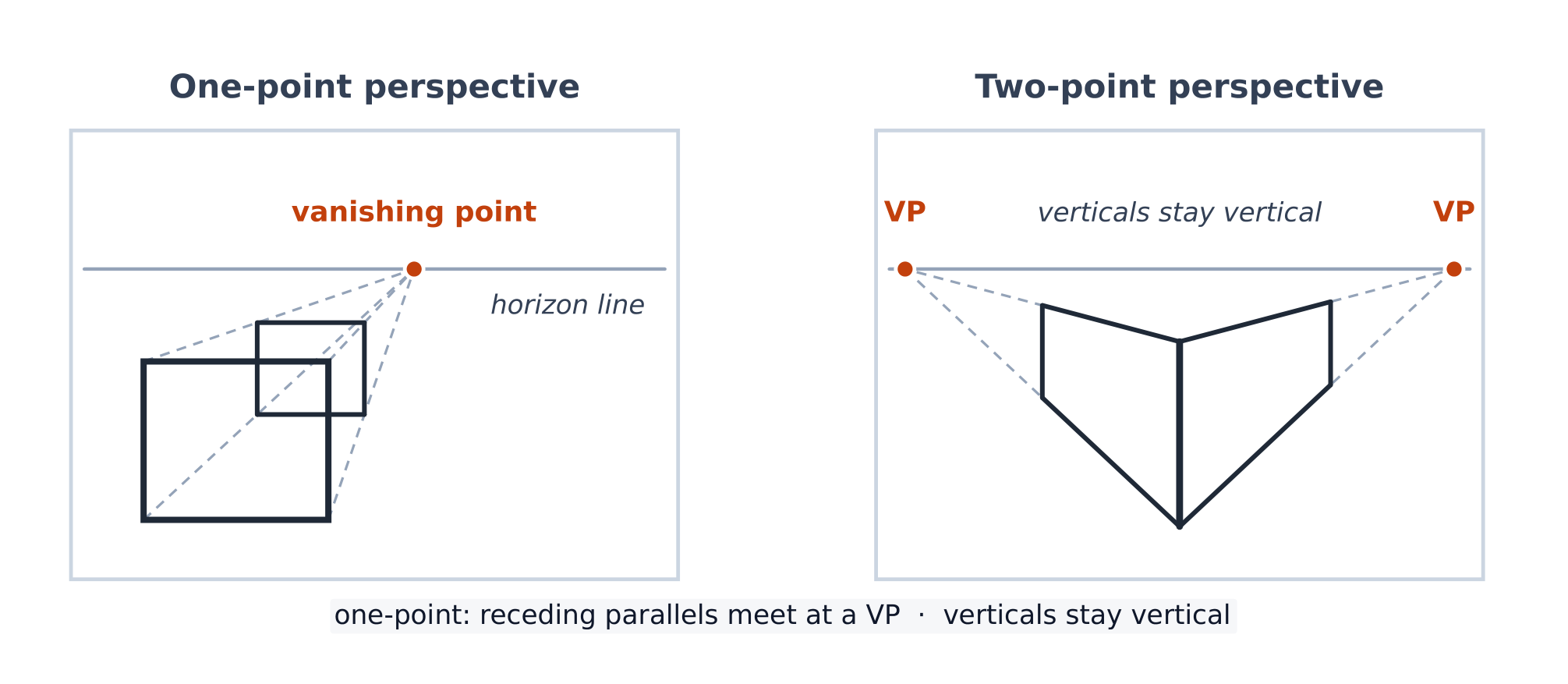
    线性透视(linear perspective)把画面当成一扇窗。在一点透视里,所有进入纵深的线都汇聚到一个点。

    一条笔直的沙漠公路径直伸向地平线,两边的边缘收窄到一个点
    一条笔直的沙漠公路:它的两条边缘看起来在地平线上汇聚到一个消失点,正是绘画为表现纵深而重现的一点透视
    一点透视与两点透视:视平线、灭点与汇聚的边线
    左:一点透视——纵深线汇聚到一个灭点。右:两点透视——每组边线汇聚到各自的灭点
    • 视平线(horizon line)是观察者眼睛的高度。低于它的东西我们俯视,高于它的我们仰视。
    • 与画面平行的线保持原样;进入场景的线汇聚到灭点(vanishing point)。
    • 相等的间距越远看起来越小。用对角线来均分后退的空间。
    • 一点透视(one-point perspective)适合正对着看的房间、街道和走廊。
    • 透视加上遮挡(overlap)等于双倍的纵深:近的边缘盖住远的边缘。
    词汇表 训练
    英文 中文 拼音
    linear perspective 线性透视 xiàn xìng tòu shì
    horizon line 视平线 shì píng xiàn
    vanishing point 灭点 miè diǎn
    one-point perspective 一点透视 yì diǎn tòu shì
    overlap 遮挡 zhē dǎng
    3.3

    两点与三点透视

    大纲

    Focus: Turn the subject at an angle and you need two vanishing points; look steeply up or down and you need a third.

    • In two-point, verticals stay vertical; both sets of horizontal edges converge to left and right points on the horizon.
    • Keep both vanishing points far apart (often off the paper) — close points create fisheye distortion.
    • Three-point adds a vertical vanishing point: skyscrapers from below (looking up) or street scenes from a rooftop (looking down).
    • Boxes drawn in perspective become the scaffolding for everything: buildings, books, vehicles, even heads.
    • Cast shadows and reflections follow the same perspective system as the objects that make them.
    • A perspective grid underdrawing keeps complex scenes consistent — construct lightly, render on top.

    来源:美国大学理事会 AP 课程与考试说明

    两点透视

    把对象转一个角度,就需要两点透视(two-point perspective);抬头仰视或低头俯视很陡时,还需要第三个点。

    • 两点透视里竖线仍然竖直;两组水平边线分别汇聚到视平线上的左右两个灭点。
    • 让两个灭点离得远——常常在纸外。灭点太近会产生鱼眼式的变形。
    • 三点透视(three-point perspective)增加一个竖直方向的灭点:从下面仰视摩天楼,或从屋顶俯视街道。
    • 透视中的方块是一切的脚手架:建筑、书本、车辆,甚至头部。
    • 投影和倒影遵守和物体本身相同的透视系统。
    词汇表 训练
    英文 中文 拼音
    two-point perspective 两点透视 liǎng diǎn tòu shì
    three-point perspective 三点透视 sān diǎn tòu shì
    3.4

    透视缩短

    大纲

    Focus: Foreshortening is perspective applied to a single form pointing toward you — lengths compress dramatically.

    • A pointing arm may appear one-third of its true length: draw the apparent shape, not the known one.
    • Overlap is the key signal: the hand overlaps the forearm, the forearm overlaps the upper arm.
    • Think in cross-sections: imagine rings around the form (like a wireframe) to feel how it turns toward you.
    • Measure foreshortened lengths by sighting — knowledge lies, observation tells the truth.
    • Classic practice: draw a figure lying down feet-first (like Mantegna's Dead Christ).
    • Strong foreshortening is high-difficulty visual evidence — examiners recognise the skill immediately.

    来源:美国大学理事会 AP 课程与考试说明

    透视缩短(foreshortening)是透视作用在一个指向你的形体上——长度被急剧压缩。

    • 一条指向你的手臂可能只显出真实长度的三分之一。画看到的形状,不是你知道的长度。
    • 遮挡是关键信号:手盖住前臂,前臂盖住上臂。
    • 横截面(cross-sections)思考:想象套在形体上的一圈圈环,像线框模型,感受它如何转向你。
    • 用目测去量被缩短的长度——记忆会说谎,观察才说真话。
    • 经典练习:从脚的方向画一个躺着的人,像曼特尼亚的《哀悼基督》。
    词汇表 训练
    英文 中文 拼音
    foreshortening 透视缩短 tòu shì suō duǎn
    cross-sections 横截面 héng jié miàn
    3.5

    空气透视

    大纲

    Focus: Atmospheric (aerial) perspective creates depth without lines: distant things are lighter, cooler, softer, and less detailed.

    • Air scatters light, so contrast fades with distance — the far mountain is a pale flat shape.
    • Foreground: darkest darks, sharpest edges, most texture; background: narrow value range, soft edges.
    • Reserve full black and full white for the foreground; the distance lives in the middle greys.
    • Detail density is a depth cue by itself — render the near leaf, suggest the far tree.
    • Combine linear and atmospheric perspective for maximum depth in landscape and cityscape drawing.
    • This is the AP skill space made visible through light and shade — two rubric skills in one device.

    来源:美国大学理事会 AP 课程与考试说明

    空气透视

    空气透视(atmospheric perspective)不用任何线条就能制造纵深:远处的东西更浅、更冷、更柔、更少细节。

    • 空气散射光线,所以对比随距离减弱。远山是一块浅淡的平面形。
    • 前景:最深的深色、最锐的边缘、最多的质感。背景:狭窄的明度范围和柔软的边缘。
    • 把纯黑和纯白留给前景;远处活在中间的灰色里。
    • 细节的密度本身就是纵深线索:近处的叶子刻画,远处的树只作暗示。
    • 在风景素描里把线性透视和空气透视结合起来,纵深感最强。
    Layered mountain ridges fade with distance: atmospheric perspective cools and lightens far forms
    Layered mountain ridges fade with distance: atmospheric perspective cools and lightens far forms
    探索

    Which depth cue is at work?

    Drawings create depth several ways at once: linear perspective (lines converge), atmospheric perspective (distance fades and softens), overlap (near covers far), and foreshortening (forms compress toward you).

    词汇表 训练
    英文 中文 拼音
    atmospheric perspective 空气透视 kōng qì tòu shì
    3.6

    构图与画面

    大纲

    Focus: Composition — how everything is arranged inside the picture's edges — is a named AP drawing skill and the first thing a scorer sees.

    • The picture plane has edges: what you crop out is as expressive as what you keep in.
    • The rule of thirds places focal points on the third-lines — safer than dead centre.
    • Control the figure-ground relationship: negative space is a designed shape, not leftover paper.
    • Lead the eye with paths: lines, value contrast, and detail act as arrows toward the focal point.
    • Vary the viewpoint — eye level is neutral; a low or high viewpoint makes an ordinary subject fresh.
    • Test compositions with a viewfinder or phone camera crop before committing to the page.

    来源:美国大学理事会 AP 课程与考试说明

    构图(composition)——画面边框内一切事物的安排——是AP点名的绘画技能,也是评卷人第一眼看到的东西。

    • 画面(picture plane)有边缘:你裁掉什么和你留下什么同样有表现力。
    • 三分法(rule of thirds)把视觉焦点放在三分线上——比放在正中央更有力。
    • 设计负空间(negative space):主体周围的空形是你画出来的形,不是剩下的空白。
    • 图底关系(figure-ground relationship)必须清楚:眼睛要始终分得清什么是主体、什么是背景。
    • 用路径引导视线——线条、明度对比和细节都是指向焦点的箭头。
    • 动笔前用取景框(viewfinder)(或手机相机)试裁三种构图。改变视点(viewpoint):平视是中性的;低角度或高角度让平凡的对象变新鲜。
    词汇表 训练
    英文 中文 拼音
    composition 构图 gòu tú
    picture plane 画面 huà miàn
    rule of thirds 三分法 sān fēn fǎ
    negative space 负空间 fù kōng jiān
    figure-ground relationship 图底关系 tú dǐ guān xì
    viewfinder 取景框 qǔ jǐng kuāng
    viewpoint 视点 shì diǎn
    3.7

    人体与肖像素描

    大纲

    Focus: The figure combines every drawing skill at once — proportion, gesture, form, and likeness under one deadline.

    • The classic adult figure stands about 7.5 heads tall; the halfway point is near the hip, not the waist.
    • In the head, eyes sit at the halfway line of the skull — the beginner error is placing them too high.
    • Start with gesture and the big masses (ribcage, pelvis, skull); features and fingers come last.
    • Sight-size checks save likeness: compare distances between landmarks, not memorised rules alone.
    • Hands and feet earn their reputation — draw them as simple geometric mittens/wedges first, then divide.
    • Figure and portrait work is a portfolio staple: it demonstrates observation, proportion, and nerve.

    来源:美国大学理事会 AP 课程与考试说明

    人体把所有绘画技能集中在一起:比例(proportion)、动态、形体,还有在同一个期限内的相似度。

    人体与头部比例:站立人体约7.5个头高;眼睛位于头骨的中线
    经典成年人体约7.5个头高;在头部,眼睛位于中线上
    • 经典的成年人体约7.5个头高;身体的中点在髋部附近,不在腰部。
    • 在头部,眼睛位于头骨的中线(halfway line)上——初学者总是画得太高。
    • 从动态和大块体量(胸腔、骨盆、头骨)开始;五官和手指最后画。
    • 用参照点之间的距离检查相似度,不要只靠背下来的规则——每张脸都会偏离平均值。
    • 先把手和脚画成简单的几何"手套"和"楔子",再往里细分。
    词汇表 训练
    英文 中文 拼音
    proportion 比例 bǐ lì
    halfway line 中线 zhōng xiàn
    3.7

    考试技巧

    • 透视错误是评卷人最容易发现的错误——刻画之前,检查每条纵深线是否真的指向它的灭点。
    • 在作品集里放一个扎实的写生空间(室内、楼梯间、街道):它毫无疑义地展示评分标准点名的空间技能。
    • **透视缩短是高价值证据。**一条画得可信的缩短的手臂或物体,告诉评卷人你画的是看到的,不是记住的。
    • **像设计师一样裁切。**动笔前测试三种取景裁切,选负空间最强的那个——构图在第一眼就被评判。
    • 石墨里也要用空气透视,不只是颜料:用可塑橡皮把远处边缘擦软,又快又显功力。
  • 4

    绘画媒介与创作过程

    讲义 词汇表
    4.1

    石墨铅笔

    大纲

    Focus: Graphite is the everyday drawing medium — precise, erasable, and capable of a full (if silvery) value range.

    • Grades run hard to soft: 9H (palest, hardest) through HB to 9B (darkest, softest).
    • Hard grades suit construction lines and fine detail; soft grades build rich darks fast.
    • Graphite gets shiny when layered heavily — deepest blacks may need charcoal or carbon pencil instead.
    • Vary the grip: writing grip for detail, overhand grip for broad, light shading from the arm.
    • Woodless graphite sticks and powder cover big areas; erasers then carve lights back out.
    • A full-value graphite still life is the classic control test — worth one polished example in any portfolio.

    来源:美国大学理事会 AP 课程与考试说明

    石墨(graphite)是最日常的绘画媒介——精确、可擦除,并且能画出完整(虽然偏银灰)的明度范围。

    从硬2H到软8B的铅笔硬度,以及每一级能达到的明度
    铅笔硬度:硬铅浅而精确;软铅很快达到浓重的深色
    • 铅笔硬度等级(grades)从硬到软:9H(最浅、最硬)经过HB到9B(最深、最软)。
    • 硬铅适合起稿线和精细细节;软铅能快速建立浓重的深色。
    • 石墨画重了会反光。要最深的黑,改用木炭或炭笔(carbon pencil)。
    • 变换握笔:写字握法画细节,横握(overhand grip)用手臂做大面积的轻扫排线。
    • 全石墨棒和石墨粉铺大面积;再用橡皮把亮部"刻"回来。
    • 一张完整明度的石墨静物是经典的控制力测试——任何作品集里都值得放一张精修的。
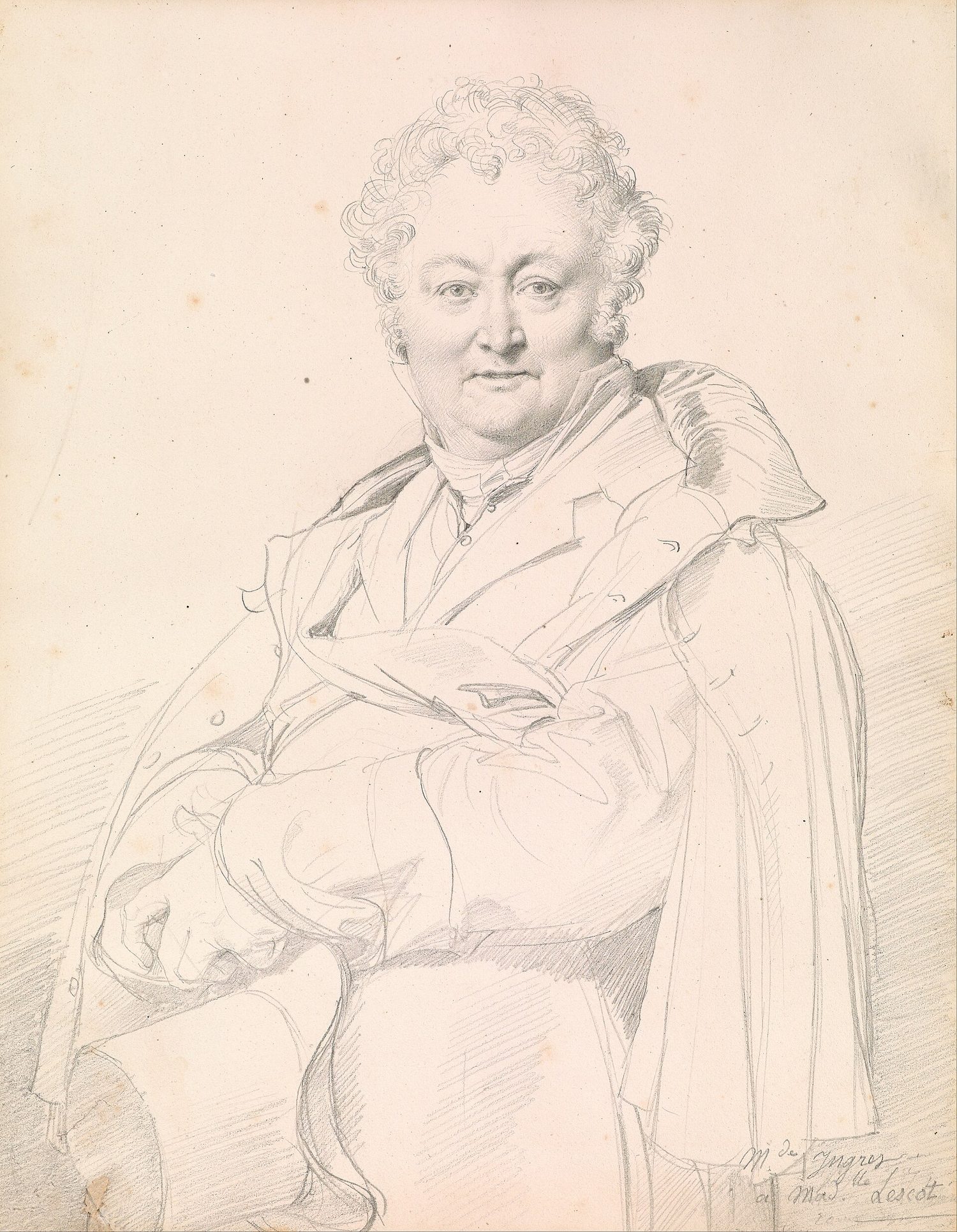
    Ingres's graphite portrait: precise hard-grade line and controlled value describe form cleanly
    Ingres's graphite portrait: precise hard-grade line and controlled value describe form cleanly
    词汇表 训练
    英文 中文 拼音
    graphite 石墨 shí mò
    grades 硬度等级 yìng dù děng jí
    carbon pencil 炭笔 tàn bǐ
    overhand grip 横握 héng wò
    4.2

    木炭与炭精条

    大纲

    Focus: Charcoal is fast, bold, and deeply black — the medium of gesture, chiaroscuro, and large-scale drawing.

    • Vine/willow charcoal is soft and dusts off easily (great for starts); compressed charcoal is dense and permanent.
    • Charcoal loves toned and textured paper; it blends with stumps, cloth, and the side of the hand.
    • Conté crayons (sanguine, sepia, black, white) are waxier — crisper lines, classic figure-drawing look.
    • Work big: charcoal rewards shoulder-scale marks that graphite cannot make.
    • Fixative stops smudging — spray lightly in layers, and always in ventilation.
    • The trio of white conté + sanguine + black on toned paper (trois crayons) is a proven portfolio look.

    来源:美国大学理事会 AP 课程与考试说明

    木炭(charcoal)快速、大胆、黑得深沉——是动态速写、明暗对照法和大尺幅素描的媒介。

    • 柳条木炭(vine charcoal)软、容易掸掉,适合起稿;压缩木炭(compressed charcoal)致密、持久。
    • 木炭喜欢有色和有纹理的纸。用擦笔、布或手的侧面揉擦。
    • 炭精条(conté)(血红、深褐、黑、白)更蜡质:线条更利落,是经典人体素描的样子。
    • 画大一点——木炭奖励肩膀尺度的笔触,这是石墨做不到的。
    • 定画液(fixative)防止蹭花。薄喷、分层,并保持通风。
    • 白色炭精条加血色红棕(sanguine)加黑色画在有色纸上(即三色粉笔画法)是久经考验的作品集经典。
    A charcoal still-life sketch: soft media build broad value shapes before detail
    A charcoal still-life sketch: soft media build broad value shapes before detail
    探索

    Which medium behaves like this?

    Each drawing medium has a personality: graphite is precise and silvery, charcoal is fast and deeply black, ink commits without erasing, and pastel is almost pure pigment.

    词汇表 训练
    英文 中文 拼音
    charcoal 木炭 mù tàn
    vine charcoal 柳条木炭 liǔ tiáo mù tàn
    compressed charcoal 压缩木炭 yā suō mù tàn
    conté 炭精条 tàn jīng tiáo
    fixative 定画液 dìng huà yè
    sanguine 血色红棕 xuè sè hóng zōng
    4.3

    墨水:钢笔、毛笔与淡彩

    大纲

    Focus: Ink commits — no erasing — which is exactly why it builds decisiveness and mark confidence.

    • Dip pens and fineliners build value by hatching and stippling; nib pressure varies the line's weight.
    • Brush and ink swings from hairline to broad stroke in one gesture — the most expressive line tool.
    • Ink wash (diluted ink applied in layers) works like watercolour: light washes first, darks last.
    • Combine a waterproof line with wet washes, or a water-soluble line that bleeds — two different looks.
    • East Asian ink painting (shuǐmò) treats the single loaded brushstroke as the whole discipline.
    • Mistakes become decisions in ink: incorporate them or design around them — strong process-journal material.

    来源:美国大学理事会 AP 课程与考试说明

    墨水(ink)落笔无悔——没有擦除——正因如此,它训练果断和笔触自信。

    • 蘸水笔和针管笔靠排线和点画建立明度;笔尖(nib)的压力改变线条的粗细。
    • 毛笔墨线(brush and ink)一笔之内从发丝般细到阔笔——最有表现力的线条工具。
    • 淡彩(ink wash)(稀释的墨水分层涂)像水彩一样用:先浅后深。
    • 防水的线条在湿润的淡彩下保持边缘;水溶的线条会晕开——两种效果,都有用。
    • 东亚水墨画(ink painting)把一笔蘸墨的运笔当作一整门控制的学问。
    • 在墨水里,失误变成决定:把它纳入画面或围绕它设计——这是创作过程日志的好素材。
    Rembrandt pen and brown ink with wash: committed line and layered tone without eraser
    Rembrandt pen and brown ink with wash: committed line and layered tone without eraser
    词汇表 训练
    英文 中文 拼音
    ink 墨水 mò shuǐ
    nib 笔尖 bǐ jiān
    brush and ink 毛笔墨线 máo bǐ mò xiàn
    ink wash 淡彩 dàn cǎi
    ink painting 水墨画 shuǐ mò huà
    painting 绘画 huì huà
    4.4

    彩色铅笔与色粉

    大纲

    Focus: Colour enters drawing through dry colour media — layered, optical, and fully allowed in the AP Drawing portfolio.

    • Colored pencil builds colour in transparent layers; burnishing (heavy final layer) fuses them glossy and solid.
    • Layer complements to grey a colour down instead of reaching for black — shadows stay alive.
    • Soft pastel is pure pigment: paint-like colour with drawing gestures, blended or left in strokes.
    • Oil pastel is creamy and resists smudging; it layers into sgraffito (scratch-through) effects.
    • Toned paper unifies pastel work — let the ground colour breathe between strokes.
    • Value still rules: get the values right and almost any hue choice works; get them wrong and no hue can save it.

    来源:美国大学理事会 AP 课程与考试说明

    色彩通过干性彩色媒介(dry colour media)进入素描——层叠、透亮,并且完全允许出现在AP绘画作品集里。

    • 彩色铅笔(colored pencil)以透明的层建立颜色;压光(burnishing)(最后重压的一层)把各层熔成光滑坚实的表面。
    • 要把颜色压灰,就叠加它的互补色(complement),而不是伸手拿黑色——阴影会保持鲜活。
    • 软色粉(soft pastel)几乎是纯颜料:用素描的手势涂出颜料般的色彩,可以揉合也可以保留笔触。
    • 油画棒(oil pastel)细腻黏稠、不易蹭花;层叠后可以刮出底层——刮画法(sgraffito)。
    • 有色纸统一色粉作品:让底色在笔触之间呼吸。
    • 明度仍然是王。明度对了,几乎任何色相都行;明度错了,任何色相都救不了这张画。
    Degas pastel: soft colour media build light and form with drawing gestures
    Degas pastel: soft colour media build light and form with drawing gestures
    词汇表 训练
    英文 中文 拼音
    dry colour media 干性彩色媒介 gàn xìng cǎi sè méi jiè
    colored pencil 彩色铅笔 cǎi sè qiān bǐ
    burnishing 压光 yā guāng
    complement 互补色 hù bǔ sè
    soft pastel 软色粉 ruǎn sè fěn
    oil pastel 油画棒 yóu huà bàng
    sgraffito 刮画法 guā huà fǎ
    4.5

    绘画与版画中的素描

    大纲

    Focus: The AP Drawing portfolio welcomes painting and printmaking — when mark-making and drawing skills lead the work.

    • Monochrome painting (oil, acrylic, watercolour grisaille) is drawing with a brush: value, edge, and gesture.
    • Watercolour over a drawn line keeps the drawing visible — line carries structure, wash carries light.
    • Monotype (paint on a plate, printed once) gives painterly, unrepeatable drawing marks.
    • Relief and intaglio prints (linocut, drypoint, etching) are mark-making systems: every value is built from cut or scratched lines.
    • Choose the process because it serves your inquiry — then say so in the written evidence.
    • If the work's visual language is line, tone, and mark, it belongs in Drawing; if it is colour-shape design, 2-D may fit better.

    来源:美国大学理事会 AP 课程与考试说明

    AP绘画作品集欢迎绘画(painting)和版画——只要笔触和绘画技能主导作品。

    • 单色画(油画、丙烯或水彩的灰调单色画(grisaille))就是用笔刷做素描:明度、边缘和笔势。
    • 在画好的线条上罩水彩,素描仍然可见——线条承担结构,水色承担光。
    • 独幅版画(monotype)(颜料涂在版上,只印一次)给出画意的、不可重复的笔触。
    • 凸版画(relief prints)(麻胶版)和凹版画(intaglio)(干刻、蚀刻)是笔触系统:每一块明度都由刻出或刮出的线组成。
    • 因为过程服务于你的探究而选择它——然后在书面材料里说清楚。
    • 如果作品的视觉语言是线条、色调和笔触,它属于绘画作品集;如果是色彩与形状的设计,二维作品集更合适。
    Rembrandt etching: printmaking as drawing — every value built from scratched lines
    Rembrandt etching: printmaking as drawing — every value built from scratched lines
    词汇表 训练
    英文 中文 拼音
    grisaille 灰调单色画 huī diào dān sè huà
    monotype 独幅版画 dú fú bǎn huà
    relief prints 凸版画 tū bǎn huà
    intaglio 凹版画 āo bǎn huà
    4.6

    综合媒介与实验性画面

    大纲

    Focus: Combining media and preparing your own grounds turns the surface itself into a drawing decision.

    • Classic pairs: ink line over wash, charcoal over acrylic ground, pastel over watercolour, collage under drawing.
    • Resists (wax, masking fluid) protect lights; gesso grounds let wet media sit on almost any support.
    • Draw on non-white supports: kraft paper, book pages, maps, fabric — the ground becomes part of the meaning.
    • Test combinations on scraps first and glue the tests into the journal — perfect experimentation evidence.
    • Layering must stay archival enough to photograph well — heavy buildup can glare under lights.
    • The CED's synthesis of materials, processes, and ideas (CED 2.B) is exactly this: media choices that embody the idea.

    来源:美国大学理事会 AP 课程与考试说明

    组合媒介、自制底料,让画面本身成为一个绘画决定。

    绘画媒介地图:横轴从干到湿,纵轴从线条主导到色调主导
    各种媒介住在哪里:干到湿、线条主导到色调主导——综合媒介把地图的不同角落连起来
    • 经典组合:墨线罩淡彩、丙烯底上画木炭、水彩上画色粉、拼贴底上作画。
    • 防染法(resist)(蜡、留白胶)保护亮部;石膏底料(gesso)让湿媒介能附着在几乎任何基底上。
    • 在非白色基底上画:牛皮纸、旧书页、地图、织物——底子成为意义的一部分。
    • 先在废纸上测试组合,再把测试贴进日志——完美的实验证据。
    • 让层叠稳定、易于拍摄:厚重发亮的堆积在灯光下会眩光。
    • CED所说的材料、过程与想法的综合(synthesis)正是这件事:让媒介选择本身承载想法。
    词汇表 训练
    英文 中文 拼音
    resist 防染法 fáng rǎn fǎ
    gesso 石膏底料 shí gāo dǐ liào
    synthesis 综合 zōng hé
    4.7

    速写本与日常练习

    大纲

    Focus: The sketchbook is the engine of the course: daily low-pressure drawing compounds into skill and into portfolio evidence.

    • Short daily sessions beat rare marathons — 20 focused minutes a day transforms a year.
    • Fill pages with studies: hands, cups, corners of rooms, copies of master drawings, colour tests.
    • Date pages and add one-line notes — a dated sketchbook is documentation of growth over time.
    • Master copies (Dürer, Rubens, Kollwitz, Hokusai) teach mark systems from the inside; label them as studies.
    • Photograph strong sketchbook spreads properly: process images are legitimate Sustained Investigation images.
    • Treat some pages as experiments you expect to fail — the CED rewards visible practice, experimentation, and revision.

    来源:美国大学理事会 AP 课程与考试说明

    速写本(sketchbook)是这门课的发动机:每天低压力的绘画,日积月累变成技能——也变成作品集证据。

    • 每天短练胜过偶尔的马拉松。每天二十分钟的专注,能改变一整年。
    • 用研究填满页面:手、杯子、房间的角落、颜色测试,以及大师素描的临本。
    • 每页写日期、加一行笔记——一本有日期的速写本就是成长过程的记录。
    • 临摹(master copy)(丢勒、鲁本斯、珂勒惠支、葛饰北斋)从内部教你一个笔触系统;清楚地标注它是研究。
    • 好好拍摄精彩的速写本跨页:过程图像是持续探究里合法的图像。
    • 把一些页面当作预期会失败的实验——CED奖励看得见的练习(practice)、实验与修改。
    词汇表 训练
    英文 中文 拼音
    sketchbook 速写本 sù xiě běn
    master copy 临摹 lín mó
    practice 练习 liàn xí
    4.7

    考试技巧

    • 在书面材料里精确命名材料——"有色纸上的压缩木炭与白色炭精条"读起来是行家;"铅笔什么的"读起来是敷衍。
    • 作品集里至少展示两个媒介家族(例如石墨加淡彩):材料控制的广度是省力、直观的证据。
    • 值得放一件墨水作品——这种媒介无法擦除的诚实,展示评卷人一眼就认得的果断。
    • **拍照前先喷定画液。**一道蹭花的痕迹毁掉完成度的印象,太不值了。
    • 速写本跨页作为过程图像非常上镜——选那些展示测试和笔记的跨页,而不只是完成的小画。
  • 5

    探究:探问与艺术创作过程

    讲义 词汇表
    5.1

    探问与提出问题

    大纲

    Focus: Inquiry is the intentional process of questioning that guides exploration and discovery over time. (CED Big Idea 1)

    • A workable inquiry is open, personal, and visual — answerable through drawing, not through a paragraph.
    • 'How can line weight express my grandmother's hands aging?' beats 'I will draw hands.'
    • Strong questions generate the next drawing: each work answers a little and asks a little more.
    • Test a question by listing ten works it could produce — fewer than five means it is too narrow.
    • Questions may evolve mid-investigation; document the turn in your journal and written evidence.
    • The Sustained Investigation is scored on how clearly works relate to and develop the stated inquiry.

    来源:美国大学理事会 AP 课程与考试说明

    探究(inquiry)是有意图的提问过程,引导长时间的探索与发现——这是CED大观念1的发动机。

    探究循环:提问、探索、创作、反思,再提问
    探究是一个循环:每张画回答一点,又提出一点新问题
    • 可行的探究问题是开放的、个人的、视觉的——要能通过画来回答,而不是通过一段文字。
    • "线条的轻重如何表达祖母双手的衰老?"胜过"我要画手"。
    • 强的问题会生出下一张画:每件作品回答一点,又提出一点。
    • 测试一个问题:列出它能产生的十件作品。少于五件说明太窄了。
    • 问题可以在探究中途演变——在日志和书面材料里记下这个转折。
    • 持续探究(Sustained Investigation)的评分标准是:作品与所陈述的探究之间的关联和推进有多清楚。
    探索

    Workable inquiry, or not yet?

    A workable inquiry is open, personal, and answerable through drawing itself. Questions that are closed, borrowed, or non-visual stall an investigation.

    词汇表 训练
    英文 中文 拼音
    inquiry 探究 tàn jiū
    Sustained Investigation 持续探究 chí xù tàn jiū
    5.2

    想法与经验的来源

    大纲

    Focus: Artists' experiences — surroundings, memory, culture, research — inform why, how, and what they draw. (CED 1.A)

    • Ideas come from direct observation, personal history, other disciplines, and other artists' work.
    • Document experiences as they happen: photos, thumbnail sketches, notes, collected objects.
    • Ordinary subjects carry authority — the kitchen table you know beats a fantasy castle you don't.
    • Research feeds drawing: anatomy pages, historical costume, botanical structure all sharpen observation.
    • Cultural sources (calligraphy, textiles, architecture) bring personal context into mark and composition choices.
    • Keep a source wall or folder; when momentum dips, the collected material restarts it.

    来源:美国大学理事会 AP 课程与考试说明

    艺术家的经验(experiences)——环境、记忆、文化、研究——决定了为什么画、怎么画、画什么。(CED 1.A)

    • 想法来自直接的观察(observation)、个人经历、其他学科,以及其他艺术家的作品。
    • 经验发生时就把它记录下来:照片、小构图、笔记、收集的物件。
    • 平凡的对象自带说服力:你熟悉的餐桌胜过你不了解的奇幻城堡。
    • 研究滋养绘画——解剖图、历史服饰、植物结构都会磨利观察。
    • 文化来源(书法、织物、建筑)把个人语境带进笔触和构图的选择。
    • 建一面素材墙或一个素材夹;动力下降时,收集的材料会重新点燃它。
    词汇表 训练
    英文 中文 拼音
    experiences 经验 jīng yàn
    observation 观察 guān chá
    5.3

    材料、过程与想法

    大纲

    Focus: The CED's three working components: materials (substances), processes (actions), ideas (concepts) — drawings happen where they meet.

    • Every work is a decision triangle: what it is made of, how it is made, why it is made.
    • Let one corner lead: an idea can demand a material (rust drawings about decay) or a material can spark an idea.
    • Change one component at a time to see its effect — the fair-test habit works in the studio too.
    • Name all three in written evidence: scorers look for the connection explicitly.
    • Charcoal-on-torn-paper and fineliner-on-mylar are different statements, not just different looks.
    • This triad vocabulary comes straight from the CED glossary — use the exact words in your writing.

    来源:美国大学理事会 AP 课程与考试说明

    CED点名三个工作要素:材料(materials)(物质)、过程(processes)(行动)和想法(ideas)(概念)。画就发生在三者相遇的地方。

    • 每件作品都是一个决定三角:用什么做、怎么做、为什么做。
    • 让一个角领头。想法可以要求某种材料(关于腐朽的铁锈画),材料也可以激发想法。
    • 一次只改一个要素,看它的效果——公平实验的习惯在画室里同样适用。
    • 在书面材料里把三者都点名:评卷人会明确寻找这种关联。
    • 撕裂纸上的木炭和光滑胶片上的针管笔是两种不同的表达,不只是两种外观。
    • 这套词汇直接来自CED术语表——写作时用它的原词。
    词汇表 训练
    英文 中文 拼音
    materials 材料 cái liào
    processes 过程 guò chéng
    ideas 想法 xiǎng fǎ
    5.4

    语境中的素描

    大纲

    Focus: Drawings mean more when you know when, where, and why they were made — context is an investigation tool. (CED 1.C)

    • Study master drawings as working documents: Leonardo's studies, Dürer's engravings, Rembrandt's ink landscapes.
    • Every tradition has a drawing language — Chinese ink line, Persian miniature, Renaissance chiaroscuro, manga screen-tone.
    • Ask of any drawing: what was it for — study, record, plan, or finished statement?
    • Historical technique is free training: copying a hatching system teaches decisions no video can.
    • Place your own work in context: which artists share your question, and how is your answer different?
    • Contextual notes in the journal strengthen written evidence and show intellectual depth.

    来源:美国大学理事会 AP 课程与考试说明

    知道一张画是何时、何地、为何而画,它的意义就更丰富。语境(context)是探究的工具。(CED 1.C)

    • 大师素描(master drawings)当作工作文件来研究:达·芬奇的习作、丢勒的版画、伦勃朗的水墨风景。
    • 每个传统都有自己的绘画语言——中国的墨线、波斯细密画、文艺复兴的明暗、漫画的网点。
    • 面对任何一张画都问:它是为什么画的——习作、记录、草案,还是完成的陈述?
    • 历史技法是免费的训练:临一套排线系统,学到的决定是任何视频教不了的。
    • 把自己的作品放进语境:哪些艺术家和你共享同一个问题,你的回答有何不同?
    • 日志里的语境笔记会加强书面材料,显示思考的深度。
    Dürer's Melencolia I: historical engravings model mark-making and context
    Dürer's Melencolia I: historical engravings model mark-making and context
    词汇表 训练
    英文 中文 拼音
    context 语境 yǔ jìng
    master drawings 大师素描 dà shī sù miáo
    5.5

    评价素描作品

    大纲

    Focus: Critique — of your own and others' work — is how an investigation steers. (CED 1.D/1.E)

    • Describe → analyse → interpret → judge: the four-step critique keeps opinions grounded in evidence.
    • Use the AP language: point to visual evidence of skills, materials, processes, and ideas.
    • Self-critique with distance: turn the drawing upside down, view it in a mirror, or photograph it small.
    • Ask one focused question per critique ('does the focal point read?') instead of 'is it good?'
    • Written reflections after critiques become drafts of your Sustained Investigation writing.
    • Revision decisions born from critique are exactly the development the rubric wants to see.

    来源:美国大学理事会 AP 课程与考试说明

    评图(critique)——评自己和别人的作品——是探究转向的方式。(CED 1.D/1.E)

    • 用四步阶梯:描述、分析、解读、评判。它让观点扎根于看得见的东西。
    • 说AP的语言:指出技能、材料、过程和想法的视觉证据(visual evidence)。
    • 给自我评图制造距离:把画倒过来、照镜子看,或拍成小图看。
    • 每次评图问一个聚焦的问题("焦点读得出来吗?"),而不是"好不好?"
    • 评图后的书面反思会成为持续探究写作的草稿。
    • 由评图产生的修改(revision)决定,正是评分标准想看到的推进。
    Ingres portrait drawing: critique names visible visual evidence of line and tone
    Ingres portrait drawing: critique names visible visual evidence of line and tone
    词汇表 训练
    英文 中文 拼音
    critique 评图 píng tú
    visual evidence 视觉证据 shì jué zhèng jù
    revision 修改 xiū gǎi
    5.6

    记录与创作过程日志

    大纲

    Focus: Investigation must be visible: the process journal captures questions, tests, failures, and turns as they happen. (CED 1.B)

    • Document with anything quick: phone photos, taped-in tests, dated notes, thumbnail storyboards.
    • Record the why at decision points — two lines today saves reconstructing your thinking in April.
    • Photograph work-in-progress stages; a before/after revision pair is gold for the portfolio.
    • Keep material tests (paper swatches, media trials) physically in the journal with outcomes noted.
    • Process images may be submitted among the 15 Sustained Investigation images — label them clearly.
    • A true journal (not a decorated diary) is the difference between claiming inquiry and showing it.

    来源:美国大学理事会 AP 课程与考试说明

    探究必须看得见。记录(documentation)在问题、测试、失败和转折发生的当下把它们抓住。(CED 1.B)

    绘画想法的来源:观察、记忆、研究、文化、其他艺术家、其他学科
    六个可靠的来源滋养绘画实践——在同一本日志里向它们全部取材
    • 用最快的方式记录:手机照片、贴进本子的测试、注明日期的笔记、小构图分镜。
    • 在决定点写下为什么——今天的两行字,省掉四月里重构思路的痛苦。
    • 拍下作品的中间阶段;一对修改前后的照片是作品集的金子。
    • 把材料测试(纸样、媒介试验)实物贴进创作过程日志(process journal),写明结果。
    • 过程图像可以进入持续探究的15张图像——清楚地标注它们。
    • 真正的日志(不是装饰过的日记)是声称探究与展示探究的分水岭。
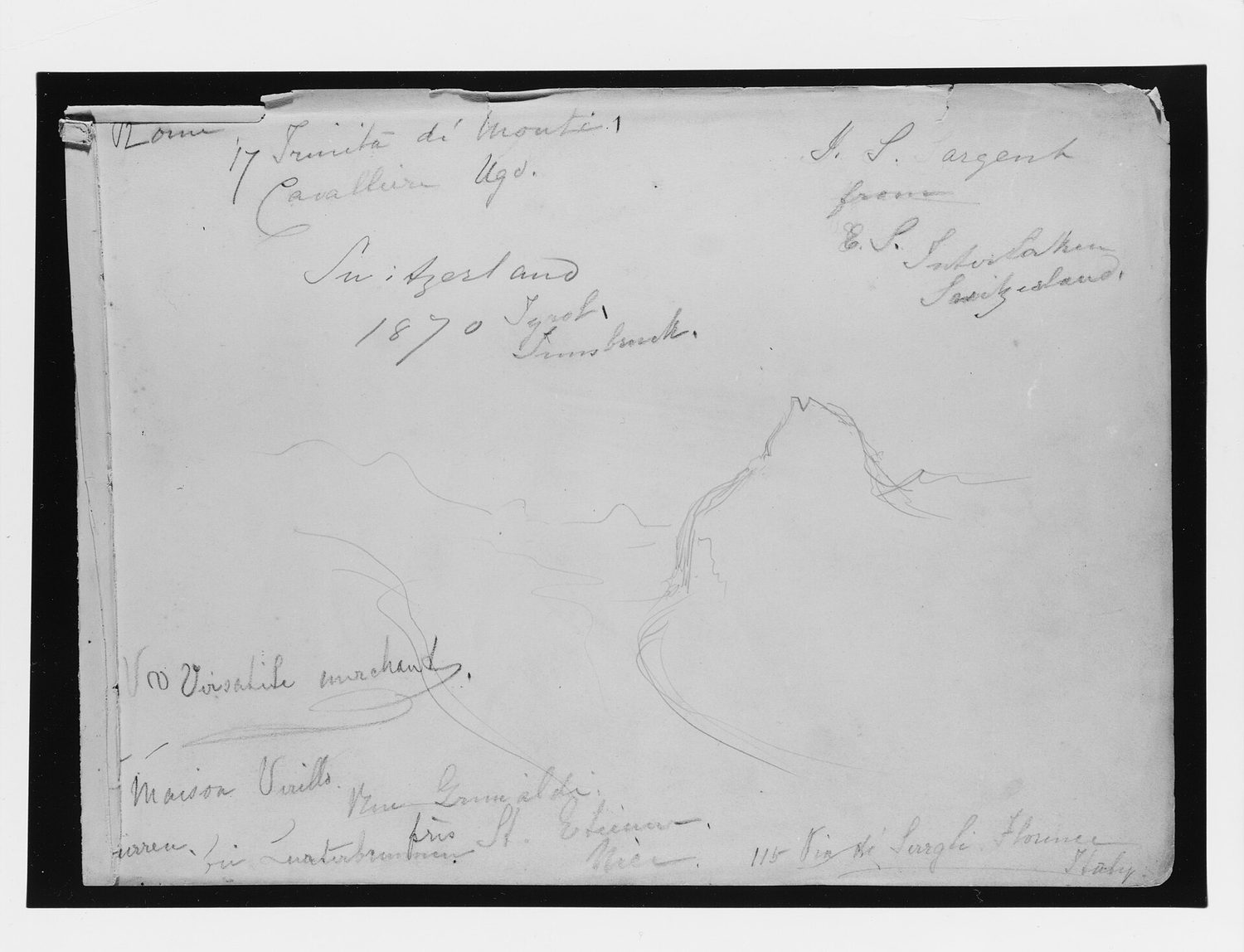
    An artist's sketchbook page: process journals record inquiry, sources, and small experiments
    An artist's sketchbook page: process journals record inquiry, sources, and small experiments
    词汇表 训练
    英文 中文 拼音
    documentation 记录 jì lù
    process journal 创作过程日志 chuàng zuò guò chéng rì zhì
    5.6

    考试技巧

    • 把探究问题写成一句清楚的话钉在桌前——持续探究的每一条评分行都在问作品与它的关系。
    • 评卷人必须看见探究:测试、失败的开头、修改前后对比是证据;一叠互不相关的完成稿不是。
    • 给一切注明日期。"随时间推进"是被评分的概念——有日期的日志页不用一个字就证明了推进。
    • 在书面材料里使用CED词汇(材料、过程、想法、实验、修改)——它把你的陈述瞬间连到评分标准上。
    • 随做随拍日志跨页,不要拖到四月:赶工补拍的过程记录,一眼就看得出来。
  • 6

    创作:实践、实验与修改

    讲义 词汇表
    6.1

    持续探究

    大纲

    Focus: The Sustained Investigation is an inquiry-based, in-depth study of materials, processes, and ideas over time. (CED Big Idea 2)

    • It is a body of work — around 15 images — that grows from one stated question or idea.
    • Sustained means over time: works should show development, not fifteen versions of the same day.
    • Plan a rhythm: make → document → reflect → revise → make again, every one or two weeks.
    • The investigation is drawings and process: studies, tests, and revisions belong in it.
    • Depth beats breadth — one question pushed hard scores above ten unrelated good drawings.
    • Start early in the year; a rushed investigation is visible at a glance.

    来源:美国大学理事会 AP 课程与考试说明

    持续探究(Sustained Investigation)是基于探究、随时间深入的材料、过程与想法研究——CED大观念2,占AP分数的60%。

    • 它是一个系列作品(body of work)——约15张图像——从一个明确陈述的问题或想法中生长出来。
    • 持续指的是随时间:作品要显示成长,而不是同一个下午的十五个版本。
    • 规划一个节奏:创作、记录、反思、修改、再创作——每一两周一轮。
    • 探究包括画过程:习作、测试与修改都属于它。
    • 深度胜过广度。把一个问题往深处推,得分高于十张互不相关的好画。
    • 学年一开始就动手。赶出来的探究一眼就看得出来。
    词汇表 训练
    英文 中文 拼音
    Sustained Investigation 持续探究 chí xù tàn jiū
    body of work 系列作品 xì liè zuò pǐn
    6.2

    实践、实验与修改

    大纲

    Focus: The CED's three engines of making: practice (repeat), experimentation (test), revision (modify and reimagine). (CED 2.A)

    • Practice repeats a skill until it is reliable — the tenth ellipse, the fiftieth hand.
    • Experimentation tests without needing success: new tool, new scale, new surface, new speed.
    • Revision returns to a work and changes it on purpose — crop, rework, redraw, or respond with a new version.
    • Show all three visibly across the portfolio: scorers must see them, not trust you.
    • Keep 'failed' experiments — annotated failures are stronger evidence than unexplained successes.
    • A revision pair (first state / revised state, with a sentence on what changed) is classic AP evidence.

    来源:美国大学理事会 AP 课程与考试说明

    CED点名创作的三个引擎:练习(practice)(重复)、实验(experimentation)(测试)和修改(revision)(调整与重想)。(CED 2.A)

    练习、实验与修改推动系列作品的产生
    创作的三个引擎:重复一项技能、测试新东西、回头修改
    • 练习重复一项技能直到可靠——第十个椭圆、第五十只手。
    • 实验测试而不要求成功:新工具、新尺幅、新表面、新速度。
    • 修改是有意回到一件作品并改变它:裁切、重画局部、重新画,或用新版本回应它。
    • 让三者在作品集里清晰可见——评卷人必须看见,不会只听你说。
    • 留下失败。一个写了批注的失败实验,比一个没有解释的成功更有说服力。
    • 一组修改前后对比(revision pair)(初版与修改版,加一句改了什么)是经典的AP证据。
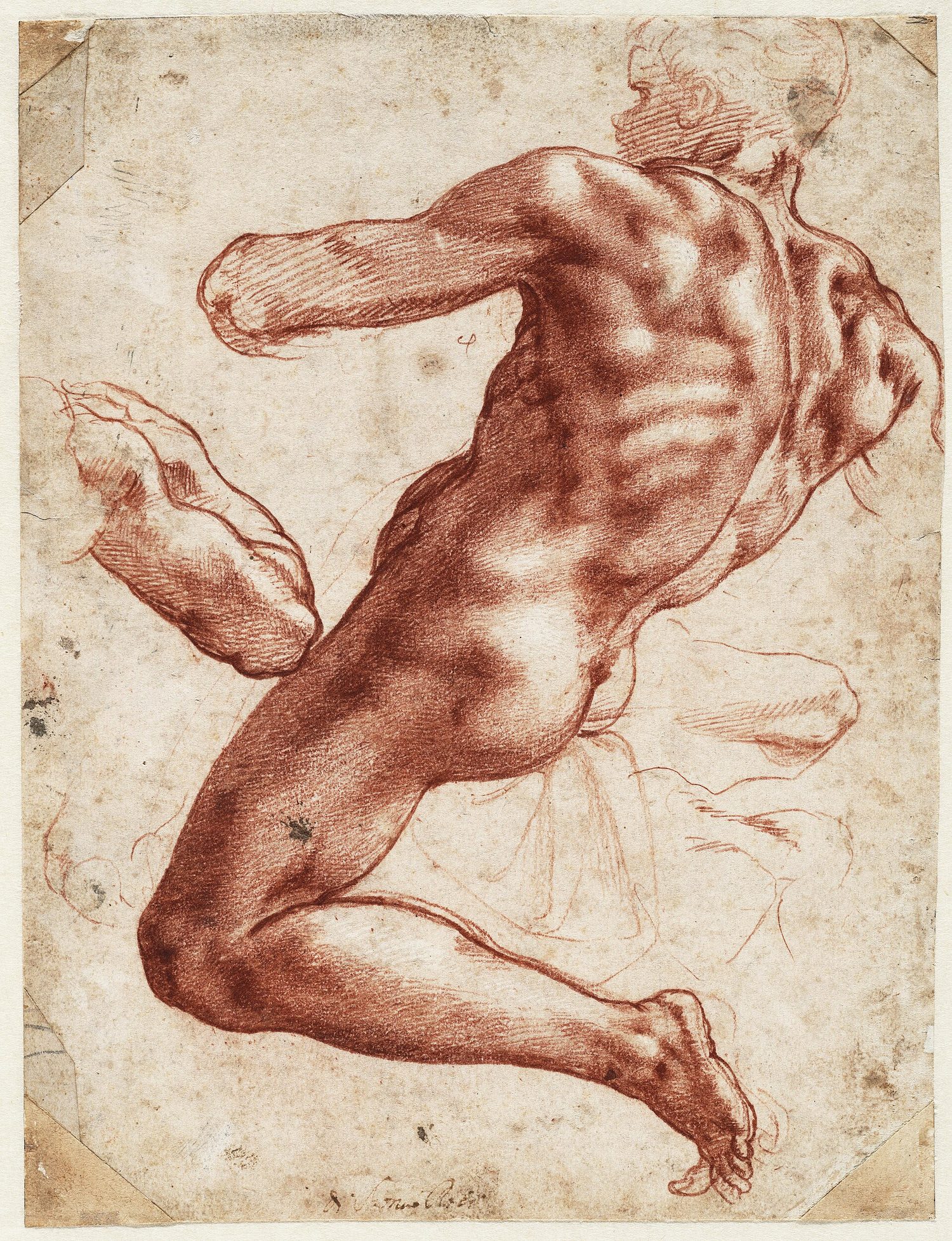
    Michelangelo's figure study: practice and revision build drawing skill through repeated investigation
    Michelangelo's figure study: practice and revision build drawing skill through repeated investigation
    探索

    Practice, experimentation, or revision?

    Practice repeats a skill until it is reliable, experimentation tests something new without needing success, and revision returns to a work and changes it on purpose. Scorers must see all three.

    词汇表 训练
    英文 中文 拼音
    practice 练习 liàn xí
    experimentation 实验 shí yàn
    revision 修改 xiū gǎi
    revision pair 修改前后对比 xiū gǎi qián hòu duì bǐ
    6.3

    材料、过程与想法的综合

    大纲

    Focus: Synthesis means the three components fuse — the material and process choices are the idea. (CED 2.B)

    • Ask of each work: could this idea exist in any other medium? If yes, the synthesis can go deeper.
    • Burnt-edge charcoal drawings about wildfire; thread-stitched portraits about family ties — material as meaning.
    • Process can carry meaning too: obsessive stippling for time, blind contour for memory's uncertainty.
    • Synthesis is the highest row of the Sustained Investigation rubric — the 5-score discriminator.
    • It cannot be added at the end: it comes from experimenting early with materials that relate to the idea.
    • One sentence of written evidence should be able to name the link: 'I used X because the idea needed Y.'

    来源:美国大学理事会 AP 课程与考试说明

    综合(synthesis)指三个要素熔合——材料与过程的选择就是想法本身。(CED 2.B)

    材料、过程与想法在中心熔合:综合
    当材料、过程和想法互相解释时,评分标准称之为综合
    • 对每件作品发问:这个想法能存在于任何别的媒介里吗?如果能,综合还可以更深。
    • 关于山火的、边缘烧焦的木炭画;关于亲情的、用线缝出来的肖像——材料即意义。
    • 过程也能承载意义:漫长的点画表现时间流逝,盲画轮廓表现记忆的不确定。
    • 综合是评分表的最高一行——是4分和5分的分水岭。
    • 它不能最后再加上。它来自一开始就用与想法相关的材料做实验。
    • 书面材料里要有一句能点破关联的话:"我用X,因为这个想法需要Y。"
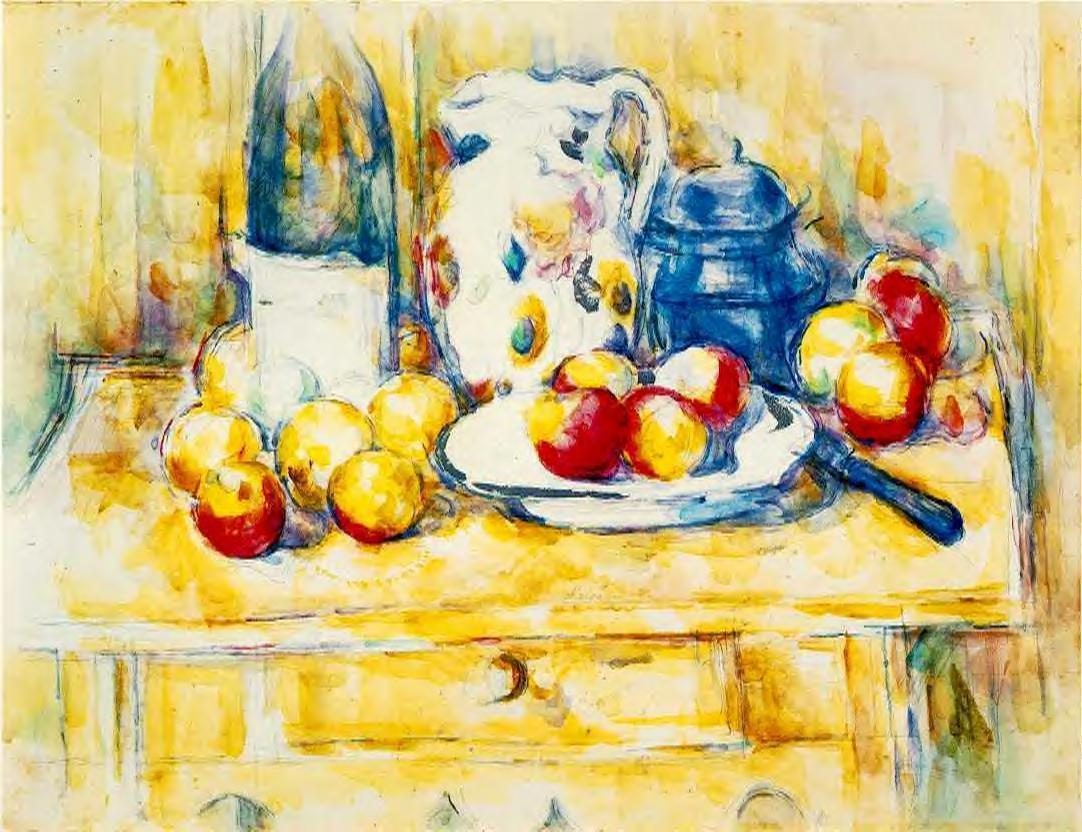
    Cézanne still life: materials, processes, and ideas synthesise in composition and mark
    Cézanne still life: materials, processes, and ideas synthesise in composition and mark
    词汇表 训练
    英文 中文 拼音
    synthesis 综合 zōng hé
    6.4

    展示绘画技能

    大纲

    Focus: The rubric's named drawing skills: mark-making, line, surface, space, light and shade, composition. (CED 2.C/2.D)

    • Audit your portfolio against the six skills — every one should appear strongly somewhere.
    • One work can carry several skills: a figure in a lit interior shows space, light and shade, and composition at once.
    • 'Good' scores need competent skills; '5' portfolios show advanced skills with visual evidence everywhere.
    • Skills must be visible in the image submitted — photograph well or the skill disappears.
    • Weak-skill areas are fixable with targeted practice blocks — see the craft topics of this course.
    • In written evidence, name skills with the CED's own words so scorers connect claim to image instantly.

    来源:美国大学理事会 AP 课程与考试说明

    评分标准点名这些绘画技能(drawing skills):笔触、线条、画面质感、空间、光影、构图。(CED 2.C/2.D)

    • 用这六项技能盘点你的作品集——每一项都应该在某处强烈出现。
    • 一件作品可以同时承载几项:光线中的室内人物同时展示空间、光影和构图。
    • "良好"的作品集展示合格的技能;5分展示高级技能,而且视觉证据(visual evidence)无处不在。
    • 技能只有在提交的图像里看得见才算数——拍不好,技能就消失了。
    • 弱项可以用针对性的练习块修补——这正是本课程前面几个技法主题的用处。
    • 在书面材料里用CED的原词命名技能,评卷人立刻把陈述连到图像上。
    Vitruvian Man: proportion and figure construction as foundational drawing skills
    Vitruvian Man: proportion and figure construction as foundational drawing skills
    词汇表 训练
    英文 中文 拼音
    drawing skills 绘画技能 huì huà jì néng
    visual evidence 视觉证据 shì jué zhèng jù
    6.5

    创作中的构图与工艺

    大纲

    Focus: Finished works are judged as made objects: composition designed, edges considered, surface controlled.

    • Plan with thumbnails and notan before committing — composition is decided before the first real mark.
    • Craft means physical care: clean margins where intended, controlled smudging, flat unwrinkled paper.
    • Damaged or dirty work photographs badly; protect drawings with cover sheets and fixative.
    • Consider scale as a decision: intimate A5 and commanding A1 are different statements of the same idea.
    • Unresolved corners betray hurry — finish or deliberately leave raw, and let the writing own the choice.
    • Craft is not fussiness: an expressive charcoal can be perfectly crafted expression.

    来源:美国大学理事会 AP 课程与考试说明

    完成的作品被当作制成品来评判:构图经过设计、边缘经过考虑、表面得到控制。

    • 动笔前用小稿(thumbnail sketches)和明暗构成做计划——构图在第一笔之前就已决定。
    • 工艺(craft)指物理上的用心:想要的干净边距、受控的揉擦、平整不起皱的纸。
    • 破损或脏污的作品拍出来很难看。用护页和定画液保护画面。
    • 尺度(scale)当作决定:亲密的A5和有气势的A1是同一个想法的两种陈述。
    • 没画完的角落暴露仓促。把它们画完——或者故意留生,并让文字说明这个选择。
    • 工艺不是洁癖:一张奔放的木炭画也可以是完美的工艺表达。
    词汇表 训练
    英文 中文 拼音
    thumbnail sketches 小稿 xiǎo gǎo
    craft 工艺 gōng yì
    scale 尺度 chǐ dù
    6.6

    想法的逐步发展

    大纲

    Focus: Development — the furthering of an inquiry through in-depth exploration — is what 'sustained' looks like in the images.

    • Sequence matters: arrange works so the investigation's growth is readable from image 1 to image 15.
    • Development moves: change scale, change viewpoint, combine two earlier works, push one variable to its extreme.
    • Series thinking helps — variations on one motif show deliberate exploration, not repetition.
    • Mid-course turns are healthy when documented: 'the shadows became the subject' is development.
    • Compare your newest work to your first — if nothing changed (skill, idea, or ambition), push a variable.
    • Scorers explicitly look for works that show development, not fifteen isolated performances.

    来源:美国大学理事会 AP 课程与考试说明

    发展(development)——通过深入探索推进探究——就是"持续"在图像里的样子。

    • 顺序重要:把作品排成从第1张到第15张都读得出成长的次序。
    • 发展的招数:换尺度、换视点、把两件早期作品合并、把一个变量(variable)推到极端。
    • 系列思维有帮助——对一个母题(motif)做变奏,显示的是有意的探索,不是重复。
    • 中途转向是健康的,只要有记录:"阴影变成了主题",这就是发展。
    • 把最新作品和第一张比。如果什么都没变——技能、想法或野心——就去推一个变量。
    • 评卷人明确寻找显示发展的作品,而不是十五场孤立的表演。
    词汇表 训练
    英文 中文 拼音
    development 发展 fā zhǎn
    variable 变量 biàn liàng
    motif 母题 mǔ tí
    6.6

    考试技巧

    • 把作品集当故事来建:第1张提出问题,中间的图像测试与转折,后面的图像有底气地回答。评卷人是按顺序读的。
    • 有意提交过程图像——15张里放两三张日志跨页、测试或修改前后对比,练习、实验与修改就无可辩驳。
    • 5分作品集展示综合:选择对你的问题有意义的材料,并在书面材料里把这种关联大声说出来。
    • 年中就用六项绘画技能盘点,不要拖到四月——趁还有时间,找到的缺口就是你的练习计划。
    • **绝不用相似品凑数。**十五张近乎相同的画读起来是一个想法的重复;每个变奏都必须移动一个变量。
  • 7

    呈现:沟通与AP绘画作品集

    讲义 词汇表
    7.1

    AP绘画作品集

    大纲

    Focus: The AP exam is a portfolio, not a written test — two sections submitted digitally in early May. (CED Big Idea 3)

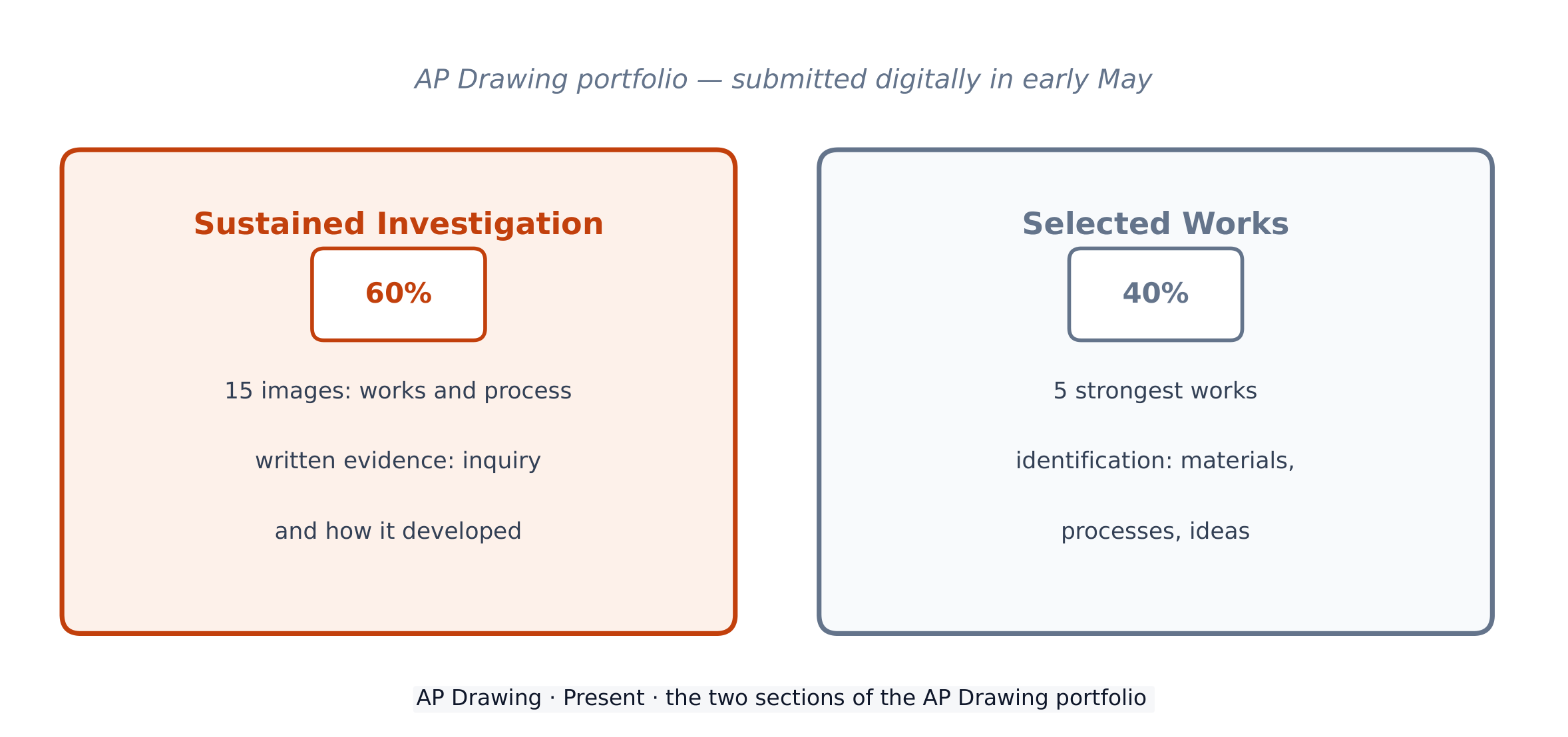
    • Sustained Investigation: 15 images of works and process, plus written evidence — 60% of the score.
    • Selected Works: 5 works demonstrating skillful synthesis of materials, processes, and ideas — 40%.
    • Selected Works may come from the investigation or outside it — choose your strongest five.
    • Everything uploads through the AP Digital Portfolio; teachers review before final submission.
    • Drawing, 2-D, and 3-D are separate portfolios; a student submits work made for the Drawing skill set.
    • Plan backwards from May: photography, writing, and selection all take real calendar time.

    来源:美国大学理事会 AP 课程与考试说明

    AP考试是一个作品集(portfolio),不是笔试——两个部分在五月初以数字方式提交。(CED大观念3)

    AP绘画作品集:持续探究(15张图像+文字,60%)与精选作品(5件,40%)
    两个部分:持续探究占分数的60%,精选作品占40%
    • 持续探究:15张作品与过程的图像,加上书面材料——占分数的60%。
    • 精选作品(Selected Works):5件展示材料、过程与想法熟练综合的作品——占40%。
    • 精选作品可以来自探究之内或之外。选你最强的五件,不论它们从哪来。
    • 一切通过数字作品集平台(AP Digital Portfolio)上传;提交前老师会审看。
    • 绘画、二维、三维艺术与设计是三个独立的作品集——提交为绘画技能而作的作品。
    • 从五月倒排计划:拍摄、写作和挑选都需要真实的日历时间。
    探索

    Where does it belong?

    The Sustained Investigation holds 15 images with written evidence (60%); the Selected Works are your five strongest pieces (40%). Some things belong in neither.

    词汇表 训练
    英文 中文 拼音
    portfolio 作品集 zuò pǐn jí
    Selected Works 精选作品 jīng xuǎn zuò pǐn
    AP Digital Portfolio 数字作品集平台 shù zì zuò pǐn jí píng tái
    7.2

    持续探究:图像与书面材料

    大纲

    Focus: The SI section pairs 15 images with short written evidence — images show, writing states. (CED 3.A/3.B)

    • Writing has two prompts: state the inquiry, and describe how the investigation developed — 1,200 characters total.
    • Every image carries its own caption fields: materials, processes, dimensions (and citations when needed).
    • Choose images that prove the writing: question stated → tests shown → development visible.
    • Process images (journal spreads, in-progress states, detail shots) count among the 15 — use several.
    • Order the images deliberately: scorers read them as a sequence, so build a narrative arc.
    • Write plainly and concretely; name materials, processes, ideas, and skills in CED vocabulary.

    来源:美国大学理事会 AP 课程与考试说明

    持续探究部分把15张图像与简短的书面证据(written evidence)配对——图像展示,文字陈述。(CED 3.A/3.B)

    • 写作回答两个提示:陈述探究问题,以及描述探究如何发展——总共约1200字符。
    • 每张图像都带说明字段:材料(materials)、过程(processes)、尺寸,以及必要时的引用。
    • 选那些能证明文字的图像:问题被陈述、测试被展示、发展看得见。
    • 过程图像——日志跨页、进行中的状态、细节照——算在15张之内。多用几张。
    • 有意安排图像的顺序:评卷人按序阅读,所以要构建一条叙事弧线。
    • 写得朴素而具体,用CED的词汇命名技能和要素。
    持续探究奖励可见的探究过程:习作、过程照片与长期发展
    持续探究奖励可见的探究过程:习作、过程照片与长期发展
    词汇表 训练
    英文 中文 拼音
    written evidence 书面证据 shū miàn zhèng jù
    materials 材料 cái liào
    processes 过程 guò chéng
    7.3

    精选作品:展示技能

    大纲

    Focus: Selected Works are your five strongest statements — each judged on written evidence, drawing skills, and synthesis. (CED 3.C)

    • Pick for range and strength: together the five should cover the drawing skills list.
    • Each work carries identification: materials, processes, ideas — 100 characters per field, make every word count.
    • Quality beats concept here: flawless craft and full value range are what a 5 looks like.
    • Strong candidates: the observational tour de force, the chiaroscuro drama, the expressive figure, the synthesis piece.
    • Details matter at scoring size — view each candidate at thumbnail scale and at full zoom before choosing.
    • Ask three viewers to rank your top eight; overlap usually finds the true five.

    来源:美国大学理事会 AP 课程与考试说明

    精选作品是你最强的五个陈述——每件按书面证据、绘画技能和综合来评分。(CED 3.C)

    • 兼顾广度强度:五件放在一起应覆盖整张绘画技能清单。
    • 每件作品带一份作品信息(identification):材料、过程、想法——每个字段约100字符,字字都要有用。
    • 在这里质量胜过概念:无可挑剔的工艺和完整的明度范围就是5分的样子。
    • 有力的候选:写生的力作、明暗对照的戏剧之作、有表现力的人物、体现综合的作品。
    • 细节在评分尺寸下很重要。挑选前,把每件候选缩成小图看一遍、再放大到全图看一遍。
    • 请三个人给你的前八名排序;重叠的部分通常就是真正的前五。
    A finished drawing for Selected Works: craft, composition and skill must read clearly in the image
    A finished drawing for Selected Works: craft, composition and skill must read clearly in the image
    词汇表 训练
    英文 中文 拼音
    identification 作品信息 zuò pǐn xìn xī
    7.4

    撰写作品说明

    大纲

    Focus: The written evidence is short, factual, and load-bearing — it directs the scorer's attention. (CED 3.D/3.E)

    • State the inquiry as a question or clear statement in the first sentence.
    • Use concrete nouns and verbs: 'compressed charcoal on gessoed cardboard, lifted with erasers' beats 'mixed media'.
    • Connect writing to visible things: if you claim experimentation, the images must show it.
    • Completely unrelated writing caps the Selected Works score — relevance is a rubric rule.
    • Draft early, cut hard: character limits reward the specific and punish the vague.
    • Have someone read writing while viewing the images — wherever they ask 'where?', revise.

    来源:美国大学理事会 AP 课程与考试说明

    书面证据简短、实事求是、承重——它引导评卷人的注意力。(CED 3.D/3.E)

    • 第一句就把探究写成一个问题或一句清楚的陈述。
    • 用具体的名词和动词:"石膏底纸板上的压缩木炭,用橡皮提亮"胜过"综合媒介"。
    • 把文字连到看得见的东西上:你声称实验,图像就必须显示实验。
    • 与作品完全无关的文字会封顶精选作品的分数——相关性是评分规则。
    • 早起草、狠删减:字符上限奖励具体、惩罚空泛。
    • 请人边看图边读你的文字。凡是对方问"在哪里?"的地方,就去修改。
    Written evidence starts in the journal: notes next to studies become portfolio text
    Written evidence starts in the journal: notes next to studies become portfolio text
    7.5

    呈现与图像质量

    大纲

    Focus: Scorers see photographs, not originals — photography quality is portfolio quality. (CED 3.F)

    • Shoot in even, indirect daylight or two-lamp setups; avoid glare, shadows across the work, and keystone distortion.
    • Fill the frame, crop to the work's edges, and keep verticals vertical.
    • Check values on screen: a washed-out photo erases the light-and-shade skill you spent weeks building.
    • Detail shots are allowed and powerful — a close-up of mark-making proves what a full view only suggests.
    • Consistent, neutral backgrounds make a sequence read professionally.
    • Photograph work as it is finished, not all in April — fixative first, then shoot, then store flat.

    来源:美国大学理事会 AP 课程与考试说明

    评卷人看到的是照片(photographs),不是原作——摄影质量就是作品集质量。(CED 3.F)

    • 在均匀的散射日光或双灯设置下拍摄。避免眩光、横过画面的阴影和梯形畸变(keystone distortion)。
    • 让作品充满画幅、裁到作品边缘、保持竖线竖直。
    • 在屏幕上检查明度:一张发白的照片会抹掉你花几周建立的光影技能。
    • 允许并且有力的细节图(detail shot)——笔触的特写能证明全景只能暗示的东西。
    • 一致的中性背景让整组图像显得专业。
    • 每件作品完成时就拍,不要都拖到四月:先喷定画液,再拍摄,然后平放收存。
    工作中的画室:认真记录过程照片与成品,用于作品集呈现
    工作中的画室:认真记录过程照片与成品,用于作品集呈现
    词汇表 训练
    英文 中文 拼音
    photographs 照片 zhào piān
    keystone distortion 梯形畸变 tī xíng jī biàn
    detail shot 细节图 xì jié tú
    7.6

    理解评分标准

    大纲

    Focus: Both sections are scored against published rubrics — knowing the rows lets you build to them.

    • Sustained Investigation rows: inquiry evident, evidence of practice/experimentation/revision, materials-processes-ideas, skills, and synthesis.
    • Selected Works criteria: written evidence identifies components; drawing skills; synthesis — scored 1-5 by preponderance of evidence.
    • Rubric language ladder: rudimentary → moderate → good → advanced — aim your evidence at the top descriptors.
    • Score your own mock portfolio against the rubric each term; the gaps write your to-do list.
    • Scores 1-5 arrive in July; college credit policies vary — but the rubric habits are the real prize.
    • Every rubric row asks for visual evidence — the recurring answer is: show it, then name it.

    来源:美国大学理事会 AP 课程与考试说明

    两个部分都按公开的评分标准(scoring guidelines)打分——了解每一行,就能朝它去构建。

    评分语言的阶梯:初步、中等、良好、高级——把证据对准最高一级
    评分标准的语言阶梯:把每一份证据都对准最高的描述词
    • 持续探究的评分行:探究可见;练习、实验与修改;材料、过程与想法;绘画技能;综合。
    • 精选作品的标准:书面证据点明要素;绘画技能;综合——按证据的总体倾向(preponderance of evidence)给1-5分。
    • 评分语言的阶梯是初步、中等、良好、高级——把证据对准最高的描述词。
    • 每学期用评分标准给自己的模拟作品集打分;缺口就是你的待办清单。
    • 1-5的分数七月公布,大学的学分政策各不相同——但评分标准养成的习惯才是真正的收获。
    • 每一行都要视觉证据。反复出现的答案是:先展示它,再命名它。
    词汇表 训练
    英文 中文 拼音
    scoring guidelines 评分标准 píng fēn biāo zhǔn
    preponderance of evidence 证据的总体倾向 zhèng jù de zǒng tǐ qīng xiàng
    7.7

    学术诚信与引用来源

    大纲

    Focus: The portfolio must be your own work; borrowed images and AI tools have strict rules.

    • Working from someone else's photograph or artwork requires citation in the image's materials/processes fields.
    • Substantially copying another artist's work — even cited — cannot demonstrate your idea development.
    • Draw from life and from your own reference photos wherever possible; it also simply teaches more.
    • Generative AI may not make your work: AP policy allows it only as a documented exploration tool, never as the artwork.
    • Plagiarism cancels scores — the College Board checks, and teachers must certify originality.
    • Integrity is also artistic self-interest: your own seeing is the only unique material you have.

    来源:美国大学理事会 AP 课程与考试说明

    作品集必须是你自己的作品。借用图像和AI工具有严格的规则。

    • 参考他人的照片或作品创作,必须在那张图像的材料/过程字段里写引用(citation)。
    • 大量照搬他人作品——即使写了引用——也无法展示你的想法发展。
    • 尽可能写生、用自己拍的参考照片;这也确实教得更多。
    • 生成式人工智能(generative AI)不能替你创作:AP政策只允许把它作为有记录的探索工具,绝不能作为作品本身。
    • 抄袭(plagiarism)会取消成绩。College Board会核查,教师必须证明原创性。
    • 诚信也是艺术上的自利:你自己的观看,是你唯一真正独有的材料。
    词汇表 训练
    英文 中文 拼音
    citation 引用 yǐn yòng
    generative AI 生成式人工智能 shēng chéng shì rén gōng zhì néng
    plagiarism 抄袭 chāo xí
    7.7

    考试技巧

    • 把拍摄当回事,因为它就是回事——5分水平的画拍出眩光和梯形畸变,读起来就是3分。凡是让你犹豫的照片都重拍。
    • 用具体信息填满每个说明字段。"英格尔有色纸上的柳条木炭,减法擦亮"在替你挣分;空白或含糊的字段浪费白给的分数。
    • 检查相关性规则:如果你的书面证据原封不动放到别人的作品集下也说得通,那就太空泛了——把每句话拴到你的图像上。
    • 用新鲜的眼睛挑五件:缩略图打印摆上桌,请三位信得过的人排序,重叠者胜出。
    • 凡不是你拍的参考照片都要引用——漏一条引用就拿整个作品集冒险;三十秒的打字消除这个风险。

登录或创建账号

IGCSE, A-Level & AP