跳到主要内容

空间、纵深与比例

AP 绘画 · 第 3 主题

训练
讲义 词汇表
3.1

测量与目测

大纲

Focus: Sighting is measuring the subject with your pencil at arm's length — the observational drawing survival skill.

  • Hold the pencil at full arm's length, lock the elbow, close one eye: now it is a ruler and a protractor.
  • Pick one unit (often the head, or a cup's height) and measure everything in that unit: comparative measurement.
  • Check angles by rotating the pencil to match an edge, then carrying that angle to the paper.
  • Plumb lines (vertical checks) and level lines (horizontal checks) locate landmarks above and below each other.
  • Draw envelope shapes first: the big simple shape that contains the whole subject, then divide it.
  • Measured accuracy is visual evidence of space and proportion control in the AP rubric's drawing skills.

来源:美国大学理事会 AP 课程与考试说明

目测(sighting)指伸直手臂用铅笔测量对象——这是写生素描的生存技能。

  • 手臂完全伸直、手肘锁定、闭上一只眼:铅笔就成了尺子和量角器。
  • 选一个单位(常用头部,或一只杯子的高度),用它去量所有东西——比较测量(comparative measurement)。
  • 转动铅笔去贴合一条边的角度,再把这个角度搬到纸上。
  • 铅垂线(plumb line)(想象中的竖直线)显示哪些参照点正好上下对齐。
  • 先画外包形(envelope):能装下整个对象的大而简单的形,再往里细分。
词汇表 训练
英文 中文 拼音
sighting 目测 mù cè
comparative measurement 比较测量 bǐ jiào cè liáng
plumb line 铅垂线 qiān chuí xiàn
envelope 外包形 wài bāo xíng
3.2

一点透视

大纲

Focus: Linear perspective turns the picture plane into a window: in one-point, all depth lines meet at a single vanishing point.

  • The horizon line is the viewer's eye level — everything above it we look up at, everything below we look down on.
  • Lines parallel to the picture plane stay true; lines going into the scene converge to the vanishing point.
  • Equal spaces look smaller as they recede — use the diagonal trick to divide receding space evenly.
  • One-point suits rooms, streets, and corridors seen straight-on.
  • Objects overlap and rise toward the horizon as they get further away — perspective plus overlap is depth doubled.
  • Perspective errors are easy to spot: check every depth line actually aims at the point.

来源:美国大学理事会 AP 课程与考试说明

一点透视

线性透视(linear perspective)把画面当成一扇窗。在一点透视里,所有进入纵深的线都汇聚到一个点。

一条笔直的沙漠公路径直伸向地平线,两边的边缘收窄到一个点
一条笔直的沙漠公路:它的两条边缘看起来在地平线上汇聚到一个消失点,正是绘画为表现纵深而重现的一点透视
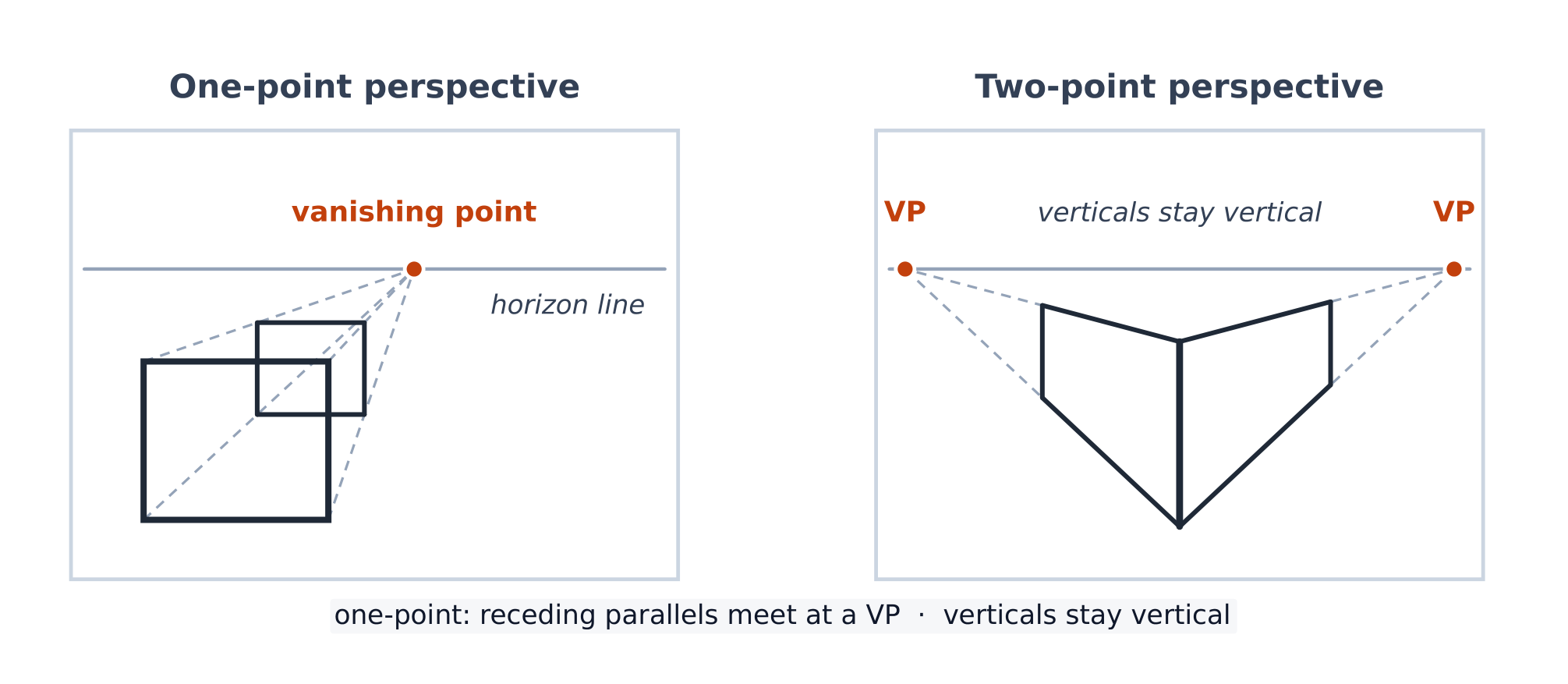
一点透视与两点透视:视平线、灭点与汇聚的边线
左:一点透视——纵深线汇聚到一个灭点。右:两点透视——每组边线汇聚到各自的灭点
  • 视平线(horizon line)是观察者眼睛的高度。低于它的东西我们俯视,高于它的我们仰视。
  • 与画面平行的线保持原样;进入场景的线汇聚到灭点(vanishing point)。
  • 相等的间距越远看起来越小。用对角线来均分后退的空间。
  • 一点透视(one-point perspective)适合正对着看的房间、街道和走廊。
  • 透视加上遮挡(overlap)等于双倍的纵深:近的边缘盖住远的边缘。
词汇表 训练
英文 中文 拼音
linear perspective 线性透视 xiàn xìng tòu shì
horizon line 视平线 shì píng xiàn
vanishing point 灭点 miè diǎn
one-point perspective 一点透视 yì diǎn tòu shì
overlap 遮挡 zhē dǎng
3.3

两点与三点透视

大纲

Focus: Turn the subject at an angle and you need two vanishing points; look steeply up or down and you need a third.

  • In two-point, verticals stay vertical; both sets of horizontal edges converge to left and right points on the horizon.
  • Keep both vanishing points far apart (often off the paper) — close points create fisheye distortion.
  • Three-point adds a vertical vanishing point: skyscrapers from below (looking up) or street scenes from a rooftop (looking down).
  • Boxes drawn in perspective become the scaffolding for everything: buildings, books, vehicles, even heads.
  • Cast shadows and reflections follow the same perspective system as the objects that make them.
  • A perspective grid underdrawing keeps complex scenes consistent — construct lightly, render on top.

来源:美国大学理事会 AP 课程与考试说明

两点透视

把对象转一个角度,就需要两点透视(two-point perspective);抬头仰视或低头俯视很陡时,还需要第三个点。

  • 两点透视里竖线仍然竖直;两组水平边线分别汇聚到视平线上的左右两个灭点。
  • 让两个灭点离得远——常常在纸外。灭点太近会产生鱼眼式的变形。
  • 三点透视(three-point perspective)增加一个竖直方向的灭点:从下面仰视摩天楼,或从屋顶俯视街道。
  • 透视中的方块是一切的脚手架:建筑、书本、车辆,甚至头部。
  • 投影和倒影遵守和物体本身相同的透视系统。
词汇表 训练
英文 中文 拼音
two-point perspective 两点透视 liǎng diǎn tòu shì
three-point perspective 三点透视 sān diǎn tòu shì
3.4

透视缩短

大纲

Focus: Foreshortening is perspective applied to a single form pointing toward you — lengths compress dramatically.

  • A pointing arm may appear one-third of its true length: draw the apparent shape, not the known one.
  • Overlap is the key signal: the hand overlaps the forearm, the forearm overlaps the upper arm.
  • Think in cross-sections: imagine rings around the form (like a wireframe) to feel how it turns toward you.
  • Measure foreshortened lengths by sighting — knowledge lies, observation tells the truth.
  • Classic practice: draw a figure lying down feet-first (like Mantegna's Dead Christ).
  • Strong foreshortening is high-difficulty visual evidence — examiners recognise the skill immediately.

来源:美国大学理事会 AP 课程与考试说明

透视缩短(foreshortening)是透视作用在一个指向你的形体上——长度被急剧压缩。

  • 一条指向你的手臂可能只显出真实长度的三分之一。画看到的形状,不是你知道的长度。
  • 遮挡是关键信号:手盖住前臂,前臂盖住上臂。
  • 横截面(cross-sections)思考:想象套在形体上的一圈圈环,像线框模型,感受它如何转向你。
  • 用目测去量被缩短的长度——记忆会说谎,观察才说真话。
  • 经典练习:从脚的方向画一个躺着的人,像曼特尼亚的《哀悼基督》。
词汇表 训练
英文 中文 拼音
foreshortening 透视缩短 tòu shì suō duǎn
cross-sections 横截面 héng jié miàn
3.5

空气透视

大纲

Focus: Atmospheric (aerial) perspective creates depth without lines: distant things are lighter, cooler, softer, and less detailed.

  • Air scatters light, so contrast fades with distance — the far mountain is a pale flat shape.
  • Foreground: darkest darks, sharpest edges, most texture; background: narrow value range, soft edges.
  • Reserve full black and full white for the foreground; the distance lives in the middle greys.
  • Detail density is a depth cue by itself — render the near leaf, suggest the far tree.
  • Combine linear and atmospheric perspective for maximum depth in landscape and cityscape drawing.
  • This is the AP skill space made visible through light and shade — two rubric skills in one device.

来源:美国大学理事会 AP 课程与考试说明

空气透视

空气透视(atmospheric perspective)不用任何线条就能制造纵深:远处的东西更浅、更冷、更柔、更少细节。

  • 空气散射光线,所以对比随距离减弱。远山是一块浅淡的平面形。
  • 前景:最深的深色、最锐的边缘、最多的质感。背景:狭窄的明度范围和柔软的边缘。
  • 把纯黑和纯白留给前景;远处活在中间的灰色里。
  • 细节的密度本身就是纵深线索:近处的叶子刻画,远处的树只作暗示。
  • 在风景素描里把线性透视和空气透视结合起来,纵深感最强。
Layered mountain ridges fade with distance: atmospheric perspective cools and lightens far forms
探索

Which depth cue is at work?

Drawings create depth several ways at once: linear perspective (lines converge), atmospheric perspective (distance fades and softens), overlap (near covers far), and foreshortening (forms compress toward you).

词汇表 训练
英文 中文 拼音
atmospheric perspective 空气透视 kōng qì tòu shì
3.6

构图与画面

大纲

Focus: Composition — how everything is arranged inside the picture's edges — is a named AP drawing skill and the first thing a scorer sees.

  • The picture plane has edges: what you crop out is as expressive as what you keep in.
  • The rule of thirds places focal points on the third-lines — safer than dead centre.
  • Control the figure-ground relationship: negative space is a designed shape, not leftover paper.
  • Lead the eye with paths: lines, value contrast, and detail act as arrows toward the focal point.
  • Vary the viewpoint — eye level is neutral; a low or high viewpoint makes an ordinary subject fresh.
  • Test compositions with a viewfinder or phone camera crop before committing to the page.

来源:美国大学理事会 AP 课程与考试说明

构图(composition)——画面边框内一切事物的安排——是AP点名的绘画技能,也是评卷人第一眼看到的东西。

  • 画面(picture plane)有边缘:你裁掉什么和你留下什么同样有表现力。
  • 三分法(rule of thirds)把视觉焦点放在三分线上——比放在正中央更有力。
  • 设计负空间(negative space):主体周围的空形是你画出来的形,不是剩下的空白。
  • 图底关系(figure-ground relationship)必须清楚:眼睛要始终分得清什么是主体、什么是背景。
  • 用路径引导视线——线条、明度对比和细节都是指向焦点的箭头。
  • 动笔前用取景框(viewfinder)(或手机相机)试裁三种构图。改变视点(viewpoint):平视是中性的;低角度或高角度让平凡的对象变新鲜。
词汇表 训练
英文 中文 拼音
composition 构图 gòu tú
picture plane 画面 huà miàn
rule of thirds 三分法 sān fēn fǎ
negative space 负空间 fù kōng jiān
figure-ground relationship 图底关系 tú dǐ guān xì
viewfinder 取景框 qǔ jǐng kuāng
viewpoint 视点 shì diǎn
3.7

人体与肖像素描

大纲

Focus: The figure combines every drawing skill at once — proportion, gesture, form, and likeness under one deadline.

  • The classic adult figure stands about 7.5 heads tall; the halfway point is near the hip, not the waist.
  • In the head, eyes sit at the halfway line of the skull — the beginner error is placing them too high.
  • Start with gesture and the big masses (ribcage, pelvis, skull); features and fingers come last.
  • Sight-size checks save likeness: compare distances between landmarks, not memorised rules alone.
  • Hands and feet earn their reputation — draw them as simple geometric mittens/wedges first, then divide.
  • Figure and portrait work is a portfolio staple: it demonstrates observation, proportion, and nerve.

来源:美国大学理事会 AP 课程与考试说明

人体把所有绘画技能集中在一起:比例(proportion)、动态、形体,还有在同一个期限内的相似度。

人体与头部比例:站立人体约7.5个头高;眼睛位于头骨的中线
经典成年人体约7.5个头高;在头部,眼睛位于中线上
  • 经典的成年人体约7.5个头高;身体的中点在髋部附近,不在腰部。
  • 在头部,眼睛位于头骨的中线(halfway line)上——初学者总是画得太高。
  • 从动态和大块体量(胸腔、骨盆、头骨)开始;五官和手指最后画。
  • 用参照点之间的距离检查相似度,不要只靠背下来的规则——每张脸都会偏离平均值。
  • 先把手和脚画成简单的几何"手套"和"楔子",再往里细分。
词汇表 训练
英文 中文 拼音
proportion 比例 bǐ lì
halfway line 中线 zhōng xiàn
3.7

考试技巧

  • 透视错误是评卷人最容易发现的错误——刻画之前,检查每条纵深线是否真的指向它的灭点。
  • 在作品集里放一个扎实的写生空间(室内、楼梯间、街道):它毫无疑义地展示评分标准点名的空间技能。
  • **透视缩短是高价值证据。**一条画得可信的缩短的手臂或物体,告诉评卷人你画的是看到的,不是记住的。
  • **像设计师一样裁切。**动笔前测试三种取景裁切,选负空间最强的那个——构图在第一眼就被评判。
  • 石墨里也要用空气透视,不只是颜料:用可塑橡皮把远处边缘擦软,又快又显功力。

本主题的互动课程

逐步学习,并即时检测练习。

AP 绘画的更多主题

登录或创建账号

IGCSE, A-Level & AP