学习目标 4.1.A: 识别物质发生化学变化和物理变化的证据。
- 4.1.A.1 当一种物质的性质发生改变但其组成未发生变化时,即发生了物理变化。物质状态(固、液、气)的改变或混合物的形成/分离是常见的物理变化。
- 4.1.A.2 当物质转化为新物质(通常具有不同的组成)时,即发生了化学变化。产生热量或光、生成气体、生成沉淀以及/或颜色改变,可作为化学变化发生的潜在证据。
AP 化学 · 知识点 4
 7:42
化学反应
一条镁金属带。用火焰接触它,它会燃烧——燃烧——发出刺眼的光。剩下的不再是镁。它是……
英语旁白 · 英中内嵌字幕
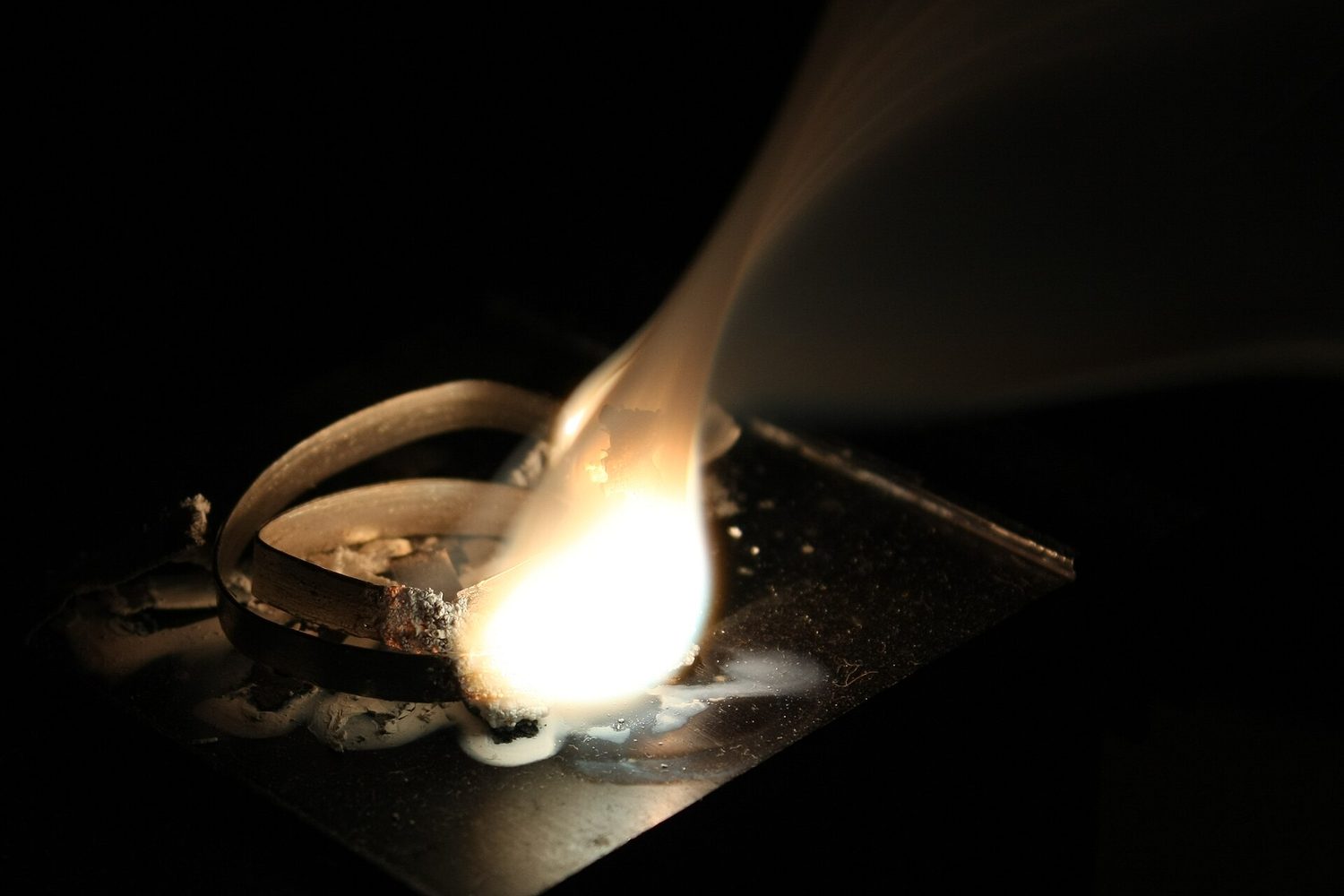
学习目标 4.1.A: 识别物质发生化学变化和物理变化的证据。
来源:College Board AP 课程与考试说明
A chemical reaction 化学反应 rearranges atoms into new substances. Possible evidence includes a color change, a gas or precipitate 沉淀 forming, or a temperature change. These observations alone do not prove that new substances formed. Atoms are conserved, so an equation must be balanced – the same count of each element on both sides.
判断每个观察结果是化学反应的迹象还是仅仅是物理变化。
| English | 中文 | 拼音 |
|---|---|---|
| chemical reaction/ˈkemɪkl rɪˈækʃn/ | 化学反应 | huà xué fǎn yìng |
| precipitate/prɪˈsɪpɪteɪt/ | 沉淀 | chén diàn |
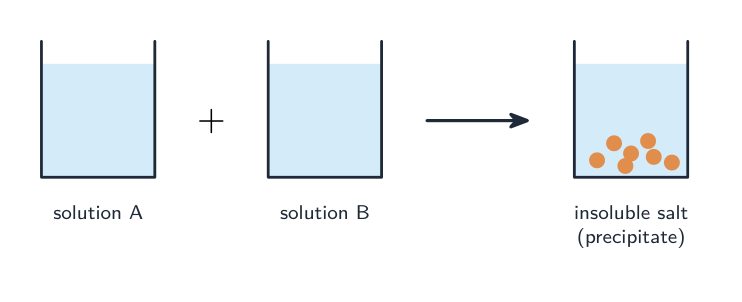
学习目标 4.2.A: 用配平的化学方程式或净离子方程式表示物质的变化: i. 对于物理变化。 ii. 对于给定的反应物和/或产物身份信息。 iii. 对于给定化学反应中的离子。
来源:College Board AP 课程与考试说明
When writing aqueous ionic equations, split dissolved strong electrolytes into ions; keep insoluble solids and weak electrolytes in their appropriate forms. A net ionic equation 净离子方程式 shows only the species that actually change, leaving out the spectator ions 旁观离子 that appear unchanged on both sides. It captures the real chemistry (e.g. $\text{Ag}^+ + \text{Cl}^- \rightarrow \text{AgCl}(s)$).
| English | 中文 | 拼音 |
|---|---|---|
| net ionic equation/net aɪˈɒnɪk ɪˈkweɪʒn/ | 净离子方程式 | jìng lí zǐ fāng chéng shì |
| spectator ions/spekˈteɪtə ˈaɪɒnz/ | 旁观离子 | páng guān lí zǐ |
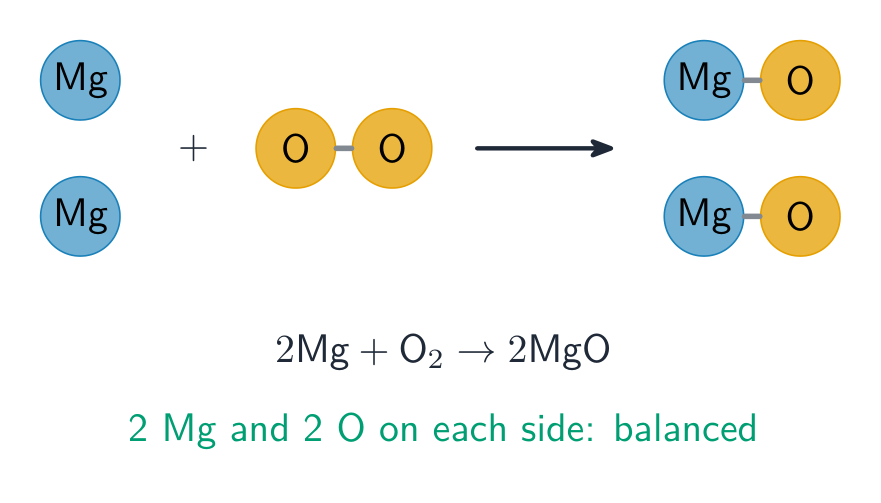
学习目标 4.3.A: 用一致的粒子模型表示给定的化学反应或物理过程。
来源:College Board AP 课程与考试说明
The same reaction can be shown as a symbolic equation, a particulate drawing (atoms and molecules), and a macroscopic observation (what you see). Moving between these levels – connecting the equation to the particles to the beaker – is a core skill.
将每个描述按化学家工作的层次进行排序。
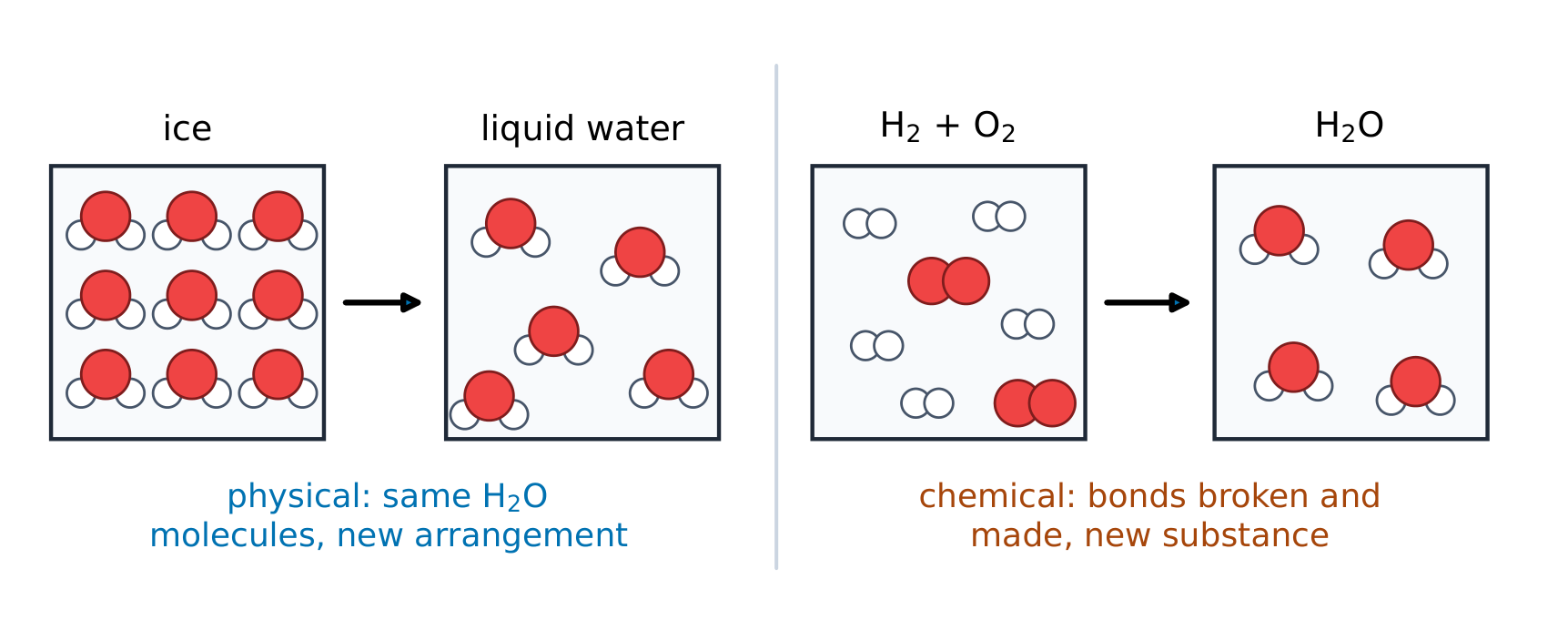
学习目标 4.4.A: 解释宏观特征与键相互作用之间的关系,适用于: i. 化学过程。 ii. 物理过程。
来源:College Board AP 课程与考试说明
A physical change 物理变化 alters form but not identity (melting, dissolving); a chemical change 化学变化 makes new substances by breaking and forming bonds. Dissolving salt is physical; the salt is unchanged and recoverable.
对每种变化进行分类。
| English | 中文 | 拼音 |
|---|---|---|
| physical change/ˈfɪzɪkl tʃeɪndʒ/ | 物理变化 | wù lǐ biàn huà |
| chemical change/ˈkemɪkl tʃeɪndʒ/ | 化学变化 | huà xué biàn huà |
学习目标 4.5.A: 根据化学反应的配平方程式,解释反应物和生成物数量的变化。
来源:College Board AP 课程与考试说明
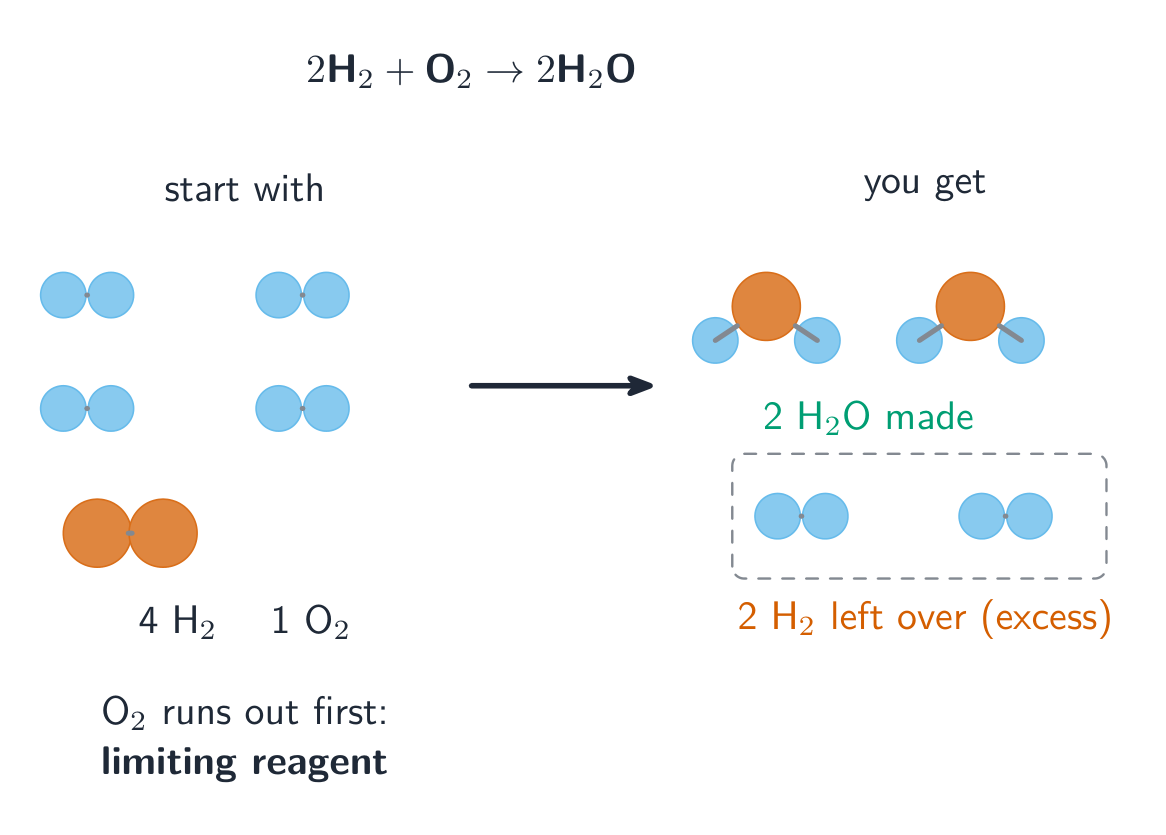
Stoichiometry 化学计量 uses the balanced equation's mole ratios to relate amounts of reactants and products. The path is always grams → moles → (mole ratio) → moles → grams. The limiting reactant 限量反应物 runs out first and sets the maximum product (the theoretical yield 理论产量); the percent yield compares actual to theoretical.
Worked example. How much water forms when $4.0\ \text{g}$ of hydrogen burns in excess oxygen? $2\text{H}_2+\text{O}_2\rightarrow2\text{H}_2\text{O}$. Convert to moles, cross the mole ratio ($2:2=1:1$ here), convert back:
Worked example (limiting reactant). $10.0\ \text{g}$ of N$_2$ reacts with $5.0\ \text{g}$ of H$_2$ ($\text{N}_2+3\text{H}_2\rightarrow2\text{NH}_3$). Which runs out? Moles: $n(\text{N}_2)=10.0/28.0=0.357$, $n(\text{H}_2)=5.0/2=2.5$. The reaction needs $3$ H$_2$ per N$_2$; you have $2.5/0.357=7.0$, far more than $3$, so N$_2$ is limiting. It makes $2\times0.357=0.714\ \text{mol}$ of ammonia ($12.1\ \text{g}$), with hydrogen left over.
平衡方程式固定了物种之间的摩尔比。产物量与限制反应物成正比,并按该比例缩放。
| English | 中文 | 拼音 |
|---|---|---|
| Stoichiometry/ˌstəʊɪkɪˈɒmətri/ | 化学计量 | huà xué jì liàng |
| limiting reactant/ˈlɪmɪtɪŋ rɪˈæktənt/ | 限量反应物 | xiàn liàng fǎn yìng wù |
| theoretical yield/θɪəˈretɪkl jiːld/ | 理论产量 | lǐ lùn chǎn liàng |
学习目标 4.6.A: 根据滴定剂和待测物的量识别滴定中的等当点,假设滴定反应进行完全。
来源:College Board AP 课程与考试说明
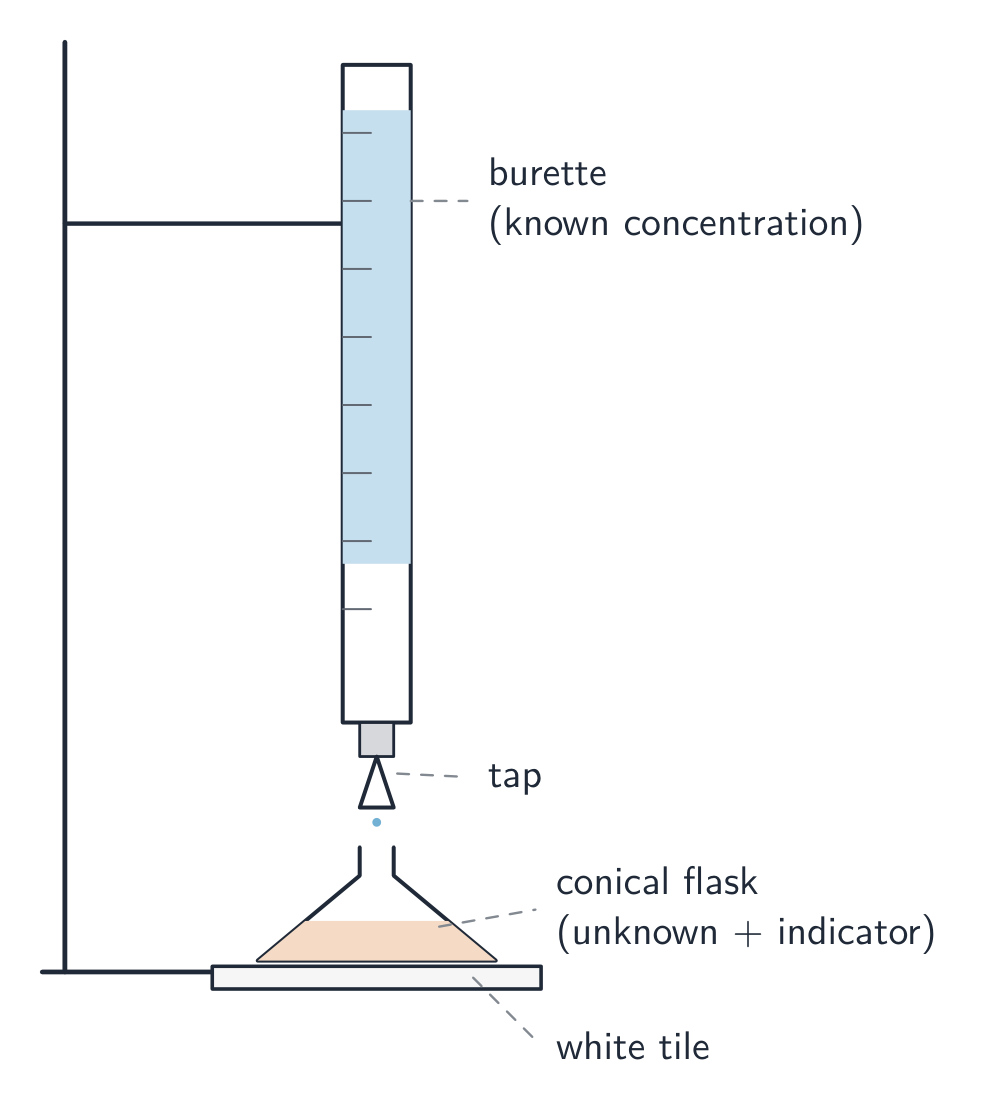
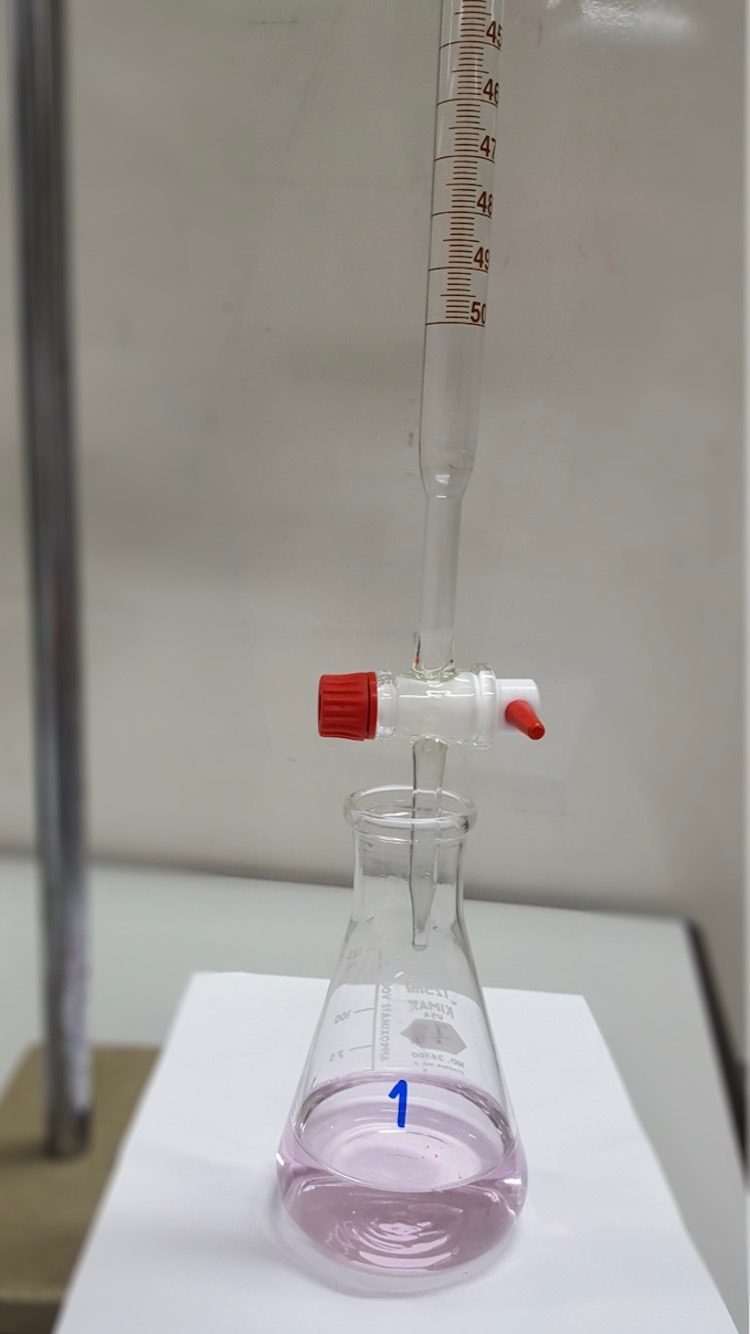
A titration 滴定 finds an unknown concentration by reacting it with a solution of known concentration until they reach the equivalence point 等当点 (stoichiometrically equal). From the known volume and concentration, use the mole ratio to find the unknown. An indicator or a pH curve signals the endpoint.
Worked example. $25.0\ \text{mL}$ of hydrochloric acid is exactly neutralized by $30.0\ \text{mL}$ of $0.100\ \text{M}$ NaOH. Find the acid's concentration. The reaction is $1:1$, so the moles match:
向酸中添加碱会缓慢提高pH,然后在等当点处急剧上升,此时酸和碱的摩尔数相等。陡峭的跳跃定位了该体积。
| English | 中文 | 拼音 |
|---|---|---|
| titration/taɪˈtreɪʃn/ | 滴定 | dī dìng |
| equivalence point/ɪˈkwɪvələns pɔɪnt/ | 等当点 | děng dāng diǎn |
学习标准 4.7.A: 识别反应为酸碱反应、氧化还原反应或沉淀反应。
来源:College Board AP 课程与考试说明
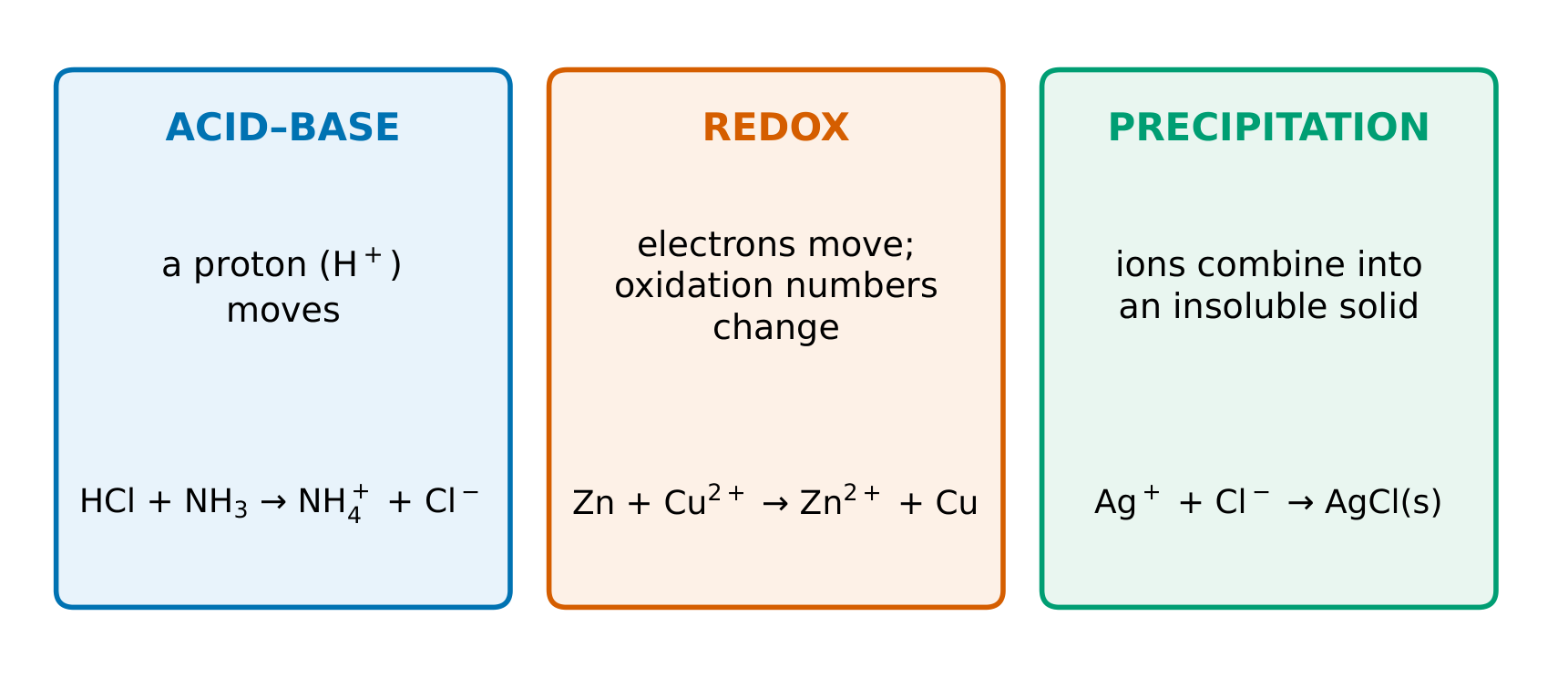
Common patterns include synthesis (combining), decomposition (breaking apart), combustion (with oxygen, releasing energy), precipitation (forming an insoluble solid), acid–base (proton transfer), and redox (electron transfer). Recognizing the type helps predict the products.
根据反应模式对每个方程式进行分类。
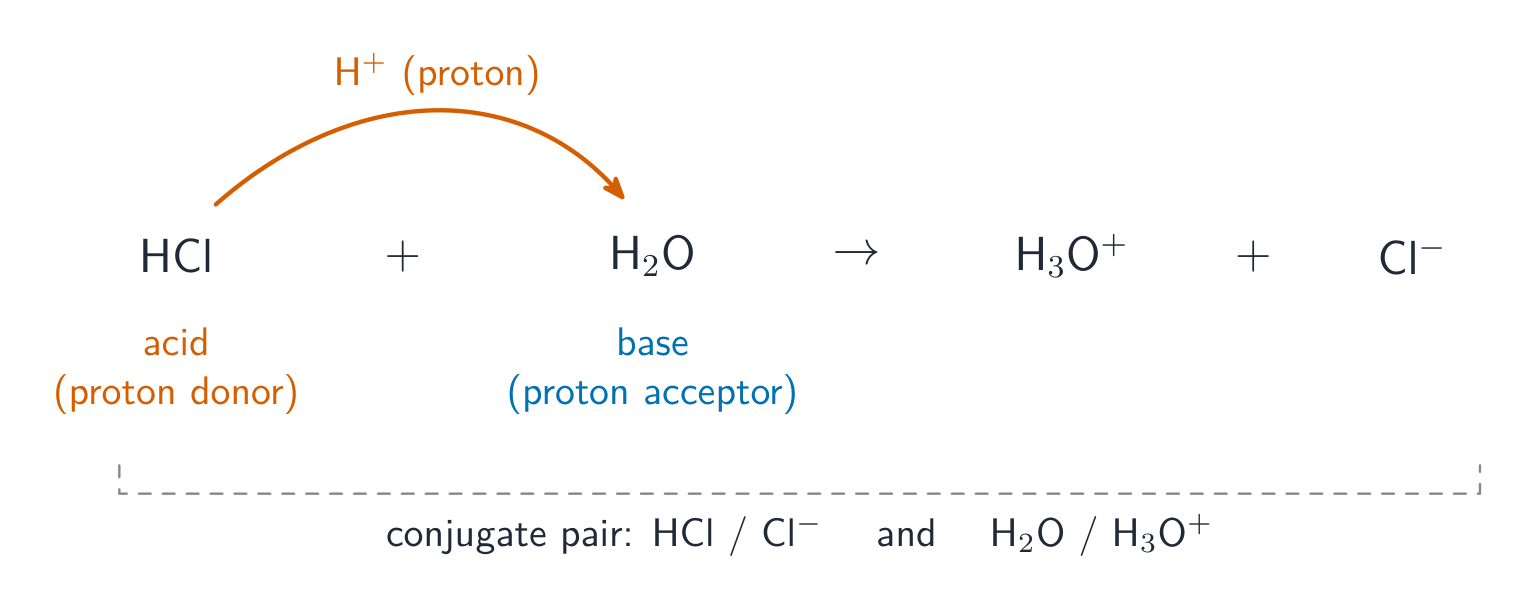
学习目标 4.8.A: 根据涉及这些物种的质子转移,识别布朗斯特-劳里酸、碱以及/或共轭酸碱对。
来源:College Board AP 课程与考试说明
An acid 酸 donates a proton ($\text{H}^+$); a base 碱 accepts one (Brønsted–Lowry). For an aqueous acid reacting with a hydroxide base, the net neutralisation is: $\text{H}^+ + \text{OH}^- \rightarrow \text{H}_2\text{O}$. Strong acids ionise essentially completely in dilute water; soluble strong hydroxide bases dissociate into ions. Weak acids and bases establish equilibria.
pH 用于衡量溶液的酸碱性。每增加 1 个 pH 单位,氢离子浓度就会发生 十倍 的变化;7 为中性,低于此值为酸性,高于此值为碱性。
| English | 中文 | 拼音 |
|---|---|---|
| acid/ˈæsɪd/ | 酸 | suān |
| base/beɪs/ | 碱 | jiǎn |
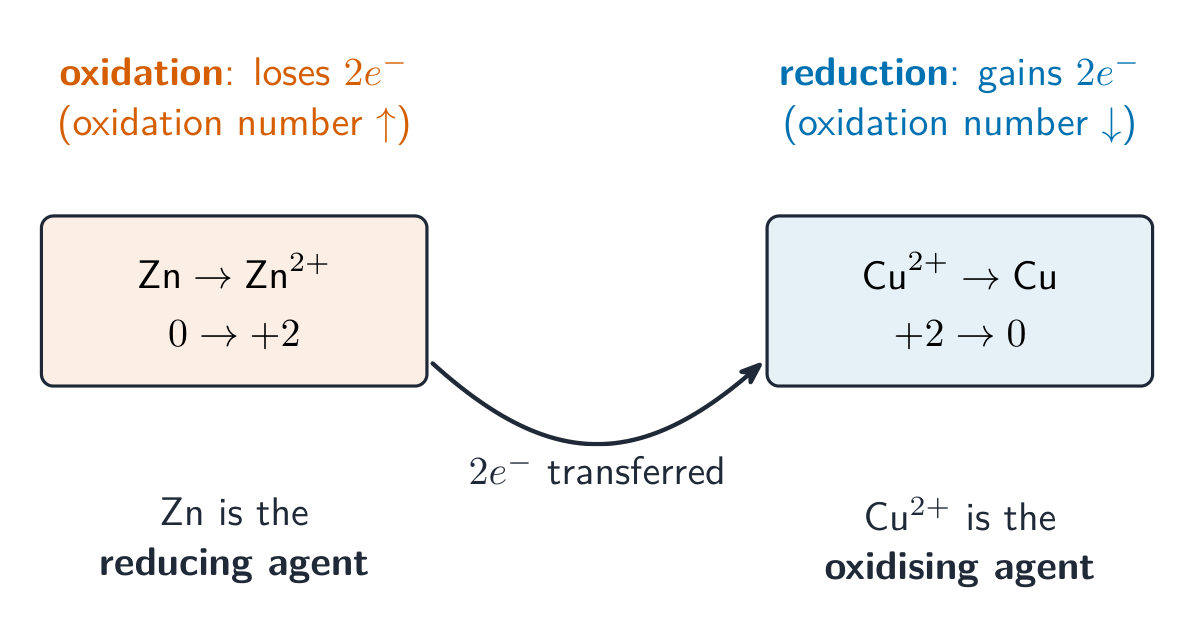
学习目标 4.9.A: 利用半反应表示配平的氧化还原反应方程式。
来源:College Board AP 课程与考试说明
In a redox 氧化还原 reaction, electrons transfer between species. Oxidation 氧化 is loss of electrons (oxidation number rises); reduction 还原 is gain (oxidation number falls). Track changes with oxidation numbers, and remember every oxidation is paired with a reduction – the electrons lost equal the electrons gained.
Worked example. Find the oxidation number of manganese in permanganate, $\text{KMnO}_4$. Potassium is $+1$ and each oxygen is $-2$ (four of them, $-8$). The whole formula is neutral, so $(+1)+\text{Mn}+(-8)=0$, giving $\text{Mn}=+7$ – its maximum, which is why permanganate is a powerful oxidizing agent (it can only gain electrons).
Common mistakes.
在氧化还原反应中,一种物质被氧化(失去电子),另一种被还原(获得电子)。跟随电子从金属转移到非金属。
| English | 中文 | 拼音 |
|---|---|---|
| redox/rɪˈdɒks/ | 氧化还原 | yǎng huà huán yuán |
| Oxidation/ˌɒksɪˈdeɪʃn/ | 氧化 | yǎng huà |
| reduction/rɪˈdʌkʃn/ | 还原 | huán yuán |
逐步完成,配合即时检查练习。
正在加载学科…