跳到主要内容

热力学与电化学

AP 化学 · 第 9 主题

训练
讲义 词汇表
9.1

熵导论

大纲
Learning ObjectiveEssential Knowledge

9.1.A
Identify the sign and relative magnitude of the entropy change associated with chemical or physical processes.

  • 9.1.A.1 Entropy increases when matter becomes more dispersed. For example, the phase change from solid to liquid or from liquid to gas results in a dispersal of matter as the individual particles become freer to move and generally occupy a larger volume. Similarly, for a gas, the entropy increases when there is an increase in volume (at constant temperature), and the gas molecules are able to move within a larger space. For reactions involving gas-phase reactants or products, the entropy generally increases when the total number of moles of gas-phase products is greater than the total number of moles of gas-phase reactants.
  • 9.1.A.2 Entropy increases when energy is dispersed. According to kinetic molecular theory (KMT), the distribution of kinetic energy among the particles of a gas broadens as the temperature increases. As a result, the entropy of the system increases with an increase in temperature.

来源:美国大学理事会 AP 课程与考试说明

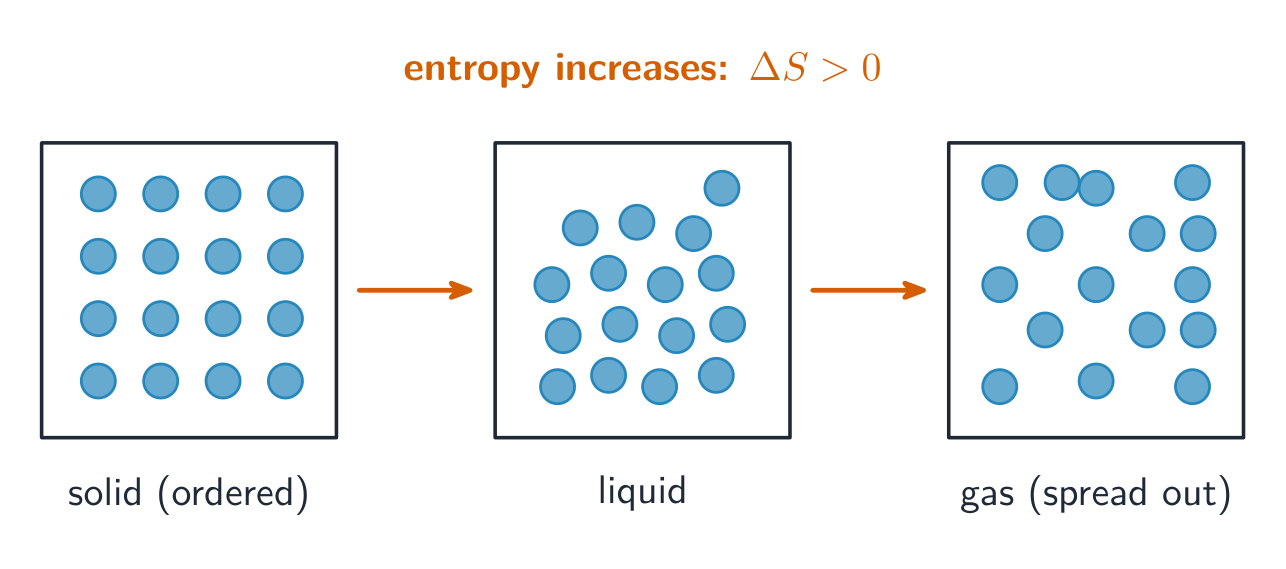
(entropy)$S$ 测量能量和物质的分散——粗略地说,排列一个系统的方式数目。熵在一个物质经历 固体 → 液体 → 气体、当一个固体溶解、当气体摩尔增加,或当温度上升时增加。更多无序意味着更高的熵。

熵从固体到液体到气体上升
熵从固体到液体到气体上升
词汇表 训练
英文 中文 拼音
Entropy shāng
9.2

绝对熵与熵变

大纲
Learning ObjectiveEssential Knowledge

9.2.A
Calculate the standard entropy change for a chemical or physical process based on the absolute entropies (standard molar entropies) of the species involved in the process.

  • 9.2.A.1 The entropy change for a process can be calculated from the absolute entropies of the species involved before and after the process occurs.
    • Equation: $\Delta S^{\circ}_{reaction} = \Sigma S^{\circ}_{products} - \Sigma S^{\circ}_{reactants}$

来源:美国大学理事会 AP 课程与考试说明

每个物质有一个正的绝对熵 $S^\circ$。对于一个反应,

$$\Delta S^\circ = \sum S^\circ(\text{products}) - \sum S^\circ(\text{reactants}).$$
从气体摩尔的变化预测它的符号:制造更多气体提高熵($\Delta S>0$)。

9.3

吉布斯自由能与热力学倾向性
大纲
Learning ObjectiveEssential Knowledge

9.3.A
Explain whether a physical or chemical process is thermodynamically favored based on an evaluation of $\Delta G^{\circ}$.

  • 9.3.A.1 The Gibbs free energy change for a chemical process in which all the reactants and products are present in a standard state (as pure substances, as solutions of 1.0 M concentration, or as gases at a pressure of 1.0 atm (or 1.0 bar)) is given the symbol $\Delta G^{\circ}$.

  • 9.3.A.2 The standard Gibbs free energy change for a chemical or physical process is a measure of thermodynamic favorability. Historically, the term "spontaneous" has been used to describe processes for which $\Delta G^{\circ} < 0$. The phrase "thermodynamically favored" is preferred instead so that common misunderstandings (equating "spontaneous" with "suddenly" or "without cause") can be avoided. When $\Delta G^{\circ} < 0$ for the process, it is said to be thermodynamically favored.

  • 9.3.A.3 The standard Gibbs free energy change for a physical or chemical process may also be determined from the standard Gibbs free energy of formation of the reactants and products.

    • Equation: $\Delta G^{\circ}_{reaction} = \Sigma \Delta G^{\circ}_{f\ products} - \Sigma \Delta G^{\circ}_{f\ reactants}$
  • 9.3.A.4 In some cases, it is necessary to consider both enthalpy and entropy to determine if a process will be thermodynamically favored. The freezing of water and the dissolution of sodium nitrate are examples of such phenomena.

  • 9.3.A.5 Knowing the values of $\Delta H^{\circ}$ and $\Delta S^{\circ}$ for a process at a given temperature allows $\Delta G^{\circ}$ to be calculated directly.

    • Equation: $\Delta G^{\circ} = \Delta H^{\circ} - T\,\Delta S^{\circ}$
  • 9.3.A.6 In general, the temperature conditions for a process to be thermodynamically favored ($\Delta G^{\circ} < 0$) can be predicted from the signs of $\Delta H^{\circ}$ and $\Delta S^{\circ}$ as shown in the table below:

    $\Delta H^{\circ}$ $\Delta S^{\circ}$ Symbols $\Delta G^{\circ} < 0$, favored at:
    $< 0$ $> 0$ $<\ >$ all $T$
    $> 0$ $< 0$ $>\ <$ no $T$
    $> 0$ $> 0$ $>\ >$ high $T$
    $< 0$ $< 0$ $<\ <$ low $T$

    In cases where $\Delta H^{\circ} < 0$ and $\Delta S^{\circ} > 0$, no calculation of $\Delta G^{\circ}$ is necessary to determine that the process is thermodynamically favored ($\Delta G^{\circ} < 0$). In cases where $\Delta H^{\circ} > 0$ and $\Delta S^{\circ} < 0$, no calculation of $\Delta G^{\circ}$ is necessary to determine that the process is thermodynamically unfavored ($\Delta G^{\circ} > 0$).

来源:美国大学理事会 AP 课程与考试说明

吉布斯自由能(Gibbs free energy)结合焓和熵:

$$\Delta G = \Delta H - T\Delta S.$$
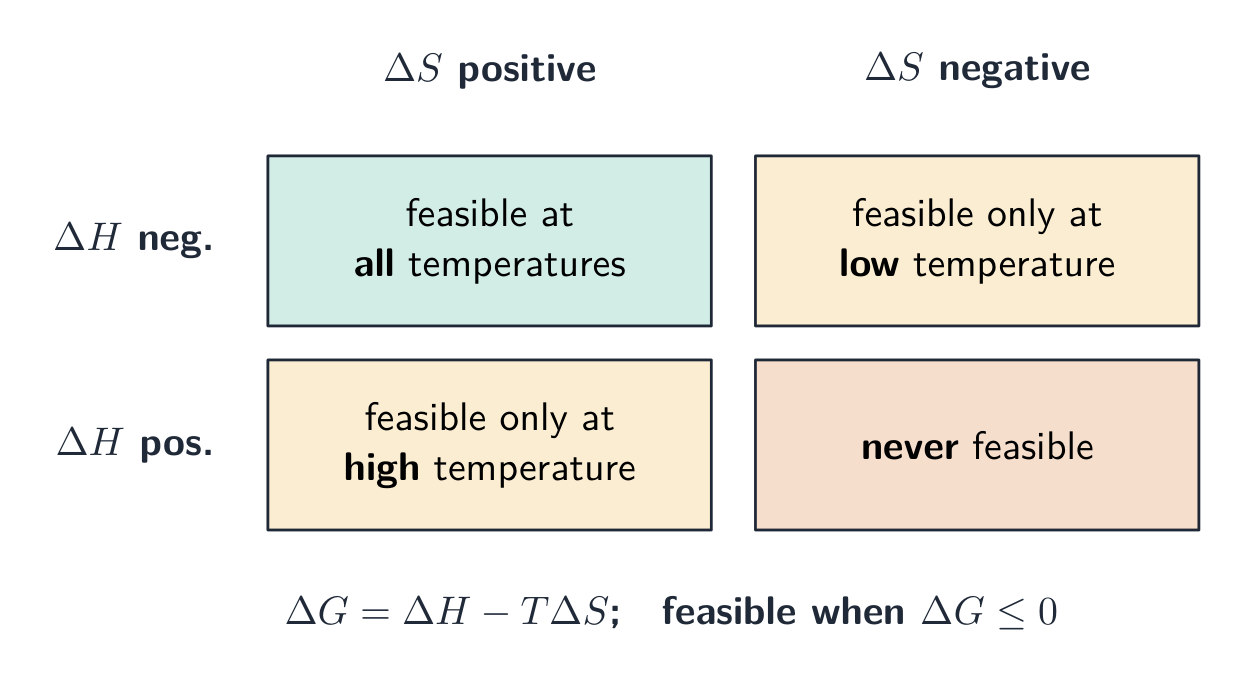
一个过程热力学有利(thermodynamically favorable),当 $\Delta G<0$ 时。所以放热($\Delta H<0$)和熵增加($\Delta S>0$)的反应总是有利;当两者对立时,温度决定。

一个反应是否有利,从焓变和熵变的符号
一个反应是否有利,从焓变和熵变的符号

Worked example. 一个反应有 $\Delta H=+40\ \text{kJ/mol}$$\Delta S=+120\ \text{J/(mol K)}$。它是吸热的(不利的焓)但熵增加,所以它只在足够热时才变得有利。令 $\Delta G=\Delta H-T\Delta S<0$ 并匹配单位($\Delta S=0.120\ \text{kJ}$):

$$T>\frac{\Delta H}{\Delta S}=\frac{40}{0.120}=333\ \text{K}\;(60\,{}^{\circ}\text{C}).$$

词汇表 训练
英文 中文 拼音
Gibbs free energy 吉布斯自由能 jí bù sī zì yóu néng
thermodynamically favorable 热力学有利 rè lì xué yǒu lì
9.4

热力学控制与动力学控制

大纲
Learning ObjectiveEssential Knowledge

9.4.A
Explain, in terms of kinetics, why a thermodynamically favored reaction might not occur at a measurable rate.

  • 9.4.A.1 Many processes that are thermodynamically favored do not occur to any measurable extent, or they occur at extremely slow rates.
  • 9.4.A.2 Processes that are thermodynamically favored, but do not proceed at a measurable rate, are under "kinetic control." High activation energy is a common reason for a process to be under kinetic control. The fact that a process does not proceed at a noticeable rate does not mean that the chemical system is at equilibrium. If a process is known to be thermodynamically favored, and yet does not occur at a measurable rate, it is reasonable to conclude that the process is under kinetic control.

来源:美国大学理事会 AP 课程与考试说明

$\Delta G<0$ 说一个反应发生,不是它快速发生。一个反应能热力学有利,却动力学地慢,因为一个高的活化能(金刚石 → 石墨)。热力学给出方向;动力学给出速度。

9.5

自由能与平衡
大纲
Learning ObjectiveEssential Knowledge

9.5.A
Explain whether a process is thermodynamically favored using the relationships between $K$, $\Delta G^{\circ}$, and $T$.

  • 9.5.A.1 The phrase "thermodynamically favored" ($\Delta G^{\circ} < 0$) means that the products are favored at equilibrium ($K > 1$) under standard conditions.
  • 9.5.A.2 The equilibrium constant is related to free energy by the equations
    • Equation: $K = e^{-\Delta G^{\circ}/RT}$
    • Equation: $\Delta G^{\circ} = -RT \ln K$
  • 9.5.A.3 Connections between $K$ and $\Delta G^{\circ}$ can be made qualitatively through estimation. When $\Delta G^{\circ}$ is near zero, the equilibrium constant will be close to 1. When $\Delta G^{\circ}$ is much larger or much smaller than $RT$, the value of $K$ deviates strongly from 1.
  • 9.5.A.4 Processes with $\Delta G^{\circ} < 0$ favor products (i.e., $K > 1$) and those with $\Delta G^{\circ} > 0$ favor reactants (i.e., $K < 1$).

来源:美国大学理事会 AP 课程与考试说明

自由能联系到平衡常数:

$$\Delta G^\circ = -RT\ln K.$$
所以 $\Delta G^\circ<0$ 给出 $K>1$(产物被偏爱),而 $\Delta G^\circ>0$ 给出 $K<1$。在平衡处 $\Delta G=0$

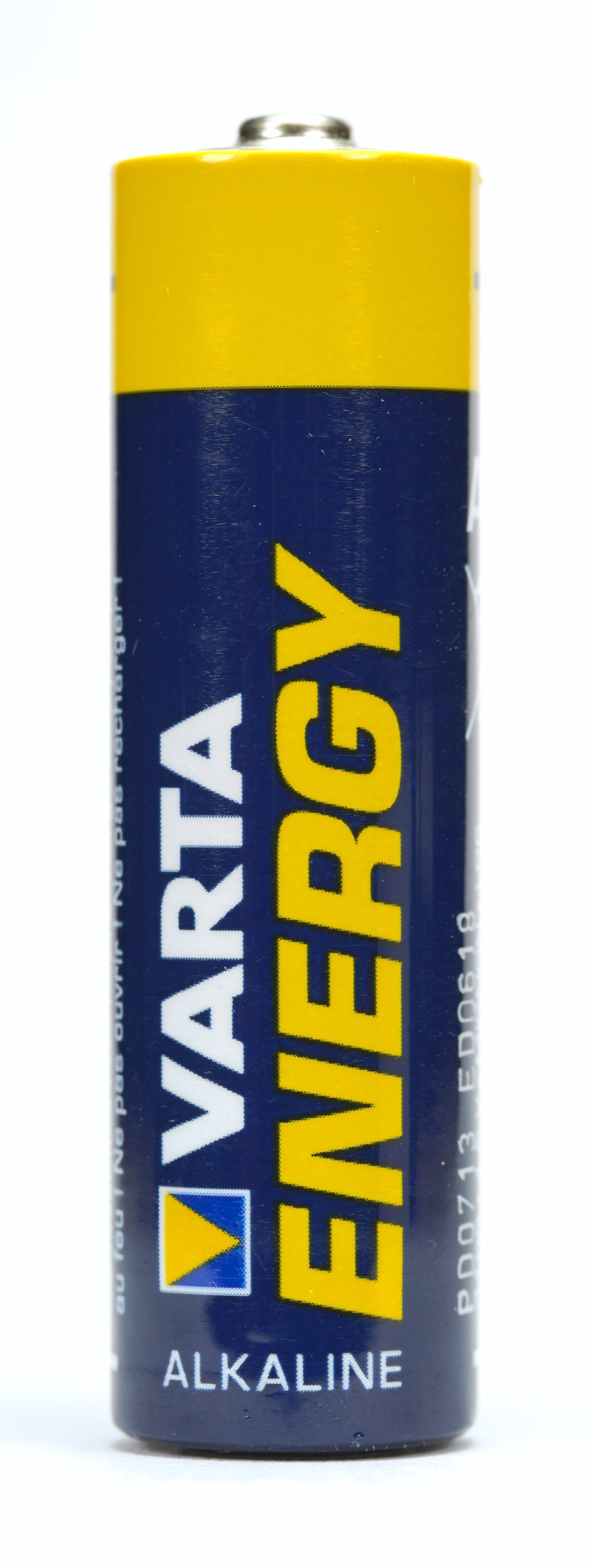
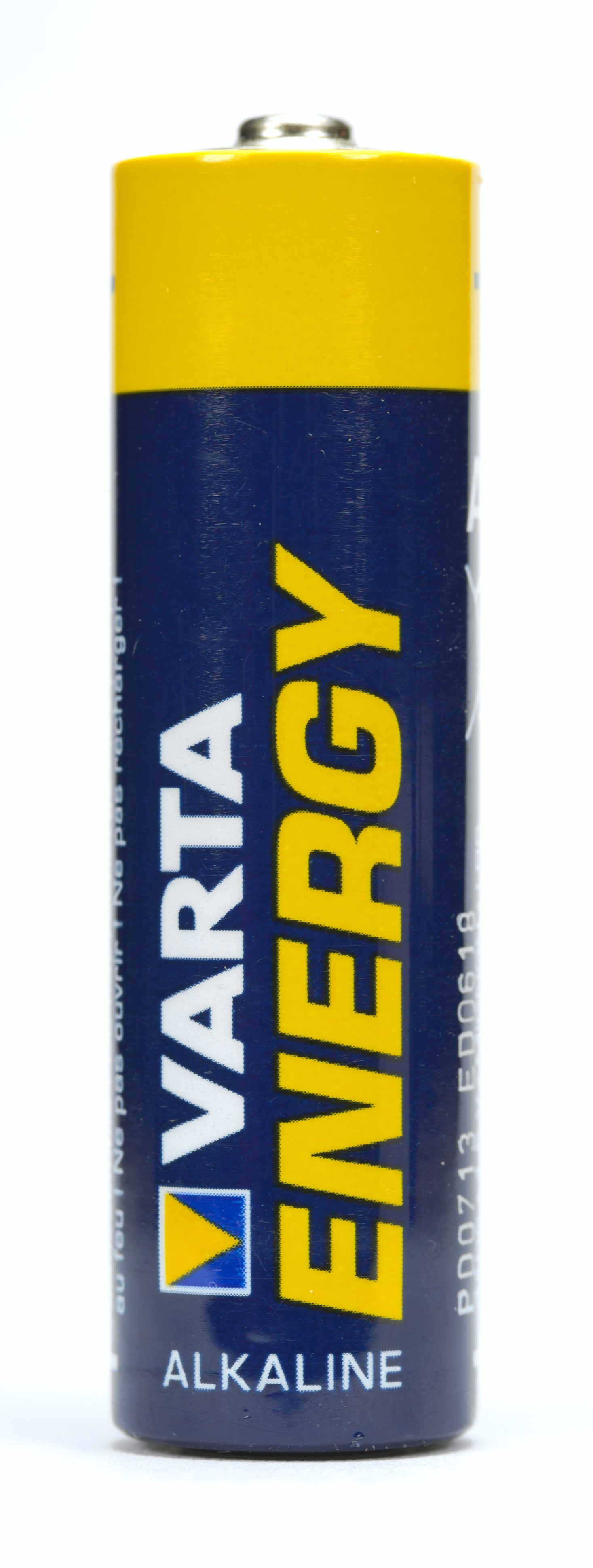
A battery converts free energy of a spontaneous redox reaction into electrical work
9.6

溶解的自由能

大纲
Learning ObjectiveEssential Knowledge

9.6.A
Explain the relationship between the solubility of a salt and changes in the enthalpy and entropy that occur in the dissolution process.

  • 9.6.A.1 The free energy change ($\Delta G^{\circ}$) for dissolution of a substance reflects a number of factors: the breaking of the intermolecular interactions that hold the solid together, the reorganization of the solvent around the dissolved species, and the interaction of the dissolved species with the solvent. It is possible to estimate the sign and relative magnitude of the enthalpic and entropic contributions to each of these factors. However, making predictions for the total change in free energy of dissolution can be challenging due to the cancellations among the free energies associated with the three factors cited.

来源:美国大学理事会 AP 课程与考试说明

一个盐是否溶解取决于溶解的自由能变化。溶解常常增加熵(有序的固体 → 分散的离子)但可能花费焓;$\Delta G$(因而 $K_{sp}$)的符号由 $\Delta H - T\Delta S$ 得出。

9.7

耦合反应

大纲
Learning ObjectiveEssential Knowledge

9.7.A
Explain the relationship between external sources of energy or coupled reactions and their ability to drive thermodynamically unfavorable processes.

  • 9.7.A.1 An external source of energy can be used to make a thermodynamically unfavorable process occur. Examples include:
    • 9.7.A.1.i Electrical energy to drive an electrolytic cell or charge a battery.
    • 9.7.A.1.ii Light to drive the overall conversion of carbon dioxide to glucose in photosynthesis.
  • 9.7.A.2 A desired product can be formed by coupling a thermodynamically unfavorable reaction that produces that product to a favorable reaction (e.g., the conversion of $ATP$ to $ADP$ in biological systems). In the coupled system, the individual reactions share one or more common intermediates. The sum of the individual reactions produces an overall reaction that achieves the desired outcome and has $\Delta G^{\circ} < 0$.

来源:美国大学理事会 AP 课程与考试说明

一个不利的反应($\Delta G>0$)能通过把它耦合(coupling)到一个共享一个共同中间体的有利的反应($\Delta G<0$)来驱动,只要$\Delta G<0$。这就是细胞如何用 ATP 来驱动否则不利的过程。

9.8

原电池与电解池
大纲
Learning ObjectiveEssential Knowledge

9.8.A
Explain the relationship between the physical components of an electrochemical cell and the overall operational principles of the cell.

  • 9.8.A.1 Each component of an electrochemical cell (electrodes, solutions in the half-cells, salt bridge, voltage/current measuring device) plays a specific role in the overall functioning of the cell. The operational characteristics of the cell (galvanic vs. electrolytic, direction of electron flow, reactions occurring in each half-cell, change in electrode mass, evolution of a gas at an electrode, ion flow through the salt bridge) can be described at both the macroscopic and particulate levels.
  • 9.8.A.2 Galvanic, sometimes called voltaic, cells involve a thermodynamically favored reaction, whereas electrolytic cells involve a thermodynamically unfavored reaction. Visual representations of galvanic and electrolytic cells are tools of analysis to identify where half-reactions occur and in what direction current flows.
  • 9.8.A.3 For all electrochemical cells, oxidation occurs at the anode and reduction occurs at the cathode.
    • Exclusion statement: Labeling an electrode as positive or negative will not be assessed on the AP Exam.

来源:美国大学理事会 AP 课程与考试说明

原电池

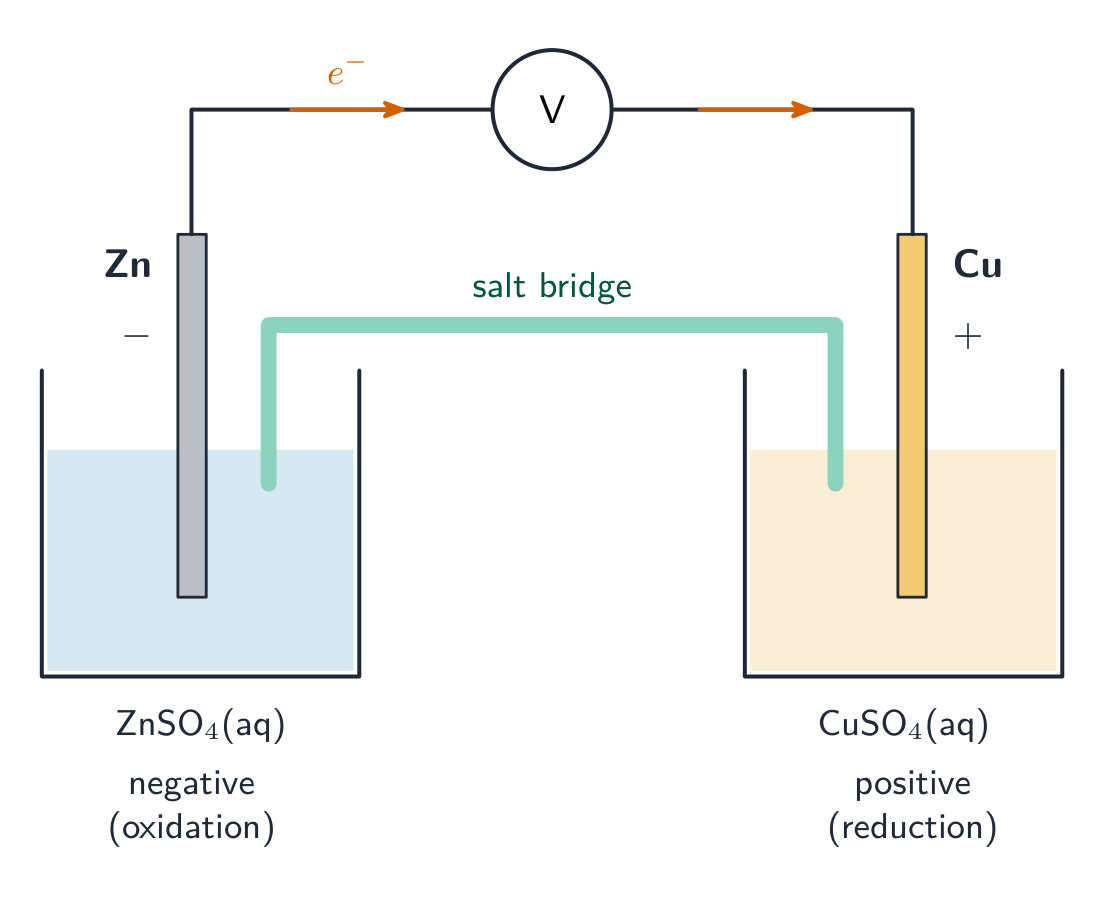
氧化还原反应能通过一根导线移动电子:

一个带盐桥和电压表的原电池
一个带盐桥和电压表的原电池
  • 一个原电池(伏打电池)(galvanic (voltaic) cell)用一个有利的反应($\Delta G<0$)来产生电——一个电池。
  • 一个电解池(electrolytic cell)用电来迫使一个不利的反应($\Delta G>0$)。

在两者里,氧化阳极(anode)发生而还原阴极(cathode)发生。

Commercial batteries: galvanic cells convert chemical free energy into electrical work
探索

Transfer electrons in a cell

In a galvanic cell a spontaneous redox reaction drives electrons through a wire, doing electrical work; oxidation at one electrode, reduction at the other.

词汇表 训练
英文 中文 拼音
galvanic (voltaic) cell 原电池 yuán diàn chí
electrolytic cell 电解池 diàn jiě chí
anode 阳极 yáng jí
cathode 阴极 yīn jí
9.9

电池电势与自由能

大纲
Learning ObjectiveEssential Knowledge

9.9.A
Explain whether an electrochemical cell is thermodynamically favored, based on its standard cell potential and the constituent half-reactions within the cell.

  • 9.9.A.1 Electrochemistry encompasses the study of redox reactions that occur within electrochemical cells. The reactions are either thermodynamically favored (resulting in a positive voltage) or thermodynamically unfavored (resulting in a negative voltage and requiring an externally applied potential for the reaction to proceed).
  • 9.9.A.2 The standard cell potential of electrochemical cells can be calculated by identifying the oxidation and reduction half-reactions and their respective standard reduction potentials.
  • 9.9.A.3 $\Delta G^{\circ}$ (standard Gibbs free energy change) is proportional to the negative of the cell potential for the redox reaction from which it is constructed. Thus, a cell with a positive $E^{\circ}$ involves a thermodynamically favored reaction, and a cell with a negative $E^{\circ}$ involves a thermodynamically unfavored reaction.
    • Equation: $\Delta G^{\circ} = -nFE^{\circ}$

来源:美国大学理事会 AP 课程与考试说明

电池电势(cell potential)$E^\circ_{\text{cell}}$ 以伏特测量驱动力,从标准还原电位求出($E^\circ_{\text{cathode}}-E^\circ_{\text{anode}}$)。它通过以下与自由能联系

$$\Delta G^\circ = -nFE^\circ_{\text{cell}},$$
其中 $n$ 是电子的摩尔而 $F$ 是法拉第常数。一个正的 $E^\circ_{\text{cell}}$ 意味着一个有利的(原电池)反应。

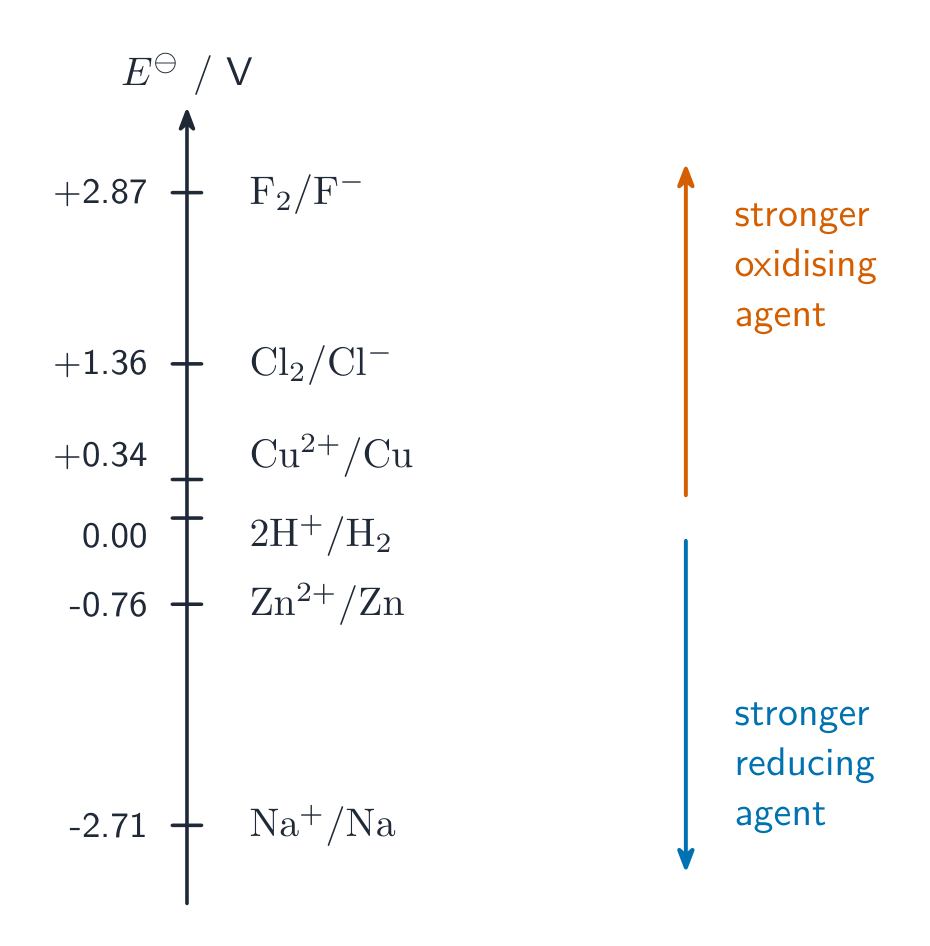
标准电极电位的电化学序
标准电极电位的电化学序

Worked example. 一个电池把一个铜阴极($\text{Cu}^{2+}+2e^-\rightarrow\text{Cu}$,$E^\circ=+0.34\ \text{V}$)与一个锌阳极($\text{Zn}^{2+}+2e^-\rightarrow\text{Zn}$,$E^\circ=-0.76\ \text{V}$)配对。电池电势是

$$E^\circ_{\text{cell}}=E^\circ_{\text{cathode}}-E^\circ_{\text{anode}}=0.34-(-0.76)=1.10\ \text{V}.$$
它是正的,所以反应是自发的而电池(一个丹尼尔电池)作为一个电池起作用。

词汇表 训练
英文 中文 拼音
cell potential 电池电势 diàn chí diàn shì
9.10

非标准条件下的电池电势

大纲
Learning ObjectiveEssential Knowledge

9.10.A
Explain the relationship between deviations from standard cell conditions and changes in the cell potential.

  • 9.10.A.1 In a real system under nonstandard conditions, the cell potential will vary depending on the concentrations of the active species. The cell potential is a driving force toward equilibrium; the farther the reaction is from equilibrium, the greater the magnitude of the cell potential.

  • 9.10.A.2 Equilibrium arguments such as Le Châtelier's principle do not apply to electrochemical systems, because the systems are not in equilibrium.

  • 9.10.A.3 The standard cell potential $E^{\circ}$ corresponds to the standard conditions of $Q = 1$. As the system approaches equilibrium, the magnitude (i.e., absolute value) of the cell potential decreases, reaching zero at equilibrium (when $Q = K$). Deviations from standard conditions that take the cell further from equilibrium than $Q = 1$ will increase the magnitude of the cell potential relative to $E^{\circ}$. Deviations from standard conditions that take the cell closer to equilibrium than $Q = 1$ will decrease the magnitude of the cell potential relative to $E^{\circ}$. In concentration cells, the direction of spontaneous electron flow can be determined by considering the direction needed to reach equilibrium.

  • 9.10.A.4 Algorithmic calculations using the Nernst equation are insufficient to demonstrate an understanding of electrochemical cells under nonstandard conditions. However, students should qualitatively understand the effects of concentration on cell potential and use conceptual reasoning, including the qualitative use of the Nernst equation:

    • Equation: $E = E^{\circ} - (RT/nF) \ln Q$

    to solve problems.

来源:美国大学理事会 AP 课程与考试说明

离开标准条件,电势随浓度移动——能斯特方程(Nernst equation)(定性地):随着反应物被消耗,$Q$ 上升而 $E_{\text{cell}}$ 下降,在平衡处达到零(一个耗尽的电池)。改变一个浓度以勒沙特列预测的方式移动 $E_{\text{cell}}$

词汇表 训练
英文 中文 拼音
Nernst equation 能斯特方程 néng sī tè fāng chéng
9.11

电解与法拉第定律

大纲
Learning ObjectiveEssential Knowledge

9.11.A
Calculate the amount of charge flow based on changes in the amounts of reactants and products in an electrochemical cell.

  • 9.11.A.1 Faraday's laws can be used to determine the stoichiometry of the redox reaction occurring in an electrochemical cell with respect to the following:
    • 9.11.A.1.i Number of electrons transferred
    • 9.11.A.1.ii Mass of material deposited on or removed from an electrode (as in electroplating)
    • 9.11.A.1.iii Current
    • 9.11.A.1.iv Time elapsed
    • 9.11.A.1.v Charge of ionic species
    • Equation: $I = q/t$

来源:美国大学理事会 AP 课程与考试说明

电解

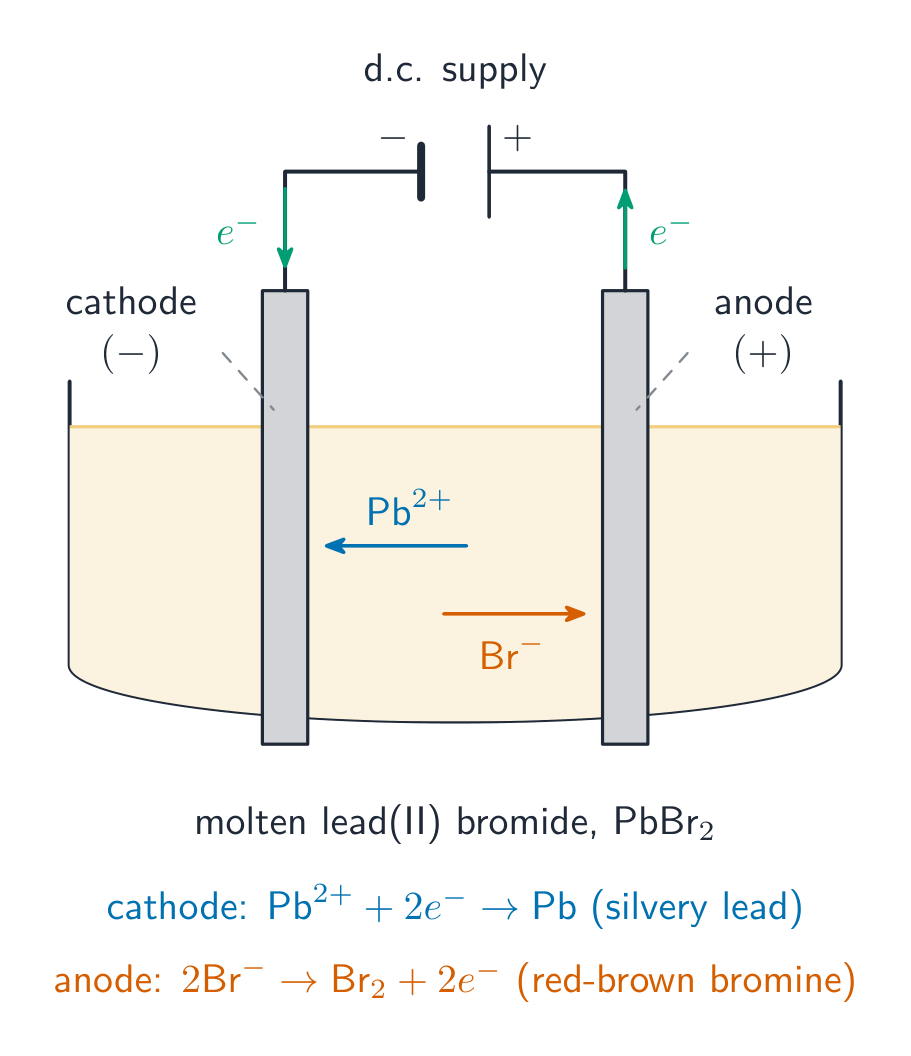
电解(electrolysis)里,通过的电荷决定多少物质被沉积或产生——法拉第定律(Faraday's law)。把 电流 × 时间 转换成电荷、电荷转换成电子的摩尔($F=96{,}485$ C/mol),然后用半反应的电子比来得到产物的摩尔(和质量)。

电解:离子移向电极并被放电
电解:离子移向电极并被放电

Worked example. 一个 $2.0\ \text{A}$ 的电流流过硫酸铜(II)($\text{Cu}^{2+}+2e^-\rightarrow\text{Cu}$)$30\ \text{minutes}$。沉积多少铜?电荷是 $Q=It=2.0\times1800=3600\ \text{C}$,给出 $3600/96485=0.0373\ \text{mol}$ 的电子。因为每个 Cu 需要 $2$ 个电子,$0.0187\ \text{mol}$ 的 Cu 形成,质量 $0.0187\times63.5=1.2\ \text{g}$

探索

Electrolyse a molten salt

Electrolysis uses current to force a non-spontaneous reaction: positive ions gain electrons at the cathode, negative ions lose them at the anode. Charge sets the amount deposited.

词汇表 训练
英文 中文 拼音
electrolysis 电解 diàn jiě
Faraday's law 法拉第定律 fǎ lā dì dìng lǜ
9.11

考试技巧

  • 一个过程热力学有利,当 $\Delta G<0$ 时;用 $\Delta G=\Delta H-T\Delta S$ 结合焓和熵(匹配单位——kJ vs J)。
  • 熵在 固体→液体→气体 以及当产生更多气体摩尔时增加
  • 有利意味着快——一个高的活化能能使一个 $\Delta G<0$ 的反应极其慢(动力学控制)。
  • 在电化学里一个正的 $E^\circ_{\text{cell}}=E^\circ_{\text{cathode}}-E^\circ_{\text{anode}}$ 意味着一个自发的(原电池)电池;氧化在阳极、还原在阴极
  • 在电解里通过的电荷($Q=It$)固定沉积的量(法拉第定律)。

本主题的互动课程

逐步学习,并即时检测练习。

AP 化学历年真题

AP 化学的更多主题

登录或创建账号

IGCSE, A-Level & AP