Skip to content

Kinetics

AP Chemistry · Topic 5

Train
5.1

How Fast a Reaction Goes

Syllabus
Learning ObjectiveEssential Knowledge

5.1.A
Explain the relationship between the rate of a chemical reaction and experimental parameters.

  • 5.1.A.1 The kinetics of a chemical reaction is defined as the rate at which an amount of reactants is converted to products per unit of time.
  • 5.1.A.2 The rates of change of reactant and product concentrations are determined by the stoichiometry in the balanced chemical equation.
  • 5.1.A.3 The rate of a reaction is influenced by reactant concentrations, temperature, surface area, catalysts, and other environmental factors.

Source: College Board AP Course and Exam Description

The Maxwell–Boltzmann distribution

Kinetics 动力学 studies reaction rate 反应速率 – how fast reactants become products. Rate is the change in concentration per unit time, and it typically decreases as reactants are used up. Rate rises with higher concentration, higher temperature, greater surface area, and a catalyst.
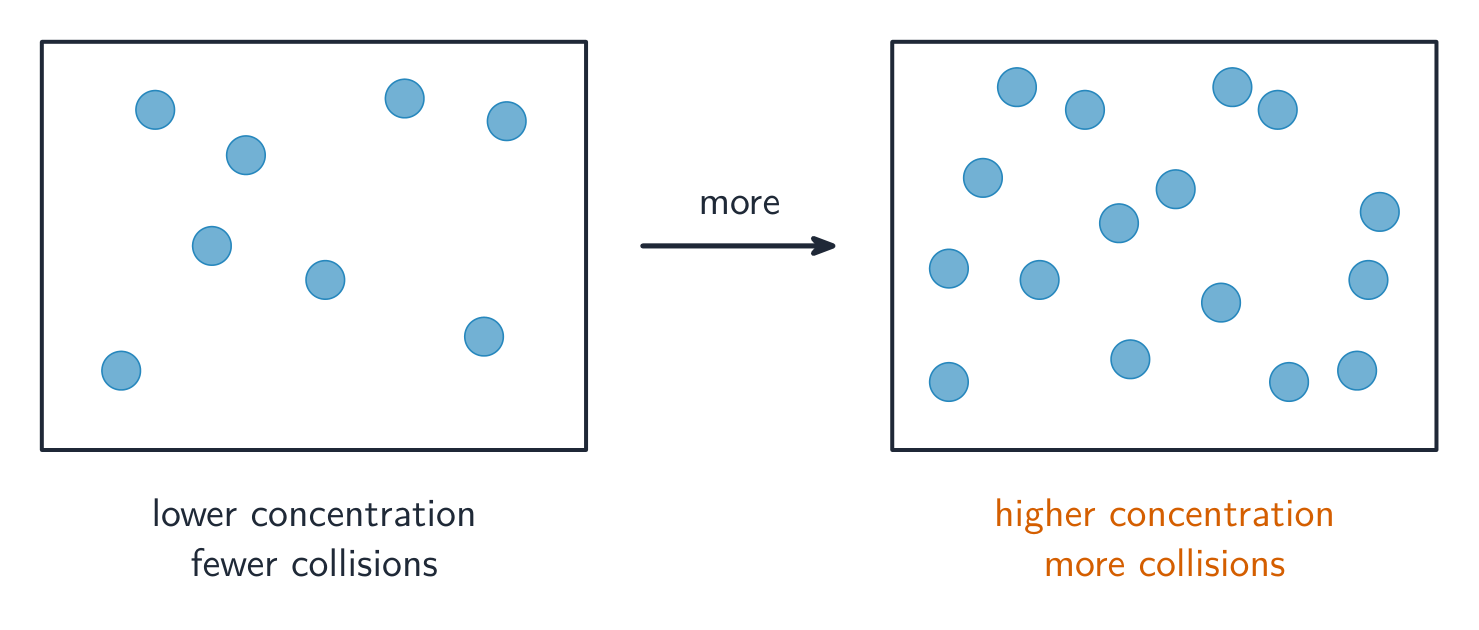
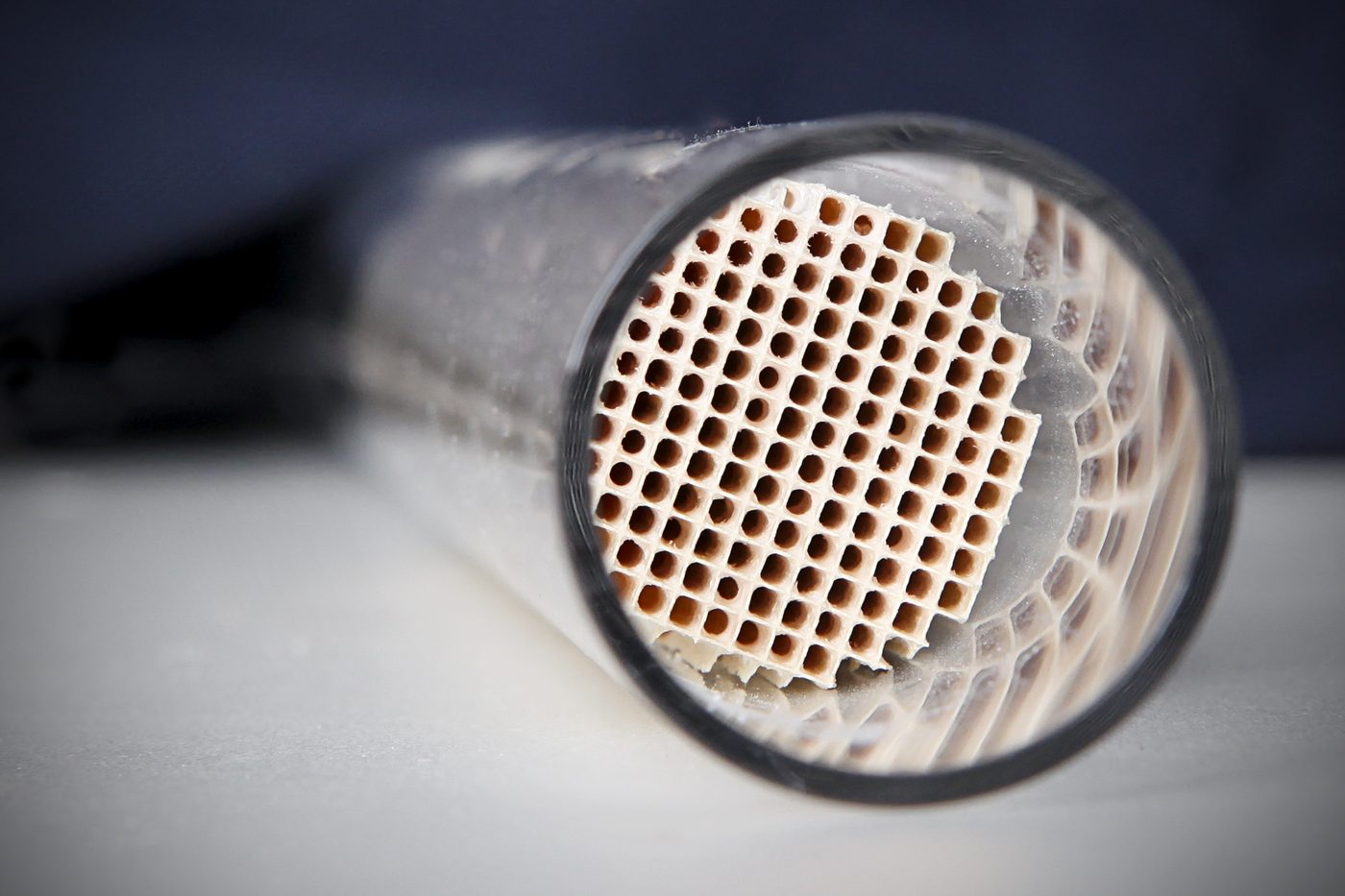
More particles in the same volume collide more often, so the rate rises More particles in the same volume collide more often, so the rate rises

Explore

Change conditions and watch the rate

Reaction rate rises with temperature, concentration, and a catalyst — each gives more frequent or more successful collisions. Change each and watch the reaction speed up.

Vocabulary Train
English Chinese Pinyin
Kinetics 动力学 dòng lì xué
reaction rate 反应速率 fǎn yìng sù lǜ
5.2

Writing the Rate Law

Syllabus
Learning ObjectiveEssential Knowledge

5.2.A
Represent experimental data with a consistent rate law expression.

  • 5.2.A.1 Experimental methods can be used to monitor the amounts of reactants and/or products of a reaction over time and to determine the rate of the reaction.
  • 5.2.A.2 The rate law expresses the rate of a reaction as proportional to the concentration of each reactant raised to a power.
  • 5.2.A.3 The power of each reactant in the rate law is the order of the reaction with respect to that reactant. The sum of the powers of the reactant concentrations in the rate law is the overall order of the reaction.
  • 5.2.A.4 The proportionality constant in the rate law is called the rate constant. The value of this constant is temperature dependent and the units reflect the overall reaction order.
  • 5.2.A.5 Comparing initial rates of a reaction is a method to determine the order with respect to each reactant.

Source: College Board AP Course and Exam Description

The rate law 速率方程 relates rate to reactant concentrations:

$$\text{rate}=k[\text{A}]^m[\text{B}]^n,$$
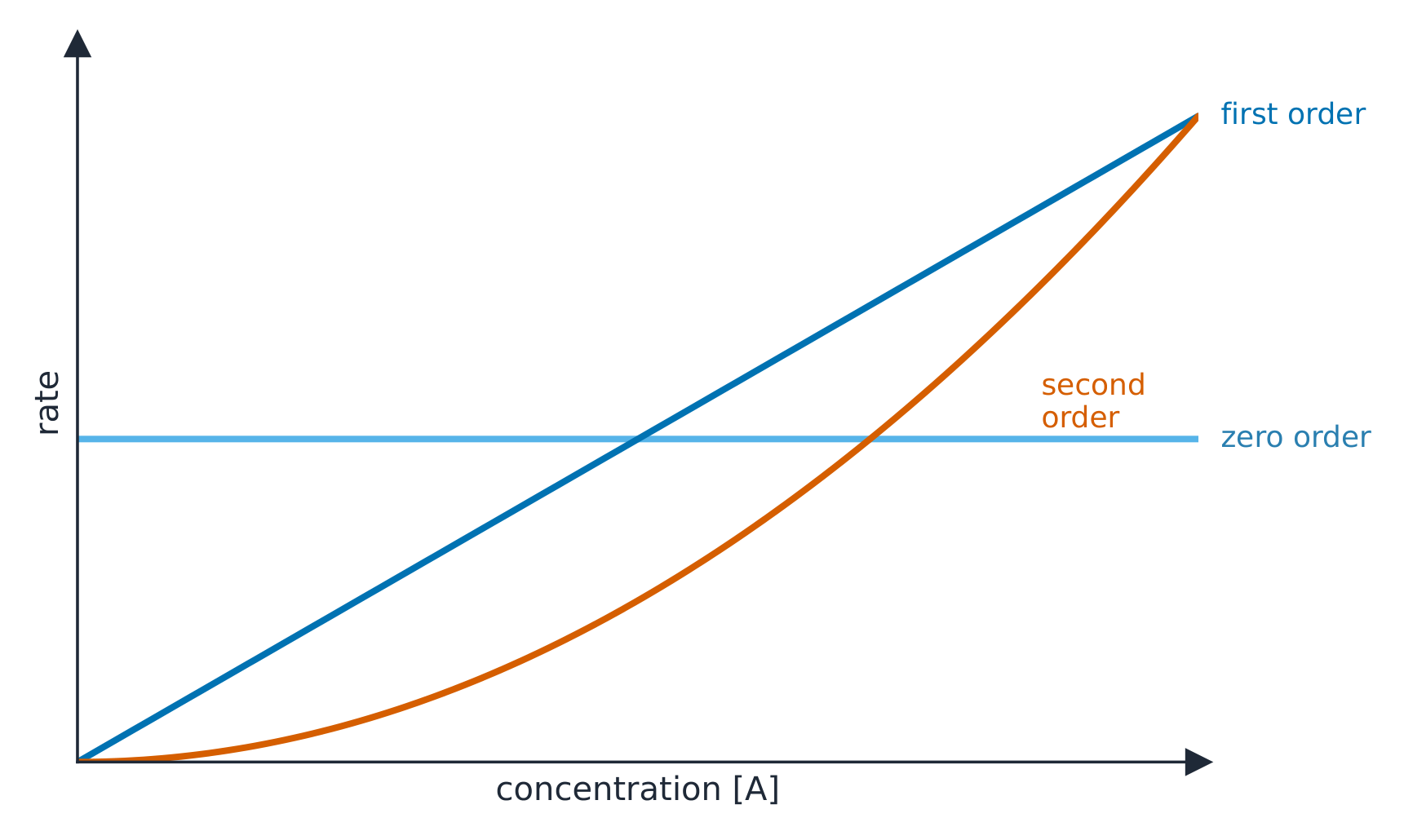
where $k$ is the rate constant 速率常数 and $m,n$ are the orders 级数. Orders are found experimentally (not from the balanced coefficients) by seeing how the rate changes when you change one concentration at a time.

Rate against concentration for zero-, first-, and second-order reactions Rate against concentration for zero-, first-, and second-order reactions

Worked example. In experiments, doubling $[\text{A}]$ makes the rate four times larger, while doubling $[\text{B}]$ leaves the rate unchanged. So the reaction is second order in A ($2^2=4$) and zero order in B, giving $\text{rate}=k[\text{A}]^2$. The overall order is $2+0=2$. Never read the orders off the balanced coefficients – only experiment gives them.

Vocabulary Train
English Chinese Pinyin
rate law 速率方程 sù lǜ fāng chéng
rate constant 速率常数 sù lǜ cháng shù
orders 级数 jí shù
5.3

Concentration Over Time

Syllabus
Learning ObjectiveEssential Knowledge

5.3.A
Identify the rate law expression of a chemical reaction using data that show how the concentrations of reaction species change over time.

  • 5.3.A.1 The order of a reaction can be inferred from a graph of concentration of reactant versus time.
  • 5.3.A.2 If a reaction is first order with respect to a reactant being monitored, a plot of the natural log (ln) of the reactant concentration as a function of time will be linear.
  • 5.3.A.3 If a reaction is second order with respect to a reactant being monitored, a plot of the reciprocal of the concentration of that reactant versus time will be linear.
  • 5.3.A.4 The slopes of the concentration versus time data for zeroth, first, and second order reactions can be used to determine the rate constant for the reaction.
    • Zeroth order:
    • Equation: $[\mathrm{A}]_t - [\mathrm{A}]_0 = -kt$
    • First order:
    • Equation: $\ln[\mathrm{A}]_t - \ln[\mathrm{A}]_0 = -kt$
    • Second order:
    • Equation: $1/[\mathrm{A}]_t - 1/[\mathrm{A}]_0 = kt$
  • 5.3.A.5 Half-life is a critical parameter for first order reactions because the half-life is constant and related to the rate constant for the reaction by the equation:
    • Equation: $t_{1/2} = 0.693/k.$
  • 5.3.A.6 Radioactive decay processes provide an important illustration of first order kinetics.

Source: College Board AP Course and Exam Description

The integrated rate laws describe how concentration falls with time and give straight-line tests:

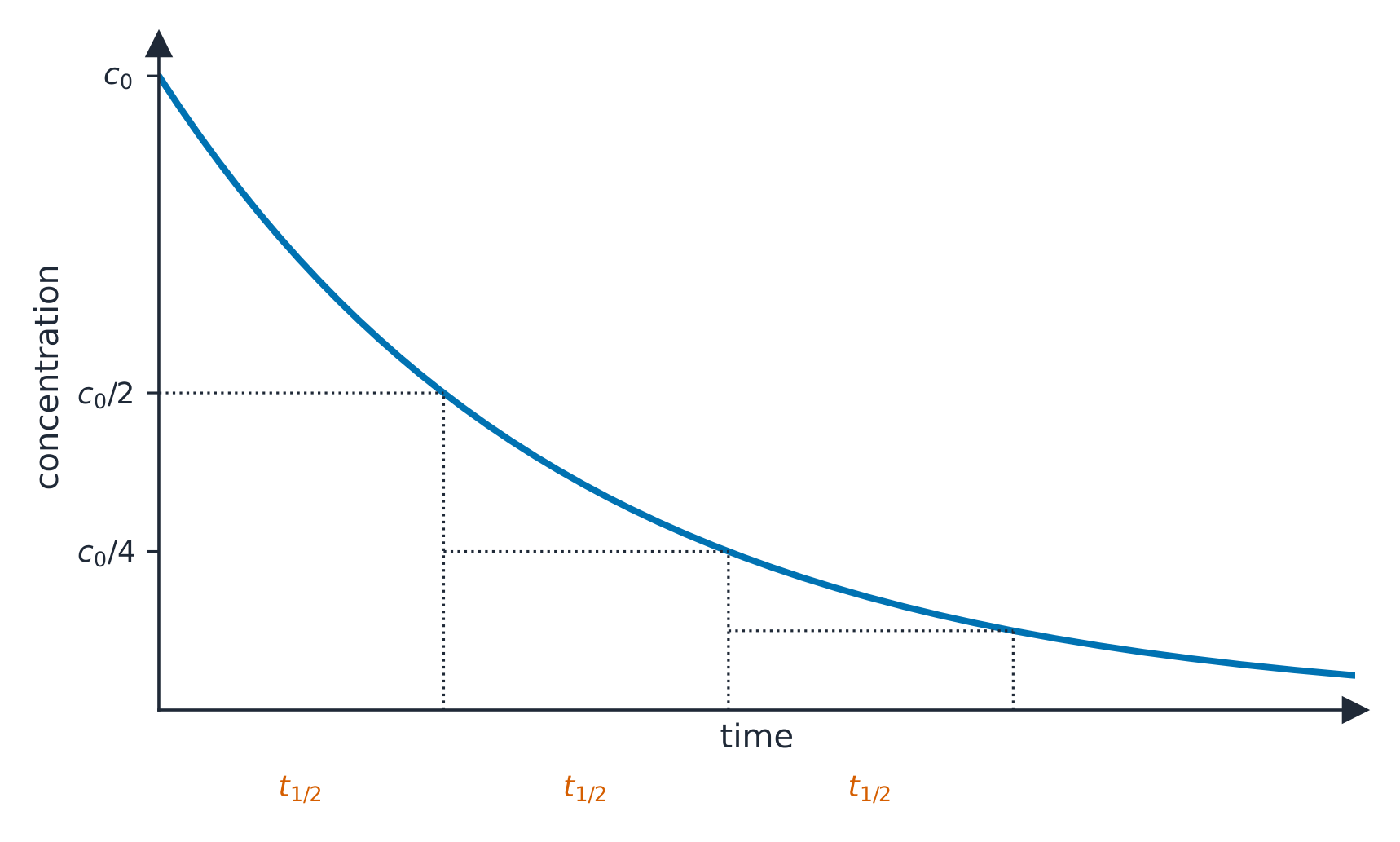
A first-order reaction has a constant half-life A first-order reaction has a constant half-life

  • Zero order: $[\text{A}]$ vs $t$ is linear.
  • First order: $\ln[\text{A}]$ vs $t$ is linear; constant half-life 半衰期.
  • Second order: $\dfrac{1}{[\text{A}]}$ vs $t$ is linear.

Whichever plot is straight tells you the order and gives $k$ from its slope.

Worked example. A first-order reaction has rate constant $k=0.030\ \text{s}^{-1}$. Its half-life is

$$t_{1/2}=\frac{0.693}{k}=\frac{0.693}{0.030}=23\ \text{s},$$
and, being first order, that half-life stays the same no matter how much reactant remains – so after $46\ \text{s}$ ($2$ half-lives) one quarter is left.

Explore

Track concentration as a reaction runs

As reactants are used up the rate slows, so a concentration-time curve is steep at first and flattens out. Raising temperature or adding a catalyst steepens it.

Vocabulary Train
English Chinese Pinyin
half-life 半衰期 bàn shuāi qī
5.4

The Steps a Reaction Really Takes

Syllabus
Learning ObjectiveEssential Knowledge

5.4.A
Represent an elementary reaction as a rate law expression using stoichiometry.

  • 5.4.A.1 The rate law of an elementary reaction can be inferred from the stoichiometry of the particles participating in a collision.
  • 5.4.A.2 Elementary reactions involving the simultaneous collision of three or more particles are rare.

Source: College Board AP Course and Exam Description

A reaction mechanism 反应机理 is the sequence of elementary steps 基元反应 that actually occur. Their molecularity (how many particles collide in a step) sets that step's rate law directly. Species made in one step and used up in a later one are intermediates 中间体.

Vocabulary Train
English Chinese Pinyin
reaction mechanism 反应机理 fǎn yìng jī lǐ
elementary steps 基元反应 jī yuán fǎn yìng
intermediates 中间体 zhōng jiān tǐ
5.5

Why Collisions Do or Do Not React

Syllabus
Learning ObjectiveEssential Knowledge

5.5.A
Explain the relationship between the rate of an elementary reaction and the frequency, energy, and orientation of particle collisions.

  • 5.5.A.1 For an elementary reaction to successfully produce products, reactants must successfully collide to initiate bond-breaking and bond-making events.
  • 5.5.A.2 In most reactions, only a small fraction of the collisions leads to a reaction. Successful collisions have both sufficient energy to overcome the activation energy requirements and orientations that allow the bonds to rearrange in the required manner.
  • 5.5.A.3 The Maxwell-Boltzmann distribution curve describes the distribution of particle energies; this distribution can be used to gain a qualitative estimate of the fraction of collisions with sufficient energy to lead to a reaction, and also how that fraction depends on temperature.

Source: College Board AP Course and Exam Description

Collision theory

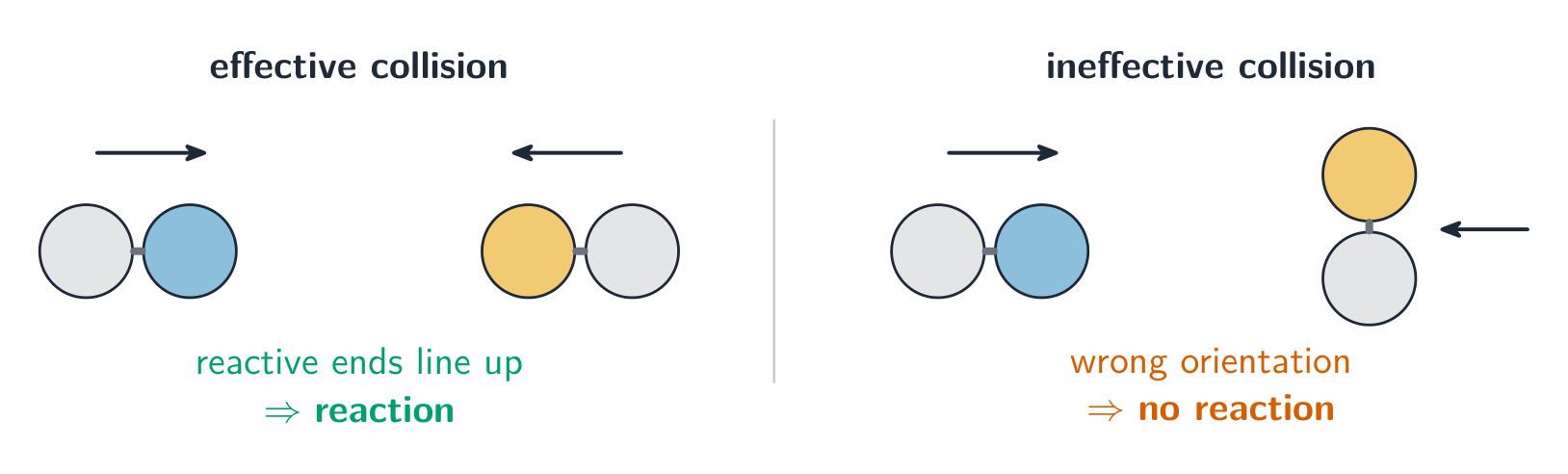
Collision theory 碰撞理论: molecules must collide with enough energy (the activation energy 活化能, $E_a$) and the correct orientation to react. Higher temperature means more molecules exceed $E_a$, so the reaction speeds up sharply.

A collision only reacts with the right orientation and enough energy A collision only reacts with the right orientation and enough energy

Explore

Which molecules clear the activation energy

Only collisions with energy above the activation energy react. Heating shifts the speed distribution right, so a much larger fraction of molecules can react.

Vocabulary Train
English Chinese Pinyin
Collision theory 碰撞理论 pèng zhuàng lǐ lùn
activation energy 活化能 huó huà néng
5.6

Reading an Energy Profile

Syllabus
Learning ObjectiveEssential Knowledge

5.6.A
Represent the activation energy and overall energy change in an elementary reaction using a reaction energy profile.

  • 5.6.A.1 Elementary reactions typically involve the breaking of some bonds and the forming of new ones.
  • 5.6.A.2 The reaction coordinate is the axis along which the complex set of motions involved in rearranging reactants to form products can be plotted.
  • 5.6.A.3 The energy profile gives the energy along the reaction coordinate, which typically proceeds from reactants, through a transition state, to products. The energy difference between the reactants and the transition state is the activation energy for the forward reaction.
  • 5.6.A.4 The rate of an elementary reaction is temperature dependent because the proportion of particle collisions that are energetic enough to reach the transition state varies with temperature. The Arrhenius equation relates the temperature dependence of the rate of an elementary reaction to the activation energy needed by molecular collisions to reach the transition state.
    • Exclusion statement: Calculations involving the Arrhenius equation will not be assessed on the AP Exam.

Source: College Board AP Course and Exam Description

Reaction energy profile

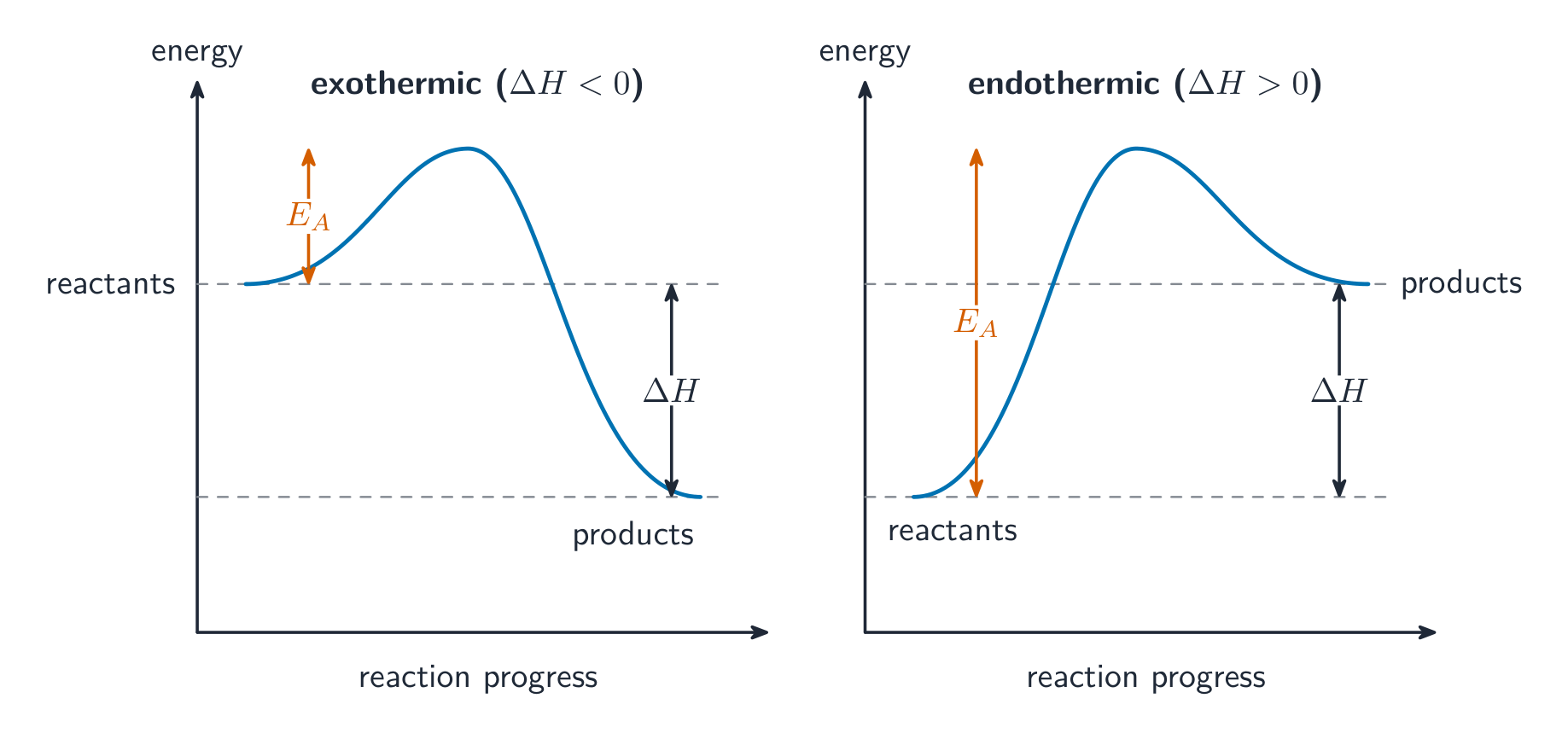
An energy profile 能量图 plots energy along the reaction path. The peak is the transition state 过渡态; the climb from reactants to the peak is $E_a$; the difference between reactant and product energies is the enthalpy change $\Delta H$ (down for exothermic).

Exothermic reactions end lower than the reactants; endothermic end higher Exothermic reactions end lower than the reactants; endothermic end higher

Explore

Read activation energy off the profile

An energy profile plots energy along the reaction. The hump is the activation energy; the drop from reactants to products is $\Delta H$. A catalyst lowers the hump.

Vocabulary Train
English Chinese Pinyin
energy profile 能量图 néng liàng tú
transition state 过渡态 guò dù tài
5.7

The Sequence of Steps

Syllabus
Learning ObjectiveEssential Knowledge

5.7.A
Identify the components of a reaction mechanism.

  • 5.7.A.1 A reaction mechanism consists of a series of elementary reactions, or steps, that occur in sequence. The components may include reactants, intermediates, products, and catalysts.
  • 5.7.A.2 The elementary steps when combined should align with the overall balanced equation of a chemical reaction.
  • 5.7.A.3 A reaction intermediate is produced by some elementary steps and consumed by others, such that it is present only while a reaction is occurring.
  • 5.7.A.4 Experimental detection of a reaction intermediate is a common way to build evidence in support of one reaction mechanism over an alternative mechanism.
    • Exclusion statement: Collection of data pertaining to detection of a reaction intermediate will not be assessed on the AP Exam.

Source: College Board AP Course and Exam Description

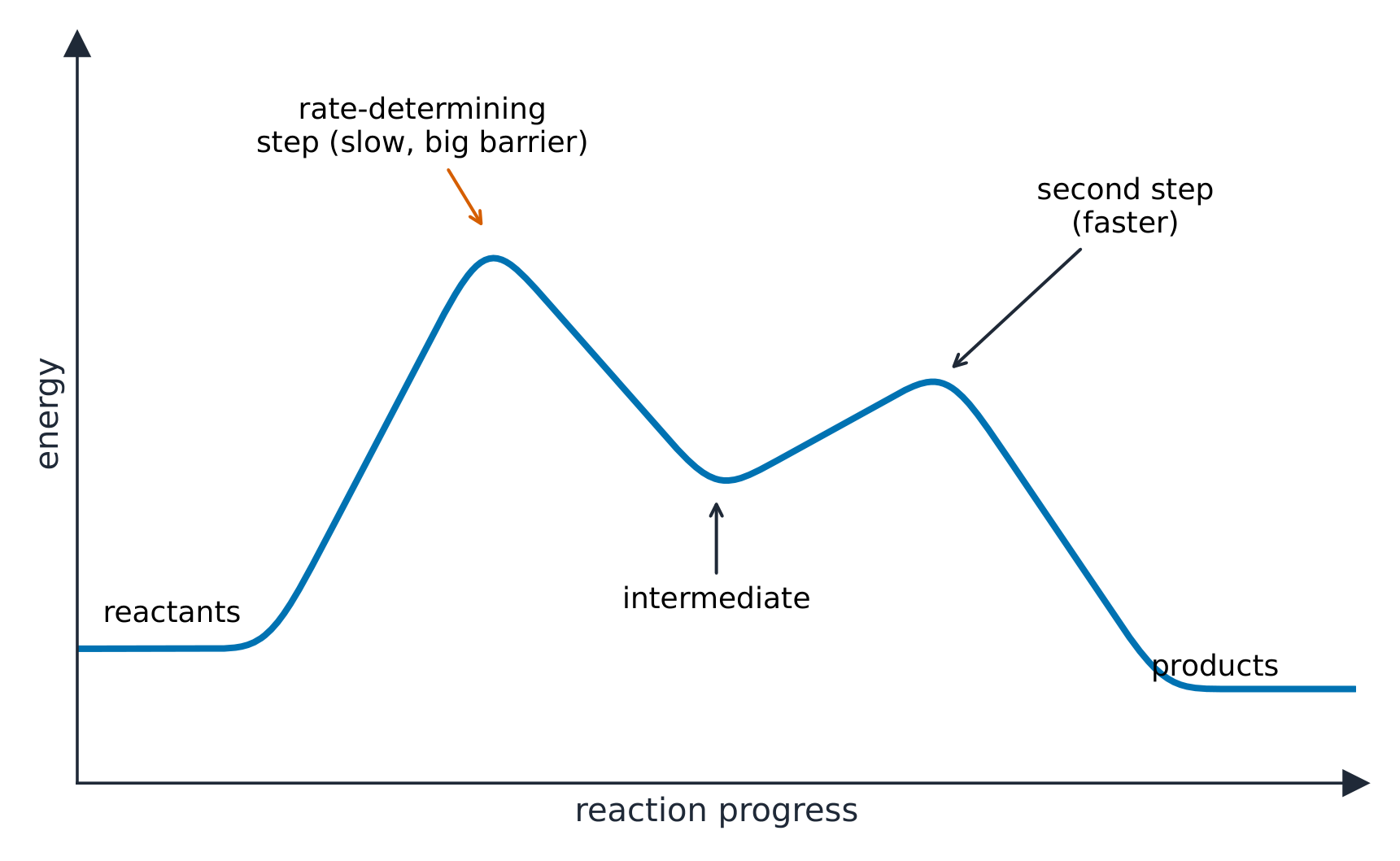
In a multi-step mechanism, the steps must add up to the overall balanced equation (intermediates cancel). Each step has its own energy hill; the tallest hill is the slowest step.

The slow step with the higher barrier is rate-determining The slow step with the higher barrier is rate-determining

5.8

Finding the Rate Law From a Mechanism

Syllabus
Learning ObjectiveEssential Knowledge

5.8.A
Identify the rate law for a reaction from a mechanism in which the first step is rate limiting.

  • 5.8.A.1 For reaction mechanisms in which each elementary step is irreversible, or in which the first step is rate limiting, the rate law of the reaction is set by the molecularity of the slowest elementary step (i.e., the rate-limiting step).
    • Exclusion statement: Collection of data pertaining to detection of a reaction intermediate will not be assessed on the AP Exam.

Source: College Board AP Course and Exam Description

The rate-determining step 决速步骤 is the slowest step; its molecularity gives the overall rate law. A valid mechanism must (1) add to the overall reaction and (2) predict the experimentally observed rate law.

Worked example. Suppose the slow (rate-determining) step is the bimolecular collision $\text{NO}_2+\text{NO}_2\rightarrow\text{NO}_3+\text{NO}$. Its molecularity gives the rate law directly: $\text{rate}=k[\text{NO}_2]^2$. If experiment shows exactly this, the proposed mechanism is consistent; if experiment gave $\text{rate}=k[\text{NO}_2]$, the mechanism would be wrong.

Vocabulary Train
English Chinese Pinyin
rate-determining step 决速步骤 jué sù bù zhòu
5.9

When the First Step Is Fast

Syllabus
Learning ObjectiveEssential Knowledge

5.9.A
Identify the rate law for a reaction from a mechanism in which the first step is not rate limiting.

  • 5.9.A.1 If the first elementary reaction is not rate limiting, approximations (such as pre-equilibrium) must be made to determine a rate law expression.

Source: College Board AP Course and Exam Description

If a fast step precedes the slow one, an intermediate appears in the slow step's rate law. Use the fast pre-equilibrium to rewrite that intermediate in terms of reactants, so the final rate law contains only measurable species.

5.10

Energy Profiles for Many Steps

Syllabus
Learning ObjectiveEssential Knowledge

5.10.A
Represent the activation energy and overall energy change in a multistep reaction with a reaction energy profile.

  • 5.10.A.1 Knowledge of the energetics of each elementary reaction in a mechanism allows for the construction of an energy profile for a multistep reaction.

Source: College Board AP Course and Exam Description

A multi-step reaction's profile shows several peaks (one per step) with valleys (intermediates) between them. The highest peak is the rate-determining transition state – it controls the overall rate.

5.11

How Catalysts Speed Things Up
Syllabus
Learning ObjectiveEssential Knowledge

5.11.A
Explain the relationship between the effect of a catalyst on a reaction and changes in the reaction mechanism.

  • 5.11.A.1 In order for a catalyst to increase the rate of a reaction, the addition of the catalyst must increase the number of effective collisions and/or provide a reaction path with a lower activation energy relative to the original reaction coordinate.
  • 5.11.A.2 In a reaction mechanism containing a catalyst, the net concentration of the catalyst is constant. However, the catalyst will frequently be consumed in the rate-determining step of the reaction, only to be regenerated in a subsequent step in the mechanism.
  • 5.11.A.3 Some catalysts accelerate a reaction by binding to the reactant(s). The reactants are either oriented more favorably or react with lower activation energy. There is often a new reaction intermediate in which the catalyst is bound to the reactant(s). Many enzymes function in this manner.
  • 5.11.A.4 Some catalysts involve covalent bonding between the catalyst and the reactant(s). An example is acid-base catalysis, in which a reactant or intermediate either gains or loses a proton. This introduces a new reaction intermediate and new elementary reactions involving that intermediate.
  • 5.11.A.5 In surface catalysis, a reactant or intermediate binds to, or forms a covalent bond with, the surface. This introduces elementary reactions involving these new bound reaction intermediate(s).

Source: College Board AP Course and Exam Description

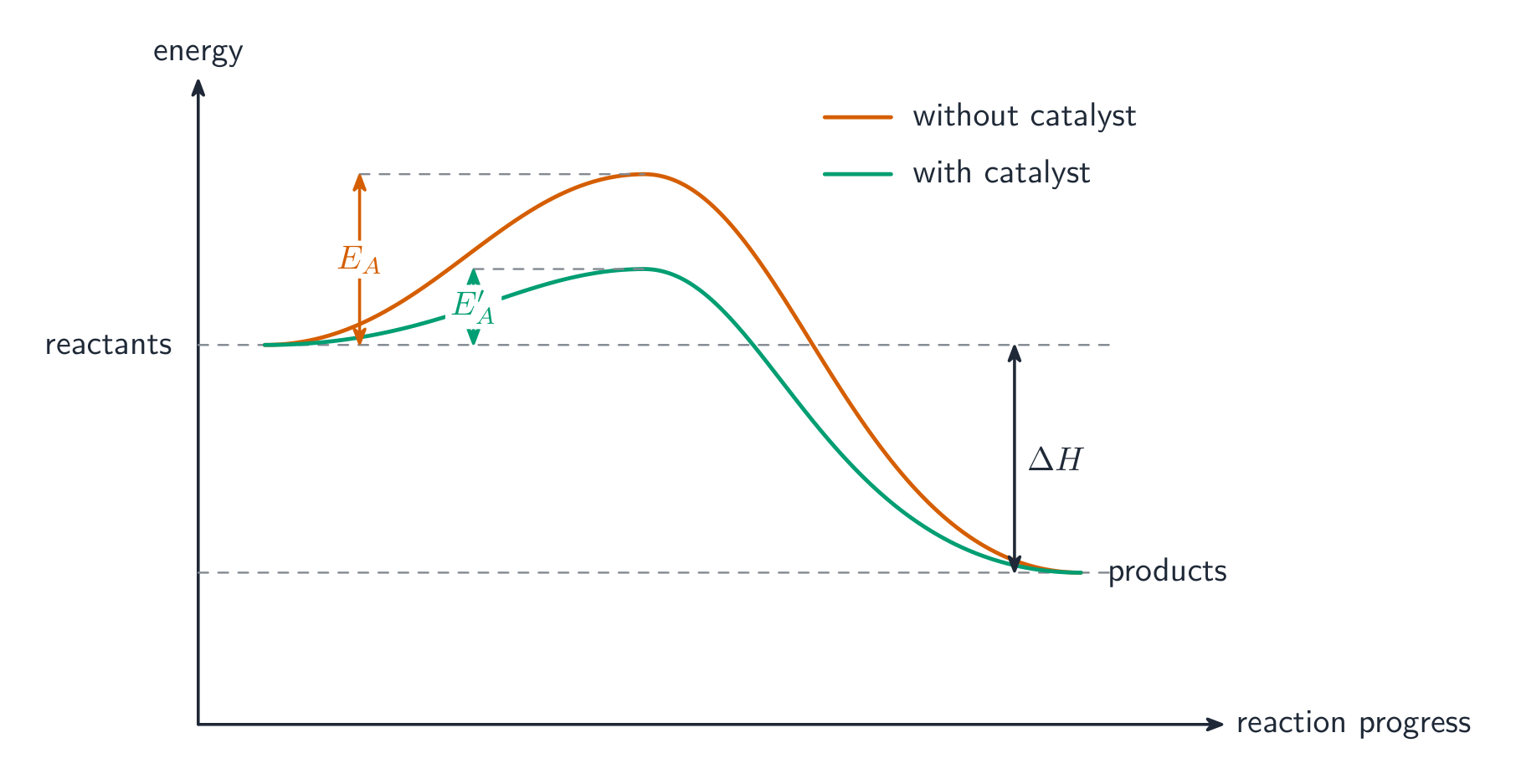
A catalyst 催化剂 speeds a reaction by providing a new pathway with a lower activation energy, without being consumed. It does not change $\Delta H$ or the equilibrium position – only how fast equilibrium is reached. On an energy profile, a catalyst lowers the peak(s).

A catalyst gives a route with lower activation energy; the enthalpy change is unchanged A catalyst gives a route with lower activation energy; the enthalpy change is unchanged

Vocabulary Train
English Chinese Pinyin
catalyst 催化剂 cuī huà jì
5.11

Exam tips

  • Rate rises with concentration, temperature, surface area, and a catalyst — explain each with collision theory (more, or more energetic, successful collisions).
  • Temperature works mainly by getting more particles above the activation energy, not just more collisions.
  • Reaction orders come from experiment, not the balanced coefficients — see how the rate changes when one concentration is varied.
  • On an energy profile the hill height is the activation energy and the reactant–product gap is $\Delta H$.
  • A catalyst lowers the activation energy (a new pathway) but leaves $\Delta H$ and the equilibrium position unchanged.

Log in or create account

IGCSE & A-Level