| Learning Objective | Essential Knowledge |
|---|---|
4.1.A |
|
Chemical Reactions
AP Chemistry · Topic 4
 7:42
7:42
Chemical Reactions
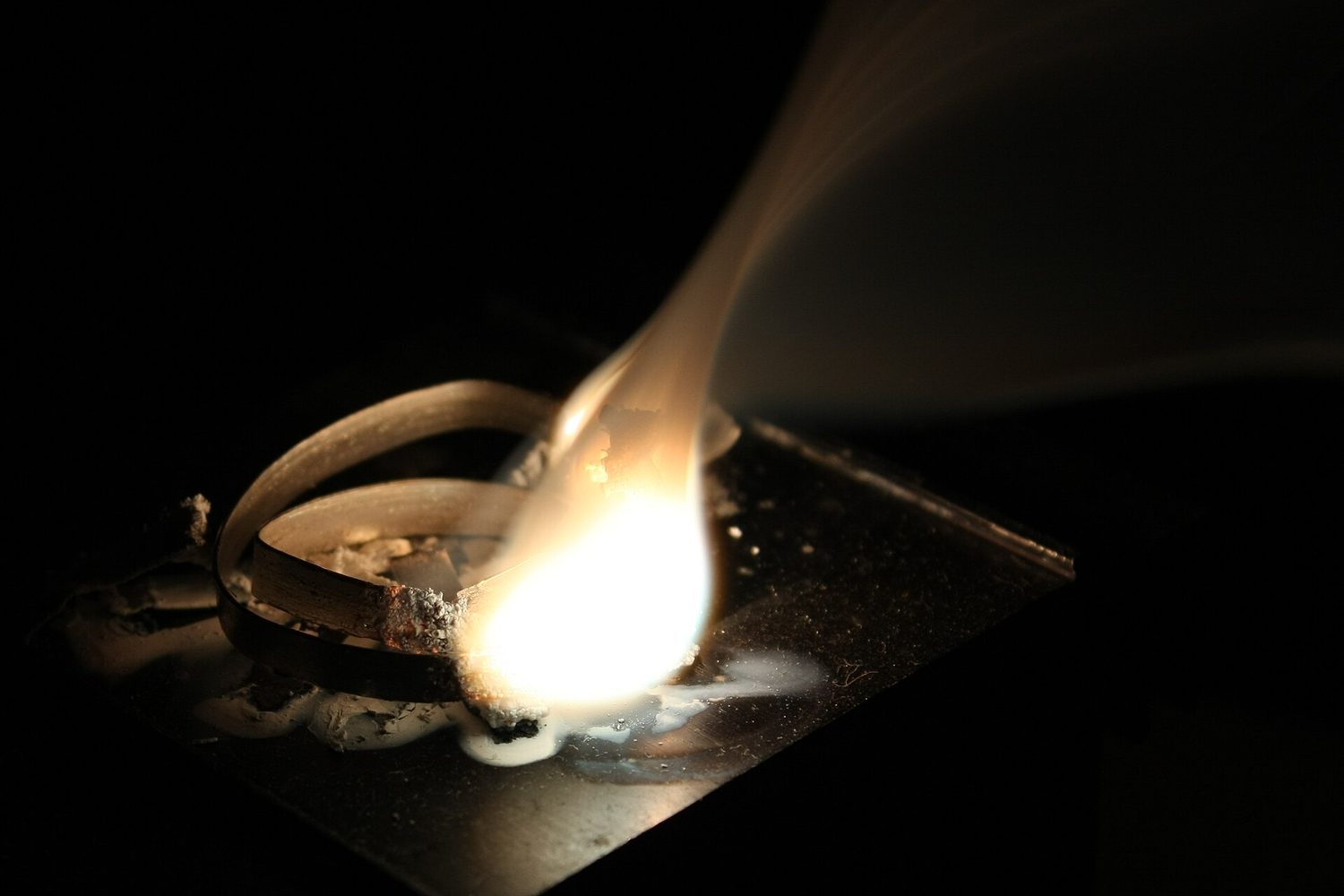
A strip of magnesium metal. Touch it with a flame and it burns — combustion — with a light too bright to look at. What is left is not magnesium any more. It is…
English narration · English + 中文 subtitles burned in
4.1
Recognizing a Chemical Reaction
Syllabus
Source: College Board AP Course and Exam Description
A chemical reaction 化学反应 rearranges atoms into new substances. Signs one has happened: a color change, a gas or precipitate 沉淀 forming, or a temperature change. Atoms are conserved, so an equation must be balanced – the same count of each element on both sides.
Vocabulary
Train
| English |
|---|
| chemical reaction/ˈkemɪkl rɪˈækʃn/ |
| precipitate/prɪˈsɪpɪteɪt/ |
4.2
Net Ionic Equations
Syllabus
| Learning Objective | Essential Knowledge |
|---|---|
4.2.A |
|
Source: College Board AP Course and Exam Description
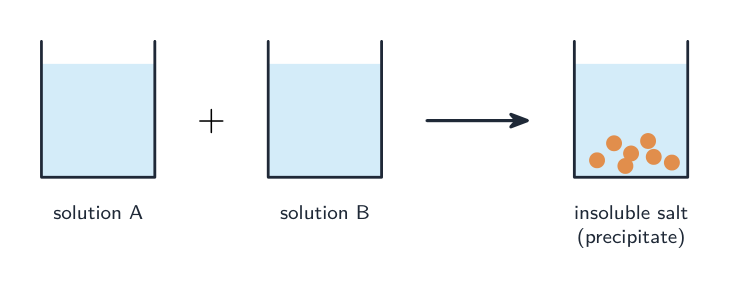
For reactions in water, ionic compounds split into ions. A net ionic equation 净离子方程式 shows only the species that actually change, leaving out the spectator ions 旁观离子 that appear unchanged on both sides. It captures the real chemistry (e.g. $\text{Ag}^+ + \text{Cl}^- \rightarrow \text{AgCl}(s)$).
Vocabulary
Train
| English |
|---|
| net ionic equation/net aɪˈɒnɪk ɪˈkweɪʒn/ |
| spectator ions/spekˈteɪtə ˈaɪɒnz/ |
4.3
Three Ways to Represent a Reaction
Syllabus
| Learning Objective | Essential Knowledge |
|---|---|
4.3.A |
|
Source: College Board AP Course and Exam Description
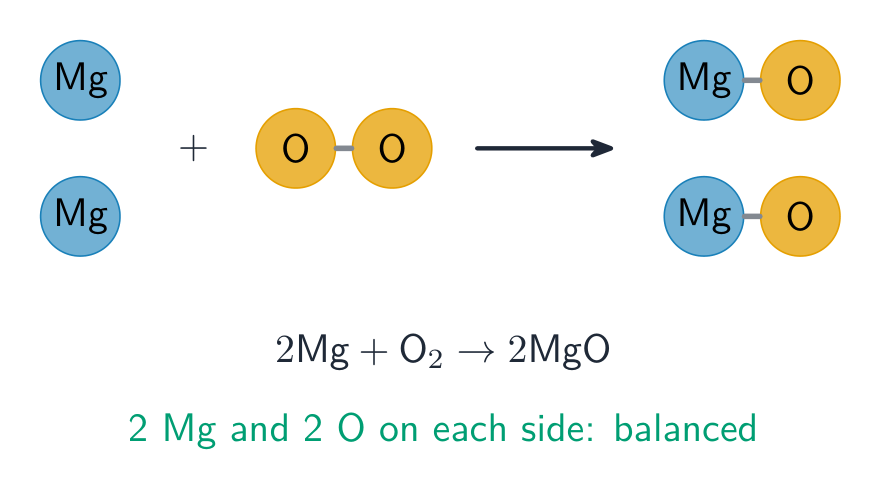
The same reaction can be shown as a symbolic equation, a particulate drawing (atoms and molecules), and a macroscopic observation (what you see). Moving between these levels – connecting the equation to the particles to the beaker – is a core skill.
4.4
Physical Changes versus Chemical Changes
Syllabus
| Learning Objective | Essential Knowledge |
|---|---|
4.4.A |
|
Source: College Board AP Course and Exam Description
A physical change 物理变化 alters form but not identity (melting, dissolving); a chemical change 化学变化 makes new substances by breaking and forming bonds. Dissolving salt is physical; the salt is unchanged and recoverable.
Vocabulary
Train
| English |
|---|
| physical change/ˈfɪzɪkl tʃeɪndʒ/ |
| chemical change/ˈkemɪkl tʃeɪndʒ/ |
4.5
Stoichiometry
Syllabus
| Learning Objective | Essential Knowledge |
|---|---|
4.5.A |
|
Source: College Board AP Course and Exam Description
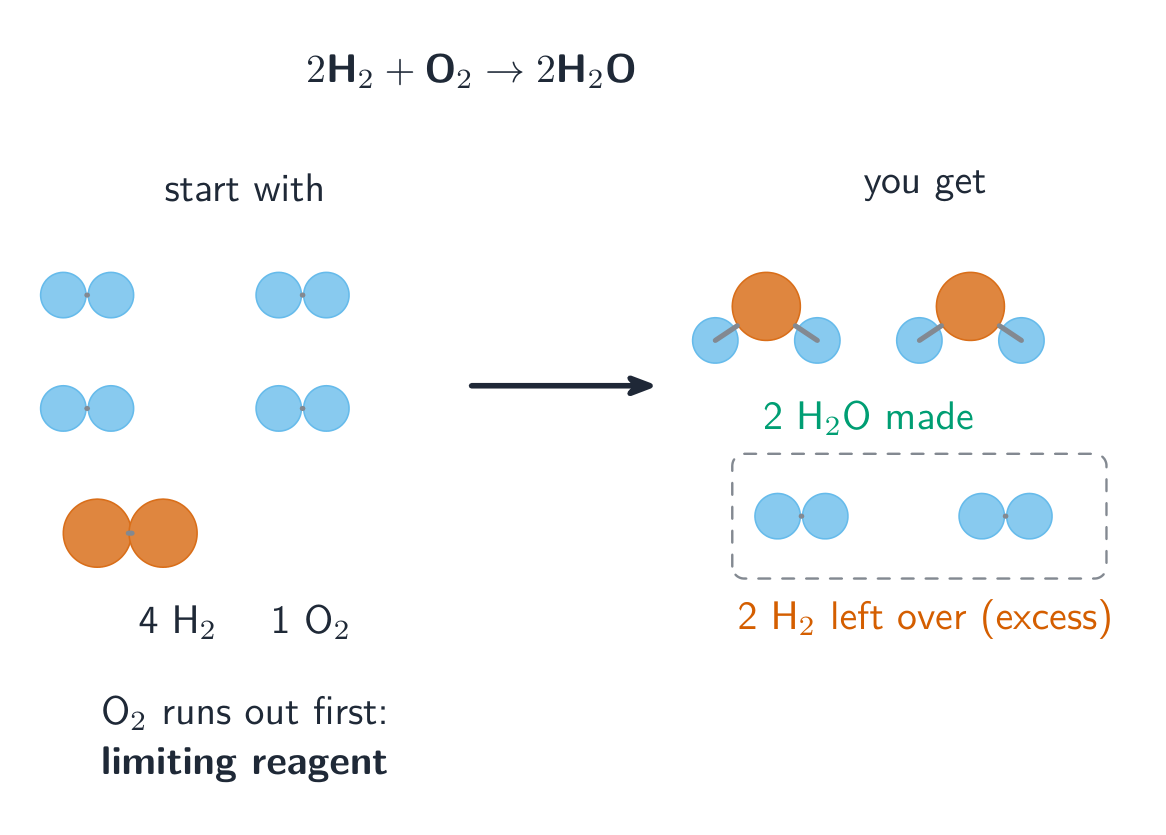
Stoichiometry 化学计量 uses the balanced equation's mole ratios to relate amounts of reactants and products. The path is always grams → moles → (mole ratio) → moles → grams. The limiting reactant 限量反应物 runs out first and sets the maximum product (the theoretical yield 理论产量); the percent yield compares actual to theoretical.
Worked example. How much water forms when $4.0\ \text{g}$ of hydrogen burns in excess oxygen? $2\text{H}_2+\text{O}_2\rightarrow2\text{H}_2\text{O}$. Convert to moles, cross the mole ratio ($2:2=1:1$ here), convert back:
$$n(\text{H}_2)=\frac{4.0}{2.0}=2.0\ \text{mol}\;\Rightarrow\;n(\text{H}_2\text{O})=2.0\ \text{mol}\;\Rightarrow\;m=2.0\times18=36\ \text{g}.$$
Worked example (limiting reactant). $10.0\ \text{g}$ of N$_2$ reacts with $5.0\ \text{g}$ of H$_2$ ($\text{N}_2+3\text{H}_2\rightarrow2\text{NH}_3$). Which runs out? Moles: $n(\text{N}_2)=10.0/28=0.36$, $n(\text{H}_2)=5.0/2=2.5$. The reaction needs $3$ H$_2$ per N$_2$; you have $2.5/0.36=7.0$, far more than $3$, so N$_2$ is limiting. It makes $2\times0.36=0.72\ \text{mol}$ of ammonia, with hydrogen left over.
Explore
Scale reactants and products by the mole ratio
A balanced equation fixes the mole ratio between species. Product amount is proportional to the limiting reactant, scaled by that ratio.
Vocabulary
Train
| English |
|---|
| Stoichiometry/ˌstəʊɪkɪˈɒmətri/ |
| limiting reactant/ˈlɪmɪtɪŋ rɪˈæktənt/ |
| theoretical yield/θɪəˈretɪkl jiːld/ |
4.6
Introduction to Titration
Syllabus
| Learning Objective | Essential Knowledge |
|---|---|
4.6.A |
|
Source: College Board AP Course and Exam Description
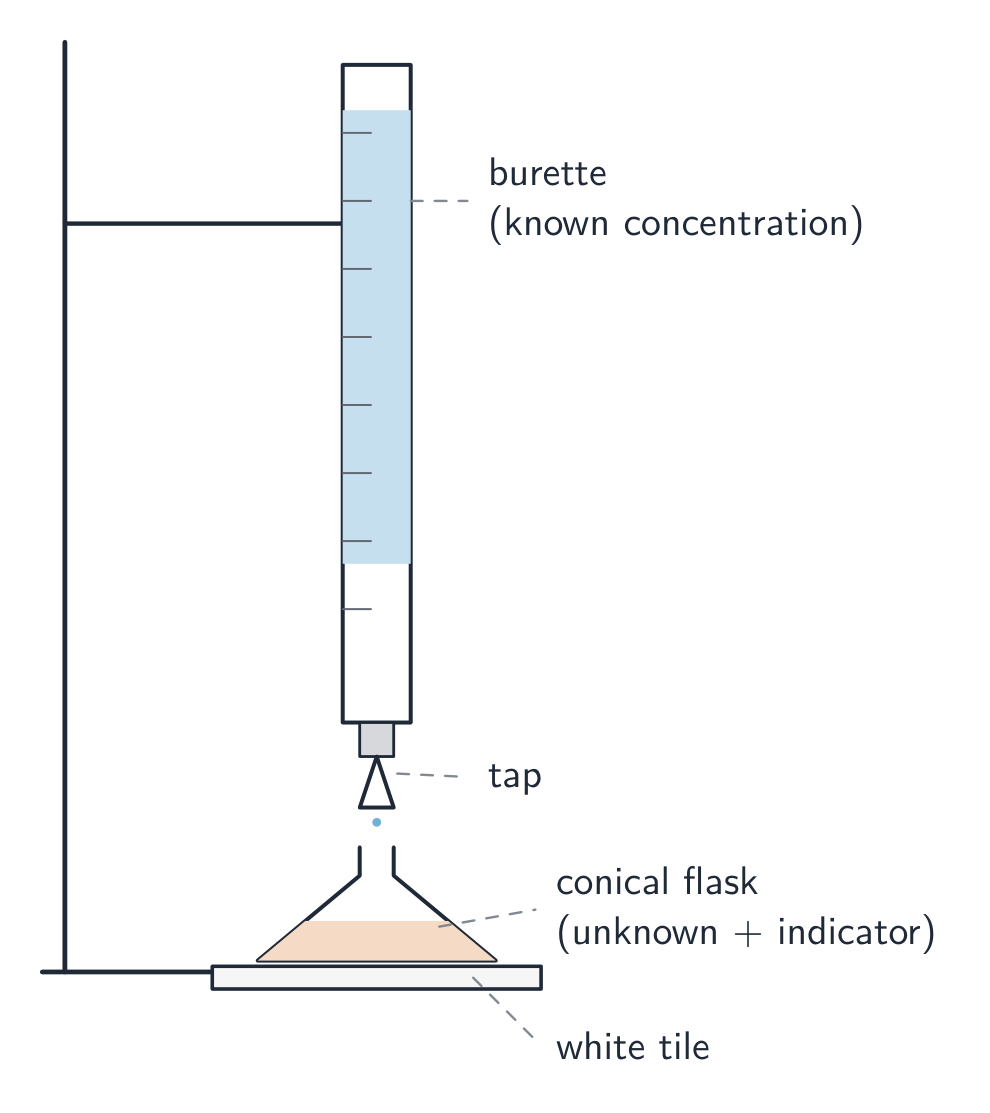
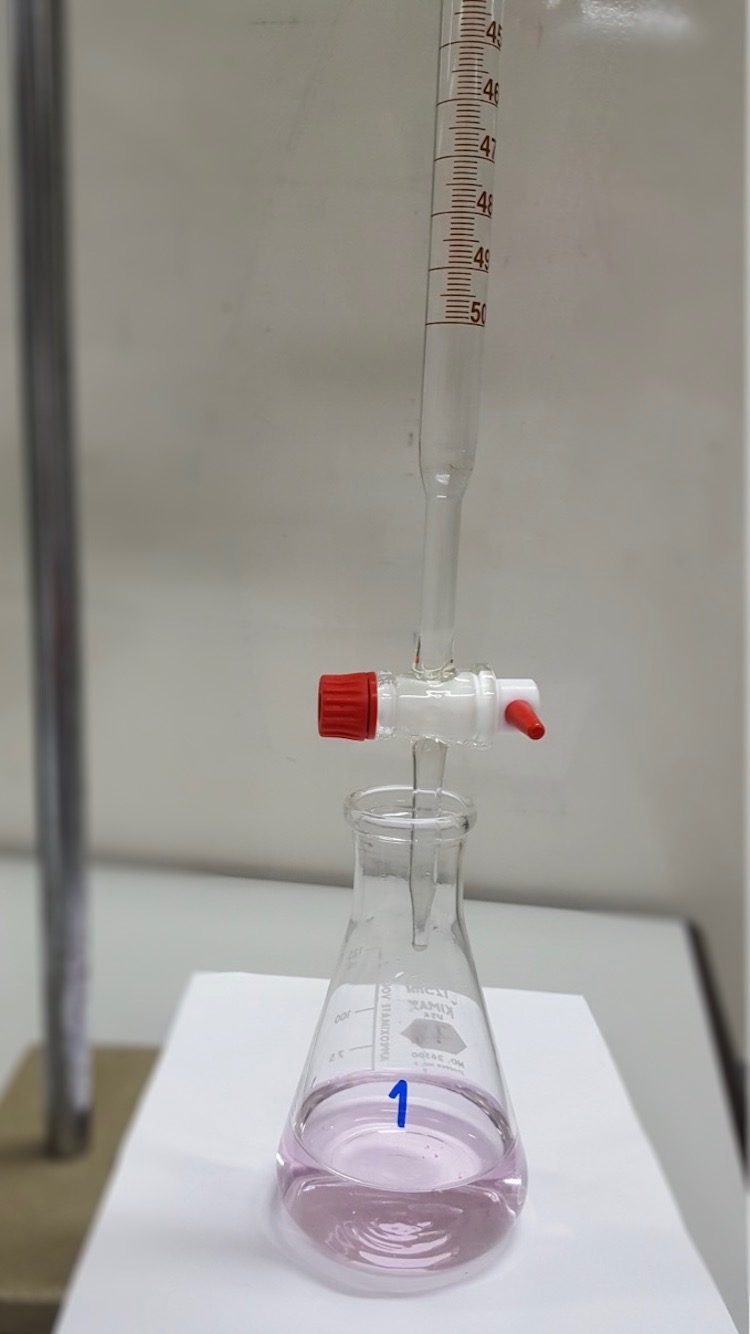
A titration 滴定 finds an unknown concentration by reacting it with a solution of known concentration until they reach the equivalence point 等当点 (stoichiometrically equal). From the known volume and concentration, use the mole ratio to find the unknown. An indicator or a pH curve signals the endpoint.
Worked example. $25.0\ \text{mL}$ of hydrochloric acid is exactly neutralized by $30.0\ \text{mL}$ of $0.100\ \text{M}$ NaOH. Find the acid's concentration. The reaction is $1:1$, so the moles match:
$$n(\text{NaOH})=0.0300\times0.100=3.00\times10^{-3}\ \text{mol}=n(\text{HCl}),\qquad [\text{HCl}]=\frac{3.00\times10^{-3}}{0.0250}=0.120\ \text{M}.$$
Explore
Titrate an acid and find the equivalence point
Adding base to acid raises the pH slowly, then sharply at the equivalence point where moles of acid and base are equal. The steep jump locates that volume.
Vocabulary
Train
| English |
|---|
| titration/taɪˈtreɪʃn/ |
| equivalence point/ɪˈkwɪvələns pɔɪnt/ |
4.7
Types of Chemical Reactions
Syllabus
| Learning Objective | Essential Knowledge |
|---|---|
4.7.A |
|
Source: College Board AP Course and Exam Description
Common patterns include synthesis (combining), decomposition (breaking apart), combustion (with oxygen, releasing energy), precipitation (forming an insoluble solid), acid–base (proton transfer), and redox (electron transfer). Recognizing the type helps predict the products.
4.8
Acid-Base Reactions
Syllabus
| Learning Objective | Essential Knowledge |
|---|---|
4.8.A |
|
Source: College Board AP Course and Exam Description
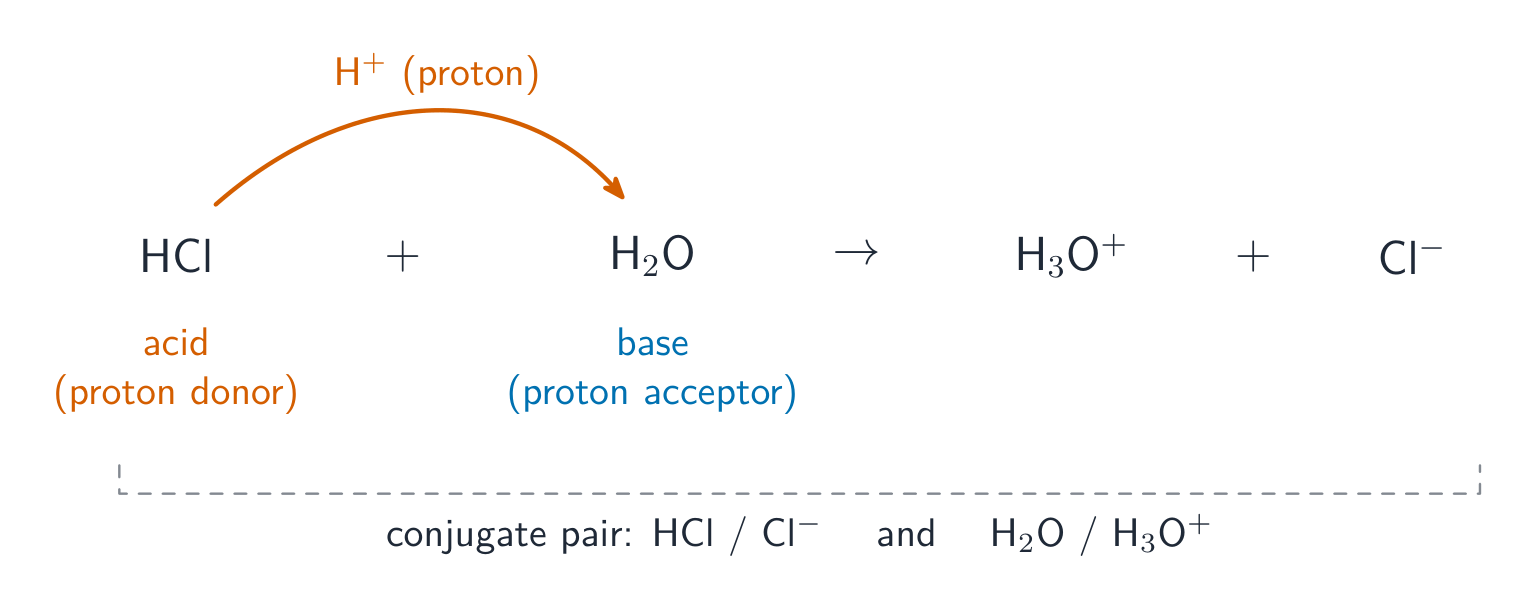
An acid 酸 donates a proton ($\text{H}^+$); a base 碱 accepts one (Brønsted–Lowry). They react to form water and a salt: $\text{H}^+ + \text{OH}^- \rightarrow \text{H}_2\text{O}$. Strong acids and bases dissociate completely; weak ones only partly.
Explore
Move along the pH scale
pH measures how acidic or basic a solution is. Each step of 1 pH is a tenfold change in hydrogen-ion concentration; 7 is neutral, below is acidic, above is basic.
Vocabulary
Train
| English |
|---|
| acid/ˈæsɪd/ |
| base/beɪs/ |
4.9
Oxidation-Reduction (Redox) Reactions
Syllabus
| Learning Objective | Essential Knowledge |
|---|---|
4.9.A |
|
Source: College Board AP Course and Exam Description
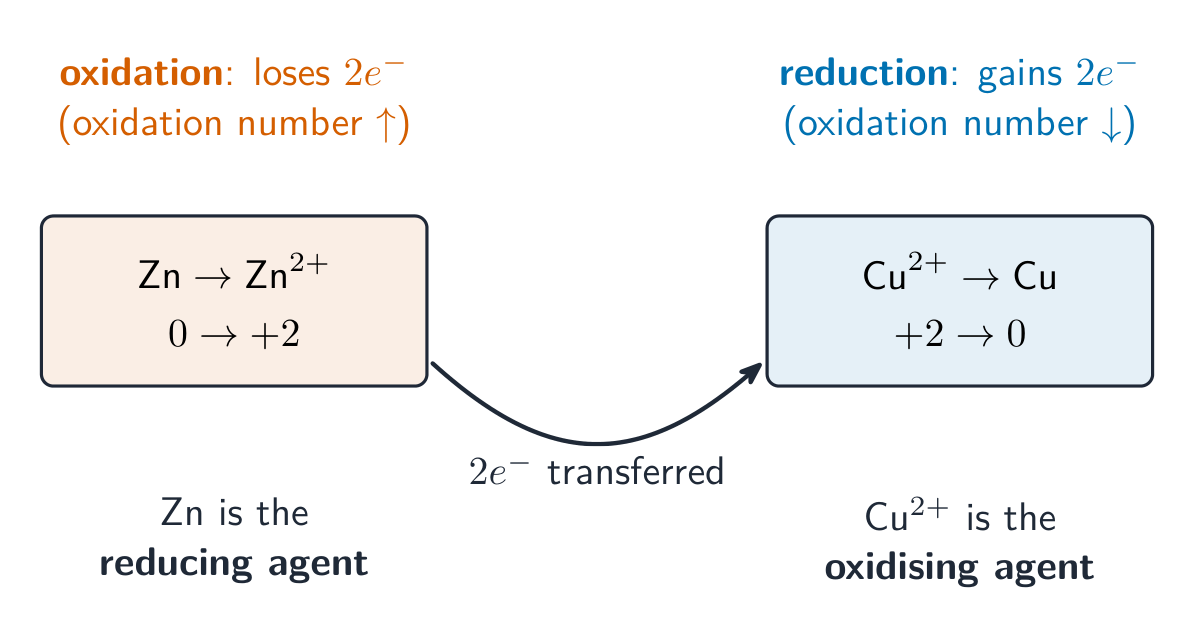
In a redox 氧化还原 reaction, electrons transfer between species. Oxidation 氧化 is loss of electrons (oxidation number rises); reduction 还原 is gain (oxidation number falls). Track changes with oxidation numbers, and remember every oxidation is paired with a reduction – the electrons lost equal the electrons gained.
Worked example. Find the oxidation number of manganese in permanganate, $\text{KMnO}_4$. Potassium is $+1$ and each oxygen is $-2$ (four of them, $-8$). The whole formula is neutral, so $(+1)+\text{Mn}+(-8)=0$, giving $\text{Mn}=+7$ – its maximum, which is why permanganate is a powerful oxidizing agent (it can only gain electrons).
Explore
Watch electrons transfer in a redox reaction
In a redox reaction one species is oxidised (loses electrons) and another is reduced (gains them). Follow the electrons move from the metal to the non-metal.
Vocabulary
Train
| English |
|---|
| redox/rɪˈdɒks/ |
| Oxidation/ˌɒksɪˈdeɪʃn/ |
| reduction/rɪˈdʌkʃn/ |
4.9
Exam tips
- Balance every equation and work in moles — convert grams→moles, cross the mole ratio, then convert back.
- Find the limiting reactant by comparing mole ratios; it sets the maximum product (theoretical yield).
- In redox, remember OIL RIG: oxidation is loss of electrons, reduction is gain; every oxidation is paired with a reduction.
- For titrations use the balanced ratio to link the known and unknown at the equivalence point.
- A net ionic equation shows only the species that change; leave out spectator ions.
Interactive lessons on this topic
Work through it step by step, with instant-check exercises.