| Learning Objective | Essential Knowledge |
|---|---|
3.1.A |
|
Properties of Substances and Mixtures
AP Chemistry · Topic 3
 10:54
10:54
Properties of Substances and Mixtures
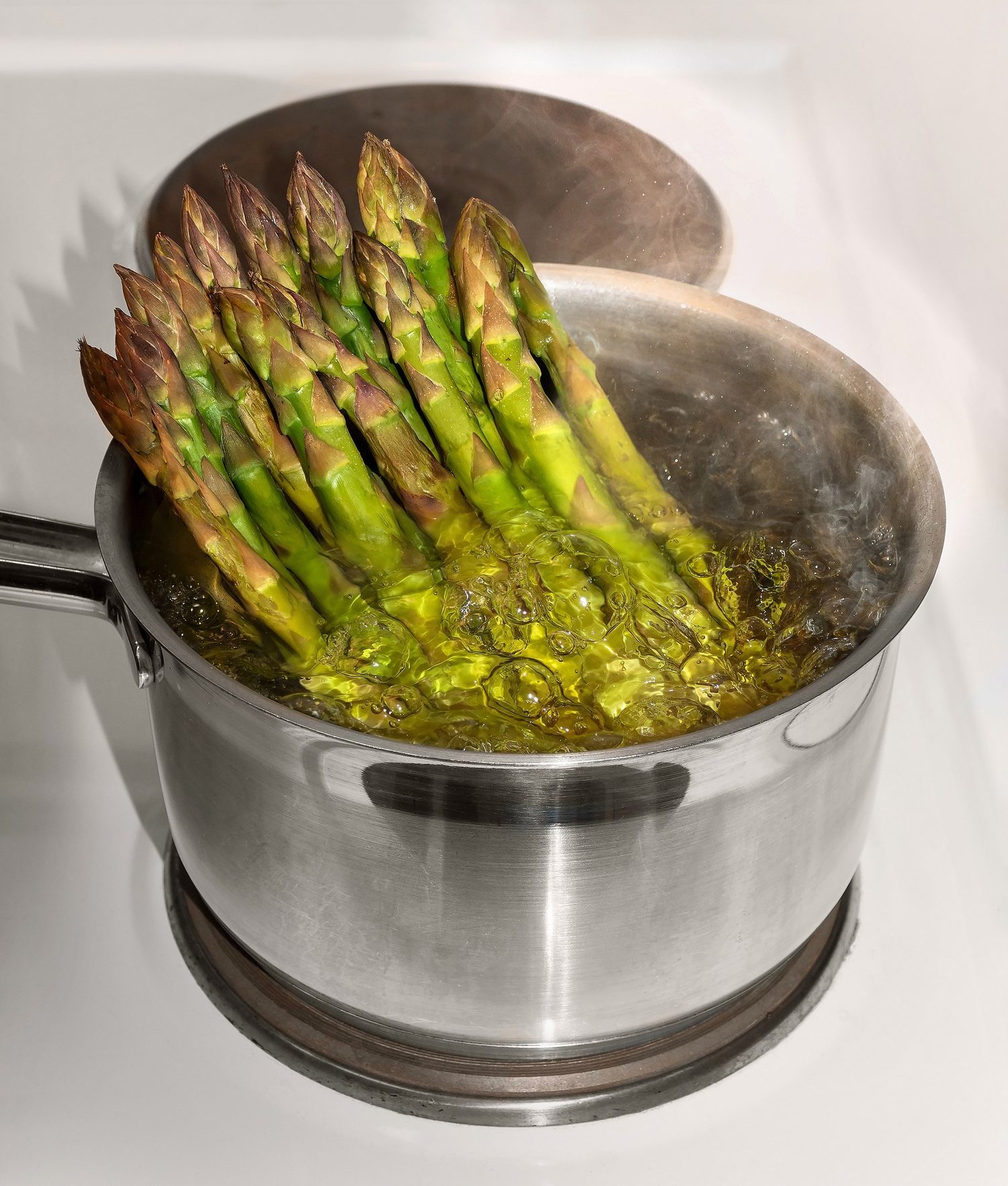
Boiling water. To make steam you must reach one hundred degrees Celsius. Methane has almost the same mass, and boils at minus one hundred and sixty-two.…
English narration · English + 中文 subtitles burned in
3.1
Intermolecular and Interparticle Forces
Syllabus
Source: College Board AP Course and Exam Description
Intermolecular forces 分子间作用力 (IMFs) are attractions between molecules – much weaker than bonds, but they set melting/boiling points. From weakest to strongest:
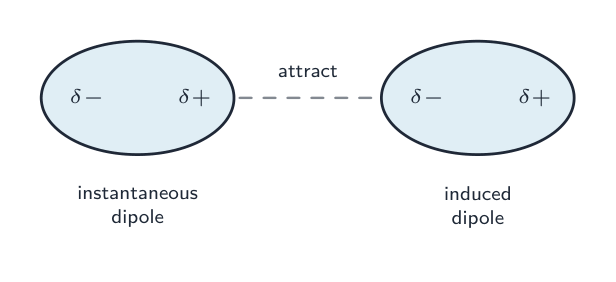
- London dispersion forces 伦敦色散力: present in all molecules; they arise from Coulombic attraction between temporary, fluctuating dipoles, and are stronger for larger, more polarizable electron clouds - often the strongest net force between large molecules.
- Dipole–dipole 偶极-偶极: between polar molecules. Their strength depends on the size of the dipoles and their relative orientation - a $\delta+$ end lining up with a neighbour's $\delta-$ end attracts, so these act in addition to dispersion and make polar molecules stickier than nonpolar ones of similar size.
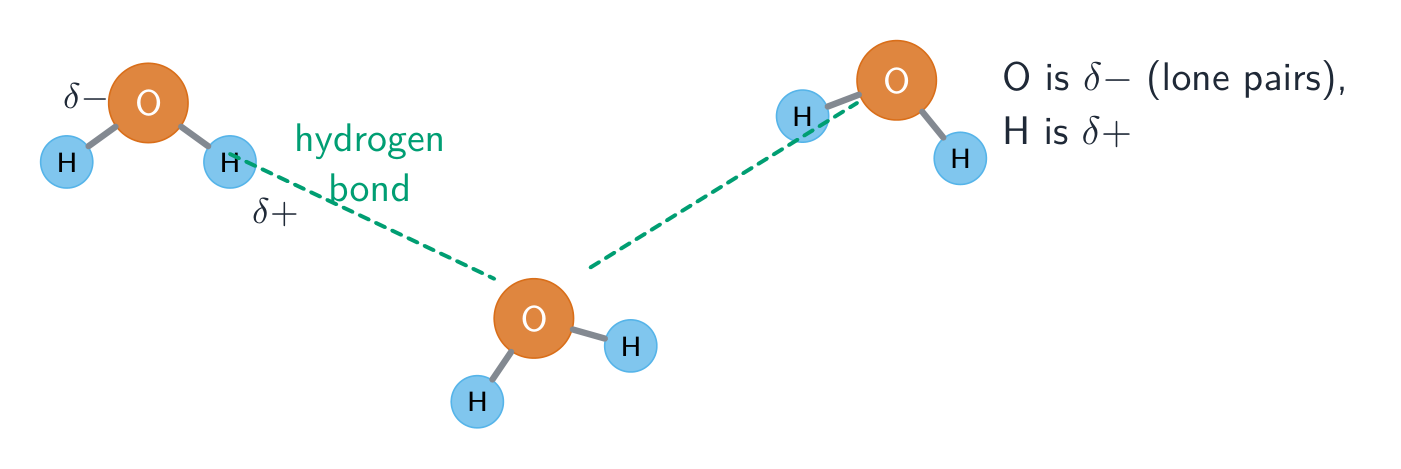
- Hydrogen bonding 氢键: a strong dipole force when H is bonded to N, O, or F.
- Ion–dipole 离子-偶极: between an ion and a polar molecule (the ion pulls on the oppositely-charged end of the dipole). These are the strongest of the four here (stronger even than hydrogen bonds), and are exactly what lets water dissolve an ionic solid - each $\text{Na}^+$ is surrounded by the $\delta-$ oxygen ends of water molecules.
The whole ladder is understood qualitatively by looking at the sign of the partial charges: a larger or better-aligned partial charge, or a full ionic charge, gives a stronger attraction. Stronger IMFs mean higher boiling points and lower vapor pressure. This is why water ($18\ \text{g/mol}$, hydrogen-bonded) boils at $100\,{}^{\circ}\text{C}$ while methane ($16\ \text{g/mol}$, dispersion only) boils at $-162\,{}^{\circ}\text{C}$.
Vocabulary
Train
| English |
|---|
| Intermolecular forces/ˌɪntəməˈlekjʊlə ˈfɔːsɪz/ |
| London dispersion forces/ˈlʌndn dɪˈspɜːʃn ˈfɔːsɪz/ |
| Dipole–dipole/ˈdaɪpəʊl ˈdaɪpəʊl/ |
| Ion–dipole/ˈaɪɒn ˈdaɪpəʊl/ |
| Hydrogen bonding/ˈhaɪdrədʒn ˈbɒndɪŋ/ |
3.2
Properties of Solids
Syllabus
| Learning Objective | Essential Knowledge |
|---|---|
3.2.A |
|
Source: College Board AP Course and Exam Description
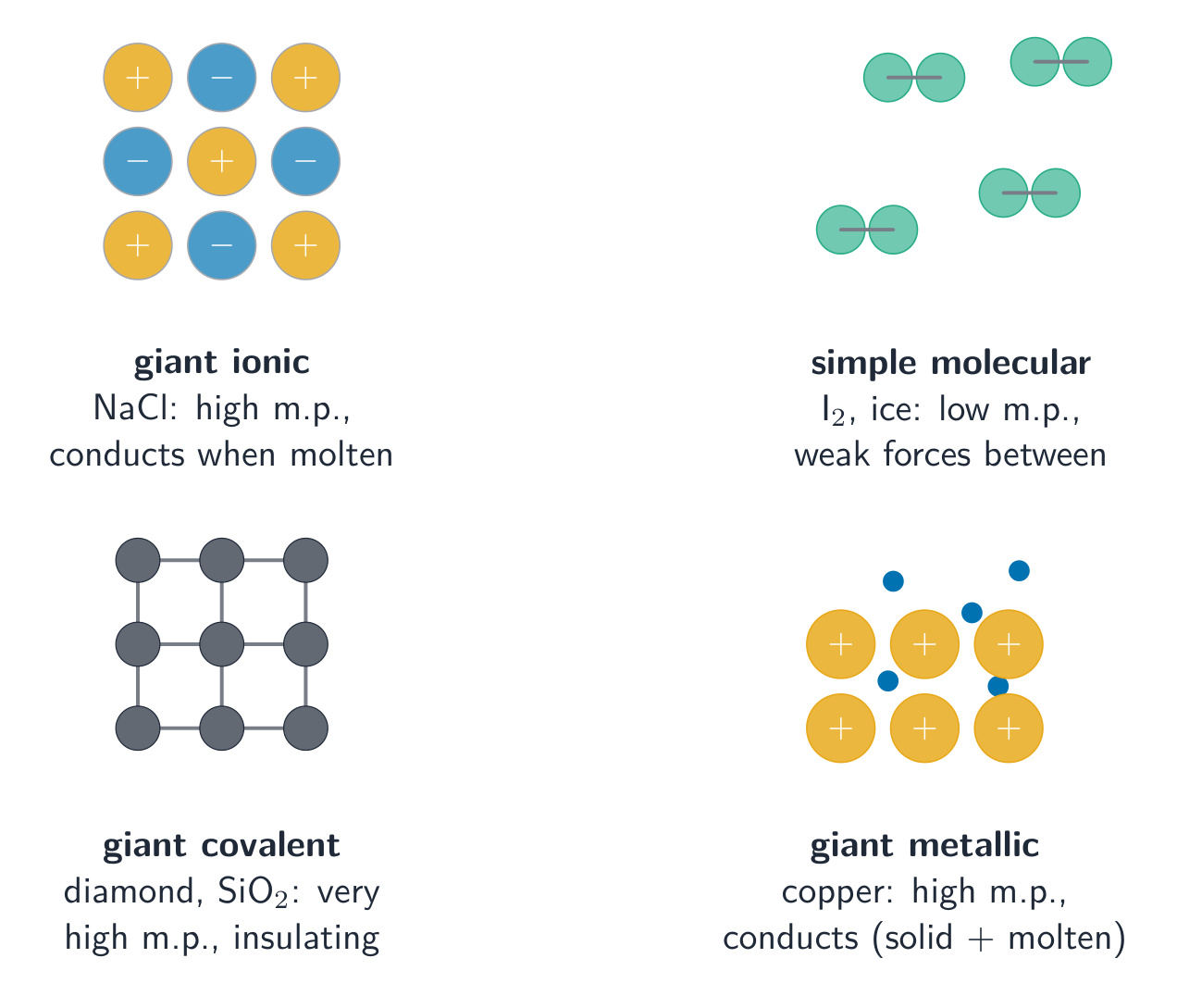
A solid's properties reflect the particles and forces holding it: ionic, covalent-network (a 3D network like diamond, very hard and high-melting; graphite is a layered exception — high-melting but soft, because its 2D layers slide over one another), metallic, and molecular solids (held by weak IMFs, soft, low-melting). Matching a solid's properties to its structure is a common exam task.
Metallic solids conduct electricity and heat and are malleable 可锻的 and ductile 可延展的, all because their free valence electrons 自由价电子 move easily and let the metal ions slide past one another without breaking the bonding. Solids are also either crystalline 晶体 (particles in a regular, repeating 3-D arrangement) or amorphous 非晶体 (no long-range order, like glass).
Vocabulary
Train
| English |
|---|
| malleable/ˈmæləbl/ |
| ductile/ˈdʌktaɪl/ |
| free valence electrons/friː ˈveɪləns ɪˈlektrɒnz/ |
| crystalline/ˈkrɪstəlaɪn/ |
| amorphous/əˈmɔːfəs/ |
3.3
Solids, Liquids, and Gases
Syllabus
| Learning Objective | Essential Knowledge |
|---|---|
3.3.A |
|
Source: College Board AP Course and Exam Description
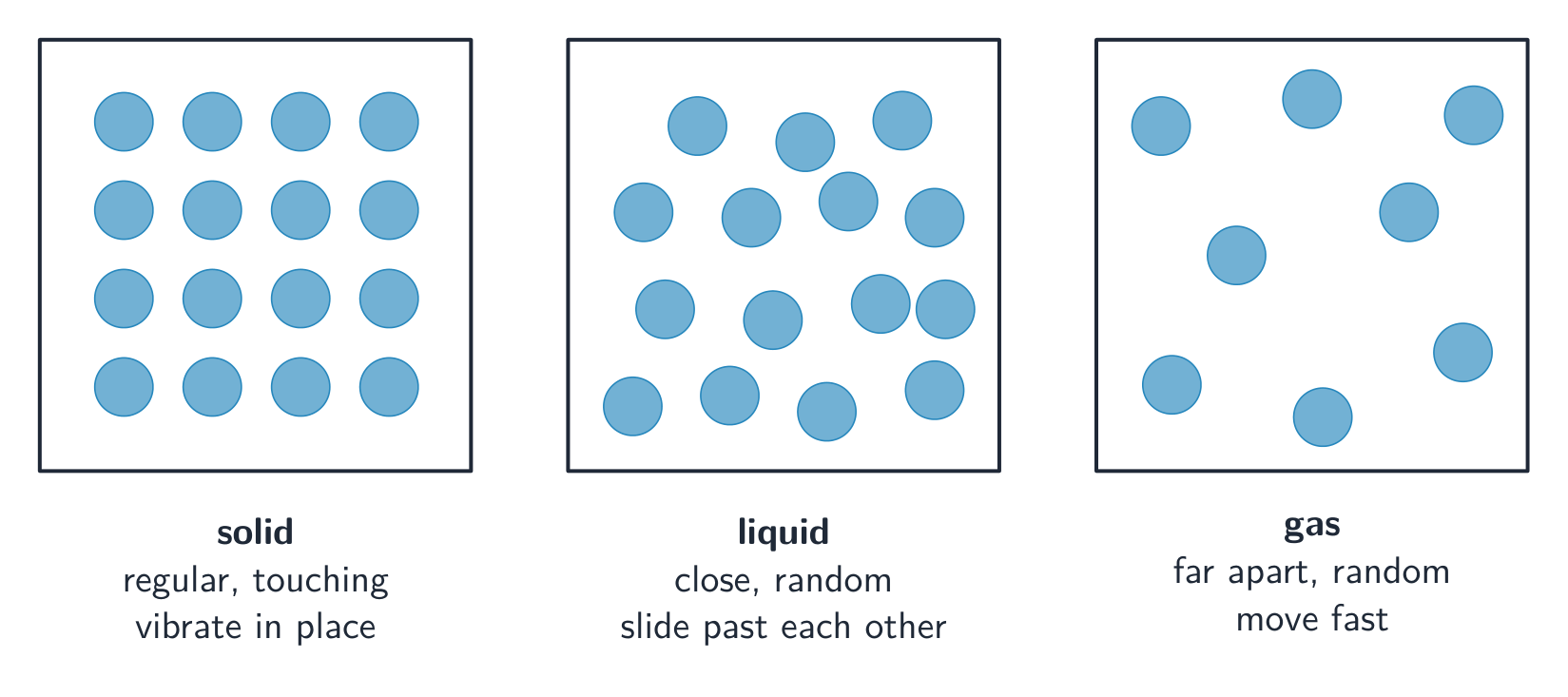
The three states differ in how tightly particles are held. Rising temperature raises average kinetic energy; when it overcomes the attractions, the substance melts or boils. Gases are mostly empty space, so they are compressible and fill their container.
Explore
Melt and boil by adding heat
Temperature sets the average kinetic energy of the particles. Warm a solid and the particles break their fixed pattern (melt), then spread right out (boil).
3.4
The Ideal Gas Law
Syllabus
| Learning Objective | Essential Knowledge |
|---|---|
3.4.A |
|
Source: College Board AP Course and Exam Description
An ideal gas obeys
$$PV=nRT,$$
linking pressure, volume, moles, and absolute temperature. Use it to find any one quantity from the others, or (holding some constant) to predict how a gas responds to a change.
Worked example. How many moles of gas fill a $2.0\ \text{L}$ container at $300\ \text{K}$ and $1.5\ \text{atm}$? Using $R=0.0821\ \text{L atm/(mol K)}$,
$$n=\frac{PV}{RT}=\frac{1.5\times2.0}{0.0821\times300}=0.12\ \text{mol}.$$
Always use kelvin for $T$ and match the units of $R$ to your pressure and volume.
Explore
Compress a gas and watch the pressure
$PV = nRT$. At fixed temperature, squeezing the gas into a smaller volume packs the molecules closer, so they hit the walls more often and the pressure rises.
3.5
Kinetic Molecular Theory
Syllabus
| Learning Objective | Essential Knowledge |
|---|---|
3.5.A |
|
Source: College Board AP Course and Exam Description
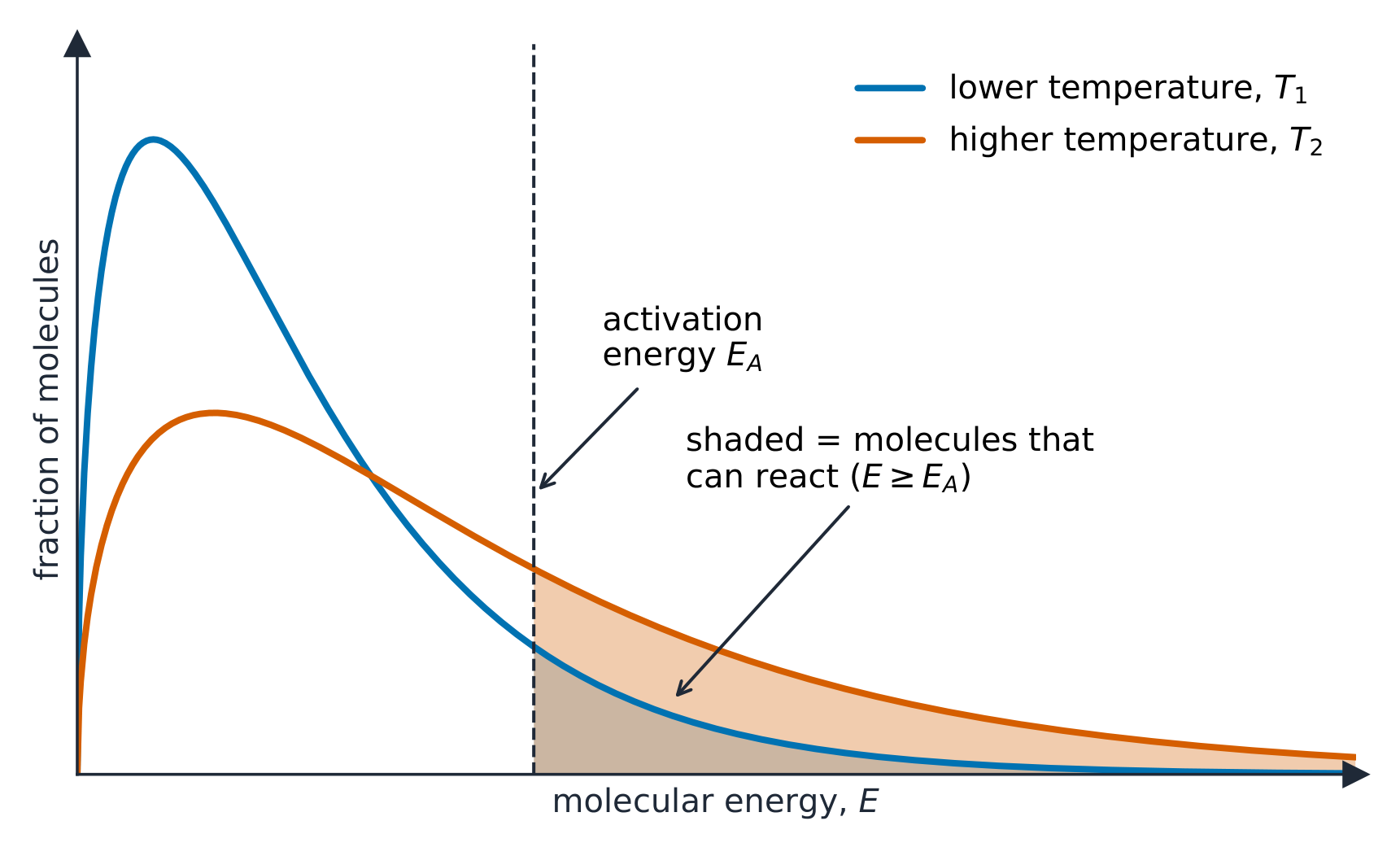
Kinetic molecular theory 分子运动论 explains gas behavior: particles are tiny, in constant random motion, with negligible volume and no attractions, and collisions are elastic. Temperature is proportional to average kinetic energy, so at a given temperature lighter molecules move faster (Graham's law of effusion).
Explore
Heat a gas and watch the speed spread
Gas molecules have a range of speeds. Raising the temperature shifts the whole distribution to higher speeds and flattens it, so more molecules move fast.
Vocabulary
Train
| English |
|---|
| Kinetic molecular theory/kɪˈnetɪk məˈlekjʊlə ˈθɪəri/ |
3.6
Deviation from the Ideal Gas Law
Syllabus
| Learning Objective | Essential Knowledge |
|---|---|
3.6.A |
|
Source: College Board AP Course and Exam Description
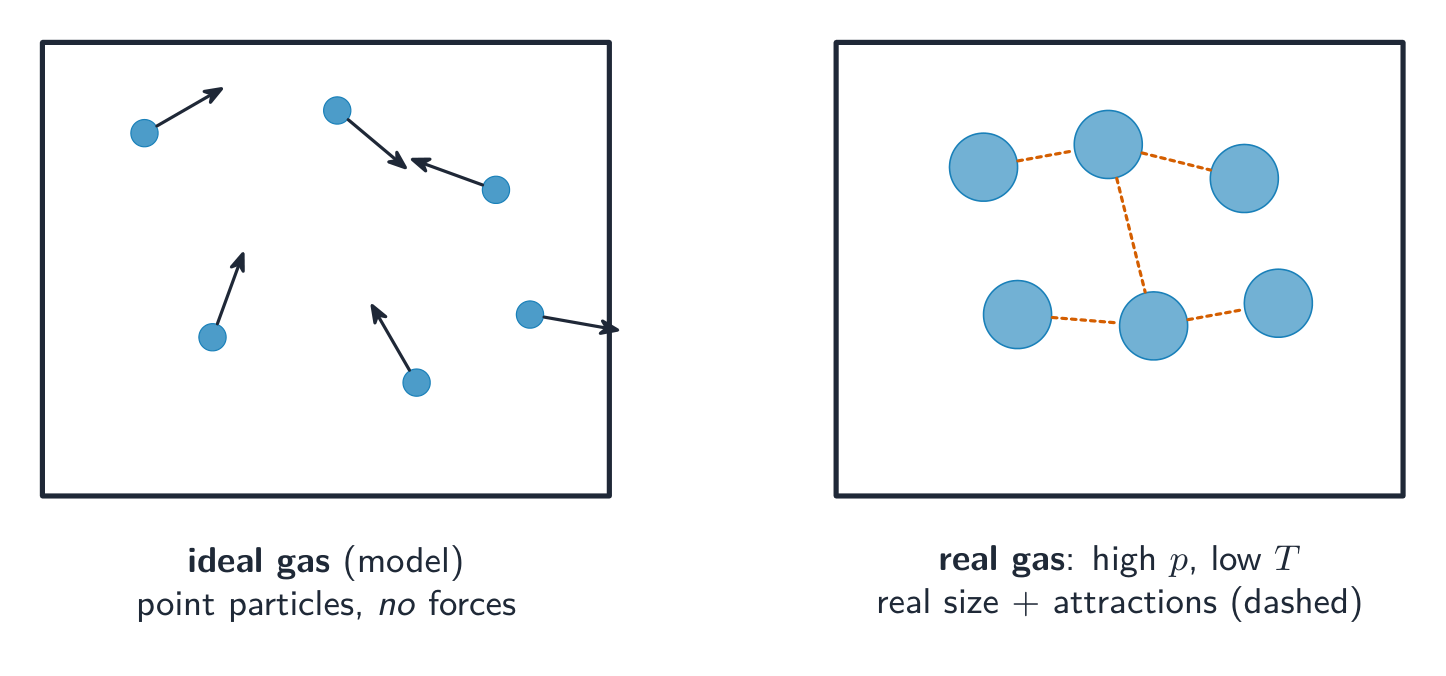
Real gases deviate from ideal behavior at high pressure and low temperature, where molecules are close enough that their real volume and their attractions matter. Attractions lower the pressure below ideal; molecular volume raises it.
3.7
Solutions and Mixtures
Syllabus
| Learning Objective | Essential Knowledge |
|---|---|
3.7.A |
|
Source: College Board AP Course and Exam Description
A solution 溶液 is a homogeneous mixture of a solute 溶质 dissolved in a solvent 溶剂. Concentration is usually molarity 摩尔浓度:
$$M=\frac{\text{moles of solute}}{\text{liters of solution}}.$$
Dilution conserves moles: $M_1V_1=M_2V_2$.
Worked example. What volume of water must you add to $50\ \text{mL}$ of $6.0\ \text{M}$ HCl to make it $2.0\ \text{M}$? The moles of HCl are unchanged, so $M_1V_1=M_2V_2$ gives the final volume $V_2=\dfrac{M_1V_1}{M_2}=\dfrac{6.0\times50}{2.0}=150\ \text{mL}$. You therefore add $150-50=100\ \text{mL}$ of water.
Vocabulary
Train
| English |
|---|
| solution/səˈluːʃn/ |
| solute/ˈsɒljuːt/ |
| solvent/ˈsɒlvənt/ |
| molarity/məʊˈlærɪti/ |
3.8
Representations of Solutions
Syllabus
| Learning Objective | Essential Knowledge |
|---|---|
3.8.A |
|
Source: College Board AP Course and Exam Description
A particulate diagram shows the solute and solvent particles. For an ionic solute, show it fully dissociated into separate ions surrounded by solvent; count particles to reason about concentration and conductivity.
3.9
Separation of Solutions and Mixtures
Syllabus
| Learning Objective | Essential Knowledge |
|---|---|
3.9.A |
|
Source: College Board AP Course and Exam Description
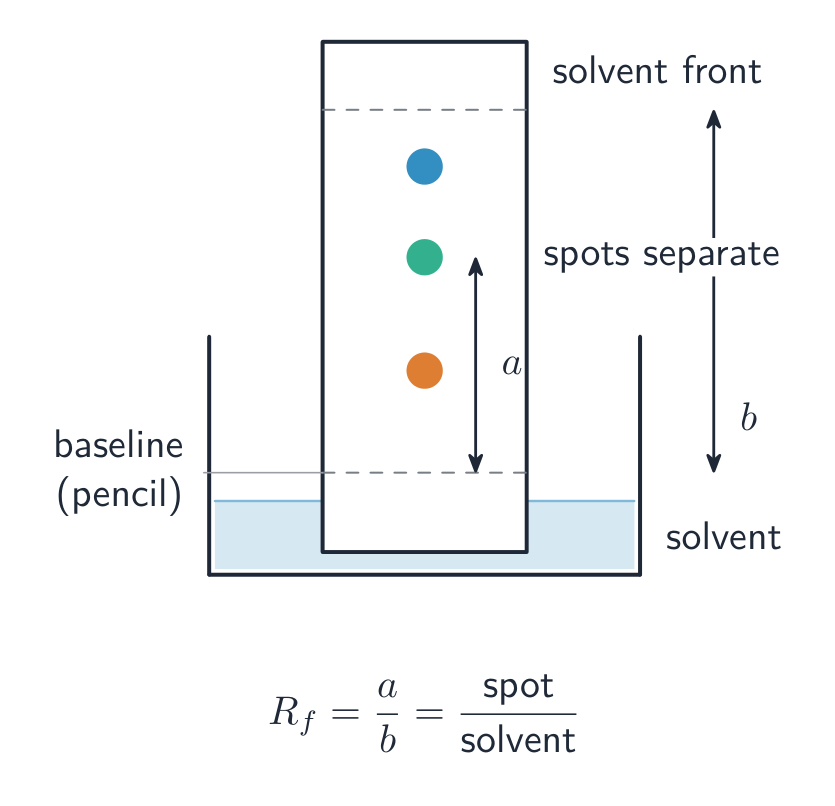
Because a mixture's components keep their properties, physical methods separate them: filtration (by particle size), distillation (by boiling point), and chromatography 色谱法 (by how strongly each component sticks to a stationary phase versus moving with a solvent).
Vocabulary
Train
| English |
|---|
| chromatography/krəʊməˈtɒɡrəfi/ |
3.10
Solubility
Syllabus
| Learning Objective | Essential Knowledge |
|---|---|
3.10.A |
|
Source: College Board AP Course and Exam Description
Solubility 溶解度 is how much solute dissolves. "Like dissolves like": polar (and ionic) solutes dissolve in polar solvents; nonpolar in nonpolar. Dissolving happens when solute–solvent attractions are comparable to the attractions being broken.
Vocabulary
Train
| English |
|---|
| Solubility/ˌsɒljuːˈbɪlɪti/ |
3.11
Spectroscopy and the Electromagnetic Spectrum
Syllabus
| Learning Objective | Essential Knowledge |
|---|---|
3.11.A |
|
Source: College Board AP Course and Exam Description
Spectroscopy 光谱学 studies how matter absorbs or emits light. Different regions of the electromagnetic spectrum probe different changes: microwaves (rotation), infrared (bond vibrations), ultraviolet–visible (electron transitions). The light absorbed reveals structure.
Explore
Scan across the electromagnetic spectrum
Light is a wave with a range of wavelengths. Shorter wavelength means higher frequency and more energy per photon, from radio waves up to gamma rays.
Vocabulary
Train
| English |
|---|
| Spectroscopy/spekˈtrɒskəpi/ |
3.12
Properties of Photons
Syllabus
| Learning Objective | Essential Knowledge |
|---|---|
3.12.A |
|
Source: College Board AP Course and Exam Description
Light is carried by photons 光子, each with energy $E=h\nu=\dfrac{hc}{\lambda}$. Higher frequency (shorter wavelength) means higher energy. A molecule absorbs a photon only when its energy matches an allowed energy gap.
Vocabulary
Train
| English |
|---|
| photons/ˈfəʊtɒnz/ |
3.13
The Beer-Lambert Law
Syllabus
| Learning Objective | Essential Knowledge |
|---|---|
3.13.A |
|
Source: College Board AP Course and Exam Description
The Beer–Lambert law 比尔-朗伯定律 relates how much light a solution absorbs to its concentration:
$$A=\varepsilon\,b\,c,$$
where $A$ is absorbance, $\varepsilon$ the molar absorptivity, $b$ the path length, and $c$ the concentration. Since $A$ is proportional to $c$, measuring absorbance is a fast way to find an unknown concentration.
Worked example. A dye has molar absorptivity $\varepsilon=2000\ \text{L/(mol cm)}$; in a $1.0\ \text{cm}$ cell a sample reads absorbance $A=0.40$. Its concentration is $c=\dfrac{A}{\varepsilon b}=\dfrac{0.40}{2000\times1.0}=2.0\times10^{-4}\ \text{M}$. Because $A\propto c$, a solution twice as concentrated would read $A=0.80$ – the basis of a calibration curve.
Explore
Link absorbance to concentration
The Beer-Lambert law says absorbance $A = \varepsilon b c$: absorbance is proportional to concentration, so a calibration line lets you read an unknown concentration.
Vocabulary
Train
| English |
|---|
| Beer–Lambert law/bɪə ˈlæmbət lɔː/ |
3.13
Exam tips
- Intermolecular forces (dispersion < dipole–dipole < hydrogen bonding) set boiling points — they are much weaker than the bonds inside a molecule.
- Boiling breaks the forces between molecules, not the covalent bonds within them.
- Use $PV=nRT$ with temperature in kelvin and $R$ matched to your pressure/volume units.
- For solutions use molarity $M=\text{mol}/\text{L}$; dilution conserves moles, so $M_1V_1=M_2V_2$.
- "Like dissolves like" — polar/ionic solutes dissolve in polar solvents, non-polar in non-polar.
Interactive lessons on this topic
Work through it step by step, with instant-check exercises.
- Intermolecular and Interparticle Forces
- Properties of Solids
- Solids, Liquids, and Gases
- The Ideal Gas Law
- Kinetic Molecular Theory
- Deviation from the Ideal Gas Law
- Solutions and Mixtures
- Representations of Solutions
- Separation of Solutions and Mixtures
- Solubility
- Spectroscopy and the Electromagnetic Spectrum
- Properties of Photons
- The Beer-Lambert Law