| Learning Objective | Essential Knowledge |
|---|---|
1.1.A |
|
Atomic Structure and Properties
AP Chemistry · Topic 1
 9:19
9:19
Atomic Structure and Properties
A chemical equation counts particles. Two of this react with one of that. But atoms are far too small to count, and there is no instrument that will hand you a…
English narration · English + 中文 subtitles burned in
1.1
Moles and Molar Mass
Syllabus
Source: College Board AP Course and Exam Description
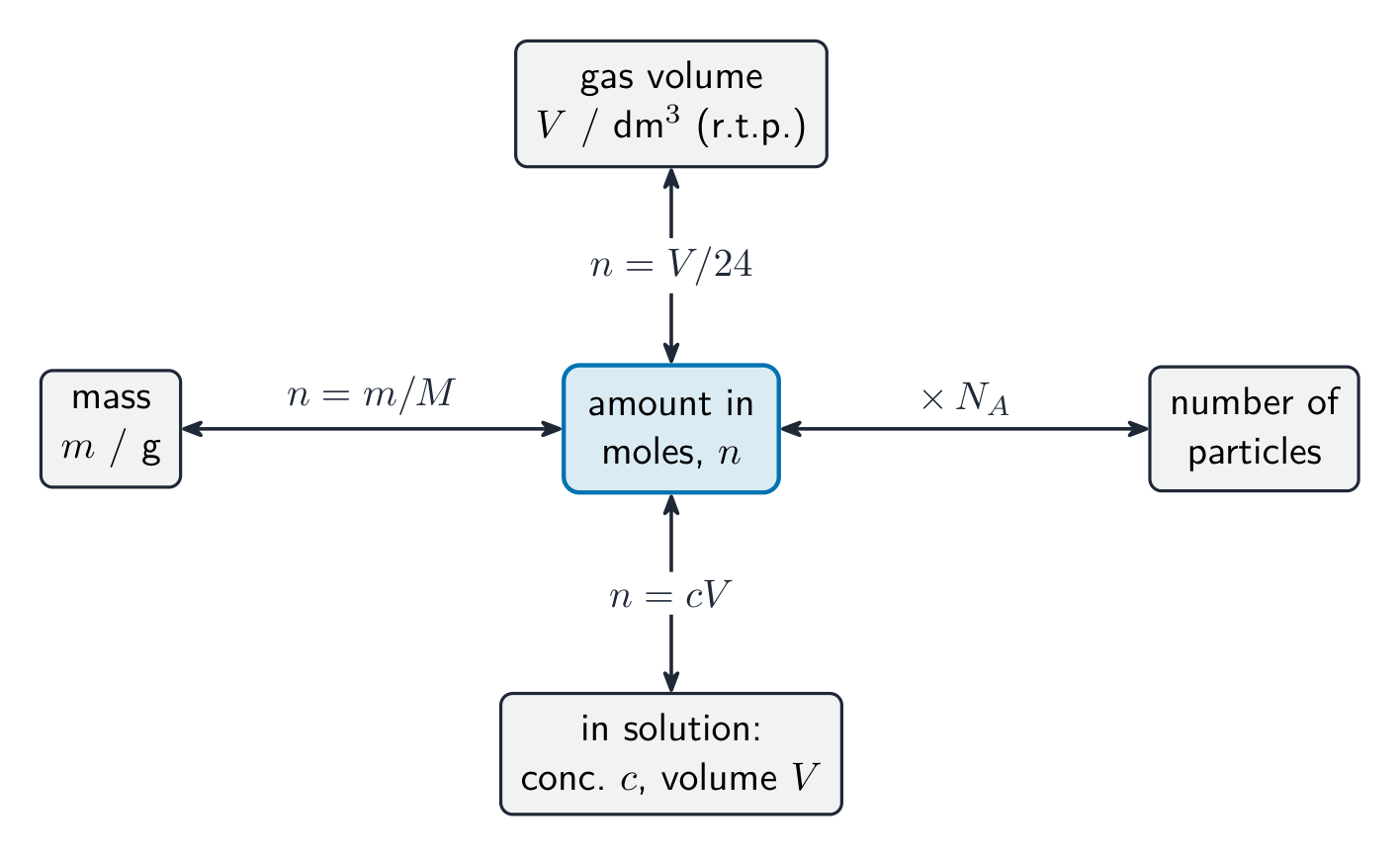
Because atoms are far too small to count, chemists count in moles 摩尔. One mole is Avogadro's number 阿伏伽德罗常数 of particles, $N_A=6.022\times10^{23}$. The molar mass 摩尔质量 (grams per mole, read off the periodic table) converts between mass and moles:
$$n=\frac{m}{M}.$$
Moles are the bridge between the lab (grams you weigh) and the equation (particles that react).
Worked example. How many moles, and how many molecules, are in $36.0\ \text{g}$ of water ($M=18.0\ \text{g/mol}$)?
$$n=\frac{m}{M}=\frac{36.0}{18.0}=2.0\ \text{mol},\qquad N=n\,N_A=2.0\times6.022\times10^{23}=1.2\times10^{24}\ \text{molecules}.$$
Explore
Link mass, moles and molar mass
Molar mass $M$ is the bridge between the mass you weigh and the number of moles: $m = M \times n$. Because $M$ is fixed for a substance, mass is proportional to moles — double the moles, double the mass.
Vocabulary
Train
| English |
|---|
| moles/məʊlz/ |
| Avogadro's number/ˌævəˈɡædrəʊz ˈnʌmbə/ |
| molar mass/ˈməʊlə mæs/ |
1.2
Mass Spectra of Elements
Syllabus
| Learning Objective | Essential Knowledge |
|---|---|
1.2.A |
|
Source: College Board AP Course and Exam Description
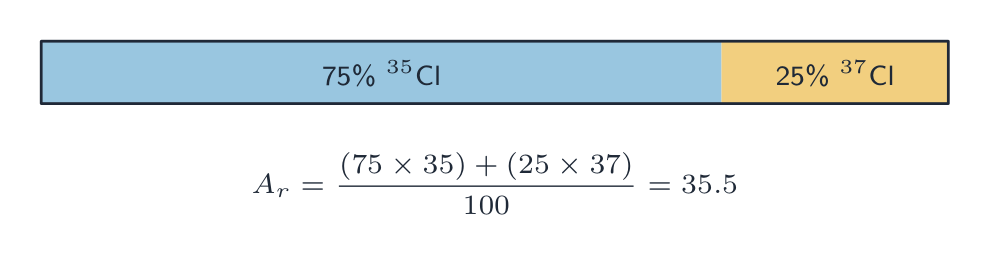
A mass spectrometer 质谱仪 separates atoms by mass, giving a mass spectrum 质谱: peaks at each isotope 同位素 (same element, different neutron count) with heights showing their relative abundance 相对丰度. The element's average atomic mass is the abundance-weighted average of its isotope masses.
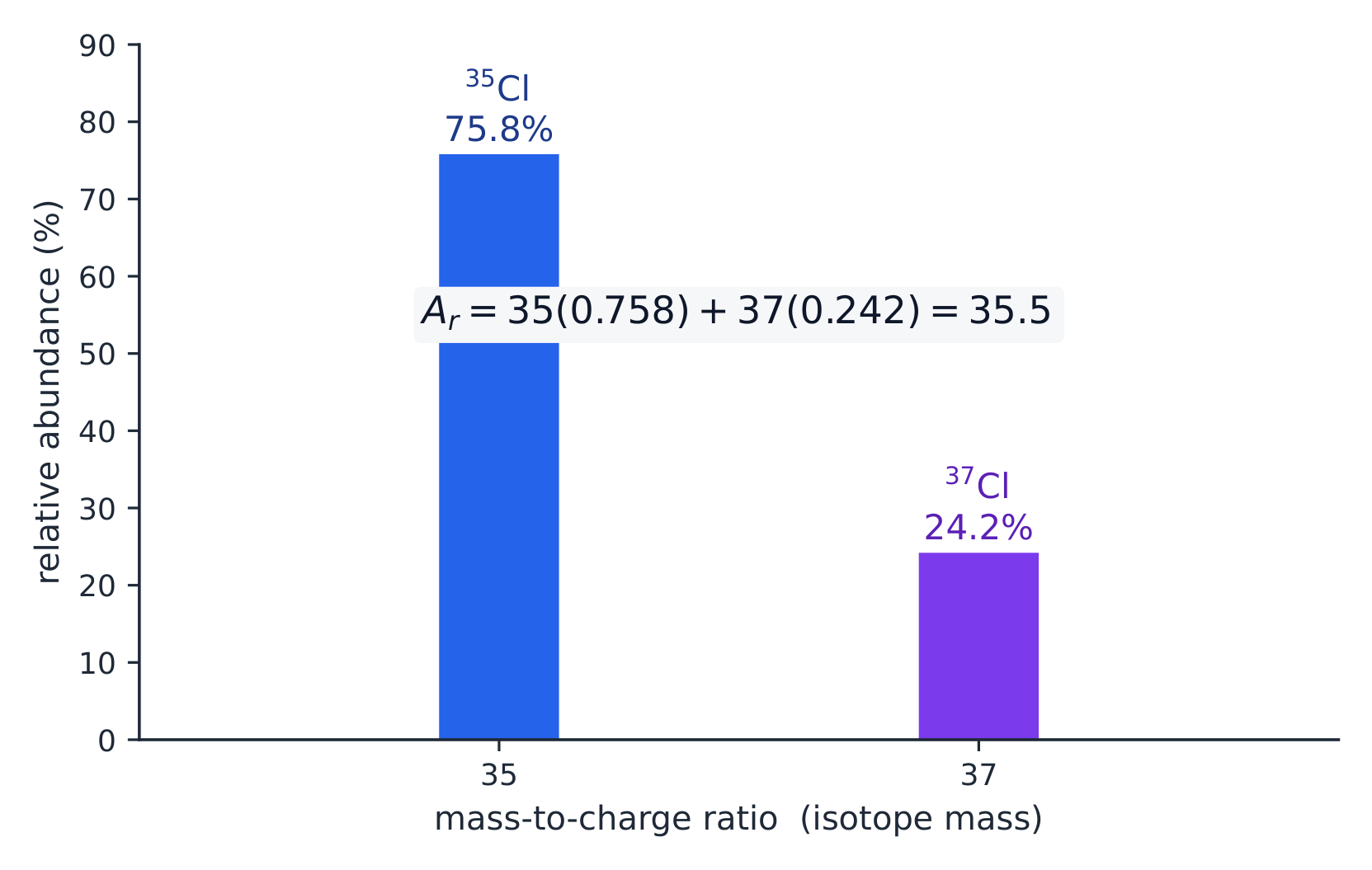
Worked example. Chlorine is $75.8\%$ chlorine-35 and $24.2\%$ chlorine-37. Its average atomic mass is
$$A_r=(35)(0.758)+(37)(0.242)=26.5+8.95=35.5.$$
The average lies closer to $35$ because that isotope is more abundant – which is why the periodic-table value is $35.5$, not a whole number.
Explore
Explore isotopes — same element, different mass
Keep the protons fixed but change the neutrons to build the two chlorine isotopes ($^{35}$Cl and $^{37}$Cl). Same element, different mass — exactly the peaks a mass spectrum shows.
Vocabulary
Train
| English |
|---|
| mass spectrometer/mæs spekˈtrɒmɪtə/ |
| mass spectrum/mæs ˈspektrəm/ |
| isotope/ˈaɪsətəʊp/ |
| relative abundance/ˈrelətɪv əˈbʌndəns/ |
1.3
Elemental Composition of Pure Substances
Syllabus
| Learning Objective | Essential Knowledge |
|---|---|
1.3.A |
|
Source: College Board AP Course and Exam Description
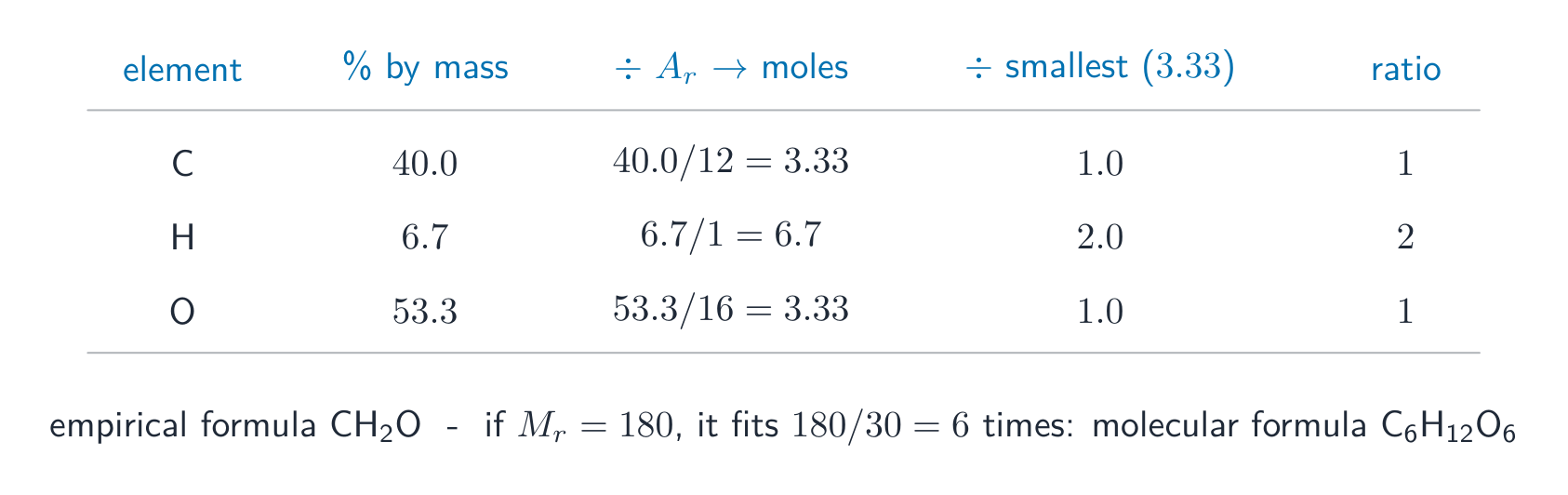
The percent composition 百分组成 of a compound is each element's mass fraction. From it you find the empirical formula 实验式 (simplest whole-number ratio of atoms) by converting each element's mass to moles and dividing by the smallest. The molecular formula 分子式 is a whole-number multiple of the empirical formula, found from the molar mass.
Worked example. A compound is $40.0\%$ C, $6.7\%$ H, and $53.3\%$ O by mass. Assuming $100\ \text{g}$, convert each mass to moles and divide by the smallest:
$$\text{C}:\frac{40.0}{12}=3.33,\quad \text{H}:\frac{6.7}{1}=6.7,\quad \text{O}:\frac{53.3}{16}=3.33 \;\xrightarrow{\div 3.33}\; 1:2:1,$$
so the empirical formula is $\text{CH}_2\text{O}$. If the molar mass were $180\ \text{g/mol}$ ($=6\times30$), the molecular formula would be $\text{C}_6\text{H}_{12}\text{O}_6$ – glucose.
Vocabulary
Train
| English |
|---|
| percent composition/pəˈsent ˌkɒmpəˈzɪʃn/ |
| empirical formula/emˈpɪrɪkl ˈfɔːmjʊlə/ |
| molecular formula/məˈlekjʊlə ˈfɔːmjʊlə/ |
1.4
Composition of Mixtures
Syllabus
| Learning Objective | Essential Knowledge |
|---|---|
1.4.A |
|
Source: College Board AP Course and Exam Description
Unlike a pure compound, a mixture 混合物 has variable composition – its parts keep their own identities. Describe a mixture by the mass or mole fraction of each component; these do not follow a fixed formula. Spectroscopy (like PES or absorption) can measure how much of each component is present.
Vocabulary
Train
| English |
|---|
| mixture/ˈmɪkstʃə/ |
1.5
Atomic Structure and Electron Configuration
Syllabus
| Learning Objective | Essential Knowledge |
|---|---|
1.5.A |
|
Source: College Board AP Course and Exam Description
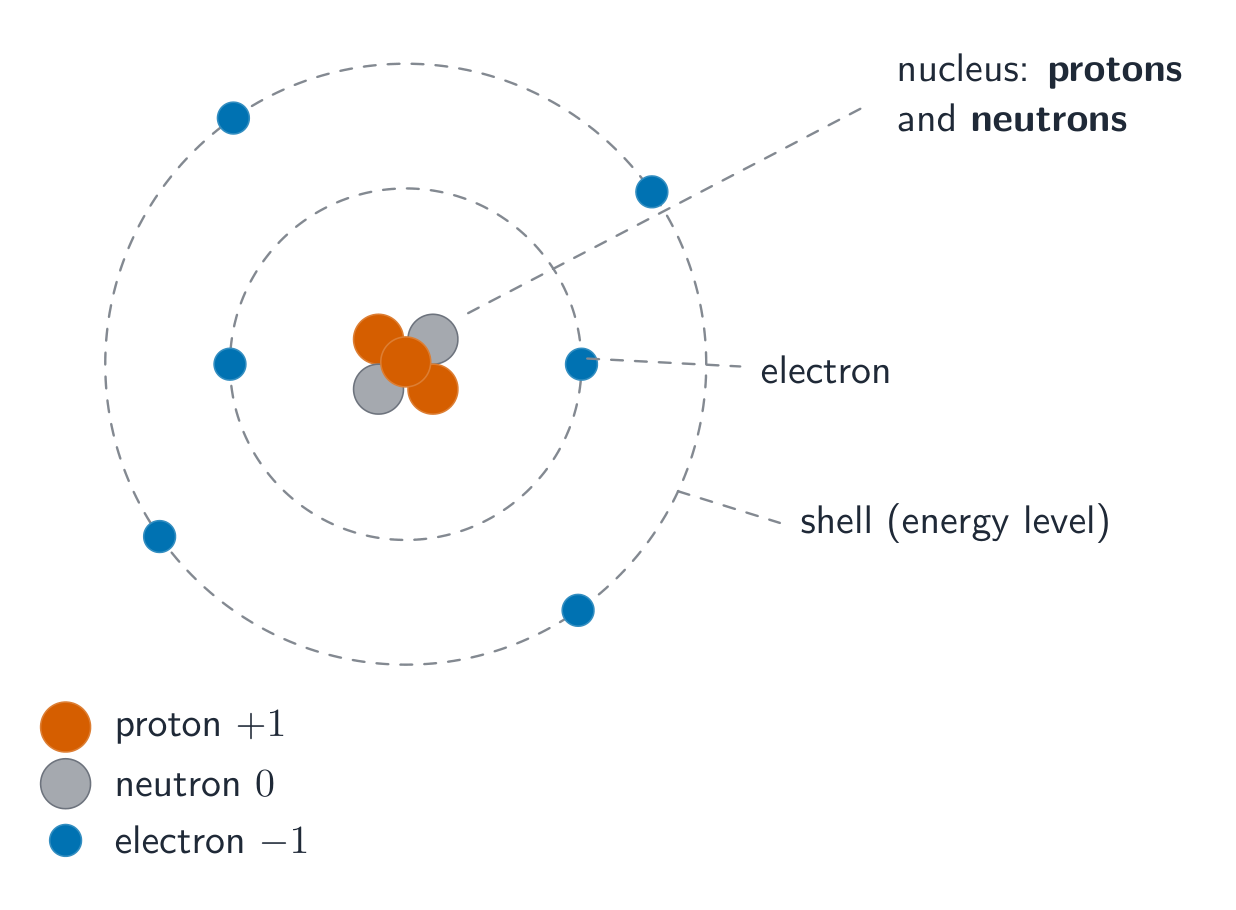
An atom is a tiny nucleus 原子核 (protons and neutrons) surrounded by electrons in shells and subshells (s, p, d, f). The electron configuration 电子排布 lists how electrons fill these, lowest energy first (e.g. $1s^2\,2s^2\,2p^6$). The outermost, highest-energy electrons – the valence electrons 价电子 – control chemistry. Coulomb's law explains their energies: electrons closer to, and less shielded from, the nucleus are held more tightly.
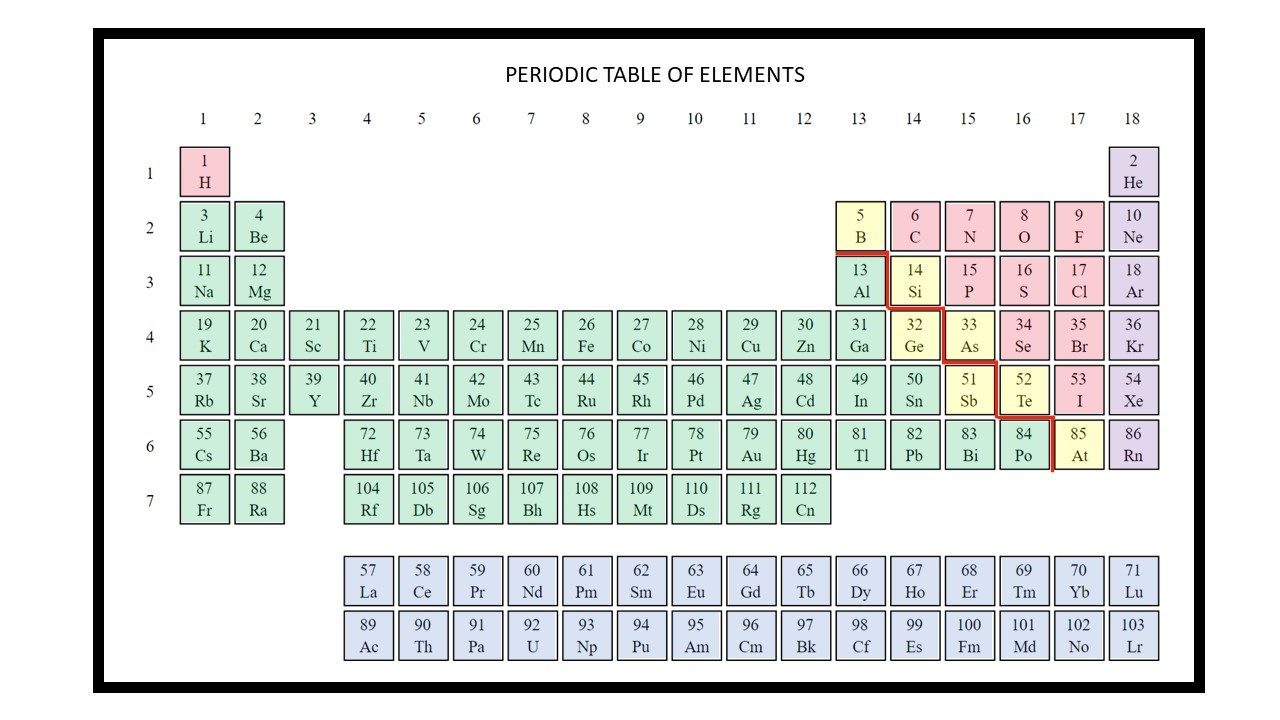
Worked example. Write the electron configuration of sulfur ($Z=16$). Fill subshells in order until $16$ electrons are placed: $1s^2\,2s^2\,2p^6\,3s^2\,3p^4$. The $3s$ and $3p$ electrons (six in total) are the valence electrons, so sulfur tends to gain two electrons to complete its octet.
Explore
Explore how electrons fill the shells
Change the atomic number $Z$ and watch the electrons fill the shells lowest-energy-first (the Aufbau principle 构造原理). The outermost electrons are the valence electrons that drive bonding.
Vocabulary
Train
| English |
|---|
| nucleus/ˈnjuːklɪəs/ |
| electron configuration/ɪˈlektrɒn kənˌfɪɡjəˈreɪʃn/ |
| valence electrons/ˈveɪləns ɪˈlektrɒnz/ |
1.6
Photoelectron Spectroscopy
Syllabus
| Learning Objective | Essential Knowledge |
|---|---|
1.6.A |
|
Source: College Board AP Course and Exam Description
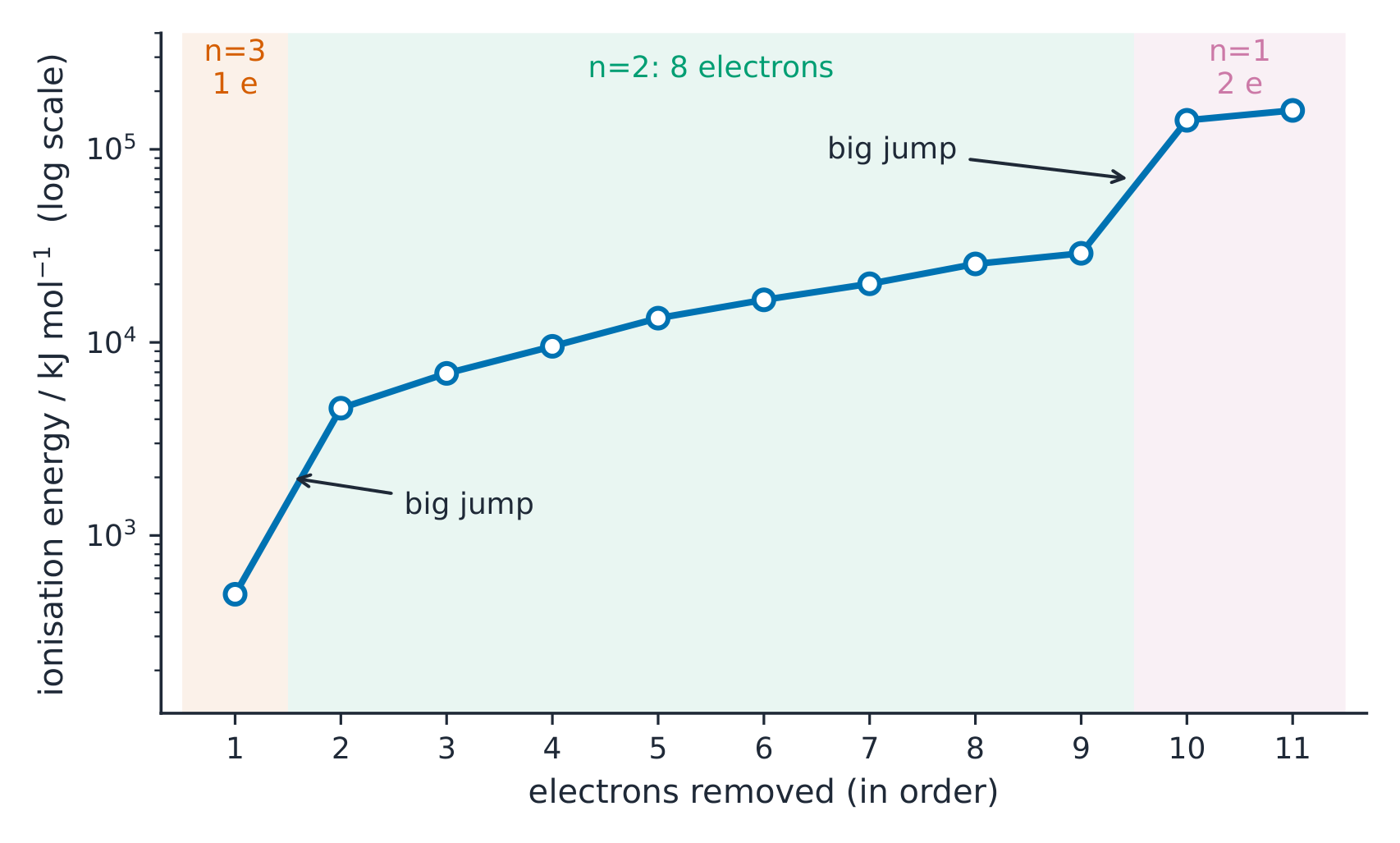
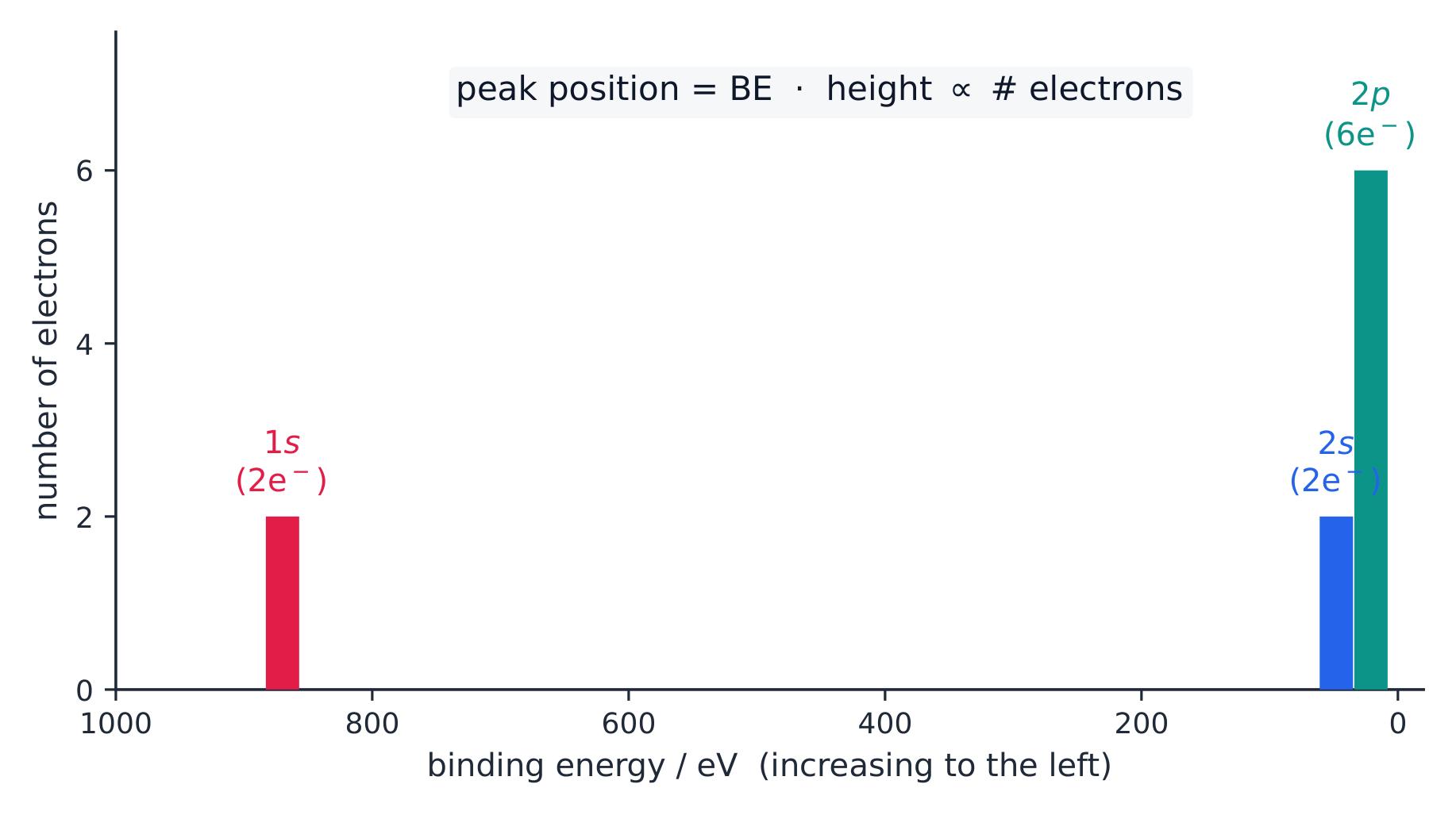
Photoelectron spectroscopy 光电子能谱 (PES) measures the energy needed to remove electrons from each subshell. Each peak is a subshell: its position gives the binding energy (how tightly held) and its height gives the number of electrons in it. PES data let you read an element's electron configuration and confirm shell structure directly.
Vocabulary
Train
| English |
|---|
| Photoelectron spectroscopy/ˌfəʊtəʊɪˈlektrɒn spekˈtrɒskəpi/ |
1.7
Periodic Trends
Syllabus
| Learning Objective | Essential Knowledge |
|---|---|
1.7.A |
|
Source: College Board AP Course and Exam Description
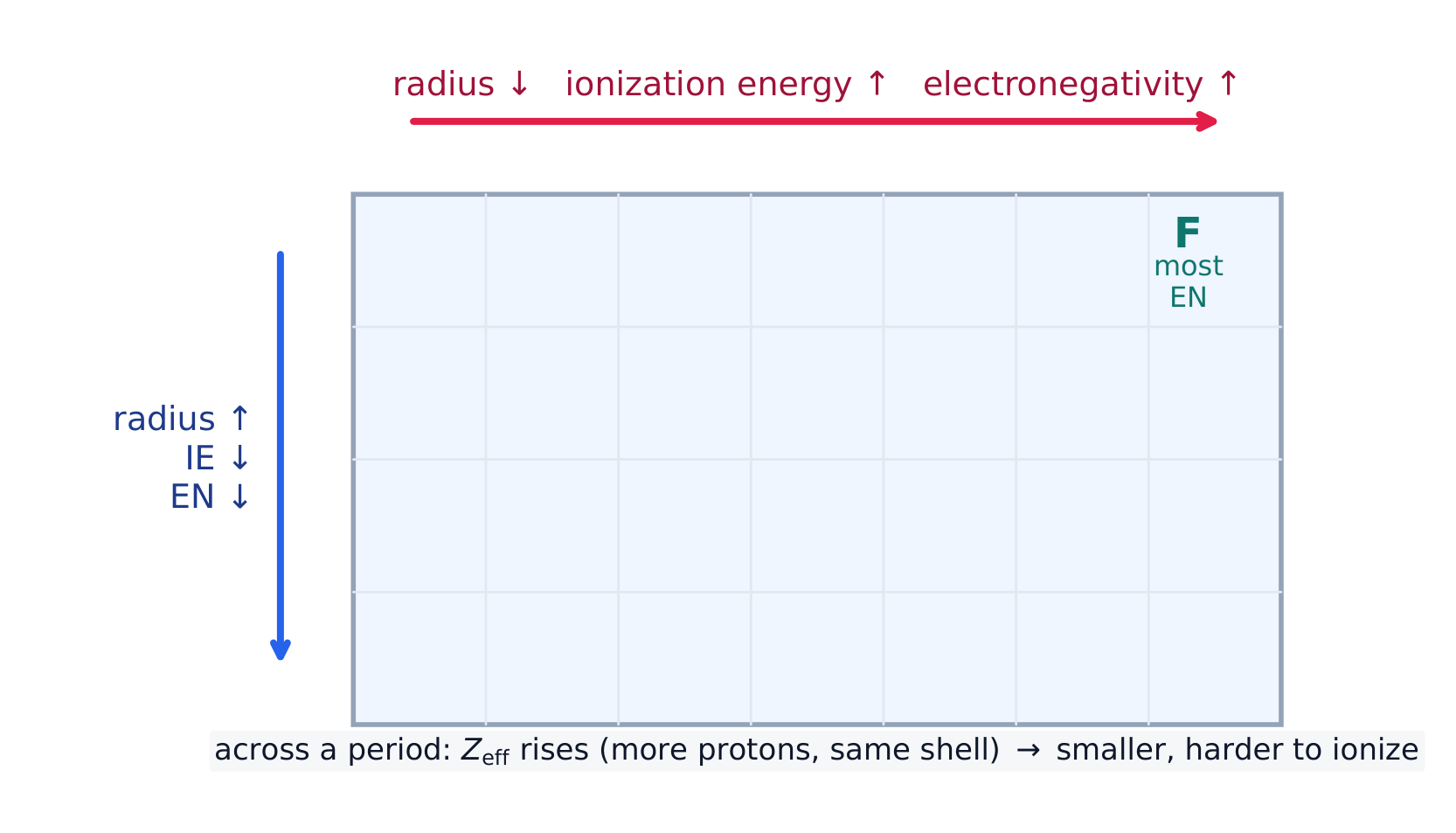
Trends across the periodic table follow from nuclear charge and shielding:
- Atomic radius 原子半径 decreases across a period (stronger pull) and increases down a group (more shells).
- Ionization energy 电离能 (energy to remove an electron) increases across, decreases down – opposite to radius.
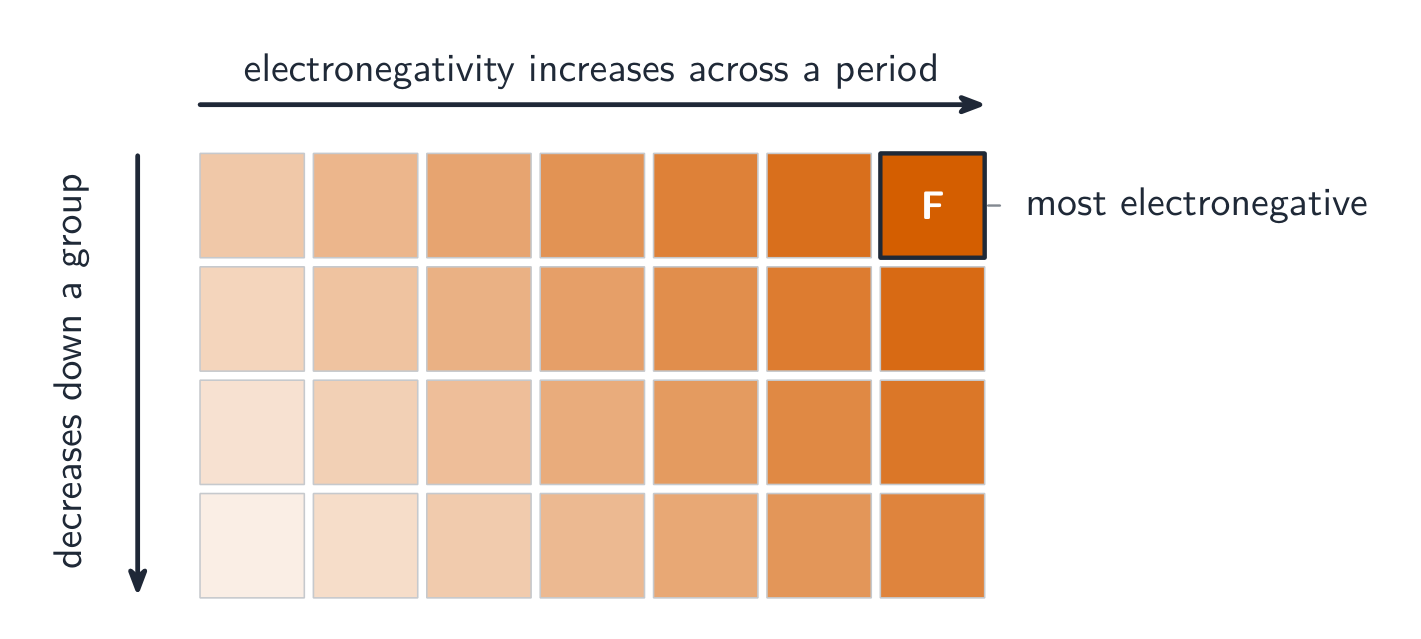
- Electronegativity 电负性 (pull on shared electrons) increases across and up, toward fluorine.
Explore
Explore atomic radius across a period
Step across Period 3 and watch the atomic radius shrink — each added proton raises the effective nuclear charge and pulls the same shell in tighter.
Vocabulary
Train
| English |
|---|
| Atomic radius/əˈtɒmɪk ˈreɪdɪəs/ |
| Ionization energy/ˌaɪənaɪˈzeɪʃn ˈenədʒi/ |
| Electronegativity/ɪˌlektrəʊŋɡəˈtɪvɪti/ |
1.8
Valence Electrons and Ionic Compounds
Syllabus
| Learning Objective | Essential Knowledge |
|---|---|
1.8.A |
|
Source: College Board AP Course and Exam Description
Atoms gain, lose, or share valence electrons to reach stable configurations. Metals (low ionization energy) lose electrons to form cations 阳离子; nonmetals gain electrons to form anions 阴离子. Oppositely charged ions attract into an ionic compound 离子化合物, whose formula balances the charges to make the whole neutral. For example, aluminium ($3+$) and oxide ($2-$) combine as $\text{Al}_2\text{O}_3$ so the $+6$ and $-6$ cancel.
Explore
Watch an ionic bond form by electron transfer
A metal gives up its valence electron(s) and a non-metal takes them, so both reach a full shell. The atoms become oppositely charged ions that attract — that electrostatic pull is the ionic bond.
Vocabulary
Train
| English |
|---|
| cations/ˈkætaɪənz/ |
| anions/ˈænaɪənz/ |
| ionic compound/aɪˈɒnɪk ˈkɒmpaʊnd/ |
1.8
Exam tips
- Use the mole as the hub: convert grams↔moles with $n=m/M$ and moles↔particles with Avogadro's number.
- Relative atomic mass is the abundance-weighted average of the isotopes — it lies closer to the more abundant one, not halfway.
- For an empirical formula, turn each element's mass into moles and divide by the smallest; scale up to whole numbers.
- Read periodic trends from nuclear charge and shielding: atomic radius decreases across a period, ionisation energy and electronegativity increase across (and up).
- Fill electron configurations in energy order; the outer valence electrons control the chemistry.
Interactive lessons on this topic
Work through it step by step, with instant-check exercises.