Skip to content

Acids and Bases

AP Chemistry · Topic 8

Train
8.1

Introduction to Acids and Bases

Syllabus
Learning ObjectiveEssential Knowledge

8.1.A
Calculate the values of $\mathrm{pH}$ and $\mathrm{pOH}$, based on $K_w$ and the concentration of all species present in a neutral solution of water.

  • 8.1.A.1 The concentrations of hydronium ion and hydroxide ion are often reported as $\mathrm{pH}$ and $\mathrm{pOH}$, respectively.
    • Equation: $\mathrm{pH} = -\log[\mathrm{H_3O^+}]$
    • Equation: $\mathrm{pOH} = -\log[\mathrm{OH^-}]$
    • The terms "hydrogen ion" and "hydronium ion" and the symbols $\mathrm{H^+}(aq)$ and $\mathrm{H_3O^+}(aq)$ are often used interchangeably for the aqueous ion of hydrogen. Hydronium ion and $\mathrm{H_3O^+}(aq)$ are preferred, but $\mathrm{H^+}(aq)$ is also accepted on the AP Exam.
  • 8.1.A.2 Water autoionizes with an equilibrium constant $K_w$.
    • Equation: $K_w = [\mathrm{H_3O^+}][\mathrm{OH^-}] = 1.0 \times 10^{-14}$ at 25°C
  • 8.1.A.3 In pure water, $\mathrm{pH} = \mathrm{pOH}$ is called a neutral solution. At 25°C, $\mathrm{p}K_w = 14.0$ and thus $\mathrm{pH} = \mathrm{pOH} = 7.0$.
    • Equation: $\mathrm{p}K_w = 14 = \mathrm{pH} + \mathrm{pOH}$ at 25°C
  • 8.1.A.4 The value of $K_w$ is temperature dependent, so the pH of pure, neutral water will deviate from 7.0 at temperatures other than 25°C.

Source: College Board AP Course and Exam Description

By the Brønsted–Lowry definition, an acid is a proton ($\text{H}^+$) donor and a base is a proton acceptor. When an acid donates a proton it becomes its conjugate base 共轭碱; a base gaining a proton becomes its conjugate acid 共轭酸. Water is amphoteric – it can act as either.
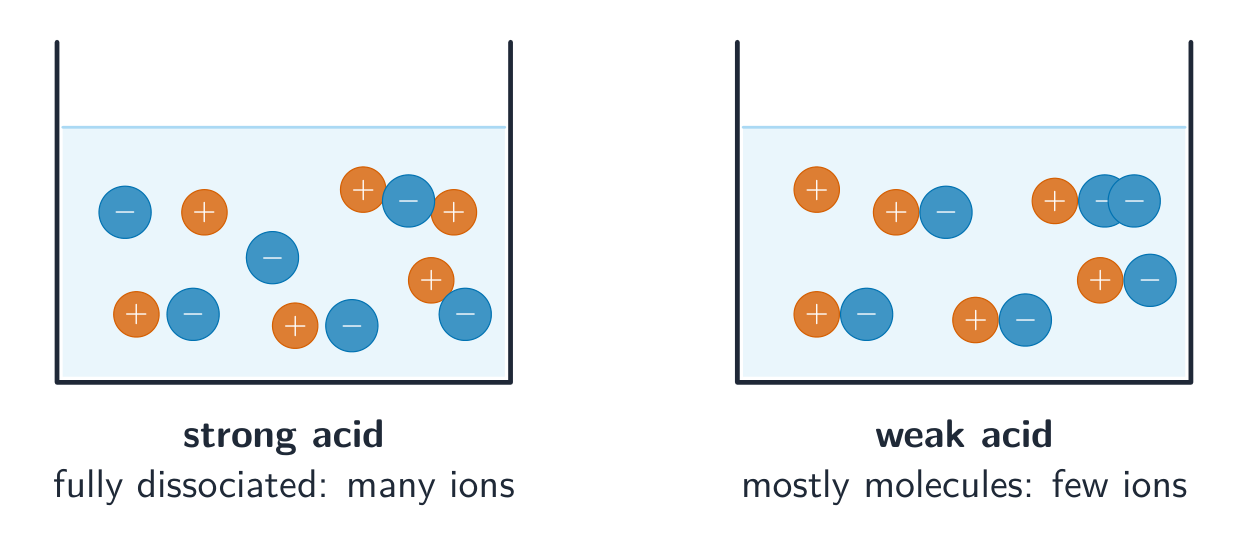
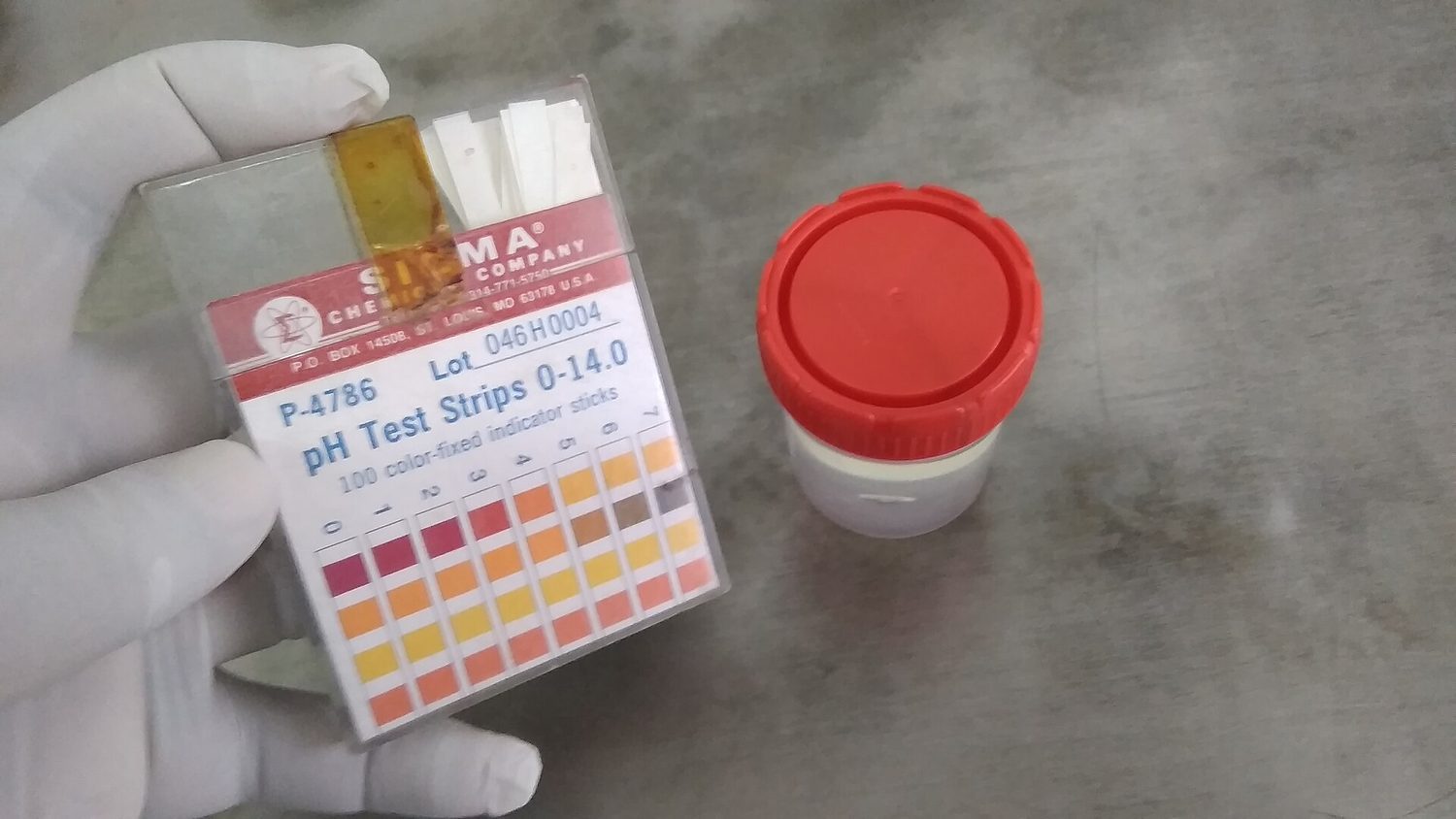
A strong acid is fully dissociated; a weak acid is only partly dissociated A strong acid is fully dissociated; a weak acid is only partly dissociated

Vocabulary Train
English Chinese Pinyin
acid suān
base jiǎn
conjugate base 共轭碱 gòng è jiǎn
conjugate acid 共轭酸 gòng è suān
8.1

The Autoionization of Water

Syllabus
Learning ObjectiveEssential Knowledge

8.1.A
Calculate the values of $\mathrm{pH}$ and $\mathrm{pOH}$, based on $K_w$ and the concentration of all species present in a neutral solution of water.

  • 8.1.A.1 The concentrations of hydronium ion and hydroxide ion are often reported as $\mathrm{pH}$ and $\mathrm{pOH}$, respectively.
    • Equation: $\mathrm{pH} = -\log[\mathrm{H_3O^+}]$
    • Equation: $\mathrm{pOH} = -\log[\mathrm{OH^-}]$
    • The terms "hydrogen ion" and "hydronium ion" and the symbols $\mathrm{H^+}(aq)$ and $\mathrm{H_3O^+}(aq)$ are often used interchangeably for the aqueous ion of hydrogen. Hydronium ion and $\mathrm{H_3O^+}(aq)$ are preferred, but $\mathrm{H^+}(aq)$ is also accepted on the AP Exam.
  • 8.1.A.2 Water autoionizes with an equilibrium constant $K_w$.
    • Equation: $K_w = [\mathrm{H_3O^+}][\mathrm{OH^-}] = 1.0 \times 10^{-14}$ at 25°C
  • 8.1.A.3 In pure water, $\mathrm{pH} = \mathrm{pOH}$ is called a neutral solution. At 25°C, $\mathrm{p}K_w = 14.0$ and thus $\mathrm{pH} = \mathrm{pOH} = 7.0$.
    • Equation: $\mathrm{p}K_w = 14 = \mathrm{pH} + \mathrm{pOH}$ at 25°C
  • 8.1.A.4 The value of $K_w$ is temperature dependent, so the pH of pure, neutral water will deviate from 7.0 at temperatures other than 25°C.

Source: College Board AP Course and Exam Description

Even pure water conducts a tiny current, because water molecules react with each other in a reaction called autoionization 自偶电离:

$$2\text{H}_2\text{O} \rightleftharpoons \text{H}_3\text{O}^+ + \text{OH}^-.$$
One water molecule passes a proton to another, making a hydronium ion 水合氢离子 ($\text{H}_3\text{O}^+$, the ion we loosely write as $\text{H}^+$) and a hydroxide ion. This equilibrium has its own constant, the ion-product constant of water 水的离子积:
$$K_w = [\text{H}_3\text{O}^+][\text{OH}^-] = 1.0\times10^{-14}$$
at 25 °C. Defining $\text{pOH}=-\log[\text{OH}^-]$ and taking $-\log$ of the $K_w$ expression gives the rule the rest of this topic leans on:
$$\text{pH} + \text{pOH} = \text{p}K_w = 14.0$$
(again at 25 °C). Know one of pH or pOH and you get the other by subtracting from 14.

In pure water the two ions form in equal numbers, so $[\text{H}_3\text{O}^+]=[\text{OH}^-]$ and $\text{pH}=\text{pOH}=7.0$. This is what neutral 中性 means. Acidic means $[\text{H}_3\text{O}^+]>[\text{OH}^-]$ (pH below 7); basic is the reverse.

Worked example. A solution has $[\text{H}_3\text{O}^+]=2.0\times10^{-3}\ \text{M}$. Find $[\text{OH}^-]$. Because $K_w$ always holds in water,

$$[\text{OH}^-]=\frac{K_w}{[\text{H}_3\text{O}^+]}=\frac{1.0\times10^{-14}}{2.0\times10^{-3}}=5.0\times10^{-12}\ \text{M}.$$
The hydroxide concentration is far smaller than the hydronium, confirming the solution is acidic.

$K_w$ is temperature dependent: autoionization is endothermic, so heating water shifts it forward and raises $K_w$. At 50 °C, $K_w>1.0\times10^{-14}$, so neutral water has $\text{pH}=\text{pOH}<7.0$. It is still neutral, because the ion concentrations are still equal – neutral means equal ions, not a pH of exactly 7.

Vocabulary Train
English Chinese Pinyin
autoionization 自偶电离 zì ǒu diàn lí
hydronium ion 水合氢离子 shuǐ hé qīng lí zi
ion-product constant of water 水的离子积 shuǐ de lí zi jī
neutral 中性 zhōng xìng
8.2

pH and pOH of Strong Acids and Bases
Syllabus
Learning ObjectiveEssential Knowledge

8.2.A
Calculate $\mathrm{pH}$ and $\mathrm{pOH}$ based on concentrations of all species in a solution of a strong acid or a strong base.

  • 8.2.A.1 Molecules of a strong acid (e.g., $\mathrm{HCl}$, $\mathrm{HBr}$, $\mathrm{HI}$, $\mathrm{HClO_4}$, $\mathrm{H_2SO_4}$, and $\mathrm{HNO_3}$) will completely ionize in aqueous solution to produce hydronium ions and the conjugate base of the acid. As such, the concentration of $\mathrm{H_3O^+}$ in a strong acid solution is equal to the initial concentration of the strong acid, and thus the $\mathrm{pH}$ of the strong acid solution is easily calculated.
  • 8.2.A.2 When dissolved in solution, strong bases (e.g., group I and II hydroxides) completely dissociate to produce hydroxide ions. As such, the concentration of $\mathrm{OH^-}$ in a strong base solution is equal to the initial concentration of a group I hydroxide and double the initial concentration of a group II hydroxide, and thus the $\mathrm{pOH}$ (and $\mathrm{pH}$) of the strong base solution is easily calculated.

Source: College Board AP Course and Exam Description

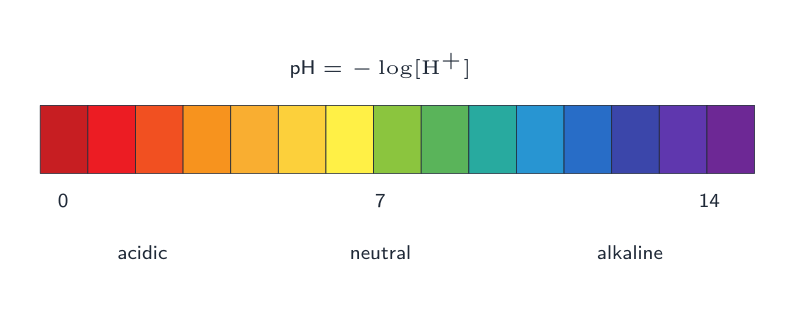
The pH pH scale measures acidity: $\text{pH}=-\log[\text{H}^+]$, with $\text{pH}+\text{pOH}=14$ at 25 °C. A strong acid 强酸 or strong base 强碱 dissociates completely, so its ion concentration equals its concentration – read pH directly. Lower pH means more acidic.

The pH scale: pH is the negative log of the hydrogen-ion concentration The pH scale: pH is the negative log of the hydrogen-ion concentration

Worked example. Find the pH of $0.010\ \text{M}$ HCl. Because HCl is a strong acid it is fully dissociated, so $[\text{H}^+]=0.010\ \text{M}$ and

$$\text{pH}=-\log(0.010)=2.0.$$
For a strong base like $0.010\ \text{M}$ NaOH, $\text{pOH}=2.0$, so $\text{pH}=14-2.0=12.0$.

Explore

Move along the pH scale

pH measures hydrogen-ion concentration on a log scale: each unit is a tenfold change. Strong acids sit low, strong bases high, 7 is neutral.

Vocabulary Train
English Chinese Pinyin
pH pH值 pH zhí
strong acid 强酸 qiáng suān
strong base 强碱 qiáng jiǎn
8.3

Weak Acid and Base Equilibria

Syllabus
Learning ObjectiveEssential Knowledge

8.3.A
Explain the relationship among $\mathrm{pH}$, $\mathrm{pOH}$, and concentrations of all species in a solution of a monoprotic weak acid or weak base.

  • 8.3.A.1 Weak acids react with water to produce hydronium ions. However, only a small percentage of molecules of a weak acid will ionize in this way. Thus, the concentration of $\mathrm{H_3O^+}$ is much less than the initial concentration of the molecular acid, and the vast majority of the acid molecules remain un-ionized.
  • 8.3.A.2 A solution of a weak acid involves equilibrium between an un-ionized acid and its conjugate base. The equilibrium constant for this reaction is $K_a$, often reported as $\mathrm{p}K_a$. The pH of a weak acid solution can be determined from the initial acid concentration and the $\mathrm{p}K_a$.
    • Equation: $K_a = \dfrac{[\mathrm{H_3O^+}][\mathrm{A^-}]}{[\mathrm{HA}]}$
    • Equation: $\mathrm{p}K_a = -\log K_a$
  • 8.3.A.3 Weak bases react with water to produce hydroxide ions in solution. However, ordinarily just a small percentage of the molecules of a weak base in solution will ionize in this way. Thus, the concentration of $\mathrm{OH^-}$ in the solution does not equal the initial concentration of the base, and the vast majority of the base molecules remain un-ionized.
  • 8.3.A.4 A solution of a weak base involves equilibrium between an un-ionized base and its conjugate acid. The equilibrium constant for this reaction is $K_b$, often reported as $\mathrm{p}K_b$. The $\mathrm{pH}$ of a weak base solution can be determined from the initial base concentration and the $\mathrm{p}K_b$.
    • Equation: $K_b = \dfrac{[\mathrm{OH^-}][\mathrm{HB^+}]}{[\mathrm{B}]}$
    • Equation: $\mathrm{p}K_b = -\log K_b$
  • 8.3.A.5 The percent ionization of a weak acid (or base) can be calculated from its $\mathrm{p}K_a$ ($\mathrm{p}K_b$) and the initial concentration of the acid (base). The percent ionization can also be calculated from the initial concentration of the acid (base) and the equilibrium concentration of any of the species in the equilibrium expression.
  • 8.3.A.6 For any conjugate acid-base pair, the acid ionization constant and base ionization constant are related by $K_w$:
    • Equation: $K_w = K_a \times K_b$
    • Equation: $\mathrm{p}K_w = \mathrm{p}K_a + \mathrm{p}K_b$

Source: College Board AP Course and Exam Description

A weak acid 弱酸 only partly dissociates, described by an equilibrium constant $K_a$ (larger $K_a$ = stronger weak acid); a weak base has $K_b$. For any conjugate acid–base pair the two are linked through water, $K_a\times K_b = K_w$, so $\text{p}K_a+\text{p}K_b=14$ – a stronger acid always has a weaker conjugate base. Because dissociation is small, find $[\text{H}^+]$ with an ICE table and the $K_a$ expression, often using the small-$x$ approximation.

Worked example. Find the pH of $0.10\ \text{M}$ acetic acid, $K_a=1.8\times10^{-5}$. Let $x=[\text{H}^+]$ at equilibrium; the ICE table gives $K_a=\dfrac{x^2}{0.10-x}\approx\dfrac{x^2}{0.10}$ (small-$x$ approximation), so

$$x=\sqrt{K_a\times0.10}=\sqrt{1.8\times10^{-6}}=1.3\times10^{-3}\ \text{M}\;\Rightarrow\;\text{pH}=-\log(1.3\times10^{-3})=2.9.$$
The weak acid is far less acidic than a strong acid of the same concentration (which would be pH $1.0$).

Vocabulary Train
English Chinese Pinyin
weak acid 弱酸 ruò suān
8.4

Acid-Base Reactions and Buffers

Syllabus
Learning ObjectiveEssential Knowledge

8.4.A
Explain the relationship among the concentrations of major species in a mixture of weak and strong acids and bases.

  • 8.4.A.1 When a strong acid and a strong base are mixed, they react quantitatively in a reaction represented by the equation: $\mathrm{H^+}(aq) + \mathrm{OH^-}(aq) \rightarrow \mathrm{H_2O}(l)$. The pH of the resulting solution may be determined from the concentration of excess reagent.
  • 8.4.A.2 When a weak acid and a strong base are mixed, they react quantitatively in a reaction represented by the equation: $\mathrm{HA}(aq) + \mathrm{OH^-}(aq) \rightleftarrows \mathrm{A^-}(aq)\ \mathrm{H_2O}(l)$. If the weak acid is in excess, then a buffer solution is formed, and the $\mathrm{pH}$ can be determined from the Henderson-Hasselbalch (H–H) equation (see 8.9.A.1). If the strong base is in excess, then the $\mathrm{pH}$ can be determined from the moles of excess hydroxide ion and the total volume of solution. If they are equimolar, then the (slightly basic) $\mathrm{pH}$ can be determined from the equilibrium represented by the equation: $\mathrm{A^-}(aq) + \mathrm{H_2O}(l) \rightleftarrows \mathrm{HA}(aq) + \mathrm{OH^-}(aq)$.
  • 8.4.A.3 When a weak base and a strong acid are mixed, they will react quantitatively in a reaction represented by the equation: $\mathrm{B}(aq) + \mathrm{H_3O^+}(aq) \rightleftarrows \mathrm{HB^+}(aq) + \mathrm{H_2O}(l)$. If the weak base is in excess, then a buffer solution is formed, and the $\mathrm{pH}$ can be determined from the H–H equation. If the strong acid is in excess, then the $\mathrm{pH}$ can be determined from the moles of excess hydronium ion and the total volume of solution. If they are equimolar, then the (slightly acidic) $\mathrm{pH}$ can be determined from the equilibrium represented by the equation: $\mathrm{HB^+}(aq) + \mathrm{H_2O}(l) \rightleftarrows \mathrm{B}(aq) + \mathrm{H_3O^+}(aq)$.
  • 8.4.A.4 When a weak acid and a weak base are mixed, they will react to an equilibrium state whose reaction may be represented by the equation: $\mathrm{HA}(aq) + \mathrm{B}(aq) \rightleftarrows \mathrm{A^-}(aq) + \mathrm{HB^+}(aq)$.

Source: College Board AP Course and Exam Description

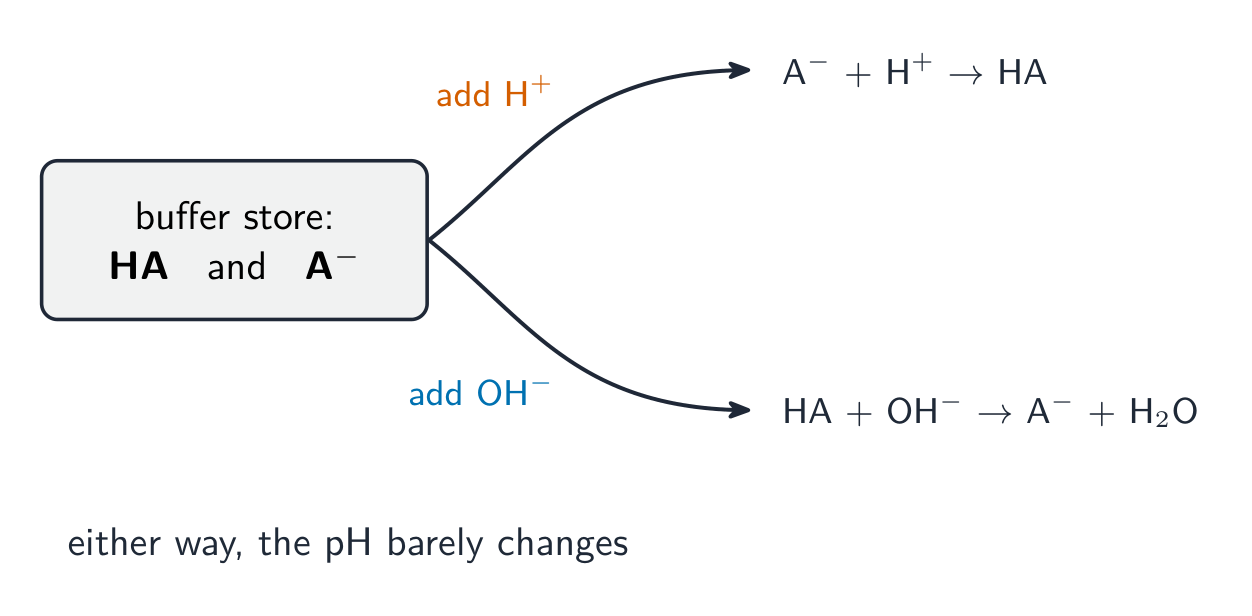
A buffer 缓冲溶液 resists pH change. It contains a weak acid and its conjugate base (or a weak base and its conjugate acid) in comparable amounts. Added acid is neutralized by the conjugate base, and added base by the weak acid, so pH barely moves.

Vocabulary Train
English Chinese Pinyin
buffer 缓冲溶液 huǎn chōng róng yè
8.5

Acid-Base Titrations

Syllabus
Learning ObjectiveEssential Knowledge

8.5.A
Explain results from the titration of a mono- or polyprotic acid or base solution, in relation to the properties of the solution and its components.

  • 8.5.A.1 An acid-base reaction can be carried out under controlled conditions in a titration. A titration curve, plotting $\mathrm{pH}$ against the volume of titrant added, is useful for summarizing results from a titration.
  • 8.5.A.2 At the equivalence point for titrations of monoprotic acids or bases, the number of moles of titrant added is equal to the number of moles of analyte originally present. This relationship can be used to obtain the concentration of the analyte. This is the case for titrations of strong acids/bases and weak acids/bases.
  • 8.5.A.3 For titrations of weak acids/bases, it is useful to consider the point halfway to the equivalence point, that is, the half-equivalence point. At this point, there are equal concentrations of each species in the conjugate acid-base pair, for example, for a weak acid $[\mathrm{HA}] = [\mathrm{A^-}]$. Because $\mathrm{pH} = \mathrm{p}K_a$ when the conjugate acid and base have equal concentrations, the $\mathrm{p}K_a$ can be determined from the $\mathrm{pH}$ at the half-equivalence point in a titration.
  • 8.5.A.4 At the equivalence point, pH is determined by the major species in solution. Strong acid and strong base titrations result in neutral pH at the equivalence point. However, in titrations of weak acids (weak bases), the conjugate base of the weak acid (conjugate acid of the weak base) is present at the equivalence point and can undergo proton-transfer reactions with the surrounding water, producing basic (acidic) solutions.
  • 8.5.A.5 For polyprotic acids, titration curves can be used to determine the number of acidic protons. In doing so, the major species present at any point along the curve can be identified, along with the $\mathrm{p}K_a$ associated with each proton in a weak polyprotic acid.
    • Exclusion statement: Computation of the concentration of each species present in the titration curve for polyprotic acids will not be assessed on the AP Exam. Such computations for titration of monoprotic acids are within the scope of the course (see 8.4.A.2 and 8.4.A.3), as is qualitative reasoning regarding what species are present in large versus small concentrations at any point in a titration of a polyprotic acid.

Source: College Board AP Course and Exam Description

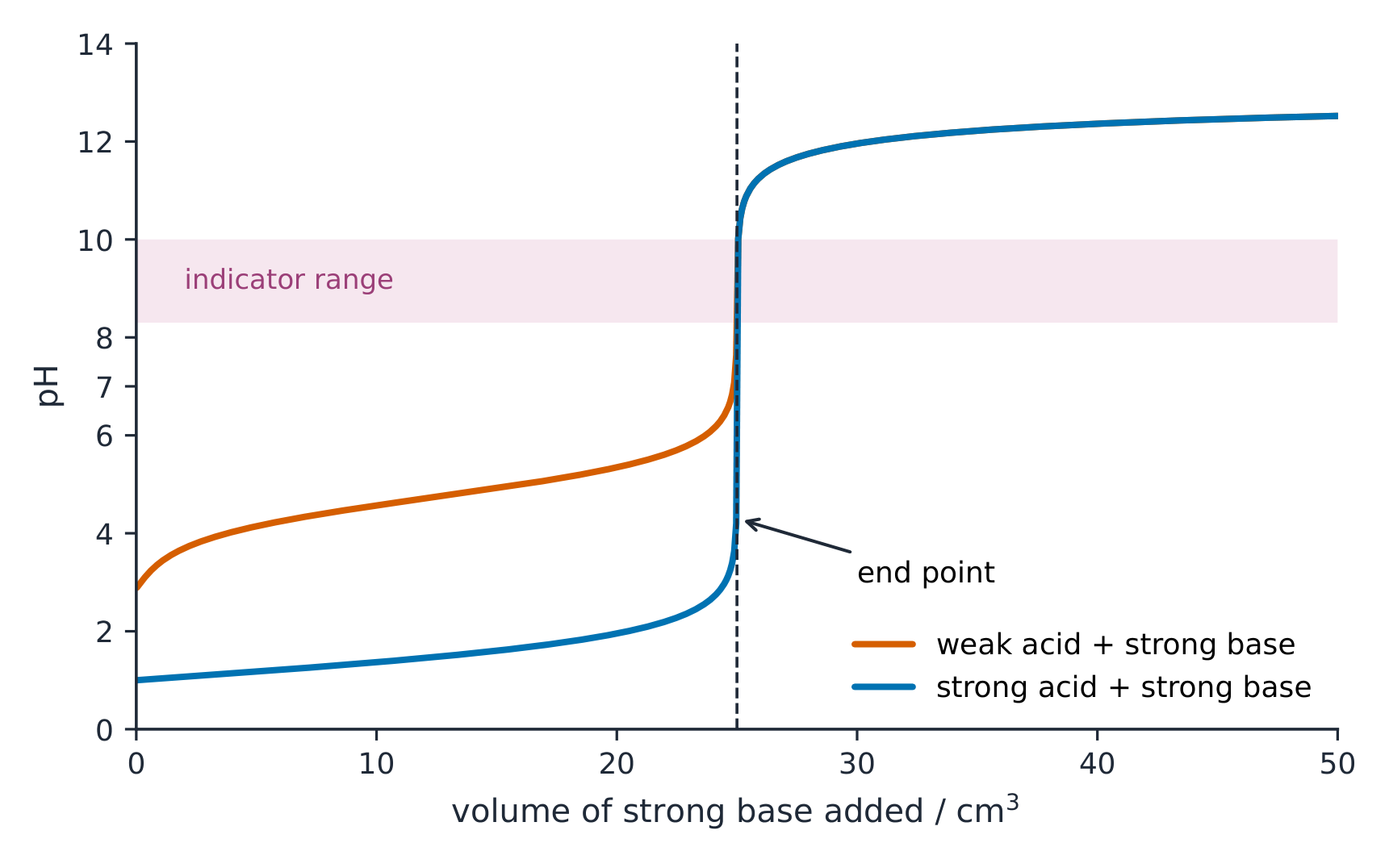
An acid–base titration curve

A titration curve 滴定曲线 plots pH as base (or acid) is added. Key points: the equivalence point 等当点 (moles of acid = moles of base – a steep jump), and the half-equivalence point, where $\text{pH}=\text{p}K_a$ (half the weak acid is converted, so a buffer is at its center).

An acid-base indicator 酸碱指示剂 is itself a weak acid whose protonated and deprotonated forms have different colours, so its colour responds to pH. You pick an indicator whose colour change happens near the titration's equivalence-point pH, so the colour flips just as the reaction completes.

A titration curve has a steep jump near the equivalence point A titration curve has a steep jump near the equivalence point

Explore

Titrate to the equivalence point

A titration curve rises gently, then sharply at the equivalence point where moles of acid and base match. The steep jump pinpoints that volume.

Vocabulary Train
English Chinese Pinyin
titration curve 滴定曲线 dī dìng qū xiàn
equivalence point 等当点 děng dāng diǎn
acid-base indicator 酸碱指示剂 suān jiǎn zhǐ shì jì
8.6

Molecular Structure of Acids and Bases

Syllabus
Learning ObjectiveEssential Knowledge

8.6.A
Explain the relationship between the strength of an acid or base and the structure of the molecule or ion.

  • 8.6.A.1 The protons on a molecule that will participate in acid-base reactions, and the relative strength of these protons, can be inferred from the molecular structure.
    • i. Strong acids (such as $\mathrm{HCl}$, $\mathrm{HBr}$, $\mathrm{HI}$, $\mathrm{HClO_4}$, $\mathrm{H_2SO_4}$, and $\mathrm{HNO_3}$) have very weak conjugate bases that are stabilized by electronegativity, inductive effects, resonance, or some combination thereof.
    • ii. Carboxylic acids are one common class of weak acid.
    • iii. Strong bases (such as group I and II hydroxides) have very weak conjugate acids.
    • iv. Common weak bases include nitrogenous bases such as ammonia as well as carboxylate ions.
    • v. Electronegative elements tend to stabilize the conjugate base relative to the conjugate acid, and so increase acid strength.

Source: College Board AP Course and Exam Description

Strength has structural roots. An acid is stronger when its conjugate base is more stable – for example, more electronegative atoms or resonance spreading the negative charge stabilize it. For oxoacids, more oxygen atoms on the central atom means a stronger acid.

8.7

pH and pKa

Syllabus
Learning ObjectiveEssential Knowledge

8.7.A
Explain the relationship between the predominant form of a weak acid or base in solution at a given $\mathrm{pH}$ and the $\mathrm{p}K_a$ of the conjugate acid or the $\mathrm{p}K_b$ of the conjugate base.

  • 8.7.A.1 The protonation state of an acid or base (i.e., the relative concentrations of $\mathrm{HA}$ and $\mathrm{A^-}$) can be predicted by comparing the $\mathrm{pH}$ of a solution to the $\mathrm{p}K_a$ of the acid in that solution. When solution $\mathrm{pH} < \mathrm{acid}\ \mathrm{p}K_a$, the acid form has a higher concentration than the base form. When solution $\mathrm{pH} > \mathrm{acid}\ \mathrm{p}K_a$, the base form has a higher concentration than the acid form.
  • 8.7.A.2 Acid-base indicators are substances that exhibit different properties (such as color) in their protonated versus deprotonated state, making that property respond to the $\mathrm{pH}$ of a solution.
  • 8.7.A.3 To ensure accurate results in a titration experiment, acid-base indicators should be selected that have a $\mathrm{p}K_a$ close to the $\mathrm{pH}$ at the equivalence point.

Source: College Board AP Course and Exam Description

$\text{p}K_a=-\log K_a$: a smaller $\text{p}K_a$ means a stronger acid. Comparing pH to $\text{p}K_a$ tells you the dominant form: below $\text{p}K_a$ the acid form dominates; above it, the conjugate base form dominates.

8.8

Properties of Buffers
Syllabus
Learning ObjectiveEssential Knowledge

8.8.A
Explain the relationship between the ability of a buffer to stabilize $\mathrm{pH}$ and the reactions that occur when an acid or a base is added to a buffered solution.

  • 8.8.A.1 A buffer solution contains a large concentration of both members in a conjugate acid-base pair. The conjugate acid reacts with added base and the conjugate base reacts with added acid. These reactions are responsible for the ability of a buffer to stabilize $\mathrm{pH}$.

Source: College Board AP Course and Exam Description

How a buffer resists pH change

A buffer works best when the weak acid and conjugate base concentrations are similar (pH near $\text{p}K_a$). Choose a buffer whose $\text{p}K_a$ is close to the target pH. Diluting a buffer barely changes its pH, because the acid-to-base ratio stays the same.

A buffer resists pH change by mopping up added acid or base A buffer resists pH change by mopping up added acid or base

8.9

The Henderson-Hasselbalch Equation

Syllabus
Learning ObjectiveEssential Knowledge

8.9.A
Identify the $\mathrm{pH}$ of a buffer solution based on the identity and concentrations of the conjugate acid-base pair used to create the buffer.

  • 8.9.A.1 The $\mathrm{pH}$ of the buffer is related to the $\mathrm{p}K_a$ of the acid and the concentration ratio of the conjugate acid-base pair. This relation is a consequence of the equilibrium expression associated with the dissociation of a weak acid, and is described by the Henderson-Hasselbalch equation. Adding small amounts of acid or base to a buffered solution does not significantly change the ratio of $[\mathrm{A^-}]/[\mathrm{HA}]$ and thus does not significantly change the solution $\mathrm{pH}$. The change in $\mathrm{pH}$ on addition of acid or base to a buffered solution is therefore much less than it would have been in the absence of the buffer.
    • Equation: $\mathrm{pH} = \mathrm{p}K_a + \log\dfrac{[\mathrm{A^-}]}{[\mathrm{HA}]}$
    • Exclusion statement: Computation of the change in pH resulting from the addition of an acid or a base to a buffer will not be assessed on the AP Exam.
    • Exclusion statement: Derivation of the Henderson-Hasselbalch equation will not be assessed on the AP Exam.

Source: College Board AP Course and Exam Description

For a buffer, the pH follows from the acid-to-base ratio:

$$\text{pH}=\text{p}K_a+\log\frac{[\text{A}^-]}{[\text{HA}]}.$$
When the concentrations are equal, the log is zero and $\text{pH}=\text{p}K_a$. Use it to design a buffer or find its pH quickly.

Worked example. A buffer holds $0.20\ \text{M}$ acetic acid ($\text{p}K_a=4.74$) and $0.30\ \text{M}$ acetate. Its pH is

$$\text{pH}=4.74+\log\frac{0.30}{0.20}=4.74+\log(1.5)=4.74+0.18=4.92.$$
A little more conjugate base than acid pushes the pH just above $\text{p}K_a$, as the equation predicts.

8.10

Buffer Capacity

Syllabus
Learning ObjectiveEssential Knowledge

8.10.A
Explain the relationship between the buffer capacity of a solution and the relative concentrations of the conjugate acid and conjugate base components of the solution.

  • 8.10.A.1 Increasing the concentration of the buffer components (while keeping the ratio of these concentrations constant) keeps the $\mathrm{pH}$ of the buffer the same but increases the capacity of the buffer to neutralize added acid or base.
  • 8.10.A.2 When a buffer has more conjugate acid than base, it has a greater buffer capacity for addition of added base than acid. When a buffer has more conjugate base than acid, it has a greater buffer capacity for addition of added acid than base.

Source: College Board AP Course and Exam Description

Buffer capacity 缓冲容量 is how much acid or base a buffer can absorb before its pH changes sharply. It is greatest when the components are concentrated and in roughly equal amounts. Once one component is used up, the buffer fails.

Vocabulary Train
English Chinese Pinyin
Buffer capacity 缓冲容量 huǎn chōng róng liàng
8.11

pH and Solubility

Syllabus
Learning ObjectiveEssential Knowledge

8.11.A
Identify the qualitative effect of changes in pH on the solubility of a salt.

  • 8.11.A.1 The solubility of a salt is pH sensitive when one of the constituent ions is a weak acid, a weak base, or the hydroxide ion. These effects can be understood qualitatively using Le Châtelier's principle.
    • Exclusion statement: Computations of solubility as a function of pH will not be assessed on the AP Exam.

Source: College Board AP Course and Exam Description

The solubility of a salt with a basic anion rises in acidic solution: the added $\text{H}^+$ reacts with the anion, removing it from the solubility equilibrium and pulling more solid to dissolve (Le Chatelier applied to $K_{sp}$). So pH can control whether an ionic solid dissolves.

8.11

Exam tips

  • Neutral means equal ions, not pH 7. In pure water $[\text{H}_3\text{O}^+]=[\text{OH}^-]$; since $K_w$ rises with temperature, neutral pH drifts below 7 above 25 °C. Use $K_w=[\text{H}_3\text{O}^+][\text{OH}^-]=1.0\times10^{-14}$ (25 °C) to convert between $[\text{OH}^-]$ and $[\text{H}_3\text{O}^+]$.
  • $\text{pH}=-\log[\text{H}^+]$ is logarithmic — each unit is a ten-fold change in $[\text{H}^+]$.
  • A strong acid/base dissociates completely (so $[\text{H}^+]$ = concentration); a weak one only partly, needing $K_a$.
  • A buffer contains a weak acid and its conjugate base together; it resists pH change by mopping up added acid or base.
  • On a titration curve the equivalence point is the steep jump; the half-equivalence point has $\text{pH}=\text{p}K_a$.
  • A smaller $\text{p}K_a$ means a stronger acid.

Log in or create account

IGCSE & A-Level