| Learning Objective | Essential Knowledge |
|---|---|
9.1.A |
|
Thermodynamics and Electrochemistry
AP Chemistry · Topic 9
 8:16
8:16
Thermodynamics and Electrochemistry
Two puzzles. Hold an ice cube: it melts in your hand, even though melting takes energy in. Now look at a diamond. Every diamond should slowly turn into…
English narration · English + 中文 subtitles burned in
9.1
Introduction to Entropy
Syllabus
Source: College Board AP Course and Exam Description
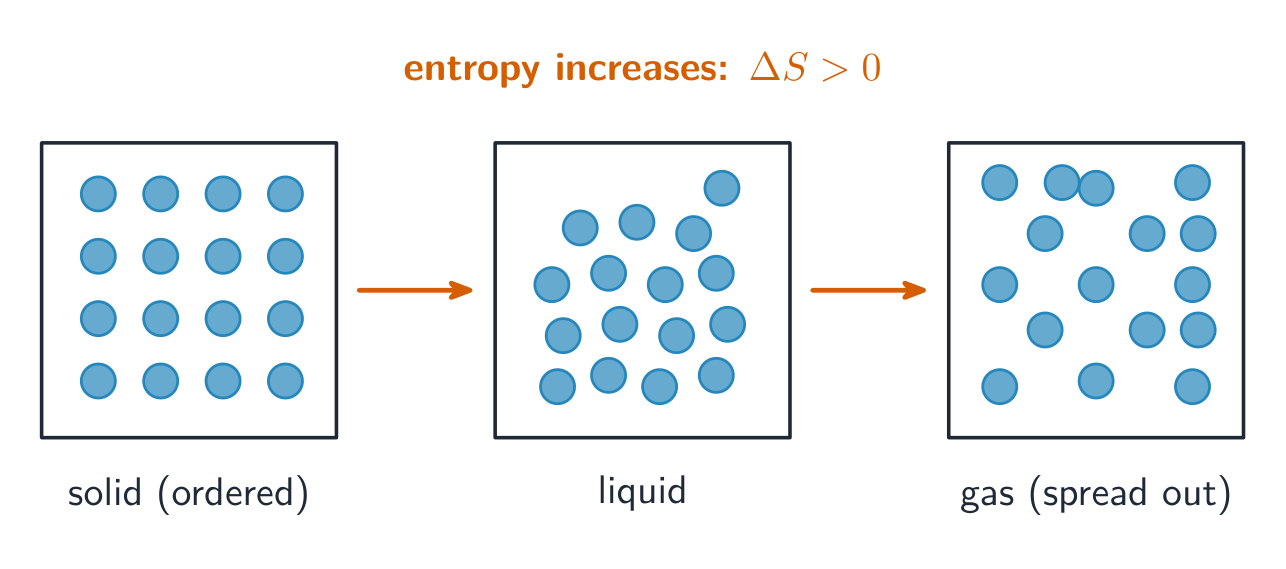
Entropy 熵 $S$ measures the dispersal of energy and matter – loosely, the number of ways to arrange a system. Entropy increases when a substance goes solid → liquid → gas, when a solid dissolves, when gas moles increase, or when temperature rises. More disorder means higher entropy.
Vocabulary
Train
| English |
|---|
| Entropy/ˈentrəpi/ |
9.2
Absolute Entropy and Entropy Change
Syllabus
| Learning Objective | Essential Knowledge |
|---|---|
9.2.A |
|
Source: College Board AP Course and Exam Description
Every substance has a positive absolute entropy $S^\circ$. For a reaction,
$$\Delta S^\circ = \sum S^\circ(\text{products}) - \sum S^\circ(\text{reactants}).$$
Predict its sign from the change in gas moles: making more gas raises entropy ($\Delta S>0$).
9.3
Gibbs Free Energy and Thermodynamic Favorability
Syllabus
| Learning Objective | Essential Knowledge | ||||||||||||||||||||
|---|---|---|---|---|---|---|---|---|---|---|---|---|---|---|---|---|---|---|---|---|---|
9.3.A |
|
Source: College Board AP Course and Exam Description
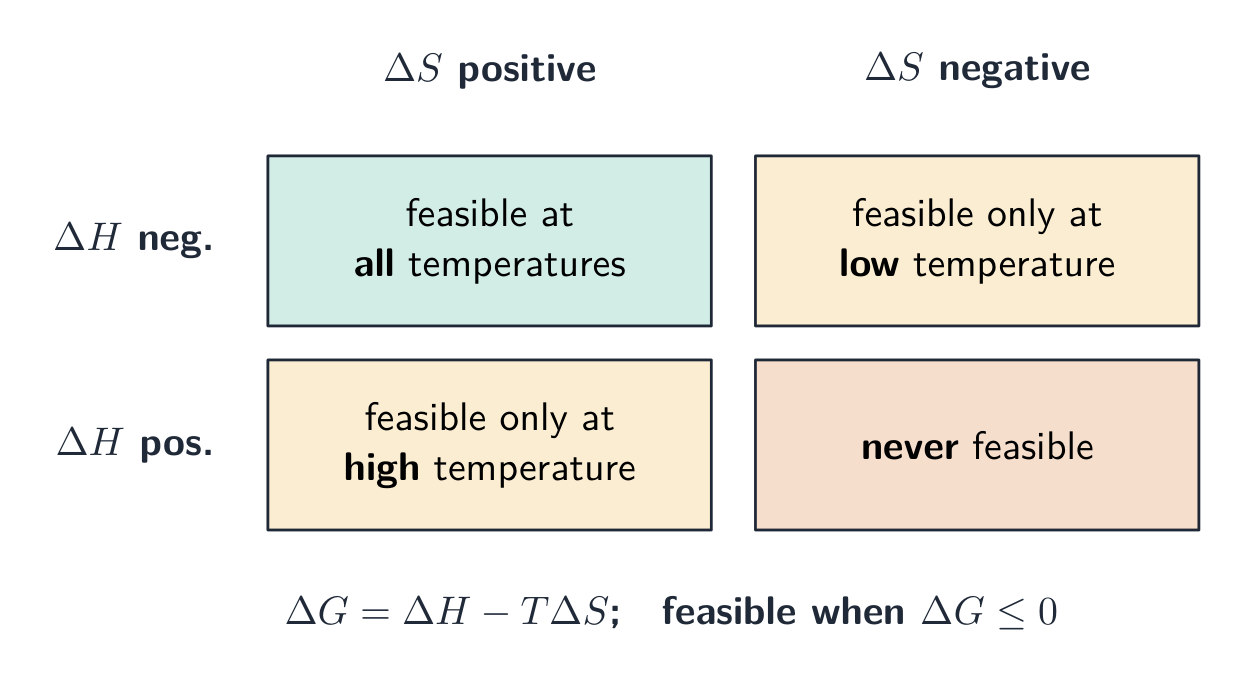
Gibbs free energy 吉布斯自由能 combines enthalpy and entropy:
$$\Delta G = \Delta H - T\Delta S.$$
A process is thermodynamically favorable 热力学有利 when $\Delta G<0$. So exothermic ($\Delta H<0$) and entropy-increasing ($\Delta S>0$) reactions are always favorable; when the two oppose, temperature decides.
Worked example. A reaction has $\Delta H=+40\ \text{kJ/mol}$ and $\Delta S=+120\ \text{J/(mol K)}$. It is endothermic (unfavorable enthalpy) but entropy-increasing, so it becomes favorable only when hot enough. Setting $\Delta G=\Delta H-T\Delta S<0$ and matching units ($\Delta S=0.120\ \text{kJ}$):
$$T>\frac{\Delta H}{\Delta S}=\frac{40}{0.120}=333\ \text{K}\;(60\,{}^{\circ}\text{C}).$$
Vocabulary
Train
| English |
|---|
| Gibbs free energy/ɡɪbz friː ˈenədʒi/ |
| thermodynamically favorable/ˌθɜːməʊdaɪˈnæmɪkli ˈfeɪvərəbl/ |
9.4
Thermodynamic and Kinetic Control
Syllabus
| Learning Objective | Essential Knowledge |
|---|---|
9.4.A |
|
Source: College Board AP Course and Exam Description
$\Delta G<0$ says a reaction can happen, not that it will happen fast. A reaction can be thermodynamically favorable yet kinetically slow because of a high activation energy (diamond → graphite). Thermodynamics gives the direction; kinetics gives the speed.
9.5
Free Energy and Equilibrium
Syllabus
| Learning Objective | Essential Knowledge |
|---|---|
9.5.A |
|
Source: College Board AP Course and Exam Description
Free energy links to the equilibrium constant:
$$\Delta G^\circ = -RT\ln K.$$
So $\Delta G^\circ<0$ gives $K>1$ (products favored), and $\Delta G^\circ>0$ gives $K<1$. At equilibrium $\Delta G=0$.
9.6
Free Energy of Dissolution
Syllabus
| Learning Objective | Essential Knowledge |
|---|---|
9.6.A |
|
Source: College Board AP Course and Exam Description
Whether a salt dissolves depends on the free-energy change of dissolving. Dissolving often increases entropy (ordered solid → dispersed ions) but may cost enthalpy; the sign of $\Delta G$ (and thus $K_{sp}$) follows from $\Delta H - T\Delta S$.
9.7
Coupled Reactions
Syllabus
| Learning Objective | Essential Knowledge |
|---|---|
9.7.A |
|
Source: College Board AP Course and Exam Description
An unfavorable reaction ($\Delta G>0$) can be driven by coupling it to a favorable one ($\Delta G<0$) that shares a common intermediate, as long as the sum has $\Delta G<0$. This is how cells use ATP to power otherwise unfavorable processes.
9.8
Galvanic and Electrolytic Cells
Syllabus
| Learning Objective | Essential Knowledge |
|---|---|
9.8.A |
|
Source: College Board AP Course and Exam Description
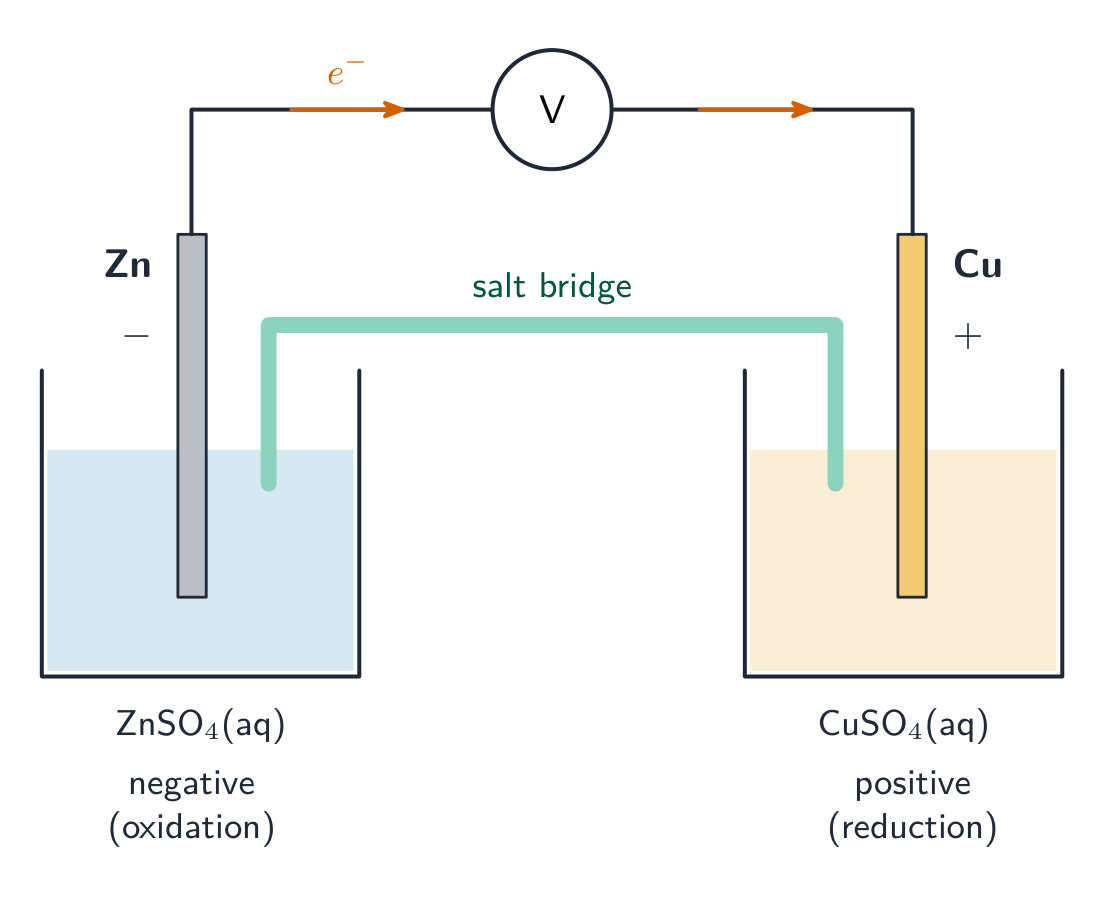
Redox reactions can move electrons through a wire:
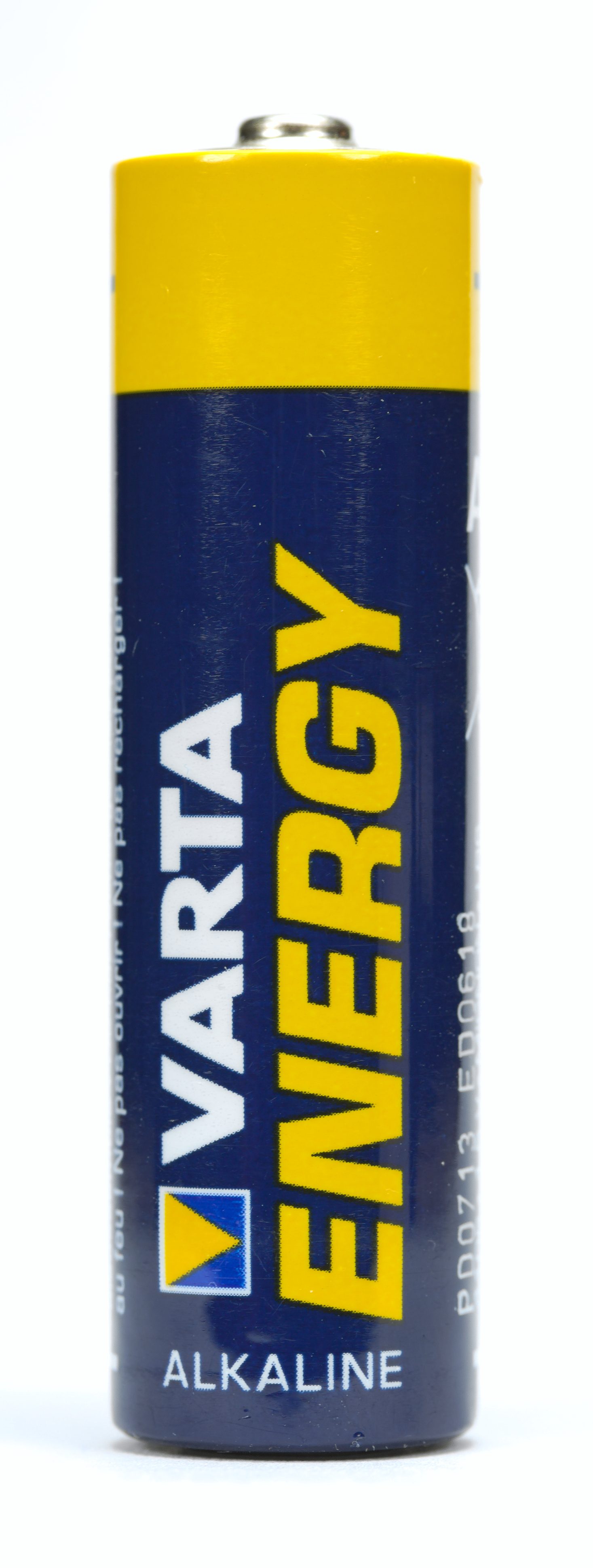
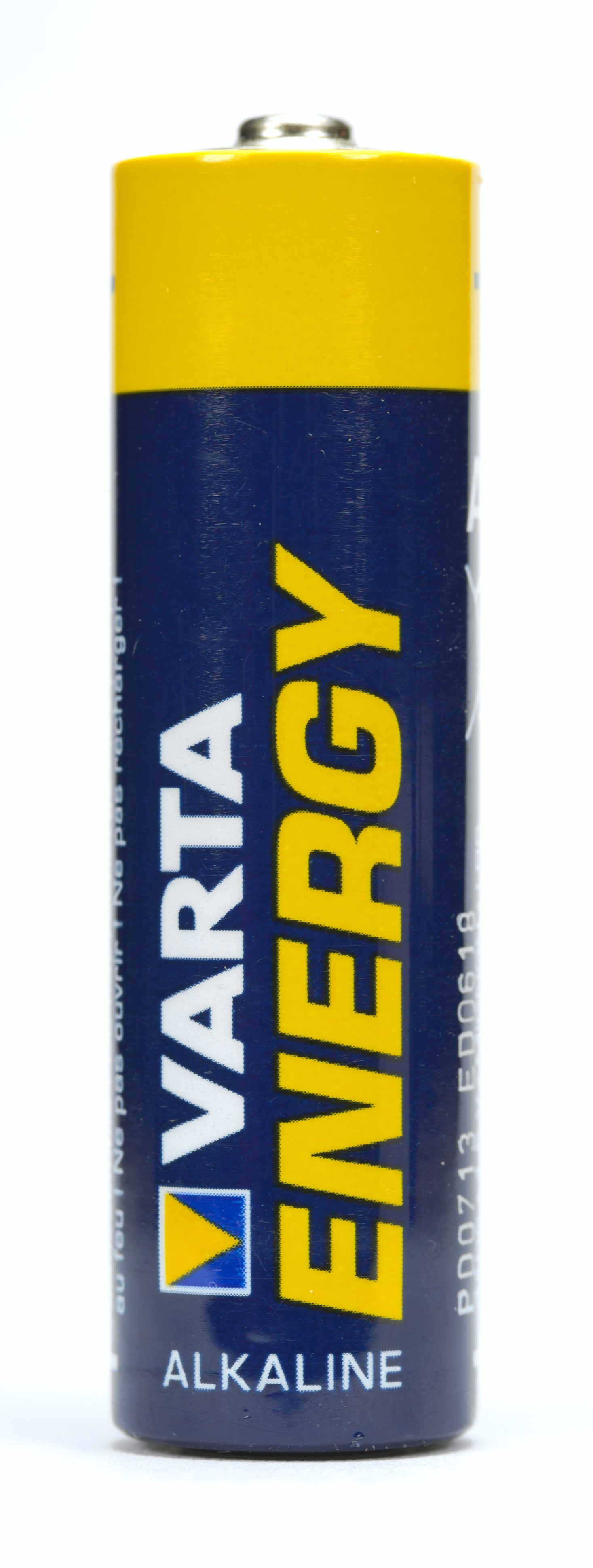
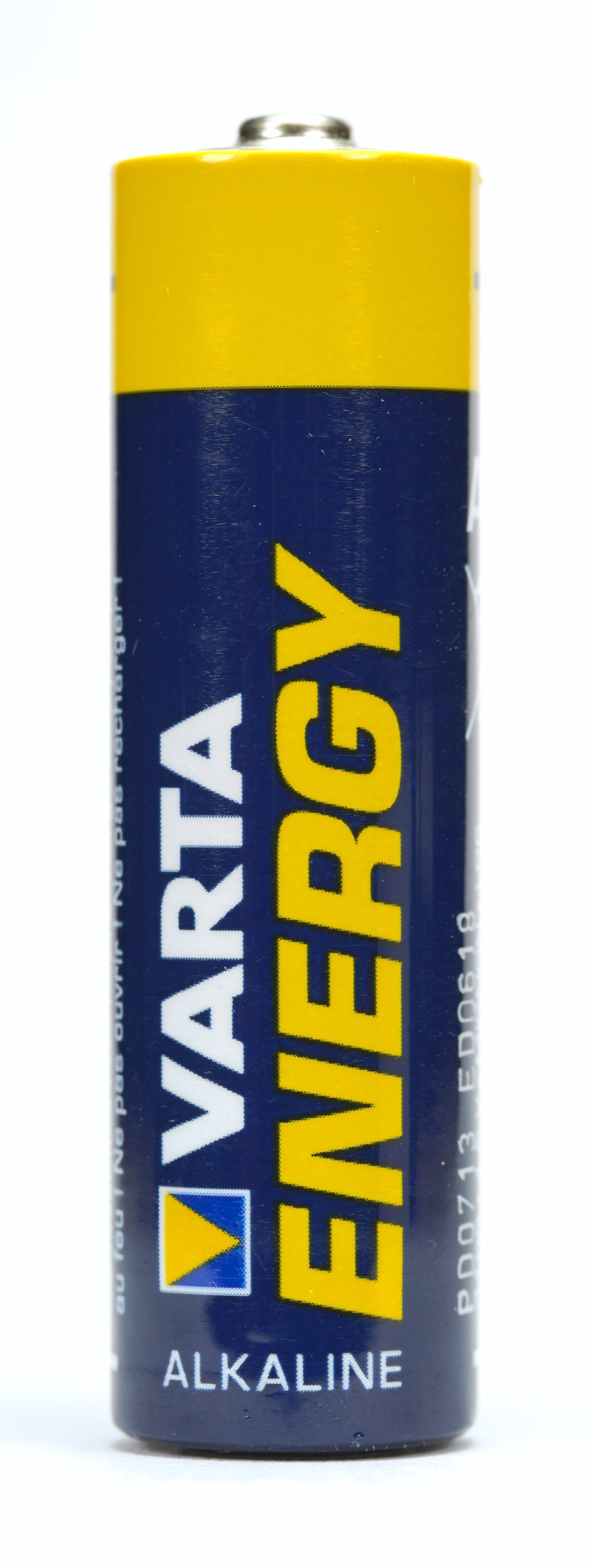
- A galvanic (voltaic) cell 原电池 uses a favorable reaction ($\Delta G<0$) to produce electricity – a battery.
- An electrolytic cell 电解池 uses electricity to force an unfavorable reaction ($\Delta G>0$).
In both, oxidation happens at the anode 阳极 and reduction at the cathode 阴极.
Explore
Transfer electrons in a cell
In a galvanic cell a spontaneous redox reaction drives electrons through a wire, doing electrical work; oxidation at one electrode, reduction at the other.
Vocabulary
Train
| English |
|---|
| galvanic (voltaic) cell/ɡælˈvænɪk sel/ |
| electrolytic cell/ɪˌlektrəˈlɪtɪk sel/ |
| anode/ˈænəʊd/ |
| cathode/ˈkæθəʊd/ |
9.9
Cell Potential and Free Energy
Syllabus
| Learning Objective | Essential Knowledge |
|---|---|
9.9.A |
|
Source: College Board AP Course and Exam Description
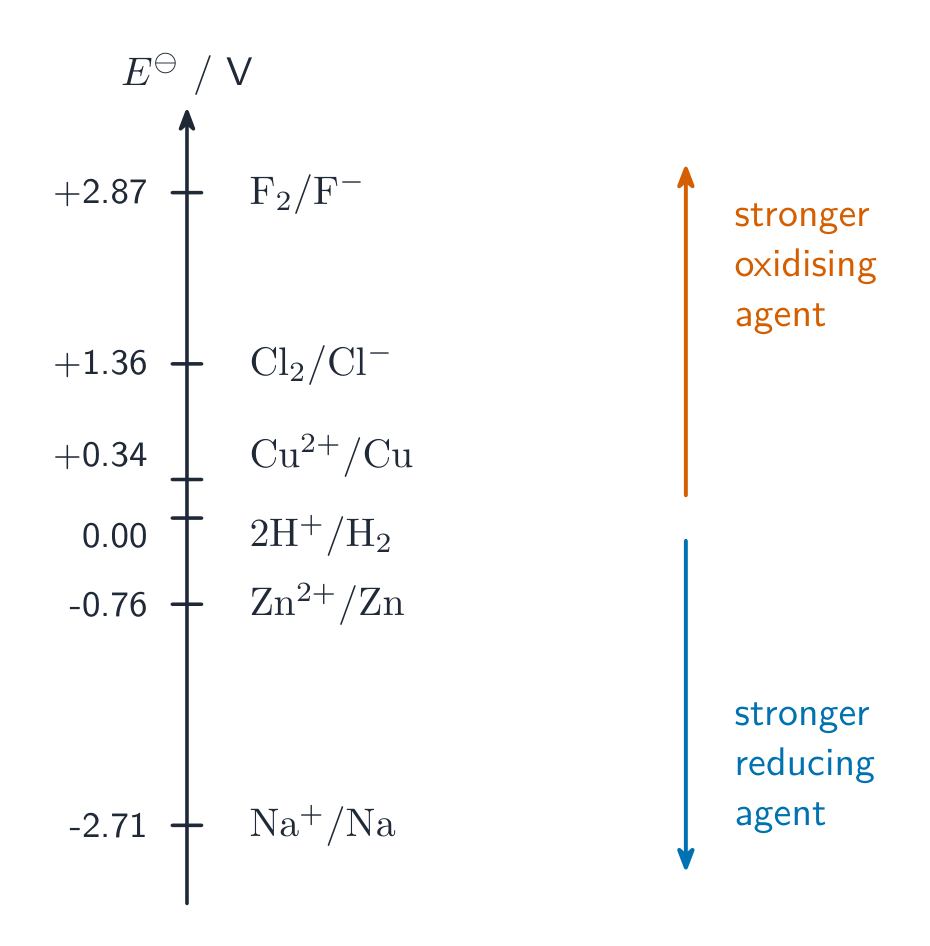
The cell potential 电池电势 $E^\circ_{\text{cell}}$ measures the driving force in volts, found from standard reduction potentials ($E^\circ_{\text{cathode}}-E^\circ_{\text{anode}}$). It links to free energy by
$$\Delta G^\circ = -nFE^\circ_{\text{cell}},$$
where $n$ is moles of electrons and $F$ the Faraday constant. A positive $E^\circ_{\text{cell}}$ means a favorable (galvanic) reaction.
Worked example. A cell pairs a copper cathode ($\text{Cu}^{2+}+2e^-\rightarrow\text{Cu}$, $E^\circ=+0.34\ \text{V}$) with a zinc anode ($\text{Zn}^{2+}+2e^-\rightarrow\text{Zn}$, $E^\circ=-0.76\ \text{V}$). The cell potential is
$$E^\circ_{\text{cell}}=E^\circ_{\text{cathode}}-E^\circ_{\text{anode}}=0.34-(-0.76)=1.10\ \text{V}.$$
It is positive, so the reaction is spontaneous and the cell (a Daniell cell) acts as a battery.
Vocabulary
Train
| English |
|---|
| cell potential/sel pəˈtenʃl/ |
9.10
Cell Potential Under Nonstandard Conditions
Syllabus
| Learning Objective | Essential Knowledge |
|---|---|
9.10.A |
|
Source: College Board AP Course and Exam Description
Away from standard conditions, the potential shifts with concentration – the Nernst equation 能斯特方程 (qualitatively): as reactants are consumed, $Q$ rises and $E_{\text{cell}}$ falls, reaching zero at equilibrium (a dead battery). Changing a concentration shifts $E_{\text{cell}}$ the way Le Chatelier predicts.
Vocabulary
Train
| English |
|---|
| Nernst equation/nɜːnst ɪˈkweɪʒn/ |
9.11
Electrolysis and Faraday's Law
Syllabus
| Learning Objective | Essential Knowledge |
|---|---|
9.11.A |
|
Source: College Board AP Course and Exam Description
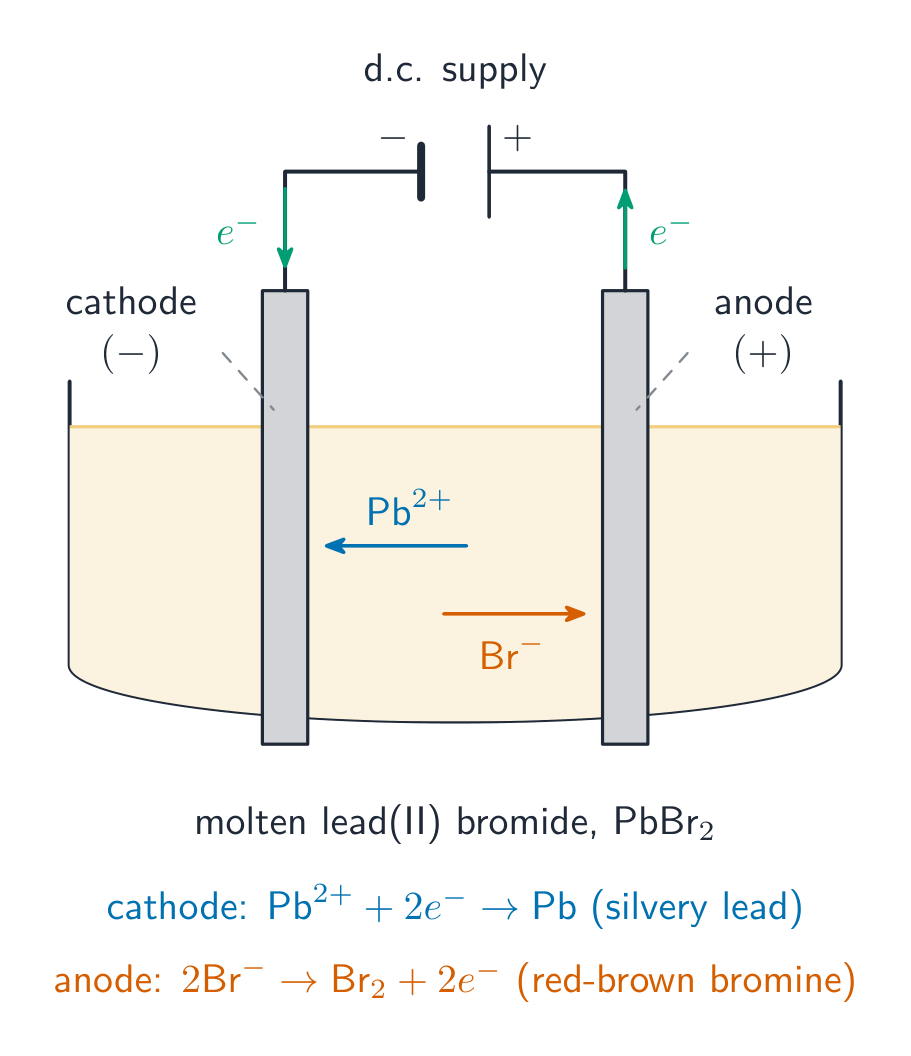
In electrolysis 电解, the charge passed determines how much substance is deposited or produced – Faraday's law 法拉第定律. Convert current × time to charge, charge to moles of electrons ($F=96{,}485$ C/mol), then use the half-reaction's electron ratio to get moles (and mass) of product.
Worked example. A current of $2.0\ \text{A}$ flows for $30\ \text{minutes}$ through copper(II) sulfate ($\text{Cu}^{2+}+2e^-\rightarrow\text{Cu}$). How much copper is deposited? The charge is $Q=It=2.0\times1800=3600\ \text{C}$, giving $3600/96485=0.0373\ \text{mol}$ of electrons. Since each Cu needs $2$ electrons, $0.0187\ \text{mol}$ of Cu forms, a mass of $0.0187\times63.5=1.2\ \text{g}$.
Explore
Electrolyse a molten salt
Electrolysis uses current to force a non-spontaneous reaction: positive ions gain electrons at the cathode, negative ions lose them at the anode. Charge sets the amount deposited.
Vocabulary
Train
| English |
|---|
| electrolysis/ɪlekˈtrɒləsɪs/ |
| Faraday's law/ˈfærədeɪz lɔː/ |
9.11
Exam tips
- A process is thermodynamically favourable when $\Delta G<0$; combine enthalpy and entropy with $\Delta G=\Delta H-T\Delta S$ (match units — kJ vs J).
- Entropy increases solid→liquid→gas and when more gas moles are produced.
- Favourable does not mean fast — a high activation energy can make a $\Delta G<0$ reaction extremely slow (kinetic control).
- In electrochemistry a positive $E^\circ_{\text{cell}}=E^\circ_{\text{cathode}}-E^\circ_{\text{anode}}$ means a spontaneous (galvanic) cell; oxidation is at the anode, reduction at the cathode.
- In electrolysis the charge passed ($Q=It$) fixes the amount deposited (Faraday's law).
Interactive lessons on this topic
Work through it step by step, with instant-check exercises.
- Introduction to Entropy
- Absolute Entropy and Entropy Change
- Gibbs Free Energy and Thermodynamic Favorability
- Thermodynamic and Kinetic Control
- Free Energy and Equilibrium
- Free Energy of Dissolution
- Coupled Reactions
- Galvanic and Electrolytic Cells
- Cell Potential and Free Energy
- Cell Potential Under Nonstandard Conditions
- Electrolysis and Faraday's Law