| Learning Objective | Essential Knowledge |
|---|---|
7.1.A |
|
Equilibrium
AP Chemistry · Topic 7
 8:24
8:24
Equilibrium
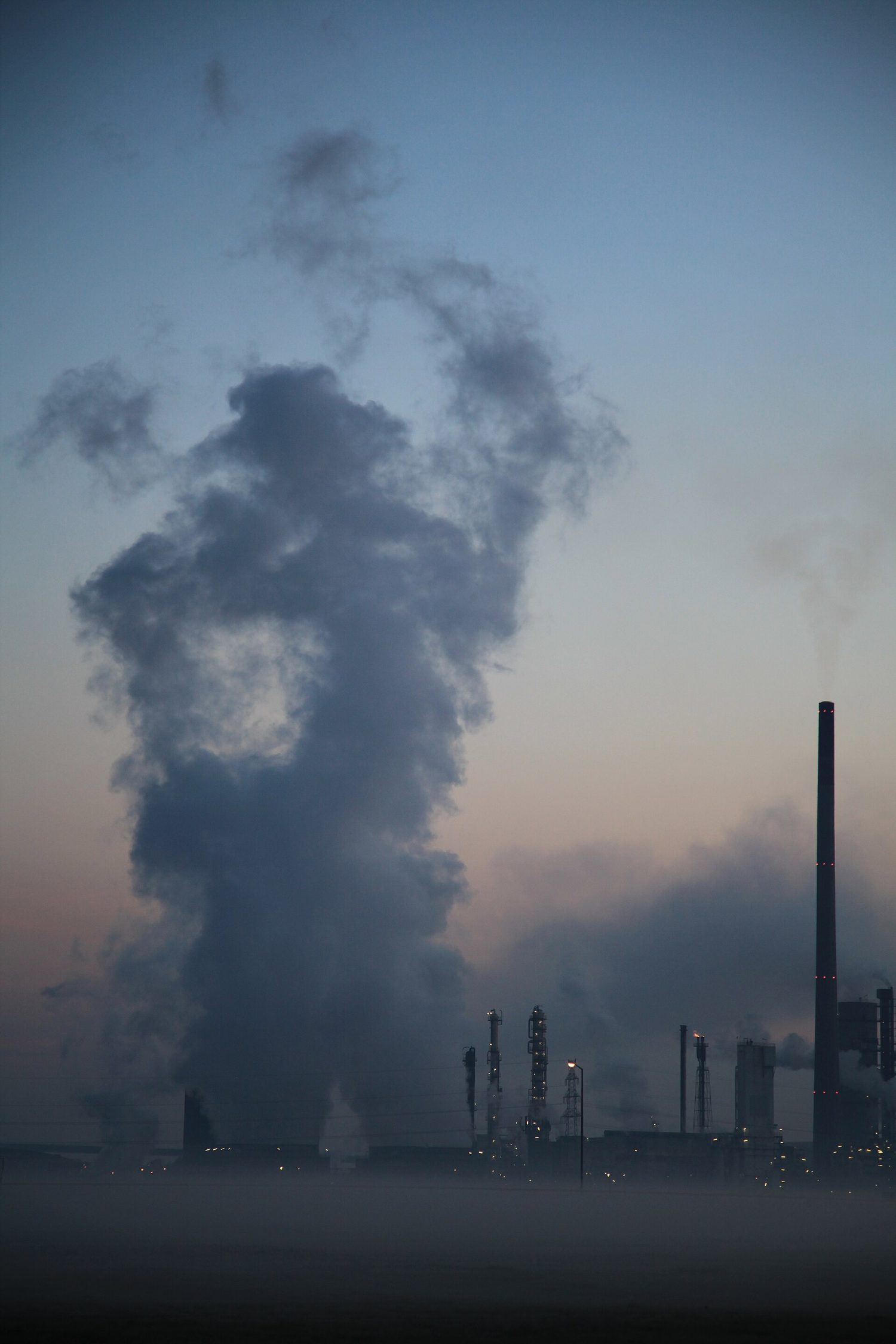
A chemical plant at dusk. Inside it, nitrogen from the air is turned into ammonia — the fertiliser that feeds about half the people alive today. But the…
English narration · English + 中文 subtitles burned in
7.1
Introduction to Equilibrium
Syllabus
Source: College Board AP Course and Exam Description
A reversible reaction 可逆反应 runs both ways. Chemical equilibrium 化学平衡 is reached when the forward and reverse rates become equal, so concentrations stop changing. Equilibrium is dynamic – both reactions continue, but at matching rates, so nothing appears to change.
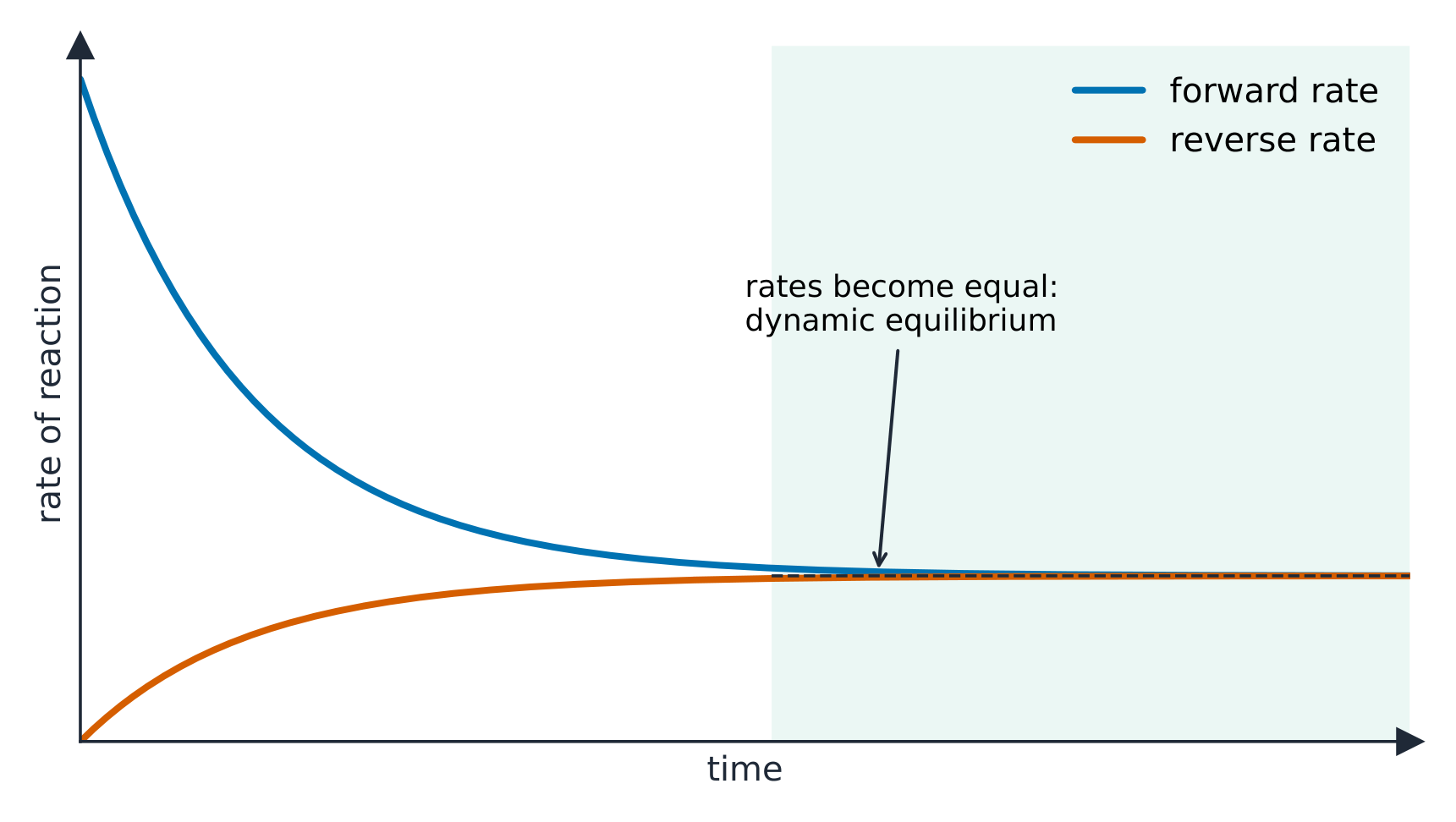
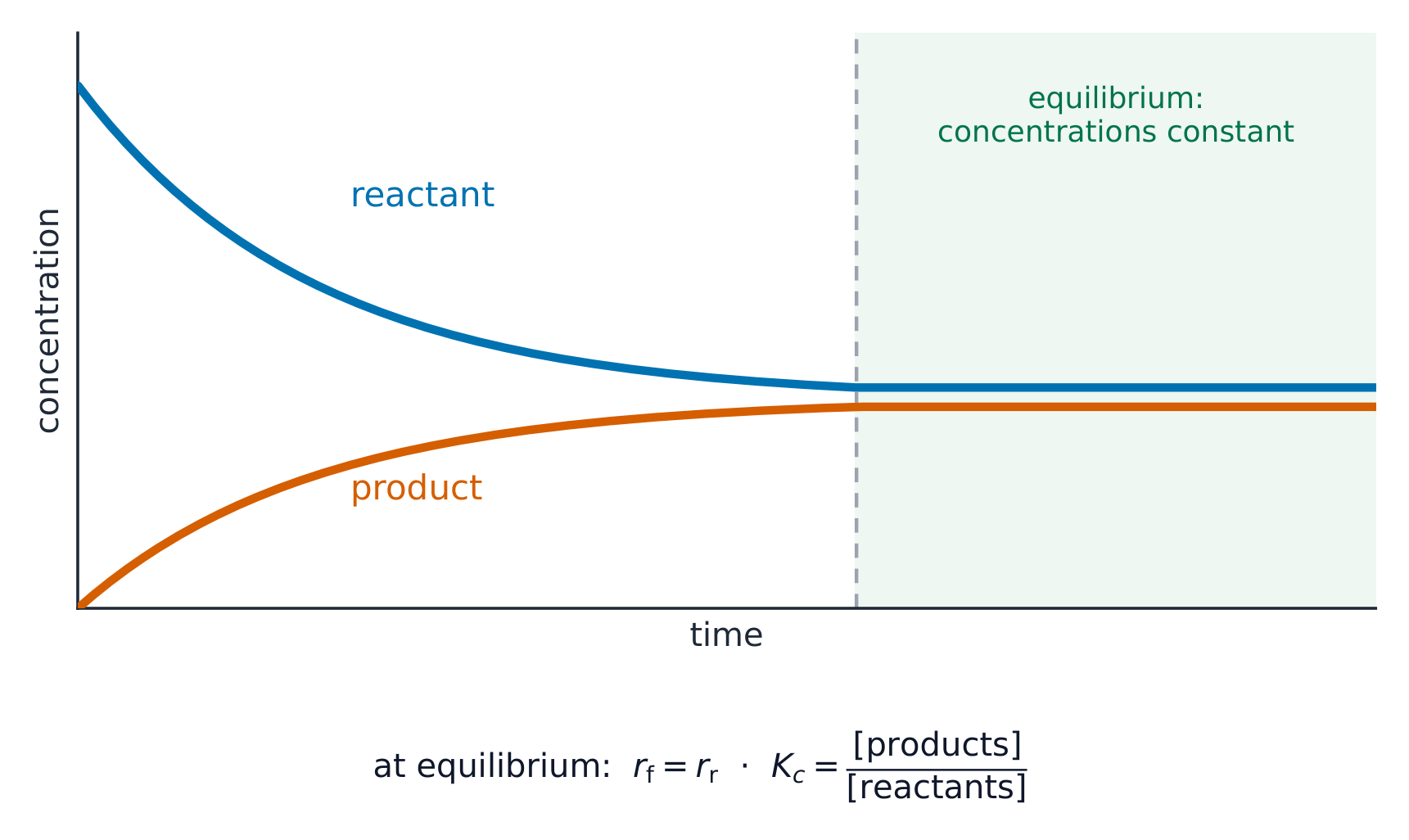
The rates graph above explains why concentrations settle; this next graph shows what the concentrations do – reactants fall and products rise until, once the rates match, both hold constant (they need not be equal).
Vocabulary
Train
| English |
|---|
| reversible reaction/rɪˈvɜːsɪbl rɪˈækʃn/ |
| Chemical equilibrium/ˈkemɪkl ˌiːkwɪˈlɪbrɪəm/ |
7.2
Direction of Reversible Reactions
Syllabus
| Learning Objective | Essential Knowledge |
|---|---|
7.2.A |
|
Source: College Board AP Course and Exam Description
At equilibrium the amounts of reactants and products are fixed but usually not equal. Whether the mixture favors products or reactants depends on the reaction; you compare the current state to the equilibrium condition to predict which way it shifts.
7.3
The Reaction Quotient and Equilibrium Constant
Syllabus
| Learning Objective | Essential Knowledge |
|---|---|
7.3.A |
|
Source: College Board AP Course and Exam Description
The reaction quotient 反应商 $Q$ has the same form as the equilibrium expression but uses current concentrations:
$$Q=\frac{[\text{products}]}{[\text{reactants}]}\ \text{(each raised to its coefficient)}.$$
At equilibrium $Q$ equals the equilibrium constant 平衡常数 $K$. Comparing them predicts direction: $Q
Vocabulary
Train
| English |
|---|
| reaction quotient/rɪˈækʃn ˈkwəʊʃənt/ |
| equilibrium constant/ˌiːkwɪˈlɪbrɪəm ˈkɒnstənt/ |
7.4
Calculating the Equilibrium Constant
Syllabus
| Learning Objective | Essential Knowledge |
|---|---|
7.4.A |
|
Source: College Board AP Course and Exam Description
Write $K$ from the balanced equation (pure solids and liquids are left out). From equilibrium concentrations (or partial pressures for $K_p$), plug in and compute. $K_c$ uses molarities; $K_p$ uses pressures.
Worked example. For $\text{N}_2\text{O}_4\rightleftharpoons2\text{NO}_2$, the equilibrium concentrations are $[\text{N}_2\text{O}_4]=0.20\ \text{M}$ and $[\text{NO}_2]=0.10\ \text{M}$. Then
$$K_c=\frac{[\text{NO}_2]^2}{[\text{N}_2\text{O}_4]}=\frac{(0.10)^2}{0.20}=0.050.$$
The NO$_2$ coefficient of $2$ becomes the power; N$_2$O$_4$ (coefficient $1$) is just to the first power.
7.5
Magnitude of the Equilibrium Constant
Syllabus
| Learning Objective | Essential Knowledge |
|---|---|
7.5.A |
|
Source: College Board AP Course and Exam Description
- $K\gg 1$: products strongly favored (reaction nearly complete).
- $K\ll 1$: reactants favored (little reaction).
- $K\approx 1$: significant amounts of both.
The size of $K$ tells you where the equilibrium "sits."
7.6
Properties of the Equilibrium Constant
Syllabus
| Learning Objective | Essential Knowledge |
|---|---|
7.6.A |
|
Source: College Board AP Course and Exam Description
$K$ changes in predictable ways: reversing a reaction inverts $K$ ($1/K$); multiplying coefficients by $n$ raises $K$ to the $n$th power; adding reactions multiplies their $K$ values. Only temperature changes the value of $K$ itself.
7.7
Calculating Equilibrium Concentrations
Syllabus
| Learning Objective | Essential Knowledge |
|---|---|
7.7.A |
|
Source: College Board AP Course and Exam Description
Use an ICE table (Initial, Change, Equilibrium): fill in starting amounts, express the change with $x$ using the mole ratios, then substitute into the $K$ expression and solve for $x$. When $K$ is small, the approximation "$x$ is negligible" often simplifies the algebra.
Worked example. For $\text{H}_2+\text{I}_2\rightleftharpoons2\text{HI}$ with $K_c=50$, start with $0.100\ \text{M}$ each of H$_2$ and I$_2$. The ICE table gives equilibrium $[\text{H}_2]=[\text{I}_2]=0.100-x$ and $[\text{HI}]=2x$. Substitute:
$$K_c=\frac{(2x)^2}{(0.100-x)^2}=50\;\Rightarrow\;\frac{2x}{0.100-x}=\sqrt{50}=7.07\;\Rightarrow\;x=0.078,$$
so $[\text{HI}]=2x=0.156\ \text{M}$. Taking the square root of both sides works here because the expression is a perfect square.
7.8
Representations of Equilibrium
Syllabus
| Learning Objective | Essential Knowledge |
|---|---|
7.8.A |
|
Source: College Board AP Course and Exam Description
A particulate picture at equilibrium shows a fixed mix of reactant and product particles. Graphs of concentration vs time level off (never reaching zero) once equilibrium is reached – both curves flatten at the same moment.
7.9
Introduction to Le Chatelier's Principle
Syllabus
| Learning Objective | Essential Knowledge |
|---|---|
7.9.A |
|
Source: College Board AP Course and Exam Description
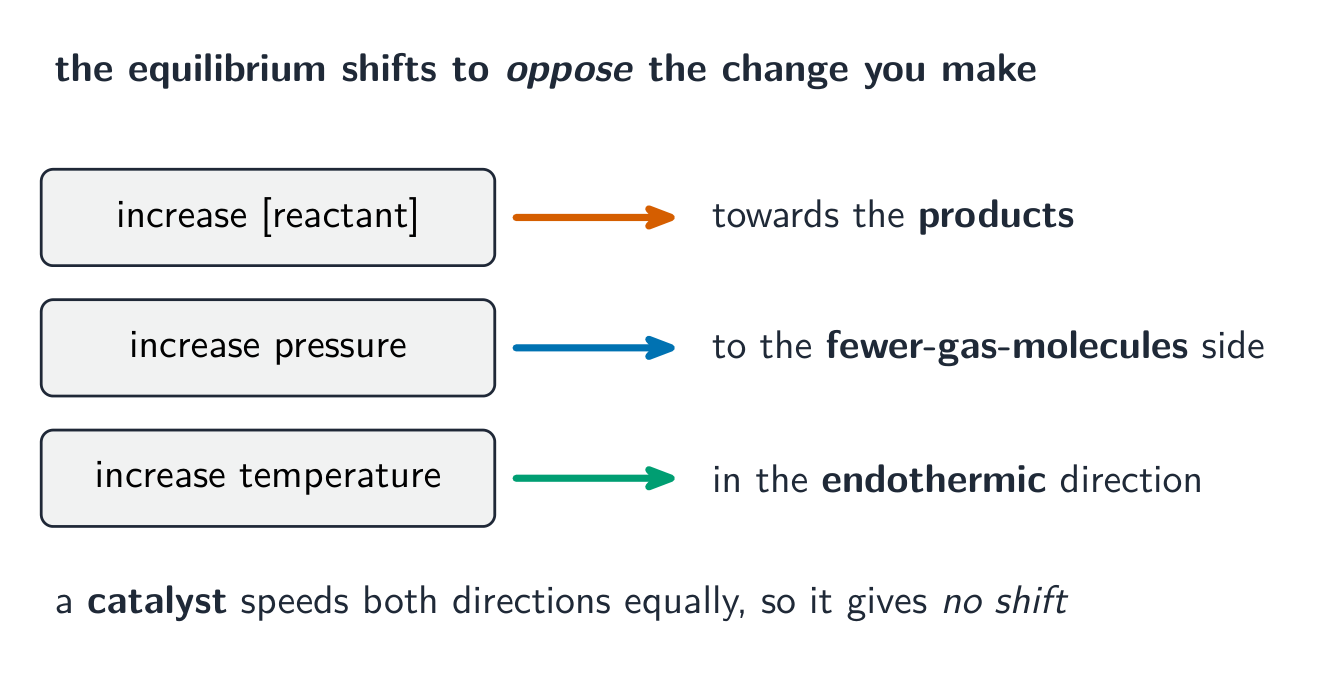
Le Chatelier's principle 勒沙特列原理: if you disturb a system at equilibrium, it shifts to partly counteract the change. Adding a reactant shifts forward; removing product shifts forward; increasing pressure (by reducing volume) shifts toward the side with fewer gas moles; raising temperature shifts in the endothermic direction.
Explore
Disturb an equilibrium
Le Chatelier's principle: an equilibrium shifts to oppose a change. Add reactant, change pressure or temperature and watch the position of equilibrium move.
Vocabulary
Train
| English |
|---|
| Le Chatelier's principle/lə ˈtʃeɪtlɪəz ˈprɪnsɪpl/ |
7.10
The Reaction Quotient and Le Chatelier's Principle
Syllabus
| Learning Objective | Essential Knowledge |
|---|---|
7.10.A |
|
Source: College Board AP Course and Exam Description
You can justify every Le Chatelier shift with $Q$ versus $K$: a disturbance changes $Q$, and the system reacts to bring $Q$ back to $K$. This quantitative view backs up the qualitative rule and is the fuller answer on the exam.
Explore
Compare Q with K
If the reaction quotient $Q
7.11 7.12
Introduction to Solubility Equilibria
Syllabus
| Learning Objective | Essential Knowledge |
|---|---|
7.11.A |
|
| Learning Objective | Essential Knowledge |
|---|---|
7.12.A |
|
Source: College Board AP Course and Exam Description
For a slightly soluble salt, the solubility product 溶度积 $K_{sp}$ is the equilibrium constant for its dissolving:
$$\text{M}_a\text{X}_b(s)\rightleftharpoons a\,\text{M}^{b+}+b\,\text{X}^{a-},\qquad K_{sp}=[\text{M}^{b+}]^a[\text{X}^{a-}]^b.$$
A smaller $K_{sp}$ means less soluble. The common-ion effect – adding an ion already in the salt – pushes the equilibrium back and lowers solubility.
Worked example. Silver chloride has $K_{sp}=1.8\times10^{-10}$. If its molar solubility is $s$, then $[\text{Ag}^+]=[\text{Cl}^-]=s$, so $K_{sp}=s^2$ and
$$s=\sqrt{1.8\times10^{-10}}=1.3\times10^{-5}\ \text{M}.$$
Adding NaCl (a common ion) would raise $[\text{Cl}^-]$, forcing $s$ down – far less AgCl would dissolve.
Vocabulary
Train
| English |
|---|
| solubility product/ˌsɒljuːˈbɪlɪti ˈprɒdʌkt/ |
7.11 7.12
Exam tips
- At equilibrium the forward and reverse rates are equal, but the amounts are usually not.
- Leave pure solids and liquids out of the $K$ expression; a large $K$ favours products, a small $K$ favours reactants.
- Apply Le Chatelier: add reactant → shift forward; raise pressure → shift toward fewer gas moles; raise temperature → shift in the endothermic direction.
- A catalyst does not shift the position of equilibrium — it only speeds the approach.
- Use an ICE table for equilibrium concentrations, and the small-$x$ approximation when $K$ is small.
Interactive lessons on this topic
Work through it step by step, with instant-check exercises.
- Introduction to Equilibrium
- Direction of Reversible Reactions
- The Reaction Quotient and Equilibrium Constant
- Calculating the Equilibrium Constant
- Magnitude of the Equilibrium Constant
- Properties of the Equilibrium Constant
- Calculating Equilibrium Concentrations
- Representations of Equilibrium
- Introduction to Le Chatelier's Principle
- The Reaction Quotient and Le Chatelier's Principle
- Introduction to Solubility Equilibria
- The Common-Ion Effect