跳到主要内容

化合物的结构与性质

AP 化学 · 第 2 主题

训练
讲义 词汇表
2.1

化学键的类型

大纲
Learning ObjectiveEssential Knowledge

2.1.A
Explain the relationship between the type of bonding and the properties of the elements participating in the bond.

  • 2.1.A.1 Electronegativity values for the representative elements increase going from left to right across a period and decrease going down a group. These trends can be understood qualitatively through the electronic structure of the atoms, the shell model, and Coulomb's law.
  • 2.1.A.2 Valence electrons shared between atoms of similar electronegativity constitute a nonpolar covalent bond. For example, bonds between carbon and hydrogen are effectively nonpolar even though carbon is slightly more electronegative than hydrogen.
  • 2.1.A.3 Valence electrons shared between atoms of unequal electronegativity constitute a polar covalent bond.
    • i. The atom with a higher electronegativity will develop a partial negative charge relative to the other atom in the bond.
    • ii. In single bonds, greater differences in electronegativity lead to greater bond dipoles.
    • iii. All polar bonds have some ionic character, and the difference between ionic and covalent bonding is not distinct but rather a continuum.
  • 2.1.A.4 The difference in electronegativity is not the only factor in determining if a bond should be designated as ionic or covalent. Generally, bonds between a metal and nonmetal are ionic, and bonds between two nonmetals are covalent. Examination of the properties of a compound is the best way to characterize the type of bonding.
  • 2.1.A.5 In a metallic solid, the valence electrons from the metal atoms are considered to be delocalized and not associated with any individual atom.

来源:美国大学理事会 AP 课程与考试说明

一个化学键(chemical bond)是把原子维系在一起的一种吸引。哪种类型形成取决于原子的电负性:

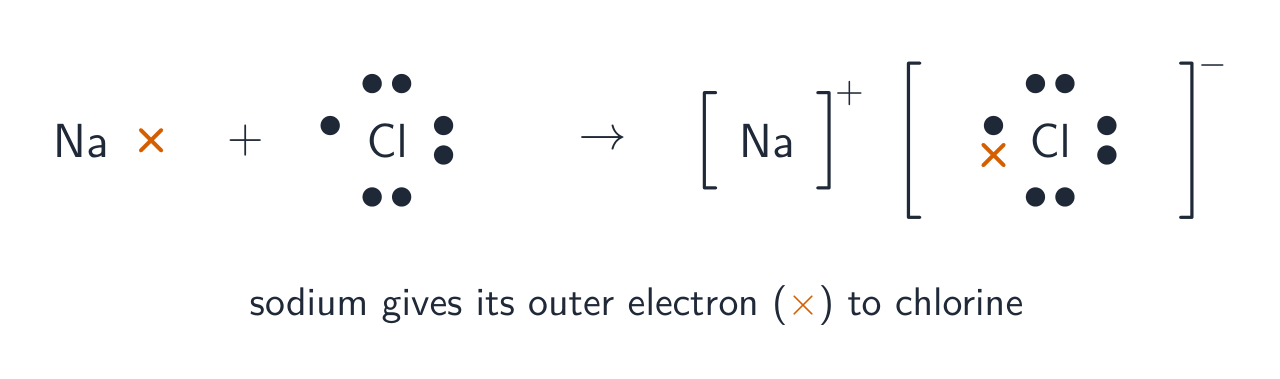
离子键合:一个金属把它的外层电子转移给一个非金属
  • 离子键(ionic bond):电子从一个金属转移到一个非金属(大的电负性差)。
  • 共价键(covalent bond):非金属共享电子(小的差)。一个大但不巨大的差给出一个极性共价(polar covalent)键。
  • 金属键(metallic bond):金属原子共享一"海"可移动的电子。
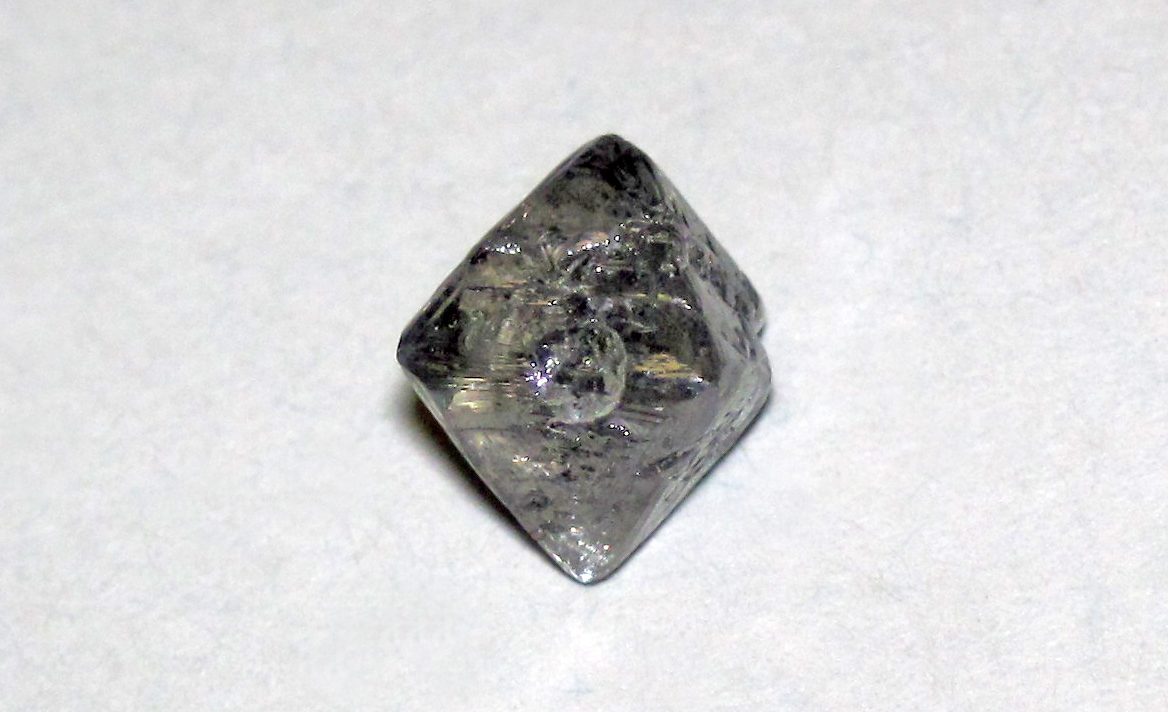
A diamond crystal: giant covalent networks explain extreme hardness and high melting points
探索

Form an ionic bond by electron transfer

An ionic bond forms when a metal gives electrons to a non-metal, making oppositely charged ions that attract; a covalent bond shares electrons instead.

词汇表 训练
英文 中文 拼音
chemical bond 化学键 huà xué jiàn
Ionic bond 离子键 lí zi jiàn
Covalent bond 共价键 gòng jià jiàn
polar covalent 极性共价 jí xìng gòng jià
Metallic bond 金属键 jīn shǔ jiàn
2.2

分子内作用力与势能

大纲
Learning ObjectiveEssential Knowledge

2.2.A
Represent the relationship between potential energy and distance between atoms, based on factors that influence the interaction strength.

  • 2.2.A.1 A graph of potential energy versus the distance between atoms (internuclear distance) is a useful representation for describing the interactions between atoms. Such graphs illustrate both the equilibrium bond length (the separation between atoms at which the potential energy is lowest) and the bond energy (the energy required to separate the atoms).
  • 2.2.A.2 In a covalent bond, the bond length is influenced by both the size of the atom's core and the bond order (i.e., single, double, triple). Bonds with a higher order are shorter and have larger bond energies.
  • 2.2.A.3 Coulomb's law can be used to understand the strength of interactions between cations and anions.
    • i. Because the interaction strength is proportional to the charge on each ion, larger charges lead to stronger interactions.
    • ii. Because the interaction strength increases as the distance between the centers of the ions (nuclei) decreases, smaller ions lead to stronger interactions.

来源:美国大学理事会 AP 课程与考试说明

当两个原子接近时,一条势能(potential energy)曲线捕捉吸引和排斥的平衡。它在键长(bond length)(稳定的间距)处降到一个最小值,它的深度是键能(bond energy)。更短、更强的键坐在更深、更紧的势阱里;更多共享对(双键、三键)给出更短、更强的键。

词汇表 训练
英文 中文 拼音
potential energy 势能 shì néng
bond length 键长 jiàn zhǎng
bond energy 键能 jiàn néng
2.3

离子固体的结构

大纲
Learning ObjectiveEssential Knowledge

2.3.A
Represent an ionic solid with a particulate model that is consistent with Coulomb's law and the properties of the constituent ions.

  • 2.3.A.1 The cations and anions in an ionic crystal are arranged in a systematic, periodic 3-D array that maximizes the attractive forces among cations and anions while minimizing the repulsive forces.
    • Exclusion statement: Knowledge of specific crystal structures is not essential to an understanding of the learning objective and will not be assessed on the AP Exam.

来源:美国大学理事会 AP 课程与考试说明

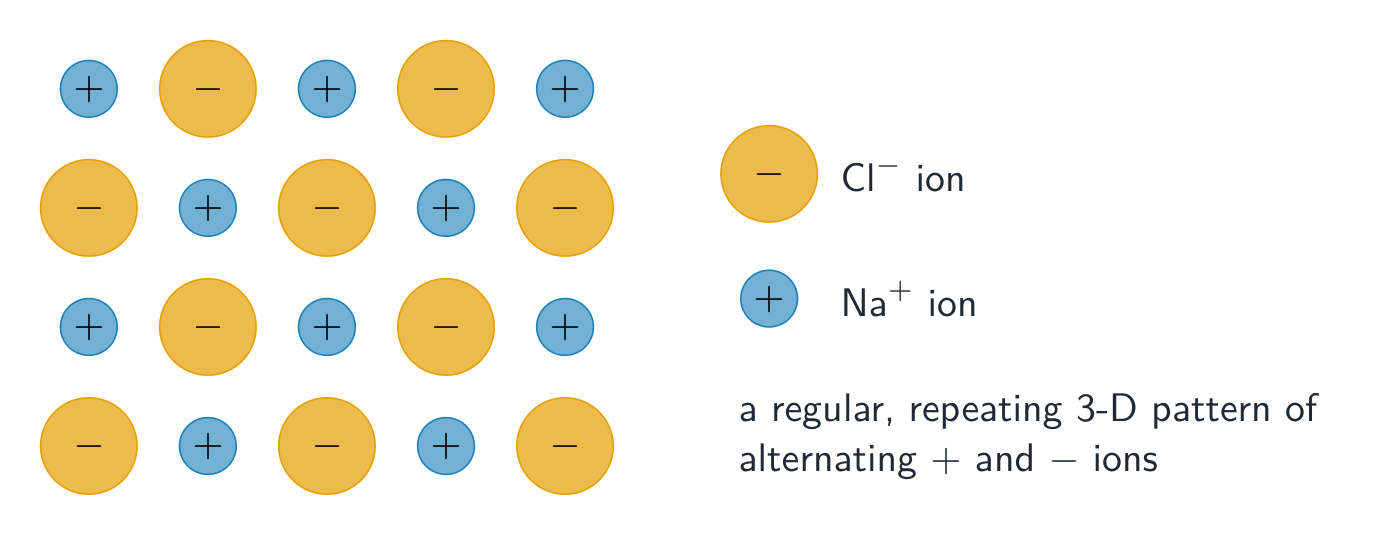
一个离子固体(ionic solid)是一个交替的阳离子和阴离子的重复三维晶格(lattice),由强的静电吸引维系。这解释它们高的熔点、脆性,以及为什么它们只在熔融或溶解时(离子被释放去移动)导电。晶格能(lattice energy)随着更大的离子电荷和更小的离子上升,所以 MgO(都是 $2+/2-$)比 NaCl(都是 $1+/1-$)熔化得高得多。

离子堆积成一个交替的正离子和负离子的巨大晶格
词汇表 训练
英文 中文 拼音
ionic solid 离子固体 lí zi gù tǐ
lattice 晶格 jīng gé
2.4

金属与合金的结构

大纲
Learning ObjectiveEssential Knowledge

2.4.A
Represent a metallic solid and/or alloy using a model to show essential characteristics of the structure and interactions present in the substance.

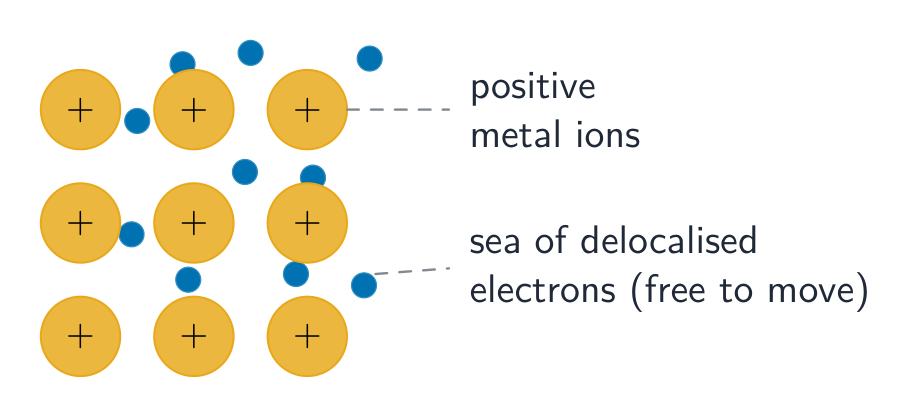
  • 2.4.A.1 Metallic bonding can be represented as an array of positive metal ions surrounded by delocalized valence electrons (i.e., a "sea of electrons").
  • 2.4.A.2 Interstitial alloys form between atoms of significantly different radii, where the smaller atoms fill the interstitial spaces between the larger atoms (e.g., with steel in which carbon occupies the interstices in iron).
  • 2.4.A.3 Substitutional alloys form between atoms of comparable radius, where one atom substitutes for the other in the lattice. (e.g., in certain brass alloys, other elements, usually zinc, substitute for copper.)

来源:美国大学理事会 AP 课程与考试说明

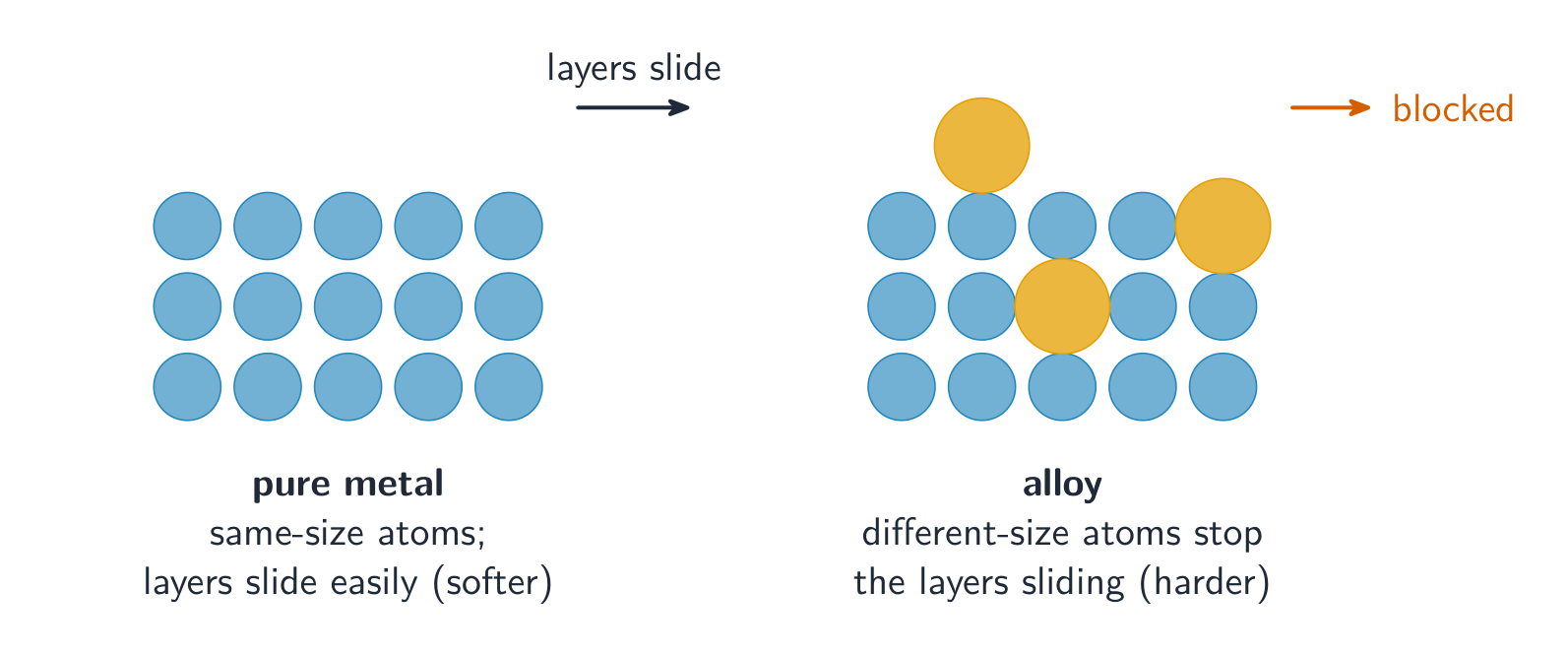
在一个金属里,阳离子坐在一个浸浴在离域(delocalized)电子里的晶格里,这解释导电性、延展性和光泽。一个合金(alloy)混合金属:一个置换(substitutional)合金换入相似大小的原子;一个间隙(interstitial)合金(像钢)把小原子放进空隙里,使它更硬。
一个合金里不同大小的原子阻止层滑动,所以它更硬
金属键合:正离子在一海离域电子里
金属键合:正离子在一海离域电子里
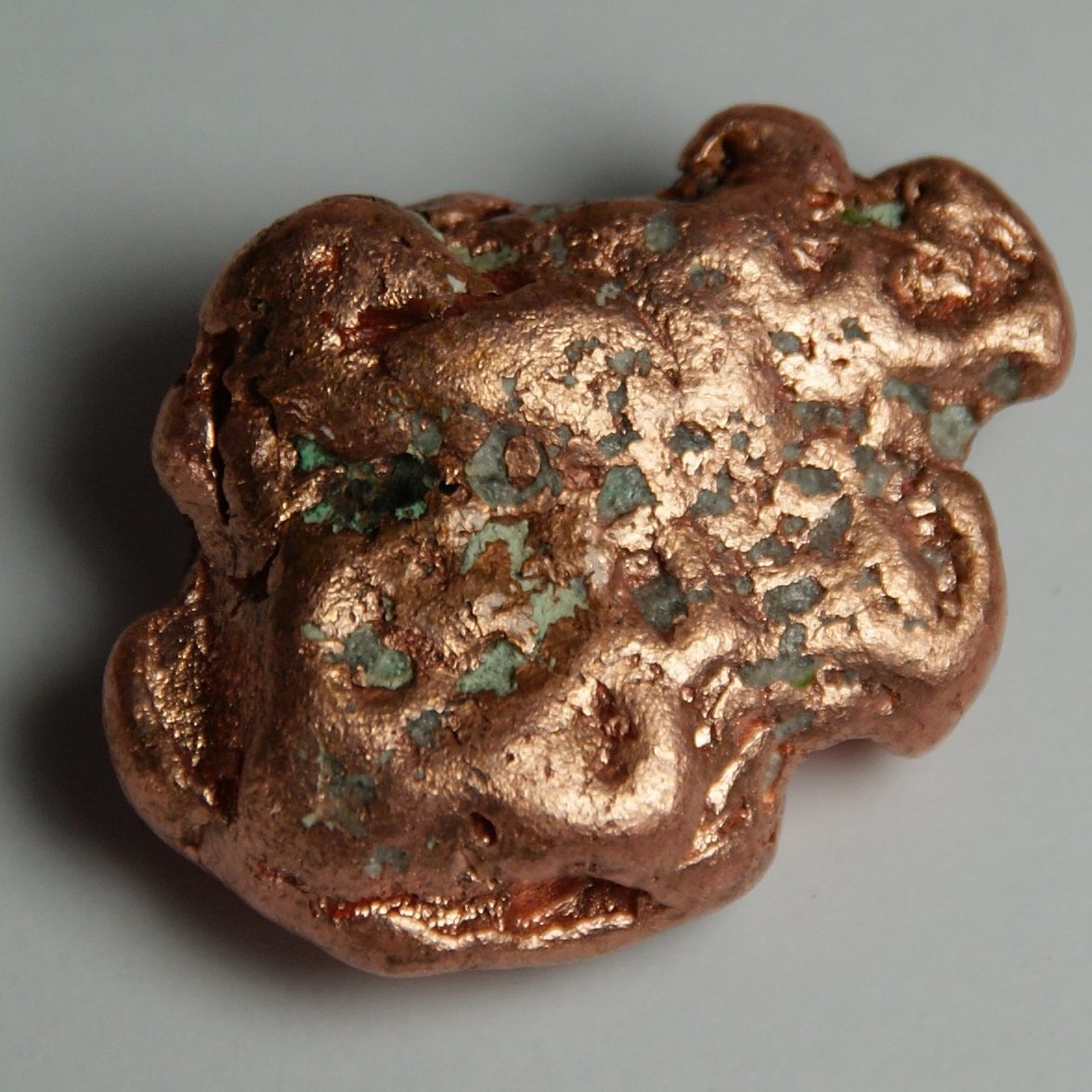
Native copper: metallic bonding gives a shiny, malleable solid with delocalised electrons
探索

Slide layers in a metallic lattice

A metal is positive ions in a sea of delocalised electrons. The layers can slide without breaking the bond, so metals are malleable and conduct.

词汇表 训练
英文 中文 拼音
delocalized 离域 lí yù
alloy 合金 hé jīn
2.5

路易斯结构式

大纲
Learning ObjectiveEssential Knowledge

2.5.A
Represent a molecule with a Lewis diagram.

  • 2.5.A.1 Lewis diagrams can be constructed according to an established set of principles.

来源:美国大学理事会 AP 课程与考试说明

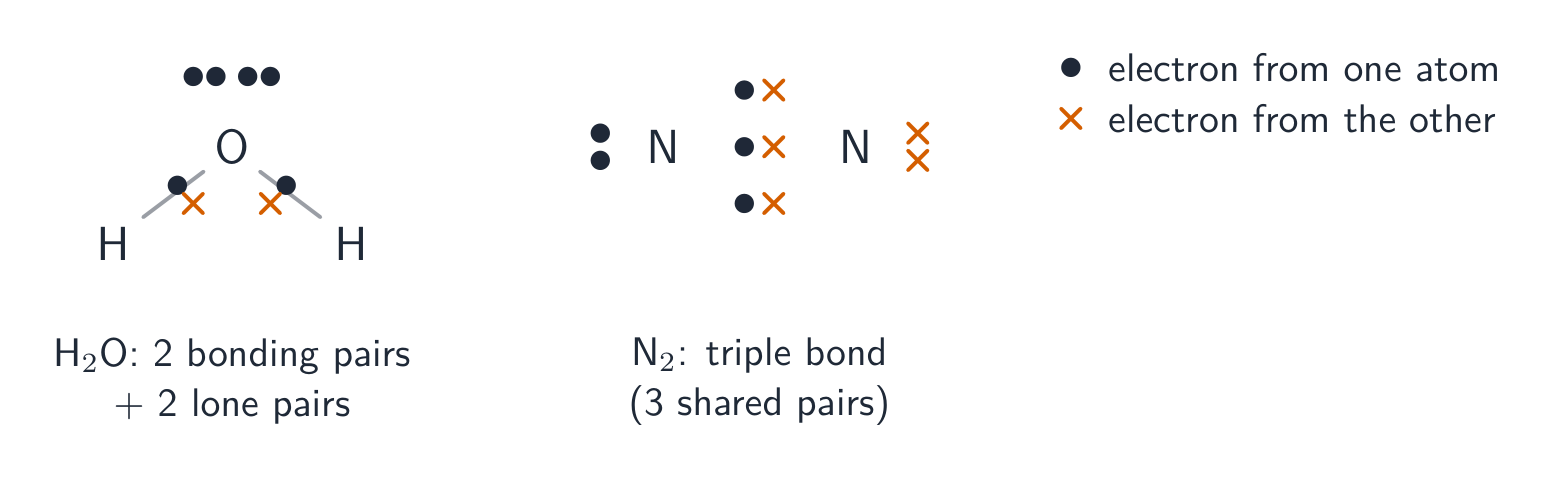
一个路易斯结构(Lewis diagram)把价电子显示为成键对和孤对电子(lone pairs),给大多数原子一个八隅体(octet)(8 个价电子;H 想要 2)。步骤:数总价电子、用单键连接原子、完成外层原子的八隅体,然后若中心原子不足则形成多重键。

点叉图显示一个分子里的成键对和孤对电子
点叉图显示一个分子里的成键对和孤对电子

Worked example. 画二氧化碳,$\text{CO}_2$。总价电子 $=4+2(6)=16$。把 C 放在中心;到每个 O 的单键用 $4$ 个电子并使外层 O 原子不足。完成八隅体迫使两个键,$\text{O}=\text{C}=\text{O}$:每个 O 然后有两个孤对、C 没有,而所有 $16$ 个电子都放置,每个原子都在一个八隅体。

词汇表 训练
英文 中文 拼音
Lewis diagram 路易斯结构 lù yì sī jié gòu
lone pairs 孤对电子 gū duì diàn zi
octet 八隅体 bā yú tǐ
2.6

共振与形式电荷

大纲
Learning ObjectiveEssential Knowledge

2.6.A
Represent a molecule with a Lewis diagram that accounts for resonance between equivalent structures or that uses formal charge to select between nonequivalent structures.

  • 2.6.A.1 In cases where more than one equivalent Lewis structure can be constructed, resonance must be included as a refinement to the Lewis structure. In many such cases, this refinement is needed to provide qualitatively accurate predictions of molecular structure and properties.
  • 2.6.A.2 The octet rule and formal charge can be used as criteria for determining which of several possible valid Lewis diagrams provides the best model for predicting molecular structure and properties.
  • 2.6.A.3 As with any model, there are limitations to the use of the Lewis structure model, particularly in cases with an odd number of valence electrons.

来源:美国大学理事会 AP 课程与考试说明

当两个或更多有效的路易斯结构只在电子放置上不同时,真正的结构是一个平均——共振(resonance)。形式电荷(formal charge)(价电子减孤对电子减成键电子的一半)挑选最好的结构:形式电荷最接近零、而任何负电荷在最电负的原子上的那个。

Worked example. 在硝酸根离子 $\text{NO}_3^{-}$(一个双键、两个单键)里分配形式电荷。对 N(4 个键、无孤对):$5-0-4=+1$。对双键的 O(2 个孤对):$6-4-2=0$。对每个单键的 O(3 个孤对):$6-6-1=-1$。总量是 $+1+0+(-1)+(-1)=-1$,匹配离子的总电荷——一个结构画得正确的好检查。因为三个 O 原子由于共振是等价的,真正的离子有三个相同的键。

词汇表 训练
英文 中文 拼音
resonance 共振 gòng zhèn
Formal charge 形式电荷 xíng shì diàn hè
2.7

价层电子对互斥理论与杂化

大纲
Learning ObjectiveEssential Knowledge

2.7.A
Based on the relationship between Lewis diagrams, VSEPR theory, bond orders, and bond polarities:

  • i. Explain structural properties of molecules.
  • ii. Explain electron properties of molecules.
  • 2.7.A.1 VSEPR theory uses the Coulombic repulsion between electrons as a basis for predicting the arrangement of electron pairs around a central atom.
  • 2.7.A.2 Both Lewis diagrams and VSEPR theory must be used for predicting electronic and structural properties of many covalently bonded molecules and polyatomic ions, including the following:
    • i. Molecular geometry (linear, trigonal planar, tetrahedral, trigonal pyramidal, bent, trigonal bipyramidal, seesaw, T-shaped, octahedral, square pyramidal, square planar)
    • ii. Bond angles
    • iii. Relative bond energies based on bond order
    • iv. Relative bond lengths (multiple bonds, effects of atomic radius)
    • v. Presence of a dipole moment
    • vi. Hybridization of valence orbitals for atoms within a molecule or polyatomic ion
  • 2.7.A.3 The terms "hybridization" and "hybrid atomic orbital" are used to describe the arrangement of electrons around a central atom. When the central atom is $sp$ hybridized, its ideal bond angles are $180°$; for $sp^2$ hybridized atoms the bond angles are $120°$; and for $sp^3$ hybridized atoms the bond angles are $109.5°$.
    • Exclusion statement: An understanding of the derivation and depiction of hybrid orbitals will not be assessed on the AP Exam. The course includes the distinction between sigma and pi bonding, the use of VSEPR to explain the shapes of molecules, and the $sp$, $sp^2$, and $sp^3$ nomenclature.
    • Exclusion statement: Hybridization involving d orbitals will not be assessed on the AP Exam. When an atom has more than four pairs of electrons surrounding the central atom, students are only responsible for the shape of the resulting molecule.
  • 2.7.A.4 Bond formation is associated with overlap between atomic orbitals. In multiple bonds, such overlap leads to the formation of both sigma and pi bonds. The overlap is stronger in sigma than pi bonds, which is reflected in sigma bonds having greater bond energy than pi bonds. The presence of a pi bond also prevents the rotation of the bond and leads to geometric isomers.
    • Exclusion statement: Molecular orbital theory is recommended as a way to provide deeper insight into bonding. However, the AP Exam will neither explicitly assess molecular orbital diagrams, filling of molecular orbitals, nor the distinction between bonding, nonbonding, and antibonding orbitals.

来源:美国大学理事会 AP 课程与考试说明

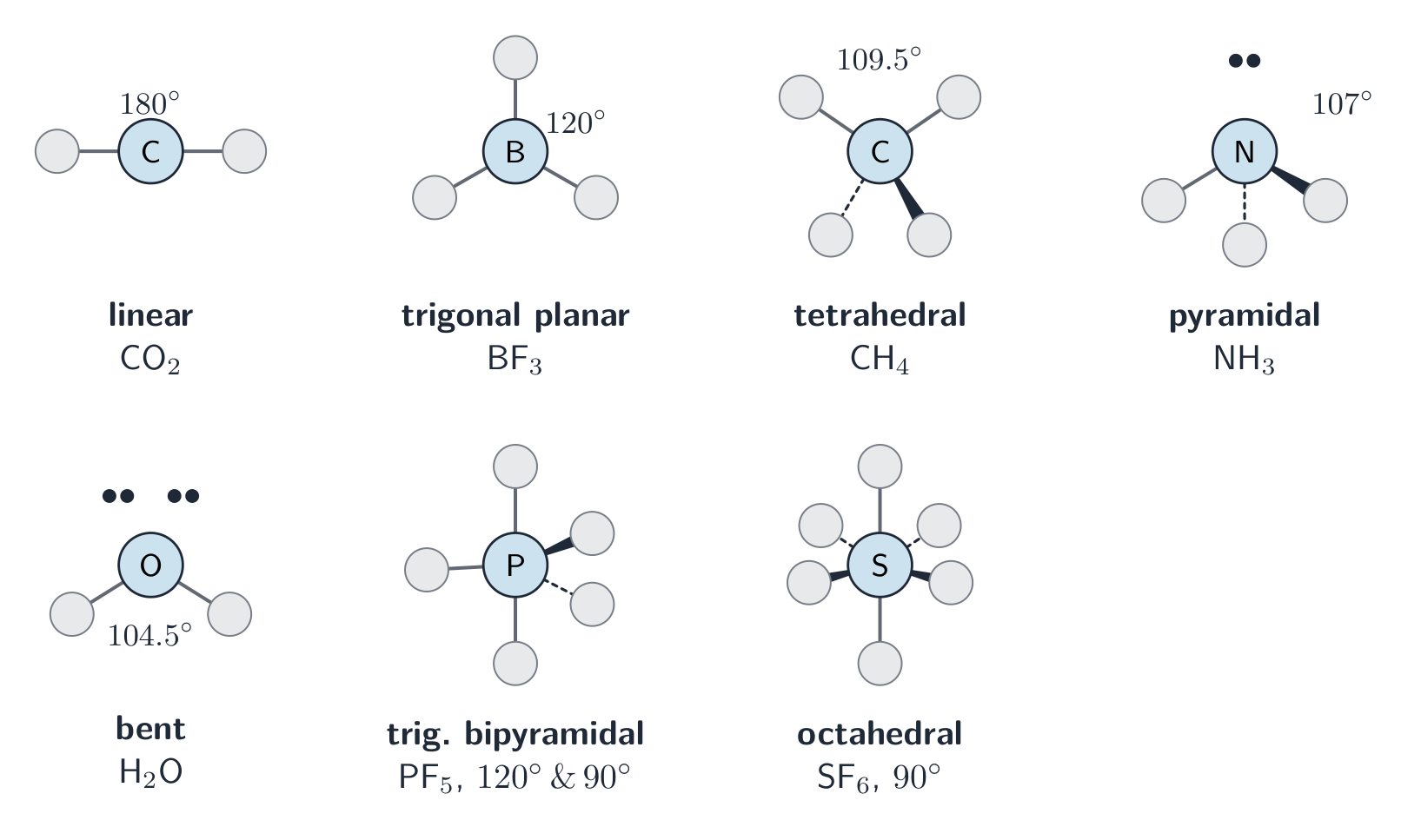
VSEPR 分子构型

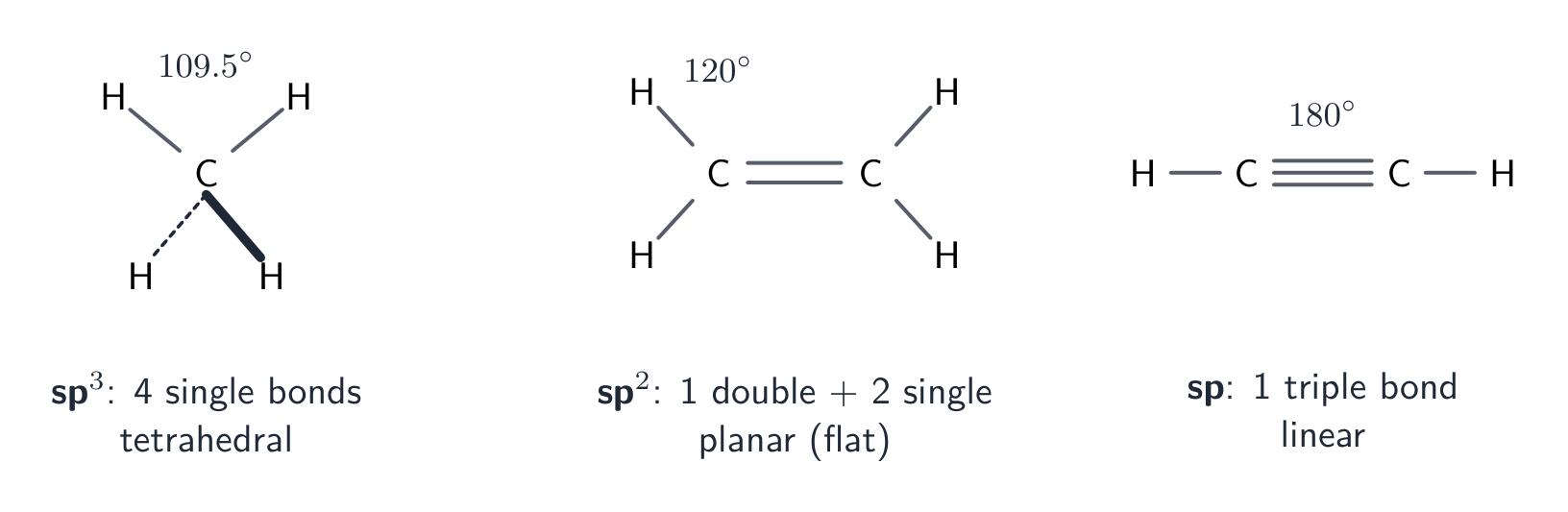
价层电子对互斥(VSEPR)理论预测形状:一个中心原子周围的电子对(键和孤对)尽可能远地散开。数电子域给出几何(直线、平面三角、四面体……);孤对把键推得更近,弯曲形状。杂化(hybridization)($sp$$sp^2$$sp^3$)描述匹配那个几何的混合轨道。分子形状和键极性一起决定整个分子是否极性。
杂化和形状:sp3 四面体、sp2 平面、sp 直线
常见的 VSEPR 形状及其键角
常见的 VSEPR 形状及其键角

Worked example. 预测氨 $\text{NH}_3$ 的形状。氮有 $3$ 个成键对和 $1$ 个孤对——四个电子域,所以电子几何是四面体而杂化是 $sp^3$。孤对在形状里不可见但仍把键推到一起,所以分子形状是三角锥,键角约 $107^{\circ}$(比理想的 $109.5^{\circ}$ 稍小)。三个 N–H 偶极不抵消,所以分子是极性的。

键在原子轨道重叠时形成。每一个单键是一个 σ 键(sigma bond)——轨道沿着连接两个原子的直线头对头重叠。一个多重键增加一个 π 键(pi bond),由 $p$ 轨道在那条线的上方和下方侧向重叠形成:一个双键是一个 σ 加一个 π,一个三键是一个 σ 加两个 π。头对头重叠更有效,所以一个 σ 键比一个 π 键更强(更高键能)——这就是为什么一个双键比一个单键强,却不是两倍强。一个 π 键还锁住两个原子使它们不能绕键旋转;所以一个 C=C 双键有固定的顺式(cis)和反式(trans)形式——几何异构体(geometric isomers),这是一个自由旋转的单键永远无法显示的。

Worked example. 数一数乙烯 $\text{H}_2\text{C}=\text{CH}_2$ 里的键。四个 C–H 键是单键(每个一个 σ);C=C 是一个 σ 加一个 π。所以乙烯有 5 个 σ 和 1 个 π 键,而那一个 π 键正是阻止两个 $\text{CH}_2$ 端相对扭转的原因。

探索

Predict molecular shape with VSEPR

VSEPR: electron pairs repel and spread as far apart as possible, setting the molecule's shape. Add bonding and lone pairs and watch the geometry change.

词汇表 训练
英文 中文 拼音
VSEPR 价层电子对互斥 jià céng diàn zi duì hù chì
Hybridization 杂化 zá huà
sigma bond σ键 σ jiàn
pi bond π键 π jiàn
geometric isomers 几何异构体 jǐ hé yì gòu tǐ
练习卷
2.7

考试技巧

  • 从原子决定键类型:离子(金属 + 非金属,电子转移)、共价(非金属,共享)、金属(离域电子的海)。
  • 一个离子固体只在熔融或溶解时(离子自由移动)导电,作为固体从不。
  • 路易斯结构以满足八隅体(H 想要 2),然后用 VSEPR ——电子对尽可能远地散开——来预测形状。
  • 孤对占据空间并把键推得更近,弯曲形状(水是弯的、氨是锥形的)。
  • 一个分子能有极性键,却整体上非极性,若它的对称使偶极抵消($\text{CO}_2$)。

本主题的互动课程

逐步学习,并即时检测练习。

AP 化学历年真题

AP 化学的更多主题

登录或创建账号

IGCSE, A-Level & AP