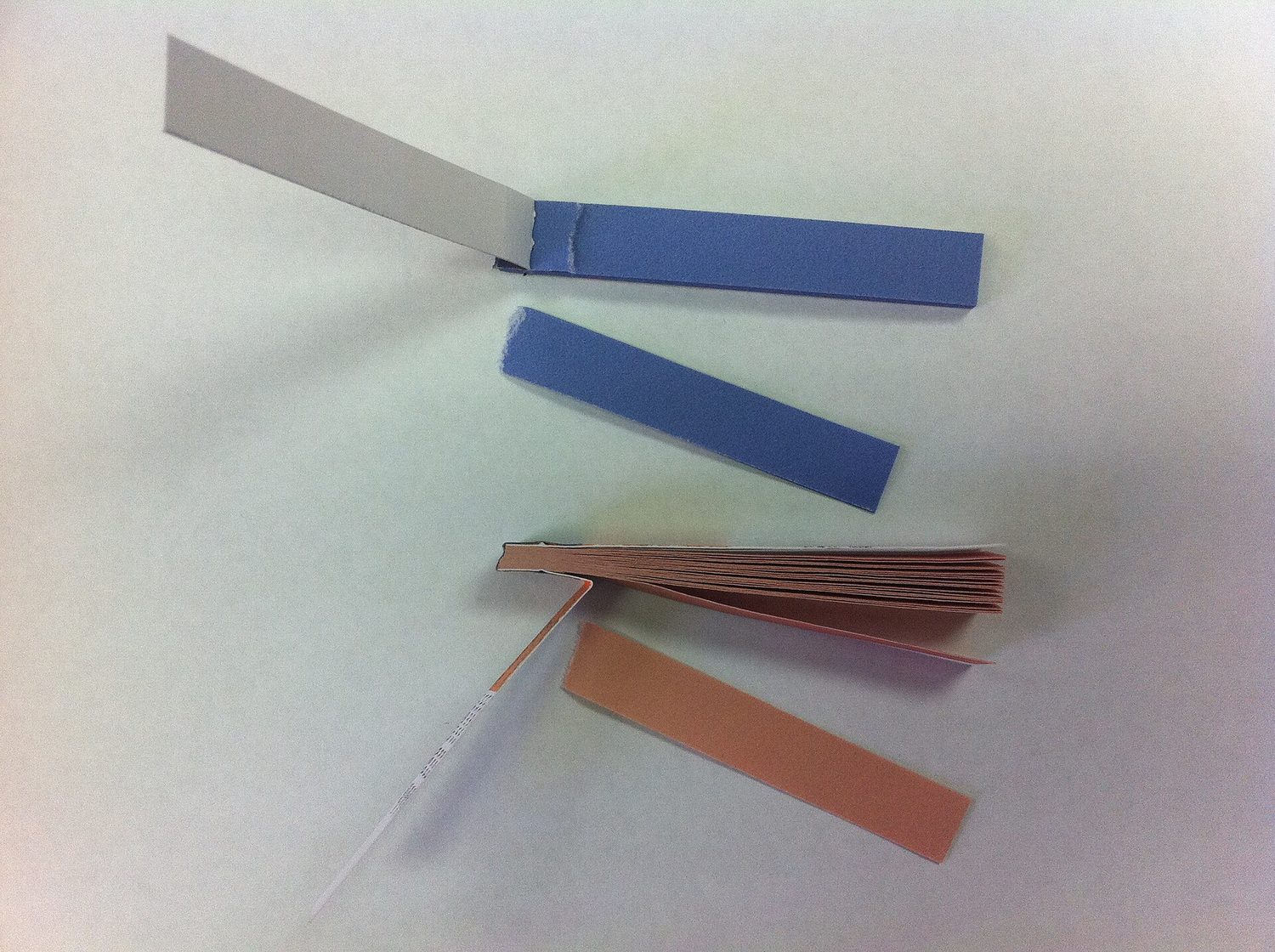
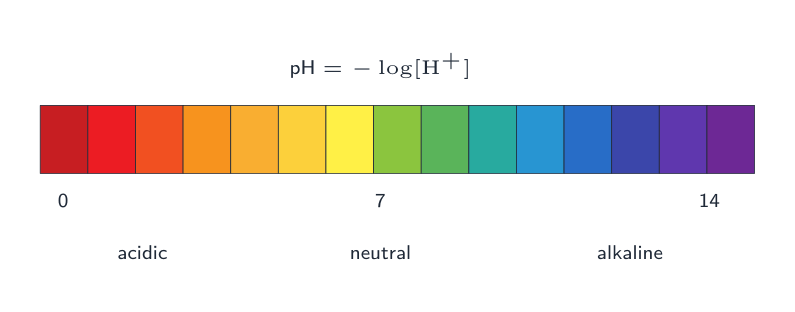
Litmus paper: acid–base indicators change colour with H⁺ concentration (pH)
By the Brønsted–Lowry definition, an acid 酸 is a proton ($\text{H}^+$) donor and a base 碱 is a proton acceptor. When an acid donates a proton it becomes its conjugate base 共轭碱; a base gaining a proton becomes its conjugate acid 共轭酸. Water is amphoteric – it can act as either.
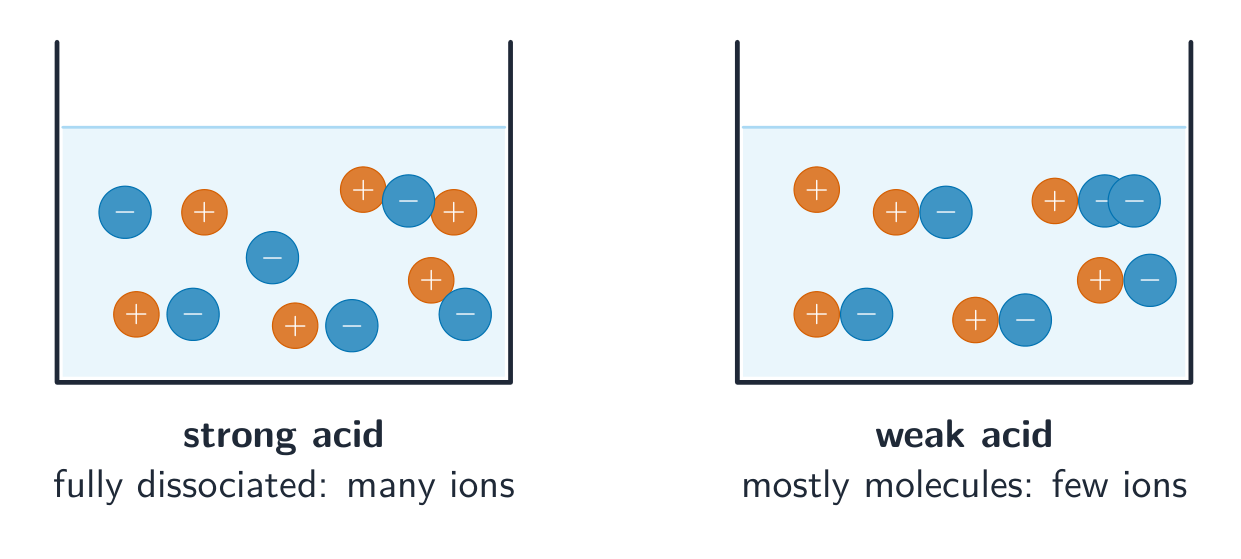
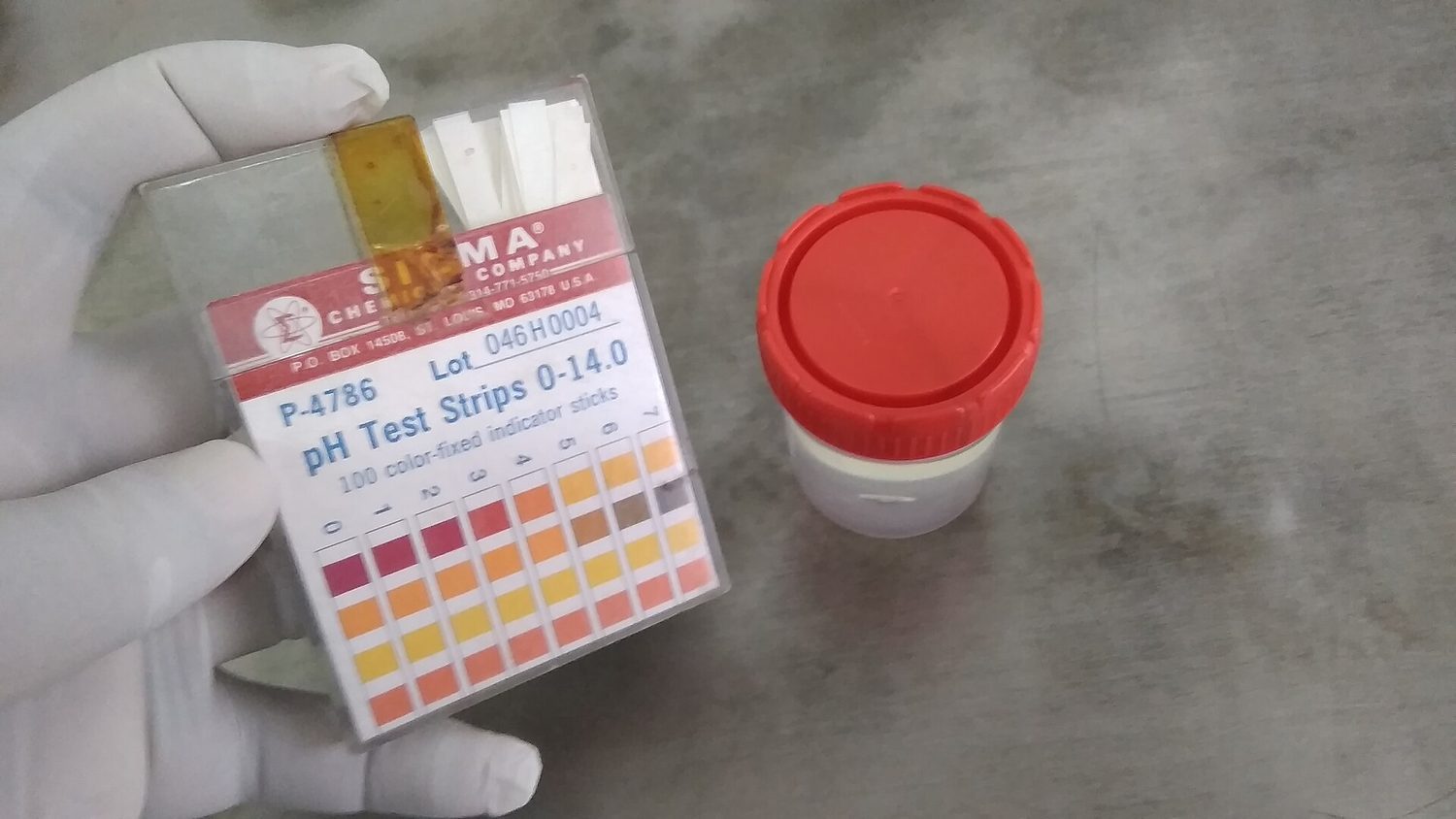
A strong acid is fully dissociated; a weak acid is only partly dissociatedpH test strips: acid–base strength and concentration set the pH you measure
One water molecule passes a proton to another, making a hydronium ion 水合氢离子 ($\text{H}_3\text{O}^+$, the ion we loosely write as $\text{H}^+$) and a hydroxide ion. This equilibrium has its own constant, the ion-product constant of water 水的离子积:
at 25 °C. Defining $\text{pOH}=-\log[\text{OH}^-]$ and taking $-\log$ of the $K_w$ expression gives the rule the rest of this topic leans on:
$$\text{pH} + \text{pOH} = \text{p}K_w = 14.0$$
(again at 25 °C). Know one of pH or pOH and you get the other by subtracting from 14.
At 25 °C, in pure water the two ions form in equal numbers, so $[\text{H}_3\text{O}^+]=[\text{OH}^-]$ and $\text{pH}=\text{pOH}=7.0$. This is what neutral 中性 means. Acidic means $[\text{H}_3\text{O}^+]>[\text{OH}^-]$ (pH below 7); basic is the reverse.
Worked example. A solution has $[\text{H}_3\text{O}^+]=2.0\times10^{-3}\ \text{M}$. Find $[\text{OH}^-]$. Because $K_w$ always holds in water,
The hydroxide concentration is far smaller than the hydronium, confirming the solution is acidic.
$K_w$ is temperature dependent: autoionization is endothermic, so heating water shifts it forward and raises $K_w$. At 50 °C, $K_w>1.0\times10^{-14}$, so neutral water has $\text{pH}=\text{pOH}<7.0$. It is still neutral, because the ion concentrations are still equal – neutral means equal ions, not a pH of exactly 7.
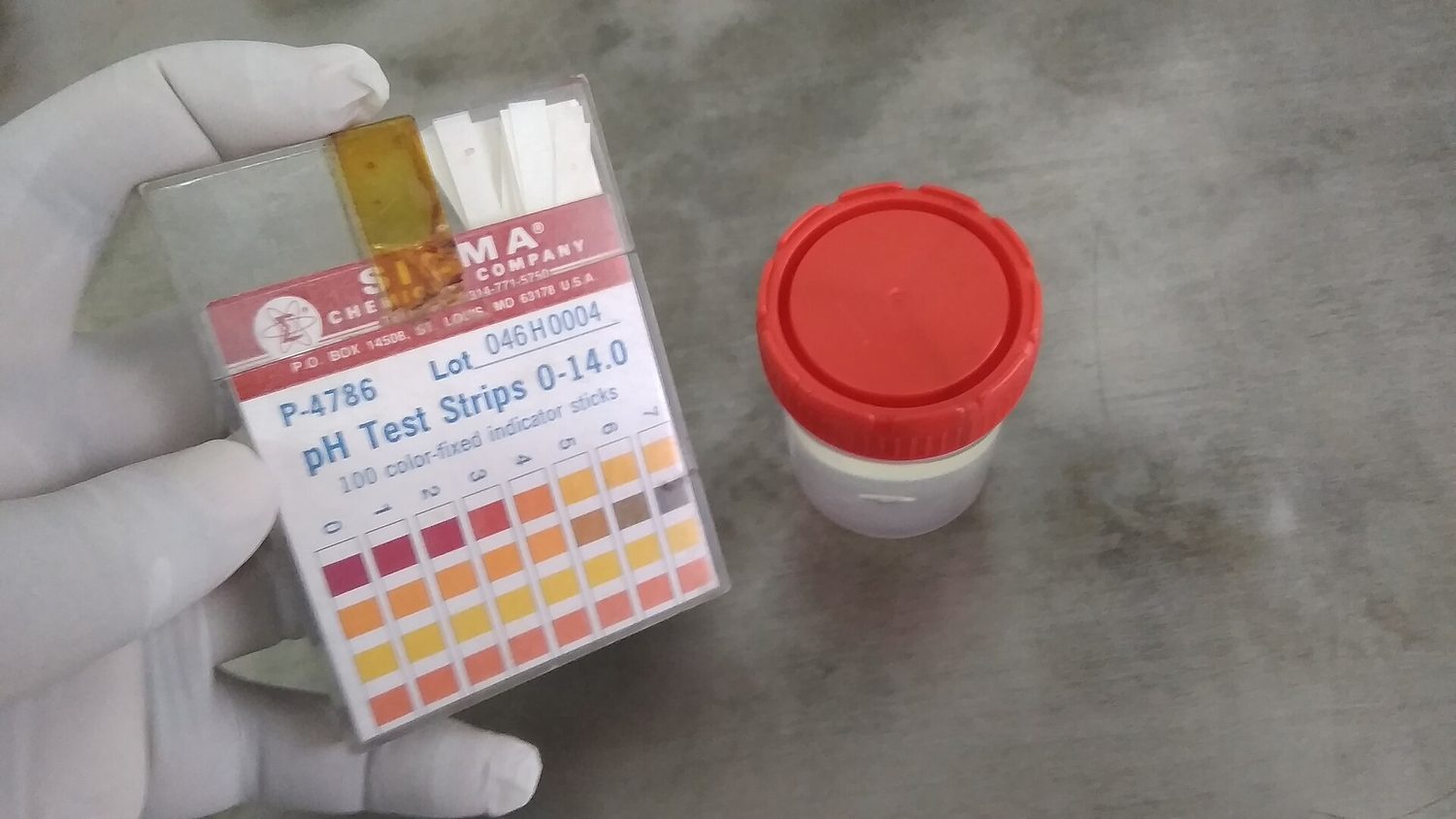
pH strips: water autoionizes so pure water is pH 7; acids and bases shift H+ and OH-
8.2.A.2 当溶解在溶液中时,强碱(例如第 I 族和第 II 族氢氧化物)会完全解离以产生氢氧根离子。因此,强碱溶液中的 $\mathrm{OH^-}$ 浓度等于第 I 族氢氧化物的初始浓度,或是第 II 族氢氧化物初始浓度的两倍,从而可以很容易地计算出该强碱溶液的 $\mathrm{pOH}$(以及 $\mathrm{pH}$)。
来源:College Board AP 课程与考试说明
English
The pH pH值 scale measures acidity: $\text{pH}=-\log[\text{H}^+]$, with $\text{pH}+\text{pOH}=14$ at 25 °C. A strong acid 强酸 ionises essentially completely in dilute water; a soluble strong base 强碱 such as NaOH dissociates. For a monoprotic acid or a base supplying one hydroxide per formula unit, the ion concentration is approximately the analytical concentration when water autoionisation is negligible. Otherwise use the balanced stoichiometric ratio. Lower pH means more acidic.
The pH scale: pH is the negative log of the hydrogen-ion concentration
Worked example. Find the pH of $0.010\ \text{M}$ HCl. Because HCl is a strong acid it is fully dissociated, so $[\text{H}^+]=0.010\ \text{M}$ and
$$\text{pH}=-\log(0.010)=2.0.$$
For a strong base like $0.010\ \text{M}$ NaOH, $\text{pOH}=2.0$, so $\text{pH}=14-2.0=12.0$.
A weak acid 弱酸 only partly dissociates, described by an equilibrium constant $K_a$ (larger $K_a$ = stronger weak acid); a weak base has $K_b$. For any conjugate acid–base pair the two are linked through water, $K_a\times K_b = K_w$, so $\text{p}K_a+\text{p}K_b=14$ – a stronger acid always has a weaker conjugate base. Find $[\text{H}^+]$ with an ICE table and the $K_a$ expression. Use a small-$x$ approximation only after checking that the dissociated fraction is small.
Worked example. Find the pH of $0.10\ \text{M}$ acetic acid, $K_a=1.8\times10^{-5}$. Let $x=[\text{H}^+]$ at equilibrium; the ICE table gives $K_a=\dfrac{x^2}{0.10-x}\approx\dfrac{x^2}{0.10}$ (small-$x$ approximation), so
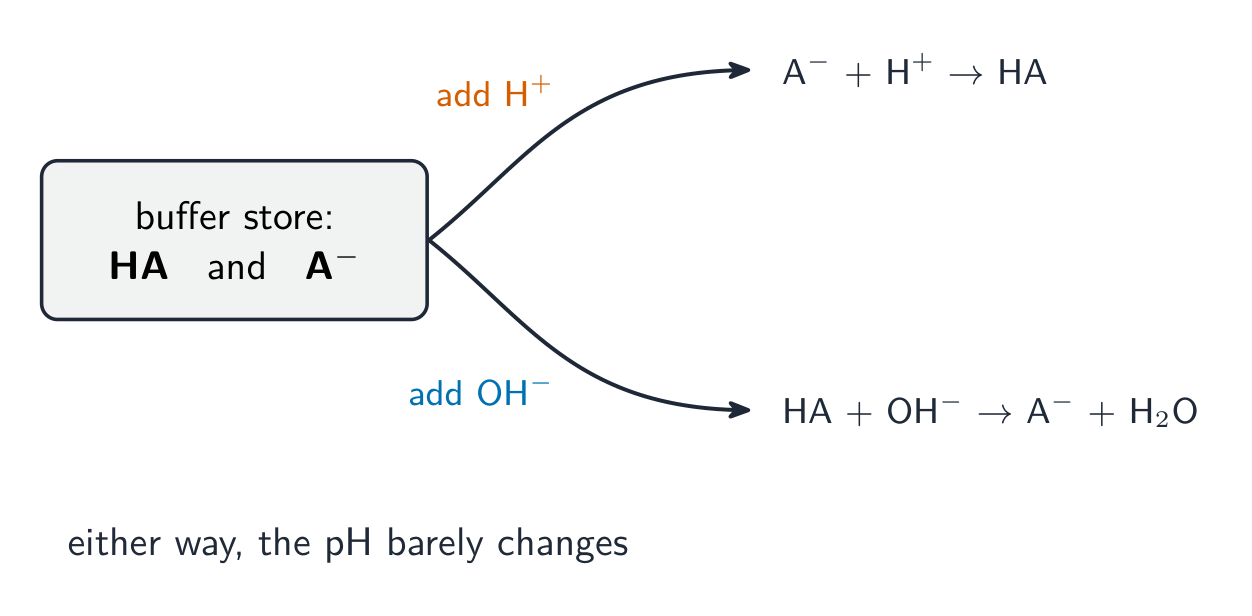
A buffer 缓冲溶液 resists pH change. It contains a weak acid and its conjugate base (or a weak base and its conjugate acid) in comparable amounts. Added acid is neutralized by the conjugate base, and added base by the weak acid, so pH barely moves.
排除声明: AP 考试不评估多质子酸滴定曲线中各物种浓度的计算。此类计算属于单质子酸滴定的课程范围(见 8.4.A.2 和 8.4.A.3),关于在多质子酸滴定过程中任意时刻大量存在与少量存在的物种的定性推理也在课程范围内。
来源:College Board AP 课程与考试说明
English
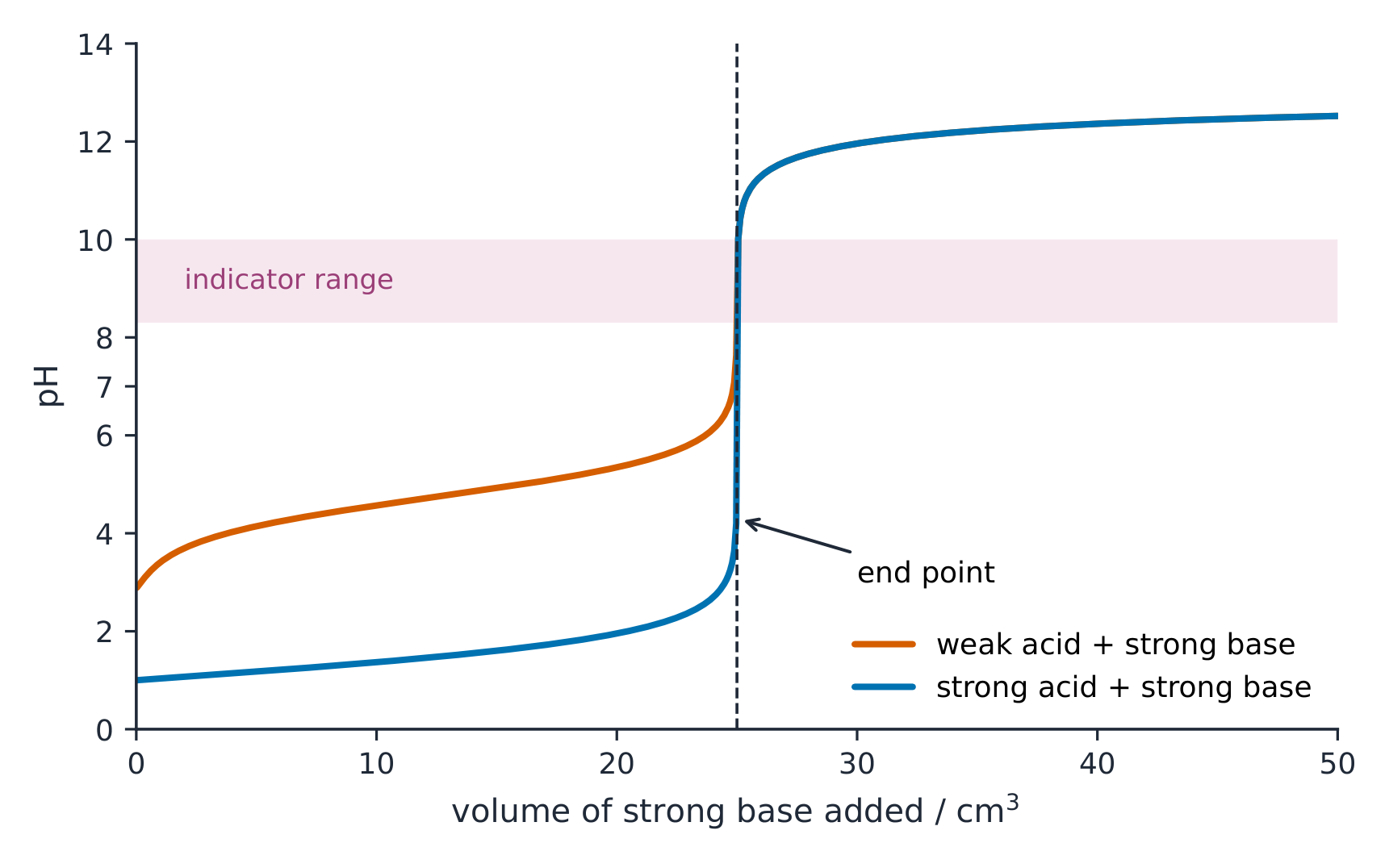
An acid–base titration curve
A titration curve 滴定曲线 plots pH as base (or acid) is added. Key points: the equivalence point 等当点 (acid and base mixed in their balanced stoichiometric ratio; equal moles only for a 1:1 reaction), and, for a single weak-acid titration stage, the half-equivalence point, where $\text{pH}=\text{p}K_a$ (half the weak acid is converted, so a buffer is at its center).
An acid-base indicator 酸碱指示剂 is itself a weak acid whose protonated and deprotonated forms have different colours, so its colour responds to pH. You pick an indicator whose colour change happens near the titration's equivalence-point pH, so the colour flips just as the reaction completes.
A titration curve has a steep jump near the equivalence point
i. 强酸(如 $\mathrm{HCl}$、$\mathrm{HBr}$、$\mathrm{HI}$、$\mathrm{HClO_4}$、$\mathrm{H_2SO_4}$ 和 $\mathrm{HNO_3}$)具有非常弱的共轭碱,这些共轭碱通过电负性、诱导效应、共振或其组合而得到稳定。
ii. 羧酸是弱酸的一个常见类别。
iii. 强碱(如第 I 族和第 II 族氢氧化物)具有非常弱的共轭酸。
iv. 常见的弱碱包括含氮碱(如氨)以及羧酸根离子。
v. 电负性元素相对于共轭酸而言倾向于稳定共轭碱,从而增强酸性。
来源:College Board AP 课程与考试说明
English
Strength has structural roots. An acid is stronger when its conjugate base is more stable – for example, more electronegative atoms or resonance spreading the negative charge stabilize it. For oxoacids, more oxygen atoms on the central atom means a stronger acid.
$\text{p}K_a=-\log K_a$: a smaller$\text{p}K_a$ means a stronger acid. Comparing pH to $\text{p}K_a$ tells you the dominant form: below $\text{p}K_a$ the acid form dominates; above it, the conjugate base form dominates.
A buffer works best when the weak acid and conjugate base concentrations are similar (pH near $\text{p}K_a$). Choose a buffer whose $\text{p}K_a$ is close to the target pH. Diluting a buffer barely changes its pH, because the acid-to-base ratio stays the same.
A buffer resists pH change by mopping up added acid or base
A little more conjugate base than acid pushes the pH just above $\text{p}K_a$, as the equation predicts.
At half-equivalence [HA] = [A⁻], so the pH equals the pKa
Buffer capacity 缓冲容量 is how much acid or base a buffer can absorb before its pH changes sharply. It is greatest when the components are concentrated and in roughly equal amounts. Once one component is used up, the buffer fails.
The solubility of a salt with a basic anion rises in acidic solution: the added $\text{H}^+$ reacts with the anion, removing it from the solubility equilibrium and pulling more solid to dissolve (Le Chatelier applied to $K_{sp}$). So pH can control whether an ionic solid dissolves.
Common mistakes.
Expecting every equivalence point to be at pH 7. Weak acid + strong base ends above 7 (the conjugate base is left); weak base + strong acid ends below 7.
Reading $\text{p}K_a$ at the equivalence point. $\text{pH} = \text{p}K_a$ at the half-equivalence point, where $[\text{HA}] = [\text{A}^-]$.
Turning the Henderson–Hasselbalch ratio upside down. It is $\text{pH} = \text{p}K_a + \log\dfrac{[\text{A}^-]}{[\text{HA}]}$: more base than acid gives a pH above$\text{p}K_a$.
Using the strong-acid shortcut for a weak acid. For a weak acid, $[\text{H}_3\text{O}^+]$ is much smaller than the acid concentration; set up the $K_a$ expression.
Saying a more concentrated buffer has a different pH. The pH depends on the ratio$[\text{A}^-]/[\text{HA}]$; a more concentrated buffer with the same ratio has the same pH but a larger capacity.
Mixing up the direction of $K_a$ and $\text{p}K_a$. A stronger acid has a larger$K_a$ and a smaller$\text{p}K_a$.
探索
pH是否改变溶解度?
根据降低pH是否使每种盐更易溶,对其进行排序。
8.11
考试技巧
English
Neutral means equal ions, not pH 7. In pure water $[\text{H}_3\text{O}^+]=[\text{OH}^-]$; since $K_w$ rises with temperature, neutral pH drifts below 7 above 25 °C. Use $K_w=[\text{H}_3\text{O}^+][\text{OH}^-]=1.0\times10^{-14}$ (25 °C) to convert between $[\text{OH}^-]$ and $[\text{H}_3\text{O}^+]$.
$\text{pH}=-\log[\text{H}^+]$ is logarithmic — each unit is a ten-fold change in $[\text{H}^+]$.
For strong acids/bases use complete ionisation or dissociation with the balanced ion ratio; for weak species use the appropriate equilibrium constant.
A buffer holds a weak acid and its conjugate base, which mop up added acid or base.
On a titration curve the equivalence point is the steep jump; at half-equivalence$\text{pH}=\text{p}K_a$, and a smaller $\text{p}K_a$ means a stronger acid.