跳到主要内容

化学动力学

AP 化学 · 第 5 主题

训练
讲义 词汇表
5.1

反应速率

大纲
Learning ObjectiveEssential Knowledge

5.1.A
Explain the relationship between the rate of a chemical reaction and experimental parameters.

  • 5.1.A.1 The kinetics of a chemical reaction is defined as the rate at which an amount of reactants is converted to products per unit of time.
  • 5.1.A.2 The rates of change of reactant and product concentrations are determined by the stoichiometry in the balanced chemical equation.
  • 5.1.A.3 The rate of a reaction is influenced by reactant concentrations, temperature, surface area, catalysts, and other environmental factors.

来源:美国大学理事会 AP 课程与考试说明

麦克斯韦-玻尔兹曼分布

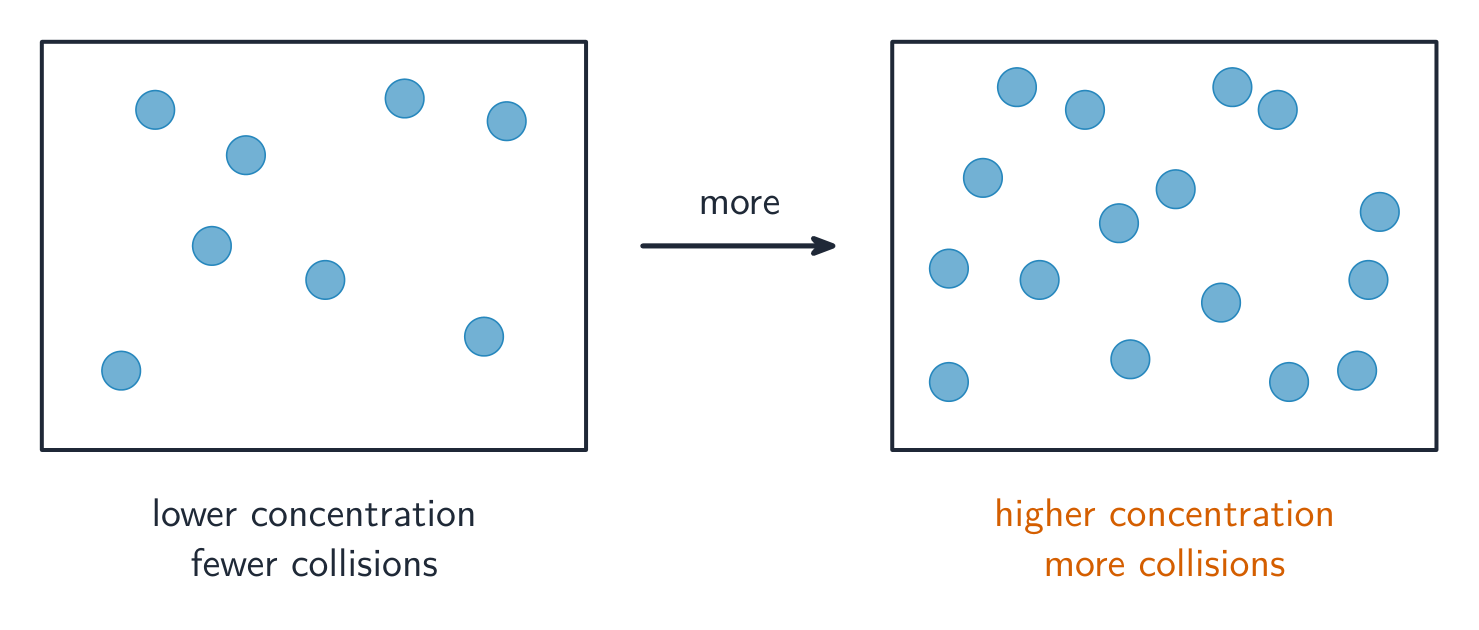
动力学(kinetics)研究反应速率(reaction rate)——反应物变成产物有多快。速率是每单位时间浓度的变化,而它通常随着反应物被用尽而减小。速率随着更高的浓度、更高的温度、更大的表面积和一个催化剂而上升。
相同体积里更多的粒子更频繁地碰撞,所以速率上升
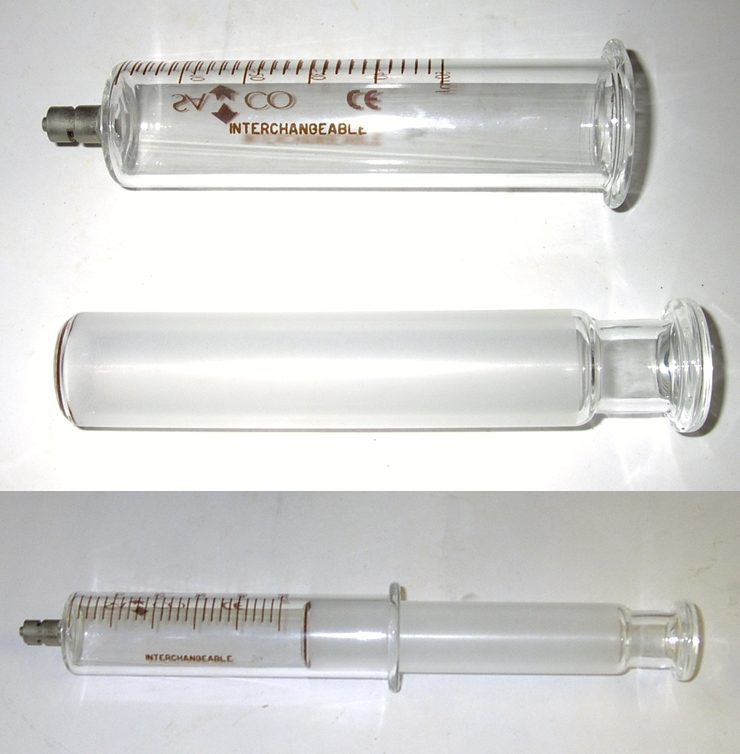
A gas syringe: measuring gas volume over time gives reaction rate from the slope
探索

Change conditions and watch the rate

Reaction rate rises with temperature, concentration, and a catalyst — each gives more frequent or more successful collisions. Change each and watch the reaction speed up.

词汇表 训练
英文 中文 拼音
Kinetics 动力学 dòng lì xué
reaction rate 反应速率 fǎn yìng sù lǜ
5.2

速率定律导论

大纲
Learning ObjectiveEssential Knowledge

5.2.A
Represent experimental data with a consistent rate law expression.

  • 5.2.A.1 Experimental methods can be used to monitor the amounts of reactants and/or products of a reaction over time and to determine the rate of the reaction.
  • 5.2.A.2 The rate law expresses the rate of a reaction as proportional to the concentration of each reactant raised to a power.
  • 5.2.A.3 The power of each reactant in the rate law is the order of the reaction with respect to that reactant. The sum of the powers of the reactant concentrations in the rate law is the overall order of the reaction.
  • 5.2.A.4 The proportionality constant in the rate law is called the rate constant. The value of this constant is temperature dependent and the units reflect the overall reaction order.
  • 5.2.A.5 Comparing initial rates of a reaction is a method to determine the order with respect to each reactant.

来源:美国大学理事会 AP 课程与考试说明

速率方程(rate law)把速率与反应物浓度关联:

$$\text{rate}=k[\text{A}]^m[\text{B}]^n,$$
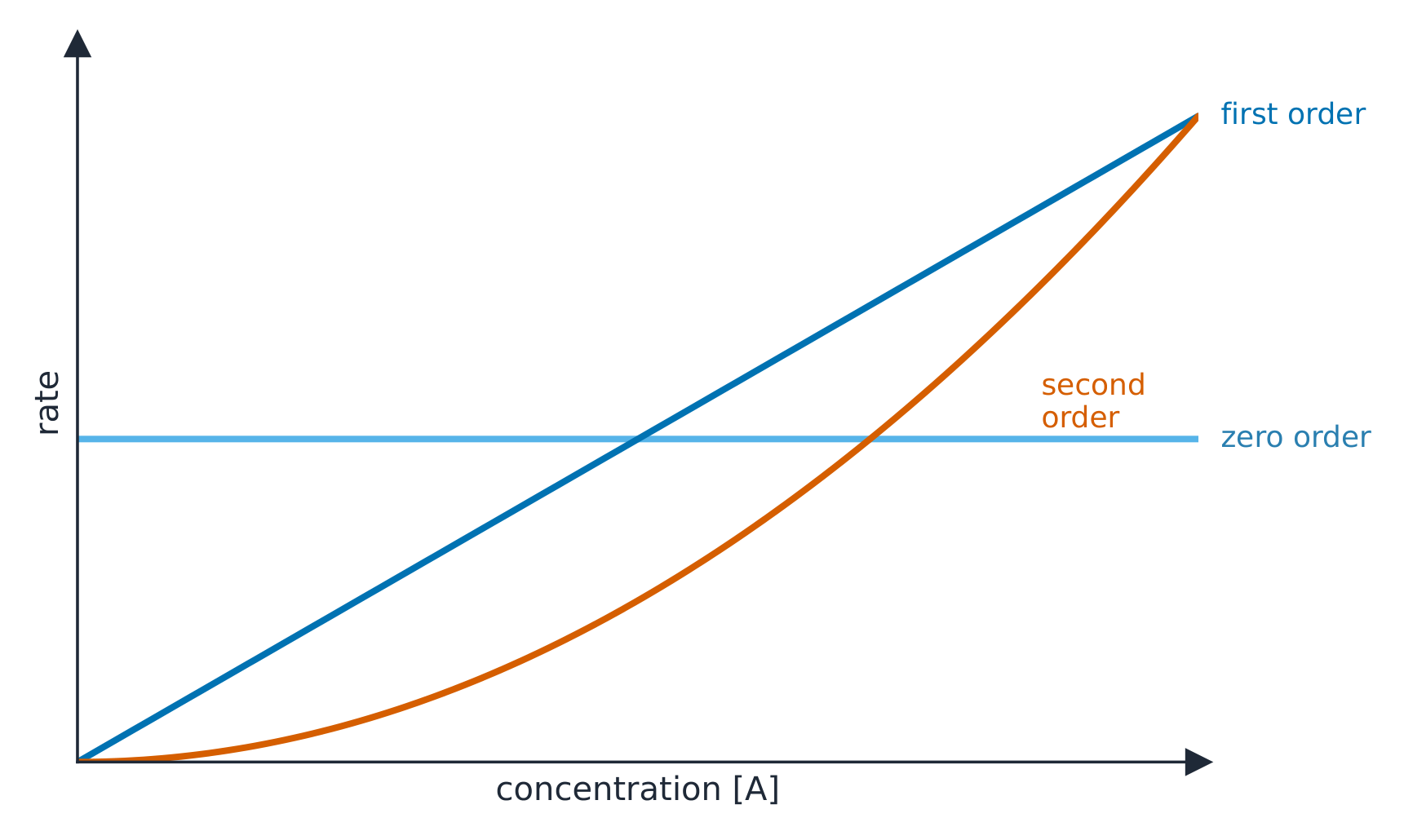
其中 $k$速率常数(rate constant)而 $m,n$级数(orders)。级数实验地(experimentally)找到(不是从配平的系数),通过看每次改变一个浓度时速率如何变化。

零级、一级和二级反应的速率对浓度
零级、一级和二级反应的速率对浓度

Worked example. 在实验里,把 $[\text{A}]$ 加倍使速率大四倍,而把 $[\text{B}]$ 加倍使速率不变。所以反应对 A 是二级($2^2=4$)而对 B 是零级,给出 $\text{rate}=k[\text{A}]^2$。总级数是 $2+0=2$。绝不从配平的系数读级数——只有实验给出它们。

词汇表 训练
英文 中文 拼音
rate law 速率方程 sù lǜ fāng chéng
rate constant 速率常数 sù lǜ cháng shù
orders 级数 jí shù
5.3

浓度随时间的变化

大纲
Learning ObjectiveEssential Knowledge

5.3.A
Identify the rate law expression of a chemical reaction using data that show how the concentrations of reaction species change over time.

  • 5.3.A.1 The order of a reaction can be inferred from a graph of concentration of reactant versus time.
  • 5.3.A.2 If a reaction is first order with respect to a reactant being monitored, a plot of the natural log (ln) of the reactant concentration as a function of time will be linear.
  • 5.3.A.3 If a reaction is second order with respect to a reactant being monitored, a plot of the reciprocal of the concentration of that reactant versus time will be linear.
  • 5.3.A.4 The slopes of the concentration versus time data for zeroth, first, and second order reactions can be used to determine the rate constant for the reaction.
    • Zeroth order:
    • Equation: $[\mathrm{A}]_t - [\mathrm{A}]_0 = -kt$
    • First order:
    • Equation: $\ln[\mathrm{A}]_t - \ln[\mathrm{A}]_0 = -kt$
    • Second order:
    • Equation: $1/[\mathrm{A}]_t - 1/[\mathrm{A}]_0 = kt$
  • 5.3.A.5 Half-life is a critical parameter for first order reactions because the half-life is constant and related to the rate constant for the reaction by the equation:
    • Equation: $t_{1/2} = 0.693/k.$
  • 5.3.A.6 Radioactive decay processes provide an important illustration of first order kinetics.

来源:美国大学理事会 AP 课程与考试说明

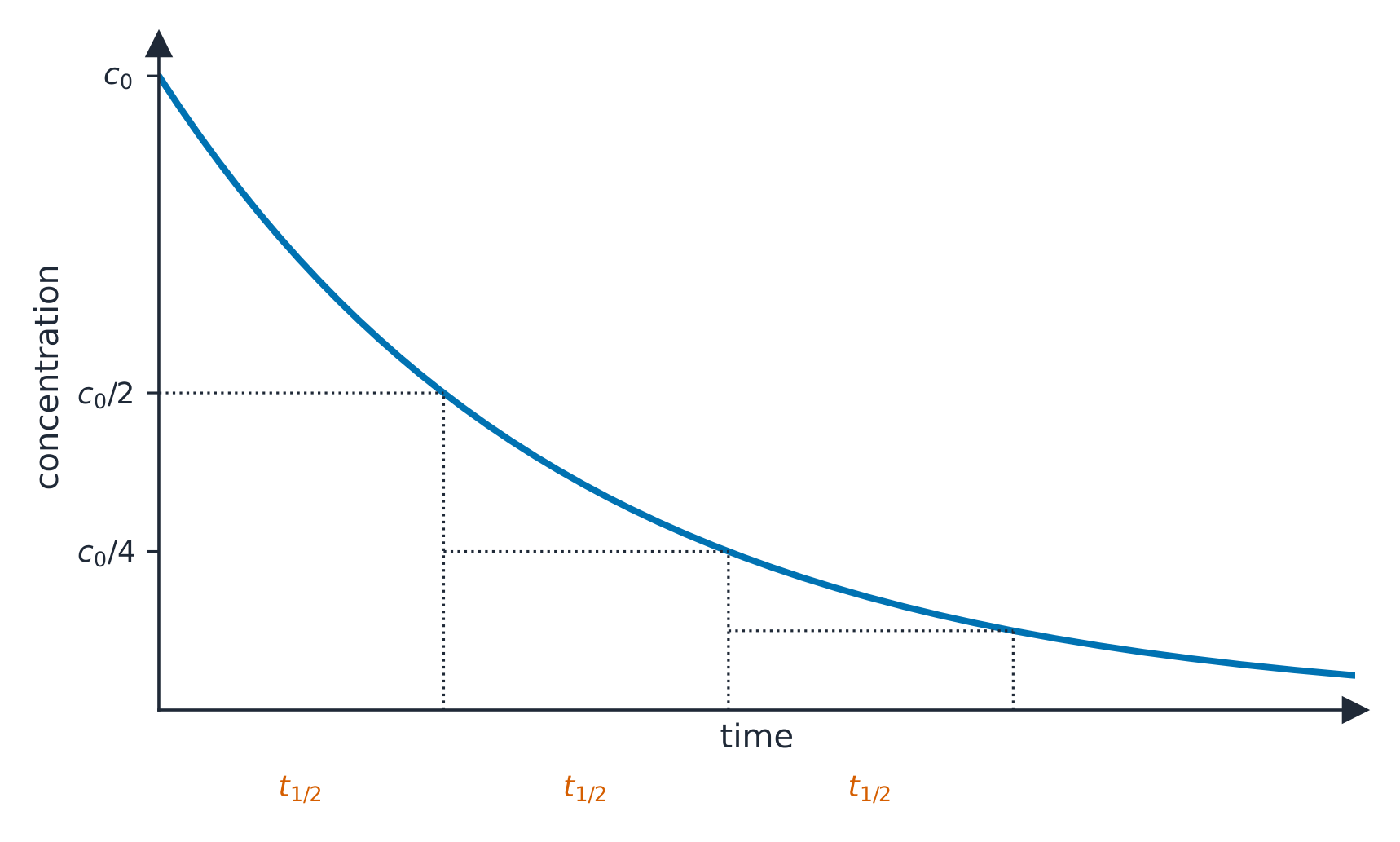
积分速率方程(integrated rate laws)描述浓度如何随时间下降并给出直线测试:

一个一级反应有一个恒定的半衰期
一个一级反应有一个恒定的半衰期
  • 零级: $[\text{A}]$$t$ 是线性的。
  • 一级: $\ln[\text{A}]$$t$ 是线性的;恒定的半衰期(half-life)。
  • 二级: $\dfrac{1}{[\text{A}]}$$t$ 是线性的。

哪个图是直的告诉你级数并从它的斜率给出 $k$

Worked example. 一个一级反应有速率常数 $k=0.030\ \text{s}^{-1}$。它的半衰期是

$$t_{1/2}=\frac{0.693}{k}=\frac{0.693}{0.030}=23\ \text{s},$$
而,因为是一级,那个半衰期无论剩多少反应物都保持相同——所以 $46\ \text{s}$($2$ 个半衰期)后剩四分之一。

探索

Track concentration as a reaction runs

As reactants are used up the rate slows, so a concentration-time curve is steep at first and flattens out. Raising temperature or adding a catalyst steepens it.

词汇表 训练
英文 中文 拼音
half-life 半衰期 bàn shuāi qī
5.4

基元反应

大纲
Learning ObjectiveEssential Knowledge

5.4.A
Represent an elementary reaction as a rate law expression using stoichiometry.

  • 5.4.A.1 The rate law of an elementary reaction can be inferred from the stoichiometry of the particles participating in a collision.
  • 5.4.A.2 Elementary reactions involving the simultaneous collision of three or more particles are rare.

来源:美国大学理事会 AP 课程与考试说明

一个反应机理(reaction mechanism)是实际发生的基元反应(elementary steps)的序列。它们的分子数(molecularity)(一步中多少粒子碰撞)直接设定那一步的速率方程。在一步中制造而在较后一步中用尽的物种是中间体(intermediates)。

词汇表 训练
英文 中文 拼音
reaction mechanism 反应机理 fǎn yìng jī lǐ
elementary steps 基元反应 jī yuán fǎn yìng
intermediates 中间体 zhōng jiān tǐ
5.5

碰撞模型

大纲
Learning ObjectiveEssential Knowledge

5.5.A
Explain the relationship between the rate of an elementary reaction and the frequency, energy, and orientation of particle collisions.

  • 5.5.A.1 For an elementary reaction to successfully produce products, reactants must successfully collide to initiate bond-breaking and bond-making events.
  • 5.5.A.2 In most reactions, only a small fraction of the collisions leads to a reaction. Successful collisions have both sufficient energy to overcome the activation energy requirements and orientations that allow the bonds to rearrange in the required manner.
  • 5.5.A.3 The Maxwell-Boltzmann distribution curve describes the distribution of particle energies; this distribution can be used to gain a qualitative estimate of the fraction of collisions with sufficient energy to lead to a reaction, and also how that fraction depends on temperature.

来源:美国大学理事会 AP 课程与考试说明

碰撞理论

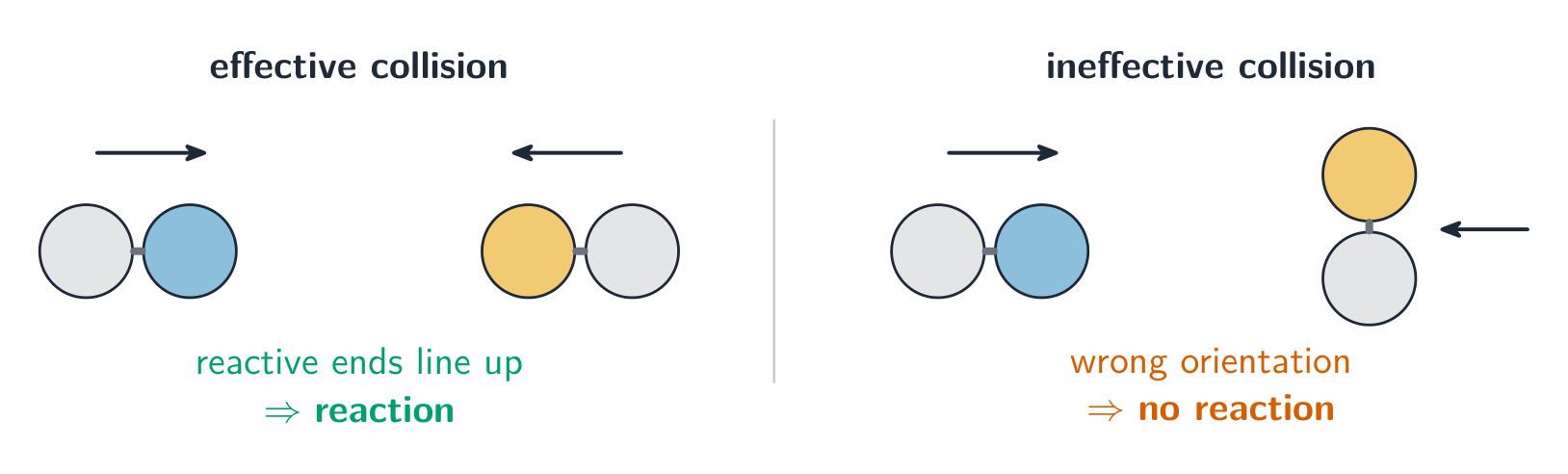
碰撞理论(collision theory):分子必须以足够的能量(活化能(activation energy),$E_a$)和正确的取向(orientation)碰撞才能反应。更高的温度意味着更多分子超过 $E_a$,所以反应急剧加速。

一次碰撞只在正确的取向和足够的能量下才反应
探索

Which molecules clear the activation energy

Only collisions with energy above the activation energy react. Heating shifts the speed distribution right, so a much larger fraction of molecules can react.

词汇表 训练
英文 中文 拼音
Collision theory 碰撞理论 pèng zhuàng lǐ lùn
activation energy 活化能 huó huà néng
5.6

反应能量图

大纲
Learning ObjectiveEssential Knowledge

5.6.A
Represent the activation energy and overall energy change in an elementary reaction using a reaction energy profile.

  • 5.6.A.1 Elementary reactions typically involve the breaking of some bonds and the forming of new ones.
  • 5.6.A.2 The reaction coordinate is the axis along which the complex set of motions involved in rearranging reactants to form products can be plotted.
  • 5.6.A.3 The energy profile gives the energy along the reaction coordinate, which typically proceeds from reactants, through a transition state, to products. The energy difference between the reactants and the transition state is the activation energy for the forward reaction.
  • 5.6.A.4 The rate of an elementary reaction is temperature dependent because the proportion of particle collisions that are energetic enough to reach the transition state varies with temperature. The Arrhenius equation relates the temperature dependence of the rate of an elementary reaction to the activation energy needed by molecular collisions to reach the transition state.
    • Exclusion statement: Calculations involving the Arrhenius equation will not be assessed on the AP Exam.

来源:美国大学理事会 AP 课程与考试说明

反应能量曲线

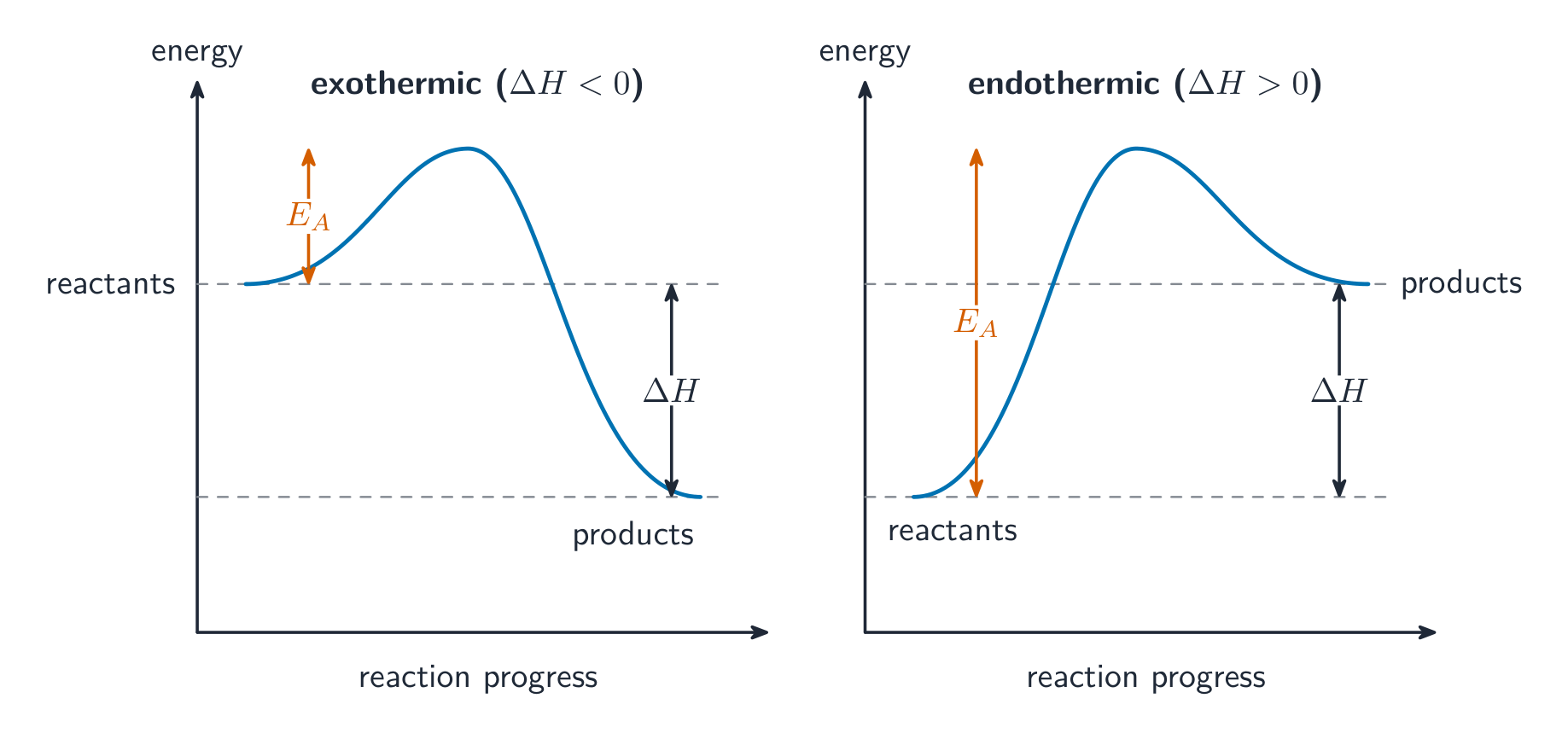
一个能量图(energy profile)沿反应路径画出能量。峰是过渡态(transition state);从反应物到峰的攀升是 $E_a$;反应物和产物能量之间的差是焓变 $\Delta H$(放热时向下)。

放热反应结束时比反应物低;吸热结束时更高
探索

Read activation energy off the profile

An energy profile plots energy along the reaction. The hump is the activation energy; the drop from reactants to products is $\Delta H$. A catalyst lowers the hump.

词汇表 训练
英文 中文 拼音
energy profile 能量图 néng liàng tú
transition state 过渡态 guò dù tài
5.7

反应机理导论

大纲
Learning ObjectiveEssential Knowledge

5.7.A
Identify the components of a reaction mechanism.

  • 5.7.A.1 A reaction mechanism consists of a series of elementary reactions, or steps, that occur in sequence. The components may include reactants, intermediates, products, and catalysts.
  • 5.7.A.2 The elementary steps when combined should align with the overall balanced equation of a chemical reaction.
  • 5.7.A.3 A reaction intermediate is produced by some elementary steps and consumed by others, such that it is present only while a reaction is occurring.
  • 5.7.A.4 Experimental detection of a reaction intermediate is a common way to build evidence in support of one reaction mechanism over an alternative mechanism.
    • Exclusion statement: Collection of data pertaining to detection of a reaction intermediate will not be assessed on the AP Exam.

来源:美国大学理事会 AP 课程与考试说明

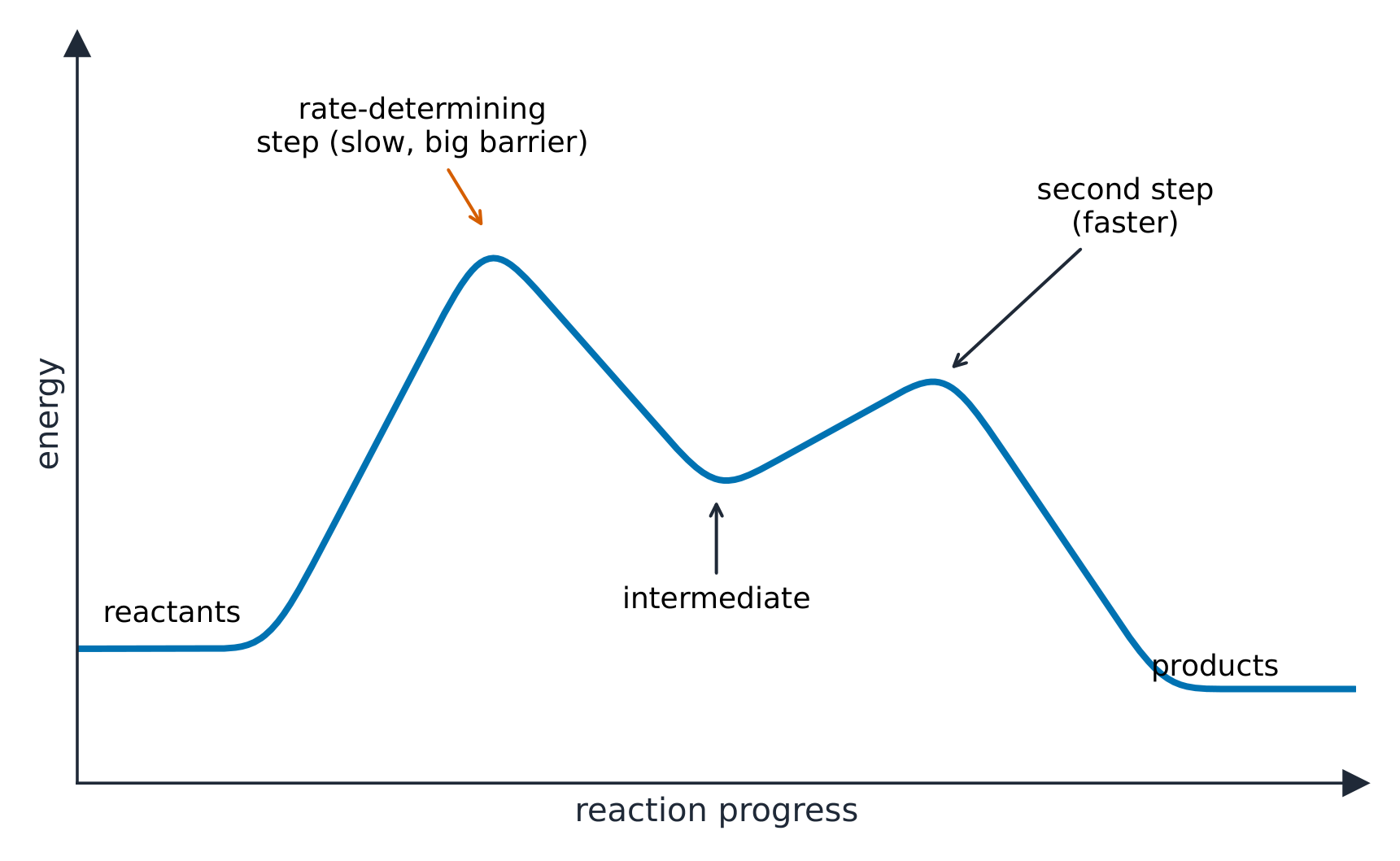
在一个多步机理里,这些步骤必须加起来等于总的配平方程(中间体抵消)。每一步有它自己的能量山;最高的山是最慢的步骤。

带更高势垒的慢步骤是决速的
带更高势垒的慢步骤是决速的
词汇表 训练
英文 中文 拼音
rate-determining step 决速步骤 jué sù bù zhòu
5.8

反应机理与速率定律

大纲
Learning ObjectiveEssential Knowledge

5.8.A
Identify the rate law for a reaction from a mechanism in which the first step is rate limiting.

  • 5.8.A.1 For reaction mechanisms in which each elementary step is irreversible, or in which the first step is rate limiting, the rate law of the reaction is set by the molecularity of the slowest elementary step (i.e., the rate-limiting step).
    • Exclusion statement: Collection of data pertaining to detection of a reaction intermediate will not be assessed on the AP Exam.

来源:美国大学理事会 AP 课程与考试说明

决速步骤(rate-determining step)是最慢的步骤;它的分子数给出总速率方程。一个有效的机理必须 (1) 加起来等于总反应,并 (2) 预测实验观察到的速率方程。

Worked example. 假设慢(决速)步骤是双分子碰撞 $\text{NO}_2+\text{NO}_2\rightarrow\text{NO}_3+\text{NO}$。它的分子数直接给出速率方程:$\text{rate}=k[\text{NO}_2]^2$。若实验显示恰好这个,提出的机理是一致的;若实验给出 $\text{rate}=k[\text{NO}_2]$,机理会是错的。

5.9

预平衡近似

大纲
Learning ObjectiveEssential Knowledge

5.9.A
Identify the rate law for a reaction from a mechanism in which the first step is not rate limiting.

  • 5.9.A.1 If the first elementary reaction is not rate limiting, approximations (such as pre-equilibrium) must be made to determine a rate law expression.

来源:美国大学理事会 AP 课程与考试说明

若一个快步骤在慢步骤之前,一个中间体在慢步骤的速率方程里出现。用快前平衡(fast pre-equilibrium)以反应物重写那个中间体,所以最终的速率方程只包含可测量的物种。

5.10

多步反应能量图

大纲
Learning ObjectiveEssential Knowledge

5.10.A
Represent the activation energy and overall energy change in a multistep reaction with a reaction energy profile.

  • 5.10.A.1 Knowledge of the energetics of each elementary reaction in a mechanism allows for the construction of an energy profile for a multistep reaction.

来源:美国大学理事会 AP 课程与考试说明

一个多步反应的能量图显示几个峰(每步一个),它们之间有谷(中间体)。最高的峰是决速的过渡态——它控制总速率。

5.11

催化作用
大纲
Learning ObjectiveEssential Knowledge

5.11.A
Explain the relationship between the effect of a catalyst on a reaction and changes in the reaction mechanism.

  • 5.11.A.1 In order for a catalyst to increase the rate of a reaction, the addition of the catalyst must increase the number of effective collisions and/or provide a reaction path with a lower activation energy relative to the original reaction coordinate.
  • 5.11.A.2 In a reaction mechanism containing a catalyst, the net concentration of the catalyst is constant. However, the catalyst will frequently be consumed in the rate-determining step of the reaction, only to be regenerated in a subsequent step in the mechanism.
  • 5.11.A.3 Some catalysts accelerate a reaction by binding to the reactant(s). The reactants are either oriented more favorably or react with lower activation energy. There is often a new reaction intermediate in which the catalyst is bound to the reactant(s). Many enzymes function in this manner.
  • 5.11.A.4 Some catalysts involve covalent bonding between the catalyst and the reactant(s). An example is acid-base catalysis, in which a reactant or intermediate either gains or loses a proton. This introduces a new reaction intermediate and new elementary reactions involving that intermediate.
  • 5.11.A.5 In surface catalysis, a reactant or intermediate binds to, or forms a covalent bond with, the surface. This introduces elementary reactions involving these new bound reaction intermediate(s).

来源:美国大学理事会 AP 课程与考试说明

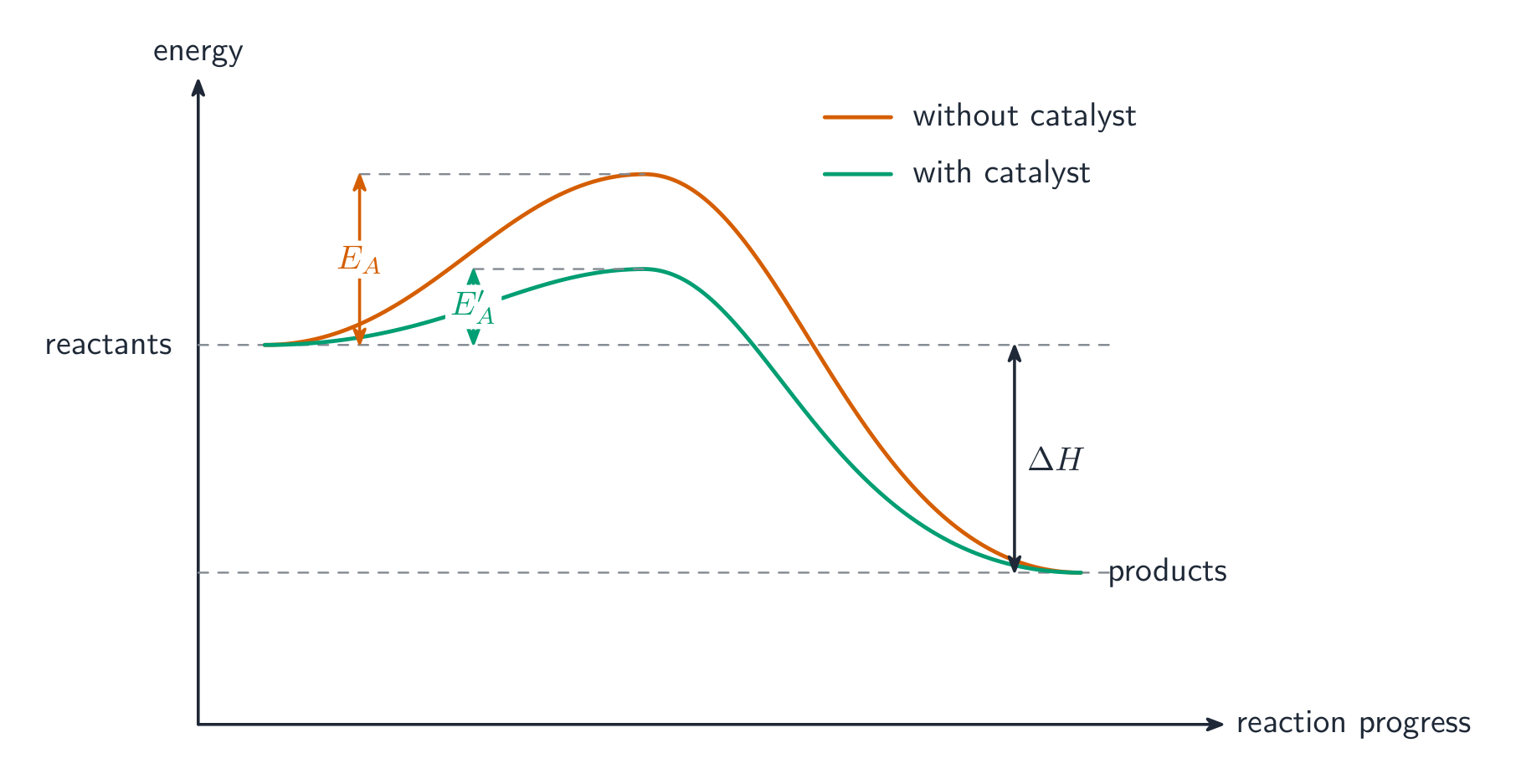
一个催化剂(catalyst)通过提供一条带更低活化能的新途径来加速一个反应,而不被消耗。它不改变 $\Delta H$ 或平衡位置——只改变平衡被达到的速度。在一个能量图上,一个催化剂降低峰。

一个催化剂给出一条带更低活化能的路线;焓变不变
词汇表 训练
英文 中文 拼音
catalyst 催化剂 cuī huà jì
5.11

考试技巧

  • 速率随着浓度、温度、表面积和一个催化剂而上升——用碰撞理论解释每一个(更多、或更有能量的、成功的碰撞)。
  • 温度主要通过使更多粒子在活化能之上起作用,不只是更多碰撞。
  • 反应级数来自实验,不是配平的系数——看每次改变一个浓度时速率如何变化。
  • 在一个能量图上山高是活化能而反应物-产物间隙是 $\Delta H$
  • 一个催化剂降低活化能(一条新途径)但使 $\Delta H$ 和平衡位置不变。

本主题的互动课程

逐步学习,并即时检测练习。

AP 化学历年真题

AP 化学的更多主题

登录或创建账号

IGCSE, A-Level & AP