跳到主要内容

物质与混合物的性质

AP 化学 · 第 3 主题

训练
讲义 词汇表
3.1

分子间与粒子间作用力

大纲
Learning ObjectiveEssential Knowledge

3.1.A
Explain the relationship between the chemical structures of molecules and the relative strength of their intermolecular forces when:
i. The molecules are of the same chemical species.
ii. The molecules are of two different chemical species.

  • 3.1.A.1 London dispersion forces are a result of the Coulombic interactions between temporary, fluctuating dipoles. London dispersion forces are often the strongest net intermolecular force between large molecules.
    • i. Dispersion forces increase with increasing contact area between molecules and with increasing polarizability of the molecules.
    • ii. The polarizability of a molecule increases with an increasing number of electrons in the molecule and the size of the electron cloud. It is enhanced by the presence of pi bonding.
    • iii. The term "London dispersion forces" should not be used synonymously with the term "van der Waals forces."
  • 3.1.A.2 The dipole moment of a polar molecule leads to additional interactions with other chemical species.
    • i. Dipole-induced dipole interactions are present between a polar and nonpolar molecule. These forces are always attractive. The strength of these forces increases with the magnitude of the dipole of the polar molecule and with the polarizability of the nonpolar molecule.
    • ii. Dipole-dipole interactions are present between polar molecules. The interaction strength depends on the magnitudes of the dipoles and their relative orientation. Interactions between polar molecules are typically greater than those between nonpolar molecules of comparable size because these interactions act in addition to London dispersion forces.
    • iii. Ion-dipole forces of attraction are present between ions and polar molecules. These tend to be stronger than dipole-dipole forces.
  • 3.1.A.3 The relative strength and orientation dependence of dipole-dipole and ion-dipole forces can be understood qualitatively by considering the sign of the partial charges responsible for the molecular dipole moment, and how these partial charges interact with an ion or with an adjacent dipole.
  • 3.1.A.4 Hydrogen bonding is a strong type of intermolecular interaction that exists when hydrogen atoms covalently bonded to the highly electronegative atoms (N, O, and F) are attracted to the negative end of a dipole formed by the electronegative atom (N, O, and F) in a different molecule, or a different part of the same molecule.
  • 3.1.A.5 In large biomolecules, noncovalent interactions may occur between different molecules or between different regions of the same large biomolecule.

来源:美国大学理事会 AP 课程与考试说明

分子间作用力(intermolecular forces)(IMFs)是分子之间的吸引——比键弱得多,但它们设定熔点/沸点。从最弱到最强:
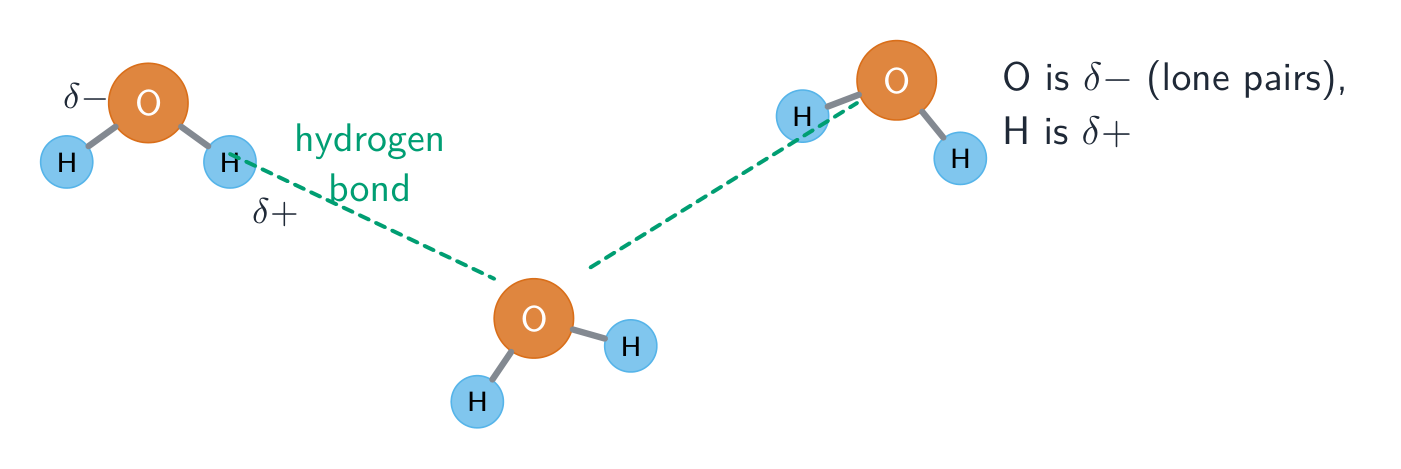
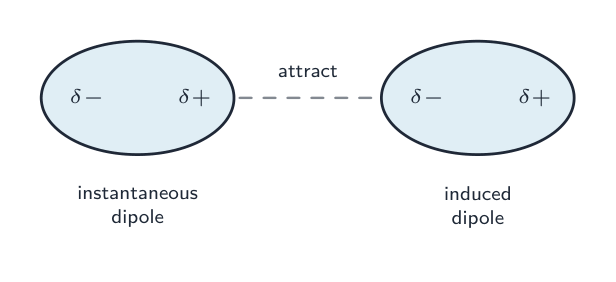
伦敦色散:一个瞬时偶极在一个邻居里诱导一个偶极
氢键:一个 N/O/F 上的 H 被吸引到另一个分子上的一个孤对
  • 伦敦色散力(London dispersion forces):存在于所有分子里;它源于瞬时的、涨落的偶极之间的库仑吸引,对更大、更可极化的电子云更强 —— 在大分子之间往往是最强的净作用力。
  • 偶极-偶极(dipole–dipole):在极性分子之间。它的强度取决于偶极的大小以及它们的相对取向 —— 一个 $\delta+$ 端与相邻分子的 $\delta-$ 端对齐就会吸引,所以它是在色散之上额外起作用的,这让极性分子比大小相近的非极性分子更"黏"。
  • 氢键(hydrogen bonding):当 H 键合到 N、O 或 F 时的一个强的偶极力。
  • 离子-偶极(ion–dipole):在一个离子和一个极性分子之间(离子拉住偶极中带相反电荷的那一端)。它是这里四者中最强的(甚至强于氢键),正是它让水能溶解一种离子固体 —— 每个 $\text{Na}^+$ 都被水分子的 $\delta-$ 氧端所包围。

整个强度阶梯都可以定性地通过看部分电荷的正负号来理解:部分电荷越大、对齐得越好,或者是一个完整的离子电荷,吸引就越强。更强的 IMFs 意味着更高的沸点和更低的蒸气压。这就是为什么水($18\ \text{g/mol}$,氢键合)在 $100\,{}^{\circ}\text{C}$ 沸腾,而甲烷($16\ \text{g/mol}$,只有色散)在 $-162\,{}^{\circ}\text{C}$ 沸腾。

词汇表 训练
英文 中文 拼音
Intermolecular forces 分子间作用力 fèn zǐ jiàn zuò yòng lì
London dispersion forces 伦敦色散力 lún dūn sè sàn lì
Dipole–dipole 偶极-偶极 ǒu jí - ǒu jí
Ion–dipole 离子-偶极 lí zi - ǒu jí
Hydrogen bonding 氢键 qīng jiàn
3.2

固体的性质

大纲
Learning ObjectiveEssential Knowledge

3.2.A
Explain the relationship among the macroscopic properties of a substance, the particulate-level structure of the substance, and the interactions between these particles.

  • 3.2.A.1 Many properties of liquids and solids are determined by the strengths and types of intermolecular forces present. Because intermolecular interactions are overcome completely when a substance vaporizes, the vapor pressure and boiling point are directly related to the strength of those interactions. Melting points also tend to correlate with interaction strength, but because the interactions are only rearranged, in melting, the relations can be more subtle.
  • 3.2.A.2 Particulate-level representations, showing multiple interacting chemical species, are a useful means to communicate or understand how intermolecular interactions help to establish macroscopic properties.
  • 3.2.A.3 Due to strong interactions between ions, ionic solids tend to have low vapor pressures, high melting points, and high boiling points. They tend to be brittle due to the repulsion of like charges caused when one layer slides across another layer. They conduct electricity only when the ions are mobile, as when the ionic solid is melted (i.e., in a molten state) or dissolved in water or another solvent.
  • 3.2.A.4 In covalent network solids, the atoms are covalently bonded together into a three-dimensional network (e.g., diamond) or layers of two-dimensional networks (e.g., graphite). These are only formed from nonmetals and metalloids: elemental (e.g., diamond, graphite) or binary compounds (e.g., silicon dioxide and silicon carbide). Due to the strong covalent interactions, covalent solids have high melting points. Three-dimensional network solids are also rigid and hard, because the covalent bond angles are fixed. However, graphite is soft because adjacent layers can slide past each other relatively easily.
  • 3.2.A.5 Molecular solids are composed of distinct, individual units of covalently-bonded molecules attracted to each other through relatively weak intermolecular forces. Molecular solids generally have a low melting point because of the relatively weak intermolecular forces present between the molecules. They do not conduct electricity because their valence electrons are tightly held within the covalent bonds and the lone pairs of each constituent molecule. Molecular solids are sometimes composed of very large molecules or polymers.
  • 3.2.A.6 Metallic solids are good conductors of electricity and heat, due to the presence of free valence electrons. They also tend to be malleable and ductile, due to the ease with which the metal cores can rearrange their structure. In an interstitial alloy, interstitial atoms tend to make the lattice more rigid, decreasing malleability and ductility. Alloys typically retain a sea of mobile electrons and so remain conducting.
  • 3.2.A.7 In large biomolecules or polymers, noncovalent interactions may occur between different molecules or between different regions of the same large biomolecule. The functionality and properties of such molecules depend strongly on the shape of the molecule, which is largely dictated by noncovalent interactions.

来源:美国大学理事会 AP 课程与考试说明

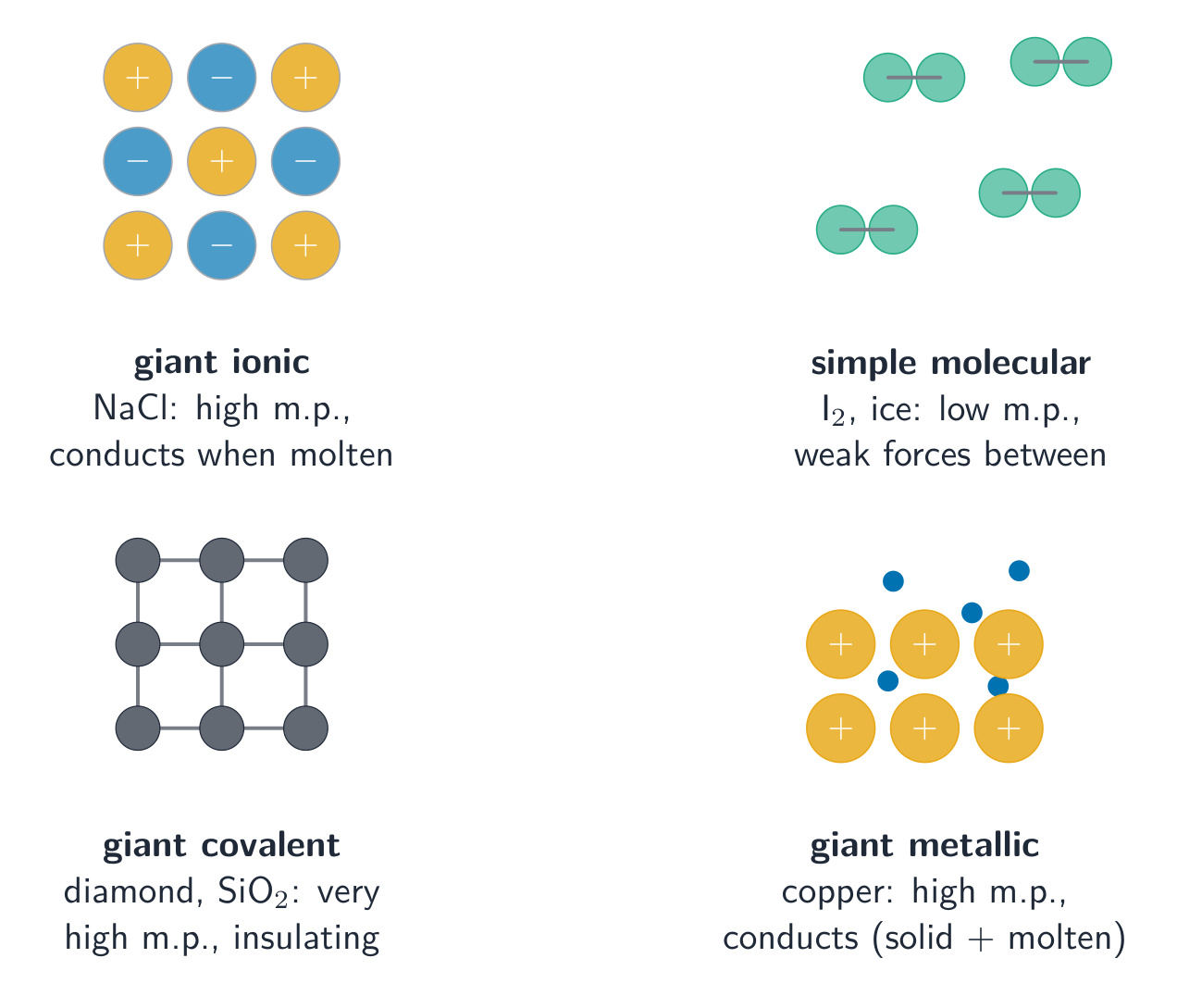
一个固体的性质反映维系它的粒子和作用力:离子共价网络(covalent-network)(像金刚石这样的三维网络非常硬、高熔点;石墨是一个分层的例外——高熔点但软,因为它的二维层能相互滑动)、金属,和分子固体(由弱的 IMFs 维系、软、低熔点)。把一个固体的性质匹配到它的结构是一个常见的考试任务。

金属固体导电导热,并且是可锻的(malleable)和可延展的(ductile),这全都是因为它的自由价电子(free valence electrons)易于移动,并让金属离子在不破坏键合的情况下彼此滑过。固体还分为晶体(crystalline)(粒子排成规则、重复的三维排列)或非晶体(amorphous)(没有长程有序,像玻璃)。

四种固体结构:巨型离子、简单分子、巨型共价和金属
词汇表 训练
英文 中文 拼音
malleable 可锻的 kě duàn de
ductile 可延展的 kě yán zhǎn de
free valence electrons 自由价电子 zì yóu jià diàn zi
crystalline 晶体 jīng tǐ
amorphous 非晶体 fēi jīng tǐ
3.3

固体、液体与气体

大纲
Learning ObjectiveEssential Knowledge

3.3.A
Represent the differences between solid, liquid, and gas phases using a particulate-level model.

  • 3.3.A.1 Solids can be crystalline, where the particles are arranged in a regular three-dimensional structure, or they can be amorphous, where the particles do not have a regular, orderly arrangement. In both cases, the motion of the individual particles is limited, and the particles do not undergo overall translation with respect to each other. The structure of the solid is influenced by interparticle interactions and the ability of the particles to pack together.
  • 3.3.A.2 The constituent particles in liquids are in close contact with each other, and they are continually moving and colliding. The arrangement and movement of particles are influenced by the nature and strength of the forces (e.g., polarity, hydrogen bonding, and temperature) between the particles.
  • 3.3.A.3 The solid and liquid phases for a particular substance typically have similar molar volume because, in both phases, the constituent particles are in close contact at all times.
  • 3.3.A.4 In the gas phase, the particles are in constant motion. Their frequencies of collision and the average spacing between them are dependent on temperature, pressure, and volume. Because of this constant motion, and minimal effects of forces between particles, a gas has neither a definite volume nor a definite shape.
    • Exclusion Statement: Understanding/interpreting phase diagrams will not be assessed on the AP Exam.

来源:美国大学理事会 AP 课程与考试说明

三种状态在粒子被维系得多紧上不同。上升的温度(temperature)提高平均动能;当它克服吸引时,物质熔化或沸腾。气体大多是空的空间,所以它们可压缩并填满它们的容器。
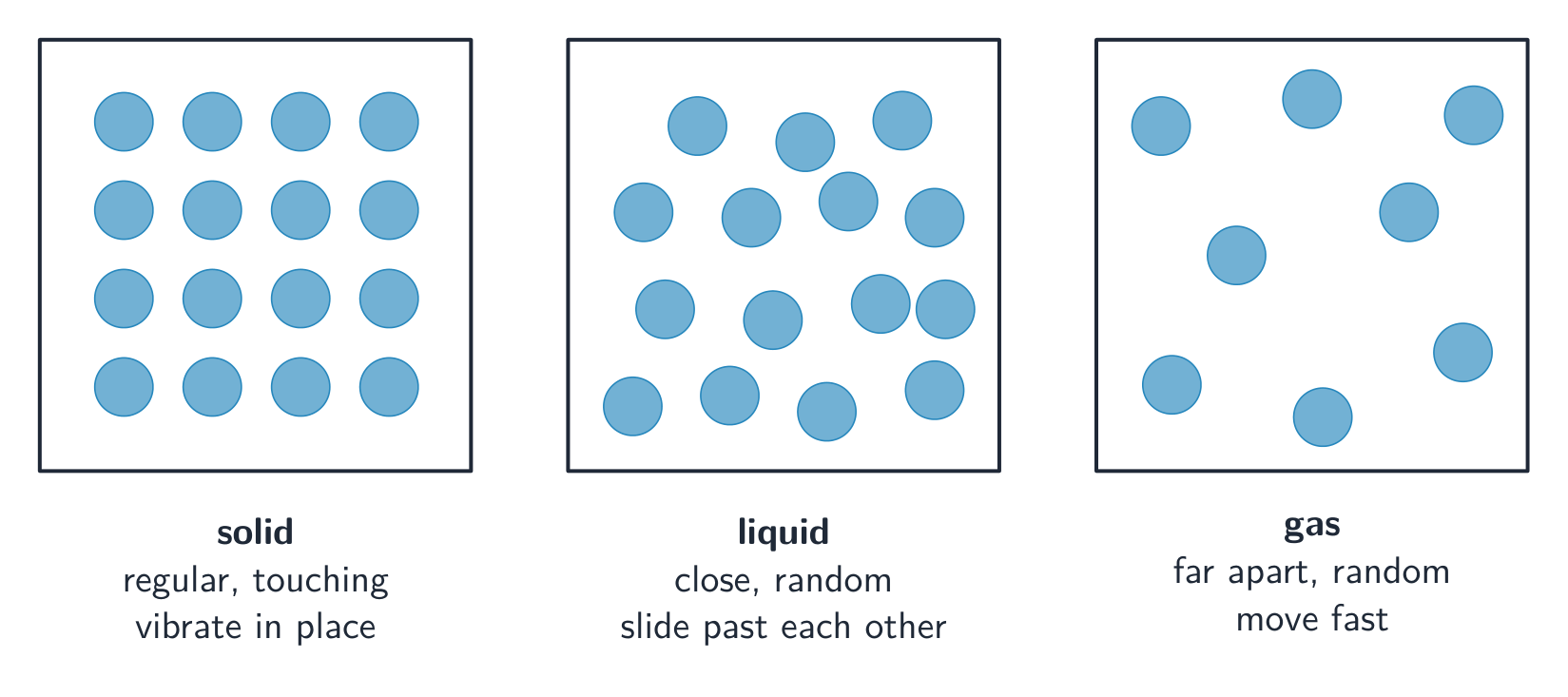
粒子在一个固体里堆积、在一个液体里靠近但可移动,而在一个气体里远离
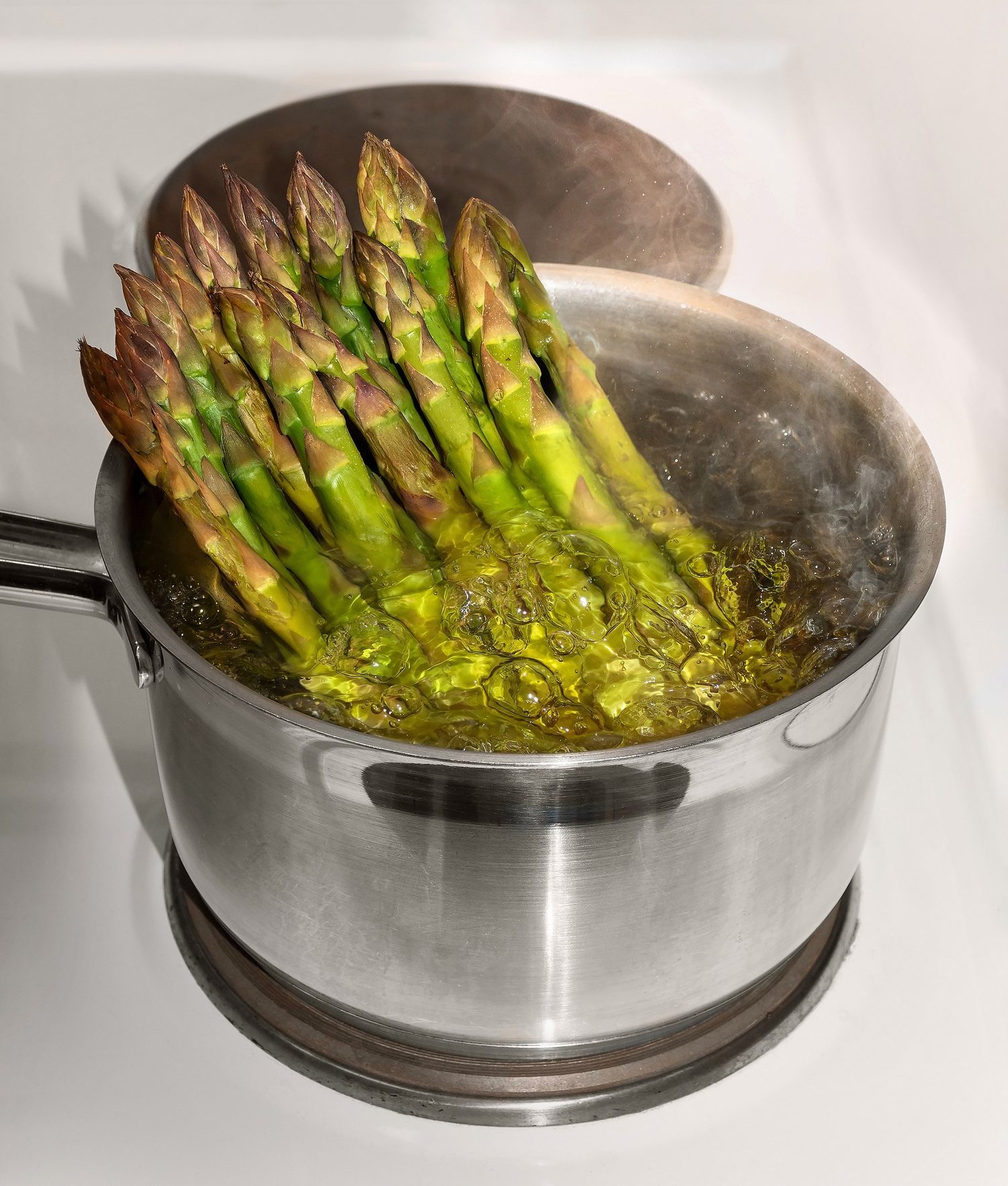
Steam rising from boiling water: gases expand to fill space and obey the ideal gas law at high T and low P
探索

Melt and boil by adding heat

Temperature sets the average kinetic energy of the particles. Warm a solid and the particles break their fixed pattern (melt), then spread right out (boil).

3.4

理想气体定律
大纲
Learning ObjectiveEssential Knowledge

3.4.A
Explain the relationship between the macroscopic properties of a sample of gas or mixture of gases using the ideal gas law.

  • 3.4.A.1 The macroscopic properties of ideal gases are related through the ideal gas law:
    • EQN: $PV = nRT$.
  • 3.4.A.2 In a sample containing a mixture of ideal gases, the pressure exerted by each component (the partial pressure) is independent of the other components. Therefore, the partial pressure of a gas within the mixture is proportional to its mole fraction ($X$), and the total pressure of the sample is the sum of the partial pressures.
    • EQN: $P_{A} = P_{total} \times X_{A}$, where $X_{A} =$ moles A/total moles;
    • EQN: $P_{total} = P_{A} + P_{B} + P_{C} + \ldots$
  • 3.4.A.3 Graphical representations of the relationships between $P$, $V$, $T$, and $n$ are useful to describe gas behavior.

来源:美国大学理事会 AP 课程与考试说明

一个理想气体(ideal gas)遵循

$$PV=nRT,$$
联系压力、体积、摩尔和绝对温度。用它从其他量求任何一个量,或(保持一些恒定)预测一个气体如何对一个变化反应。

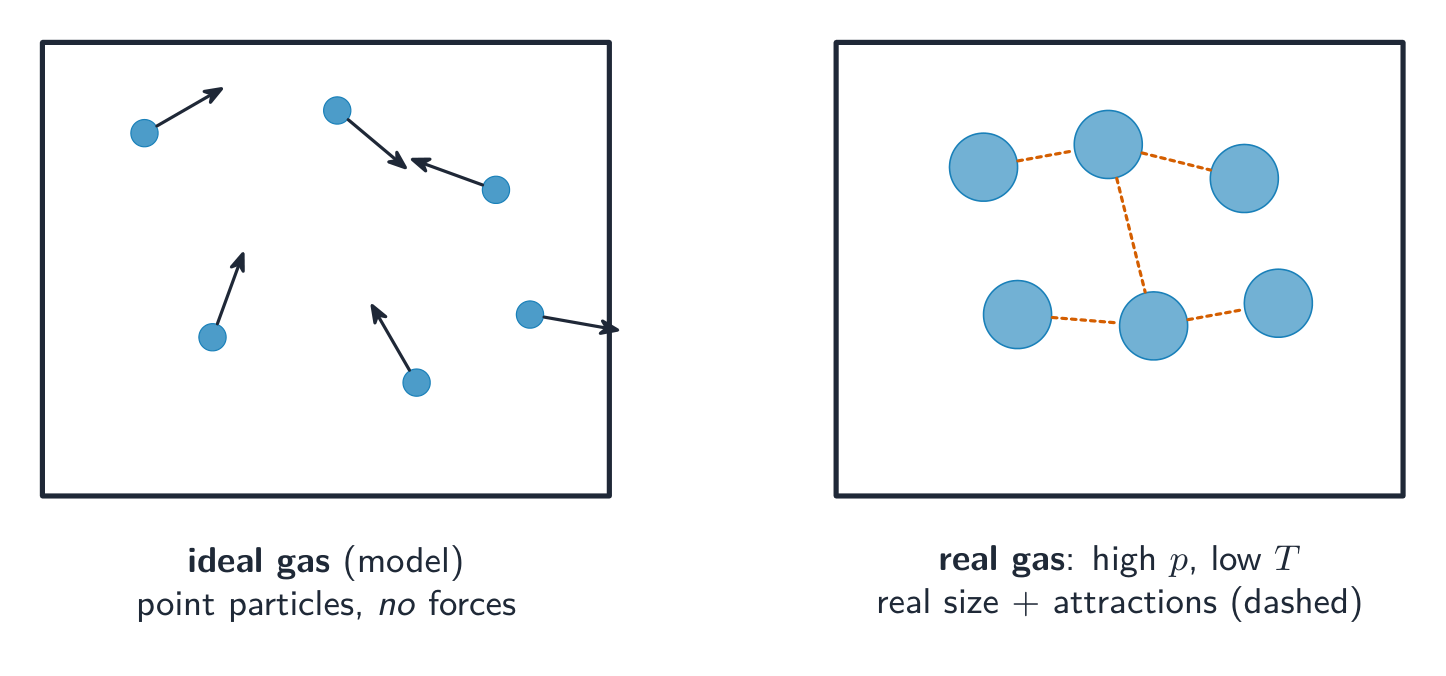
一个理想气体是一个之间没有作用力的点粒子模型

Worked example.$300\ \text{K}$$1.5\ \text{atm}$ 下多少摩尔气体填满一个 $2.0\ \text{L}$ 容器?用 $R=0.0821\ \text{L atm/(mol K)}$,

$$n=\frac{PV}{RT}=\frac{1.5\times2.0}{0.0821\times300}=0.12\ \text{mol}.$$
$T$ 总是用开尔文(kelvin),并把 $R$ 的单位匹配到你的压力和体积。

探索

Compress a gas and watch the pressure

$PV = nRT$. At fixed temperature, squeezing the gas into a smaller volume packs the molecules closer, so they hit the walls more often and the pressure rises.

3.5

分子运动论
大纲
Learning ObjectiveEssential Knowledge

3.5.A
Explain the relationship between the motion of particles and the macroscopic properties of gases with:
i. The kinetic molecular theory (KMT).
ii. A particulate model.
iii. A graphical representation.

  • 3.5.A.1 The kinetic molecular theory (KMT) relates the macroscopic properties of gases to motions of the particles in the gas. The Maxwell-Boltzmann distribution describes the distribution of the kinetic energies of particles at a given temperature.
  • 3.5.A.2 All the particles in a sample of matter are in continuous, random motion. The average kinetic energy of a particle is related to its average velocity by the equation:
    • EQN: $KE = \frac{1}{2}\,mv^{2}$.
  • 3.5.A.3 The Kelvin temperature of a sample of matter is proportional to the average kinetic energy of the particles in the sample.
  • 3.5.A.4 The Maxwell-Boltzmann distribution provides a graphical representation of the energies/velocities of particles at a given temperature.

来源:美国大学理事会 AP 课程与考试说明

气体分子运动论:压强

分子运动论(kinetic molecular theory)解释气体行为:粒子微小、处于不断的随机运动、体积可忽略而没有吸引,而碰撞是弹性的。温度与平均动能成比例,所以在一个给定温度下更轻的分子移动得更快(格雷姆逸散定律)。

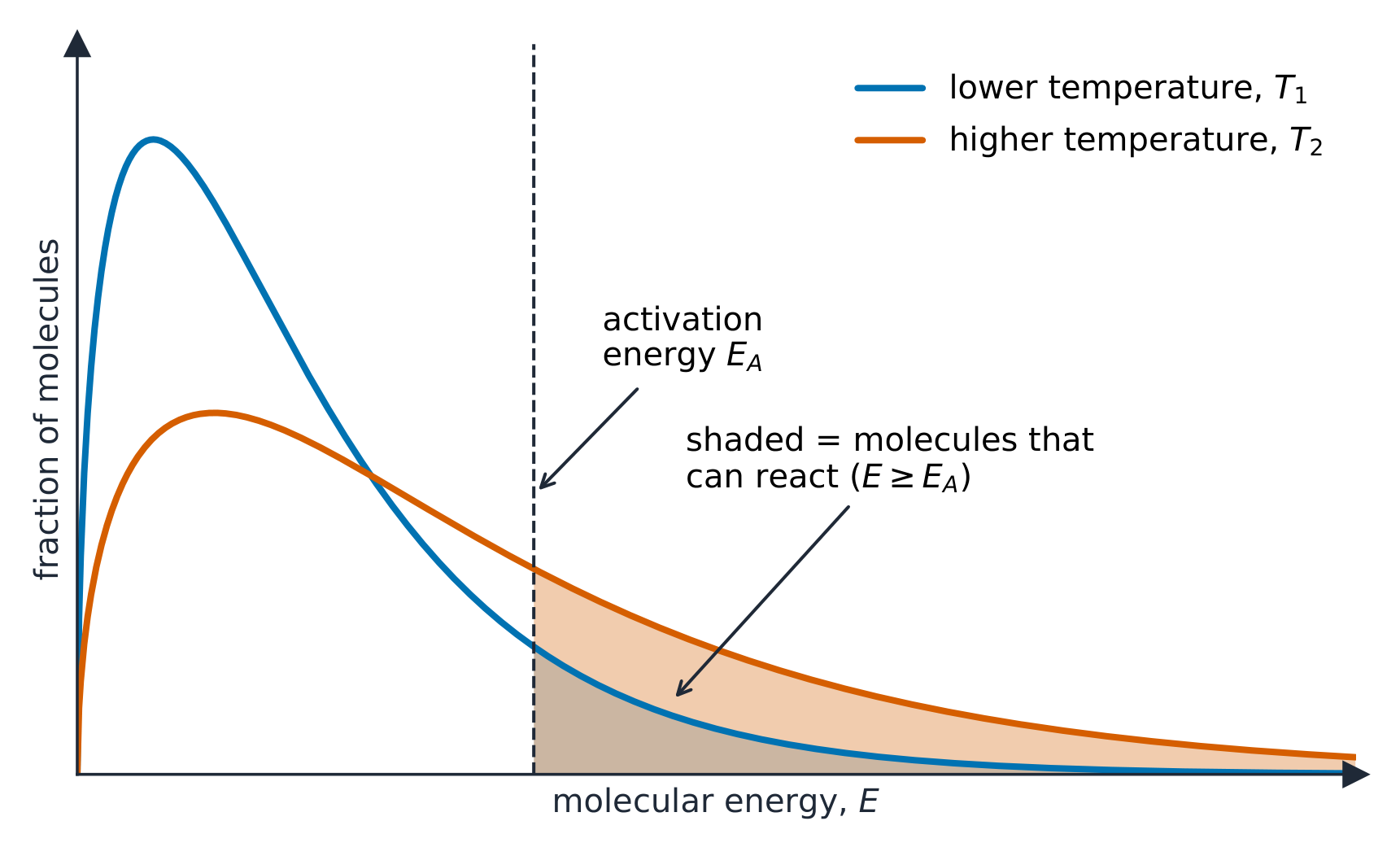
分子速率的麦克斯韦-玻尔兹曼分布在加热时向右移
探索

Heat a gas and watch the speed spread

Gas molecules have a range of speeds. Raising the temperature shifts the whole distribution to higher speeds and flattens it, so more molecules move fast.

词汇表 训练
英文 中文 拼音
Kinetic molecular theory 分子运动论 fēn zǐ yùn dòng lùn
练习卷
3.6

偏离理想气体定律

大纲
Learning ObjectiveEssential Knowledge

3.6.A
Explain the relationship among non-ideal behaviors of gases, interparticle forces, and/or volumes.

  • 3.6.A.1 The ideal gas law does not explain the actual behavior of real gases. Deviations from the ideal gas law may result from interparticle attractions among gas molecules, particularly at conditions that are close to those resulting in condensation. Deviations may also arise from particle volumes, particularly at extremely high pressures.

来源:美国大学理事会 AP 课程与考试说明

真实气体(real gases)在高压低温下偏离理想行为,那里分子足够近以致它们的真实体积和它们的吸引重要。吸引把压力降到理想以下;分子体积把它提高。

3.7

溶液与混合物

大纲
Learning ObjectiveEssential Knowledge

3.7.A
Calculate the number of solute particles, volume, or molarity of solutions.

  • 3.7.A.1 Solutions, also sometimes called homogeneous mixtures, can be solids, liquids, or gases. In a solution, the macroscopic properties do not vary throughout the sample. In a heterogeneous mixture, the macroscopic properties depend on location in the mixture.
  • 3.7.A.2 Solution composition can be expressed in a variety of ways; molarity is the most common method used in the laboratory.
    • EQN: $M = n_{solute}/L_{solution}$

来源:美国大学理事会 AP 课程与考试说明

一个溶液(solution)是溶解在一个溶剂(solvent)里的一个溶质(solute)的均相混合物。浓度通常是摩尔浓度(molarity):

$$M=\frac{\text{moles of solute}}{\text{liters of solution}}.$$
稀释(dilution)守恒摩尔:$M_1V_1=M_2V_2$

Worked example. 你必须向 $50\ \text{mL}$$6.0\ \text{M}$ HCl 加多少体积的水来使它成为 $2.0\ \text{M}$?HCl 的摩尔不变,所以 $M_1V_1=M_2V_2$ 给出最终体积 $V_2=\dfrac{M_1V_1}{M_2}=\dfrac{6.0\times50}{2.0}=150\ \text{mL}$。因此你 $150-50=100\ \text{mL}$ 的水。

词汇表 训练
英文 中文 拼音
solution 溶液 róng yè
solute 溶质 róng zhì
solvent 溶剂 róng jì
molarity 摩尔浓度 mó ěr nóng dù
3.8

溶液的表示方法

大纲
Learning ObjectiveEssential Knowledge

3.8.A
Using particulate models for mixtures:
i. Represent interactions between components.
ii. Represent concentrations of components.

  • 3.8.A.1 Particulate representations of solutions communicate the structure and properties of solutions, by illustration of the relative concentrations of the components in the solution and/or drawings that show interactions among the components.
    • Exclusion Statement: Colligative properties will not be assessed on the AP Exam.
    • Exclusion Statement: Calculations of molality, percent by mass, and percent by volume for solutions will not be assessed on the AP Exam.

来源:美国大学理事会 AP 课程与考试说明

一个微粒图(particulate diagram)显示溶质和溶剂粒子。对于一个离子溶质,把它显示为完全解离(dissociated)成被溶剂围绕的分开的离子;数粒子以推理浓度和导电性。

3.9

溶液与混合物的分离
大纲
Learning ObjectiveEssential Knowledge

3.9.A
Explain the results of a separation experiment based on intermolecular interactions.

  • 3.9.A.1 The components of a liquid solution cannot be separated by filtration. They can, however, be separated using processes that take advantage of differences in the intermolecular interactions of the components.
    • i. Chromatography (paper, thin-layer, and column) separates chemical species by taking advantage of the differential strength of intermolecular interactions between and among the components of the solution (the mobile phase) and with the surface components of the stationary phase. The resulting chromatogram can be used to infer the relative polarities of components in a mixture.
    • ii. Distillation separates chemical species by taking advantage of the differential strength of intermolecular interactions between and among the components and the effects these interactions have on the vapor pressures of the components in the mixture.

来源:美国大学理事会 AP 课程与考试说明

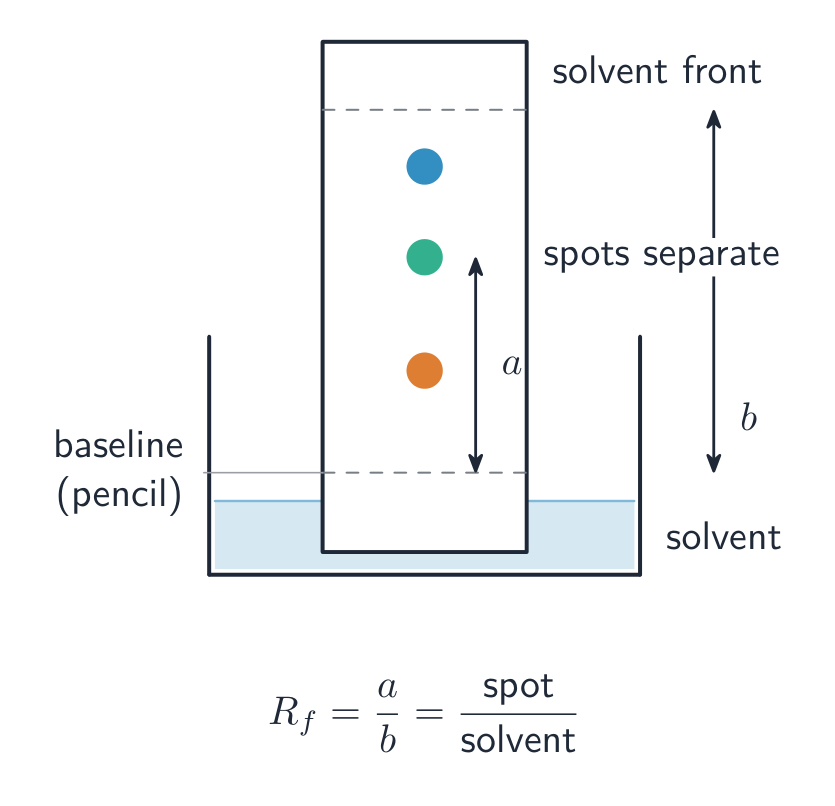
因为一个混合物的组分保持它们的性质,物理方法分离它们:过滤(filtration)(按粒子大小)、蒸馏(distillation)(按沸点),和色谱法(chromatography)(按每个组分多强地粘附在一个固定相上与随一个溶剂移动)。

纸色谱在溶剂沿纸上升时分离一个混合物
纸色谱在溶剂沿纸上升时分离一个混合物
词汇表 训练
英文 中文 拼音
chromatography 色谱法 sè pǔ fǎ
3.10

溶解度

大纲
Learning ObjectiveEssential Knowledge

3.10.A
Explain the relationship between the solubility of ionic and molecular compounds in aqueous and nonaqueous solvents, and the intermolecular interactions between particles.

  • 3.10.A.1 Substances with similar intermolecular interactions tend to be miscible or soluble in one another.

来源:美国大学理事会 AP 课程与考试说明

溶解度(solubility)是多少溶质溶解。"相似相溶":极性(和离子)溶质在极性溶剂里溶解;非极性在非极性里。溶解发生在溶质-溶剂吸引与被破坏的吸引相当时。

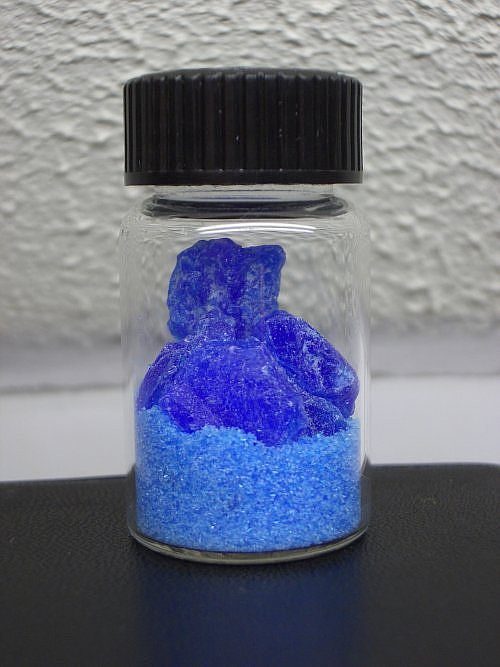
一簇又大又亮、玻璃般的蓝色硫酸铜晶体
从溶液中长出的蓝色硫酸铜(II)晶体:一份饱和溶液放置蒸发,会把溶解的固体以规则晶体的形式重新析出
词汇表 训练
英文 中文 拼音
Solubility 溶解度 róng jiě dù
3.11

光谱学与电磁波谱

大纲
Learning ObjectiveEssential Knowledge

3.11.A
Explain the relationship between a region of the electromagnetic spectrum and the types of molecular or electronic transitions associated with that region.

  • 3.11.A.1 Differences in absorption or emission of photons in different spectral regions are related to the different types of molecular motion or electronic transition:
    • i. Microwave radiation is associated with transitions in molecular rotational levels.
    • ii. Infrared radiation is associated with transitions in molecular vibrational levels.
    • iii. Ultraviolet/visible radiation is associated with transitions in electronic energy levels.

来源:美国大学理事会 AP 课程与考试说明

光谱学(spectroscopy)研究物质如何吸收或发射光。电磁谱(electromagnetic spectrum)的不同区域探测不同的变化:微波(转动)、红外(键振动)、紫外-可见(电子跃迁)。吸收的光揭示结构。

探索

Scan across the electromagnetic spectrum

Light is a wave with a range of wavelengths. Shorter wavelength means higher frequency and more energy per photon, from radio waves up to gamma rays.

词汇表 训练
英文 中文 拼音
Spectroscopy 光谱学 guāng pǔ xué
3.12

光子的性质

大纲
Learning ObjectiveEssential Knowledge

3.12.A
Explain the properties of an absorbed or emitted photon in relationship to an electronic transition in an atom or molecule.

  • 3.12.A.1 When a photon is absorbed (or emitted) by an atom or molecule, the energy of the species is increased (or decreased) by an amount equal to the energy of the photon.

  • 3.12.A.2 The wavelength of the electromagnetic wave is related to its frequency and the speed of light by the equation:

    • EQN: $c = \lambda\nu$.

    The energy of a photon is related to the frequency of the electromagnetic wave through Planck's equation:

    • EQN: $E = h\nu$.

来源:美国大学理事会 AP 课程与考试说明

光由光子(photons)携带,每个带能量 $E=h\nu=\dfrac{hc}{\lambda}$。更高的频率(更短的波长)意味着更高的能量。一个分子只在它的能量匹配一个允许的能隙时才吸收一个光子。

词汇表 训练
英文 中文 拼音
photons 光子 guāng zi
3.13

比尔-朗伯定律

大纲
Learning ObjectiveEssential Knowledge

3.13.A
Explain the amount of light absorbed by a solution of molecules or ions in relationship to the concentration, path length, and molar absorptivity.

  • 3.13.A.1 The Beer-Lambert law relates the absorption of light by a solution to three variables according to the equation:

    • EQN: $A = \varepsilon bc$.

    The molar absorptivity, $\varepsilon$, describes how intensely a chemical species absorbs light of a specific wavelength. The path length, $b$, and concentration, $c$, are proportional to the number of light-absorbing particles in the light path.

  • 3.13.A.2 In most experiments the path length and wavelength of light are held constant. In such cases, the absorbance is proportional only to the concentration of absorbing molecules or ions. The spectrophotometer is typically set to the wavelength of maximum absorbance (optimum wavelength) for the species being analyzed to ensure the maximum sensitivity of measurement.

来源:美国大学理事会 AP 课程与考试说明

比尔-朗伯定律(Beer–Lambert law)把一个溶液吸收多少光与它的浓度关联:

$$A=\varepsilon\,b\,c,$$
其中 $A$ 是吸光度、$\varepsilon$ 是摩尔吸光系数、$b$ 是光程,而 $c$ 是浓度。因为 $A$$c$ 成比例,测量吸光度是求一个未知浓度的一个快速方式。

Worked example. 一种染料有摩尔吸光系数 $\varepsilon=2000\ \text{L/(mol cm)}$;在一个 $1.0\ \text{cm}$ 的比色皿里一个样本读吸光度 $A=0.40$。它的浓度是 $c=\dfrac{A}{\varepsilon b}=\dfrac{0.40}{2000\times1.0}=2.0\times10^{-4}\ \text{M}$。因为 $A\propto c$,一个浓度两倍的溶液会读 $A=0.80$ ——一条校准曲线的基础。

探索

Link absorbance to concentration

The Beer-Lambert law says absorbance $A = \varepsilon b c$: absorbance is proportional to concentration, so a calibration line lets you read an unknown concentration.

词汇表 训练
英文 中文 拼音
Beer–Lambert law 比尔-朗伯定律 bǐ ěr - lǎng bó dìng lǜ
3.13

考试技巧

  • 分子间作用力(色散 < 偶极-偶极 < 氢键)设定沸点——它们比一个分子里面的键弱得多。
  • 沸腾破坏分子之间的作用力,不是它们里面的共价键。
  • $PV=nRT$,温度以开尔文计而 $R$ 匹配你的压力/体积单位。
  • 对溶液用摩尔浓度 $M=\text{mol}/\text{L}$;稀释守恒摩尔,所以 $M_1V_1=M_2V_2$
  • "相似相溶"——极性/离子溶质在极性溶剂里溶解,非极性在非极性里。

本主题的互动课程

逐步学习,并即时检测练习。

AP 化学历年真题

AP 化学的更多主题

登录或创建账号

IGCSE, A-Level & AP