跳到主要内容

热化学

AP 化学 · 第 6 主题

训练
讲义 词汇表
6.1

吸热与放热过程

大纲
Learning ObjectiveEssential Knowledge

6.1.A
Explain the relationship between experimental observations and energy changes associated with a chemical or physical transformation.

  • 6.1.A.1 Temperature changes in a system indicate energy changes.
  • 6.1.A.2 Energy changes in a system can be described as endothermic and exothermic processes such as the heating or cooling of a substance, phase changes, or chemical transformations.
  • 6.1.A.3 When a chemical reaction occurs, the energy of the system either decreases (exothermic reaction), increases (endothermic reaction), or remains the same. For exothermic reactions, the energy lost by the reacting species (system) is gained by the surroundings, as heat transfer from or work done by the system. Likewise, for endothermic reactions, the system gains energy from the surroundings by heat transfer to or work done on the system.
  • 6.1.A.4 The formation of a solution may be an exothermic or endothermic process, depending on the relative strengths of intermolecular/interparticle interactions before and after the dissolution process.

来源:美国大学理事会 AP 课程与考试说明

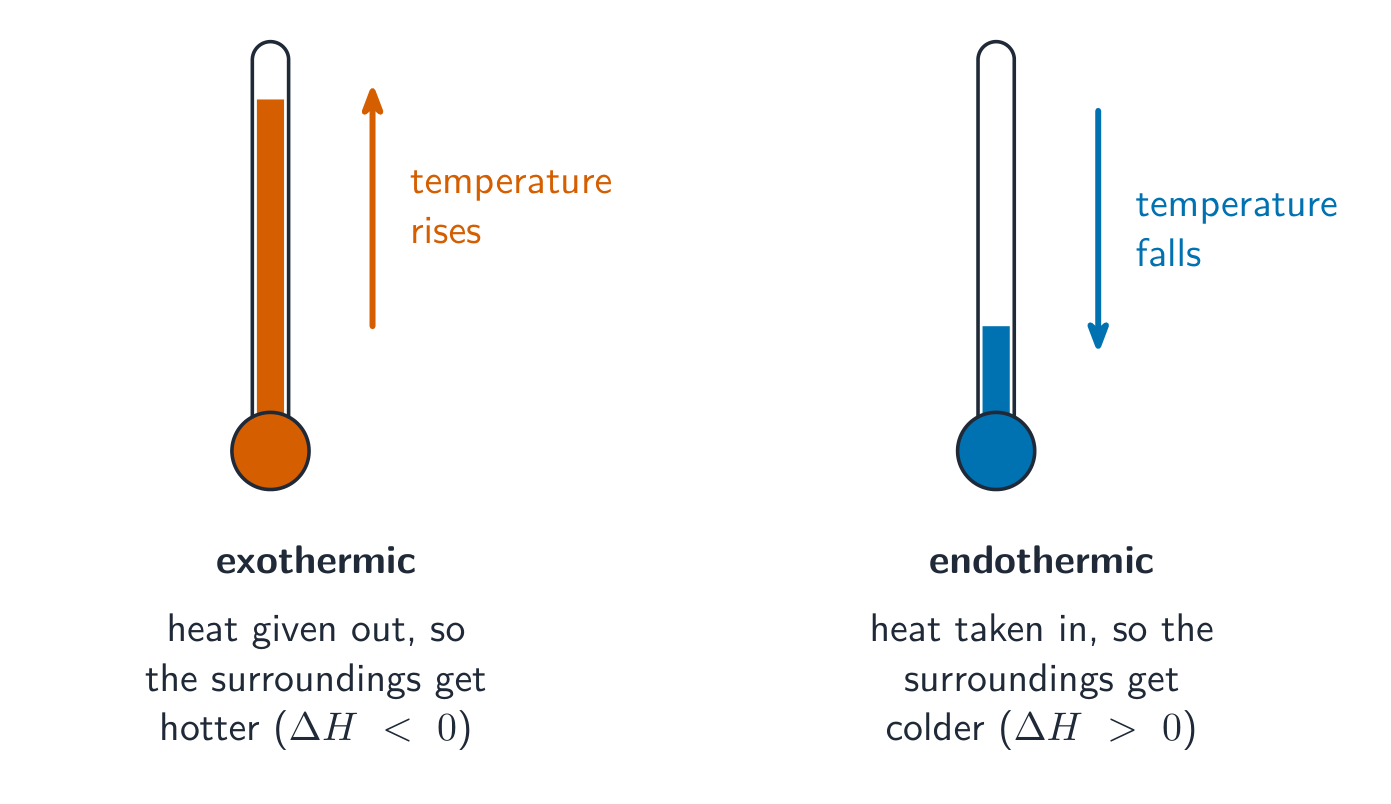
热化学(thermochemistry)追踪反应里的能量。一个过程是放热(exothermic),若它向环境释放能量(感觉热,$\Delta H<0$),而吸热(endothermic),若它吸收能量(感觉冷,$\Delta H>0$)。破坏键花费能量;形成键释放它——净决定符号。

一个放热反应使环境变暖;一个吸热的使它们变冷
探索

Compare endothermic and exothermic profiles

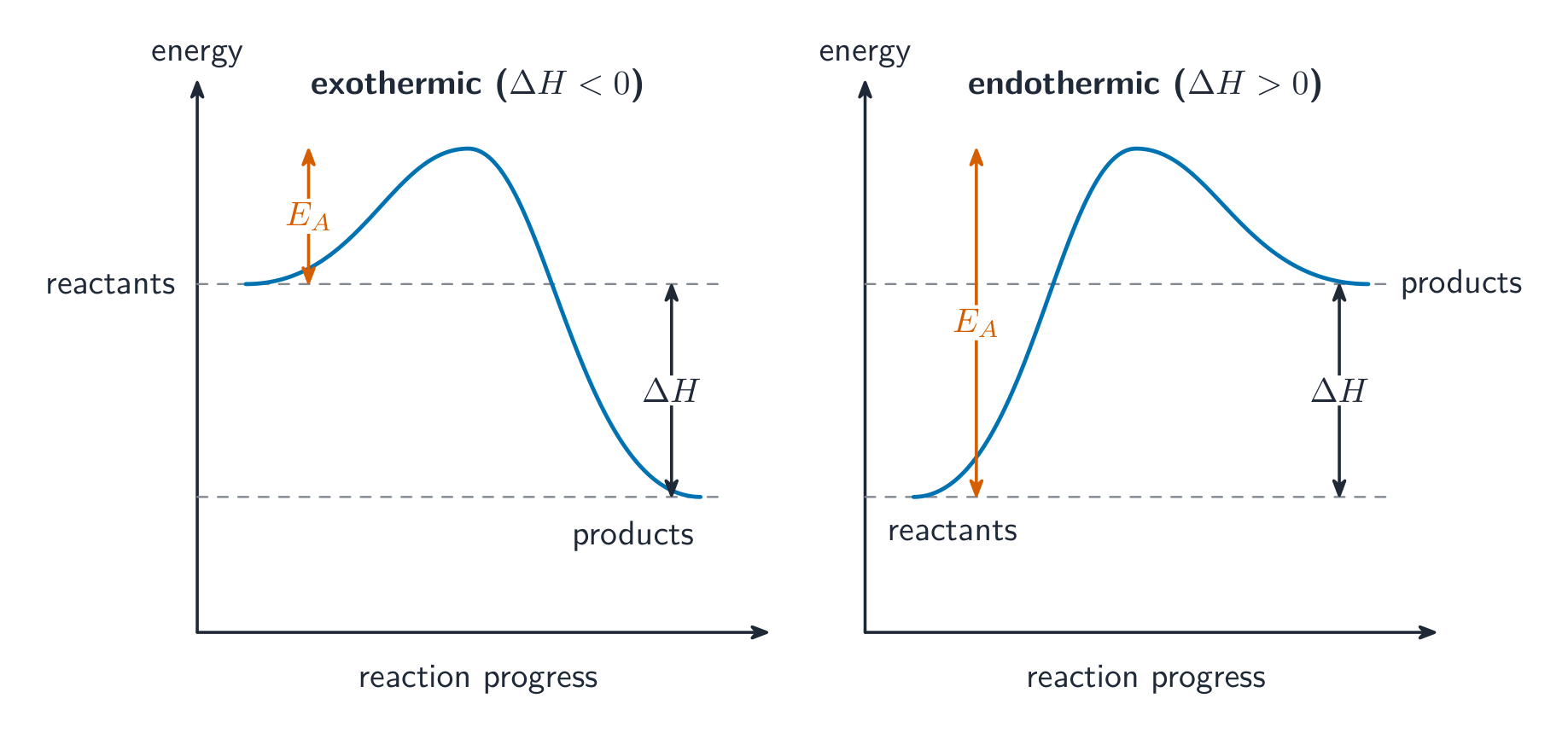
An exothermic reaction releases energy (products lower than reactants, $\Delta H<0$); an endothermic one absorbs it. The hump is the activation energy.

词汇表 训练
英文 中文 拼音
Thermochemistry 热化学 rè huà xué
exothermic 放热 fàng rè
endothermic 吸热 xī rè
6.2

能量图

大纲
Learning ObjectiveEssential Knowledge

6.2.A
Represent a chemical or physical transformation with an energy diagram.

  • 6.2.A.1 A physical or chemical process can be described with an energy diagram that shows the endothermic or exothermic nature of that process.

来源:美国大学理事会 AP 课程与考试说明

一个能量图画出从反应物到产物的能量。反应物在产物之上意味着放热;之下意味着吸热。它们之间的竖直间隙是焓变 $\Delta H$

能量图:放热产物坐在反应物之下,吸热在之上
6.3

热传递与热平衡

大纲
Learning ObjectiveEssential Knowledge

6.3.A
Explain the relationship between the transfer of thermal energy and molecular collisions.

  • 6.3.A.1 The particles in a warmer body have a greater average kinetic energy than those in a cooler body.
  • 6.3.A.2 Collisions between particles in thermal contact can result in the transfer of energy. This process is called "heat transfer," "heat exchange," or "transfer of energy as heat."
  • 6.3.A.3 Eventually, thermal equilibrium is reached as the particles continue to collide. At thermal equilibrium, the average kinetic energy of both bodies is the same, and hence, their temperatures are the same.

来源:美国大学理事会 AP 课程与考试说明

热量(heat)从热流向冷,直到物体达到热平衡(thermal equilibrium)(相等的温度)。能量守恒:热物体失去的热等于冷物体获得的热。

词汇表 训练
英文 中文 拼音
Heat 热量 rè liàng
thermal equilibrium 热平衡 rè píng héng
6.4

热容与量热法

大纲
Learning ObjectiveEssential Knowledge

6.4.A
Calculate the heat $q$ absorbed or released by a system undergoing heating/cooling based on the amount of the substance, the heat capacity, and the change in temperature.

  • 6.4.A.1 The heating of a cool body by a warmer body is an important form of energy transfer between two systems. The amount of heat transferred between two bodies may be quantified by the heat transfer equation:

    • Equation: $q = mc\Delta T$.

    Calorimetry experiments are used to measure the transfer of heat.

  • 6.4.A.2 The first law of thermodynamics states that energy is conserved in chemical and physical processes.

  • 6.4.A.3 The transfer of a given amount of thermal energy will not produce the same temperature change in equal masses of matter with differing specific heat capacities.

  • 6.4.A.4 Heating a system increases the energy of the system, while cooling a system decreases the energy of the system.

  • 6.4.A.5 The specific heat capacity of a substance and the molar heat capacity are both used in energy calculations.

  • 6.4.A.6 Chemical systems change their energy through three main processes: heating/cooling, phase transitions, and chemical reactions.

  • 6.4.A.7 In calorimetry experiments involving dissolution, temperature changes of the mixture within the calorimeter can be used to determine the direction of energy flow. If the temperature of the mixture increases, thermal energy is released by the dissolution process (exothermic). If the temperature of the mixture decreases, thermal energy is absorbed by the dissolution process (endothermic).

来源:美国大学理事会 AP 课程与考试说明

改变一个物质温度的热是

$$q=mc\,\Delta T,$$
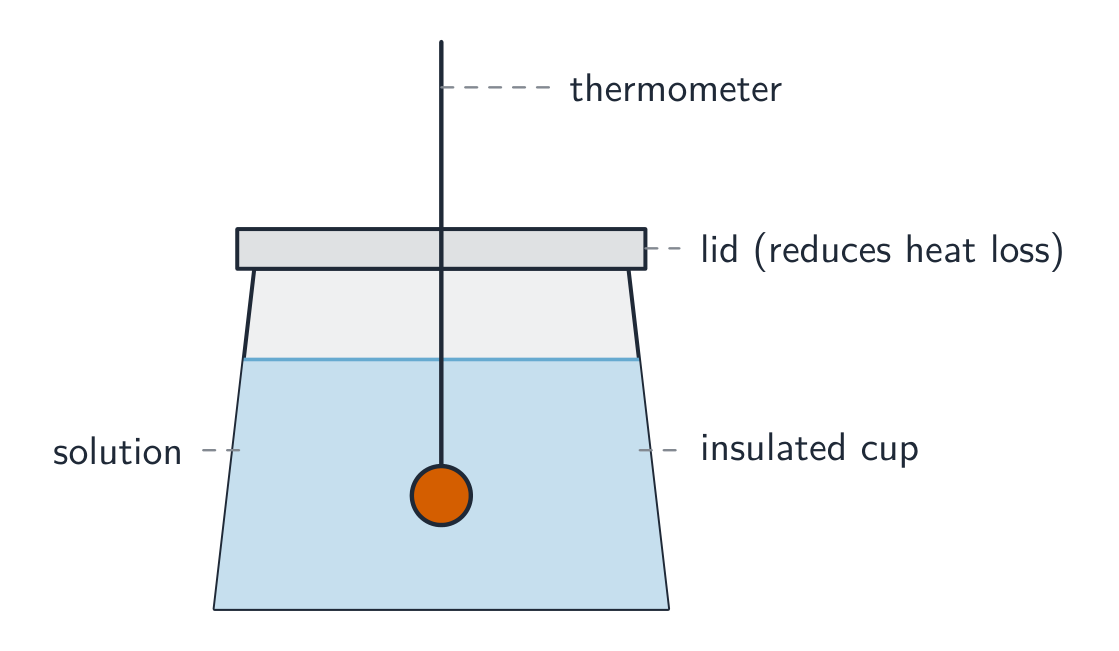
其中 $c$比热容(specific heat)(每克每度的能量)。量热法(calorimetry)通过追踪周围水的温度变化来测量一个反应的热:水获得的热等于反应释放的热。

量热法:测量一个已知质量溶液的温度变化
量热法:测量一个已知质量溶液的温度变化

Worked example. 一个咖啡杯量热计里的一个反应使 $100\ \text{g}$ 的水变暖 $8.0\,{}^{\circ}\text{C}$($c=4.18\ \text{J/(g}\,{}^{\circ}\text{C)}$)。水吸收的热是

$$q=mc\,\Delta T=100\times4.18\times8.0=3.3\times10^{3}\ \text{J}.$$
由能量守恒反应释放了这 $3.3\ \text{kJ}$,所以它是放热的($q_{\text{rxn}}=-3.3\ \text{kJ}$)。

探索

Heat different materials

$Q=mc\Delta T$: a high specific heat (like water's) means a lot of energy for a small temperature rise. Compare materials for the same heat input.

词汇表 训练
英文 中文 拼音
specific heat 比热容 bǐ rè róng
Calorimetry 量热法 liàng rè fǎ
6.5

相变的能量

大纲
Learning ObjectiveEssential Knowledge

6.5.A
Explain changes in the heat $q$ absorbed or released by a system undergoing a phase transition based on the amount of the substance in moles and the molar enthalpy of the phase transition.

  • 6.5.A.1 Energy must be transferred to a system to cause a substance to melt (or boil). The energy of the system therefore increases as the system undergoes a solid-to-liquid (or liquid-to-gas) phase transition. Likewise, a system releases energy when it freezes (or condenses). The energy of the system decreases as the system undergoes a liquid-to-solid (or gas-to-liquid) phase transition. The temperature of a pure substance remains constant during a phase change.
  • 6.5.A.2 The energy absorbed during a phase change is equal to the energy released during a complementary phase change in the opposite direction. For example, the molar enthalpy of condensation of a substance is equal to the negative of its molar enthalpy of vaporization. Similarly, the molar enthalpy of fusion can be used to calculate the energy absorbed when melting a substance and the energy released when freezing a substance.

来源:美国大学理事会 AP 课程与考试说明

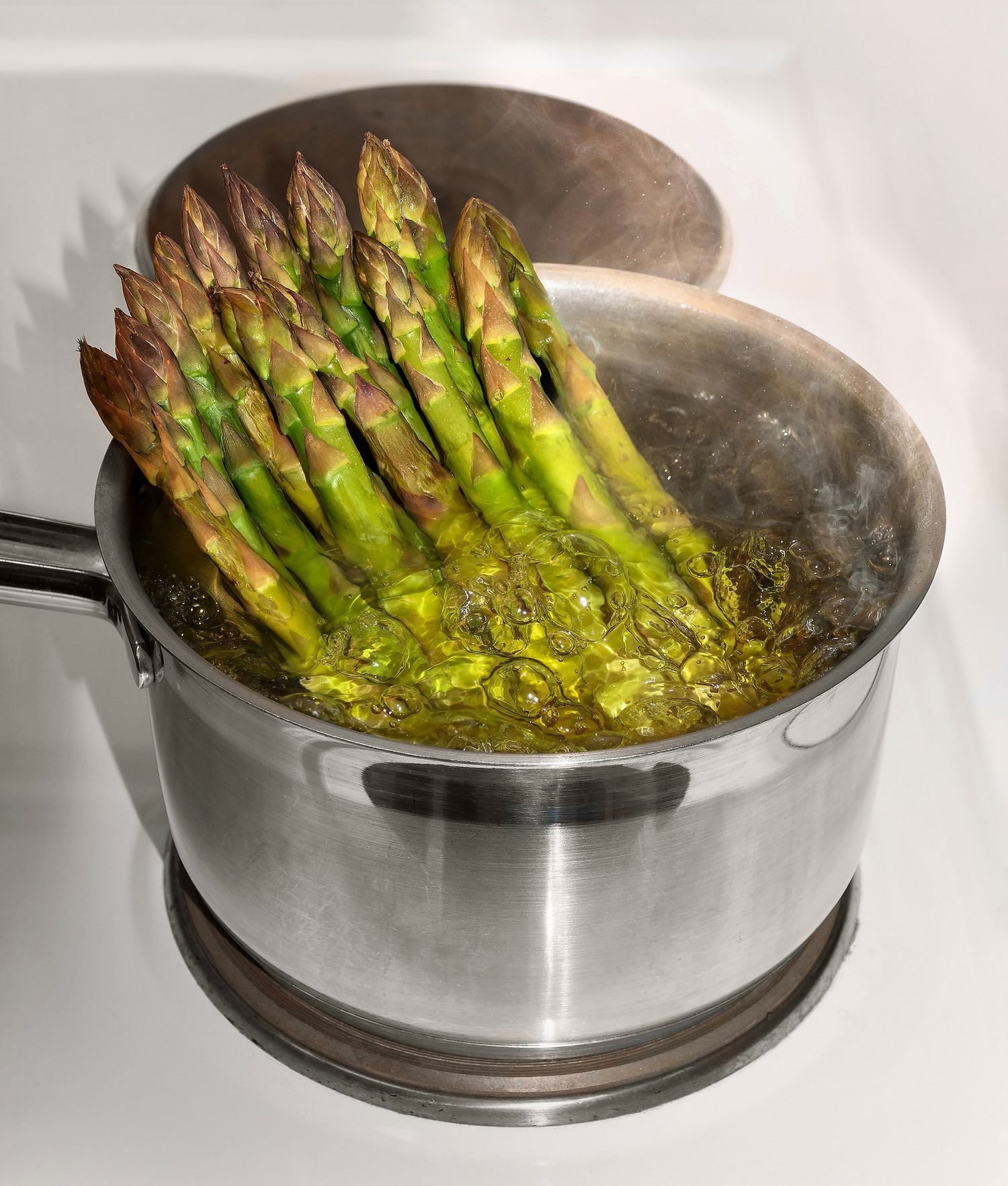
在一个相变(phase change)(熔化、沸腾)期间温度保持恒定,而热进入破坏分子间作用力,不是提高动能。所需的能量是 $q=n\,\Delta H_{\text{fus}}$(熔化)或 $q=n\,\Delta H_{\text{vap}}$(沸腾)——一条加热曲线上的平坦阶梯。

Steam from boiling water: phase changes absorb or release energy at constant temperature
探索

Heat through a phase change

During a phase change the temperature holds flat while energy breaks bonds — the latent heat. Watch the plateaus at melting and boiling.

词汇表 训练
英文 中文 拼音
phase change 相变 xiāng biàn
6.6

反应焓导论

大纲
Learning ObjectiveEssential Knowledge

6.6.A
Calculate the heat $q$ absorbed or released by a system undergoing a chemical reaction in relationship to the amount of the reacting substance in moles and the molar enthalpy of reaction.

  • 6.6.A.1 The enthalpy change of a reaction gives the amount of heat energy released (for negative values) or absorbed (for positive values) by a chemical reaction at constant pressure.
  • 6.6.A.2 When the products of a reaction are at a different temperature than their surroundings, they exchange energy with the surroundings to reach thermal equilibrium. Thermal energy is transferred to the surroundings as the reactants convert to products in an exothermic reaction. Thermal energy is transferred from the surroundings as the reactants convert to products in an endothermic reaction.
  • 6.6.A.3 The chemical potential energy of the products of a reaction is different from that of the reactants because of the breaking and forming of bonds. The energy difference results in a change in the kinetic energy of the particles, which manifests as a temperature change.
    • Exclusion Statement: The technical distinctions between enthalpy and internal energy will not be assessed on the AP Exam. Most reactions studied at the AP level are carried out at constant pressure, where the enthalpy change of the process is equal to the heat (and by extension, the energy) of reaction.

来源:美国大学理事会 AP 课程与考试说明

反应焓(enthalpy of reaction)$\Delta H_{\text{rxn}}$ 是在恒定压力下释放或吸收的热。因为焓是一个状态函数(state function),$\Delta H$ 只取决于初始和最终状态,不是所走的路径——使接下来三个方法起作用的关键。

词汇表 训练
英文 中文 拼音
enthalpy of reaction 反应焓 fǎn yìng hán
state function 状态函数 zhuàng tài hán shù
6.7

键焓

大纲
Learning ObjectiveEssential Knowledge

6.7.A
Calculate the enthalpy change of a reaction based on the average bond energies of bonds broken and formed in the reaction.

  • 6.7.A.1 During a chemical reaction, bonds are broken and/or formed, and these events change the potential energy of the system.
  • 6.7.A.2 The average energy required to break all of the bonds in the reactant molecules can be estimated by adding up the average bond energies of all the bonds in the reactant molecules. Likewise, the average energy released in forming the bonds in the product molecules can be estimated. If the energy released is greater than the energy required, the reaction is exothermic. If the energy required is greater than the energy released, the reaction is endothermic.

来源:美国大学理事会 AP 课程与考试说明

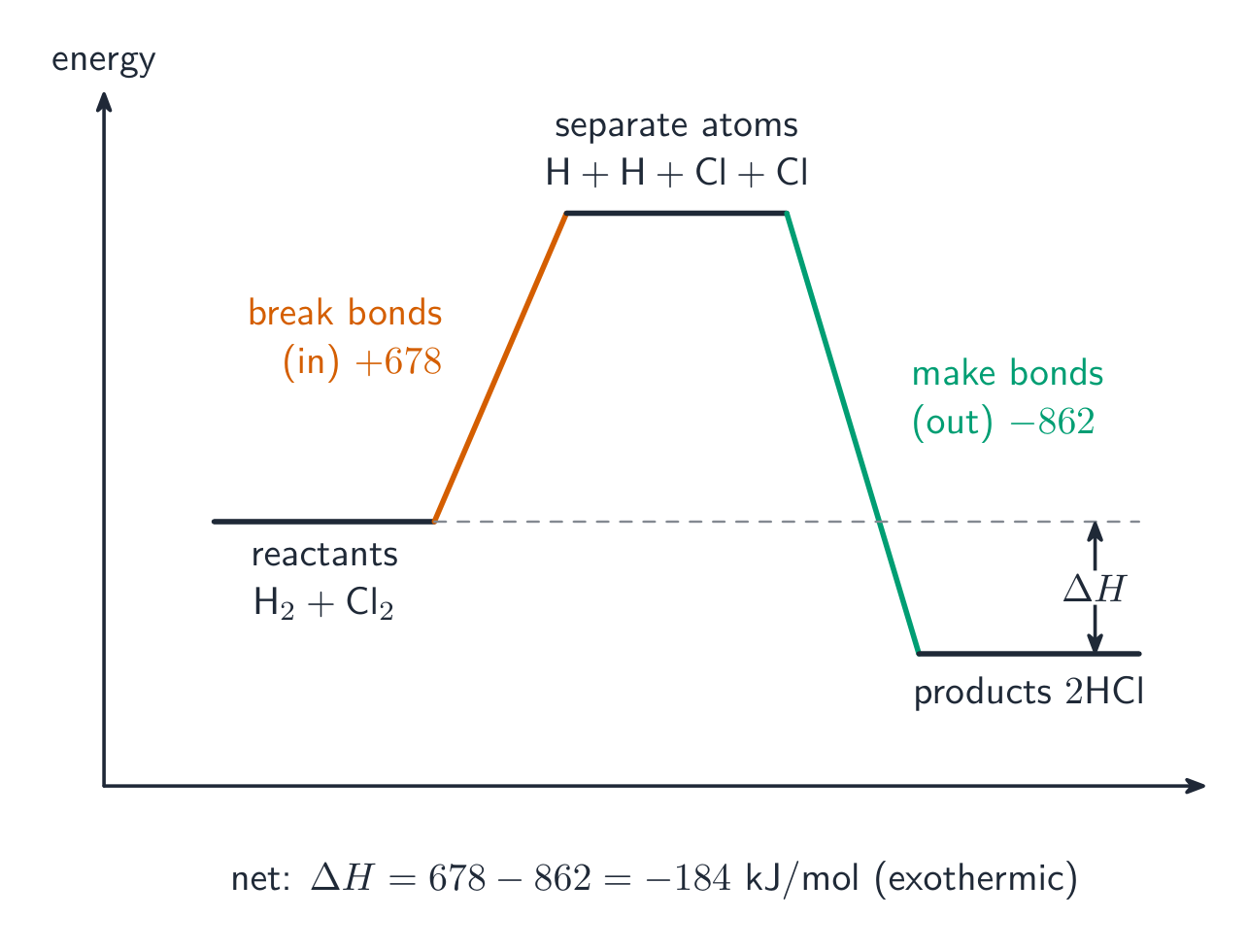
估计 $\Delta H$ 的一种方式:把破坏所有反应物键的能量相加,然后减去形成产物键释放的能量:

$$\Delta H \approx \sum (\text{bonds broken}) - \sum (\text{bonds formed}).$$
这是一个近似,因为键焓是平均值。

破坏键吸入能量;制造键释放它
破坏键吸入能量;制造键释放它

Worked example. 用键焓 H–H $=436$、Cl–Cl $=242$、H–Cl $=431\ \text{kJ/mol}$ 估计 $\text{H}_2+\text{Cl}_2\rightarrow2\text{HCl}$$\Delta H$。破坏两个反应物键($436+242=678$)并形成两个 H–Cl 键($2\times431=862$):

$$\Delta H\approx 678-862=-184\ \text{kJ},$$
放热,因为形成的强 H–Cl 键释放的多于反应物键花费的。

6.8

生成焓
大纲
Learning ObjectiveEssential Knowledge

6.8.A
Calculate the enthalpy change for a chemical or physical process based on the standard enthalpies of formation.

  • 6.8.A.1 Tables of standard enthalpies of formation can be used to calculate the standard enthalpies of reactions.
    • Equation: $\Delta H^{\circ}_{reaction} = \Sigma \Delta H^{\circ}_{f\ products} - \Sigma \Delta H^{\circ}_{f\ reactants}$

来源:美国大学理事会 AP 课程与考试说明

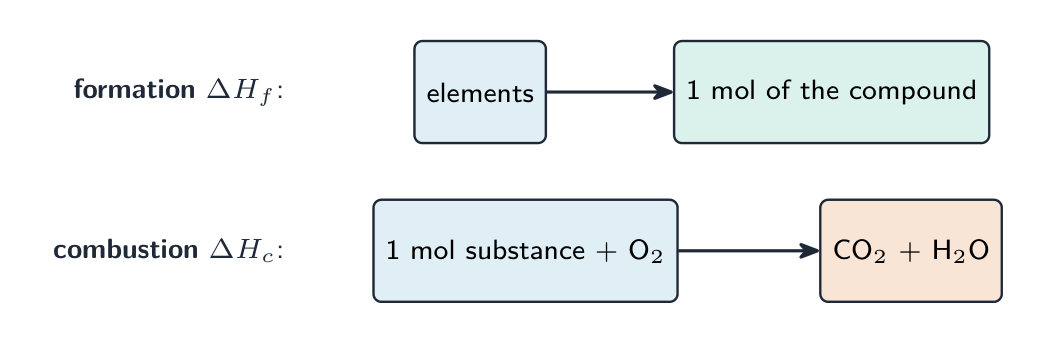
标准生成焓(standard enthalpy of formation)$\Delta H_f^\circ$ 是从一个化合物的元素制造一摩尔它的焓(对一个处于它标准状态的元素为零)。那么

$$\Delta H_{\text{rxn}}^\circ = \sum \Delta H_f^\circ(\text{products}) - \sum \Delta H_f^\circ(\text{reactants}).$$

生成从一个化合物的元素制造它;燃烧在氧里烧它

Worked example. 给定 $\Delta H_f^\circ$:CH$_4=-75$、CO$_2=-394$、H$_2$O$=-286\ \text{kJ/mol}$(O$_2=0$),求燃烧甲烷 $\text{CH}_4+2\text{O}_2\rightarrow\text{CO}_2+2\text{H}_2\text{O}$$\Delta H_{\text{rxn}}^\circ$。产物减反应物:

$$\Delta H_{\text{rxn}}^\circ=[-394+2(-286)]-[-75+0]=-966+75=-891\ \text{kJ},$$
一个大的释放,正如对一次燃烧所期望的。

词汇表 训练
英文 中文 拼音
standard enthalpy of formation 生成焓 shēng chéng hán
6.9

盖斯定律

大纲
Learning ObjectiveEssential Knowledge

6.9.A
Represent a chemical or physical process as a sequence of steps.

  • 6.9.A.1 Many processes can be broken down into a series of steps. Each step in the series has its own energy change.

6.9.B
Explain the relationship between the enthalpy of a chemical or physical process and the sum of the enthalpies of the individual steps.

  • 6.9.B.1 Because total energy is conserved (first law of thermodynamics), and each individual reaction in a sequence transfers thermal energy to or from the surroundings, the net thermal energy transferred in the sequence will be equal to the sum of the thermal energy transfers in each of the steps. These thermal energy transfers are the result of potential energy changes among the species in the reaction sequence; thus, at constant pressure, the enthalpy change of the overall process is equal to the sum of the enthalpy changes of the individual steps.
  • 6.9.B.2 The following are essential principles of Hess's law:
    • i. When a reaction is reversed, the enthalpy change stays constant in magnitude but becomes reversed in mathematical sign.
    • ii. When a reaction is multiplied by a factor $c$, the enthalpy change is multiplied by the same factor $c$.
    • iii. When two (or more) reactions are added to obtain an overall reaction, the individual enthalpy changes of each reaction are added to obtain the net enthalpy change of the overall reaction.
    • Exclusion Statement: The concept of state functions will not be assessed on the AP Exam.

来源:美国大学理事会 AP 课程与考试说明

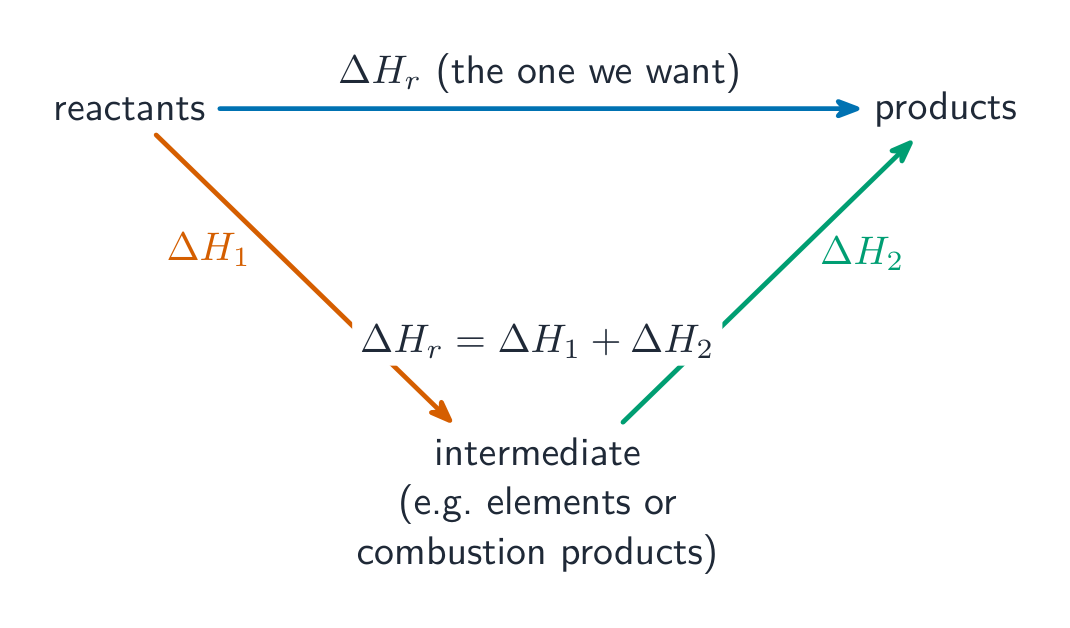
盖斯定律:路径无关

盖斯定律(Hess's law):若一个反应是几个步骤的和,它的 $\Delta H$ 是这些步骤的 $\Delta H$ 值的和。反转一步并翻转符号;缩放一步并缩放它的 $\Delta H$。这让你能通过组合已知反应求一个难以测量的 $\Delta H$ ——一个频繁的考试计算。

盖斯定律:直接和间接路线给出相同的总焓变
词汇表 训练
英文 中文 拼音
Hess's law 盖斯定律 gài sī dìng lǜ
6.9

考试技巧

  • 一个放热反应有 $\Delta H<0$(感觉热);吸热有 $\Delta H>0$ ——总是给 $\Delta H$ 一个符号和单位。
  • 在量热法里用 $q=mc\,\Delta T$,以水/溶液的质量;反应释放水获得的。
  • 键焓:$\Delta H\approx\sum(\text{bonds broken})-\sum(\text{bonds made})$ ——破坏是吸热的、制造是放热的(经典的符号陷阱)。
  • 盖斯定律:总 $\Delta H$ 是这些步骤的和——反转一步并翻转符号,缩放一步并缩放 $\Delta H$
  • 在一个相变期间温度保持恒定,而能量进入粒子之间的作用力。

本主题的互动课程

逐步学习,并即时检测练习。

AP 化学历年真题

AP 化学的更多主题

登录或创建账号

IGCSE, A-Level & AP