跳到主要内容

化学平衡

AP 化学 · 第 7 主题

训练
讲义 词汇表
7.1

化学平衡导论

大纲
Learning ObjectiveEssential Knowledge

7.1.A
Explain the relationship between the occurrence of a reversible chemical or physical process, and the establishment of equilibrium, to experimental observations.

  • 7.1.A.1 Many observable processes are reversible. Examples include evaporation and condensation of water, absorption and desorption of a gas, or dissolution and precipitation of a salt. Some important reversible chemical processes include the transfer of protons in acid-base reactions and the transfer of electrons in redox reactions.
  • 7.1.A.2 When equilibrium is reached, no observable changes occur in the system. Reactants and products are simultaneously present, and the concentrations or partial pressures of all species remain constant.
  • 7.1.A.3 The equilibrium state is dynamic. The forward and reverse processes continue to occur at equal rates, resulting in no net observable change.
  • 7.1.A.4 Graphs of concentration, partial pressure, or rate of reaction versus time for simple chemical reactions can be used to understand the establishment of chemical equilibrium.

来源:美国大学理事会 AP 课程与考试说明

动态平衡

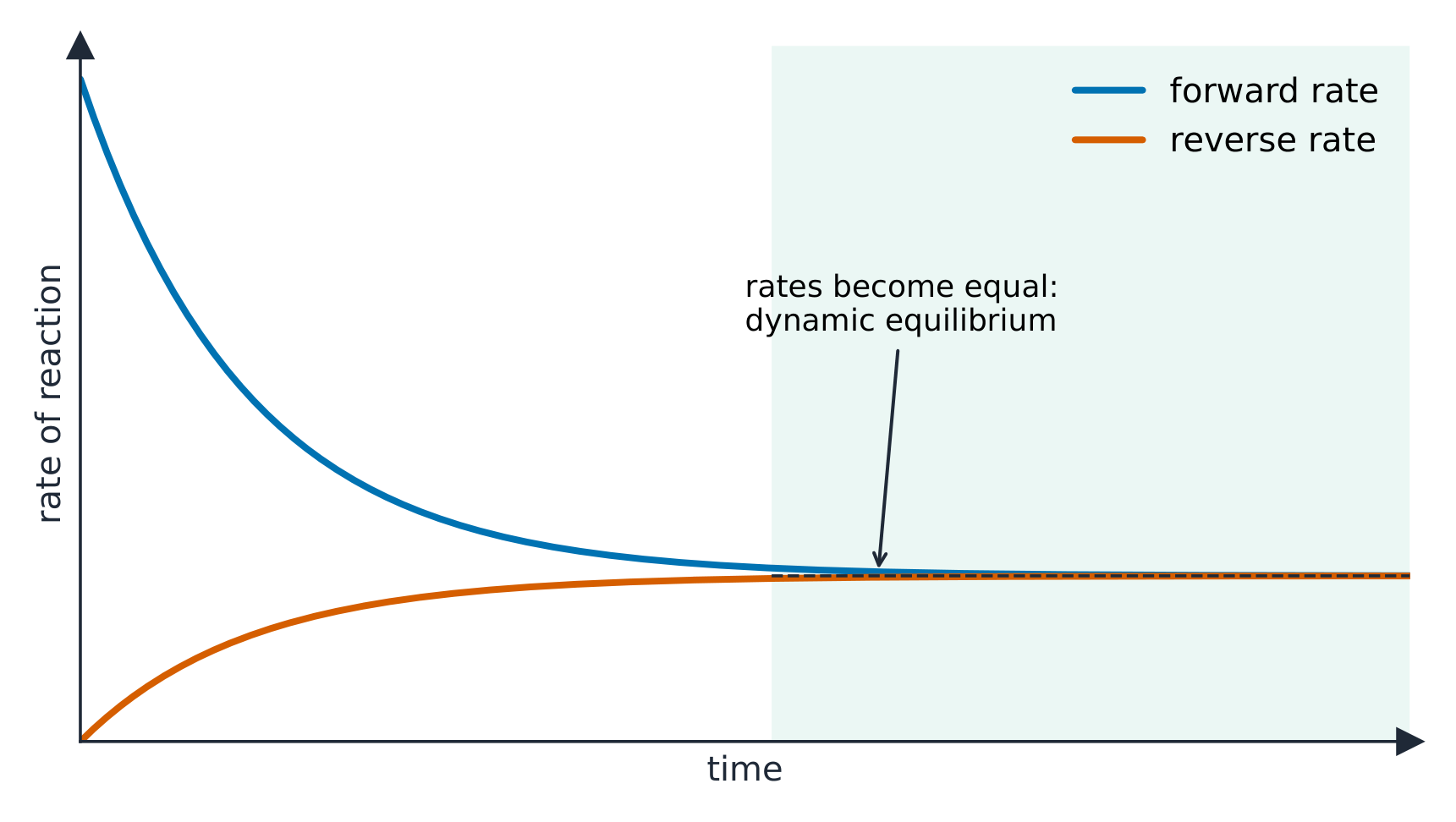
一个可逆反应(reversible reaction)双向进行。化学平衡(chemical equilibrium)在正向和逆向速率变得相等时达到,所以浓度停止变化。平衡是动态(dynamic)的——两个反应都继续,但以匹配的速率,所以什么都看似不变。

动态平衡:正向和逆向速率变得相等
动态平衡:正向和逆向速率变得相等

上面的速率图解释为什么浓度稳定;接下来这个图显示浓度做什么——反应物下降而产物上升,直到一旦速率匹配,两者都保持恒定(它们不必相等)。
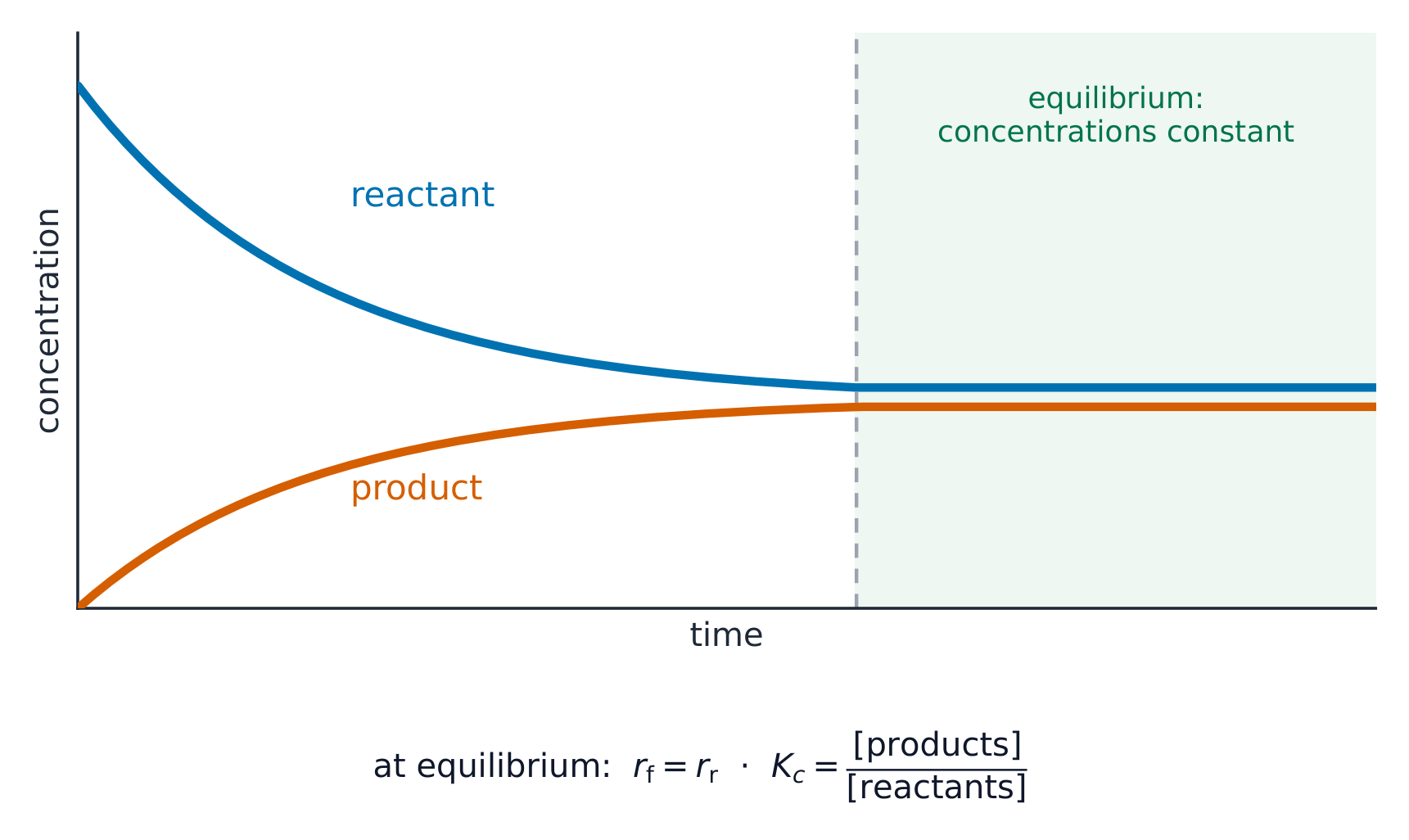
反应物和产物浓度变化,然后一旦达到平衡就保持恒定
词汇表 训练
英文 中文 拼音
reversible reaction 可逆反应 kě nì fǎn yìng
Chemical equilibrium 化学平衡 huà xué píng héng
7.2

可逆反应的方向

大纲
Learning ObjectiveEssential Knowledge

7.2.A
Explain the relationship between the direction in which a reversible reaction proceeds and the relative rates of the forward and reverse reactions.

  • 7.2.A.1 If the rate of the forward reaction is greater than the reverse reaction, then there is a net conversion of reactants to products. If the rate of the reverse reaction is greater than that of the forward reaction, then there is a net conversion of products to reactants. An equilibrium state is reached when these rates are equal.

来源:美国大学理事会 AP 课程与考试说明

在平衡处反应物和产物的量是固定的但通常相等。混合物偏向产物还是反应物取决于反应;你把当前状态与平衡条件比较以预测它向哪个方向移动。

7.3

反应商与平衡常数

大纲
Learning ObjectiveEssential Knowledge

7.3.A
Represent the reaction quotient $Q_c$ or $Q_p$, for a reversible reaction, and the corresponding equilibrium expressions $K_c = Q_c$ or $K_p = Q_p$.

  • 7.3.A.1 The reaction quotient $Q_c$ describes the relative concentrations of reaction species at any time. For gas phase reactions, the reaction quotient may instead be written in terms of partial pressures as $Q_p$. The reaction quotient tends toward the equilibrium constant such that at equilibrium $K_c = Q_c$ and $K_p = Q_p$. As examples, for the reaction

    $$a\,\mathrm{A} + b\,\mathrm{B} \rightleftarrows c\,\mathrm{C} + d\,\mathrm{D}$$
    the law of mass action indicates that the equilibrium expression for $(K_c, Q_c)$ is

    • Equation: $K_c = \dfrac{[\mathrm{C}]^c [\mathrm{D}]^d}{[\mathrm{A}]^a [\mathrm{B}]^b}$

    and that for $(K_p, Q_p)$ is

    • Equation: $K_p = \dfrac{(P_\mathrm{C})^c (P_\mathrm{D})^d}{(P_\mathrm{A})^a (P_\mathrm{B})^b}$
    • Exclusion statement: Conversion between $K_c$ and $K_p$ will not be assessed on the AP Exam. Students should be aware of the conceptual differences and pay attention to whether $K_c$ or $K_p$ is used in an exam question.
    • Exclusion statement: Equilibrium calculations on systems where a dissolved species is in equilibrium with that species in the gas phase will not be assessed on the AP Exam.
  • 7.3.A.2 The reaction quotient does not include substances whose concentrations (or partial pressures) are independent of the amount, such as for solids and pure liquids.

来源:美国大学理事会 AP 课程与考试说明

反应商(reaction quotient)$Q$ 有与平衡表达式相同的形式但用当前浓度:

$$Q=\frac{[\text{products}]}{[\text{reactants}]}\ \text{(each raised to its coefficient)}.$$
在平衡处 $Q$ 等于平衡常数(equilibrium constant)$K$。比较它们预测方向:$Q 正向移动(朝产物);$Q>K$ 逆向移动;$Q=K$ 意味着已经在平衡。

词汇表 训练
英文 中文 拼音
reaction quotient 反应商 fǎn yìng shāng
equilibrium constant 平衡常数 píng héng cháng shù
7.4

平衡常数的计算

大纲
Learning ObjectiveEssential Knowledge

7.4.A
Calculate $K_c$ or $K_p$ based on experimental observations of concentrations or pressures at equilibrium.

  • 7.4.A.1 Equilibrium constants can be determined from experimental measurements of the concentrations or partial pressures of the reactants and products at equilibrium.

来源:美国大学理事会 AP 课程与考试说明

从配平的方程写 $K$(纯固体和液体被略去)。从平衡浓度(或对 $K_p$ 的分压),代入并计算。$K_c$ 用摩尔浓度;$K_p$ 用压力。

Worked example. 对于 $\text{N}_2\text{O}_4\rightleftharpoons2\text{NO}_2$,平衡浓度是 $[\text{N}_2\text{O}_4]=0.20\ \text{M}$$[\text{NO}_2]=0.10\ \text{M}$。那么

$$K_c=\frac{[\text{NO}_2]^2}{[\text{N}_2\text{O}_4]}=\frac{(0.10)^2}{0.20}=0.050.$$
NO$_2$ 的系数 $2$ 变成幂;N$_2$O$_4$(系数 $1$)只是一次幂。

7.5

平衡常数的大小

大纲
Learning ObjectiveEssential Knowledge

7.5.A
Explain the relationship between very large or very small values of $K$ and the relative concentrations of chemical species at equilibrium.

  • 7.5.A.1 Some equilibrium reactions have very large $K$ values and proceed essentially to completion. Others have very small $K$ values and barely proceed at all.

来源:美国大学理事会 AP 课程与考试说明

  • $K\gg 1$:产物强烈地被偏爱(反应几乎完全)。
  • $K\ll 1$:反应物被偏爱(很少反应)。
  • $K\approx 1$:两者都有显著的量。

$K$ 的大小告诉你平衡"坐"在哪里。

7.6

平衡常数的性质

大纲
Learning ObjectiveEssential Knowledge

7.6.A
Represent a multistep process with an overall equilibrium expression, using the constituent $K$ expressions for each individual reaction.

  • 7.6.A.1 When a reaction is reversed, $K$ is inverted.
  • 7.6.A.2 When the stoichiometric coefficients of a reaction are multiplied by a factor $c$, $K$ is raised to the power $c$.
  • 7.6.A.3 When reactions are added together, the $K$ of the resulting overall reaction is the product of the $K$'s for the reactions that were summed.
  • 7.6.A.4 Since the expressions for $K$ and $Q$ have identical mathematical forms, all valid algebraic manipulations of $K$ also apply to $Q$.

来源:美国大学理事会 AP 课程与考试说明

$K$ 以可预测的方式变化:反转一个反应反转 $K$($1/K$);把系数乘以 $n$$K$ 提高到 $n$ 次幂;把反应相加相乘它们的 $K$ 值。只有温度改变 $K$ 本身的值。

7.7

平衡浓度的计算

大纲
Learning ObjectiveEssential Knowledge

7.7.A
Identify the concentrations or partial pressures of chemical species at equilibrium based on the initial conditions and the equilibrium constant.

  • 7.7.A.1 The concentrations or partial pressures of species at equilibrium can be predicted given the balanced reaction, initial concentrations, and the appropriate $K$.
  • 7.7.A.2 When $Q < K$, the reaction will proceed with a net consumption of reactants and generation of products. When $Q > K$, the reaction will proceed with a net consumption of products and generation of reactants. When $Q = K$, the system is at dynamic equilibrium; both forward and reverse reactions proceed at the same rate, and the proportion of reactants and products remains constant.

来源:美国大学理事会 AP 课程与考试说明

用一张 ICE 表(Initial, Change, Equilibrium):填入起始量、用摩尔比以 $x$ 表示变化,然后代入 $K$ 表达式并解 $x$。当 $K$ 小时,近似"$x$ 可忽略"常常简化代数。

Worked example. 对于 $\text{H}_2+\text{I}_2\rightleftharpoons2\text{HI}$,$K_c=50$,以各 $0.100\ \text{M}$ 的 H$_2$ 和 I$_2$ 开始。ICE 表给出平衡 $[\text{H}_2]=[\text{I}_2]=0.100-x$$[\text{HI}]=2x$。代入:

$$K_c=\frac{(2x)^2}{(0.100-x)^2}=50\;\Rightarrow\;\frac{2x}{0.100-x}=\sqrt{50}=7.07\;\Rightarrow\;x=0.078,$$
所以 $[\text{HI}]=2x=0.156\ \text{M}$。对两侧取平方根在这里起作用,因为表达式是一个完全平方。

7.8

平衡的表示方法

大纲
Learning ObjectiveEssential Knowledge

7.8.A
Represent a system undergoing a reversible reaction with a particulate model.

  • 7.8.A.1 Particulate representations can be used to describe the relative numbers of reactant and product particles present prior to and at equilibrium, and the value of the equilibrium constant.

来源:美国大学理事会 AP 课程与考试说明

一幅平衡处的微粒图片显示反应物和产物粒子的一个固定混合。浓度对时间的图一旦达到平衡就趋平(从不达到零)——两条曲线在同一时刻变平。

7.9

勒夏特列原理导论
大纲
Learning ObjectiveEssential Knowledge

7.9.A
Identify the response of a system at equilibrium to an external stress, using Le Châtelier's principle.

  • 7.9.A.1 Le Châtelier's principle can be used to predict the response of a system to stresses such as addition or removal of a chemical species, change in temperature, change in volume/pressure of a gas-phase system, or dilution of a reaction system.
  • 7.9.A.2 Le Châtelier's principle can be used to predict the effect that a stress will have on experimentally measurable properties such as pH, temperature, and color of a solution.

来源:美国大学理事会 AP 课程与考试说明

勒夏特列原理

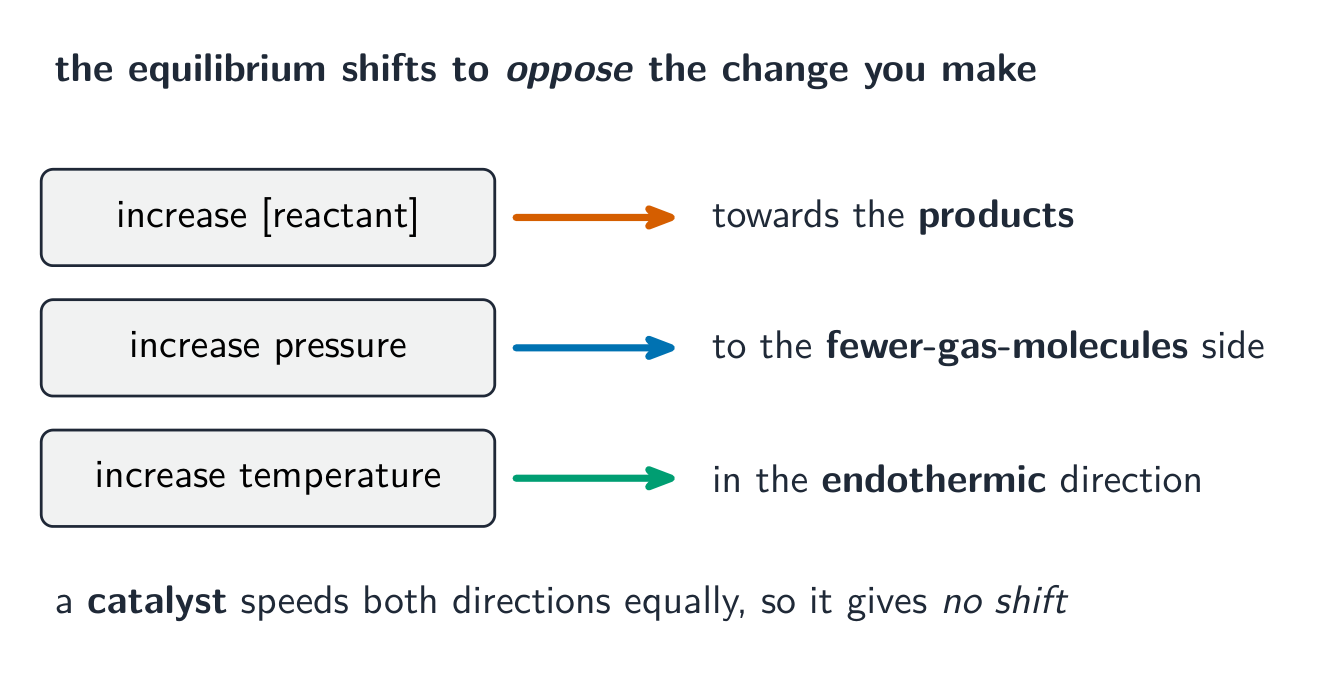
勒沙特列原理(Le Chatelier's principle):若你扰动一个平衡的系统,它移动以部分抵消这个变化。加一个反应物向前移动;移除产物向前移动;增加压力(通过减少体积)朝气体摩尔更少的一侧移动;提高温度朝吸热方向移动。
勒沙特列原理:平衡移动以对抗所做的变化
勒沙特列原理:平衡移动以对抗所做的变化
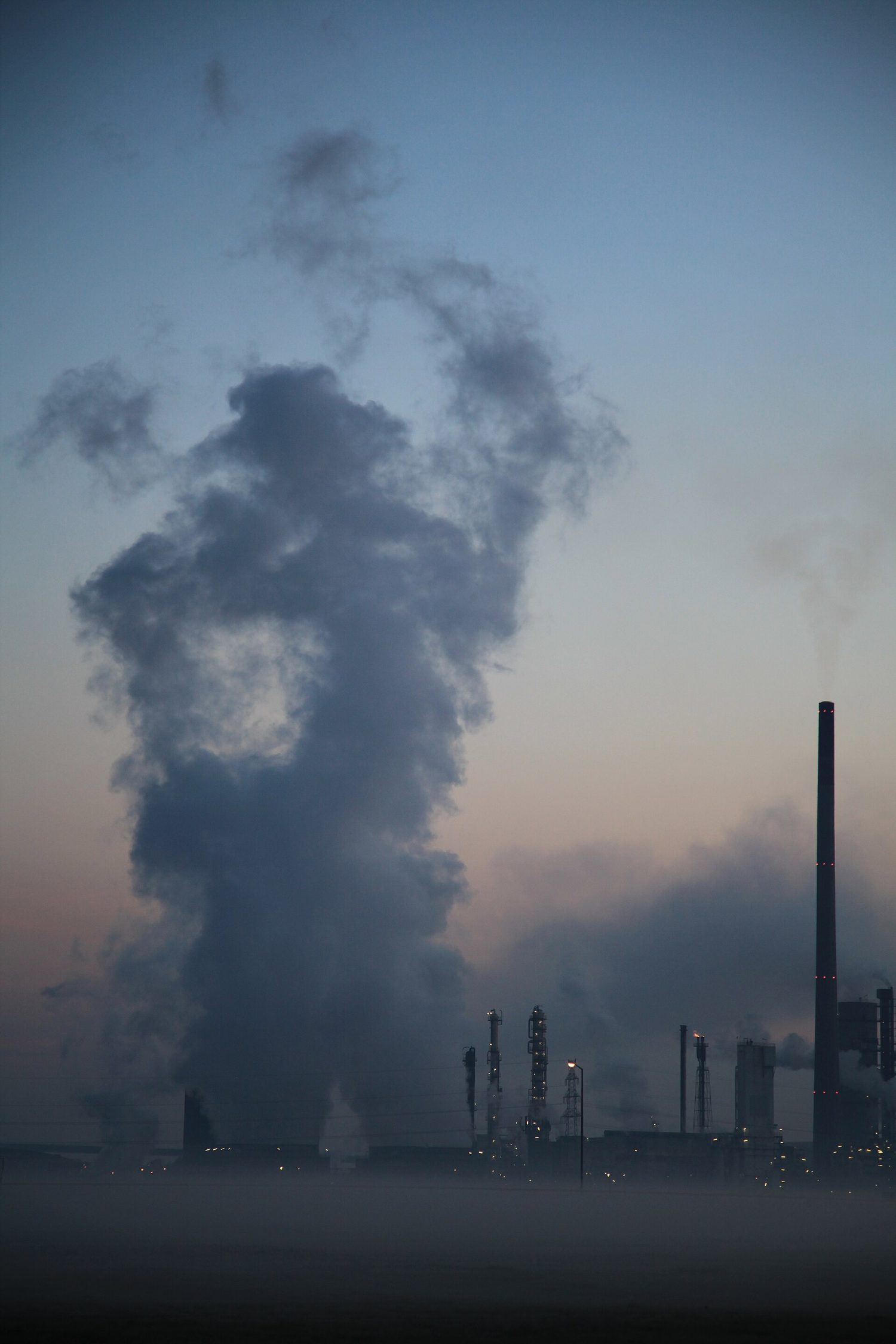
An ammonia plant: industrial equilibria like Haber's process are driven by pressure, temperature and catalysts
探索

Disturb an equilibrium

Le Chatelier's principle: an equilibrium shifts to oppose a change. Add reactant, change pressure or temperature and watch the position of equilibrium move.

词汇表 训练
英文 中文 拼音
Le Chatelier's principle 勒沙特列原理 lēi shā tè liè yuán lǐ
7.10

反应商与勒夏特列原理

大纲
Learning ObjectiveEssential Knowledge

7.10.A
Explain the relationships between $Q$, $K$, and the direction in which a reversible reaction will proceed to reach equilibrium.

  • 7.10.A.1 A disturbance to a system at equilibrium causes $Q$ to differ from $K$, thereby taking the system out of equilibrium. The system responds by bringing $Q$ back into agreement with $K$, thereby establishing a new equilibrium state.
  • 7.10.A.2 Some stresses, such as changes in concentration, cause a change in $Q$ only. A change in temperature causes a change in $K$. In either case, the concentrations or partial pressures of species redistribute to bring $Q$ and $K$ back into equality.

来源:美国大学理事会 AP 课程与考试说明

你能用 $Q$$K$ 论证每个勒沙特列移动:一个扰动改变 $Q$,而系统反应以把 $Q$ 带回 $K$。这个定量的视角支持定性的规则,并且是考试上更完整的答案。

探索

Compare Q with K

If the reaction quotient $Q the forward reaction is favoured; $Q>K$ favours the reverse. Perturb the system and watch it move back toward $Q=K$.

7.11 7.12

溶解平衡导论

大纲
Learning ObjectiveEssential Knowledge

7.11.A
Calculate the solubility of a salt based on the value of $K_{sp}$ for the salt.

  • 7.11.A.1 The dissolution of a salt is a reversible process whose extent can be described by $K_{sp}$, the solubility-product constant.
  • 7.11.A.2 The solubility of a substance can be calculated from the $K_{sp}$ for the dissolution process. This relationship can also be used to predict the relative solubility of different substances.
  • 7.11.A.3 The solubility rules (see 4.7.A.5) can be quantitatively related to $K_{sp}$, in which $K_{sp}$ values $>1$ correspond to soluble salts.
  • 7.11.A.4 The molar solubility of one or more species in a saturated solution can be used to calculate the $K_{sp}$ of a substance.
Learning ObjectiveEssential Knowledge

7.12.A
Identify the solubility of a salt, and/or the value of $K_{sp}$ for the salt, based on the concentration of a common ion already present in solution.

  • 7.12.A.1 The solubility of a salt is reduced when it is dissolved into a solution that already contains one of the ions present in the salt. The impact of this "common-ion effect" on solubility can be understood qualitatively using Le Châtelier's principle or calculated from the $K_{sp}$ for the dissolution process.

来源:美国大学理事会 AP 课程与考试说明

对于一个微溶的盐,溶度积(solubility product)$K_{sp}$ 是它溶解的平衡常数:

$$\text{M}_a\text{X}_b(s)\rightleftharpoons a\,\text{M}^{b+}+b\,\text{X}^{a-},\qquad K_{sp}=[\text{M}^{b+}]^a[\text{X}^{a-}]^b.$$
一个更小的 $K_{sp}$ 意味着更难溶。同离子效应(common-ion effect)——加一个已经在盐里的离子——把平衡推回并降低溶解度。

Worked example. 氯化银有 $K_{sp}=1.8\times10^{-10}$。若它的摩尔溶解度是 $s$,那么 $[\text{Ag}^+]=[\text{Cl}^-]=s$,所以 $K_{sp}=s^2$

$$s=\sqrt{1.8\times10^{-10}}=1.3\times10^{-5}\ \text{M}.$$
加 NaCl(一个同离子)会提高 $[\text{Cl}^-]$,迫使 $s$ 下降——远少的 AgCl 会溶解。

词汇表 训练
英文 中文 拼音
solubility product 溶度积 róng dù jī
7.11 7.12

考试技巧

  • 在平衡处正向和逆向速率相等,但通常不相等。
  • 把纯固体和液体留在 $K$ 表达式之外;一个大的 $K$ 偏爱产物,一个小的 $K$ 偏爱反应物。
  • 应用勒沙特列:加反应物 → 向前移动;提高压力 → 朝气体摩尔更少移动;提高温度 → 朝吸热方向移动。
  • 一个催化剂不移动平衡的位置——它只加速逼近。
  • 对平衡浓度用一张 ICE 表,当 $K$ 小时用小-$x$ 近似。

本主题的互动课程

逐步学习,并即时检测练习。

AP 化学历年真题

AP 化学的更多主题

登录或创建账号

IGCSE, A-Level & AP