跳到主要内容

二维媒介、材料与技法

AP 二维艺术与设计 · 第 3 主题

训练
讲义 词汇表
3.1

素描媒介

大纲

Focus: Drawing media make marks directly on a surface — the foundation of most 2-D work.

  • Dry media: graphite (pencil), charcoal, conte, chalk and oil pastel, coloured pencil.
  • Wet media: pen and ink, brush and ink, markers.
  • Mark-making techniques: hatching, cross-hatching, stippling, blending, and scribbling.
  • Choice of media and paper (tooth/texture) changes the line and value possible.
  • Drawing is used both to investigate ideas (studies, sketches) and to make finished works.

来源:美国大学理事会 AP 课程与考试说明

媒介(media)是艺术家使用的材料。绘画媒介直接在一个表面上做标记,是大多数二维作品的基础。

  • 干性媒介(dry media):石墨(铅笔)、木炭、康特笔、粉笔和油画棒、彩色铅笔。
  • 湿性媒介(wet media):钢笔和墨水、毛笔和墨水、马克笔。
  • 标记制作技法:排线(hatching)、交叉排线(cross-hatching)、点画(stippling)、混合和涂鸦。
  • 纸的纸纹(tooth)(肌理)改变可能的线条和明度。

绘画既被用来调查(investigate)想法(习作和速写),也被用来制作成品作品。

词汇表 训练
英文 中文 拼音
Media 媒介 méi jiè
Dry media 干性媒介 gàn xìng méi jiè
Wet media 湿性媒介 shī xìng méi jiè
hatching 排线 pái xiàn
cross-hatching 交叉排线 jiāo chā pái xiàn
stippling 点画 diǎn huà
tooth 纸纹 zhǐ wén
3.2

绘画媒介

大纲

Focus: Painting applies pigment suspended in a binder to a surface, building colour, value, and texture.

  • Common media: watercolour (transparent), gouache (opaque water-based), acrylic (fast-drying), oil (slow, blendable).
  • Support and ground (paper, canvas, board; primer/gesso) affect how paint behaves.
  • Techniques: washes, glazing, wet-on-wet, dry-brush, impasto, and layering.
  • Water-based paints dry quickly and clean with water; oils dry slowly and blend richly.
  • Brush choice, dilution, and paint thickness control mark, edge, and texture.

来源:美国大学理事会 AP 课程与考试说明

绘画(painting)把保持在一种粘合剂(binder)里的颜料涂到一个表面上,建立色彩、明度和肌理。

  • 水彩(watercolour)是透明的;水粉(gouache)是不透明的、水基的;丙烯(acrylic)干得快;油画(oil)干得慢并丰富地混合。
  • 底材(support)和底子(纸、画布、板;底漆或石膏底料(gesso))影响颜料如何表现。
  • 技法包括平涂、罩染(glazing)、湿画法、干笔和厚涂。
Oil painting builds colour in layers: media choices shape surface, value and space
词汇表 训练
英文 中文 拼音
Painting 绘画 huì huà
binder 粘合剂 nián hé jì
Watercolour 水彩 shuǐ cǎi
gouache 水粉 shuǐ fěn
acrylic 丙烯 bǐng xī
oil 油画 yóu huà
support 底材 dǐ cái
gesso 石膏底料 shí gāo dǐ liào
glazing 罩染 zhào rǎn
Layers 图层 tú céng
3.3

版画

大纲

Focus: Printmaking transfers an image from a prepared surface (matrix) to paper, allowing multiple copies (an edition).

  • Relief (linocut, woodcut): ink the raised surface; the cut-away areas stay blank.
  • Intaglio (etching, engraving): ink sits in incised lines below the surface.
  • Planographic (lithography): image and non-image areas are on the same level, using grease and water.
  • Stencil (screen printing): ink is pushed through open areas of a mesh.
  • Prints are usually made in a numbered edition; the reversed matrix flips the image.

来源:美国大学理事会 AP 课程与考试说明

版画(printmaking)把一个图像从一个准备好的表面((matrix))转移到纸上,以便许多副本(一个版数(edition))能被制作。

四个版画家族:凸版、凹版、平版和孔版
凸版从凸起的表面印;凹版从刻入的线印;平版从一个平坦的油性图像印;孔版把墨水推过一个网
  • 凸版(relief)(油毡刻、木刻)——墨水坐在凸起的表面上;切除的区域保持空白。
  • 凹版(intaglio)(蚀刻、雕版)——墨水坐在切到表面之下的线里。
  • 平版(planographic)(石版)——图像和非图像区域在同一层面上,利用油脂和水。
  • 孔版(stencil)(丝网印刷)——墨水被推一个网的开放区域。

版被反转,所以印出的图像是版的一个镜像。

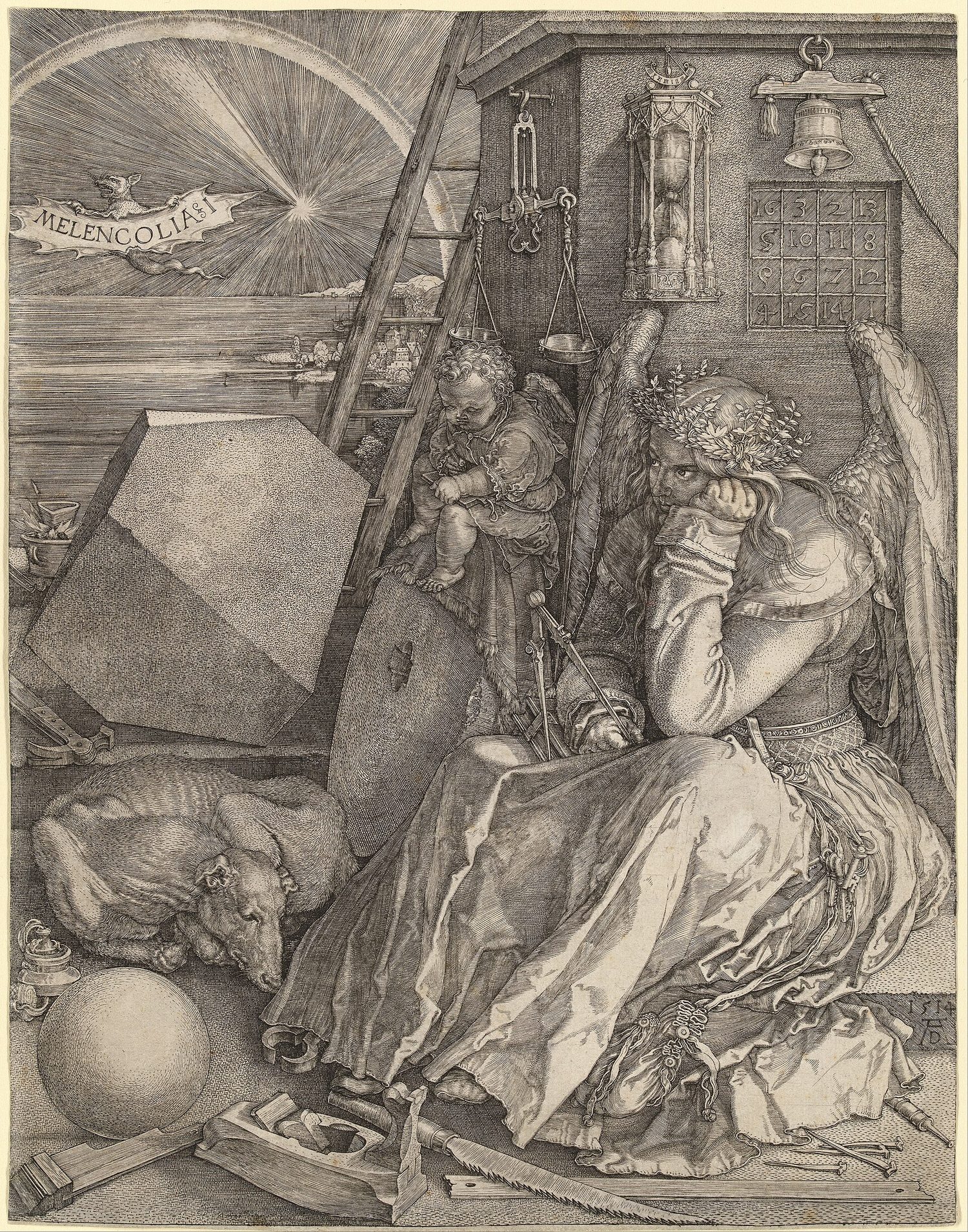
一幅密集、极其精细的古老版画:一个坐着的带翼人物,周围环绕着工具和符号,全由细密的雕刻线条构成
丢勒的雕版画《忧郁 I》:凹版把线条刻进金属版,雕版所能实现的细密线条塑造出深邃的阴影和丰富的细节
探索

Which printmaking process?

Relief prints from the raised surface; intaglio from lines cut below the surface; planographic from a flat greasy image; stencil pushes ink through a mesh.

词汇表 训练
英文 中文 拼音
Printmaking 版画 bǎn huà
matrix bǎn
edition 版数 bǎn shù
Relief 凸版 tū bǎn
Intaglio 凹版 āo bǎn
Planographic 平版 píng bǎn
Stencil 孔版 kǒng bǎn
3.4

拼贴与综合媒介

大纲

Focus: Collage assembles found materials onto a surface; mixed media combines two or more materials or processes.

  • Collage glues papers, photos, fabric, or found objects into a composition.
  • Mixed media layers, for example, drawing over paint, or print with stitching.
  • These processes add actual texture and unexpected juxtapositions of image and meaning.
  • Materials can carry meaning (a ticket, a map) beyond their visual role.
  • Good mixed-media work still uses the elements and principles to stay unified.

来源:美国大学理事会 AP 课程与考试说明

拼贴(collage)把找到的材料组装到一个表面上;综合媒介(mixed media)结合两种或更多材料或工序。

  • 拼贴把纸、照片、织物或找到的物体粘到一个构图里。
  • 综合媒介层叠工序——例如,在颜料上绘画,或印刷带缝纫。
  • 这些增加实际肌理和意想不到的意义;一种找到的材料(一张票、一张地图)能携带超出它外观的意义。
词汇表 训练
英文 中文 拼音
Collage 拼贴 pīn tiē
mixed media 综合媒介 zōng hé méi jiè
3.5

摄影与镜头媒介

大纲

Focus: Photography makes images with light and a lens; the same elements and principles apply to the frame.

  • Key controls: framing/composition, focus, exposure (light), depth of field, and viewpoint.
  • The rule of thirds, leading lines, and negative space compose a photograph.
  • Light direction and quality (hard/soft) shape value, form, and mood.
  • Editing (cropping, contrast, colour) is part of the creative process, not just correction.
  • Digital and darkroom processes both count as lens-based 2-D art and design.

来源:美国大学理事会 AP 课程与考试说明

摄影(photography)用光和一个镜头制作图像;元素和原则应用于画框,正如在任何二维作品里。

一张黑白照片:一艘拥挤的船上的乘客,被一道舷梯分成上下两层,形成强烈的几何形状
阿尔弗雷德·施蒂格利茨的《统舱》,一张著名的早期艺术摄影:舷梯、烟囱和人物构成强烈的几何构图,可见元素和原则同样适用于照片
  • 关键控制:取景、对焦(focus)、曝光(exposure)(光)、景深(depth of field),和视点。
  • 三分法、引导线和负空间构图一张照片。
  • 后期(editing)(裁剪、对比、色彩)是创作过程的一部分,不只是纠正。
词汇表 训练
英文 中文 拼音
Photography 摄影 shè yǐng
focus 对焦 duì jiāo
exposure 曝光 bào guāng
depth of field 景深 jǐng shēn
Editing 后期 hòu qī
3.6

数字艺术与设计

大纲

Focus: Digital tools create and edit images on a computer or tablet, working in layers and pixels or vectors.

  • Raster images are made of pixels (photo editing, painting apps); vector images use math paths (scalable).
  • Layers let an artist build, mask, and revise non-destructively.
  • Digital colour uses RGB (screen, additive) or CMYK (print, subtractive).
  • Resolution (DPI/PPI) affects print quality; keep files high-resolution for the portfolio.
  • The same elements and principles guide digital work as any other 2-D medium.

来源:美国大学理事会 AP 课程与考试说明

数字媒介(digital media)在一台计算机或平板上创造和编辑图像,以图层工作。

  • 位图(raster)图像由像素构成(照片编辑、数字绘画);矢量(vector)图像使用数学路径并缩放而不失质量。
  • 图层(layers)让一个艺术家在不损坏较早作品的情况下构建、遮罩和修改。
  • 数字色彩使用 RGB(屏幕,加色)或 CMYK(印刷,减色);为作品集保持文件高分辨率(resolution)。
Additive versus subtractive colour
混合光(RGB)向白色变亮;混合颜料(CMY)向黑色变暗
词汇表 训练
英文 中文 拼音
Digital media 数字媒介 shù zì méi jiè
Raster 位图 wèi tú
vector 矢量 shǐ liàng
resolution 分辨率 fēn biàn lǜ
3.7

平面设计与插画

大纲

Focus: Graphic design communicates a message visually; illustration makes images that support or tell a story.

  • Design combines type, image, colour, and layout to communicate to a viewer or client.
  • Visual hierarchy (size, weight, contrast, placement) guides the eye to what matters first.
  • Typography — typeface, size, spacing, alignment — is a core design element.
  • Illustration serves a purpose: editorial, book, product, poster, or narrative.
  • Design and illustration are problem-solving: audience and message shape every choice.

来源:美国大学理事会 AP 课程与考试说明

平面设计(graphic design)视觉地传达一个信息;插画(illustration)制作支持或讲述一个故事的图像。

  • 设计结合字体(type)、图像、色彩和版式以触及一个观者或客户。
  • 视觉层次引导眼睛通过大小、粗细和位置先看什么重要。
  • 字体排印(typography)——字体、大小、间距、对齐——是一个核心设计工具。
  • 设计和插画是问题解决:受众和信息塑造每个选择。

Worked example(写关于过程)。 当你的书面证据必须解释一种材料和过程时:"我在有色纸上用木炭,因为它柔软、可涂抹的线条让我快速建立深阴影,而我用橡皮擦提亮高光来暗示形体。" 注意结构——说出媒介,说为什么选它,并把它与你在探索的想法联系起来。列出一种材料而不给原因得分很少。

词汇表 训练
英文 中文 拼音
Graphic design 平面设计 píng miàn shè jì
illustration 插画 chā huà
type 字体 zì tǐ
Typography 字体排印 zì tǐ pái yìn
3.7

考试技巧

  • 媒介匹配到意图的效果,并论证这个选择。
  • 对于版画,陈述凸版凹版,并记住印出的图像反转。
  • 解释透明不透明颜料,以及数字作品里的图层矢量位图
  • 拼贴综合媒介材料当作意义,不只是肌理。
  • 平面设计中,展示一个服务于信息的清晰视觉层次

本主题的互动课程

逐步学习,并即时检测练习。

AP 二维艺术与设计的更多主题

登录或创建账号

IGCSE, A-Level & AP