- understand that mass is the property of an object that resists change in motion
- recall $F = ma$ and solve problems using it, understanding that acceleration and resultant force are always in the same direction
- define and use linear momentum as the product of mass and velocity
- define and use force as rate of change of momentum
- state and apply each of Newton’s laws of motion
- describe and use the concept of weight as the effect of a gravitational field on a mass and recall that the weight of an object is equal to the product of its mass and the acceleration of free fall
动力学
A-Level 物理 · 第 3 主题
 20:03
20:03
Dynamics
In the empty vacuum of space, there is nothing to push against — no ground, no air, nothing at all. And yet a rocket can still speed up. How? It throws mass…
英文讲解 · 内嵌中英文字幕
3.1
动量与牛顿运动定律

大纲
来源:剑桥国际大纲
质量
质量(mass)告诉你改变一个物体的运动有多难。质量越大,要给它某个加速度(acceleration)所需的力(force)就越大。质量以千克($\text{kg}$)为单位,是一个标量(scalar)。
动量
线动量(linear momentum)是质量与速度的乘积:
$$p = mv.$$
动量是一个矢量(vector)——它与速度(velocity)指向同一方向。它的单位是 $\text{kg m s}^{-1}$,和 $\text{N s}$ 相同。
力是动量的变化率
牛顿第二定律的一般形式:物体所受的合力(resultant force)等于它动量的变化率。
$$F = \frac{\Delta p}{\Delta t}.$$
当质量恒定时,这变成 $F = ma$,因为 $\Delta p = m\,\Delta v$ 且 $\Delta v / \Delta t = a$。剑桥的题目常常要你在碰撞(collision)或冲量(impulse)问题中直接用 $F = \Delta p / \Delta t$:平均力等于动量的变化除以接触时间。
一个球以动量 $p_{1}$ 撞墙,又以相反方向的动量 $p_{2}$ 弹回。动量的变化是 $\Delta p = p_{2} - p_{1}$(给每个方向正确的正负号)。平均力是 $\Delta p / \Delta t$,其中 $\Delta t$ 是接触时间。
例题。 一个 $0.20\ \text{kg}$ 的球以 $8.0\ \text{m s}^{-1}$ 撞墙,又直接以 $6.0\ \text{m s}^{-1}$ 弹回。接触持续 $0.050\ \text{s}$。求球所受的平均力。
取弹回方向为正,所以 $u = -8.0\ \text{m s}^{-1}$、$v = +6.0\ \text{m s}^{-1}$:
$$\Delta p = m(v - u) = 0.20 \times \big(6.0 - (-8.0)\big) = 2.8\ \text{kg m s}^{-1},$$
$$F = \frac{\Delta p}{\Delta t} = \frac{2.8}{0.050} = 56\ \text{N}.$$
当你知道动量但不知道速率时,动能(kinetic energy)的变化是
$$\Delta E_{\text{k}} = \frac{p_{2}^{2} - p_{1}^{2}}{2m}.$$
这来自 $E_{\text{k}} = \tfrac{1}{2} m v^{2} = p^{2} / (2m)$。
动量-时间图
因为 $F = \Delta p / \Delta t$,动量-时间图的斜率就是合力,正如速度-时间图的斜率是加速度。直线表示恒定的合力;水平线表示合力为零;向下倾斜的线表示有一个与运动方向相反的力。
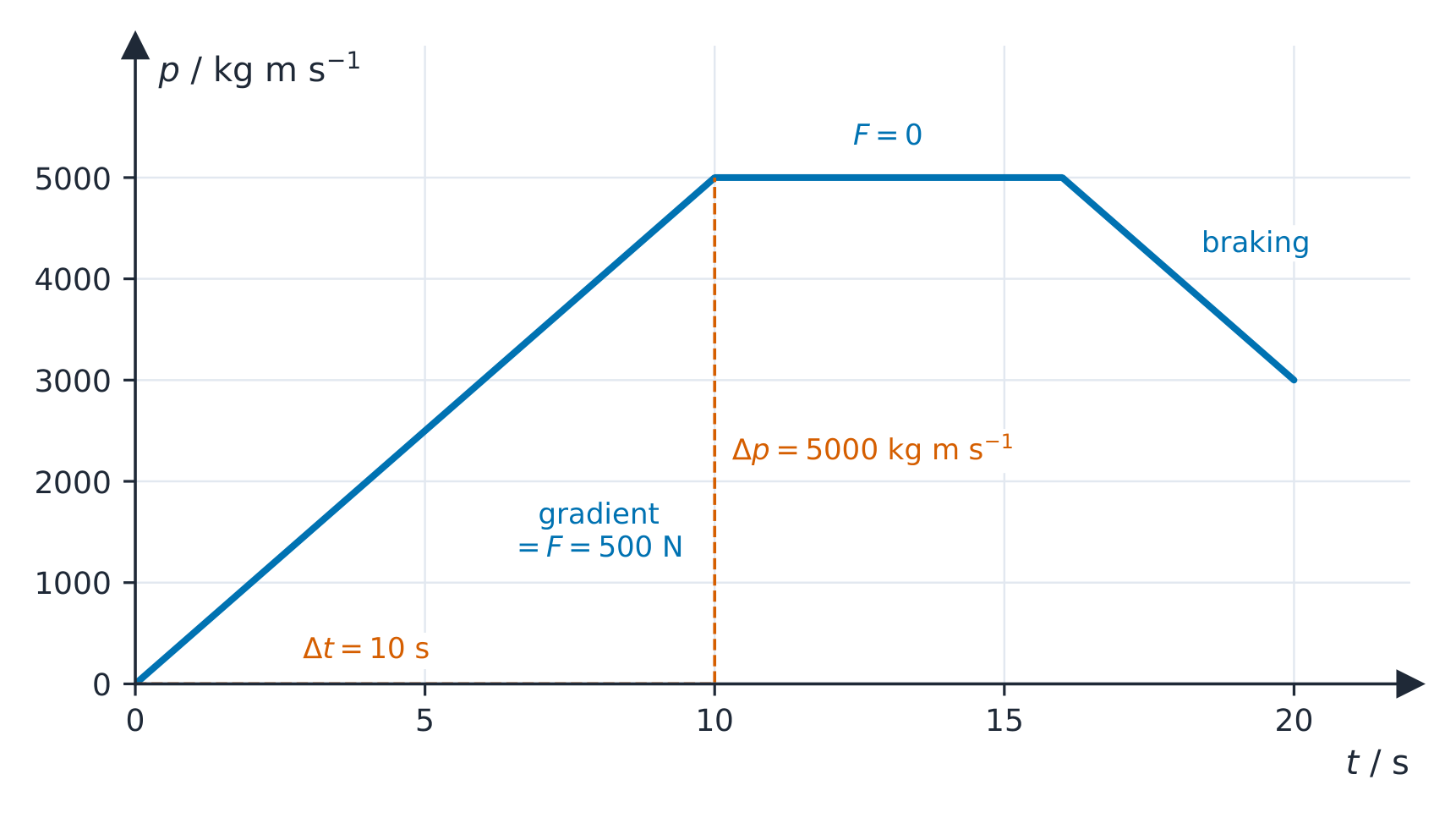
例题。 图中给出一辆摩托车的动量。求最初 $10\ \text{s}$ 内它所受的合力。
斜率 $= \Delta p / \Delta t = 5000 / 10 = 500\ \text{N}$。在 $10\ \text{s}$ 到 $16\ \text{s}$ 之间动量不变,所以合力为零:驱动力恰好与阻力平衡。从 $16\ \text{s}$ 到 $20\ \text{s}$ 动量减少 $2000\ \text{kg m s}^{-1}$,所以合力为 $-500\ \text{N}$,向后作用。
如果题目告诉你速率在变而合力保持不变,那么这个力不可能是空气阻力:阻力取决于速率,所以它会随速率变化而变化,而且阻力总是与运动方向相反。
探索
Free-body diagram (F = ma)
The resultant of the forces, divided by the mass, gives the acceleration.
探索
Newton's second law
F = ma (resultant)
The resultant force sets the acceleration; balanced forces ⇒ none.
词汇表
训练
| 英文 | 中文 | 拼音 |
|---|---|---|
| mass/mæs/ | 质量 | zhì liàng |
| force/fɔːs/ | 力 | lì |
| acceleration/əkˌseləˈreɪʃn/ | 加速度 | jiā sù dù |
| scalar/ˈskeɪlə/ | 标量 | biāo liàng |
| linear momentum/ˈlɪnɪə məʊˈmentəm/ | 动量 | dòng liàng |
| velocity/vəˈlɒsɪti/ | 速度 | sù dù |
| vector/ˈvektə/ | 矢量 | shǐ liàng |
| resultant force/rɪˈzʌltənt fɔːs/ | 合力 | hé lì |
| impulse/ˈɪmpʌls/ | 冲量 | chōng liàng |
| collision/kəˈlɪʒn/ | 碰撞 | pèng zhuàng |
| kinetic energy/kɪˈnetɪk ˈenədʒi/ | 动能 | dòng néng |
3.1
牛顿运动三定律

第一定律
一个物体保持静止,或沿直线以匀速继续运动,除非有一个合外力(external force)作用在它上面。简言之:合力为零就意味着加速度为零。
第二定律
物体所受的合力等于它动量的变化率,并且作用方向与那个变化相同。用 SI 单位,
$$F = \frac{\Delta p}{\Delta t} = ma \quad\text{(for constant mass)}.$$
加速度与合力总是指向同一方向。


第三定律
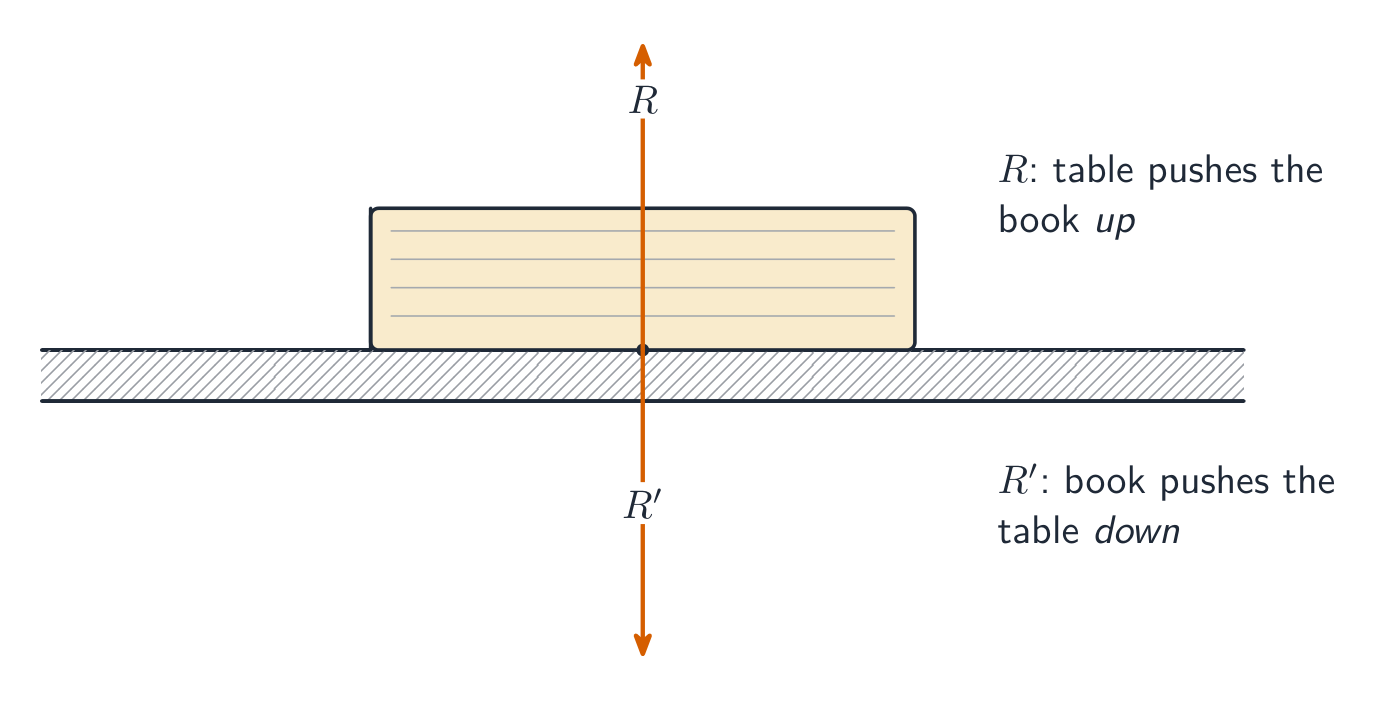
当物体 A 推物体 B 时,物体 B 以一个等大反向的力回推物体 A。这两个力:
- 作用在不同的物体上,
- 是同一类型的(都是引力、都是接触力、都是静电(electrostatic)力,等等),
- 大小相同、方向相反。
一个常见陷阱:桌上一个物块的重力(weight)和桌子给的支持力(normal contact force)不是一对第三定律力(它们作用在同一物体上,而且类型不同)。物块重力的第三定律配对力,是物块对地球的吸引。桌子接触力的第三定律配对力,是物块对桌子的推力。
要说出第三定律的配对力,把句子里的两个物体对调。"自行车后轮向后推路面"配对"路面向前推后轮",而这个向前的推力正是驱动自行车的力。"地球吸引月球"配对"月球吸引地球",力的大小相同。
对于火箭:作用在火箭上的推力(thrust)和作用在气体上的力是一对第三定律力(发动机把气体往下推,气体把发动机往上推)。重力和空气阻力不属于这一对。
词汇表
训练
| 英文 | 中文 | 拼音 |
|---|---|---|
| thrust/θrʌst/ | 推力 | tuī lì |
| external force/ekˈstɜːnl fɔːs/ | 外力 | wài lì |
| weight/weɪt/ | 重力 | zhòng lì |
| normal contact force/ˈnɔːml ˈkɒntækt fɔːs/ | 支持力 | zhī chí lì |
| electrostatic/ɪˌlektrəʊˈstætɪk/ | 静电 | jìng diàn |
3.1
重力
重力(weight)是重力场(gravitational field)对物体施加的力。在地球表面附近,
$$W = mg,$$
其中 $g \approx 9.81\ \text{m s}^{-2}$ 是自由落体加速度。重力是一个指向地心的矢量。不要把它和质量搞混:质量处处相同,但重力随地点变化。
在月球上 $g$ 约为 $1.6\ \text{m s}^{-2}$,所以宇航员的质量不变,而重力约为地球上的六分之一。当选择题问哪个陈述描述了重力时,答案是说"重力场对物体施加的力"的那个,而不是"质量乘以加速度",也不是"合力"。
词汇表
训练
| 英文 | 中文 | 拼音 |
|---|---|---|
| gravitational field/ˌɡrævɪˈteɪʃənl fiːld/ | 重力场 | zhòng lì chǎng |
3.2
非匀速运动

大纲
- show a qualitative understanding of frictional forces and viscous/drag forces including air resistance (no treatment of the coefficients of friction and viscosity is required, and a simple model of drag force increasing as speed increases is sufficient)
- describe and explain qualitatively the motion of objects in a uniform gravitational field with air resistance
- understand that objects moving against a resistive force may reach a terminal (constant) velocity
来源:剑桥国际大纲
摩擦力和阻力
两个固体表面之间的摩擦力(friction)沿表面作用,阻碍滑动。黏性(viscous)力或阻力(drag)是流体(fluid,液体或气体)对在其中运动的物体的阻碍力;对空气而言就是空气阻力。你不需要用任何摩擦或黏性系数(coefficient)。
一个简单模型:速率越大,阻力越大。速率为零时,阻力为零。阻力还随物体的横截面积(cross-sectional area)和流体的密度增大;降落伞的原理就是把面积、从而把阻力变得大得多。这些摩擦力和阻力都是阻碍运动的力(resistive forces):它们与运动方向相反,并把动能转化为热能。
一个穿过空气下落的物体
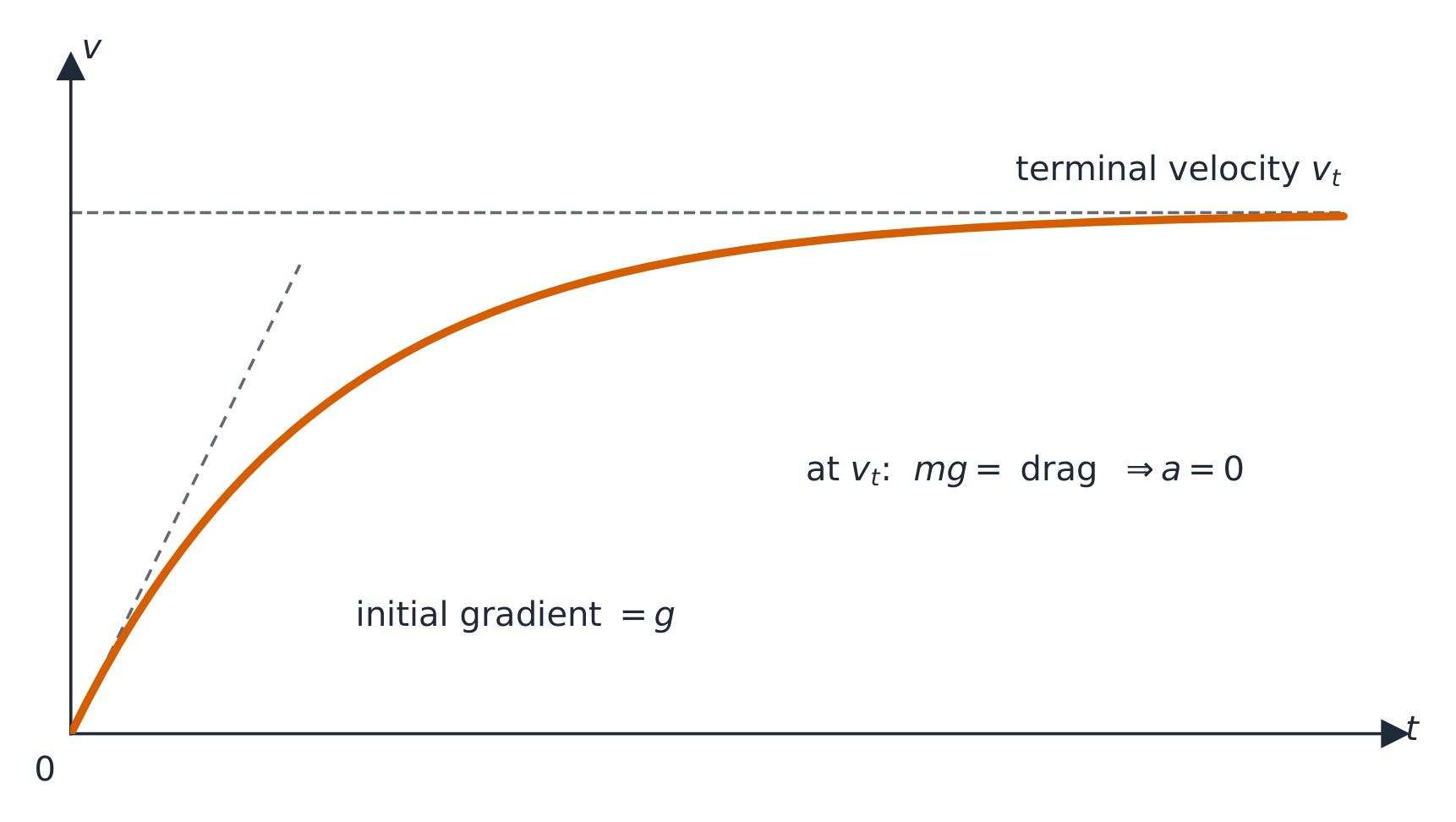
对于从静止释放、穿过空气下落的物体:
- 起初只有重力作用,所以物体以 $g$ 向下加速。
- 随着速率增大,向上的阻力增大。合力变小,所以加速度变小。
- 最终,阻力等于重力。合力为零,加速度为零,速率保持恒定——收尾速度(terminal velocity)。
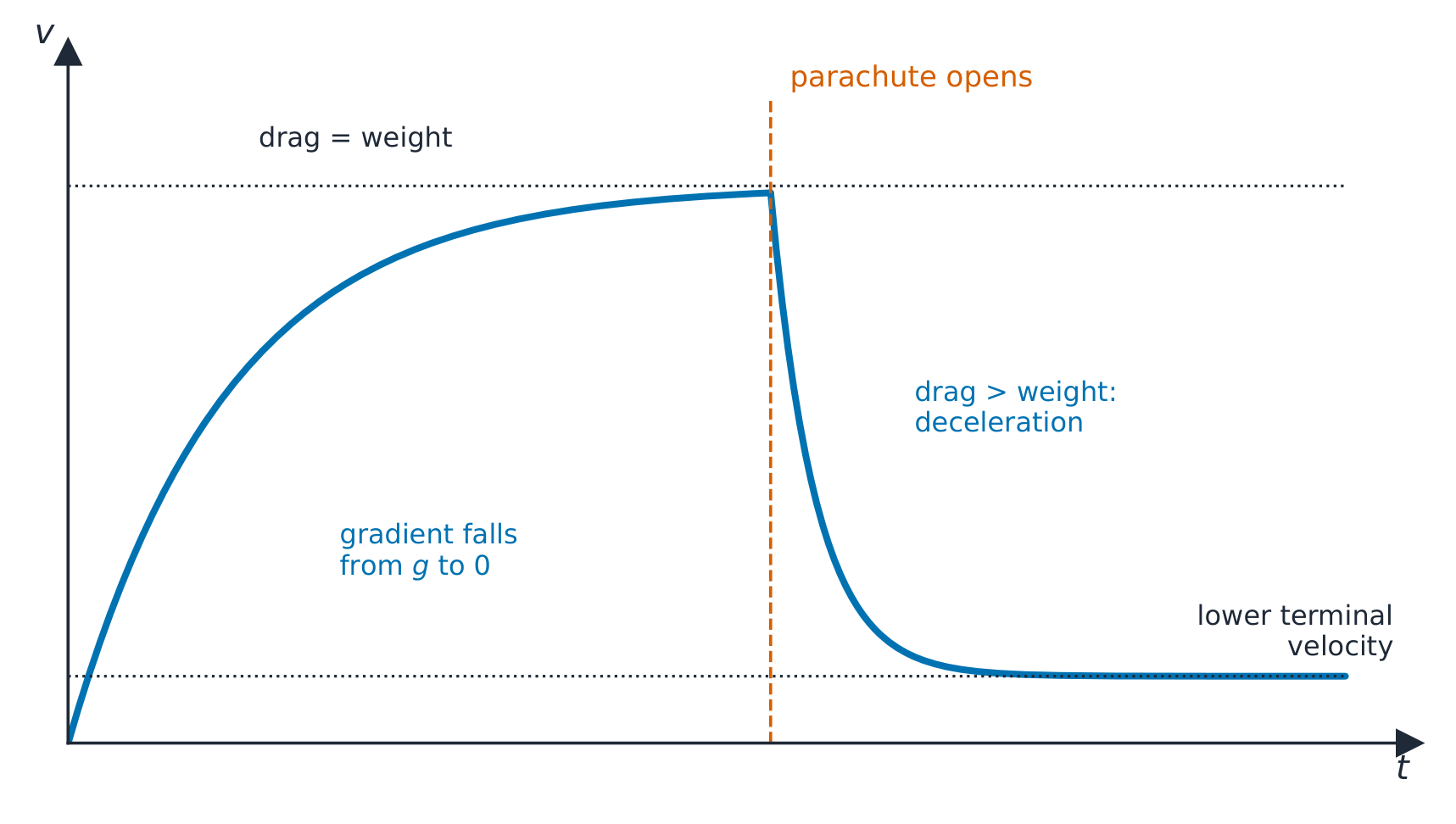
在速度-时间图上,线起初是斜率为 $g$ 的直线,然后弯曲并在收尾速度处变平。这种形状(起步快、加速度渐减、最后匀速)正是"有空气阻力的下落"区别于匀强重力场(uniform gravitational field)中"真空中自由落体"的地方。在加速度-时间图上,加速度从 $g$ 开始减小,沿曲线降到零。
两个大小相同、密度不同的球有不同的收尾速度:密度大的球重力更大,所以需要更大的阻力来平衡它,而阻力只有在更高的速率下才能达到这个值。这也正是降落伞改变一切的原因:伞打开时,阻力突然超过重力,合力向上,跳伞者减速(速度仍向下时加速度向上),直到阻力重新降到等于重力,达到一个新的、低得多的收尾速度。

在液体中下落:三个力
一个在液体中下落的球受到三个力:向下的重力、向上的浮力(upthrust)和向上的黏性阻力(viscous drag)。浮力来自流体静压强(hydrostatic pressure):液体中的压强随深度增大,所以液体对球底部的推力比对顶部的更大,这些推力的合力向上。它的大小等于球排开的液体的重力,$U = \rho_{\text{liquid}} V g$(主题 4)。阻力随速率增大。当重力 $=$ 浮力 $+$ 阻力时,合力为零,球以收尾速率下落。"画出带标注的箭头"类题目要的正是这三个力:浮力和阻力都向上,重力向下。
例题。 一个半径 $2.0\ \text{mm}$、重力 $2.56 \times 10^{-3}\ \text{N}$ 的钢球在密度 $850\ \text{kg m}^{-3}$ 的油中下落。它所受的黏性阻力为 $F = 6\pi \eta r v$,其中 $\eta$ 是油的黏度(viscosity),$v$ 是速率。(a) 求 $\eta$ 的 SI 基本单位。(b) 证明球所受的浮力为 $2.8 \times 10^{-4}\ \text{N}$。(c) 取 SI 单位下 $\eta = 0.20$,求收尾速率。
(a) $\eta = F / (6\pi r v)$,所以它的单位是 $\text{N} / (\text{m} \cdot \text{m s}^{-1}) = \text{kg m s}^{-2} / (\text{m}^{2}\ \text{s}^{-1}) = \text{kg m}^{-1}\ \text{s}^{-1}$。
(b) $V = \tfrac{4}{3}\pi r^{3} = \tfrac{4}{3}\pi (2.0 \times 10^{-3})^{3} = 3.35 \times 10^{-8}\ \text{m}^{3}$,所以 $U = 850 \times 3.35 \times 10^{-8} \times 9.81 = 2.79 \times 10^{-4}\ \text{N} \approx 2.8 \times 10^{-4}\ \text{N}$。
(c) 在收尾速率时,阻力 $= W - U = 2.56 \times 10^{-3} - 2.8 \times 10^{-4} = 2.28 \times 10^{-3}\ \text{N}$。所以 $v = F / (6\pi \eta r) = 2.28 \times 10^{-3} / (6\pi \times 0.20 \times 2.0 \times 10^{-3}) = 0.30\ \text{m s}^{-1}$。

收尾速度下落过程中的能量
在收尾速度时,一名跳伞者(parachutist)的动能恒定。但随着他们下降,重力势能(gravitational potential energy)一直在减少。它去了哪里?几乎全部变成了他们周围空气的热能(thermal energy)。它没有变成跳伞者的动能——那保持不变。
匀速行驶的骑车人或汽车
平路上匀速行驶的车辆合力为零。向前的驱动力(driving force)与总阻力(摩擦、空气阻力和滚动阻力)等大反向。速率越高,阻力越大,所以驱动力也必须越大——因此功率(power)也必须越大。
在斜坡上,重力有一个沿路面的分量。匀速上坡时,驱动力必须同时平衡阻力和重力沿斜坡向下的那部分 $W\sin\theta$;下坡时,这个分量反而帮助运动。
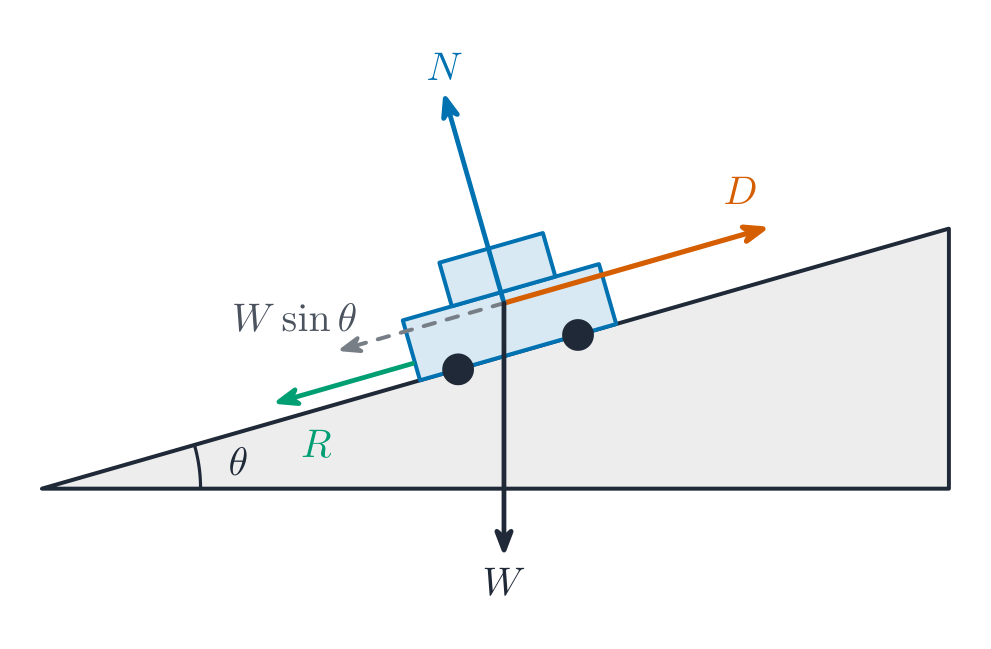
例题。 一辆质量 $1500\ \text{kg}$ 的汽车以恒定的 $30\ \text{m s}^{-1}$ 沿与水平方向成 $12°$ 的路面上坡。总阻力为 $1600\ \text{N}$。求驱动力和发动机的有用输出功率。
匀速意味着沿斜坡方向合力为零:$D = 1600 + 1500 \times 9.81 \times \sin 12° = 1600 + 3060 = 4660\ \text{N} \approx 4700\ \text{N}$。功率是力乘以速度(主题 5):$P = Dv = 4660 \times 30 = 1.4 \times 10^{5}\ \text{W}$。
探索
Stopping a car
Friction is what brakes a car. Set a speed and brake — the car keeps moving while the driver reacts, then friction slows it. Double the speed and watch the braking distance quadruple.
探索
Reach terminal velocity
Jump and watch the air-resistance arrow grow until it balances the weight — then the speed is constant. Open the parachute and the much bigger drag drops the diver to a slow, safe terminal velocity.
词汇表
训练
| 英文 | 中文 | 拼音 |
|---|---|---|
| driving force/ˈdraɪvɪŋ fɔːs/ | 驱动力 | qū dòng lì |
| drag/dræɡ/ | 阻力 | zǔ lì |
| friction/ˈfrɪkʃn/ | 摩擦力 | mó cā lì |
| terminal velocity/ˈtɜːmɪnl vəˈlɒsɪti/ | 收尾速度 | shōu wěi sù dù |
| viscous/ˈvɪskəs/ | 黏性 | nián xìng |
| fluid/ˈfluːɪd/ | 流体 | liú tǐ |
| coefficient/ˌkəʊɪˈfɪʃənt/ | 系数 | xì shù |
| viscosity/vɪˈskɒsɪti/ | 黏度 | nián dù |
| cross-sectional area/krɒs ˈsekʃənl ˈeərɪə/ | 横截面积 | héng jié miàn jī |
| thermal energy/ˈθɜːml ˈenədʒi/ | 热能 | rè néng |
| uniform gravitational field/ˈjuːnɪfɔːm ˌɡrævɪˈteɪʃənl fiːld/ | 匀强重力场 | yún qiáng zhòng lì chǎng |
| upthrust/ˈʌpθrʌst/ | 浮力 | fú lì |
| hydrostatic pressure/ˌhaɪdrəˈstætɪk ˈpreʃə/ | 流体静压强 | liú tǐ jìng yā qiáng |
| parachutist/ˈpærətʃuːtɪst/ | 跳伞者 | tiào sǎn zhě |
| gravitational potential energy/ˌɡrævɪˈteɪʃənl pəˈtenʃl ˈenədʒi/ | 重力势能 | zhòng lì shì néng |
| power/ˈpaʊə/ | 功率 | gōng lǜ |
3.3
线动量及其守恒

大纲
- state the principle of conservation of momentum
- apply the principle of conservation of momentum to solve simple problems, including elastic and inelastic interactions between objects in both one and two dimensions (knowledge of the concept of coefficient of restitution is not required)
- recall that, for an elastic collision, total kinetic energy is conserved and the relative speed of approach is equal to the relative speed of separation
- understand that, while momentum of a system is always conserved in interactions between objects, some change in kinetic energy may take place
来源:剑桥国际大纲
原理
对于没有合外力的系统,总动量保持恒定。这就是动量守恒(conservation of momentum)。按考官给两分的表述来说:只要没有合外力作用于系统,一个物体系统的总动量保持不变。 两半都要写:只写"总动量不变"只得一分。
只要没有外部合力,它总是成立的——在碰撞、爆炸(explosions)和反冲(recoil)中都是如此。在二维情形下,动量沿每个方向各自守恒。
例题。 一辆 $2.0\ \text{kg}$ 的小车和一辆 $3.0\ \text{kg}$ 的小车被压紧在一个压缩的弹簧两侧,然后从静止释放。$2.0\ \text{kg}$ 的小车以 $6.0\ \text{m s}^{-1}$ 飞出。求另一辆小车的速率。
总动量保持为零(它从静止开始),所以
$$0 = (2.0)(6.0) + (3.0)(-v) \quad\Rightarrow\quad v = \frac{12}{3.0} = 4.0\ \text{m s}^{-1}$$
方向相反。

弹性碰撞与非弹性碰撞
在每一次碰撞中,动量都守恒(只要没有外部合力)。
弹性碰撞(elastic collision)是总动能也守恒的碰撞。一个快速判据:在弹性碰撞中,接近的相对速率(relative speed)等于分离的相对速率。
在非弹性碰撞(inelastic collision)中,动量守恒但动能减少——一部分变成热能、声能或形变(deformation)能。如果两个物体粘在一起,这次碰撞就是完全非弹性的。
解碰撞问题(一维)

对于质量为 $m_{1}, m_{2}$、初速度为 $u_{1}, u_{2}$ 的两个正面(head-on)相撞的物体,写出
$$m_{1} u_{1} + m_{2} u_{2} = m_{1} v_{1} + m_{2} v_{2}.$$
用带正负号的速度(在选定的一个方向上为正)。如果碰撞是弹性的,再加上相对速率方程
$$u_{1} - u_{2} = -(v_{1} - v_{2}),$$
或者,等价地,$\tfrac{1}{2} m_{1} u_{1}^{2} + \tfrac{1}{2} m_{2} u_{2}^{2} = \tfrac{1}{2} m_{1} v_{1}^{2} + \tfrac{1}{2} m_{2} v_{2}^{2}$。这给出两个方程解两个未知量。
例题。 一辆 $1500\ \text{kg}$ 的汽车以 $12\ \text{m s}^{-1}$ 运动,撞上一辆静止的 $1000\ \text{kg}$ 的汽车,两者锁在一起。求碰后它们共同的速度。
动量守恒(两车粘在一起,所以 $v_{1} = v_{2} = v$):
$$1500 \times 12 + 1000 \times 0 = (1500 + 1000)\,v \quad\Rightarrow\quad v = \frac{18\,000}{2500} = 7.2\ \text{m s}^{-1}.$$
题目常常接着问有多大比例的动能转化为其他形式。碰前:$E_{\text{k}} = \tfrac{1}{2} \times 1500 \times 12^{2} = 1.08 \times 10^{5}\ \text{J}$。碰后:$\tfrac{1}{2} \times 2500 \times 7.2^{2} = 6.48 \times 10^{4}\ \text{J}$。所以 $4.3 \times 10^{4}\ \text{J}$,即原动能的 $40\%$,变成了热能、声能和汽车的形变。动量守恒;动能不守恒。
例题。 一个质量为 $222\,u$ 的静止原子核衰变,以 $1.6 \times 10^{7}\ \text{m s}^{-1}$ 放出一个质量为 $4\,u$ 的α粒子(alpha particle)。求剩余原子核的速率。
衰变前总动量为零,所以衰变后两者的动量等大反向:$218\,u \times v = 4\,u \times 1.6 \times 10^{7}$,得 $v = 2.9 \times 10^{5}\ \text{m s}^{-1}$,方向与 α 粒子相反。单位 $u$ 约掉了,所以从不需要它的数值。在衰变中,动量、电荷(质子数)、核子数和总的质量-能量都守恒(主题 11)。
一个有用的结论,对于质量 $m$ 与一个静止(stationary)质量 $M$ 的正面弹性碰撞:
$$v_{m} = \frac{m - M}{m + M} u, \qquad v_{M} = \frac{2m}{m + M} u.$$
二维碰撞
如果物体在二维内运动,把速度分解为垂直(perpendicular)的分量(components),并沿每个方向各自应用动量守恒。对于物体以某角度相撞的碰撞,选一个轴沿第一个物体的运动方向、另一个轴与之垂直。总动量沿每个轴都守恒。
例题。 在无摩擦的表面上,球 A 的动量为 $4.0\ \text{N s}$ 向正东,球 B 的动量为 $3.0\ \text{N s}$ 向正北。两球相撞并粘在一起。求合成物体的动量。
动量沿每个轴各自守恒:碰后仍是向东 $4.0\ \text{N s}$、向北 $3.0\ \text{N s}$,与碰前完全一样。总动量是矢量和,$\sqrt{4.0^{2} + 3.0^{2}} = 5.0\ \text{N s}$,方向为东偏北 $\tan^{-1}(3.0 / 4.0) = 37°$;合成物体沿这个方向运动,速率是 $5.0\ \text{N s}$ 除以总质量。给出两个动量箭头的选择题问的正是这个:把箭头首尾相接相加。

火箭 / 抛出质量
火箭以速度 $u$(相对自身)按质量流率(mass-flow rate)$\dot m$(每秒的千克数)抛出气体。它感受到一个推力
$$F = \dot m \cdot u,$$
它来自 $F = \Delta p / \Delta t$。每秒给予气体的动量等于作用在火箭上的推力(牛顿第三定律:火箭把气体推向一边,气体把火箭推向另一边)。一台每秒以 $190\ \text{m s}^{-1}$ 喷出 $90\ \text{kg}$ 气体的发动机产生 $90 \times 190 = 1.7 \times 10^{4}\ \text{N}$ 的推力。
例题。 一枚重力为 $W$ 的火箭以初始加速度 $a$ 离开地面。它的发动机产生多大的推力?
取向上为正。合力是推力减重力,所以 $T - W = ma$。由 $m = W / g$ 得 $T = W + Wa / g = W(1 + a / g)$。一枚重力 $2.0 \times 10^{6}\ \text{N}$、以 $4.0\ \text{m s}^{-2}$ 加速的火箭需要 $2.0 \times 10^{6} \times (1 + 4.0 / 9.81) = 2.8 \times 10^{6}\ \text{N}$ 的推力。推力必须先超过重力,火箭才会动。
探索
A collision
Set the masses and speeds, then collide them. Total momentum is conserved — the total before equals the total after.
词汇表
训练
| 英文 | 中文 | 拼音 |
|---|---|---|
| component/kəmˈpəʊnənt/ | 分量 | fèn liàng |
| perpendicular/ˌpɜːpənˈdɪkjʊlə/ | 垂直 | chuí zhí |
| conservation of momentum/ˌkɒnsəˈveɪʃn ɒv məʊˈmentəm/ | 动量守恒 | dòng liàng shǒu héng |
| explosion/ekˈspləʊʒn/ | 爆炸 | bào zhà |
| recoil/rɪˈkɔɪl/ | 反冲 | fǎn chōng |
| inelastic collision/ɪnɪˈlæstɪk kəˈlɪʒn/ | 非弹性碰撞 | fēi tán xìng pèng zhuàng |
| elastic collision/ɪˈlæstɪk kəˈlɪʒn/ | 弹性碰撞 | tán xìng pèng zhuàng |
| relative speed/ˈrelətɪv spiːd/ | 相对速率 | xiāng duì sù lǜ |
| deformation/ˌdiːfɔːˈmeɪʃn/ | 形变 | xíng biàn |
| head-on/hed ɒn/ | 正面 | zhèng miàn |
| stationary/ˈsteɪʃənəri/ | 静止 | jìng zhǐ |
| alpha particle/ˈælfə ˈpɑːtɪkl/ | α粒子 | α lì zi |
| mass-flow rate/mæs fləʊ reɪt/ | 质量流率 | zhì liàng liú lǜ |
3.3
考官认可的定义
定义题按固定的表述给分。把这些记准确,并且只写一个答案。
| 术语 | 定义 |
|---|---|
| 质量(mass) | 物体抵抗其运动状态改变的性质 |
| 线动量(linear momentum) | 物体的质量与速度的乘积 |
| 力(force) | 动量的变化率 |
| 牛顿第一定律 | 除非受到合力作用,物体保持静止或匀速运动 |
| 牛顿第二定律 | 物体所受的合力与其动量的变化率成正比,方向与该变化相同 |
| 牛顿第三定律 | 两个物体相互作用时,一个物体所受的力与另一个物体所受的力大小相等、方向相反 |
| 重力(weight) | 重力场对物体施加的力;等于质量与自由落体加速度的乘积 |
| 动量守恒原理 | 只要没有合外力作用于系统,一个物体系统的总动量保持不变 |
| 弹性碰撞(elastic collision) | 总动能守恒的碰撞(而且接近的相对速率等于分离的相对速率) |
| 非弹性碰撞(inelastic collision) | 动量守恒但一部分动能转化为其他形式的碰撞 |
| 收尾速度(terminal velocity) | 当运动物体所受的阻碍力等于驱动它的力、合力为零时达到的恒定速度 |
3.3
考试技巧
- 牛顿第二定律是 $F = \Delta p / \Delta t$(动量的变化率);$F = ma$ 是质量恒定时的特例。
- 正确辨认第三定律的一对力:同一类型的力,作用在两个不同的物体上——不是一个物体上相互平衡的力。
- 在每一次碰撞中动量都守恒;动能只在弹性碰撞中守恒。
- 对于收尾速度,要说明阻力随速率上升,直到阻力 $=$ 重力,于是加速度变为零。
常见错误
- 写"这些力是平衡的"或"这些力相互抵消"。要说"物体所受的合力为零"。
- 因为动量是"总的",就在正碰中把两个速率相加。选定正方向,给相反方向的速度加负号,再相加。
- 用速度的分量计算动能。动能要用每个物体的完整速率。
- 把一个物体所受的重力和支持力叫作一对第三定律力。一对力作用在两个不同的物体上,而且是同一类型的力。
- 陈述动量守恒时不写条件。它只在没有合外力作用于系统时成立。
本主题的互动课程
逐步学习,并即时检测练习。