Friction, drag and terminal velocity
Introduced| English | Meaning |
|---|---|
| terminal velocity/ˈtɜːmɪnl vəˈlɒsɪti/ | A constant falling velocity reached when weight is balanced by resistance. |
| air resistance/eə rɪˈzɪstəns/ | A drag force opposing motion through air. |
| friction/ˈfrɪkʃn/ | A force that opposes relative motion between contacting surfaces. |
| drag/dræɡ/ | A resistive force exerted by a fluid on an object moving relative to it. |
| viscous/ˈvɪskəs/ | Describing a fluid that resists relative motion between neighbouring layers. |
| fluid/ˈfluːɪd/ | A substance that can flow, including liquids and gases. |
| upthrust/ˈʌpθrʌst/ | The upward buoyant force exerted by a fluid on an object immersed in it. |
| resultant force/rɪˈzʌltənt fɔːs/ | The single force equivalent to all the forces acting together. |
| thermal energy/ˈθɜːml ˈenədʒi/ | Energy associated with the random motion and interactions of particles in a substance. |
| power/ˈpaʊə/ | The rate of energy transfer or work done. |
Why a skydiver stops speeding up
- Jump from a plane and you accelerate — but not forever.
- Soon you fall at a steady speed, the terminal velocity 收尾速度, even though gravity still pulls.
- The reason is air resistance 空气阻力 growing with speed.
Friction 摩擦力 and drag 阻力
- Friction acts between two solid surfaces, opposing the sliding.
- Drag (a viscous 黏性 force) is the resistance from a fluid 流体 — a liquid or gas.
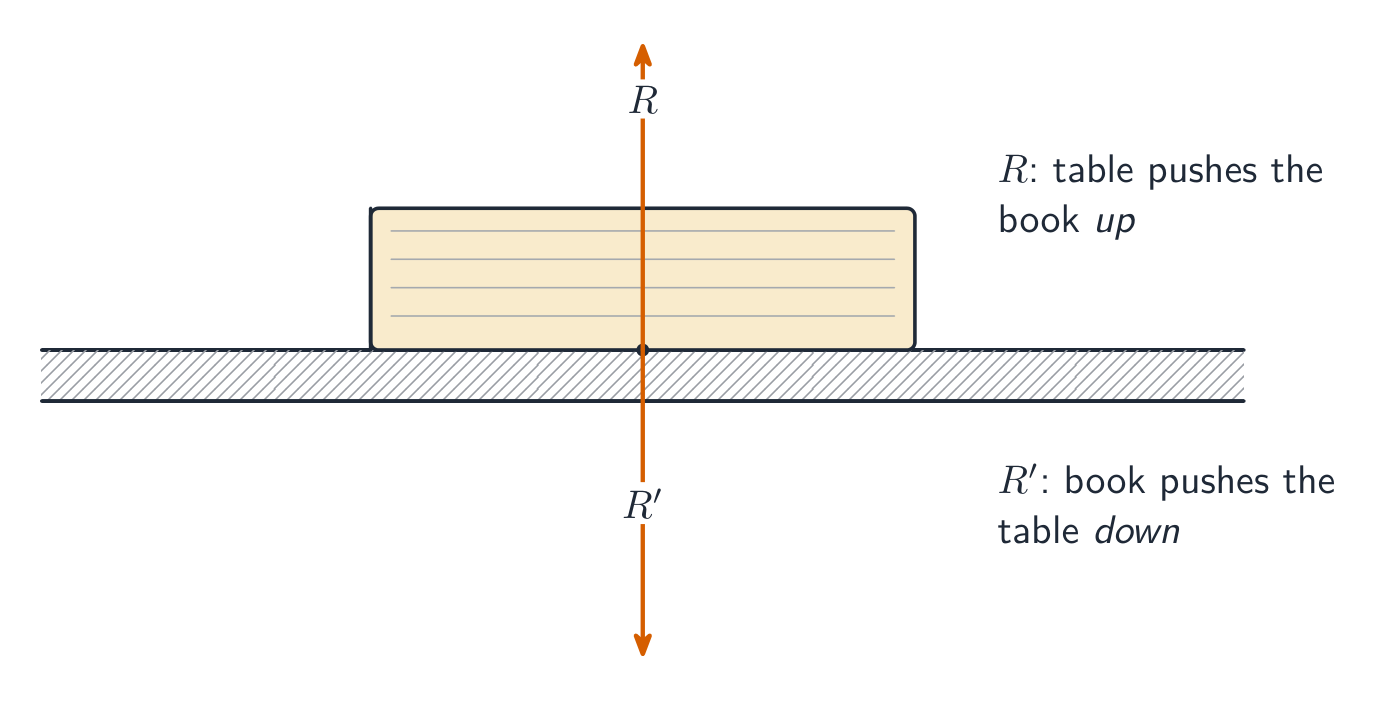
Newton's third-law pair: R on the book (up) and R-prime on the table (down)
Stopping a car
Friction is what brakes a car. Set a speed and brake — the car keeps moving while the driver reacts, then friction slows it. Double the speed and watch the braking distance quadruple.
Which best describes a drag (viscous) force?
Difficulty 1/5 · 100 coins + a small bonus on first completion today
Drag is the resistance a fluid (liquid or gas) exerts on something moving through it. Friction is the solid-on-solid case.
Drag grows with speed
- At rest there is no drag.
- The faster you go, the bigger the drag force becomes.
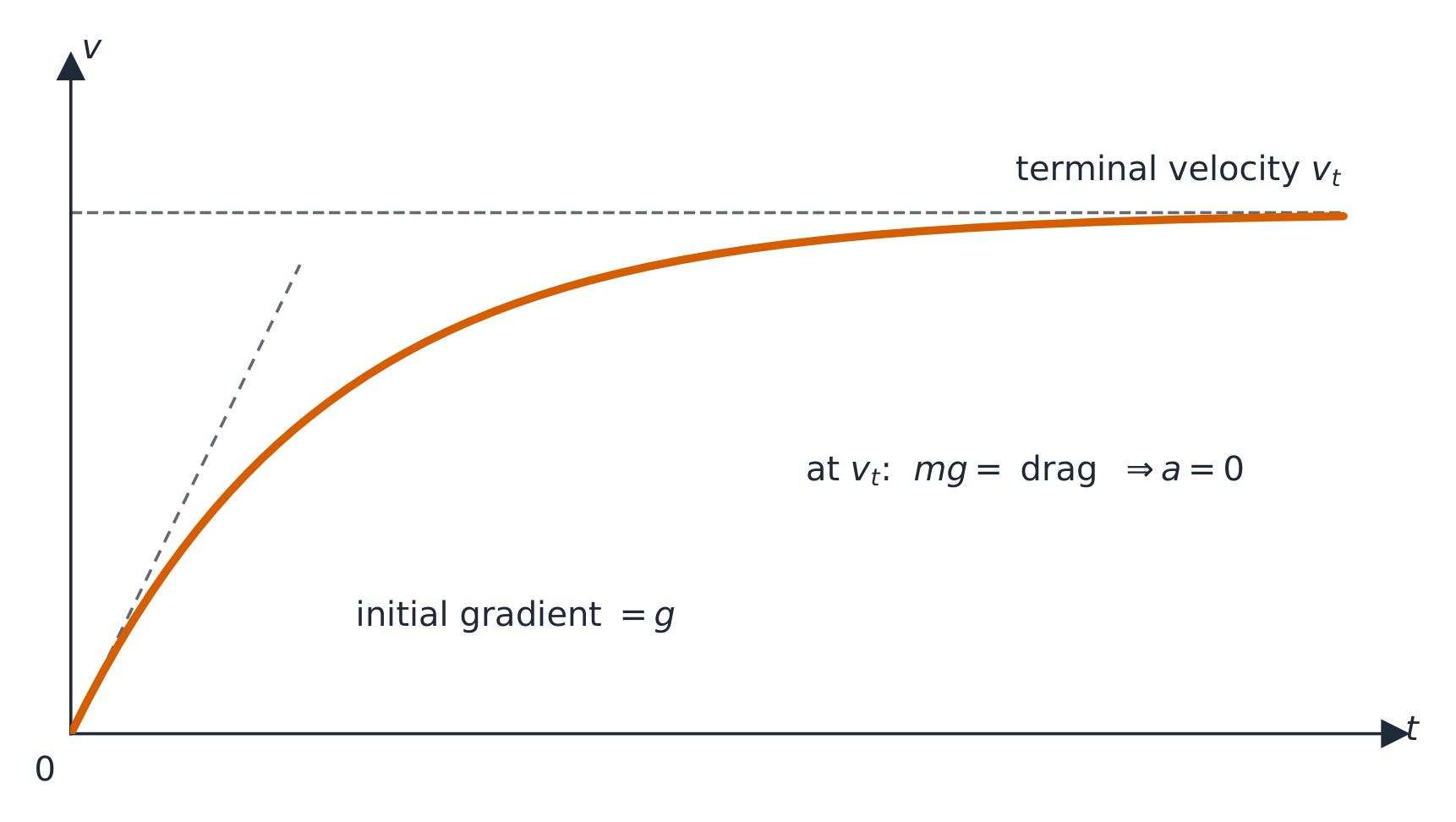
Velocity-time graph for an object falling through air
The drag force on a falling object grows as its speed grows.
Difficulty 1/5 · 100 coins + a small bonus on first completion today
Yes — at rest the drag is zero, and it increases with speed. That is what eventually balances the weight.
Three forces on a ball falling in a liquid
- Weight $W$ — down, always the same.
- Upthrust 浮力 $U$ — up, the same at every speed (it depends only on the liquid pushed aside).
- Drag $F$ — up, opposite to the motion, and growing as the ball speeds up.
- Exam habit: draw each force as a labelled arrow from the ball, and never add a "motion" arrow.

A free-body diagram shows only the forces on the object — the same idea for a falling ball
A steel ball is falling through oil. Which forces act on the ball? Select all that apply.
Difficulty 2/5 · 140 coins + a small bonus on first completion today
Three forces: weight down, upthrust up, and drag up (opposite to the motion). There is no separate force of motion — the ball moves because of its velocity, not because a force pushes it along.
Falling to terminal velocity
- Start: only weight (and upthrust) act, so the resultant force is largest and the acceleration is largest.
- Middle: drag grows, the resultant force 合力 shrinks, so the acceleration falls.
- End: upward forces equal the weight → zero resultant force → constant speed.

Reach terminal velocity
Jump and watch the air-resistance arrow grow until it balances the weight — then the speed is constant. Open the parachute and the much bigger drag drops the diver to a slow, safe terminal velocity.
Put the stages of a fall through air in order, from the moment of release.
Difficulty 3/5 · 200 coins + a small bonus on first completion today
Drag starts at zero and builds with speed until it cancels the weight, ending the acceleration.
At terminal velocity, the drag force is equal to the ____.
Difficulty 1/5 · 100 coins + a small bonus on first completion today
Drag = weight, so the resultant force is zero and the speed stays constant.
At terminal velocity the acceleration is zero — not the velocity. The object is still moving, and it still loses height. A common exam error is "the forces are balanced so it stops".
Worked example: terminal speed in oil
A small steel ball of weight $0.050\ \text{N}$ falls through oil. The upthrust on it is $0.010\ \text{N}$, and the drag is $F = kv$ with $k = 0.080\ \dfrac{\text{N s}}{\text{m}}$. Find the terminal speed.
- At terminal speed the resultant force is zero: $W = U + F$.
- So $F = 0.050 - 0.010 = 0.040\ \text{N}$.
- Then $kv = 0.040$, giving $v = \dfrac{0.040}{0.080} = 0.50\ \dfrac{\text{m}}{\text{s}}$.
- Check: in a liquid, forgetting the upthrust gives $v = 0.63\ \dfrac{\text{m}}{\text{s}}$ — the wrong answer, and a lost mark.
A ball of weight $0.12\ \text{N}$ falls through a liquid. The upthrust is $0.030\ \text{N}$ and the drag is $F = kv$ with $k = 0.30\ \dfrac{\text{N s}}{\text{m}}$. What is its terminal speed, in m/s?
Difficulty 2/5 · 140 coins + a small bonus on first completion today
At terminal speed $W = U + kv$, so $kv = 0.12 - 0.030 = 0.090\ \text{N}$ and $v = \dfrac{0.090}{0.30} = 0.30\ \dfrac{\text{m}}{\text{s}}$.
Energy at terminal velocity
- The kinetic energy is now constant, but the object keeps losing height.
- That lost gravitational PE turns mainly into thermal energy 热能 of the fluid — not into extra speed.
As a parachutist falls at terminal velocity, the lost gravitational PE turns mainly into:
Difficulty 1/5 · 100 coins + a small bonus on first completion today
The kinetic energy is constant, so the falling PE cannot become KE — it heats the air (and the parachutist) through drag.
Cruising at constant speed
- A car at steady speed has zero resultant force: driving force = total resistance.
- On a slope, the driving force must also balance the component of the weight along the slope, $W\sin\theta$.
- Going faster means more drag, so more driving force — and more power 功率, since $P = Fv$.
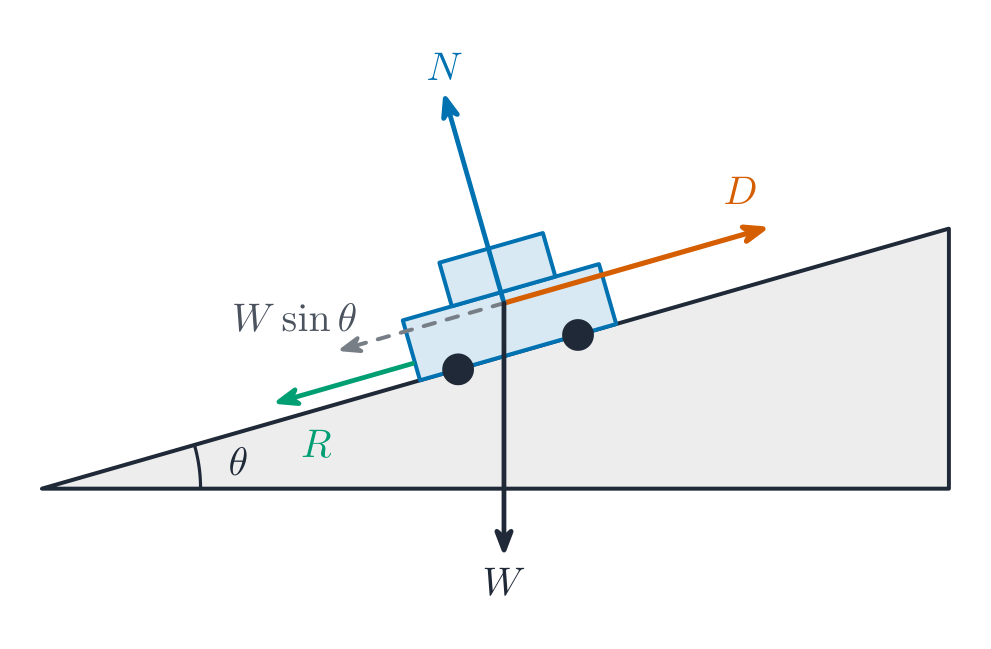
On a slope the driving force works against drag and against part of the weight
A car cruising at a higher steady speed needs more power because the drag is larger.
Difficulty 1/5 · 100 coins + a small bonus on first completion today
Higher speed → larger drag → a larger driving force is needed → more power (power = force × velocity).
Worked example: power up a slope
A car of mass $1200\ \text{kg}$ climbs a slope of $5.0^\circ$ at a steady $25\ \dfrac{\text{m}}{\text{s}}$. The total resistive force is $900\ \text{N}$. Find the useful output power of the engine.
- Steady speed → the driving force $D$ balances everything pulling back.
- Weight component down the slope: $mg\sin\theta = 1200 \times 9.81 \times \sin 5.0^\circ = 1030\ \text{N}$.
- So $D = 900 + 1030 = 1930\ \text{N}$.
- Power: $P = Dv = 1930 \times 25 = 4.8 \times 10^{4}\ \text{W}$ (about $48\ \text{kW}$).
- Check: using $mg$ instead of $mg\sin\theta$ would give a driving force bigger than the car's whole weight — impossible on a gentle slope.
A lorry climbs a slope at a steady $20\ \dfrac{\text{m}}{\text{s}}$. The total resistive force is $2000\ \text{N}$ and the component of its weight along the slope is $3000\ \text{N}$. What useful output power does the engine deliver, in kW?
Difficulty 2/5 · 140 coins + a small bonus on first completion today
Steady speed, so the driving force is $2000 + 3000 = 5000\ \text{N}$. Power $P = Fv = 5000 \times 20 = 1.0 \times 10^{5}\ \text{W} = 100\ \text{kW}$.
You've got it
- drag grows with speed; friction is between solids, drag is from a fluid
- terminal velocity: upward forces (drag + upthrust) = weight, so zero resultant force and constant speed — zero acceleration, not zero motion
- the lost gravitational PE becomes thermal energy of the fluid, not kinetic energy
- steady speed on a slope: driving force = resistance + $W\sin\theta$, and $P = Fv$