Conservation of momentum
Introduced| English | Meaning |
|---|---|
| external force/ekˈstɜːnl fɔːs/ | A force exerted on a chosen system by something outside that system. |
| conservation of momentum/ˌkɒnsəˈveɪʃn ɒv məʊˈmentəm/ | Total momentum remains constant when no resultant external force acts. |
| collision/kəˈlɪʒn/ | An interaction in which objects or particles strike or exert large forces on one another over a short time. |
| explosion/ekˈspləʊʒn/ | A rapid release of stored energy that can cause an object or system to separate into parts moving apart. |
| recoil/rɪˈkɔɪl/ | The backward motion of an object when it ejects or launches something, associated with conservation of momentum. |
| elastic/ɪˈlæstɪk/ | Describing a material or object that returns to its original shape or size after a deforming force is removed, within its elastic limit. |
| inelastic/ɪnɪˈlæstɪk/ | Describing a deformation that is not fully recovered on unloading, or a collision in which total kinetic energy is not conserved. |
| thrust/θrʌst/ | A driving force that pushes or propels an object, for example from an engine or expelled fluid. |
Push off and drift apart
- Two ice skaters stand still, then push on each other and glide apart.
- One goes left, one goes right — the total momentum stays zero.
- Nothing pushed from outside, so momentum was conserved.
The principle
- If there is no resultant external force 外力, the total momentum of a system stays constant.
- This is conservation of momentum 动量守恒.

Free-body diagram of a book being pulled on a table
Conservation of momentum
m₁u₁ + m₂u₂ = (m₁+m₂)v
In a collision the total momentum is conserved.
Total momentum stays constant when the resultant ____ force on the system is zero.
Difficulty 1/5 · 100 coins + a small bonus on first completion today
With no resultant external force, the system's total momentum is conserved (internal forces come in third-law pairs and cancel).
When it holds
- It works for collisions 碰撞, explosions 爆炸 and recoil 反冲 — any time outside forces cancel.
- In two dimensions, momentum is conserved along each direction on its own.

Forces on a falling object in a fluid
Elastic 弹性 vs inelastic 非弹性
- In every collision, momentum is conserved.
- Elastic: kinetic energy is also conserved (relative speed of approach = of separation).
- Inelastic: some KE becomes heat/sound/deformation. If they stick, it is perfectly inelastic.

Newton's third law in an isolated two-particle system: equal and opposite forces
In an inelastic collision, momentum is still conserved.
Difficulty 1/5 · 100 coins + a small bonus on first completion today
Momentum is conserved in every collision (no external force). In an inelastic one it is the kinetic energy that is not conserved.
Compared with collisions in general, what is special about an elastic collision?
Difficulty 1/5 · 100 coins + a small bonus on first completion today
All collisions conserve momentum; an elastic collision also conserves kinetic energy.
Solving a head-on collision
- Use signed velocities: $m_1u_1 + m_2u_2 = m_1v_1 + m_2v_2$.
- If it is elastic, add $u_1 - u_2 = -(v_1 - v_2)$ to get a second equation.
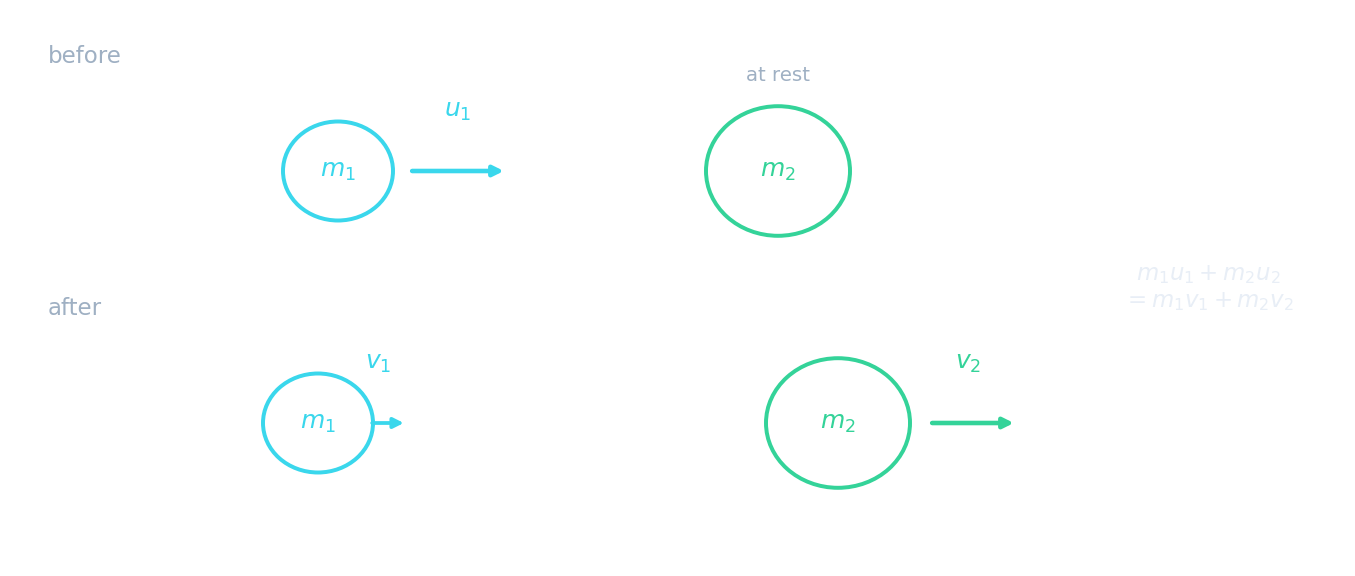
A $2.0\ \text{kg}$ trolley at $3.0\ \dfrac{\text{m}}{\text{s}}$ hits a stationary $1.0\ \text{kg}$ trolley and they stick. Find their common velocity.
Difficulty 2/5 · 140 coins + a small bonus on first completion today
Momentum: $2.0 \times 3.0 = (2.0 + 1.0)\,v$, so $v = \dfrac{6.0}{3.0} = 2.0\ \dfrac{\text{m}}{\text{s}}$.
Collisions in two dimensions
- Split each velocity into perpendicular components.
- Apply conservation of momentum along each axis separately.

In two dimensions, resolve along two axes and conserve momentum on each one separately
In two dimensions, momentum is conserved separately along each perpendicular direction.
Difficulty 1/5 · 100 coins + a small bonus on first completion today
Yes — resolve into components and apply conservation of momentum to each axis on its own.
Rockets and recoil
- A rocket throws gas one way and is pushed the other way (Newton's third law).
- Thrust 推力 $F = \dot{m}\,u$ — mass thrown per second times its speed.
A rocket ejects gas at $100\ \dfrac{\text{m}}{\text{s}}$ with a mass-flow rate of $2.0\ \dfrac{\text{kg}}{\text{s}}$. What thrust does it feel?
Difficulty 2/5 · 140 coins + a small bonus on first completion today
Thrust $F = \dot{m}\,u = 2.0 \times 100 = 200\ \text{N}$.
Worked example: a head-on collision
- A $1200\ \text{kg}$ car moving at $15\ \text{m/s}$ east collides head-on with an $800\ \text{kg}$ car moving at $10\ \text{m/s}$ west. They lock together. Find their common velocity.
- Choose east as positive. The second car's velocity is then $-10\ \text{m/s}$.
- Momentum before: $(1200)(15) + (800)(-10) = 18000 - 8000 = 10000\ \text{kg m/s}$.
- After: $(1200 + 800)v = 10000$, so $v = 5.0\ \text{m/s}$, still east.
- The commonest error is adding both speeds because the total is wanted. Choose a positive direction, give the opposing velocity a minus sign, and then add.
Elastic against inelastic
- An elastic collision conserves total kinetic energy, and equivalently the relative speed of approach equals the relative speed of separation.
- An inelastic collision conserves momentum but transfers some kinetic energy to other forms, usually internal energy and sound.
- Momentum is conserved in both. That is what makes it the useful quantity: it survives a collision that kinetic energy does not.
- Check whether a collision is elastic: compute the total kinetic energy before and after using the full speed of each body, not a component. If they match, it is elastic.
- A "perfectly inelastic" collision is the one where the bodies stick together, which loses the most kinetic energy possible while still conserving momentum.
A 1200 kg car at 15 m/s east hits an 800 kg car at 10 m/s west head-on and they lock together. What is their common velocity, in m/s east?
Difficulty 2/5 · 140 coins + a small bonus on first completion today
East positive: 18000 - 8000 = 10000 kg m/s, shared by 2000 kg, so 5.0 m/s east. Adding both speeds without the minus sign gives 13 m/s, which is the classic wrong answer.
Marks that slip away
- State the condition: momentum is conserved provided no resultant external force acts on the system. Without it the statement is incomplete.
- Choose a positive direction and give opposing velocities a minus sign. Never add two speeds in a head-on collision.
- Kinetic energy uses the full speed of each body, never one component.
- Momentum is a vector, so in two dimensions it is conserved separately in each of two perpendicular directions.
- An elastic collision conserves kinetic energy; an inelastic one does not. Both conserve momentum.
Match each collision type to what it conserves.
Difficulty 2/5 · 140 coins + a small bonus on first completion today
Momentum survives every collision, which is exactly why it is the useful quantity. Kinetic energy does not.
A complete statement of the principle of conservation of momentum includes which of these? Select all that apply.
Difficulty 2/5 · 140 coins + a small bonus on first completion today
Elasticity is irrelevant: momentum is conserved in every collision. Leaving out the external-force condition is what loses the mark.
Put the test for whether a collision is elastic in order.
Difficulty 3/5 · 200 coins + a small bonus on first completion today
Use the full speed, not a component: kinetic energy is a scalar built from the whole velocity.
In a two-dimensional collision, momentum is conserved separately in each of two perpendicular directions.
Difficulty 1/5 · 100 coins + a small bonus on first completion today
Momentum is a vector, so its conservation is a vector equation, and a vector equation is two scalar equations in a plane. That is what makes 2-D collision questions solvable.
You've got it
- no external resultant force → total momentum is conserved
- momentum is conserved in all collisions; elastic ones also conserve KE
- solve 1-D collisions with $m_1u_1 + m_2u_2 = m_1v_1 + m_2v_2$ (use signs)