Turning effects of forces
Introduced| English | Meaning |
|---|---|
| pivot/ˈpɪvət/ | A fixed point about which an object can turn. |
| centre of gravity/ˈsentə ɒv ˈɡrævɪti/ | The point through which an object’s resultant weight acts. |
| moment/ˈməʊmənt/ | The turning effect of a force about a pivot. |
| perpendicular distance/ˌpɜːpənˈdɪkjʊlə ˈdɪstəns/ | The shortest distance from a point to a line or plane, measured at right angles to it. |
| line of action/laɪn ɒv ˈækʃn/ | The straight line passing through a force's point of application in the direction of that force. |
| couple/ˈkʌpl/ | Two equal and opposite parallel forces acting along different lines, producing a turning effect without a resultant force. |
| torque/tɔːk/ | The turning effect of a couple, equal to one of its forces multiplied by the perpendicular distance between the two lines of action. |
Why the handle is far from the hinge
- A door handle sits as far from the hinges as possible.
- The same push, applied further from the pivot 支点, turns the door more easily.
- Turning effect depends on force and distance.
Centre of gravity 重心
- The whole weight of an object can be treated as acting at one point: its centre of gravity.
- For a uniform, regular shape it sits at the middle.

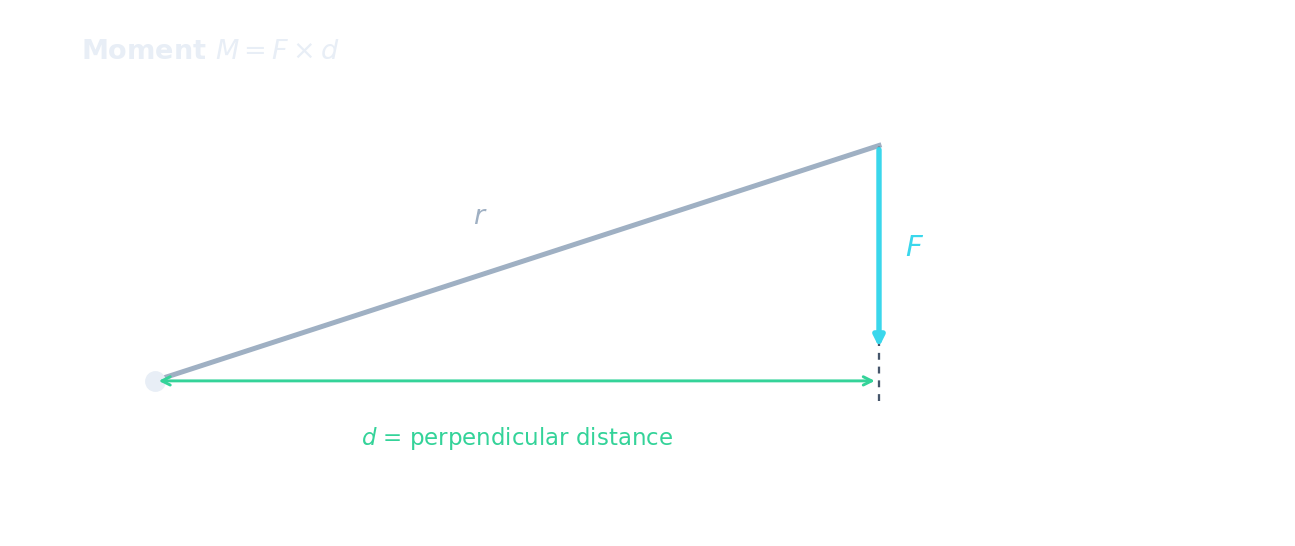
The moment 力矩 depends on the perpendicular distance 垂直距离 $d$ from the pivot to the line of action 作用线 of the force
Balance the see-saw
Put a weight on each side and slide it in or out. A small weight far from the pivot can balance a big weight close in — the beam is level when force × distance matches on both sides.
Moment of a force
- The moment is $M = F \times d$, where $d$ is the perpendicular distance from the pivot to the force's line of action.
- Unit: $\text{N}\cdot\text{m}$. A moment is clockwise or anticlockwise.
A force of $20\ \text{N}$ acts at a perpendicular distance of $0.50\ \text{m}$ from a pivot. What is the moment?
Difficulty 2/5 · 140 coins + a small bonus on first completion today
$M = F \times d = 20 \times 0.50 = 10\ \text{N}\cdot\text{m}$.
Why is a door handle placed far from the hinges?
Difficulty 1/5 · 100 coins + a small bonus on first completion today
Moment $= F \times d$. A bigger $d$ means a bigger turning effect for the same force, so the door opens more easily.
Angle matters
- Only the part of the force perpendicular to the arm turns it.
- For a force at angle $\theta$ to an arm of length $r$: $M = Fr\sin\theta$.

Weights on a rule balanced at a pivot — used to test the principle of moments
Only the part of a force perpendicular to the arm contributes to the turning.
Difficulty 1/5 · 100 coins + a small bonus on first completion today
Yes — that is why $M = Fr\sin\theta$: $\sin\theta$ picks out the perpendicular part of the force.
Match each term to the definition the examiner marks.
Difficulty 2/5 · 140 coins + a small bonus on first completion today
Two of these hinge on the phrase line of action, which is what makes the distance perpendicular rather than measured along the rod.
A couple 力偶
- A couple is two forces: equal in size, opposite in direction, a distance apart.
- It makes the body turn only — the resultant force is zero, so no straight-line push.
Select all the features of a couple.
Difficulty 2/5 · 140 coins + a small bonus on first completion today
A couple is equal, opposite forces a distance apart, giving zero resultant force but a pure turning effect. Same-direction forces are not a couple.
Torque 力偶矩 of a couple
- The torque is $\tau = F \times d$, where $d$ is the distance between the two lines of action.
- It is the same about any point — a special property of couples.
A couple has forces of $5.0\ \text{N}$ with their lines $0.40\ \text{m}$ apart. What is the torque?
Difficulty 2/5 · 140 coins + a small bonus on first completion today
$\tau = F \times d = 5.0 \times 0.40 = 2.0\ \text{N}\cdot\text{m}$.
Two equal forces in the same direction are not a couple — they have a resultant force and push the body along.
Two equal forces pointing in the same direction form a couple.
Difficulty 1/5 · 100 coins + a small bonus on first completion today
No — a couple needs equal and opposite forces. Same-direction forces have a resultant and push the body along.
Worked example: a beam that is not weightless
- A uniform beam of length $4.0\ \text{m}$ and weight $120\ \text{N}$ rests on a pivot $1.5\ \text{m}$ from its left end. A $200\ \text{N}$ load hangs from the left end. What force at the right end holds it in equilibrium?
- The beam is uniform, so its own weight acts at its centre, $2.0\ \text{m}$ from the left, which is $0.5\ \text{m}$ to the right of the pivot.
- Take moments about the pivot. Anticlockwise: $200 \times 1.5 = 300\ \text{N m}$.
- Clockwise: the beam's weight $120 \times 0.5 = 60\ \text{N m}$, plus the unknown $F$ at $2.5\ \text{m}$.
- $300 = 60 + 2.5F$, so $F = 96\ \text{N}$.
- Leaving out the beam's own weight is the standard lost mark, and it only vanishes when the pivot is at the centre.
Marks that slip away
- A moment uses the perpendicular distance from the point to the line of action of the force, not the distance along the rod.
- The weight of a uniform beam acts at its centre and has a moment about any pivot that is not there. Do not leave it out.
- The torque of a couple uses the distance between the two lines of action, so a symmetric couple gives $2Fd$, not $Fd$ measured from the middle.
- Check whether the geometry needs $\sin\theta$ or $\cos\theta$ by drawing the triangle. Do not guess.
- Equilibrium means the resultant force and the resultant torque are both zero. Two conditions, and a question can test either.
A uniform 4.0 m beam of weight 120 N is pivoted 1.5 m from its left end, with a 200 N load at that end. What upward force at the right end gives equilibrium, in N?
Difficulty 2/5 · 140 coins + a small bonus on first completion today
Moments about the pivot: 200 x 1.5 = 120 x 0.5 + 2.5F, so F = 96 N. Forgetting the beam's own 120 N at its centre gives 120 N, the classic wrong answer.
Put the method for a principle-of-moments problem in order.
Difficulty 3/5 · 200 coins + a small bonus on first completion today
Taking moments about a point an unknown passes through removes it from the equation, which is why the choice of point is worth a moment's thought.
A body is in equilibrium. Which must be true? Select all that apply.
Difficulty 2/5 · 140 coins + a small bonus on first completion today
Equilibrium permits constant velocity as well as rest. Both conditions are needed, and a question can test either one alone.
You've got it
- moment $M = F \times d$ — use the perpendicular distance to the line of action
- a couple is equal, opposite forces a distance apart: pure turning, torque $\tau = Fd$
- weight acts at the centre of gravity