Equilibrium of forces
Introduced| English | Meaning |
|---|---|
| equilibrium/ˌiːkwɪˈlɪbrɪəm/ | A state with no resultant force or resultant moment. |
| principle of moments/ˈprɪnsɪpl ɒv ˈməʊmənts/ | For rotational equilibrium, total clockwise moment equals total anticlockwise moment. |
| clockwise/ˈklɒkwaɪz/ | Moving or turning in the same direction as the hands of a clock when viewed from the specified side. |
| anticlockwise/ˌæntɪˈklɒkwaɪz/ | In the direction opposite to the movement of a clock's hands. |
| tension/ˈtenʃn/ | A pulling force transmitted through a stretched string, cable or similar object. |
| line of action/laɪn ɒv ˈækʃn/ | The straight line passing through a force's point of application in the direction of that force. |
| vector triangle/ˈvektə ˈtraɪæŋɡl/ | A head-to-tail triangle showing the addition of two vectors and their resultant. |
| resolve/rɪˈzɒlv/ | resolve |
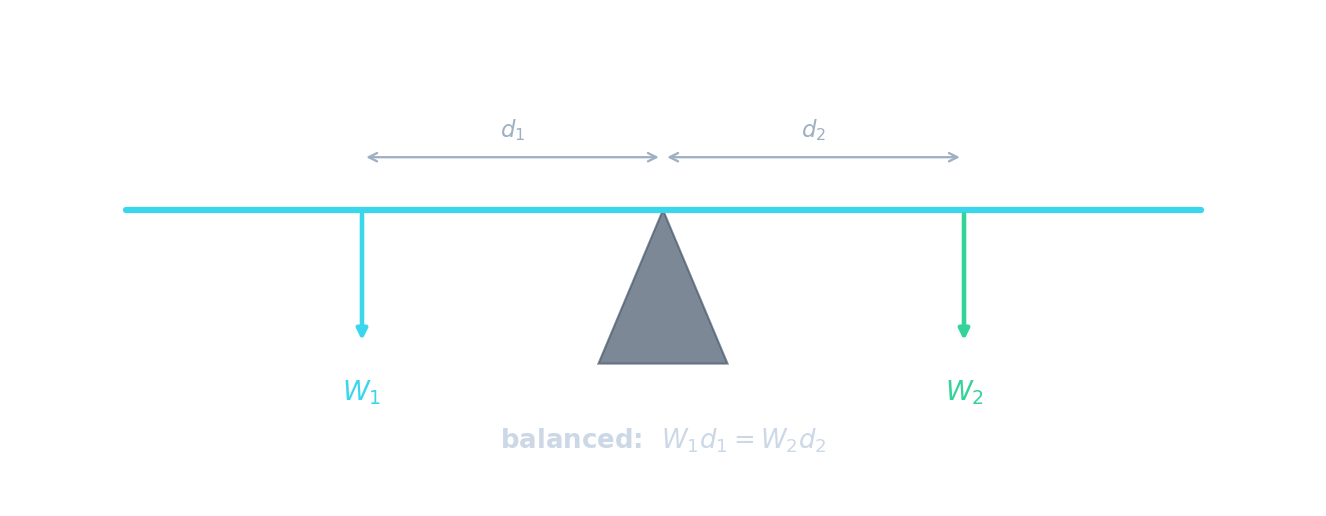
A balanced see-saw
- Two children balance a see-saw even when they weigh different amounts.
- The lighter one just sits further out.
- Balance is about both forces and their turning effects.
Two conditions for equilibrium 平衡
- A body is in equilibrium when both are true:
- the resultant force is zero, and the resultant moment is zero.

A couple: two equal and opposite forces, a distance apart, producing a torque
Forces in equilibrium
When forces are balanced the resultant is zero — the vectors form a closed loop. Drag the arrows to keep them cancelling.
Select both conditions a body must meet to be in equilibrium.
Difficulty 2/5 · 140 coins + a small bonus on first completion today
Equilibrium = zero resultant force and zero resultant moment. A body can be in equilibrium while moving at constant velocity.
A body with zero resultant force must be in equilibrium.
Difficulty 1/5 · 100 coins + a small bonus on first completion today
Not necessarily — a couple gives zero resultant force but still turns the body. You also need zero resultant moment.
Principle of moments 力矩原理
- For a body that is not turning: total clockwise 顺时针 moment = total anticlockwise 逆时针 moment (about any point).
At balance, the total clockwise moment equals the total ____ moment.
Difficulty 1/5 · 100 coins + a small bonus on first completion today
That is the principle of moments — the two turning effects cancel about any chosen point.
Step one: draw every force
- Before any equation, draw each force as a labelled arrow at the point where it acts.
- The usual cast: weight (down, at the centre of gravity), tension 张力 (along the string, away from the object), normal contact force (at right angles to the surface), friction (along the surface).
- Never draw an arrow for "motion" or "momentum" — they are not forces, and an examiner counts them as errors.
A book rests on a table while someone pushes it slowly along. Which of these should not appear on its force diagram?
Difficulty 1/5 · 100 coins + a small bonus on first completion today
Motion is not a force. A force diagram shows only forces: weight, normal contact force, friction and the push.
Solving a balance problem
- Take moments about an unknown force, so its moment is zero and it drops out.
- List each force × its perpendicular distance, then set clockwise = anticlockwise.
- Use "resultant force = 0" if you need a second equation.
To simplify a moments problem, it is smart to take moments about the point where:
Difficulty 1/5 · 100 coins + a small bonus on first completion today
A force acting at the pivot has zero perpendicular distance, so its moment is zero and it drops out of the equation.
Put the steps for solving a moments problem in order.
Difficulty 3/5 · 200 coins + a small bonus on first completion today
Forces first, then a pivot that removes an unknown, then the moments equation, and finally the force balance for whatever is left.
Worked example: a beam and a cable
A uniform beam of weight $120\ \text{N}$ and length $2.0\ \text{m}$ is hinged at one end and held horizontal by a vertical cable at the other end. A $300\ \text{N}$ load hangs $0.50\ \text{m}$ from the hinge. Find the tension in the cable and the vertical force at the hinge.
- Moments about the hinge — its unknown force then has zero moment.
- Clockwise: $120 \times 1.0 + 300 \times 0.50 = 270\ \text{N m}$ (the beam's weight acts at its middle).
- Anticlockwise: $T \times 2.0$.
- So $T = \dfrac{270}{2.0} = 135\ \text{N}$.
- Vertical forces balance: $H + 135 = 120 + 300$, so the hinge pushes up with $H = 285\ \text{N}$.
- Check: the cable, further from the load, carries less than the hinge — as expected.
A child of weight $200\ \text{N}$ sits $1.5\ \text{m}$ left of a see-saw pivot. What weight, $1.0\ \text{m}$ to the right, balances it?
Difficulty 2/5 · 140 coins + a small bonus on first completion today
Clockwise = anticlockwise: $W \times 1.0 = 200 \times 1.5$, so $W = 300\ \text{N}$.
A uniform beam of weight $80\ \text{N}$ and length $4.0\ \text{m}$ is hinged at one end and held horizontal by a vertical cable at the other. A $200\ \text{N}$ load hangs $1.0\ \text{m}$ from the hinge. What is the tension in the cable, in N?
Difficulty 2/5 · 140 coins + a small bonus on first completion today
Moments about the hinge: $T \times 4.0 = 80 \times 2.0 + 200 \times 1.0 = 360$, so $T = 90\ \text{N}$.
The distance in a moment is the perpendicular distance from the pivot to the force's line of action 作用线. For a force at angle $\theta$ to the beam, that is $d\sin\theta$, not $d$. Using the full length of the beam for a slanting cable is the most common lost mark in this topic.
The vector triangle 矢量三角形
- Three forces in equilibrium, drawn tip to tail, form a closed triangle.
- Solve it with the sine/cosine rule, or resolve into perpendicular components instead.
Three forces in equilibrium, drawn tip to tail, form a closed triangle.
Difficulty 1/5 · 100 coins + a small bonus on first completion today
Yes — if they balance, the three arrows return to the start, making a closed vector triangle.
Worked example: two strings, one lamp
A lamp of weight $40\ \text{N}$ hangs from two identical strings, each at $30^\circ$ to the horizontal. Find the tension in each string.
- Resolve 分解 vertically: the two upward components carry the weight.
- Each string pulls up by $T\sin 30^\circ$, so $2T\sin 30^\circ = 40$.
- $\sin 30^\circ = 0.5$, so $T = 40\ \text{N}$.
- Horizontally the two $T\cos 30^\circ$ components cancel, which is why the lamp does not swing sideways.
- Check: flatter strings (smaller $\theta$) give a smaller $\sin\theta$ and a larger tension — a washing line pulled nearly straight can snap.
You've got it
- equilibrium needs both: zero resultant force and zero resultant moment
- principle of moments: clockwise = anticlockwise about any point — take moments about an unknown force
- a moment uses the perpendicular distance to the line of action
- three balanced forces close into a vector triangle, or resolve into components