Newton's laws, force and momentum
Introduced| English | Meaning |
|---|---|
| momentum/məʊˈmentəm/ | The product of mass and velocity. |
| impulse/ˈɪmpʌls/ | The change in momentum, equal to force multiplied by its duration for a constant force. |
| collision/kəˈlɪʒn/ | An interaction in which objects or particles strike or exert large forces on one another over a short time. |
| weight/weɪt/ | The gravitational force acting on an object. |
| resultant force/rɪˈzʌltənt fɔːs/ | The single force equivalent to all the forces acting together. |
| inertia/ɪˈnɜːʃə/ | An object's resistance to changes in its state of motion, measured by its mass in translational motion. |
Why soft hands catch an egg
- Catch a thrown egg with stiff hands and it breaks; with soft, giving hands it survives.
- Both stop the same egg — but soft hands take more time, so the force is smaller.
- That link between force, momentum 动量 and time is the heart of dynamics.
Momentum
- Momentum $p = mv$ — mass times velocity. It is a vector (same direction as $v$).
- Unit: $\dfrac{\text{kg}\cdot\text{m}}{\text{s}}$, the same as $\text{N}\cdot\text{s}$.

A rocket pushes gas down; by Newton's third law the gas pushes it up
Free-body diagram (F = ma)
The resultant of the forces, divided by the mass, gives the acceleration.
Newton's second law
F = ma (resultant)
The resultant force sets the acceleration; balanced forces ⇒ none.
A $2.0\ \text{kg}$ ball moves at $3.0\ \dfrac{\text{m}}{\text{s}}$. What is its momentum?
Difficulty 2/5 · 140 coins + a small bonus on first completion today
$p = mv = 2.0 \times 3.0 = 6.0\ \dfrac{\text{kg}\cdot\text{m}}{\text{s}}$.
Momentum is a vector.
Difficulty 1/5 · 100 coins + a small bonus on first completion today
Yes — $p = mv$ points the same way as the velocity, so it has a direction.
Force = rate of change of momentum
- Newton's second law, in full: $F = \dfrac{\Delta p}{\Delta t}$.
- When the mass is constant this becomes the familiar $F = ma$.

In a crash, a large force acts over a very short time to change momentum
In its general form, Newton's second law says the resultant force equals the:
Difficulty 1/5 · 100 coins + a small bonus on first completion today
$F = \dfrac{\Delta p}{\Delta t}$ — the rate of change of momentum. For constant mass this is $F = ma$.
Match each of Newton's laws to its statement.
Difficulty 2/5 · 140 coins + a small bonus on first completion today
The second law's wording is about the rate of change of MOMENTUM. F = ma is a special case, valid only when the mass is constant.
Impulse 冲量 and collisions 碰撞
- The average force in a hit is $F = \dfrac{\Delta p}{\Delta t}$ — change in momentum over contact time.
- A longer contact time means a smaller force (the egg, a crumple zone, a bent knee on landing).
- Energy link: $E_{\text{k}} = \dfrac{p^{2}}{2m}$.

Weight 重力 and normal contact force on a book resting on a table
Catching an egg with soft hands makes the contact time longer, which makes the average force ____.
Difficulty 1/5 · 100 coins + a small bonus on first completion today
Same change in momentum over a longer time means a smaller force: $F = \dfrac{\Delta p}{\Delta t}$.
A 0.15 kg ball hits a wall at 12 m/s and rebounds at 8.0 m/s along the same line. What is the magnitude of the impulse on it, in N s?
Difficulty 2/5 · 140 coins + a small bonus on first completion today
Take one direction as positive: the change is 0.15 x (8.0 - (-12)) = 3.0 N s. Adding the speeds without the sign gives the same number here only because the ball reverses; get the sign convention right or a glancing rebound will catch you out.
Newton's first law
- With zero resultant force 合力, an object stays at rest or moves at constant velocity.
- You lurch forward when a bus brakes because your body "wants" to keep moving — inertia 惯性.
Newton's second law
- A resultant force gives an acceleration: $F = ma$.
- The acceleration always points the same way as the resultant force.
Newton's third law
- If A pushes B, then B pushes A back — equal in size, opposite in direction.
- The two forces act on different objects and are the same type of force.
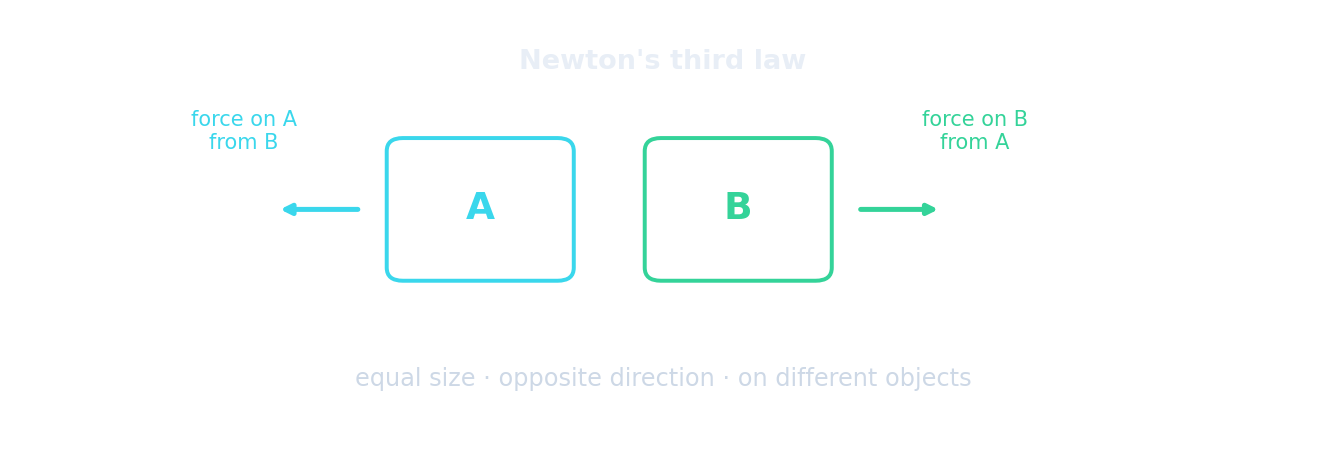
A book's weight and the table's upward push are not a third-law pair — they act on the same object (the book) and are different types of force.
Which pair are genuine Newton's third-law partners?
Difficulty 1/5 · 100 coins + a small bonus on first completion today
The contact forces "book on table" and "table on book" are equal, opposite, same type, and act on different objects. The book's weight and the table's push act on the same object, so they are not a pair.
Select all the true statements about a Newton's third-law pair of forces.
Difficulty 2/5 · 140 coins + a small bonus on first completion today
A third-law pair is equal, opposite, the same type, and acts on two different objects — never on the same one.
Weight
- Weight is the gravitational force on a mass: $W = mg$.
- Mass is the same everywhere; weight changes with $g$ (less on the Moon).
What is the weight of a $5.0\ \text{kg}$ bag near Earth's surface? (Use $g = 9.81\ \dfrac{\text{m}}{\text{s}^2}$.)
Difficulty 2/5 · 140 coins + a small bonus on first completion today
$W = mg = 5.0 \times 9.81 \approx 49\ \text{N}$.
For a body in equilibrium, do not say the forces cancel. Say the ____ force on it is zero.
Difficulty 1/5 · 100 coins + a small bonus on first completion today
"Balanced" and "cancel out" are both refused. The examiner is checking that you can name the single vector sum of all the forces.
Put the test for a Newton's third-law pair in order.
Difficulty 3/5 · 200 coins + a small bonus on first completion today
The last two are what rule out the classic wrong answer. A book's weight (gravitational) and the table's push on it (contact) fail both: same body, different types.
Marks that slip away
- Never write "the forces are balanced" or "the forces cancel out". The marked phrase is the resultant force on the object is zero.
- Newton's second law is about the rate of change of momentum, not simply $F = ma$. That form assumes a constant mass.
- A third-law pair acts on two different objects and is one type of force. The weight of a book and the table's push on it are not a pair: both act on the book.
- Conservation of momentum needs its condition stated: provided no resultant external force acts on the system.
- Mass resists a change in motion and is in kilograms; weight is a force in newtons, equal to $mg$. A question that says "mass" wants kilograms.
You've got it
- momentum $p = mv$ (a vector); force $F = \dfrac{\Delta p}{\Delta t} = ma$
- a longer contact time gives a smaller force (impulse)
- third-law pairs are equal, opposite, same type, different objects; $W = mg$