- 运用定量市场分析:销售预测、时间序列分析(移动平均法、趋势、季节性波动)、相关分析
- 解释弹性(价格弹性、收入弹性、交叉弹性)及其在营销决策中的应用
市场营销(A Level)
A-Level 商业 · 知识点 8
 8:06
市场营销(A Level)
每家商店都在用数字运营。订多少货?定什么价?尝试哪款新产品?一旦出错,食物就会被扔进垃圾桶,或者货架……
英语旁白 · 英中内嵌字幕
8.1
营销分析

教学大纲
来源:Cambridge International 教学大纲
English
Marketing analysis 营销分析 means using data to understand the market and to make better marketing decisions. At A Level you study some numbers tools: sales forecasting, time-series analysis, correlation, and elasticity.
词汇
训练
| English | 中文 | 拼音 |
|---|---|---|
| marketing analysis/ˈmɑːkɪtɪŋ əˈnæləsɪs/ | 营销分析 | yíng xiāo fēn xī |
8.1
销售预测与时间序列分析

English
Sales forecasting 销售预测 is predicting future sales from past data and market knowledge. Good forecasts help a firm plan production, staff, stock and cash.
Time-series analysis 时间序列分析 studies past sales recorded over time to find a pattern. It has two main parts:
- the trend 趋势 — the general direction of sales over the long run (up, down or flat).
- the seasonal variation 季节性波动 — the regular rise and fall within a year (e.g. ice cream sells more in summer).
To find the trend, firms use a moving average 移动平均, which smooths the ups and downs by averaging several periods in a row. The seasonal variation is then how far the actual figure sits above or below the trend:
$$\text{seasonal variation} = \text{actual value} - \text{trend value}$$
A forecast extends the trend into the future (called extrapolation 外推) and then adds the usual seasonal variation. This works only if past patterns continue, so forecasts are never certain.
探索
销售预测实验室
销售额 = 趋势 + 季节性效应
沿销售趋势移动,观察预测值与实际值如何分离。
词汇
训练
| English | 中文 | 拼音 |
|---|---|---|
| sales forecasting/seɪlz ˈfɔːkæstɪŋ/ | 销售预测 | xiāo shòu yù cè |
| time-series analysis/taɪm ˈsɪəriːz əˈnæləsɪs/ | 时间序列分析 | shí jiān xù liè fēn xī |
| trend/trend/ | 趋势 | qū shì |
| seasonal variation/ˈsiːzənl ˌveərɪˈeɪʃn/ | 季节性波动 | jì jié xìng bō dòng |
| moving average/ˈmuːvɪŋ ˈævrɪdʒ/ | 移动平均 | yí dòng píng jūn |
| extrapolation/ekˈstræpəleɪʃn/ | 外推 | wài tuī |
8.1
相关性
English
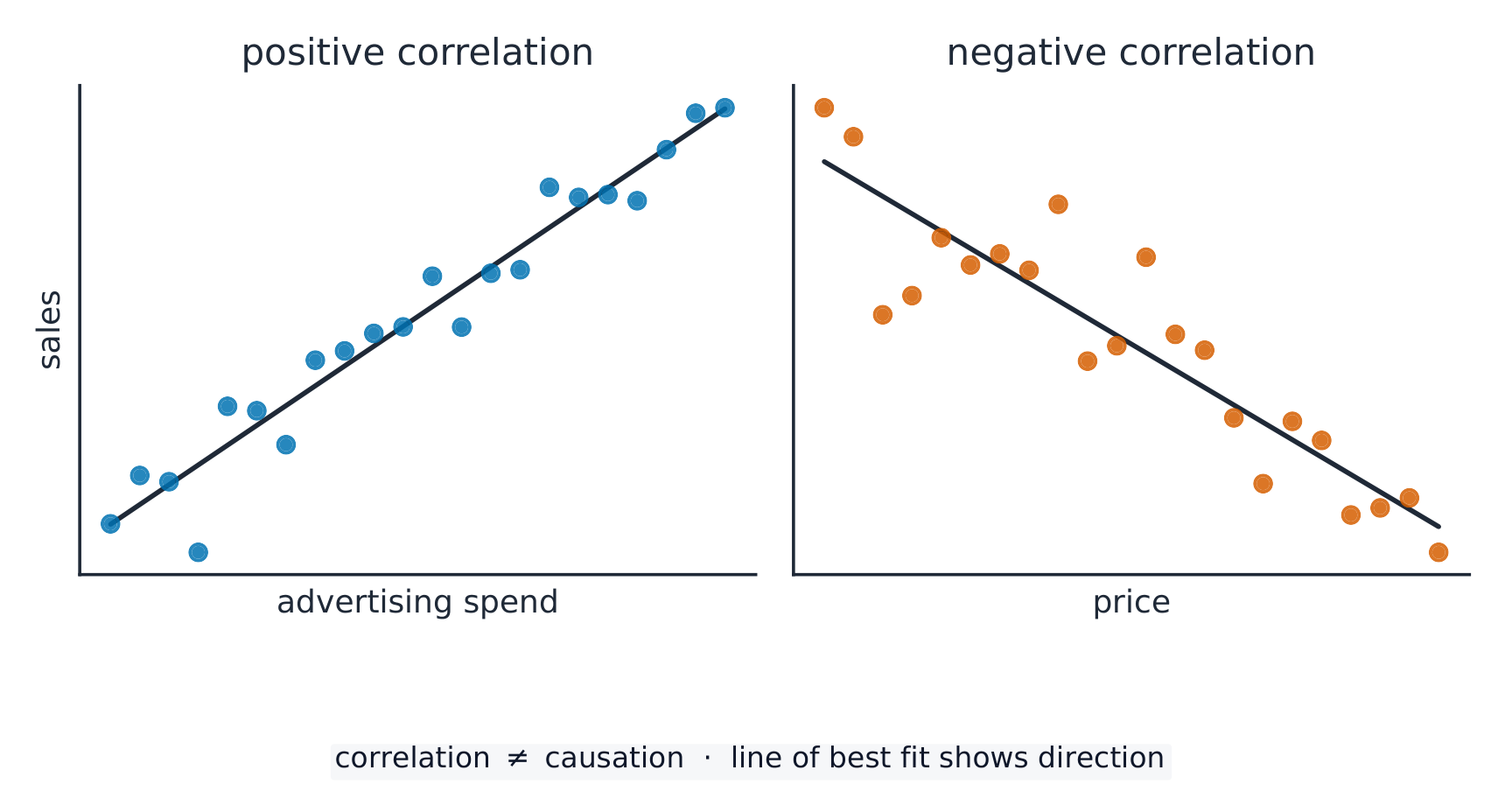
Correlation 相关性 measures how strongly two things move together — for example, advertising spending and sales.
- positive correlation 正相关 — when one rises, the other rises too.
- negative correlation 负相关 — when one rises, the other falls.
Strong correlation helps a firm predict, but it does not prove that one thing causes the other. Other factors may be at work.
探索
相关性与最佳拟合线
改变关系的强度。最佳拟合线让企业发现趋势并据此进行预测。
词汇
训练
| English | 中文 | 拼音 |
|---|---|---|
| correlation/ˌkɒrɪˈleɪʃn/ | 相关性 | xiāng guān xìng |
| positive correlation/ˈpɒzɪtɪv ˌkɒrɪˈleɪʃn/ | 正相关 | zhèng xiāng guān |
| negative correlation/ˈneɡətɪv ˌkɒrɪˈleɪʃn/ | 负相关 | fù xiāng guān |
8.1
在营销决策中运用弹性

English
Elasticity 弹性 measures how much demand reacts to a change. Three types guide marketing decisions.
- price elasticity of demand 需求价格弹性 (PED) — for a price elastic 富有弹性 product, cutting the price raises total revenue; for a price inelastic 缺乏弹性 product, raising the price raises total revenue.
- income elasticity of demand 需求收入弹性 (YED) — tells a firm how sales will change as incomes rise or fall, which helps plan for booms and recessions.
- cross elasticity of demand 需求交叉弹性 (XED) — tells a firm how a rival's price change, or the price of a partner product, will affect its own sales.
So elasticity helps a firm set prices, choose products, and predict the effect of a competitor's move.
Worked example. Quarterly sales run Q1 100, Q2 140, Q3 180, Q4 120, then next Q1 108. Find the four-quarter moving-average trend centred on Q3, and the seasonal variation for Q3. Average the first four quarters: $(100 + 140 + 180 + 120) \div 4 = 135$. Average the next four: $(140 + 180 + 120 + 108) \div 4 = 137$. A four-period average falls between quarters, so centre the two: $(135 + 137) \div 2 = 136$, the trend at Q3. The seasonal variation is actual minus trend: $180 - 136 =$ +44, so Q3 runs about 44 units above trend, and next year's Q3 forecast is the projected trend plus 44. The centring step is the one most answers drop: with an even number of periods the average lands between two quarters and must be centred before it can be compared with an actual figure.
词汇
训练
| English | 中文 | 拼音 |
|---|---|---|
| elasticity/ɪlæˈstɪsɪti/ | 弹性 | tán xìng |
| price elasticity of demand/praɪs ɪlæˈstɪsɪti ɒv dɪˈmænd/ | 需求价格弹性 | xū qiú jià gé tán xìng |
| price elastic/praɪs ɪˈlæstɪk/ | 富有弹性 | fù yǒu tán xìng |
| price inelastic/praɪs ɪnɪˈlæstɪk/ | 缺乏弹性 | quē fá tán xìng |
| income elasticity of demand/ˈɪŋkʌm ɪlæˈstɪsɪti ɒv dɪˈmænd/ | 需求收入弹性 | xū qiú shōu rù tán xìng |
| cross elasticity of demand/krɒs ɪlæˈstɪsɪti ɒv dɪˈmænd/ | 需求交叉弹性 | xū qiú jiāo chā tán xìng |
8.2
营销战略

教学大纲
- 解释营销规划和营销策略(安索夫矩阵,产品组合分析)
- 解释如何调整营销策略以进入国际市场
来源:Cambridge International 教学大纲
English
A marketing strategy 营销战略 is the long-term plan for how marketing will meet the firm's objectives. Marketing planning 营销规划 is the work of setting that plan: studying the market, choosing target customers, and deciding the marketing mix. Two tools shape strategy: Ansoff's matrix and product portfolio analysis.
探索
安索夫战略实验室
根据产品和市场风险对增长选择进行分类。
词汇
训练
| English | 中文 | 拼音 |
|---|---|---|
| marketing strategy/ˈmɑːkɪtɪŋ ˈstrætədʒi/ | 营销战略 | yíng xiāo zhàn lüè |
| marketing planning/ˈmɑːkɪtɪŋ ˈplænɪŋ/ | 营销规划 | yíng xiāo guī huà |
8.2
安索夫矩阵
English
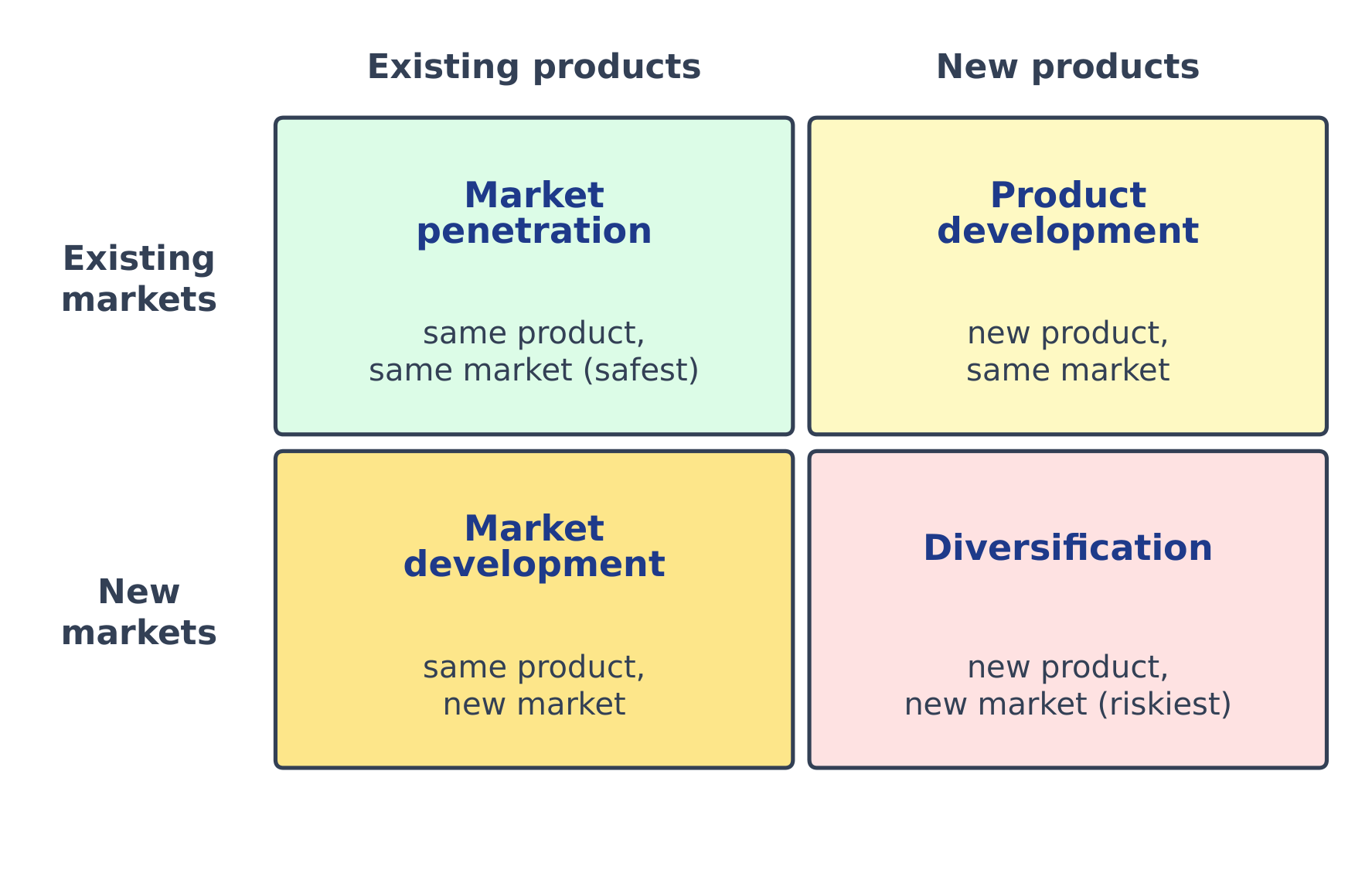
Ansoff's matrix 安索夫矩阵 shows four ways to grow, by mixing existing or new products with existing or new markets. The risk rises as you move away from what you know.
| Existing products | New products | |
|---|---|---|
| Existing markets | market penetration 市场渗透 (sell more to current buyers) | product development 产品开发 (new products for current buyers) |
| New markets | market development 市场开发 (current products to new buyers) | diversification 多元化 (new products and new markets) |
Market penetration is the safest; diversification is the riskiest because both the product and the market are new.
词汇
训练
| English | 中文 | 拼音 |
|---|---|---|
| Ansoff's matrix/ˈænsɒfs ˈmeɪtrɪks/ | 安索夫矩阵 | ān suǒ fū jǔ zhèn |
| market penetration/ˈmɑːkɪt ˌpenɪˈtreɪʃn/ | 市场渗透 | shì chǎng shèn tòu |
| product development/ˈprɒdʌkt dɪˈveləpmənt/ | 产品开发 | chǎn pǐn kāi fā |
| market development/ˈmɑːkɪt dɪˈveləpmənt/ | 市场开发 | shì chǎng kāi fā |
| diversification/daɪˌvɜːsɪfɪˈkeɪʃn/ | 多元化 | duō yuán huà |
8.2
产品组合分析
English
Product portfolio analysis 产品组合分析 looks at the firm's whole range of products together, using a tool like the Boston Matrix. It checks the balance: a firm needs some steady earners to fund its risky new products. The aim is a healthy mix, so the firm is not left with only ageing products.
探索
平衡产品组合
拖动每种产品的份额和增长率——健康的投资组合能让现金牛产品资助明星产品和问号产品,以替代前者。
词汇
训练
| English | 中文 | 拼音 |
|---|---|---|
| product portfolio analysis/ˈprɒdʌkt pɔːtˈfəʊlɪəʊ əˈnæləsɪs/ | 产品组合分析 | chǎn pǐn zǔ hé fēn xī |
8.2
进入国际市场

English
To grow, many firms sell abroad. Globalisation 全球化 (the world becoming more connected) has made this easier. A firm can enter a new country by exporting 出口, by setting up a joint venture 合资企业 with a local partner, or by opening its own branch there.
But a strategy that works at home may need changes. Localisation 本地化 means adapting the marketing mix to the new market — for example, changing the product, the language, the price, or the way it is sold to suit local tastes, laws and incomes.
探索
国际市场实验室
观察进入世界市场如何改变数量和价格压力。
词汇
训练
| English | 中文 | 拼音 |
|---|---|---|
| globalisation/ˌɡləʊbəlaɪˈzeɪʃn/ | 全球化 | quán qiú huà |
| exporting/ekˈspɔːtɪŋ/ | 出口 | chū kǒu |
| joint venture/dʒɔɪnt ˈventʃə/ | 合资企业 | hé zī qǐ yè |
| localisation/ˌləʊkəlaɪˈzeɪʃn/ | 本地化 | běn dì huà |
8.2
考试技巧
English
- Read time-series data: separate the underlying trend from seasonal variation, and extrapolate with caution.
- Interpret correlation (strength and direction) but never assume it proves causation.
- Use Ansoff's matrix to classify a growth strategy and judge its risk (diversification is riskiest).
- Use elasticity values to justify a pricing or promotion decision numerically.
Vocabulary card meanings
marketing analysis: Using market data to judge products, buyers and rivals. time-series analysis: Studying figures over time to find trend, seasonal and random movements. seasonal variation: A regular rise or fall that repeats at the same time each year. product portfolio analysis: Judging the mix of products a firm sells, often with a share-growth grid.
该知识点的互动课程
逐步完成,配合即时检查练习。