Sales forecasting and time-series · 销售预测和时间序列
| English | 中文 | Pinyin · 拼音 |
|---|---|---|
| sales forecasting/seɪlz ˈfɔːkæstɪŋ/ | 销售预测 | xiāo shòu yù cè |
| time series/taɪm ˈsɪəriːz/ | 时间序列 | shí jiān xù liè |
| trend/trend/ | 趋势 | qū shì |
| seasonal/ˈsiːzənl/ | 季节性 | jì jié xìng |
| moving average/ˈmuːvɪŋ ˈævrɪdʒ/ | 移动平均 | yí dòng píng jūn |
| extrapolation/ekˈstræpəleɪʃn/ | 外推 | wài tuī |
Predicting next quarter's sales
- How many units should the factory make next quarter? Order too much and stock piles up; too little and you lose sales.
- Sales forecasting 销售预测 uses past data to predict the future.
预测下一季度的销售
- 工厂下一季度应该制造多少单位?订得太多,库存堆积;太少,你失去销售。
- 销售预测(sales forecasting)用过去的数据预测未来。
Sales forecast lab · 销售预测实验室
sales = trend + seasonal effect · 销售额 = 趋势 + 季节性效应
Move along a sales trend and see how forecast and actual can separate. · 沿销售趋势移动,观察预测值与实际值如何分离。
A time series is data that is: · 时间序列数据是指:
A time series records a variable over regular periods. · 时间序列记录了固定时期内的变量。
The long-run underlying direction of a time series is its . · 时间序列的长期潜在方向是其。
The trend is what moving averages reveal. · 趋势正是移动平均所揭示的内容。
Time-series 时间序列 analysis
- A time series is data recorded over regular intervals (e.g. quarterly sales).
- It splits into a long-run trend 趋势, seasonal 季节性 variation, and random noise.
Sales wobble seasonally around an underlying upward trend.
时间序列分析
- 一个时间序列(time series)是以规则间隔记录的数据(例如季度销售)。
- 它分成一个长期趋势(trend)、季节性(seasonal)变化和随机噪音。
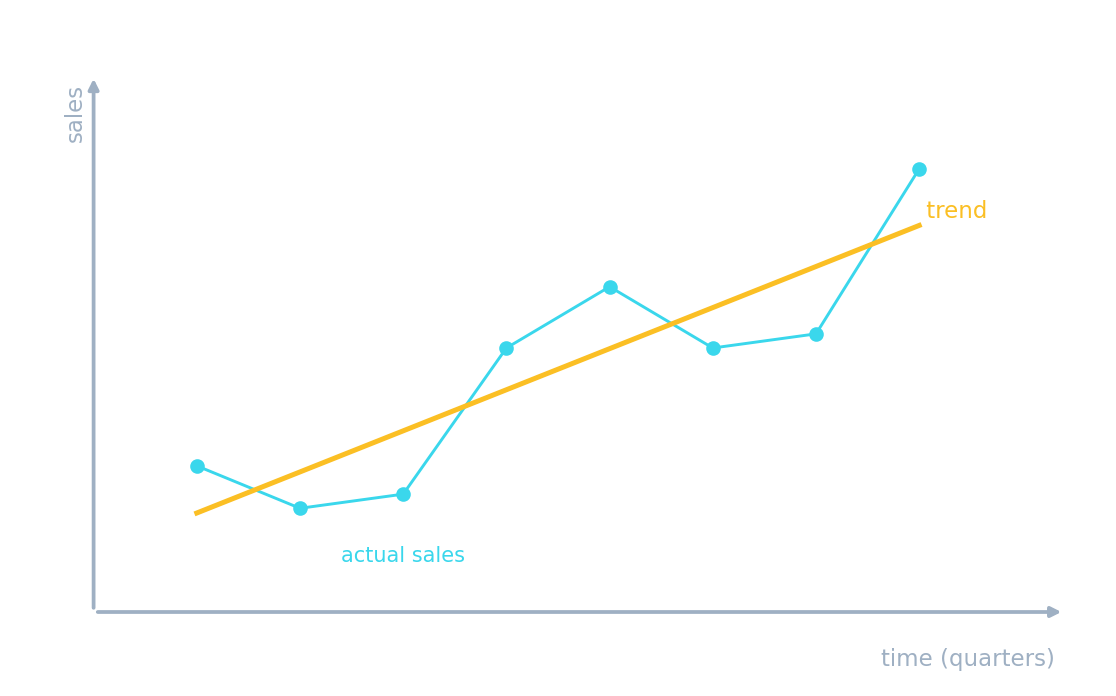
销售在一个潜在的上升趋势周围季节性地摆动。
Sales over four quarters are 30, 34, 28, 32. What is the 4-quarter moving average? · 四个季度的销售额分别为 30, 34, 28, 32。4季度移动平均数是多少?
(30 + 34 + 28 + 32) ÷ 4 = 124 ÷ 4 = 31.
The main purpose of a moving average is to: · 移动平均的主要目的是:
It smooths the data so the trend stands out. · 它平滑了数据,使趋势凸显。
Moving averages 移动平均
- A moving average smooths out short-term ups and downs to reveal the trend.
- A 4-quarter moving average averages each set of four consecutive quarters.
Worked example. Sales of 20, 24, 18, 26 over four quarters average to (20+24+18+26) ÷ 4 = 22 — the smoothed trend value, with the seasonal swings averaged out.
Sales wobble seasonally around a smooth underlying trend
移动平均
- 一个移动平均(moving average)平滑短期的起伏以揭示趋势。
- 一个 4 季度移动平均把每一组四个连续的季度求平均。
例题。 四个季度 20、24、18、26 的销售平均为(20+24+18+26)÷ 4 = 22——平滑后的趋势值,季节性波动被平均掉。

销售在一个平滑的潜在趋势周围季节性地摆动
Extrapolation assumes the future will follow the past trend. · 外推法假设未来将遵循过去的趋势。
That assumption fails if conditions change. · 如果条件发生变化,该假设就会失效。
Extrapolation 外推 and its limits
- Extrapolation extends the past trend into the future to forecast.
- It assumes the future behaves like the past — risky if conditions change (a new rival, a recession).
Forecasts are not facts. Extrapolation only works while the trend holds. A sudden shock — new competitor, technology, downturn — can make a confident forecast badly wrong.
外推及其局限
- 外推(extrapolation)把过去的趋势延伸到未来以预测。
- 它假设未来表现得像过去——如果条件改变(一个新对手、一次衰退)就冒险。
预测不是事实。 外推只在趋势保持时起作用。一个突然的冲击——新竞争者、技术、衰退——能使一个自信的预测严重错误。
You've got it
- a time series splits into trend, seasonal variation and noise
- a moving average smooths data to reveal the underlying trend
- extrapolation projects the trend forward — risky if conditions change
你掌握了
- 一个时间序列分成趋势、季节性变化和噪音
- 一个移动平均平滑数据以揭示潜在趋势
- 外推把趋势向前投射——如果条件改变就冒险