- 解释组织结构(层级制、指挥链、控制幅度、集权、分权、扁平化、矩阵结构)
- 解释授权、问责制以及组织结构对业务绩效的影响
人力资源管理(A Level)
A-Level 商业 · 知识点 7
 8:37
组织、领导力与人力资源
一位董事说:本季度削减成本百分之五。指令传至高级经理,再到部门负责人,接着是主管,最后到团队。等到……
英语旁白 · 英中内嵌字幕
7.1
组织结构
教学大纲
来源:Cambridge International 教学大纲
English
An organisational structure 组织结构 shows how a business arranges its people: who reports to whom, and who does what. A good structure makes roles clear and helps the firm meet its objectives. It is often drawn as an organisation chart.
探索
选择所有权形式
比较真实企业类型中的所有制权、控制权和责任。
词汇
训练
| English | 中文 | 拼音 |
|---|---|---|
| organisational structure/ˌɔːɡənaɪˈzeɪʃənl ˈstrʌktʃə/ | 组织结构 | zǔ zhī jié gòu |
7.1
组织结构的关键术语

English
- a hierarchy 层级 is the set of levels in a firm, from the top managers down to the shop-floor workers. A "tall" structure has many levels; a "flat" structure has few.
- the chain of command 指挥链 is the line along which orders pass down, from the top to the bottom.
- the span of control 管理幅度 is the number of staff one manager is directly in charge of. A wide span means many staff per manager; a narrow span means few.
A tall structure has narrow spans and a long chain of command, so messages travel slowly. A flat structure has wide spans, so managers must trust staff more.

词汇
训练
| English | 中文 | 拼音 |
|---|---|---|
| hierarchy/ˈhaɪərɑːki/ | 层级 | céng jí |
| chain of command/tʃeɪn ɒv kəˈmænd/ | 指挥链 | zhǐ huī liàn |
| span of control/spæn ɒv kənˈtrəʊl/ | 管理幅度 | guǎn lǐ fú dù |
7.1
集权与分权

English
- centralisation 集权 — most decisions are made at the top. This gives strong control and quick, consistent decisions, but ignores local knowledge.
- decentralisation 分权 — decisions are shared out to lower levels and local branches. This speeds up decisions and motivates staff, but control is weaker.
Most firms sit somewhere between the two.
词汇
训练
| English | 中文 | 拼音 |
|---|---|---|
| centralisation/ˌsentrəlaɪˈzeɪʃn/ | 集权 | jí quán |
| decentralisation/dɪˌsentrəlaɪˈzeɪʃn/ | 分权 | fēn quán |
7.1
扁平化与矩阵结构

English
Delayering 精简层级 means removing one or more levels of management. It cuts cost and shortens the chain of command, but it gives the remaining managers more to do.
A matrix structure 矩阵结构 groups staff by both their department and the project they work on, so a worker may report to two managers. It is good for teamwork across departments, but the two-boss system can cause confusion.
探索
商业案例实验室
对真实决策进行分类,使主要商业概念具体化。
词汇
训练
| English | 中文 | 拼音 |
|---|---|---|
| delayering/dɪˈleɪərɪŋ/ | 精简层级 | jīng jiǎn céng jí |
| matrix structure/ˈmeɪtrɪks ˈstrʌktʃə/ | 矩阵结构 | jǔ zhèn jié gòu |
7.1
授权与问责

English
Delegation 授权 means a manager gives a task, and the power to do it, to a more junior worker. It frees the manager's time, develops staff, and motivates them.
But a manager who delegates is still accountable — the accountability 问责 for the result stays with them. So managers must delegate to people they trust, and still check the outcome.
Worked example. A firm has 5 levels of hierarchy and a span of control of 4. It delayers to a span of 8. What changes, and what is the risk? A wider span means each manager handles more subordinates, so fewer managers are needed at each level and the structure becomes flatter and wider. Communication improves, because a message now passes through fewer levels, and the wage bill falls. The risks are real too: each manager now supervises 8 people instead of 4, so there is less time per subordinate and weaker control; workloads rise; and the staff who remain lose promotion rungs, which can demotivate. Link the span of control to the number of levels - for the same workforce, a wider span always gives a flatter structure - and present the trade-off as speed and cost against control and supervision.
词汇
训练
| English | 中文 | 拼音 |
|---|---|---|
| delegation/ˌdelɪˈɡeɪʃn/ | 授权 | shòu quán |
| accountability/əˌkaʊntəˈbɪlɪti/ | 问责 | wèn zé |
7.2
企业沟通

教学大纲
- 解释有效沟通的过程、方法和重要性
- 解释沟通障碍以及如何改善商务环境中的沟通
来源:Cambridge International 教学大纲
English
Communication 沟通 is the passing of a message from one person to another. Effective communication follows a clear path:
- a sender 发送者 has a message.
- the message is sent through a medium 媒介 (e.g. a meeting, email or notice).
- a receiver 接收者 takes in the message.
- feedback 反馈 shows the message was understood.
Good communication raises motivation, cuts mistakes, and speeds up decisions. Methods can be verbal (spoken), written, or visual; the best method depends on the message, the cost, and the need for a record.
探索
沟通路线实验室
观察信息从发送者移动到反馈,并查看噪音可能进入的位置。
词汇
训练
| English | 中文 | 拼音 |
|---|---|---|
| communication/kəˌmjuːnɪˈkeɪʃn/ | 沟通 | gōu tōng |
| sender/ˈsendə/ | 发送者 | fā sòng zhě |
| medium/ˈmiːdɪəm/ | 媒介 | méi jiè |
| receiver/rɪˈsiːvə/ | 接收者 | jiē shōu zhě |
| feedback/ˈfiːdbæk/ | 反馈 | fǎn kuì |
7.2
沟通的障碍
English
A barrier 障碍 is anything that stops a message getting through clearly. Common barriers are:
- a message that is too long or unclear.
- a poor medium (e.g. a noisy phone line).
- too many levels in the hierarchy, so the message is changed on the way.
- language or cultural differences, and lack of trust.
To improve communication, a firm can shorten the chain of command, choose the right medium, keep messages short and clear, and always ask for feedback.
词汇
训练
| English | 中文 | 拼音 |
|---|---|---|
| barrier/ˈbærɪə/ | 障碍 | zhàng ài |
7.3
领导力

教学大纲
- 解释领导风格(专制型、民主型、家长式、放任型)及领导理论
- 解释情商以及有效领导在管理变革中的重要性
来源:Cambridge International 教学大纲
English
A leadership style 领导风格 is the way a leader 领导 makes decisions and treats staff. Four styles are:
| Style | How decisions are made |
|---|---|
| autocratic 专制型 | the leader decides alone and tells staff what to do |
| democratic 民主型 | the leader asks staff for ideas before deciding |
| paternalistic 家长式 | the leader decides, but in what they see as the staff's best interests |
| laissez-faire 放任型 | the leader gives staff freedom to decide for themselves |
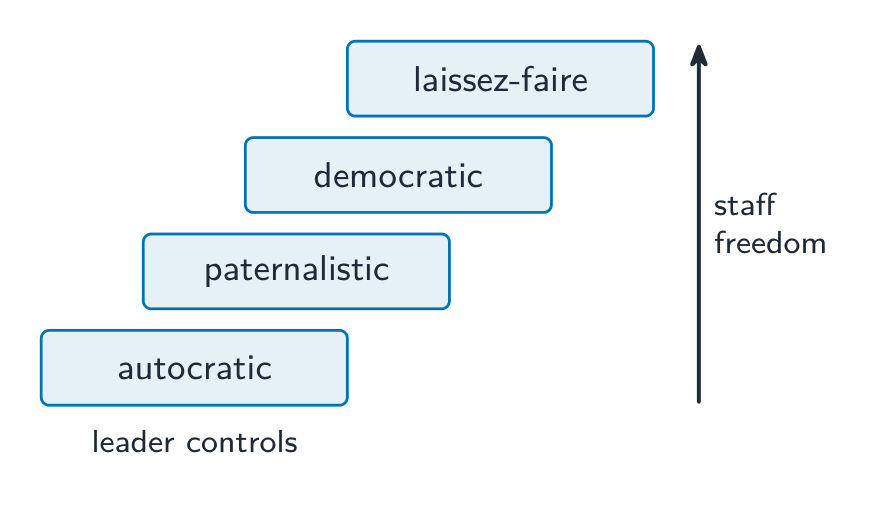
No style is always best. The right one depends on the task, the staff, and the time available — an urgent crisis may need an autocratic style, while skilled staff may work best under a democratic or laissez-faire one.
探索
领导风格实验室
选择适合每种情况的管理风格。
词汇
训练
| English | 中文 | 拼音 |
|---|---|---|
| leadership style/ˈliːdəʃɪp staɪl/ | 领导风格 | lǐng dǎo fēng gé |
| leader/ˈliːdə/ | 领导 | lǐng dǎo |
| autocratic/ˌɔːtəʊˈkrætɪk/ | 专制型 | zhuān zhì xíng |
| democratic/ˌdeməˈkrætɪk/ | 民主型 | mín zhǔ xíng |
| paternalistic/pəˌtɜːnəˈlɪstɪk/ | 家长式 | jiā zhǎng shì |
| laissez-faire/ˈleɪsez feə/ | 放任型 | fàng rèn xíng |
7.3
情商与引领变革
English
Emotional intelligence 情商 is a leader's skill in understanding their own and other people's feelings, and managing them well. Leaders with high emotional intelligence build trust and handle conflict better.
This matters most when leading change. People often resist change because they fear losing their job or status. A good leader explains why the change is needed, involves staff, and supports them through it.
词汇
训练
| English | 中文 | 拼音 |
|---|---|---|
| emotional intelligence/ɪˈməʊʃənl ɪnˈtelɪdʒəns/ | 情商 | qíng shāng |
7.4
人力资源管理战略
教学大纲
- 解释**硬性人力资源管理和软性人力资源管理(hard and soft HRM)以及劳动力规划(workforce planning)**的应用
- 解释变革管理、雇主与雇员关系以及**工会(trade unions)**的作用
来源:Cambridge International 教学大纲
English
There are two broad approaches to human resource management 人力资源管理 (HRM):
- hard HRM 硬性人力资源管理 treats staff as a resource like any other — to be used at the lowest cost. It uses tight control and short-term contracts.
- soft HRM 软性人力资源管理 treats staff as the firm's most valuable asset — to be developed and motivated. It uses training, involvement and long-term careers.
Both link to workforce planning 人力规划: working out the staff the firm will need, and how to get them.
探索
人力资源决策实验室
根据其在劳动力中承担的工作对人力资源行动进行分类。
词汇
训练
| English | 中文 | 拼音 |
|---|---|---|
| human resource management/ˈhjuːmən rɪˈzɔːs ˈmænɪdʒmənt/ | 人力资源管理 | rén lì zī yuán guǎn lǐ |
| hard HRM/hɑːd ˌeɪtʃ ɑː ˈem/ | 硬性人力资源管理 | yìng xìng rén lì zī yuán guǎn lǐ |
| soft HRM/sɒft ˌeɪtʃ ɑː ˈem/ | 软性人力资源管理 | ruǎn xìng rén lì zī yuán guǎn lǐ |
| workforce planning/ˈwɜːkfɔːs ˈplænɪŋ/ | 人力规划 | rén lì guī huà |
7.4
劳资关系与工会
English
The management of change 变革管理 works best when employer-employee relations 劳资关系 (the link between bosses and workers) are good.
A trade union 工会 is an organised group of workers that speaks for its members. Through collective bargaining 集体谈判, the union and the employer negotiate pay and conditions for the whole group, instead of one worker at a time. If talks fail, workers may take industrial action 劳工行动, such as a strike 罢工 (stopping work). Good relations and fair negotiation avoid this and keep the business running.
词汇
训练
| English | 中文 | 拼音 |
|---|---|---|
| management of change/ˈmænɪdʒmənt ɒv tʃeɪndʒ/ | 变革管理 | biàn gé guǎn lǐ |
| employer-employee relations/emˈplɔɪə emˈplɔɪiː rɪˈleɪʃnz/ | 劳资关系 | láo zī guān xì |
| trade union/treɪd ˈjuːnɪən/ | 工会 | gōng huì |
| collective bargaining/kəˈlektɪv ˈbɑːɡɪnɪŋ/ | 集体谈判 | jí tǐ tán pàn |
| industrial action/ɪnˈdʌstrɪəl ˈækʃn/ | 劳工行动 | láo gōng háng dòng |
| strike/straɪk/ | 罢工 | bà gōng |
7.4
考试技巧
English
- Read an organisation chart: span of control, chain of command and levels of hierarchy.
- Compare tall vs flat structures and centralisation vs decentralisation (tight control vs local responsiveness).
- Distinguish hard vs soft HRM (workers as a cost versus as an asset).
- Explain how trade unions and good communication shape employer-employee relations.
Vocabulary card meanings
sender: The person who starts a message. receiver: The person a message is aimed at. barrier: Something that stops a message or a plan from getting through. employer-employee relations: How managers and staff deal with each other at work. strike: A refusal by staff to work, used as pressure in a dispute.
该知识点的互动课程
逐步完成,配合即时检查练习。