English
- explain the meanings of the terms haploid (n) and diploid (2n)
- explain what is meant by homologous pairs of chromosomes
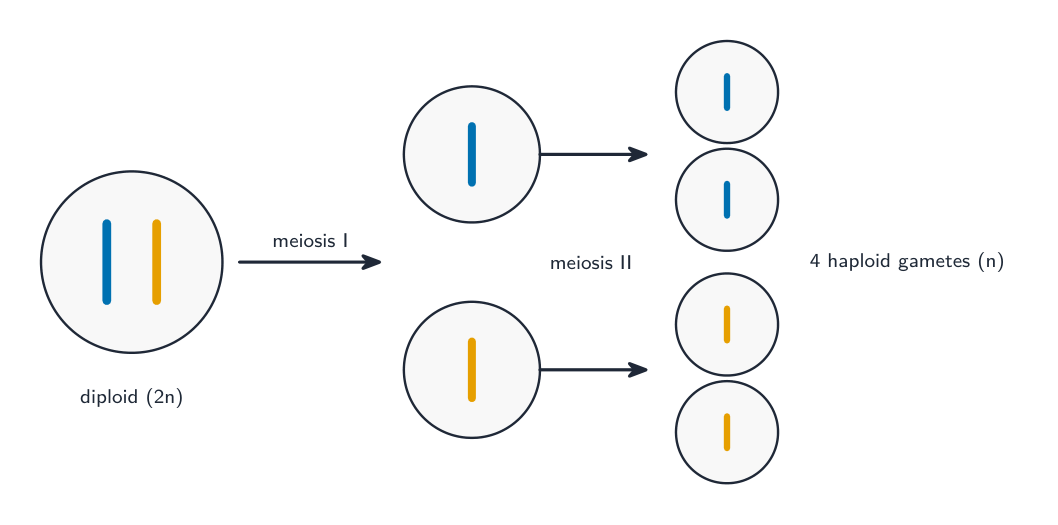
- explain the need for a reduction division during meiosis in the production of gametes
- describe the behaviour of chromosomes in plant and animal cells during meiosis and the associated behaviour of the nuclear envelope, the cell surface membrane and the spindle (names of the main stages of meiosis, but not the sub-divisions of prophase I, are expected: prophase I, metaphase I, anaphase I, telophase I, prophase II, metaphase II, anaphase II and telophase II)
- interpret photomicrographs and diagrams of cells in different stages of meiosis and identify the main stages of meiosis
- explain that crossing over and random orientation (independent assortment) of pairs of homologous chromosomes and sister chromatids during meiosis produces genetically different gametes
- explain that the random fusion of gametes at fertilisation produces genetically different individuals
Tiếng Việt
- Giải thích ý nghĩa của các thuật ngữ lưỡng bội (n) và bội (2n)
- Giải thích ý nghĩa của cặp nhiễm sắc thể tương đồng
- Giải thích nhu cầu cần thiết phải phân chia giảm phân trong giảm phân để tạo ra giao tử
- Mô tả hành vi của nhiễm sắc thể trong tế bào thực vật và động vật trong quá trình giảm phân và hành vi liên quan của màng nhân, màng tế bào và thoi vô định (các tên gọi các giai đoạn chính của giảm phân, nhưng không bao gồm các phân đoạn của kỳ đầu I, là yêu cầu: kỳ đầu I,中期 I, kỳ sau I, kỳ cuối I, kỳ đầu II,中期 II, kỳ sau II và kỳ cuối II)
- Diễn giải ảnh chụp quang học và sơ đồ tế bào ở các giai đoạn khác nhau của giảm phân và xác định các giai đoạn chính của giảm phân
- giải thích rằng trộn chéo và sự sắp xếp ngẫu nhiên (phân li độc lập) của các cặp nhiễm sắc thể tương đồng và chromatid chị em trong quá trình giảm phân tạo ra giao tử khác nhau về mặt di truyền
- giải thích rằng sự hợp nhất ngẫu nhiên của các giao tử tại thụ tinh tạo ra các cá thể khác nhau về mặt di truyền