- describe the features of the endocrine system with reference to the hormones ADH, glucagon and insulin (see 14.1.8, 14.1.9 and 14.1.10)
- compare the features of the nervous system and the endocrine system
- describe the structure and function of a sensory neurone and a motor neurone and state that intermediate neurones connect sensory neurones and motor neurones
- outline the role of sensory receptor cells in detecting stimuli and stimulating the transmission of impulses in sensory neurones
- describe the sequence of events that results in an action potential in a sensory neurone, using a chemoreceptor cell in a human taste bud as an example
- describe and explain changes to the membrane potential of neurones, including: • how the resting potential is maintained • the events that occur during an action potential • how the resting potential is restored during the refractory period
- describe and explain the rapid transmission of an impulse in a myelinated neurone with reference to saltatory conduction
- explain the importance of the refractory period in determining the frequency of impulses
- describe the structure of a cholinergic synapse and explain how it functions, including the role of calcium ions
- describe the roles of neuromuscular junctions, the T-tubule system and sarcoplasmic reticulum in stimulating contraction in striated muscle
- describe the ultrastructure of striated muscle with reference to sarcomere structure using electron micrographs and diagrams
- explain the sliding filament model of muscular contraction including the roles of troponin, tropomyosin, calcium ions and ATP
Control and coordination
A-Level Biology · Topic 15
 9:38
9:38
Nerves and Muscles
Touch something hot and your hand is already moving before you feel the pain. The signal never went to your brain to ask permission. It ran into the spinal…
English narration · English + 中文 subtitles burned in
15.1
Two systems for control

Syllabus
Source: Cambridge International syllabus
The body has two coordination systems. The endocrine system 内分泌系统 sends chemical hormones 激素 (such as ADH, glucagon and insulin) in the blood. The nervous system 神经系统 sends fast electrical signals along nerve cells.

| Feature | Nervous system | Endocrine system |
|---|---|---|
| signal | electrical impulse 冲动 | chemical hormone |
| transport | along nerve cells | in the blood |
| speed | very fast | slower |
| how long it lasts | short | longer |
Vocabulary
Train
| English |
|---|
| endocrine system/ˈendəʊkraɪn ˈsɪstəm/ |
| hormone/ˈhɔːməʊn/ |
| nervous system/ˈnɜːvəs ˈsɪstəm/ |
| impulse/ˈɪmpʌls/ |
15.1
Neurones

A neurone 神经元 is a nerve cell. There are three kinds:
- a sensory neurone 感觉神经元 carries impulses from a receptor towards the brain or spinal cord.
- a motor neurone 运动神经元 carries impulses out to an effector, such as a muscle 肌肉.
- intermediate neurones 中间神经元 connect sensory neurones to motor neurones.
A neurone has a long fibre (the axon) along which the impulse travels.
This is what real neurones look like in a stained slice of brain tissue:

Explore
Explore a motor neurone
Tap each part. The impulse travels from the cell body down the long axon to the terminals, jumping between the myelin gaps.
Vocabulary
Train
| English |
|---|
| neurone/ˈnjuːrəʊn/ |
| sensory neurone/ˈsensəri ˈnjuːrəʊn/ |
| motor neurone/ˈməʊtə ˈnjuːrəʊn/ |
| muscle/ˈmʌsl/ |
| intermediate neurone/ˌɪntəˈmiːdɪət ˈnjuːrəʊn/ |
15.1
Detecting a stimulus

A sensory receptor 感受器 cell detects a stimulus 刺激 and starts an impulse in a sensory neurone. For example, a chemoreceptor 化学感受器 cell in a taste bud 味蕾 detects chemicals in food, and this triggers an action potential 动作电位 in the sensory neurone.
Vocabulary
Train
| English |
|---|
| sensory receptor/ˈsensəri rɪˈseptə/ |
| stimulus/ˈstɪmjʊləs/ |
| chemoreceptor/ˌkiːməʊˈreseptə/ |
| taste bud/teɪst bʌd/ |
| action potential/ˈækʃn pəˈtenʃl/ |
15.1
The nerve impulse
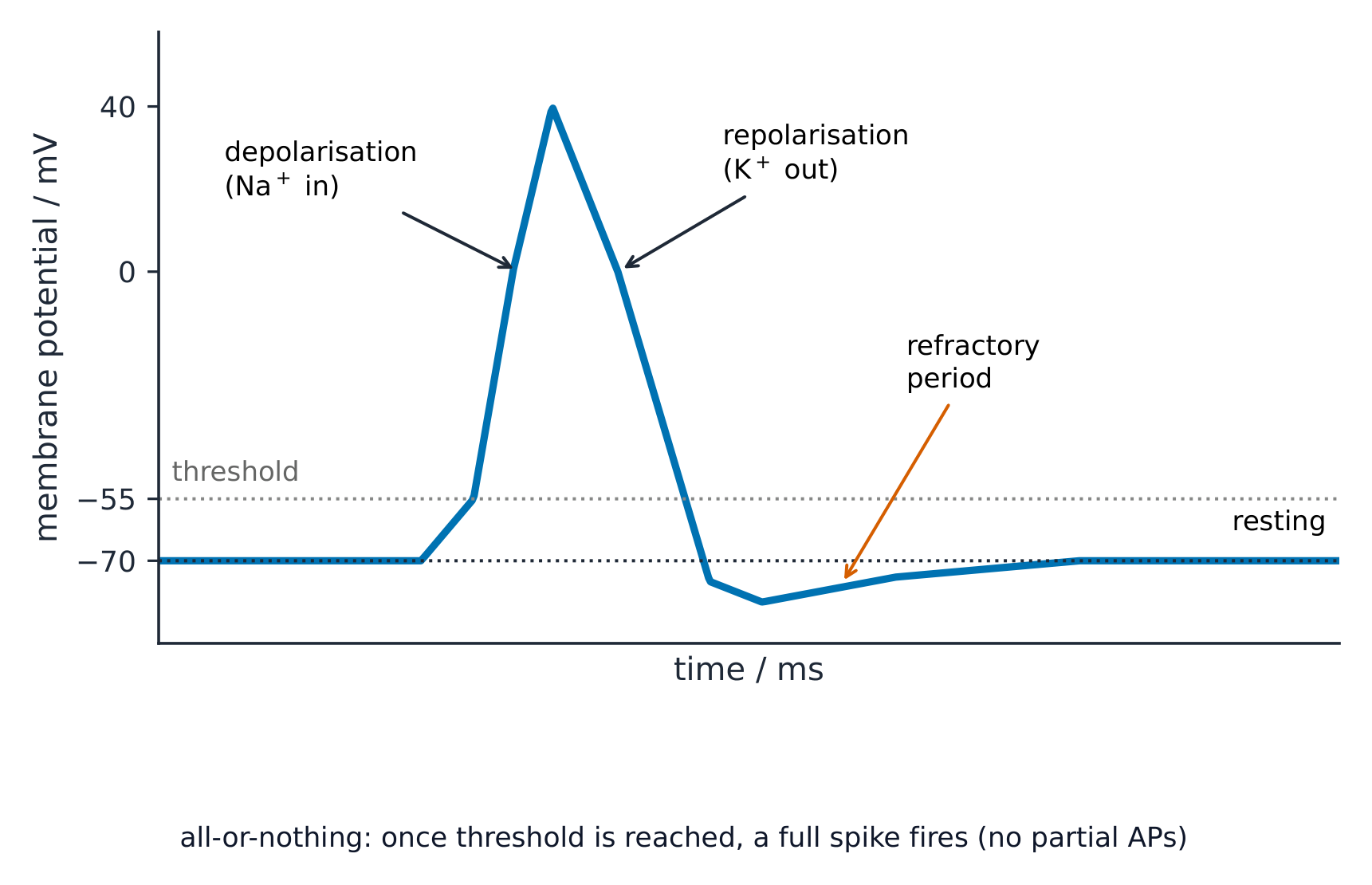
The impulse is a change in the voltage across the neurone's membrane.
- resting potential 静息电位 — when no impulse passes, the inside is negative compared to the outside. This is maintained by a pump that moves sodium ions out and potassium ions in, and by the membrane being more permeable to potassium.
- action potential — a stimulus makes sodium channels open, so sodium ions rush in and the inside briefly becomes positive (depolarisation). Then potassium channels open, potassium ions leave, and the membrane potential 膜电位 returns to negative (repolarisation).
- refractory period 不应期 — just after an action potential, the sodium channels cannot open again for a short time. This restores the resting potential and sets a limit on how often impulses can be sent (their frequency).
Faster impulses: myelin
Some neurones are wrapped in a fatty myelin sheath 髓鞘. The impulse cannot cross the sheath, so it jumps from one gap to the next. This jumping, called saltatory conduction 跳跃式传导, makes the impulse travel much faster.

Explore
The action potential
Step through one nerve impulse: a rapid depolarisation as Na⁺ enters, then repolarisation as K⁺ leaves, then recovery.
Vocabulary
Train
| English |
|---|
| resting potential/ˈrestɪŋ pəˈtenʃl/ |
| membrane potential/ˈmembreɪn pəˈtenʃl/ |
| refractory period/rɪˈfræktəri ˈpɪərɪəd/ |
| myelin sheath/ˈmaɪɪlɪn ʃiːθ/ |
| saltatory conduction/ˈsɒltətəri kənˈdʌkʃn/ |
15.1
The synapse

A synapse 突触 is a tiny gap between two neurones. A cholinergic synapse 胆碱能突触 passes the signal like this:
- the impulse arrives and makes calcium ions 钙离子 enter the first neurone.
- this makes vesicles release a neurotransmitter 神经递质 called acetylcholine 乙酰胆碱.
- the acetylcholine diffuses across the gap and binds to receptors on the next neurone.
- this starts a new impulse in the next neurone.
Explore
Across a synapse
Step through it. The electrical impulse becomes a chemical one — neurotransmitter carries the signal across the gap.
Vocabulary
Train
| English |
|---|
| synapse/ˈsɪnæps/ |
| cholinergic synapse/ˌkɒlɪˈnɜːdʒɪk ˈsɪnæps/ |
| calcium ion/ˈkælsɪəm ˈaɪɒn/ |
| neurotransmitter/ˈnjuːrətrænsmɪtə/ |
| acetylcholine/ˈæsɪtɪlkəliːn/ |
15.1
Muscles and how they contract

A neuromuscular junction 神经肌肉接头 is like a synapse, but between a motor neurone and a muscle.
Striated muscle 横纹肌 is made of long fibres. Each fibre is divided into repeating units called sarcomeres 肌节. Inside are two kinds of filament 肌丝: thick ones (myosin) and thin ones (actin). The T-tubule T小管 system carries the impulse deep into the fibre, and the sarcoplasmic reticulum 肌质网 stores and releases calcium ions.
The sliding filament model 肌丝滑动模型 explains contraction:
- an impulse causes the sarcoplasmic reticulum to release calcium ions.
- the calcium ions bind to troponin 肌钙蛋白, which makes tropomyosin 原肌球蛋白 move and uncover the binding sites on the actin.
- the myosin heads attach to the actin and pull it inwards, using energy from ATP.
- the thin filaments slide over the thick ones, so each sarcomere gets shorter and the muscle contracts.

Explore
How a muscle contracts
Step through the sliding filament model — calcium uncovers the binding sites, then myosin pulls the actin inwards.
Vocabulary
Train
| English |
|---|
| neuromuscular junction/ˌnjuːrəˈmʌskjʊlə ˈdʒʌŋkʃn/ |
| striated muscle/ˈstraɪeɪtɪd ˈmʌsl/ |
| sarcomere/ˈsɑːkəmɪə/ |
| filament/ˈfɪləmənt/ |
| T-tubule/tiː ˈtjuːbjuːl/ |
| sarcoplasmic reticulum/ˌsɑːkəˈplæzmɪk reˈtɪkjʊləm/ |
| sliding filament model/ˈslaɪdɪŋ ˈfɪləmənt ˈmɒdl/ |
| troponin/ˈtrɒpənɪn/ |
| tropomyosin/ˈtrɒpəmɪɒsɪn/ |
15.2
Control and coordination in plants

Syllabus
- describe the rapid response of the Venus fly trap to stimulation of hairs on the lobes of modified leaves and explain how the closure of the trap is achieved
- explain the role of auxin in elongation growth by stimulating proton pumping to acidify cell walls
- describe the role of gibberellin in the germination of barley (see 16.3.4)
Source: Cambridge International syllabus
The Venus fly trap
The Venus fly trap 捕蝇草 has tiny hairs on its trap-like leaves. When an insect touches the hairs, a fast electrical signal spreads, the cells quickly lose water and change shape, and the trap snaps shut to catch the insect.
Auxin and growth
Auxin 生长素 is a plant hormone that makes cells grow longer (elongation 伸长 growth). It does this by making the cell pump protons 质子 (hydrogen ions) into the cell wall 细胞壁. This acidifies 酸化 the wall, which loosens it, so the cell can stretch as water enters.

Gibberellin and germination
Gibberellin 赤霉素 controls the germination 萌发 of barley 大麦 seeds. It switches on the genes that make amylase, which then breaks down stored starch into sugars to feed the growing seedling.
Worked example. Explain why a nerve impulse crosses a synapse in one direction only, and why myelination speeds it up along an axon. At a synapse the vesicles of neurotransmitter are found only in the presynaptic neurone, and the receptors only on the postsynaptic membrane - so transmitter can only ever cross one way, which makes the synapse a one-way valve. Along a myelinated axon the myelin sheath insulates the membrane, so ions can only cross at the nodes of Ranvier; the impulse therefore jumps from node to node (saltatory conduction) instead of depolarising every part of the membrane in turn, which is far faster and uses less ATP. Locate the structure responsible for each effect: vesicles and receptors give the direction, insulation and nodes give the speed.
Explore
Phototropism: bending to the light
Step through it. Auxin gathers on the shaded side, makes those cells grow longer, and the shoot bends towards the light.
Vocabulary
Train
| English |
|---|
| Venus fly trap/ˈviːnəs flaɪ træp/ |
| auxin/ˈɔːksɪn/ |
| elongation/iːˌlɒnˈɡeɪʃn/ |
| proton/ˈprəʊtɒn/ |
| cell wall/sel wɔːl/ |
| acidify/əˈsɪdɪfaɪ/ |
| gibberellin/ˌdʒɪbəˈrelɪn/ |
| germination/ˌdʒɜːmɪˈneɪʃn/ |
| barley/ˈbɑːli/ |
15.2
Exam tips
- Explain the resting potential (Na+/K+ pump; more negative inside) then the action potential (depolarisation → repolarisation) as all-or-nothing.
- Saltatory conduction (myelin, nodes of Ranvier) speeds the impulse; the refractory period makes it one-way and discrete.
- Describe the synapse in order: Ca2+ enters → vesicles fuse → neurotransmitter → receptors → new impulse.
- Muscle contraction follows the sliding-filament model (actin, myosin, ATP, Ca2+).
Interactive lessons on this topic
Work through it step by step, with instant-check exercises.