- explain the meanings of the terms haploid (n) and diploid (2n)
- explain what is meant by homologous pairs of chromosomes
- explain the need for a reduction division during meiosis in the production of gametes
- describe the behaviour of chromosomes in plant and animal cells during meiosis and the associated behaviour of the nuclear envelope, the cell surface membrane and the spindle (names of the main stages of meiosis, but not the sub-divisions of prophase I, are expected: prophase I, metaphase I, anaphase I, telophase I, prophase II, metaphase II, anaphase II and telophase II)
- interpret photomicrographs and diagrams of cells in different stages of meiosis and identify the main stages of meiosis
- explain that crossing over and random orientation (independent assortment) of pairs of homologous chromosomes and sister chromatids during meiosis produces genetically different gametes
- explain that the random fusion of gametes at fertilisation produces genetically different individuals
Inheritance
A-Level Biology · Topic 16
 9:35
9:35
Genetics
You have twenty three pairs of chromosomes. When a gamete is made, each pair lines up independently — either way round — so the number of different gametes you…
English narration · English + 中文 subtitles burned in
16.1
Meiosis and how it creates variation

Syllabus
Source: Cambridge International syllabus
A diploid 二倍体 cell (2n) has two full sets of chromosomes 染色体 — one set from each parent. A haploid 单倍体 cell (n) has just one set.
Chromosomes come in homologous chromosomes 同源染色体 pairs: the two chromosomes in a pair are the same length and carry the same genes 基因 (though they may carry different versions of them).


Gametes 配子 (sex cells) must be haploid. If they were diploid, the chromosome number would double at every generation. So gametes are made by a special division, meiosis 减数分裂, which halves the chromosome number.
Meiosis has two divisions, one after the other, so there are eight named stages: prophase I, metaphase I, anaphase I and telophase I, then prophase II, metaphase II, anaphase II and telophase II. As in mitosis, the nuclear envelope 核膜 breaks down, a spindle 纺锤体 forms, and the chromosomes are moved by the spindle.
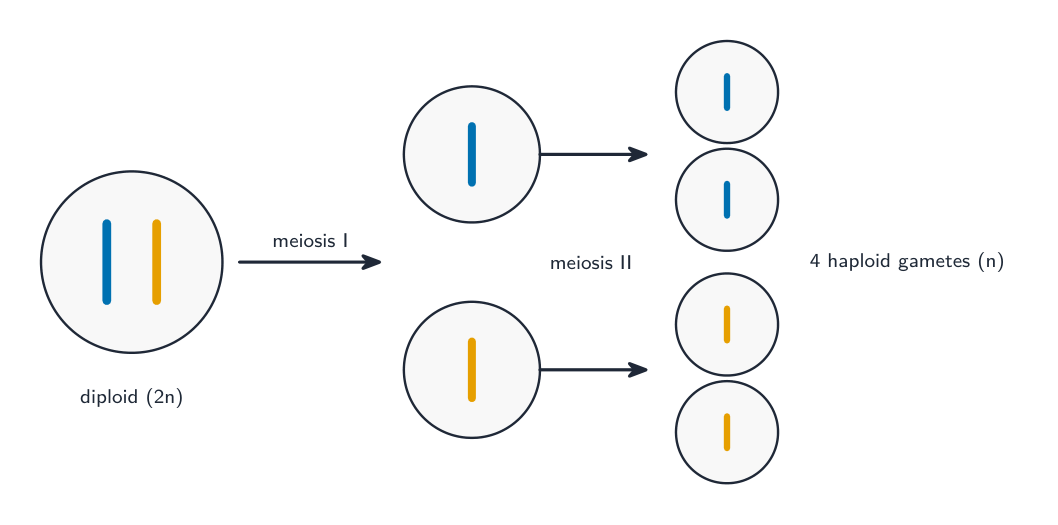
Meiosis makes the gametes genetically different from each other in two ways:
- crossing over 交叉互换 — homologous chromosomes swap matching pieces, mixing the alleles.

- independent assortment 自由组合 — the pairs line up in a random order, so each gamete gets a random mix of the parent's chromosomes.

Then at fertilisation 受精, any gamete can fuse with any other. This random fusion makes every new individual genetically different.
Explore
Meiosis
Step through it. Two divisions halve the chromosome number and shuffle the alleles, giving four unique gametes.
Vocabulary
Train
| English |
|---|
| diploid/ˈdɪplɔɪd/ |
| chromosome/ˈkrəʊməsəʊm/ |
| haploid/ˈhæplɔɪd/ |
| homologous chromosomes/həˈmɒləɡəs ˈkrəʊməsəʊmz/ |
| gene/dʒiːn/ |
| gamete/ˈɡæmiːt/ |
| meiosis/meɪˈəʊsɪs/ |
| nuclear envelope/ˈnjuːklɪə ˈenvələʊp/ |
| spindle/ˈspɪndl/ |
| crossing over/ˈkrɒsɪŋ ˈəʊvə/ |
| independent assortment/ˌɪndɪˈpendənt əˈsɔːtmənt/ |
| fertilisation/ˌfɜːtɪlaɪˈzeɪʃn/ |
16.1
The language of genetics
You must know these terms exactly:
- a gene is a length of DNA that codes for a protein 蛋白质. Its position on a chromosome is its locus 基因座.
- an allele 等位基因 is one version of a gene.
- a dominant 显性 allele shows its effect even when only one copy is present; a recessive 隐性 allele only shows when two copies are present.
- codominant 共显性 alleles both show their effect together.
- the genotype 基因型 is the alleles an organism has; the phenotype 表现型 is the features you can see.
- homozygous 纯合 means the two alleles are the same; heterozygous 杂合 means they are different.
- a test cross 测交 crosses an organism with the recessive homozygote to find its unknown genotype.
Explore
Genetics vocabulary lab
Link each genetics word to the real feature it names.
Vocabulary
Train
| English |
|---|
| protein/ˈprəʊtiːn/ |
| locus/ˈləʊkəs/ |
| allele/əˈliːl/ |
| dominant/ˈdɒmɪnənt/ |
| recessive/rɪˈsesɪv/ |
| codominant/ˈkəʊdəmɪnənt/ |
| genotype/ˈdʒenətaɪp/ |
| phenotype/ˈfenətaɪp/ |
| homozygous/ˌhɒməˈzɪɡəs/ |
| heterozygous/ˌhetrəˈzɪɡəs/ |
| test cross/test krɒs/ |
16.1
Genetic diagrams and crosses

You show a cross with a genetic diagram, often using a Punnett square 庞纳特方格 — a grid that shows all the ways the gametes can combine.
- a monohybrid cross 单基因杂交 follows one gene; a dihybrid cross 双基因杂交 follows two genes at once.
- some genes have multiple alleles 复等位基因 (more than two versions in the population), such as the alleles for human blood groups.
- in sex linkage 伴性遗传, the gene is on the X chromosome, so the result is different for males and females.
- in linkage 连锁, genes on the same autosome 常染色体 (a non-sex chromosome) tend to be inherited together.
- in epistasis 上位性, one gene affects how another gene is shown.

Explore
A monohybrid cross
Set each parent's genotype and read off the offspring. Crossing two heterozygotes (Aa × Aa) gives the classic 3 : 1 ratio.
Vocabulary
Train
| English |
|---|
| Punnett square/ˈpʌnɪt skweə/ |
| monohybrid cross/ˈmɒnəʊhaɪbrɪd krɒs/ |
| dihybrid cross/daɪˈhaɪbrɪd krɒs/ |
| multiple alleles/ˈmʌltɪpl əˈliːlz/ |
| sex linkage/seks ˈlɪŋkɪdʒ/ |
| linkage/ˈlɪŋkɪdʒ/ |
| autosome/ˈɔːtəʊsəʊm/ |
| epistasis/ɪpɪˈstɑːsiz/ |
16.1
The chi-squared test
The chi-squared test 卡方检验 compares the results you actually counted (the observed numbers, $O$) with the results you expected from the genetic diagram (the expected numbers, $E$). It tells you whether the difference is small enough to be due to chance, or large enough to mean something else is going on.
You add up, for every group, the squared difference between observed and expected, divided by the expected:
$$\chi^2 = \sum \frac{(O - E)^2}{E}$$
Then you compare this $\chi^2$ value with a critical value from a table. The row you use is set by the degrees of freedom (the number of groups minus 1). If $\chi^2$ is less than the critical value, the difference is not significant — the results fit the expected ratio, and any difference is just chance. If $\chi^2$ is greater than the critical value, the difference is significant, so some other factor is involved.
Worked example. A $\text{Tt} \times \text{Tt}$ cross gives $160$ offspring: $114$ tall and $46$ short. Test whether this fits the expected $3:1$ ratio.
The expected numbers are $\tfrac{3}{4} \times 160 = 120$ tall and $\tfrac{1}{4} \times 160 = 40$ short. Then:
$$\chi^2 = \frac{(114 - 120)^2}{120} + \frac{(46 - 40)^2}{40} = \frac{36}{120} + \frac{36}{40} = 0.30 + 0.90 = 1.20.$$
There are $2$ groups, so degrees of freedom $= 2 - 1 = 1$. The critical value at $p = 0.05$ is $3.84$. Because $1.20 < 3.84$, the difference is not significant: the results fit a $3:1$ ratio, and the small difference is due to chance.
Explore
Test a genetic ratio with chi-squared
This is the worked example on the page. The cross gives $\chi^2 = 1.20$ with $1$ degree of freedom, and the widget shows the critical value $3.84$ — set the statistic to $1.20$ and it falls well short of the shaded region, so the results fit the $3:1$ ratio. Drag it past $3.84$ to see what a significant departure would look like.
Vocabulary
Train
| English |
|---|
| chi-squared test/kaɪ skweəd test/ |
16.2
From genes to proteins to phenotype
Syllabus
- explain the terms gene, locus, allele, dominant, recessive, codominant, linkage, test cross, F1, F2, phenotype, genotype, homozygous and heterozygous
- interpret and construct genetic diagrams, including Punnett squares, to explain and predict the results of monohybrid crosses and dihybrid crosses that involve dominance, codominance, multiple alleles and sex linkage
- interpret and construct genetic diagrams, including Punnett squares, to explain and predict the results of dihybrid crosses that involve autosomal linkage and epistasis (knowledge of the expected ratios for different types of epistasis is not expected)
- interpret and construct genetic diagrams, including Punnett squares, to explain and predict the results of test crosses
- use the chi-squared test to test the significance of differences between observed and expected results (the formula for the chi-squared test will be provided, as shown in the Mathematical requirements)
- explain the relationship between genes, proteins and phenotype with respect to the: • TYR gene, tyrosinase and albinism • HBB gene, haemoglobin and sickle cell anaemia • F8 gene, factor VIII and haemophilia • HTT gene, huntingtin and Huntington’s disease
- explain the role of gibberellin in stem elongation including the role of the dominant allele, Le, that codes for a functional enzyme in the gibberellin synthesis pathway, and the recessive allele, le, that codes for a non-functional enzyme
Source: Cambridge International syllabus
A gene codes for a protein, and that protein affects the phenotype. If the gene is faulty, the protein is faulty, and the phenotype changes:
| Gene | Protein | Effect of a faulty allele |
|---|---|---|
| TYR | the enzyme 酶 tyrosinase | albinism 白化病 (no pigment made) |
| HBB | haemoglobin 血红蛋白 | sickle cell anaemia 镰状细胞贫血 |
| F8 | factor VIII (helps blood clot) | haemophilia 血友病 |
| HTT | huntingtin | Huntington's disease 亨廷顿病 |
Gibberellin and stem height
In pea plants, the dominant allele Le codes for a working enzyme that makes gibberellin 赤霉素, so the plant grows tall by stem elongation 伸长. The recessive allele le codes for a broken enzyme, so little gibberellin is made and the plant is short.
Explore
From gene to phenotype
Step through it. A gene makes a protein that does a job — so a faulty allele makes a faulty protein and a changed feature.
Vocabulary
Train
| English |
|---|
| enzyme/ˈenzaɪm/ |
| albinism/ˈælbɪnɪzəm/ |
| haemoglobin/ˌhiːməˈɡləʊbɪn/ |
| sickle cell anaemia/ˈsɪkl sel əˈniːmɪə/ |
| haemophilia/ˌhiːməˈfɪlɪə/ |
| Huntington's disease/ˈhʌntɪŋtnz dɪˈziːz/ |
| gibberellin/ˌdʒɪbəˈrelɪn/ |
| elongation/iːˌlɒnˈɡeɪʃn/ |
16.3
Gene control

Syllabus
- describe the differences between structural genes and regulatory genes and the differences between repressible enzymes and inducible enzymes
- explain genetic control of protein production in a prokaryote using the lac operon (knowledge of the role of cAMP is not expected)
- state that transcription factors are proteins that bind to DNA and are involved in the control of gene expression in eukaryotes by decreasing or increasing the rate of transcription
- explain how gibberellin activates genes by causing the breakdown of DELLA protein repressors, which normally inhibit factors that promote transcription
Source: Cambridge International syllabus
Not all genes are switched on all the time. Cells control which proteins they make.
- structural genes 结构基因 code for useful proteins such as enzymes; regulatory genes 调节基因 control whether other genes are switched on.
- an inducible enzyme 可诱导酶 is made only when it is needed; a repressible enzyme 可抑制酶 is normally made but can be switched off.
The lac operon
In a prokaryote 原核生物 such as a bacterium, a group of genes called the lac operon 乳糖操纵子 controls the digestion of lactose:
- when there is no lactose, a repressor 阻遏物 protein binds to the operator (a short control sequence within the operon) and blocks transcription 转录, so the lactose-digesting enzymes are not made.
- when lactose is present, it binds to the repressor and pulls it off. Transcription can now happen, and the enzymes are made. The enzymes are therefore inducible.
Control in eukaryotes
In eukaryotes, transcription factors 转录因子 are proteins that bind to DNA and control gene expression 基因表达, by increasing or decreasing the rate of transcription.
Gibberellin switches genes on in this way: it causes the breakdown of DELLA protein repressors. These DELLA proteins normally block the factors that turn on transcription, so removing them lets those genes be expressed.
Explore
The lac operon
Step through the switch. With no lactose the genes are blocked; lactose pulls the repressor off and switches them on.
Vocabulary
Train
| English |
|---|
| structural gene/ˈstrʌktʃərəl dʒiːn/ |
| regulatory gene/ˌreɡjʊˈleɪtəri dʒiːn/ |
| inducible enzyme/ɪnˈdjuːsɪbl ˈenzaɪm/ |
| repressible enzyme/rɪˈpresɪbl ˈenzaɪm/ |
| prokaryote/ˈprɒkərɪəʊt/ |
| lac operon/læk ˈɒpərən/ |
| repressor/rɪˈpresə/ |
| transcription/trænˈskrɪpʃn/ |
| transcription factor/trænˈskrɪpʃn ˈfæktə/ |
| gene expression/dʒiːn ekˈspreʃn/ |
16.3
Exam tips
- Set out a cross fully: parental genotypes → gametes (in circles) → Punnett square → offspring ratio and phenotypes.
- Use the chi-squared test to compare observed with expected; degrees of freedom $=$ classes $- 1$, compare with $3.84$ at $p = 0.05$.
- Recognise codominance, multiple alleles, sex linkage, epistasis and linkage — each alters the expected ratio.
- Meiosis creates variation by crossing over and independent assortment — state both.
Interactive lessons on this topic
Work through it step by step, with instant-check exercises.