Meiosis and variation
Introduced| English | Meaning |
|---|---|
| diploid/ˈdɪplɔɪd/ | Having two complete sets of chromosomes in a cell nucleus. |
| haploid/ˈhæplɔɪd/ | Having one complete set of chromosomes in a cell nucleus. |
| gamete/ˈɡæmiːt/ | A haploid reproductive cell that can fuse with another during fertilisation. |
| meiosis/meɪˈəʊsɪs/ | A type of nuclear division that produces haploid nuclei with half the original chromosome number and creates genetic variation. |
| homologous/həˈmɒləɡəs/ | homologous |
| allele/əˈliːl/ | An alternative version of a gene found at the same locus on a chromosome. |
| crossing over/ˈkrɒsɪŋ ˈəʊvə/ | Exchange of corresponding DNA segments between non-sister chromatids of homologous chromosomes during meiosis. |
| independent assortment/ˌɪndɪˈpendənt əˈsɔːtmənt/ | The independent orientation and separation of different homologous chromosome pairs during meiosis I. |
| fertilisation/ˌfɜːtɪlaɪˈzeɪʃn/ | The fusion of the nuclei of two gametes to form a zygote. |
Shuffling the genetic deck
- A diploid 二倍体 cell (2n) has two sets of chromosomes; a haploid 单倍体 cell (n) has one.
- Gametes 配子 (sex cells) must be haploid — or the number would double each generation.
- They are made by meiosis 减数分裂, which also creates variation.
Why must gametes be haploid?
Difficulty 1/5 · 100 coins + a small bonus on first completion today
If gametes were diploid, fertilisation would double the chromosome number each generation; meiosis halves it.
Meiosis halves the chromosome number, producing ______ gametes (one set of chromosomes each).
Difficulty 1/5 · 100 coins + a small bonus on first completion today
Two haploid gametes fuse at fertilisation to restore the diploid number.
Homologous 同源 pairs and meiosis
- Chromosomes come in homologous pairs: same length, same genes — but the alleles 等位基因 (versions) may differ.
- Meiosis halves the chromosome number, in two divisions (eight stages: prophase I → telophase II).
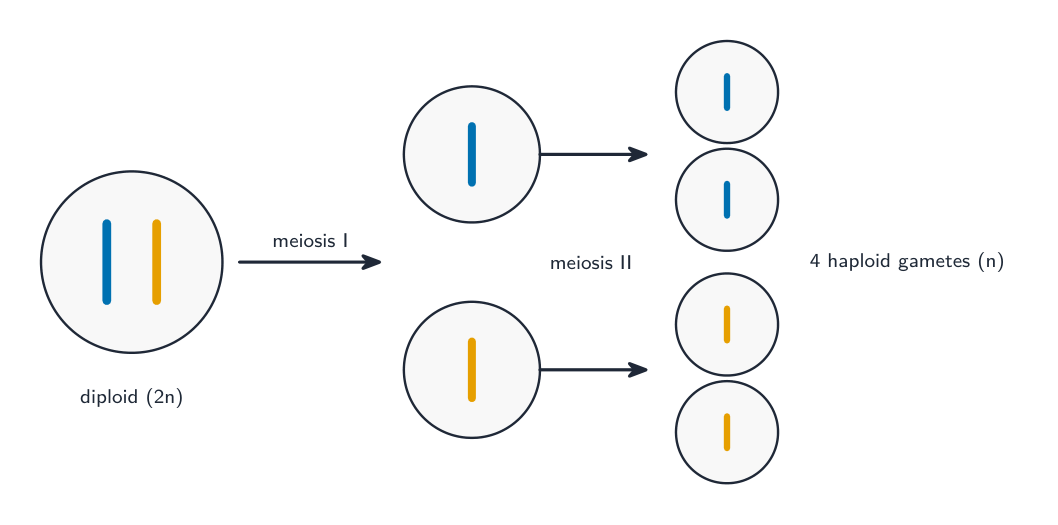
Meiosis runs two divisions, halving the chromosome number from a diploid cell to four haploid gametes

A human egg cell (ovum), one of the gametes produced by meiosis.
Meiosis
Step through it. Two divisions halve the chromosome number and shuffle the alleles, giving four unique gametes.
A homologous pair of chromosomes:
Difficulty 1/5 · 100 coins + a small bonus on first completion today
Homologous chromosomes match in length and gene positions, though they may carry different alleles.
Two sources of variation
- Crossing over 交叉互换: homologous chromosomes swap matching pieces, mixing alleles.

Crossing over swaps matching segments between homologous chromosomes, making new allele combinations
- Independent assortment 自由组合: the pairs line up in a random order, so each gamete gets a random mix.

Independent assortment: each homologous pair lines up at random, so many different gamete types form

A human karyotype: 23 pairs of chromosomes, ending in XY (male)
Crossing over creates variation by:
Difficulty 1/5 · 100 coins + a small bonus on first completion today
At a chiasma, homologous chromosomes exchange matching pieces, producing new allele combinations.
Independent assortment means each homologous pair lines up in a random order, so gametes get a random mix of chromosomes.
Difficulty 1/5 · 100 coins + a small bonus on first completion today
The random orientation of each pair at metaphase I gives an enormous number of possible gamete combinations.
Match each source of variation to what it does.
Difficulty 2/5 · 140 coins + a small bonus on first completion today
Meiosis (crossing over + independent assortment) and random fertilisation shuffle existing alleles; mutation creates new ones.
Random fertilisation 受精
- At fertilisation, any gamete can fuse with any other.
- This random fusion makes every new individual genetically different.
Random fertilisation adds to variation because:
Difficulty 1/5 · 100 coins + a small bonus on first completion today
Which two gametes meet is random, so each new combination of alleles is unique.
You've got it
- diploid (2n) = two sets; haploid (n) = one; gametes must be haploid
- homologous pairs: same genes, possibly different alleles; meiosis halves the number
- variation from crossing over + independent assortment
- plus random fertilisation → every individual is unique