- state that enzymes are globular proteins that catalyse reactions inside cells (intracellular enzymes) or are secreted to catalyse reactions outside cells (extracellular enzymes)
- explain the mode of action of enzymes in terms of an active site, enzyme–substrate complex, lowering of activation energy and enzyme specificity, including the lock-and-key hypothesis and the induced-fit hypothesis
- investigate the progress of enzyme-catalysed reactions by measuring rates of formation of products using catalase and rates of disappearance of substrate using amylase
- outline the use of a colorimeter for measuring the progress of enzyme-catalysed reactions that involve colour changes
Enzymes
A-Level Biology · Topic 3
 13:51
13:51
Enzymes
Inside every cell, thousands of chemical reactions happen every second — far faster than they ever could on their own. The secret is a special kind of protein…
English narration · English + 中文 subtitles burned in
3.1
What enzymes are

Syllabus
Source: Cambridge International syllabus
Enzymes 酶 are globular proteins 球状蛋白质 — a type of protein 蛋白质 with a rounded, soluble shape. They are biological catalysts: they catalyse 催化 (speed up) the chemical reactions in living things, and they are not used up, so each enzyme works again and again.
Enzymes work in two places:
- intracellular 细胞内 enzymes work inside the cell 细胞 that made them. An example is catalase 过氧化氢酶, which breaks down harmful hydrogen peroxide.
- extracellular 细胞外 enzymes are secreted 分泌 (sent out) to work outside the cell. An example is amylase 淀粉酶, which is released into the gut to digest 消化 starch 淀粉.
Vocabulary
Train
| English |
|---|
| enzyme/ˈenzaɪm/ |
| globular protein/ˈɡlɒbjʊlə ˈprəʊtiːn/ |
| protein/ˈprəʊtiːn/ |
| catalyse/ˈkætəlaɪz/ |
| intracellular/ˌɪntrəˈseljʊlə/ |
| cell/sel/ |
| catalase/ˈkætəleɪz/ |
| extracellular/ˌekstrəˈseljʊlə/ |
| secrete/sɪˈkriːt/ |
| amylase/ˈæmɪleɪz/ |
| digest/ˈdaɪdʒest/ |
| starch/stɑːtʃ/ |
3.1
How enzymes work

Each enzyme has a special pocket called the active site 活性位点. The molecule it acts on is its substrate 底物. The substrate fits into the active site to form an enzyme–substrate complex 酶底物复合物. The reaction then happens, and the products 产物 leave, freeing the active site for the next substrate.
Specificity
An enzyme is specific: it usually works on only one substrate. This is because the shape of the active site is complementary 互补 to (fits) the shape of that substrate and no other. We call this specificity 专一性.
Two ideas explain how the substrate fits:
- the lock-and-key hypothesis 锁钥学说 — the active site is a fixed shape, and only a substrate with the matching shape fits, like a key in a lock.
- the induced-fit hypothesis 诱导契合学说 — the active site is not quite the right shape at first. When the substrate binds, the active site changes shape a little to wrap around it tightly. This idea fits the evidence better.
Lowering activation energy
Every reaction needs a small "push" of energy to start, called the activation energy 活化能. An enzyme lowers the activation energy. This lets the reaction go quickly at the cell's normal temperature 温度, instead of needing high heat.

Explore
The catalytic cycle
Step through the cycle. The enzyme binds its substrate, the reaction happens, the products leave — and the same enzyme is free to go again.
Vocabulary
Train
| English |
|---|
| active site/ˈæktɪv saɪt/ |
| substrate/ˈsʌbstreɪt/ |
| enzyme–substrate complex/ˈenzaɪm ˈsʌbstreɪt ˈkɒmpleks/ |
| product/ˈprɒdʌkt/ |
| complementary/ˌkɒmplɪˈmentəri/ |
| specificity/ˌspesɪˈfɪsɪti/ |
| lock-and-key hypothesis/lɒk ænd kiː haɪˈpɒθəsɪs/ |
| induced-fit hypothesis/ɪnˈdjuːst fɪt haɪˈpɒθəsɪs/ |
| activation energy/ˌæktɪˈveɪʃn ˈenədʒi/ |
| temperature/ˈtemprɪtʃə/ |
3.1
Measuring the rate of a reaction

You can follow an enzyme reaction in two ways:
- measure how fast product is made. With catalase, oxygen gas is a product, so you collect the gas and measure its volume over time.
- measure how fast substrate disappears. With amylase, you remove samples and use the iodine test; the blue-black colour fades as the starch is used up.
A colorimeter 比色计 makes this exact. It shines light through the tube and measures how much light is absorbed, so a colour change becomes a number you can plot.
The rate of reaction 反应速率 is steepest at the start (most substrate present), so the initial rate (the slope at time zero) is the fairest value to compare.
Worked example. In the first $20$ seconds of a catalase reaction, $16\ \text{cm}^3$ of oxygen is collected. Estimate the rate of reaction.
$$\text{rate} = \frac{\text{volume of product}}{\text{time}} = \frac{16}{20} = 0.8\ \text{cm}^3\,\text{s}^{-1}.$$
Because the reaction is fastest at the start, measuring over this short early interval gives a value close to the initial rate; averaging over a longer time would include the slower later stages and underestimate it.
Vocabulary
Train
| English |
|---|
| colorimeter/ˌkʌləˈrɪmɪtə/ |
| rate of reaction/reɪt ɒv rɪˈækʃn/ |
3.2
Factors that affect enzyme activity

Syllabus
- investigate and explain the effects of the following factors on the rate of enzyme-catalysed reactions: • temperature • pH (using buffer solutions) • enzyme concentration • substrate concentration • inhibitor concentration
- explain that the maximum rate of reaction ($V_{\text{max}}$) is used to derive the Michaelis–Menten constant ($K_{\text{m}}$), which is used to compare the affinity of different enzymes for their substrates
- explain the effects of reversible inhibitors, both competitive and non-competitive, on enzyme activity
- investigate the difference in activity between an enzyme immobilised in alginate and the same enzyme free in solution, and state the advantages of using immobilised enzymes
Source: Cambridge International syllabus
Temperature
As temperature rises, molecules gain more kinetic energy 动能 and collide 碰撞 more often, so the rate rises. But above the optimum temperature 最适温度 the enzyme begins to denature 变性: the heat breaks the bonds holding its shape, so the active site changes and no longer fits the substrate. The rate then falls quickly.
pH
Each enzyme has an optimum pH. If the pH moves too far from it, the enzyme denatures and the rate drops. To study pH fairly, you keep it steady with a buffer solution 缓冲液.

Enzyme concentration
With plenty of substrate, more enzyme means more active sites, so the rate goes up in proportion to enzyme concentration.
Substrate concentration
At first, adding more substrate speeds the reaction. But once every active site is busy, adding more makes no difference — the rate levels off at a maximum.
Inhibitor concentration
An inhibitor 抑制剂 is a molecule that slows an enzyme. The more inhibitor present, the lower the rate.
Explore
How temperature changes enzyme activity
Drag the temperature slider. Activity rises to an optimum, then crashes as the enzyme denatures and its active site loses shape.
Vocabulary
Train
| English |
|---|
| kinetic energy/kɪˈnetɪk ˈenədʒi/ |
| collide/kəˈlaɪd/ |
| optimum temperature/ˈɒptɪməm ˈtemprɪtʃə/ |
| denature/ˈdenətʃə/ |
| buffer solution/ˈbʌfə səˈluːʃn/ |
| inhibitor/ɪnˈhɪbɪtə/ |
3.2
V_max and the Michaelis–Menten constant
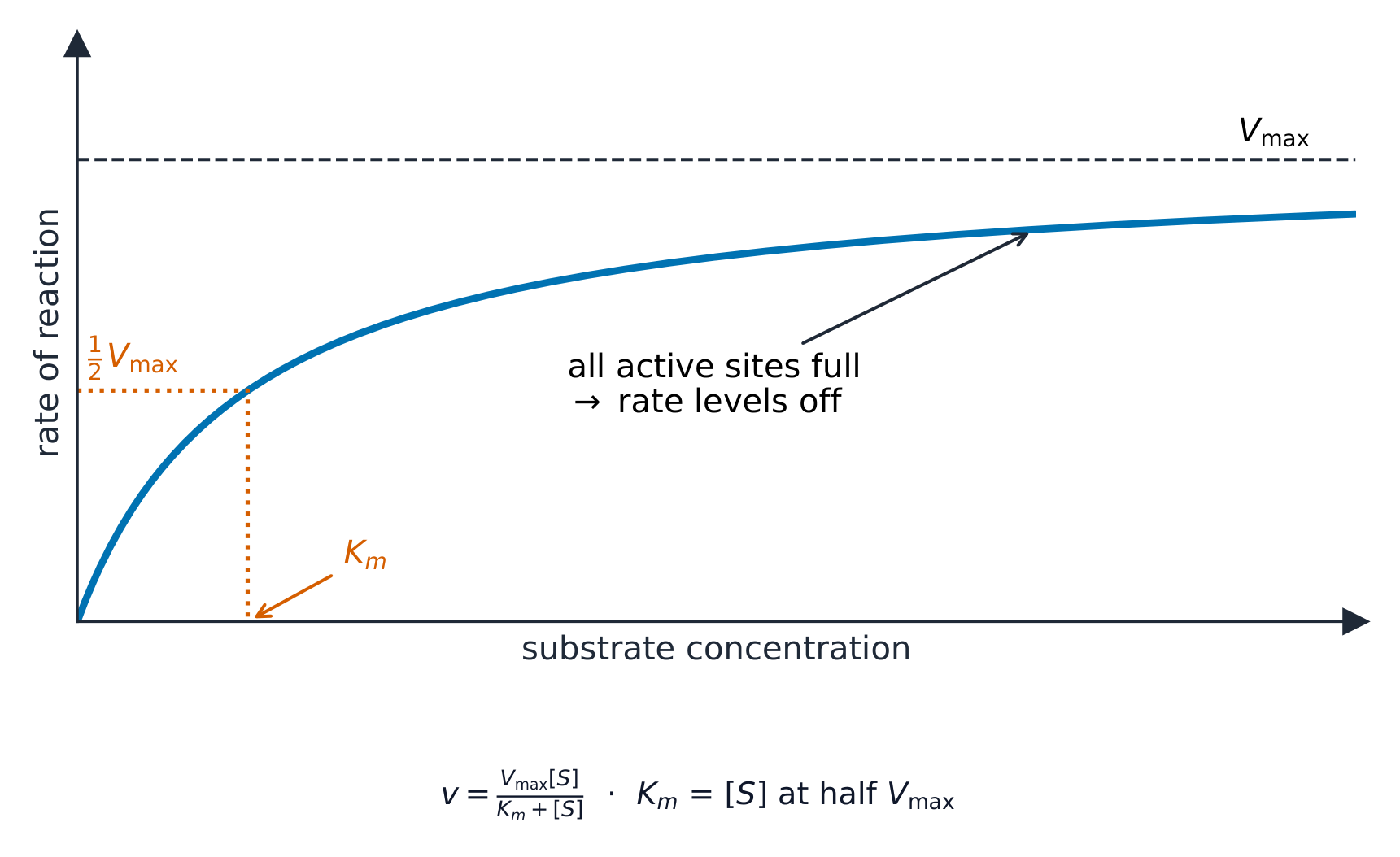
The levelling-off rate, when all active sites are full, is the maximum rate, written $V_{\text{max}}$.
The Michaelis–Menten constant 米氏常数 ($K_{\text{m}}$) is the substrate concentration that gives half of $V_{\text{max}}$. It tells you about the enzyme's affinity 亲和力 (pulling power) for its substrate:
- a low $K_{\text{m}}$ means the enzyme reaches half-speed at a low substrate concentration, so it has a high affinity.
- a high $K_{\text{m}}$ means a low affinity.
So $K_{\text{m}}$ lets you compare how strongly different enzymes hold their substrates.
Explore
Substrate concentration and Vmax
Add more substrate: the rate climbs, then plateaus at $V_{max}$ once every active site is busy. $K_m$ is the substrate concentration that gives half of $V_{max}$.
Vocabulary
Train
| English |
|---|
| Michaelis–Menten constant/ˈmaɪkəliz ˈmentn ˈkɒnstənt/ |
| affinity/əˈfɪnɪti/ |
3.2
Reversible inhibitors
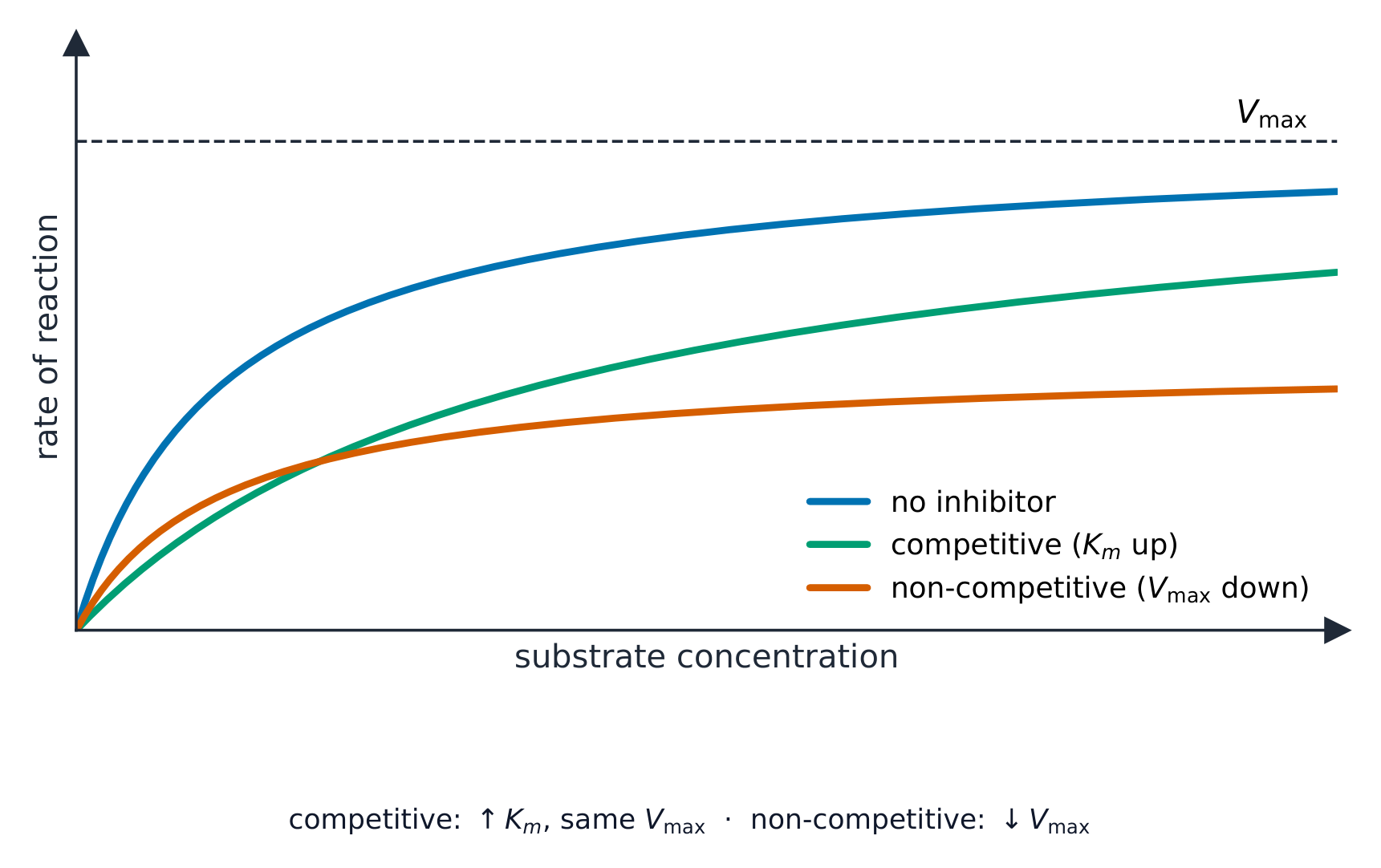
Some inhibitors are reversible 可逆: they can leave the enzyme again. There are two types.
| Type | Where it binds | Effect of adding more substrate | Effect on $V_{\text{max}}$ and $K_{\text{m}}$ |
|---|---|---|---|
| competitive inhibitor 竞争性抑制剂 | in the active site (it has a similar shape to the substrate) | more substrate out-competes it, so its effect is reduced | $V_{\text{max}}$ unchanged; $K_{\text{m}}$ rises |
| non-competitive inhibitor 非竞争性抑制剂 | at another site, changing the active site's shape | adding more substrate does not help | $V_{\text{max}}$ falls; $K_{\text{m}}$ unchanged |
Vocabulary
Train
| English |
|---|
| reversible/rɪˈvɜːsɪbl/ |
| competitive inhibitor/kəmˈpetɪtɪv ɪnˈhɪbɪtə/ |
| non-competitive inhibitor/nɒn kəmˈpetɪtɪv ɪnˈhɪbɪtə/ |
3.2
Immobilised enzymes

An immobilised enzyme 固定化酶 is fixed in place — for example, trapped inside small beads of alginate 海藻酸盐 — instead of floating free in solution. The substrate solution flows past the beads.
A free enzyme usually works a little faster, because the substrate can reach it easily. But immobilised enzymes have big practical advantages:
- the enzyme is not washed away, so it can be used again and again.
- the product is pure — it is not mixed with enzyme.
- the enzyme is more stable, so it survives changes in temperature and pH better.
- the process can run continuously, with substrate flowing in and product flowing out.

Vocabulary
Train
| English |
|---|
| immobilised enzyme/ɪˈməʊbəlaɪzd ˈenzaɪm/ |
| alginate/ˈældʒɪneɪt/ |
3.2
Exam tips
- Explain enzyme action with the induced-fit model (the active site moulds around the substrate) — now preferred to lock-and-key.
- Above the optimum the enzyme denatures (hydrogen bonds and tertiary structure break) — write "denatures", never "dies" or "is killed".
- Distinguish inhibitors: competitive binds the active site (overcome by more substrate, same $V_{max}$); non-competitive binds elsewhere (lower $V_{max}$).
- Compare rates using the initial rate (tangent at time zero) — the fairest measure, before substrate becomes limiting.
Interactive lessons on this topic
Work through it step by step, with instant-check exercises.