Genetic diagrams and crosses
Introduced| English | Meaning |
|---|---|
| Punnett square/ˈpʌnɪt skweə/ | A grid used to predict possible offspring genotypes from combinations of parental gametes. |
| monohybrid cross/ˈmɒnəʊhaɪbrɪd krɒs/ | A genetic cross used to study inheritance at one gene locus. |
| dihybrid cross/daɪˈhaɪbrɪd krɒs/ | A genetic cross examining inheritance at two gene loci. |
| multiple alleles/ˈmʌltɪpl əˈliːlz/ | Three or more alternative versions of a gene present in a population, although a diploid individual usually carries at most two. |
| sex linkage/seks ˈlɪŋkɪdʒ/ | The pattern in which a gene carried on a sex chromosome is inherited differently in males and females. |
| epistasis/ɪpɪˈstɑːsiz/ | Interaction where one gene masks or modifies the expression of another gene. |
| chi-squared test/kaɪ skweəd test/ | A statistical test that compares observed frequencies with frequencies expected under a null hypothesis. |
Genetic crosses
- A genetic diagram shows how alleles pass to offspring.
- The handiest tool is the Punnett square 庞纳特方格 — a grid of all gamete combinations.
- Then we meet the special cases.
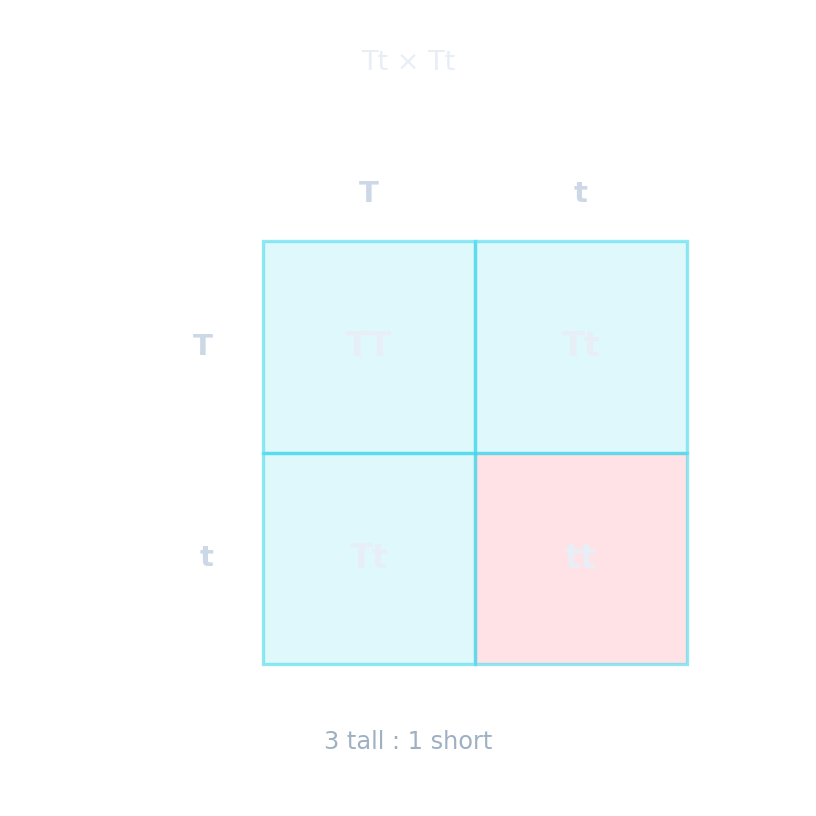
A Punnett square is used to predict the offspring genotypes and ratios of a genetic cross.
Difficulty 1/5 · 100 coins + a small bonus on first completion today
It combines every possible pairing of the parents' gametes.
The Punnett square
- A monohybrid cross 单基因杂交 follows one gene; a dihybrid cross 双基因杂交 follows two at once.
- Some genes have multiple alleles 复等位基因 (more than two versions in a population), like human blood groups.
Genetic crosses
Aa × Aa → 3 : 1
Pick the parents' genotypes and read the offspring ratios straight from the Punnett square.
In a Tt × Tt cross (T dominant), the offspring ratio is:
Difficulty 1/5 · 100 coins + a small bonus on first completion today
The Punnett square gives TT, Tt, Tt, tt — three with a dominant T (tall) to one tt (short).
In a Tt × Tt cross, what fraction of the offspring (as a decimal) are expected to be short (tt)?
Difficulty 2/5 · 140 coins + a small bonus on first completion today
One of the four boxes (TT, Tt, Tt, tt) is tt, so 1/4 = 0.25 are short.
Match each genetics term to its meaning.
Difficulty 2/5 · 140 coins + a small bonus on first completion today
Mono = one gene, di = two; a sex-linked gene is on the X; the Punnett square works out the ratios.
A cross that follows the inheritance of a single gene is a ______ cross.
Difficulty 1/5 · 100 coins + a small bonus on first completion today
A monohybrid cross follows one gene; a dihybrid cross follows two genes together.
Special inheritance patterns
- sex linkage 伴性遗传: the gene is on the X chromosome, so results differ for males and females.

A sex-linked gene sits on the X chromosome, so sons and daughters inherit it differently
- linkage: genes on the same chromosome tend to be inherited together.
- epistasis 上位性: one gene affects how another gene is shown.
Sex linkage means that:
Difficulty 1/5 · 100 coins + a small bonus on first completion today
A sex-linked gene sits on the X chromosome, so inheritance differs between the sexes.
The chi-squared test 卡方检验
- The chi-squared test compares the numbers you actually counted with those you expected.
- It tells you whether the difference is small enough to be chance, or large enough to mean something else is going on.
The chi-squared test is used to:
Difficulty 1/5 · 100 coins + a small bonus on first completion today
Chi-squared tests whether the gap between observed and expected counts is small enough to be chance.
You've got it
- a Punnett square shows all gamete combinations (Tt × Tt → 3 : 1)
- monohybrid (one gene) vs dihybrid (two genes); multiple alleles = >2 versions
- sex linkage (gene on X), linkage (same chromosome, inherited together), epistasis (one gene affects another)
- chi-squared compares observed vs expected — is the difference just chance?