- describe the structure of nucleotides, including the phosphorylated nucleotide ATP (structural formulae are not expected)
- state that the bases adenine and guanine are purines with a double ring structure, and that the bases cytosine, thymine and uracil are pyrimidines with a single ring structure (structural formulae for bases are not expected)
- describe the structure of a DNA molecule as a double helix, including: • the importance of complementary base pairing between the 5′ to 3′ strand and the 3′ to 5′ strand (antiparallel strands) • differences in hydrogen bonding between C–G and A–T base pairs • linking of nucleotides by phosphodiester bonds
- describe the semi-conservative replication of DNA during the S phase of the cell cycle, including: • the roles of DNA polymerase and DNA ligase (knowledge of other enzymes in DNA replication in cells and different types of DNA polymerase is not expected) • the differences between leading strand and lagging strand replication as a consequence of DNA polymerase adding nucleotides only in a 5′ to 3′ direction
- describe the structure of an RNA molecule, using the example of messenger RNA (mRNA)
Nucleic acids and protein synthesis
A-Level Biology · Topic 6
 9:37
9:37
DNA & Protein Synthesis
Inside almost every one of your cells sits a molecule about two metres long, folded up so tightly you cannot see it. It is DNA, and it is written in an…
English narration · English + 中文 subtitles burned in
6.1
Nucleotides — the building blocks

Syllabus
Source: Cambridge International syllabus
Nucleic acids 核酸 (DNA and RNA) are polymers of small units called nucleotides 核苷酸. Each nucleotide is made of three parts joined together:
- a phosphate 磷酸 group,
- a sugar (a 5-carbon sugar),
- a nitrogen-containing base 碱基.
ATP is a special nucleotide. It has the base adenine 腺嘌呤, the sugar ribose 核糖, and three phosphate groups. Breaking off the last phosphate releases energy 能量 for the cell.

There are five bases, in two groups:
- purines 嘌呤 have a double ring (two rings): adenine and guanine 鸟嘌呤.
- pyrimidines 嘧啶 have a single ring (one ring): cytosine 胞嘧啶, thymine 胸腺嘧啶 and uracil 尿嘧啶.

Vocabulary
Train
| English |
|---|
| nucleic acid/njuːˈklɪɪk ˈæsɪd/ |
| nucleotide/ˈnjuːklɪɒtaɪd/ |
| phosphate/ˈfɒsfeɪt/ |
| base/beɪs/ |
| adenine/ˈædəniːn/ |
| ribose/ˈrɪbəʊs/ |
| energy/ˈenədʒi/ |
| purine/ˈpjʊəriːn/ |
| guanine/ˈɡwɑːnaɪn/ |
| pyrimidine/ˈpɪrɪmɪdiːn/ |
| cytosine/ˈsaɪtəsaɪn/ |
| thymine/ˈθaɪmaɪn/ |
| uracil/ˈjʊərəsɪl/ |
6.1
The structure of DNA

A DNA molecule is two strands twisted together into a double helix 双螺旋.
Each strand 链 has a backbone of alternating sugar (here the sugar is deoxyribose 脱氧核糖) and phosphate. The sugar of one nucleotide is joined to the phosphate of the next by a phosphodiester bond 磷酸二酯键.
The two strands are held together by their bases, which meet in the middle. The pairing is exact — this is complementary base pairing 碱基互补配对:
- A always pairs with T, held by two hydrogen bonds 氢键.
- C always pairs with G, held by three hydrogen bonds (so a C–G base pair 碱基对 is harder to separate).
The two strands run in opposite directions: one goes 5′ to 3′ while the other goes 3′ to 5′. We say they are antiparallel 反平行.
The flat ladder above is twisted into a spiral. This space-filling model, where every atom is a ball, shows the real shape of the double helix:

Explore
Explore the DNA ladder
Tap each part of the double helix — two antiparallel backbones with complementary base pairs as the rungs.
Vocabulary
Train
| English |
|---|
| double helix/ˈdʌbl ˈhiːlɪks/ |
| strand/strænd/ |
| deoxyribose/diːˈɒksɪrɪbəʊs/ |
| phosphodiester bond/ˈfɒsfəʊdɪstə bɒnd/ |
| complementary base pairing/ˌkɒmplɪˈmentəri beɪs ˈpeərɪŋ/ |
| hydrogen bond/ˈhaɪdrədʒn bɒnd/ |
| base pair/beɪs peə/ |
| antiparallel/ˌæntɪˈpærəlel/ |
6.1
DNA replication

DNA replication 复制 (copying) happens during the S phase of the cell cycle. It is semi-conservative 半保留复制: each new molecule keeps one old strand and one new strand. The steps are:
- the double helix unwinds and the hydrogen bonds break, so the two strands separate.
- each old strand acts as a template. Free nucleotides pair with the exposed bases by complementary base pairing.
- the enzyme 酶 DNA polymerase 聚合酶 joins the new nucleotides into a strand. It can only add nucleotides in the 5′ to 3′ direction.
Because of that 5′ to 3′ rule, the two new strands are made differently:
- the leading strand 前导链 is built continuously, following the unwinding.
- the lagging strand 后随链 is built in short pieces, working away from the unwinding point. The enzyme DNA ligase 连接酶 then joins these pieces together.
Explore
Semi-conservative replication
Step through copying DNA. The helix unwinds, each old strand templates a new one, and you end with two identical molecules.
Vocabulary
Train
| English |
|---|
| replication/ˌreplɪˈkeɪʃn/ |
| semi-conservative replication/ˈsemi kənˈsɜːvətɪv ˌreplɪˈkeɪʃn/ |
| enzyme/ˈenzaɪm/ |
| polymerase/ˌpɒlɪməˈreɪz/ |
| leading strand/ˈliːdɪŋ strænd/ |
| lagging strand/ˈlæɡɪŋ strænd/ |
| ligase/ˈlɪɡeɪs/ |
6.1
RNA

RNA is also made of nucleotides, but it is a single strand, its sugar is ribose, and it uses uracil in place of thymine. The most important type here is messenger RNA (mRNA), which carries a copy of a gene's instructions out of the nucleus to be used.
6.2
The genetic code
Syllabus
- state that a polypeptide is coded for by a gene and that a gene is a sequence of nucleotides that forms part of a DNA molecule
- describe the principle of the universal genetic code in which different triplets of DNA bases either code for specific amino acids or correspond to start and stop codons
- describe how the information in DNA is used during transcription and translation to construct polypeptides, including the roles of: • RNA polymerase • messenger RNA (mRNA) • codons • transfer RNA (tRNA) • anticodons • ribosomes
- state that the strand of a DNA molecule that is used in transcription is called the transcribed or template strand and that the other strand is called the non-transcribed strand
- explain that, in eukaryotes, the RNA molecule formed following transcription (primary transcript) is modified by the removal of non-coding sequences (introns) and the joining together of coding sequences (exons) to form mRNA
- state that a gene mutation is a change in the sequence of base pairs in a DNA molecule that may result in an altered polypeptide
- explain that a gene mutation is a result of substitution or deletion or insertion of nucleotides in DNA and outline how each of these types of mutation may affect the polypeptide produced
Source: Cambridge International syllabus
A gene 基因 is a sequence of DNA nucleotides that codes for one polypeptide 多肽.
The code is read in triplets 三联体 — groups of three bases. Each triplet either codes for one specific amino acid 氨基酸, or acts as a start or stop signal. The code is universal: nearly all living things use the same triplets for the same amino acids.
There are 64 possible triplets but only 20 common amino acids, so most amino acids are coded by more than one triplet.
Vocabulary
Train
| English |
|---|
| gene/dʒiːn/ |
| polypeptide/ˌpɒlɪˈpeptaɪd/ |
| triplet/ˈtrɪplɪt/ |
| amino acid/əˈmiːnəʊ ˈæsɪd/ |
6.2
Protein synthesis: transcription and translation

Transcription (in the nucleus)
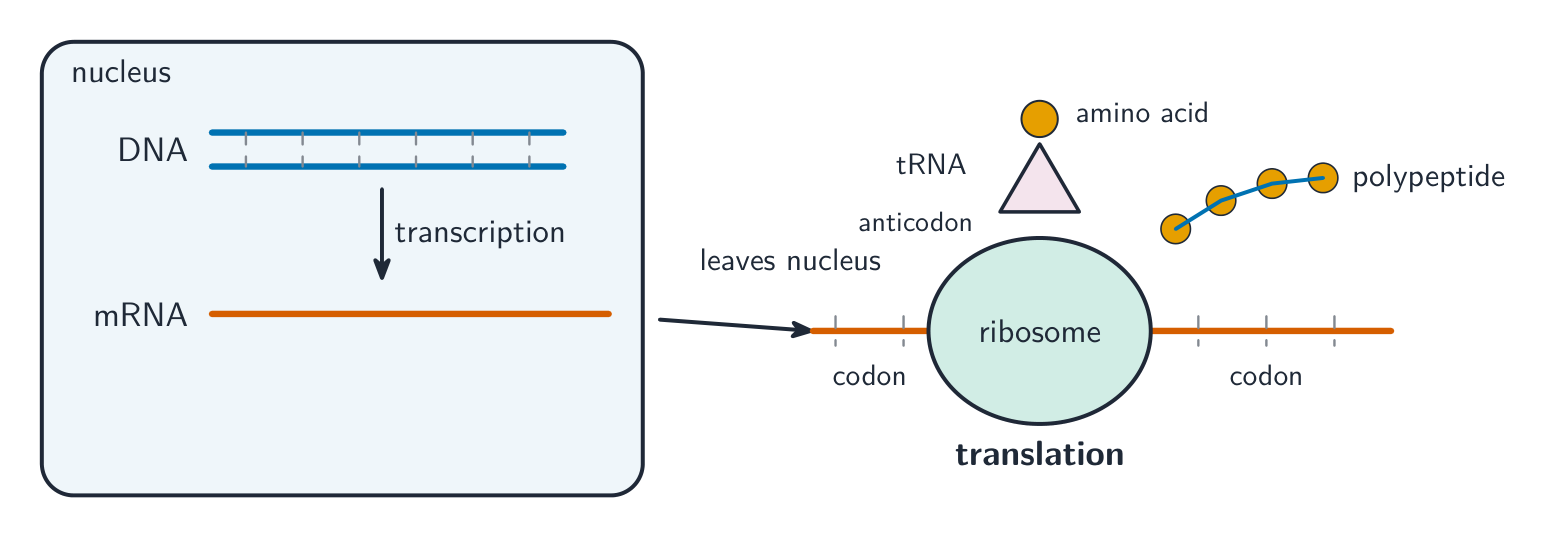
The DNA gene is copied into mRNA. This is transcription 转录.
- the strand of DNA that is copied is the template strand 模板链; the partner strand is the non-transcribed strand 非转录链.
- the enzyme RNA polymerase joins RNA nucleotides that pair with the template bases (with uracil pairing to adenine).
- in eukaryotes the first RNA made (the primary transcript 初级转录本) contains coding parts called exons 外显子 and non-coding parts called introns 内含子. The introns are cut out and the exons joined together to form the finished mRNA.
Translation (at the ribosome)
The mRNA leaves the nucleus and attaches to a ribosome 核糖体. Building the polypeptide from the mRNA code is translation 翻译.
- the mRNA is read in codons 密码子 (each codon is one triplet of mRNA bases).
- molecules of transfer RNA (tRNA) bring amino acids to the ribosome. Each tRNA has an anticodon 反密码子 that pairs with a matching codon.
- as the codons are read in order, the ribosome joins the amino acids with peptide bonds 肽键, building the polypeptide.
Worked example. A DNA template strand reads TAC GGA CTT. Give the mRNA codons, and say how long the polypeptide is. Transcribe by complementary base pairing, remembering that RNA uses uracil in place of thymine: TAC gives AUG, GGA gives CCU, CTT gives GAA. So the mRNA reads AUG CCU GAA. AUG is the start codon (methionine), so the polypeptide is three amino acids long - two once the start methionine is removed. Two errors cost most of the marks here: pairing A with T instead of U when writing mRNA, and transcribing the coding strand instead of the template strand. The mRNA is complementary to the template, and identical to the coding strand apart from U replacing T.
Explore
From gene to protein
Step through the central dogma: the DNA template is transcribed into mRNA by base pairing (A→U, T→A, G→C, C→G), then read in codons and translated into a chain of amino acids.
Explore
From gene to protein
Step through how a gene becomes a protein. Transcription copies DNA into mRNA; translation reads the mRNA to build the polypeptide.
Vocabulary
Train
| English |
|---|
| codon/ˈkəʊdɒn/ |
| transcription/trænˈskrɪpʃn/ |
| template strand/ˈtempleɪt strænd/ |
| non-transcribed strand/nɒn trænˈskraɪbd strænd/ |
| primary transcript/ˈpraɪməri ˈtrænskrɪpt/ |
| exon/eɡˈzɒn/ |
| intron/ɪnˈtrɒn/ |
| ribosome/ˈriːbəʊsəʊm/ |
| translation/trænˈsleɪʃn/ |
| anticodon/ˌæntɪˈkəʊdɒn/ |
| peptide bond/ˈpeptaɪd bɒnd/ |
6.2
Gene mutations

A gene mutation 突变 is a change in the base sequence of a DNA molecule. It may change the polypeptide made. There are three types:
- substitution 替换 — one base is swapped for a different base. This changes at most one amino acid, and sometimes none (because most amino acids have more than one triplet).
- deletion 缺失 — a base is removed.
- insertion 插入 — an extra base is added.
A deletion or insertion shifts how every later triplet is read, so it usually changes many amino acids after that point and has a large effect on the polypeptide.
Explore
Mutation type lab
Compare substitution, insertion and deletion using their effect on the code.
Vocabulary
Train
| English |
|---|
| mutation/mjuːˈteɪʃn/ |
| substitution/ˌsʌbstɪˈtjuːʃn/ |
| deletion/dɪˈliːʃn/ |
| insertion/ɪnˈsɜːʃn/ |
6.2
Exam tips
- DNA is antiparallel, held by hydrogen bonds (A=T two, C≡G three); replication is semi-conservative (each product keeps one old strand).
- State where and what: transcription (nucleus → mRNA), translation (ribosome, mRNA + tRNA → polypeptide).
- Describe the code with all four terms: triplet, non-overlapping, degenerate, universal.
- For a gene mutation (substitution, insertion, deletion) explain the effect on the protein — and why a substitution can be silent (degeneracy).
Interactive lessons on this topic
Work through it step by step, with instant-check exercises.