Bất cứ lúc nào cơ thể bạn cũng chỉ chứa khoảng năm mươi gam ATP. Thế nhưng trong suốt một ngày, bạn sẽ sản xuất và tiêu thụ xấp xỉ trọng lượng cơ thể mình của chất này. Same…
English narration · English + 中文 subtitles burned in · Giọng đọc tiếng Anh · phụ đề tiếng Anh + 中文 được ghi trực tiếp
12.1
Why living things need energy · Tại sao sinh vật cần năng lượng
Syllabus · Chương trình
English
outline the need for energy in living organisms, as illustrated by active transport, movement and anabolic reactions, such as those occurring in DNA replication and protein synthesis
describe the features of ATP that make it suitable as the universal energy currency
state that ATP is synthesised by: • transfer of phosphate in substrate-linked reactions • chemiosmosis in membranes of mitochondria and chloroplasts
explain the relative energy values of carbohydrates, lipids and proteins as respiratory substrates
state that the respiratory quotient (RQ) is the ratio of the number of molecules of carbon dioxide produced to the number of molecules of oxygen taken in, as a result of respiration
calculate RQ values of different respiratory substrates from equations for respiration
describe and carry out investigations, using simple respirometers, to determine the RQ of germinating seeds or small invertebrates (e.g. blowfly larvae)
Tiếng Việt
mô tả nhu cầu về năng lượng ở sinh vật sống, minh họa qua vận chuyển chủ động, vận động và các phản ứng đồng hóa, chẳng hạn như những phản ứng xảy ra trong sao chép DNA và tổng hợp protein
mô tả các đặc điểm của ATP khiến nó phù hợp như một đồng tiền năng lượng phổ quát
nêu rõ ATP được tổng hợp bằng cách: • chuyển phosphate trong phản ứng liên kết chất nền • hóa thẩm trên màng ti thể và lục lạp
giải thích giá trị năng lượng tương đối của carbohydrate, lipid và protein như các chất nền hô hấp
nêu rõ chỉ số hô hấp (RQ) là tỷ lệ giữa số phân tử carbon dioxide sinh ra và số phân tử oxy hấp thụ, do quá trình hô hấp
tính toán giá trị RQ của các chất nền hô hấp khác nhau từ phương trình hô hấp
mô tả và tiến hành nghiên cứu, sử dụng dụng cụ đo hô hấp đơn giản, để xác định RQ của hạt đang nảy mầm hoặc động vật không xương sống nhỏ (ví dụ: ấu trùng ruồi)
Source: Cambridge International syllabus · Nguồn: Chương trình Cambridge International
English
Cells need a steady supply of energy 能量, which they get from respiration 呼吸作用. Energy is needed for:
active transport 主动运输 (moving substances against a gradient),
movement (for example muscle contraction),
anabolic 合成代谢 reactions — the building of large molecules, such as in DNA replication and protein synthesis.
Tiếng Việt
Tế bào cần nguồn cung cấp năng lượng ổn định, mà chúng nhận được từ hô hấp. Năng lượng cần thiết cho:
vận chuyển chủ động (di chuyển chất ngược chiều gradient),
chuyển động (ví dụ co cơ),
phản ứng tổng hợp — xây dựng các phân tử lớn, chẳng hạn như trong sao chép DNA và tổng hợp protein.
Trong khi tập luyện, cơ bắp cần nguồn cung cấp năng lượng liên tục được giải phóng từ quá trình hô hấp
12.1
ATP — the energy currency · ATP — tiền tệ năng lượng
English
ATP is the molecule that carries energy to where it is needed. It is made from ADP and a phosphate group; when it loses that phosphate again, it releases a small, usable burst of energy. ATP suits this job well, so we call it the universal energy currency:
it releases energy quickly, in small amounts that match a cell's needs.
it is easily made and re-made, again and again.
it is small and soluble, so it moves easily around the cell.
ATP is made in two ways: by direct transfer of a phosphate group in phosphorylation 磷酸化 reactions, and by chemiosmosis 化学渗透 across the membranes of mitochondria 线粒体 and chloroplasts.
Tiếng Việt
ATP là phân tử mang năng lượng đến nơi cần thiết. Nó được tạo thành từ ADP và một nhóm phosphate; khi nó mất đi nhóm phosphate đó, nó giải phóng một đợt năng lượng nhỏ, có thể sử dụng được. ATP phù hợp tốt với nhiệm vụ này, nên ta gọi nó là tiền tệ năng lượng phổ quát:
nó giải phóng năng lượng nhanh chóng, với số lượng nhỏ khớp với nhu cầu của tế bào.
nó dễ dàng được tạo ra và tái tạo, lặp đi lặp lại.
nó nhỏ và tan trong nước, nên di chuyển dễ dàng quanh tế bào.
Hô hấp thêm một phosphate để tạo ATP; tế bào tách nó ra để giải phóng năng lượng
ATP được tạo thành theo hai cách: bằng cách chuyển giao trực tiếp nhóm phosphate trong các phản ứng phosphorylation, và bằng chemiosmosis xuyên qua màng của mitochondria và lục lạp.
Explore · Khám phá
The ATP cycle · Chu kỳ ATP
Step around the loop. ATP is split to release a small burst of energy, then rebuilt by respiration — over and over. · Quanh vòng lặp. ATP bị phân tách để giải phóng một đợt năng lượng nhỏ, sau đó được tổng hợp lại qua hô hấp — liên tục lặp lại.
Respiratory substrates and RQ · Chất nền hô hấp và RQ
English
A respiratory substrate 呼吸底物 is a molecule that is broken down to release energy. Per gram, lipids release the most energy (they have the most hydrogen), proteins are next, and carbohydrates the least.
The respiratory quotient 呼吸商 (RQ) compares the gases exchanged:
$$\text{RQ} = \frac{\text{molecules of carbon dioxide produced}}{\text{molecules of oxygen taken in}}$$
You can work out the RQ from a respiration equation. Carbohydrates give an RQ of about 1.0, lipids about 0.7 and proteins about 0.9.
Worked example. Find the RQ for the aerobic respiration of glucose: $\text{C}_6\text{H}_{12}\text{O}_6 + 6\text{O}_2 \rightarrow 6\text{CO}_2 + 6\text{H}_2\text{O}$.
This is why an RQ near $1.0$ suggests the organism is respiring carbohydrate; a lower RQ (about $0.7$) suggests it is using lipid, which needs more oxygen per molecule of $\text{CO}_2$.
A respirometer 呼吸计 measures the oxygen 氧气 taken in by living things, such as germinating 萌发 seeds or small invertebrates 无脊椎动物, and is used to find their RQ.
Tiếng Việt
Một chất nền hô hấp là một phân tử bị phân giải để giải phóng năng lượng. Theo mỗi gam, lipit giải phóng nhiều năng lượng nhất (chúng có nhiều hydro nhất), protein đứng thứ hai và carbohydrate ít nhất.
Lipids giải phóng nhiều năng lượng nhất trên mỗi gam, sau đó là protein, rồi đến carbohydrate
Hệ số hô hấp (RQ) so sánh các khí trao đổi:
$$\text{RQ} = \frac{\text{molecules of carbon dioxide produced}}{\text{molecules of oxygen taken in}}$$
Bạn có thể tính RQ từ phương trình hô hấp. Carbohydrat cho RQ khoảng 1.0, lipid khoảng 0.7 và protein khoảng 0.9.
Ví dụ có hướng dẫn. Tìm RQ cho quá trình hô hấp hiếu khí của glucose: $\text{C}_6\text{H}_{12}\text{O}_6 + 6\text{O}_2 \rightarrow 6\text{CO}_2 + 6\text{H}_2\text{O}$.
Đây là lý do tại sao RQ gần $1.0$ gợi ý rằng sinh vật đang hô hấp bằng carbohydrate; RQ thấp hơn (khoảng $0.7$) gợi ý rằng nó đang sử dụng lipid, điều này cần nhiều oxy hơn cho mỗi phân tử $\text{CO}_2$.
Một thiết bị đo hô hấp đo oxy được sinh vật sống như hạt đang nảy mầm hoặc các động vật không xương sống nhỏ hấp thụ, và được dùng để tìm RQ của chúng.
Soda lime hấp thụ CO₂ được thải ra, nên thể tích khí chỉ giảm đi đúng bằng lượng oxy đã dùng — và hạt dịch chuyển vào đúng khoảng cách đó
Explore · Khám phá
Respiratory quotient lab · Phòng thí nghiệm tỷ lệ hô hấp
RQ = CO2 produced / O2 used · RQ = CO2 tạo thành / O2 tiêu thụ
Change oxygen use and see how RQ compares fuels. · Thay đổi lượng oxy tiêu thụ và xem RQ so sánh các nguồn nhiên liệu.
Aerobic respiration: the four stages · Hô hấp hiếu khí: bốn giai đoạn
Syllabus · Chương trình
English
State where each of the four stages in aerobic respiration occurs in eukaryotic cells: • glycolysis in the cytoplasm • link reaction in the mitochondrial matrix • Krebs cycle in the mitochondrial matrix • oxidative phosphorylation on the inner membrane of mitochondria
outline glycolysis as phosphorylation of glucose and the subsequent splitting of fructose 1,6-bisphosphate (6C) into two triose phosphate molecules (3C), which are then further oxidised to pyruvate (3C), with the production of ATP and reduced NAD
explain that, when oxygen is available, pyruvate enters mitochondria to take part in the link reaction
describe the link reaction, including the role of coenzyme A in the transfer of acetyl (2C) groups
outline the Krebs cycle, explaining that oxaloacetate (4C) acts as an acceptor of the 2C fragment from acetyl coenzyme A to form citrate (6C), which is converted back to oxaloacetate in a series of small steps
explain that reactions in the Krebs cycle involve decarboxylation and dehydrogenation and the reduction of the coenzymes NAD and FAD
describe the role of NAD and FAD in transferring hydrogen to carriers in the inner mitochondrial membrane
explain that during oxidative phosphorylation: • hydrogen atoms split into protons and energetic electrons • energetic electrons release energy as they pass through the electron transport chain (details of carriers are not expected) • the released energy is used to transfer protons across the inner mitochondrial membrane • protons return to the mitochondrial matrix by facilitated diffusion through ATP synthase, providing energy for ATP synthesis (details of ATP synthase are not expected) • oxygen acts as the final electron acceptor to form water
describe the relationship between the structure and function of mitochondria using diagrams and electron micrographs
outline respiration in anaerobic conditions in mammals (lactate fermentation) and in yeast cells (ethanol fermentation)
explain why the energy yield from respiration in aerobic conditions is much greater than the energy yield from respiration in anaerobic conditions (a detailed account of the total yield of ATP from the aerobic respiration of glucose is not expected)
explain how rice is adapted to grow with its roots submerged in water, limited to the development of aerenchyma in roots, ethanol fermentation in roots and faster growth of stems
describe and carry out investigations using redox indicators, including DCPIP and methylene blue, to determine the effects of temperature and substrate concentration on the rate of respiration of yeast
describe and carry out investigations using simple respirometers to determine the effect of temperature on the rate of respiration
Tiếng Việt
Nêu vị trí diễn ra của mỗi trong bốn giai đoạn của hô hấp hiếu khí ở tế bào nhân thực: • glycolysis trong tế bào chất • phản ứng liên kết trong ma trận ti thể • chu trình Krebs trong ma trận ti thể • phosphoryl hóa oxy hóa trên màng trong của ti thể
mô tả glycolysis như quá trình phosphoryl hóa glucose và sự phân cắt sau đó của fructose 1,6-bisphosphate (6C) thành hai phân tử triose phosphate (3C), sau đó được oxy hóa tiếp để tạo thành pyruvate (3C), kèm theo sản sinh ATP và NAD khử
giải thích rằng, khi có sẵn oxy, pyruvate sẽ đi vào ti thể để tham gia phản ứng liên kết
mô tả phản ứng liên kết, bao gồm vai trò của coenzyme A trong việc vận chuyển các nhóm acetyl (2C)
mô tả chu trình Krebs, giải thích rằng oxaloacetate (4C) đóng vai trò là chất nhận fragment 2C từ acetyl coenzyme A để tạo thành citrate (6C), sau đó được chuyển đổi trở lại thành oxaloacetate qua một loạt các bước nhỏ
giải thích rằng các phản ứng trong chu trình Krebs liên quan đến decarboxylation và dehydrogenation cũng như sự khử các coenzyme NAD và FAD
mô tả vai trò của NAD và FAD trong việc vận chuyển hydro đến các chất mang trên màng trong ti thể
giải thích rằng trong quá trình phosphoryl hóa oxy hóa: • các nguyên tử hydro phân tách thành proton và electron năng lượng cao • electron năng lượng cao giải phóng năng lượng khi đi qua chuỗi truyền electron (chi tiết về các chất mang không yêu cầu) • năng lượng được giải phóng sử dụng để vận chuyển proton xuyên qua màng trong của ti thể • proton quay trở lại ma trận ti thể thông qua khuếch tán có协助 thông qua ATP synthase, cung cấp năng lượng cho tổng hợp ATP (chi tiết về ATP synthase không yêu cầu) • oxy đóng vai trò là chất nhận electron cuối cùng để tạo thành nước
mô tả mối quan hệ giữa cấu trúc và chức năng của ti thể bằng cách sử dụng sơ đồ và ảnh kính hiển vi điện tử
nêu khung về hô hấp trong điều kiện kỵ khí ở động vật có vú (lên men lactate) và ở tế bào nấm men (lên men ethanol)
giải thích tại sao năng lượng thu được từ hô hấp trong điều kiện hiếu khí lớn hơn nhiều so với năng lượng thu được từ hô hấp trong điều kiện kỵ khí (không yêu cầu tính toán chi tiết tổng số ATP từ hô hấp hiếu khí glucose)
giải thích cách cây lúa thích nghi để phát triển với rễ chìm trong nước, giới hạn ở sự phát triển của cân rỗng trong rễ, lên men ethanol trong rễ và sự phát triển nhanh hơn của thân
mô tả và thực hiện các thí nghiệm sử dụng chất chỉ thị oxy hóa khử, bao gồm DCPIP và methylene blue, để xác định tác động của nhiệt độ và nồng độ cơ chất lên tốc độ hô hấp của nấm men
mô tả và thực hiện các thí nghiệm sử dụng respirometer đơn giản để xác định tác động của nhiệt độ lên tốc độ hô hấp
Source: Cambridge International syllabus · Nguồn: Chương trình Cambridge International
English
Aerobic 有氧 respiration (with oxygen) has four stages, each in a set place in the cell:
Stage
Where it happens
glycolysis 糖酵解
the cytoplasm 细胞质
link reaction 连接反应
the matrix 基质 of the mitochondria
Krebs cycle 克雷布斯循环
the matrix of the mitochondria
oxidative phosphorylation 氧化磷酸化
the inner membrane of the mitochondria
Glycolysis
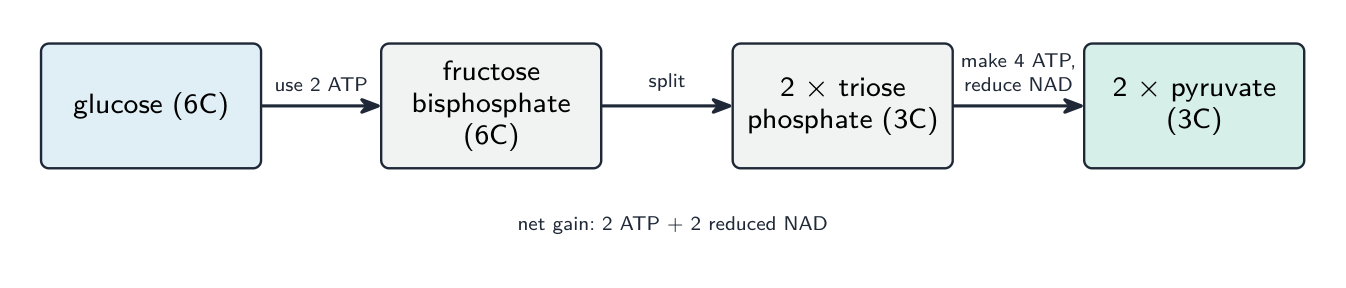
Glucose 葡萄糖 (6 carbons) is first phosphorylated, using 2 ATP, to form fructose bisphosphate (6C). This 6C molecule is split into two triose phosphate molecules (3C each). These are then oxidised 氧化 to pyruvate 丙酮酸 (3C). Glycolysis makes a net gain of 2 ATP and some reduced 还原 NAD (NAD is a coenzyme 辅酶, a helper molecule).
The link reaction
When oxygen is available, pyruvate enters the mitochondria. There each pyruvate loses a carbon dioxide 二氧化碳 and is turned into a 2-carbon acetyl 乙酰基 group. This group is carried by coenzyme A 辅酶A to form acetyl coenzyme A. Some carbon dioxide is released and NAD is reduced.
The Krebs cycle
The 2C acetyl group joins a 4-carbon molecule, oxaloacetate 草酰乙酸, to make a 6-carbon molecule, citrate 柠檬酸. Citrate is then changed back to oxaloacetate in a series of small steps, ready to accept the next acetyl group. During these steps:
decarboxylation 脱羧 removes carbon as carbon dioxide.
dehydrogenation 脱氢 removes hydrogen, which reduces the coenzymes NAD and FAD.
The reduced NAD and FAD then carry the hydrogen to the carriers in the inner mitochondrial membrane.
Oxidative phosphorylation
This stage makes most of the ATP:
the hydrogen atoms split into protons 质子 and energetic electrons 电子.
the electrons pass along the electron transport chain 电子传递链, releasing energy as they go.
this energy is used to pump protons across the inner membrane.
the protons flow back into the matrix through a channel called ATP synthase ATP合酶. This flow provides the energy to make ATP (this is chemiosmosis).
oxygen is the final electron acceptor: it joins with electrons and protons to form water.
The structure of mitochondria
The inner membrane is folded into cristae 嵴, giving a large surface for the electron transport chain and ATP synthase. The matrix inside holds the substances and helpers for the link reaction and the Krebs cycle.
Tiếng Việt
Hô hấp hiếu khí (có oxy) gồm bốn giai đoạn, mỗi giai đoạn diễn ra ở vị trí xác định trong tế bào:
Giai đoạn
Nơi diễn ra
glycolysis
tế bào chất
phản ứng liên kết
ma trận của ti thể
Chu kỳ Krebs
ma trận của ti thể
phosphoryl hóa oxy hóa
màng trong của ti thể
Bốn giai đoạn và nơi diễn ra của từng giai đoạn; NAD và FAD bị khử mang hydro đến màng trong nơi hầu hết ATP được tạo ra
Glycolysis
Glucose (6 carbon) đầu tiên bị phosphoryl hóa, sử dụng 2 ATP, để tạo fructose bisphosphate (6C). Phân tử 6C này bị chia cắt thành hai phân tử triose phosphate (mỗi loại 3C). Sau đó chúng bị oxid hóa thành pyruvate (3C). Glycolysis tạo ra lợi nhuận ròng là 2 ATP và một số NAD bị khử (NAD là một coenzyme, một phân tử trợ giúp).
Glycolysis tiêu tốn 2 ATP để khởi động nhưng tạo ra 4, nên lợi nhuận ròng là 2 ATP (cùng với NAD bị khử) — và nó không cần oxy
Phản ứng liên kết
Khi có sẵn oxy, pyruvate đi vào ti thể. Tại đó, mỗi pyruvate mất một carbon dioxide và chuyển thành nhóm acetyl 2-carbon. Nhóm này được mang bởi coenzyme AA để tạo acetyl coenzyme A. Một phần carbon dioxide được giải phóng và NAD bị khử.
Chu kỳ Krebs
Nhóm acetyl 2C kết hợp với phân tử 4 carbon, oxaloacetate, để tạo ra phân tử 6 carbon, citrate. Citrate sau đó được chuyển đổi trở lại thành oxaloacetate qua một loạt các bước nhỏ, sẵn sàng chấp nhận nhóm acetyl tiếp theo. Trong các bước này:
decarboxylation loại bỏ carbon dưới dạng carbon dioxide.
dehydrogenation loại bỏ hydro, làm khử các coenzyme NAD và FAD.
NAD và FAD bị khử sau đó mang hydro đến các bộ vận chuyển trên màng trong ti thể.
Mỗi vòng quay giải phóng carbon dioxide (decarboxylation) và NAD, FAD bị khử (dehydrogenation)
Phosphoryl hóa oxy hóa
Giai đoạn này tạo ra phần lớn ATP:
các nguyên tử hydro tách thành proton và electron năng lượng cao.
các electron truyền dọc theo chuỗi truyền electron, giải phóng năng lượng khi di chuyển.
năng lượng này được dùng để bơm proton xuyên qua màng trong.
các proton chảy ngược trở lại ma trận thông qua một kênh gọi là ATP synthase ATP. Dòng chảy này cung cấp năng lượng để tạo ATP (đây là chemiosmosis).
oxy là chất nhận electron cuối cùng: nó kết hợp với electron và proton để tạo nước.
Electron bơm proton (H⁺) vào không gian giữa hai màng; chúng chảy ngược lại qua ATP synthase để tạo ATP (chemiosmosis)
Cấu trúc của ti thể
Màng trong gấp nếp thành cristae, tạo diện tích lớn cho chuỗi truyền electron và ATP synthase. Ma trận bên trong chứa các chất và trợ thủ cho phản ứng liên kết và chu kỳ Krebs.
Hai ti thể thật, được chụp bằng kính hiển vi điện tử. Các sọc tối chạy ngang bên trong là cristae — tất cả sự gấp nếp này chính là yếu tố tạo nên diện tích lớn cho chuỗi truyền electron
Explore · Khám phá
Glycolysis · Quá trình đường phân
Step through it. Glucose is split in the cytoplasm into two pyruvate, for a small net gain of ATP and reduced NAD. · Trải qua từng bước. Glucose bị tách trong tế bào chất thành hai pyruvate, tạo ra một lợi nhuận nhỏ ATP và NAD đã khử.
Explore · Khám phá
The four stages of respiration · Bốn giai đoạn của hô hấp
Step through where ATP comes from. Glucose is broken down in stages; most ATP is made at the last stage. · Bước qua nguồn gốc của ATP. Glucose bị phân giải theo giai đoạn; hầu hết ATP được tạo ra ở giai đoạn cuối.
When there is no oxygen, only glycolysis can run. To keep glycolysis going, the cell must use up the reduced NAD. This happens by fermentation 发酵:
in mammals, pyruvate is turned into lactate 乳酸 (lactate fermentation). The lactate is later broken down when oxygen returns.
in yeast 酵母, pyruvate is turned into ethanol 乙醇 and carbon dioxide (ethanol fermentation).
Anaerobic 无氧 respiration gives far less energy than aerobic respiration. Aerobic respiration also runs the Krebs cycle and oxidative phosphorylation, which release a lot more ATP, while anaerobic respiration gains only the small amount from glycolysis.
Tiếng Việt
Khi không có oxy, chỉ có glycolysis mới hoạt động. Để duy trì glycolysis, tế bào phải tiêu thụ NAD bị khử. Điều này xảy ra qua lên men:
ở động vật có vú, pyruvate được chuyển thành lactate (lên men lactate). Lactate sau đó bị phân hủy khi oxy trở lại.
ở nấm men, pyruvate được chuyển thành ethanol và carbon dioxide (lên men ethanol).
Không có oxy, pyruvate trở thành lactat (động vật có vú) hoặc ethanol (nấm men); quá trình này tái tạo NAD để glycolysis tiếp tục
Hô hấp kỵ khí sinh ra ít năng lượng hơn nhiều so với hô hấp hiếu khí. Hô hấp hiếu khí còn thực hiện chu trình Krebs và phosphoryl hóa oxy hóa, giải phóng rất nhiều ATP, trong khi hô hấp kỵ khí chỉ thu được số lượng nhỏ từ glycolysis.
Explore · Khám phá
Why fermentation matters · Tại sao quá trình lên men quan trọng
Step through it. Without oxygen, fermentation regenerates NAD so glycolysis can keep making a little ATP. · Trải qua từng bước. Không có oxy, quá trình lên men tái sinh NAD để quá trình đường phân có thể tiếp tục tạo ra một ít ATP.
Rice and waterlogged roots · Cây lúa và rễ ngập nước
English
Rice can grow with its roots under water, where there is little oxygen. It is adapted in three ways: it develops aerenchyma 通气组织 (air-filled spaces) in the roots to carry air down; the roots use ethanol fermentation to keep making some ATP; and the stems grow faster to reach the air above the water.
Tiếng Việt
Cây lúa có thể phát triển với phần rễ dưới nước, nơi có rất ít oxy. Cây thích nghi theo ba cách: nó phát triển aerenchyma (khoảng trống chứa không khí) trong rễ để dẫn không khí xuống; các rễ sử dụng lên men ethanol để tiếp tục sản xuất một ít ATP; và thân cây grows nhanh hơn để vươn lên trên mặt nước.
Rễ của một loài cây sống trong nước, nhìn dưới mặt cắt ngang. Các khoảng trống màu trắng lớn chính là aerenchyma — các kênh dẫn khí nối liền nhau giúp oxy khuếch tán sâu xuống tận những chiếc rễ nằm trong bùn thiếu oxy
Investigating the rate of respiration · Khảo sát tốc độ hô hấp
English
A redox indicator 指示剂 such as DCPIP or methylene blue loses its colour when it gains hydrogen from respiring cells. The faster the colour is lost, the faster the yeast is respiring, so you can test the effect of temperature or substrate concentration. A respirometer can also be used to measure how temperature changes the rate of oxygen uptake.
Tiếng Việt
Một chất chỉ thị redox như DCPIP hoặc methylene blue mất màu khi nhận hydro từ các tế bào đang hô hấp. Màu càng mất nhanh thì nấm men càng hô hấp mạnh, do đó bạn có thể kiểm tra ảnh hưởng của nhiệt độ hoặc nồng độ cơ chất. Một respirometer cũng có thể dùng để đo sự thay đổi tốc độ tiêu thụ oxy theo nhiệt độ.
12.2
Exam tips · Mẹo làm bài thi
English
State where each stage happens and its ATP yield: glycolysis (cytoplasm), link reaction + Krebs (matrix), oxidative phosphorylation (inner membrane, most ATP).
Explain the roles of NAD/FAD (carry hydrogen to the electron transport chain) and of oxygen (the final electron acceptor).
RQ$=$ CO2 produced $\div$ O2 used ($\approx 1.0$ carbohydrate, $0.7$ lipid); know how a respirometer measures it.
Anaerobic respiration gives lactate (animals) or ethanol + CO2 (yeast/plants) and far less ATP (glycolysis only).
Tiếng Việt
Nêu vị trí diễn ra mỗi giai đoạn và năng suất ATP: glycolysis (tế bào chất), phản ứng liên kết + Krebs (ma trận), phosphoryl hóa oxy hóa (màng trong, nhiều ATP nhất).
Giải thích vai trò của NAD/FAD (mang hydro đến chuỗi truyền electron) và của oxy (chất nhận electron cuối cùng).
RQ$=$ CO2 sinh ra $\div$ O2 tiêu thụ ($\approx 1.0$ carbohydrate, $0.7$ lipid); biết cách respirometer đo RQ.
Hô hấp kỵ khí tạo lactat (động vật) hoặc ethanol + CO2 (nấm men/cây) và rất ít ATP (chỉ từ glycolysis).
Interactive lessons on this topic · Bài học tương tác về chủ đề này
Work through it step by step, with instant-check exercises. · Làm theo từng bước, kèm theo bài tập kiểm tra ngay lập tức.
Pick one and the site follows you — notes, papers, videos and practice all open on it. · Chọn một môn và trang sẽ điều hướng theo — ghi chú, tài liệu, video và bài tập đều mở ở đó.
Type to search notes, lessons, code, vocabulary and past-paper questions across every subject. · Nhập để tìm ghi chú, bài học, mã, từ vựng và câu hỏi đề thi cũ trên mọi môn học.