- describe the mode of action of phagocytes (macrophages and neutrophils)
- explain what is meant by an antigen (see 4.1.3) and state the difference between self antigens and non-self antigens
- describe the sequence of events that occurs during a primary immune response with reference to the roles of: • macrophages • B-lymphocytes, including plasma cells • T-lymphocytes, limited to T-helper cells and T-killer cells
- explain the role of memory cells in the secondary immune response and in long-term immunity
Immunity
A-Level Biology · Topic 11
 8:37
8:37
Immunity
Catch measles once and you will almost certainly never catch it again. Your body has not become tougher, and the virus has not become weaker. What has changed…
English narration · English + 中文 subtitles burned in
11.1
Phagocytes — the first defence

Syllabus
Source: Cambridge International syllabus
Your immune system 免疫系统 is the set of cells that defends the body against pathogens 病原体. The first cells to act are phagocytes 吞噬细胞, a group of white blood cells that includes macrophages 巨噬细胞 and neutrophils 中性粒细胞.
A phagocyte destroys a pathogen by phagocytosis 吞噬作用: it surrounds the pathogen, takes it inside in a vesicle, and digests it with enzymes. After this, a macrophage displays parts of the pathogen on its own surface, ready to alert other immune cells.

This false-coloured electron micrograph captures the moment in real life: a phagocyte reaching out to grab and engulf rod-shaped bacteria.

Explore
Phagocytosis
Step through how a phagocyte deals with a pathogen — engulf it, digest it, then display its antigen to call in the rest of the immune system.
Vocabulary
Train
| English |
|---|
| immune system/ɪˈmjuːn ˈsɪstəm/ |
| pathogen/ˈpæθədʒn/ |
| phagocyte/ˈfæɡəsaɪt/ |
| macrophage/ˈmækrəfɪdʒ/ |
| neutrophil/ˈnjuːtrəfɪl/ |
| phagocytosis/ˌfæɡəsɪˈtəʊsɪs/ |
11.1
Antigens: self and non-self

An antigen 抗原 is a molecule (usually a protein) on a cell surface that the immune system can recognise.
- self antigens 自身抗原 are the body's own markers. The immune system learns to ignore them.
- non-self antigens 非自身抗原 are foreign, for example the antigens on a pathogen. These trigger an immune response.
Vocabulary
Train
| English |
|---|
| antigen/ˈæntɪdʒen/ |
| self antigen/self ˈæntɪdʒen/ |
| non-self antigen/nɒn self ˈæntɪdʒen/ |
11.1
The primary immune response

The first time a new pathogen enters, the body makes a slow immune response 免疫反应. The main steps are:
- a macrophage engulfs the pathogen and displays its antigen.
- T-helper cells 辅助性T细胞 recognise that antigen and become active. They release chemicals that switch on other cells.
- B-lymphocytes 淋巴细胞 with a matching shape are selected. They divide to form plasma cells 浆细胞, which pour out antibodies 抗体, and memory cells 记忆细胞.
- T-killer cells 杀伤性T细胞 destroy the body's own cells that have been infected.
Explore
The primary immune response
Step through the first time the body meets a pathogen — slow at first, but it leaves memory cells behind.
Vocabulary
Train
| English |
|---|
| immune response/ɪˈmjuːn rɪˈspɒns/ |
| T-helper cell/tiː ˈhelpə sel/ |
| lymphocyte/ˈlɪmfəsaɪt/ |
| plasma cell/ˈplæzmə sel/ |
| antibody/ˈæntɪbɒdi/ |
| memory cell/ˈmeməri sel/ |
| T-killer cell/tiː ˈkɪlə sel/ |
11.1
Memory cells and long-term immunity
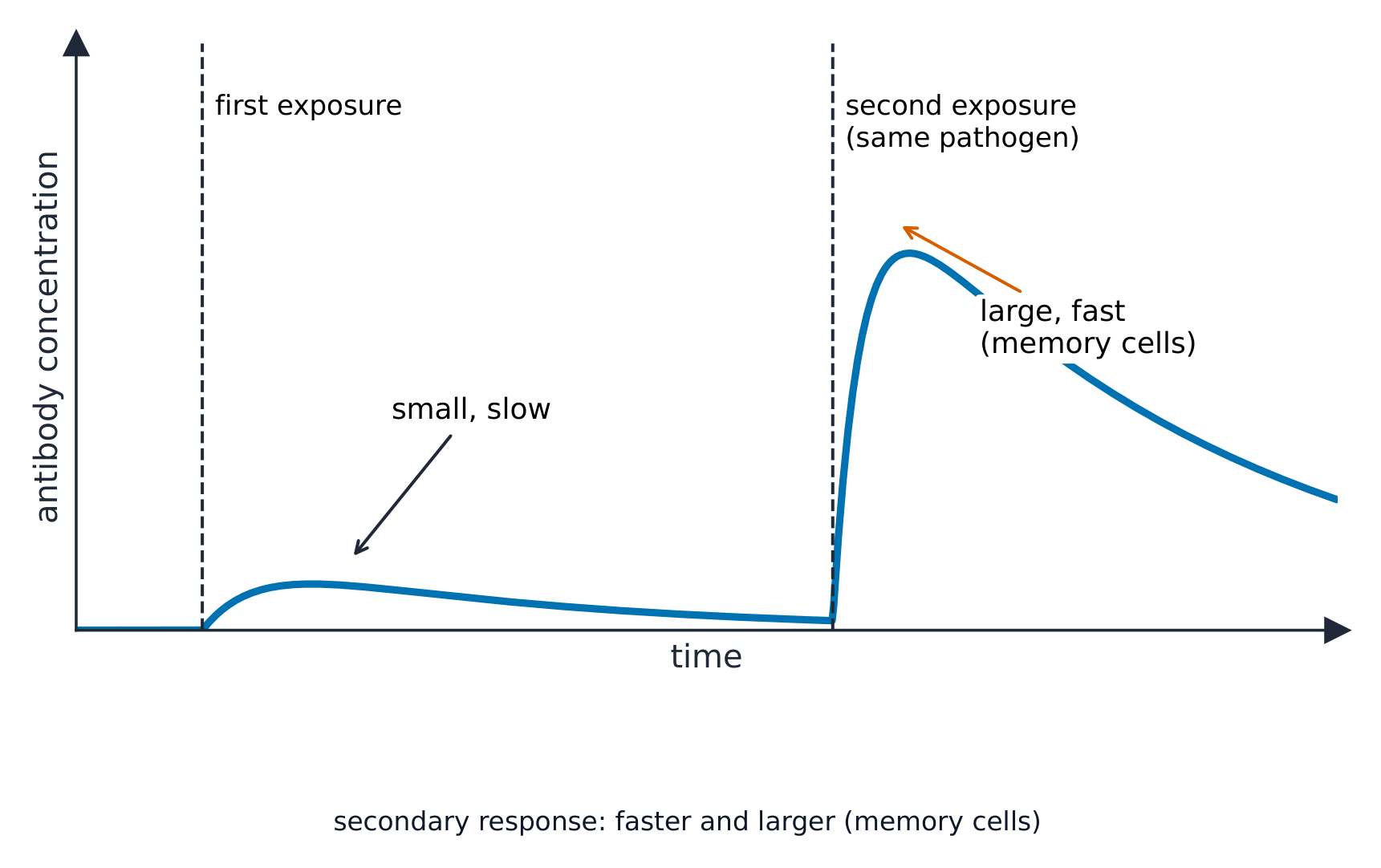
Memory cells stay in the body for years after the infection is over. If the same pathogen enters again, the memory cells start a secondary immune response that is much faster and larger than the first. The pathogen is destroyed before it can make you ill. This is what we mean by long-term immunity.
11.2
Antibodies

Syllabus
- relate the molecular structure of antibodies to their functions
- outline the hybridoma method for the production of monoclonal antibodies
- outline the principles of using monoclonal antibodies in the diagnosis of disease and in the treatment of disease
- describe the differences between active immunity and passive immunity and between natural immunity and artificial immunity
- explain that vaccines contain antigens that stimulate immune responses to provide long-term immunity
- explain how vaccination programmes can help to control the spread of infectious diseases
Source: Cambridge International syllabus
An antibody is a Y-shaped protein made by plasma cells. The two tips of the Y are antigen-binding sites 抗原结合位点. Each site has a special shape, called the variable region 可变区, that fits one antigen only, like a lock and key.
Antibodies help in several ways: they stick to antigens, clump pathogens together so they are easier to deal with, mark pathogens so phagocytes find them, and block harmful toxins.
Explore
Inside an antibody
Tap each part. The variable tips bind one specific antigen; the constant stem is the same in every antibody.
Vocabulary
Train
| English |
|---|
| antigen-binding site/ˈæntɪdʒen ˈbaɪndɪŋ saɪt/ |
| variable region/ˈveərɪəbl ˈriːdʒn/ |
11.2
Monoclonal antibodies

A monoclonal antibody 单克隆抗体 is a single type of antibody, all identical. They are made by the hybridoma 杂交瘤 method:
- an animal is given an antigen, so it makes B-lymphocytes that produce the wanted antibody.
- these B-lymphocytes are fused with tumour cells, which divide endlessly.
- the fused cell (the hybridoma) both makes the antibody and divides without stopping, producing large amounts of one identical antibody.
Monoclonal antibodies are used in the diagnosis 诊断 of disease (to detect a specific molecule, as in a pregnancy test) and in treatment (to carry drugs to specific target cells, such as cancer cells).

Vocabulary
Train
| English |
|---|
| monoclonal antibody/ˈmɒnəʊklɒnl ˈæntɪbɒdi/ |
| hybridoma/ˌhaɪbrɪˈdəʊmə/ |
| diagnosis/ˌdaɪəɡˈnəʊsɪs/ |
11.2
Types of immunity

Immunity can be active or passive, and natural or artificial.
- active immunity 主动免疫 — your own body meets an antigen and makes its own antibodies and memory cells. It is slow to start but long-lasting.
- passive immunity 被动免疫 — ready-made antibodies are given to you from outside. It works at once but does not last, because there are no memory cells.
- natural immunity 天然免疫 — gained in a natural way (active: after an infection; passive: antibodies passed from mother to baby).
- artificial immunity 人工免疫 — gained on purpose (active: your body is made to respond to a safe dose of antigen; passive: you are injected with ready-made antibodies).
Vocabulary
Train
| English |
|---|
| active immunity/ˈæktɪv ɪˈmjuːnɪti/ |
| passive immunity/ˈpæsɪv ɪˈmjuːnɪti/ |
| natural immunity/ˈnætʃərəl ɪˈmjuːnɪti/ |
| artificial immunity/ˌɑːtɪˈfɪʃl ɪˈmjuːnɪti/ |
11.2
Vaccination

A vaccine 疫苗 contains antigens — often a dead or weakened pathogen, or part of one. The antigens trigger a primary immune response and make memory cells, so you gain long-term immunity without becoming ill.
Vaccination 疫苗接种 programmes can control the spread of a disease across a population. If enough people are vaccinated, the pathogen cannot pass easily from person to person. This protects even the people who are not vaccinated, an effect called herd immunity 群体免疫.
Worked example. Classify each as active or passive, natural or artificial: (a) a baby receives antibodies in breast milk; (b) a child is vaccinated against measles; (c) someone recovers from chickenpox; (d) a patient bitten by a snake is given antivenom. Ask two questions each time. Did the person make the antibodies themselves? If yes it is active; if they were handed ready-made ones, it is passive. Did it happen by chance or deliberately? Naturally, or artificially. So (a) is natural passive - ready-made antibodies by a natural route; (b) is artificial active - the vaccine's antigens make the child produce their own; (c) is natural active - the infection made them produce their own; (d) is artificial passive - ready-made antibodies given deliberately. Only active immunity makes memory cells, which is exactly why passive immunity acts immediately but is short-lived.
Explore
How a vaccine works
Step through it. A vaccine triggers a primary response and memory cells, so the real pathogen meets a fast, strong defence.
Vocabulary
Train
| English |
|---|
| vaccine/vækˈsiːn/ |
| vaccination/ˌvæksɪˈneɪʃn/ |
| herd immunity/hɜːd ɪˈmjuːnɪti/ |
11.2
Exam tips
- Distinguish phagocytes (engulf, non-specific) from lymphocytes: B cells → antibodies (humoral), T cells (helper/killer, cell-mediated).
- Label an antibody (variable region, antigen-binding site) and explain agglutination and neutralisation.
- Compare the primary and secondary response on a graph — memory cells make the secondary faster and larger.
- Distinguish active vs passive and natural vs artificial immunity with an example of each; explain vaccination and herd immunity.
Interactive lessons on this topic
Work through it step by step, with instant-check exercises.