- outline the need for energy in living organisms, as illustrated by active transport, movement and anabolic reactions, such as those occurring in DNA replication and protein synthesis
- describe the features of ATP that make it suitable as the universal energy currency
- state that ATP is synthesised by: • transfer of phosphate in substrate-linked reactions • chemiosmosis in membranes of mitochondria and chloroplasts
- explain the relative energy values of carbohydrates, lipids and proteins as respiratory substrates
- state that the respiratory quotient (RQ) is the ratio of the number of molecules of carbon dioxide produced to the number of molecules of oxygen taken in, as a result of respiration
- calculate RQ values of different respiratory substrates from equations for respiration
- describe and carry out investigations, using simple respirometers, to determine the RQ of germinating seeds or small invertebrates (e.g. blowfly larvae)
Energy and respiration
A-Level Biology · Topic 12
 9:49
9:49
Respiration
At any moment your body holds only about fifty grams of ATP. Yet over a single day you will make and spend roughly your own body weight of it. The same…
English narration · English + 中文 subtitles burned in
12.1
Why living things need energy

Syllabus
Source: Cambridge International syllabus
Cells need a steady supply of energy 能量, which they get from respiration 呼吸作用. Energy is needed for:
- active transport 主动运输 (moving substances against a gradient),
- movement (for example muscle contraction),
- anabolic 合成代谢 reactions — the building of large molecules, such as in DNA replication and protein synthesis.
Vocabulary
Train
| English |
|---|
| energy/ˈenədʒi/ |
| respiration/ˌrespɪˈreɪʃn/ |
| active transport/ˈæktɪv ˈtrænspɔːt/ |
| anabolic/ˌænəˈbɒlɪk/ |
12.1
ATP — the energy currency

ATP is the molecule that carries energy to where it is needed. It is made from ADP and a phosphate group; when it loses that phosphate again, it releases a small, usable burst of energy. ATP suits this job well, so we call it the universal energy currency:
- it releases energy quickly, in small amounts that match a cell's needs.
- it is easily made and re-made, again and again.
- it is small and soluble, so it moves easily around the cell.
ATP is made in two ways: by direct transfer of a phosphate group in phosphorylation 磷酸化 reactions, and by chemiosmosis 化学渗透 across the membranes of mitochondria 线粒体 and chloroplasts.
Explore
The ATP cycle
Step around the loop. ATP is split to release a small burst of energy, then rebuilt by respiration — over and over.
Vocabulary
Train
| English |
|---|
| phosphorylation/ˌfɒsfɔːrɪˈleɪʃn/ |
| chemiosmosis/ˌkemɪəzˈməʊsɪs/ |
| mitochondria/ˌmaɪtəˈkɒndrɪə/ |
12.1
Respiratory substrates and RQ

A respiratory substrate 呼吸底物 is a molecule that is broken down to release energy. Per gram, lipids release the most energy (they have the most hydrogen), proteins are next, and carbohydrates the least.
The respiratory quotient 呼吸商 (RQ) compares the gases exchanged:
$$\text{RQ} = \frac{\text{molecules of carbon dioxide produced}}{\text{molecules of oxygen taken in}}$$
You can work out the RQ from a respiration equation. Carbohydrates give an RQ of about 1.0, lipids about 0.7 and proteins about 0.9.
Worked example. Find the RQ for the aerobic respiration of glucose: $\text{C}_6\text{H}_{12}\text{O}_6 + 6\text{O}_2 \rightarrow 6\text{CO}_2 + 6\text{H}_2\text{O}$.
$$\text{RQ} = \frac{\text{CO}_2 \text{ produced}}{\text{O}_2 \text{ taken in}} = \frac{6}{6} = 1.0.$$
This is why an RQ near $1.0$ suggests the organism is respiring carbohydrate; a lower RQ (about $0.7$) suggests it is using lipid, which needs more oxygen per molecule of $\text{CO}_2$.
A respirometer 呼吸计 measures the oxygen 氧气 taken in by living things, such as germinating 萌发 seeds or small invertebrates 无脊椎动物, and is used to find their RQ.

Explore
Respiratory quotient lab
RQ = CO2 produced / O2 used
Change oxygen use and see how RQ compares fuels.
Vocabulary
Train
| English |
|---|
| respiratory substrate/rɪˈspɪrətəri ˈsʌbstreɪt/ |
| respiratory quotient/rɪˈspɪrətəri ˈkwəʊʃənt/ |
| respirometer/rɪspɪˈrɒmɪtə/ |
| oxygen/ˈɒksɪdʒn/ |
| germinate/ˈdʒɜːmɪneɪt/ |
| invertebrate/ɪnˈvɜːtɪbreɪt/ |
12.2
Aerobic respiration: the four stages

Syllabus
- State where each of the four stages in aerobic respiration occurs in eukaryotic cells: • glycolysis in the cytoplasm • link reaction in the mitochondrial matrix • Krebs cycle in the mitochondrial matrix • oxidative phosphorylation on the inner membrane of mitochondria
- outline glycolysis as phosphorylation of glucose and the subsequent splitting of fructose 1,6-bisphosphate (6C) into two triose phosphate molecules (3C), which are then further oxidised to pyruvate (3C), with the production of ATP and reduced NAD
- explain that, when oxygen is available, pyruvate enters mitochondria to take part in the link reaction
- describe the link reaction, including the role of coenzyme A in the transfer of acetyl (2C) groups
- outline the Krebs cycle, explaining that oxaloacetate (4C) acts as an acceptor of the 2C fragment from acetyl coenzyme A to form citrate (6C), which is converted back to oxaloacetate in a series of small steps
- explain that reactions in the Krebs cycle involve decarboxylation and dehydrogenation and the reduction of the coenzymes NAD and FAD
- describe the role of NAD and FAD in transferring hydrogen to carriers in the inner mitochondrial membrane
- explain that during oxidative phosphorylation: • hydrogen atoms split into protons and energetic electrons • energetic electrons release energy as they pass through the electron transport chain (details of carriers are not expected) • the released energy is used to transfer protons across the inner mitochondrial membrane • protons return to the mitochondrial matrix by facilitated diffusion through ATP synthase, providing energy for ATP synthesis (details of ATP synthase are not expected) • oxygen acts as the final electron acceptor to form water
- describe the relationship between the structure and function of mitochondria using diagrams and electron micrographs
- outline respiration in anaerobic conditions in mammals (lactate fermentation) and in yeast cells (ethanol fermentation)
- explain why the energy yield from respiration in aerobic conditions is much greater than the energy yield from respiration in anaerobic conditions (a detailed account of the total yield of ATP from the aerobic respiration of glucose is not expected)
- explain how rice is adapted to grow with its roots submerged in water, limited to the development of aerenchyma in roots, ethanol fermentation in roots and faster growth of stems
- describe and carry out investigations using redox indicators, including DCPIP and methylene blue, to determine the effects of temperature and substrate concentration on the rate of respiration of yeast
- describe and carry out investigations using simple respirometers to determine the effect of temperature on the rate of respiration
Source: Cambridge International syllabus
Aerobic 有氧 respiration (with oxygen) has four stages, each in a set place in the cell:
| Stage | Where it happens |
|---|---|
| glycolysis 糖酵解 | the cytoplasm 细胞质 |
| link reaction 连接反应 | the matrix 基质 of the mitochondria |
| Krebs cycle 克雷布斯循环 | the matrix of the mitochondria |
| oxidative phosphorylation 氧化磷酸化 | the inner membrane of the mitochondria |
Glycolysis
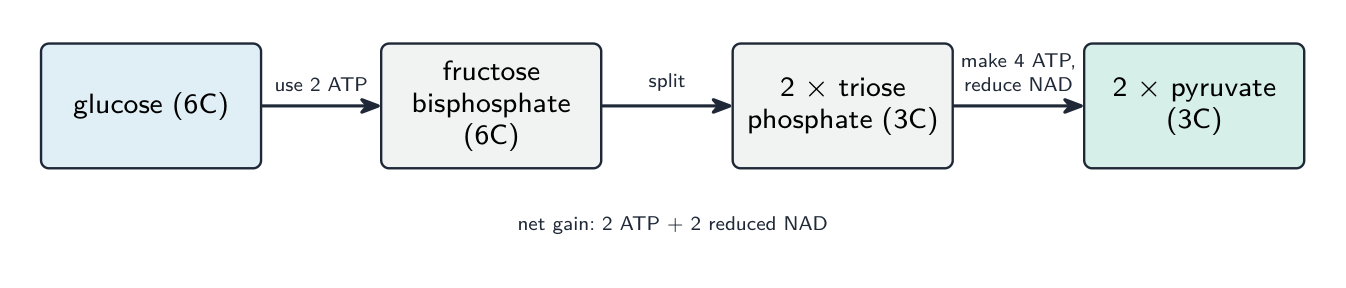
Glucose 葡萄糖 (6 carbons) is first phosphorylated, using 2 ATP, to form fructose bisphosphate (6C). This 6C molecule is split into two triose phosphate molecules (3C each). These are then oxidised 氧化 to pyruvate 丙酮酸 (3C). Glycolysis makes a net gain of 2 ATP and some reduced 还原 NAD (NAD is a coenzyme 辅酶, a helper molecule).
The link reaction
When oxygen is available, pyruvate enters the mitochondria. There each pyruvate loses a carbon dioxide 二氧化碳 and is turned into a 2-carbon acetyl 乙酰基 group. This group is carried by coenzyme A 辅酶A to form acetyl coenzyme A. Some carbon dioxide is released and NAD is reduced.
The Krebs cycle
The 2C acetyl group joins a 4-carbon molecule, oxaloacetate 草酰乙酸, to make a 6-carbon molecule, citrate 柠檬酸. Citrate is then changed back to oxaloacetate in a series of small steps, ready to accept the next acetyl group. During these steps:
- decarboxylation 脱羧 removes carbon as carbon dioxide.
- dehydrogenation 脱氢 removes hydrogen, which reduces the coenzymes NAD and FAD.
The reduced NAD and FAD then carry the hydrogen to the carriers in the inner mitochondrial membrane.

Oxidative phosphorylation
This stage makes most of the ATP:
- the hydrogen atoms split into protons 质子 and energetic electrons 电子.
- the electrons pass along the electron transport chain 电子传递链, releasing energy as they go.
- this energy is used to pump protons across the inner membrane.
- the protons flow back into the matrix through a channel called ATP synthase ATP合酶. This flow provides the energy to make ATP (this is chemiosmosis).
- oxygen is the final electron acceptor: it joins with electrons and protons to form water.

The structure of mitochondria
The inner membrane is folded into cristae 嵴, giving a large surface for the electron transport chain and ATP synthase. The matrix inside holds the substances and helpers for the link reaction and the Krebs cycle.

Explore
Glycolysis
Step through it. Glucose is split in the cytoplasm into two pyruvate, for a small net gain of ATP and reduced NAD.
Explore
The four stages of respiration
Step through where ATP comes from. Glucose is broken down in stages; most ATP is made at the last stage.
Vocabulary
Train
| English |
|---|
| aerobic/eəˈrəʊbɪk/ |
| glycolysis/ɡlaɪˈkɒləsɪs/ |
| cytoplasm/ˈsaɪtəplæzəm/ |
| link reaction/lɪŋk rɪˈækʃn/ |
| matrix/ˈmeɪtrɪks/ |
| Krebs cycle/krebz ˈsaɪkl/ |
| oxidative phosphorylation/ˈɒksɪdətɪv ˌfɒsfɔːrɪˈleɪʃn/ |
| glucose/ˈɡluːkəʊs/ |
| oxidise/ˈɒksɪdaɪz/ |
| pyruvate/ˈpaɪruːveɪt/ |
| reduce/rɪˈdjuːs/ |
| coenzyme/ˌkəʊˈenzaɪm/ |
| carbon dioxide/ˈkɑːbən daɪˈɒksaɪd/ |
| acetyl/ˈæsɪtaɪl/ |
| coenzyme A/ˌkəʊˈenzaɪm eɪ/ |
| oxaloacetate/ˈɒksələʊsɪteɪt/ |
| citrate/ˈsɪtreɪt/ |
| decarboxylation/dɪˌkɑːbəksɪˈleɪʃn/ |
| dehydrogenation/ˌdiːhaɪˈdrɒdʒəneɪʃn/ |
| electron/ɪˈlektrɒn/ |
| electron transport chain/ɪˈlektrɒn ˈtrænspɔːt tʃeɪn/ |
| proton/ˈprəʊtɒn/ |
| ATP synthase/ˌeɪ tiː ˈpiː ˈsɪnθeɪs/ |
| cristae/ˈkrɪstiː/ |
12.2
Anaerobic respiration

When there is no oxygen, only glycolysis can run. To keep glycolysis going, the cell must use up the reduced NAD. This happens by fermentation 发酵:
- in mammals, pyruvate is turned into lactate 乳酸 (lactate fermentation). The lactate is later broken down when oxygen returns.
- in yeast 酵母, pyruvate is turned into ethanol 乙醇 and carbon dioxide (ethanol fermentation).
Anaerobic 无氧 respiration gives far less energy than aerobic respiration. Aerobic respiration also runs the Krebs cycle and oxidative phosphorylation, which release a lot more ATP, while anaerobic respiration gains only the small amount from glycolysis.
Explore
Why fermentation matters
Step through it. Without oxygen, fermentation regenerates NAD so glycolysis can keep making a little ATP.
Vocabulary
Train
| English |
|---|
| fermentation/fɜːmənˈteɪʃn/ |
| lactate/ˈlækteɪt/ |
| yeast/jiːst/ |
| ethanol/ˈeθənɒl/ |
| anaerobic/ˌæneəˈrəʊbɪk/ |
12.2
Rice and waterlogged roots

Rice can grow with its roots under water, where there is little oxygen. It is adapted in three ways: it develops aerenchyma 通气组织 (air-filled spaces) in the roots to carry air down; the roots use ethanol fermentation to keep making some ATP; and the stems grow faster to reach the air above the water.
Vocabulary
Train
| English |
|---|
| aerenchyma/ˈeərəntʃɪmə/ |
12.2
Investigating the rate of respiration
A redox indicator 指示剂 such as DCPIP or methylene blue loses its colour when it gains hydrogen from respiring cells. The faster the colour is lost, the faster the yeast is respiring, so you can test the effect of temperature or substrate concentration. A respirometer can also be used to measure how temperature changes the rate of oxygen uptake.
Vocabulary
Train
| English |
|---|
| indicator/ˈɪndɪkeɪtə/ |
12.2
Exam tips
- State where each stage happens and its ATP yield: glycolysis (cytoplasm), link reaction + Krebs (matrix), oxidative phosphorylation (inner membrane, most ATP).
- Explain the roles of NAD/FAD (carry hydrogen to the electron transport chain) and of oxygen (the final electron acceptor).
- RQ $=$ CO2 produced $\div$ O2 used ($\approx 1.0$ carbohydrate, $0.7$ lipid); know how a respirometer measures it.
- Anaerobic respiration gives lactate (animals) or ethanol + CO2 (yeast/plants) and far less ATP (glycolysis only).
Interactive lessons on this topic
Work through it step by step, with instant-check exercises.